

Understanding How Virtual Reality Can Support Mindfulness Practice: Mixed Methods Study
Open accessPublished version of a preprint
The DOI matches its Crossref record; 66 of the 66 references it cites were found in a registry or an index; 7 of the 56 sources its claims cite were checked for support.
Abstract
Background: Regular mindfulness practice has been demonstrated to be beneficial for mental health, but mindfulness can be challenging to adopt, with environmental and personal distractors often cited as challenges. Virtual reality (VR) may address these challenges by providing an immersive environment for practicing mindfulness and by supporting the user to orient attention to the present moment within a tailored virtual setting. However, there is currently a limited understanding of the ways in which VR can support or hinder mindfulness practice. Such an understanding is required to design effective VR apps while ensuring that VR-supported mindfulness is acceptable to end users. Objective: This study aimed to explore how VR can support mindfulness practice and to understand user experience issues that may affect the acceptability and efficacy of VR mindfulness for users in the general population. Methods: A sample of 37 participants from the general population trialed a VR mindfulness app in a controlled laboratory setting. The VR app presented users with an omnidirectional video of a peaceful forest environment with a guided mindfulness voiceover that was delivered by a male narrator. Scores on the State Mindfulness Scale, Simulator Sickness Questionnaire, and single-item measures of positive and negative emotion and arousal were measured pre- and post-VR for all participants. Qualitative feedback was collected through interviews with a subset of 19 participants. The interviews sought to understand the user experience of mindfulness practice in VR. Results: State mindfulness (P<.001; Cohen d=1.80) and positive affect (P=.006; r=.45) significantly increased after using the VR mindfulness app. No notable changes in negative emotion, subjective arousal, or symptoms of simulator sickness were observed across the sample. Participants described the user experience as relaxing, calming, and peaceful. Participants suggested that the use of VR helped them to focus on the present moment by using visual and auditory elements of VR as attentional anchors. The sense of presence in the virtual environment (VE) was identified by participants as being helpful to practicing mindfulness. Interruptions to presence acted as distractors. Some uncomfortable experiences were discussed, primarily in relation to video fidelity and the weight of the VR headset, although these were infrequent and minor. Conclusions: This study suggests that an appropriately designed VR app can support mindfulness practice by enhancing state mindfulness and inducing positive affect. VR may help address the challenges of practicing mindfulness by creating a sense of presence in a tailored VE; by allowing users to attend to visual and auditory anchors of their choice; and by reducing the scope of the content in users’ mind-wandering. VR has the unique capability to combine guided mindfulness practice with tailored VEs that lend themselves to support individuals to focus attention on the present moment.
Overview
CoChat Summary
## TL;DR
This mixed methods pilot study found that a 15-minute VR mindfulness app significantly increased state mindfulness and positive affect in 37 general-population participants, while not increasing negative emotion, arousal, or simulator sickness. Qualitative data suggested VR can support mindfulness by creating presence, offering attention anchors, and allowing personalization, but lower video fidelity, headset discomfort, and interruptions to presence could distract users.
## Key findings
- State mindfulness increased significantly from pre- to post-VR use: t36 = -10.97, P < .001, Cohen d = 1.80.
- Positive emotion also increased significantly: median 4.00 pre-VR to 5.00 post-VR, Z = -2.75, P = .006, r = .45.
- There were no significant changes in negative emotion (P = .06) or arousal (P = .36), and no significant pre- to post-VR changes in simulator sickness items (all P > .003).
- Among 37 participants, most rated the app as engaging (22/37, 60% very; 10/37, 27% extremely), intuitive (19/37, 51% very; 13/37, 35% extremely), easy to use (16/37, 43% very; 19/37, 51% extremely), and not risky (35/37, 95% not at all).
- Qualitative themes indicated VR helped by providing presence, attentional anchors, and agency/personalization, while video fidelity, voiceover timing, and headset weight/discomfort could hinder practice.
## Methods
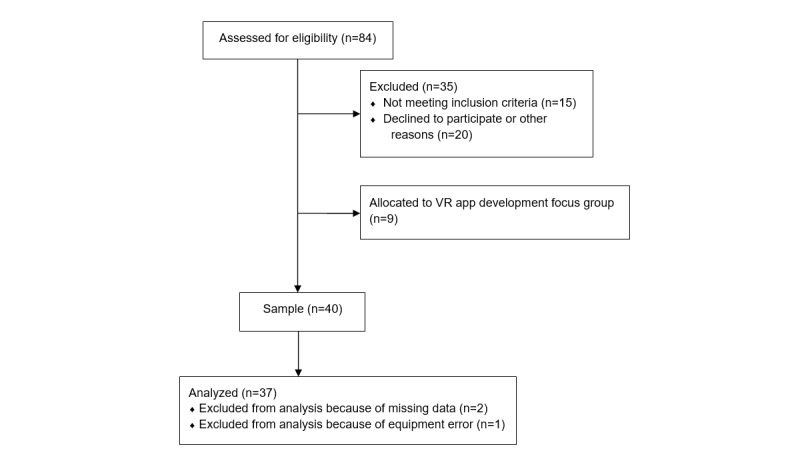
- Mixed methods pilot study in a controlled laboratory setting with 37 participants from the general population; 19 also completed semistructured interviews.
- Participants used a 15-minute VR mindfulness app featuring an omnidirectional video of a peaceful forest, ambient audio, and a guided mindfulness voiceover on an Oculus Go headset.
- Quantitative pre/post measures included state mindfulness, emotion/arousal, and simulator sickness; qualitative interviews were analyzed using a general inductive approach.
## Limitations
- The paper states that findings are limited to state-based change after a single session in a lab, so they cannot be generalized to repeated use in the real world or to long-term outcomes such as trait mindfulness or emotion regulation.
- The paper states that without a comparison or control group, it is unclear whether the changes in mindfulness and emotion were caused primarily by the VR app.
- The paper states that the sample size limited examination of moderators such as prior mindfulness experience; additionally, the evident limitation is that the sample was small (n=37) and drawn from a general-population convenience sample, which limits broader inference.
Model-written summary. Check it against the paper before relying on it.
Integrity signals
Registry
Cites
Statistics
Figures

Verification
Claims the paper makes
5 Valid · 1 Not valid · 31 Not checked · 86 Own results and interpretations
The cited sources support only part of this claim — read each source’s verdict below.
In the paper
“VR technologies may pragmatically address the challenges related to environmental distraction by providing an immersive, engaging, and controlled (ie, predictable) visual and auditory sandbox in which one could rehearse mindfulness skills [12,24,25], shifting attention away from the real-world environment.”
§ Understanding How Virtual Reality Can Support Mindfulness Practice: Mixed Methods Study > Introduction > Background
What the sources say
- Supportedcites [12] source
The Introduction (p. 1-2) states the rationale the claim paraphrases: VR stimulates the visual and auditory cortices with computer-generated images and digitized nature sounds, 'uses up a lot of attentional resources, making it less likely that attention will drift to sights and sounds in the real world,' and creates a 'virtual world specifically designed for eliciting mindfulness' in which trainees practice (rehearse) DBT mindfulness skills. The Discussion adds that VR 'blocks patients view of distracting information in the real world environment,' and the Abstract frames it as 'by limiting distractions from the real world, increasing sense of presence and giving people an interesting place to go to practice mindfulness, Virtual Reality may facilitate mindfulness practice.' The claim's hedged 'may pragmatically address' matches the source's own hedged 'may' framing; the 'controlled (predictable)' gloss is carried by the paper's description of a computer-controlled, deliberately matched multisensory environment (Study procedures). (LLM, conf=0.88)
- Not checked yetcites [24] source
- Partly supportedcites [25] sourceExperimental — accuracy not yet measured
Our copy clearly supports the 'immersive, controlled visual and auditory sandbox for rehearsing mindfulness' part: the Introduction states that the 'sense of "total immersion" created by virtual reality (VR) is an emerging technology that may entirely replace mainstream videoconferencing techniques', and ReCoVR System Design describes VR environments and 360-degree nature videos with selectable music and natural sounds (birds, wind, waves) in which an instructor- or program-controlled 8-week mindfulness course was delivered. However, no passage frames VR as addressing environmental distraction or as shifting attention away from the real-world environment; the paper's stated rationales are anonymity, presence, remote/home/workplace access and tele-supervision, and its attention-related discussion (Introduction; Discussion on head motion and attentional focus) concerns mindfulness/attention training mechanisms rather than blocking distracting real-world surroundings. Also, as a feasibility protocol with four employees and four TBI patients, it reports design and feasibility, not a demonstrated pragmatic benefit against distraction. (LLM, conf=0.70)
hedgedstates a possible cause- Asserted: passes — The authors put it forward as true.
- Checkable: passes — It can be checked against evidence.
- Load-bearing: passes — The paper’s conclusions depend on it.
- Based: passes — The paper gives a reason why it holds.
- Supported
The cited sources support only part of this claim — read each source’s verdict below.
In the paper
“Although these delivery platforms improve the accessibility of mindfulness-based interventions, research has shown that adherence with Web and mobile programs is often low [18]”
§ Understanding How Virtual Reality Can Support Mindfulness Practice: Mixed Methods Study > Introduction > Background
What the sources say
- Partly supportedcites [18] sourceExperimental — accuracy not yet measured
The Discussion (Principal Findings; page unavailable) reports that only 30%–69% of participants completed every session in the reviewed Web-based mindfulness interventions, supporting the concern about adherence. The Introduction (Web-Based Interventions; page unavailable) says mindfulness-based mobile apps had not been studied, so the paper does not establish that adherence to mobile programs is often low. (LLM, conf=0.83)
plain- Asserted: passes — The authors put it forward as true.
- Checkable: passes — It can be checked against evidence.
- Load-bearing: passes — The paper’s conclusions depend on it.
- Based: passes — The paper gives a reason why it holds.
- Partly supported
The cited sources support only part of this claim — read each source’s verdict below.
In the paper
“VR mindfulness interventions can lead to increased state mindfulness in both new and experienced meditator samples [12,22,24].”
§ Understanding How Virtual Reality Can Support Mindfulness Practice: Mixed Methods Study > Introduction > Background
What the sources say
- Partly supportedcites [12] sourceExperimental — accuracy not yet measured
The Results ('Effects of VR to practice mindfulness') confirm the outcome half of the claim: participants reported significantly higher state mindfulness after the VR mindfulness intervention (t(42) = 4.431; p < .001; d = .75), measured with a shortened MAAS state-mindfulness adaptation (Materials and methods > Assessments). However, the population is experienced meditators only — 44 attendees of a mindfulness conference, 77.3% of whom meditated daily or 3-4 times per week (Materials and methods > Participants; Results > Meditation data and experience using VR systems at baseline). The Discussion explicitly states that 'Future research exploring responsiveness to VR DBT mindfulness skills training for experts vs. non-expert meditators is needed,' so the 'new meditator samples' part of the claim is not supported by this source. (LLM, conf=0.85)
- Not checked yetcites [22] Damen, KH, 2018, Entertainment Computing – ICEC 2018 source
- Not checked yetcites [24] source
plainstates a cause- Asserted: passes — The authors put it forward as true.
- Checkable: passes — It can be checked against evidence.
- Load-bearing: unclear — It is unclear whether the paper’s conclusions depend on it.
- Based: passes — The paper gives a reason why it holds.
- Partly supported
A result the paper reports from its own data — it cites no other source for it, so there is none to check. The quote shows it is in the paper.
In the paper
“These increases were related to discomfort, concentration, and fatigue”
§ Understanding How Virtual Reality Can Support Mindfulness Practice: Mixed Methods Study > Discussion > Principal Findings
plainstates an association- Asserted: passes — The authors put it forward as true.
- Checkable: passes — It can be checked against evidence.
- Load-bearing: unclear — It is unclear whether the paper’s conclusions depend on it.
- Based: passes — The paper gives a reason why it holds.
A result the paper reports from its own data — it cites no other source for it, so there is none to check. The quote shows it is in the paper.
In the paper
“Some participants linked their sense of presence to feeling that their real-world concerns were reduced:”
§ Understanding How Virtual Reality Can Support Mindfulness Practice: Mixed Methods Study > Results > Qualitative Findings
plainstates an association- Asserted: passes — The authors put it forward as true.
- Checkable: passes — It can be checked against evidence.
- Load-bearing: passes — The paper’s conclusions depend on it.
- Based: passes — The paper gives a reason why it holds.
65 more claims
Create a free account to see all 123 claims and to verify the 49 references still open.
- Probably not a substantial claim. 31
- It may state two separate claims as one. 27
Claims other papers make about this one
Each is checked against this paper’s own text: does it say what the citing paper says it does?
The source backs part of the claim, not all of it — or backs it for a different population, condition or comparison.
In the citing paper
“Recent studies have reported that for mindfulness practices to bring about optimum mental health benefits, they need to be conducted regularly (Chiam et al. 2020; Seabrook et al. 2020).”
From The Effect of Mindfulness-Based and Acceptance Commitment Therapy-Based Interventions to Improve the Mental Well-Being Among Parents of Children with Developmental Disabilities: A Systematic Review and Meta-Analysis. (2022) · cites this paper as Seabrook et al. 2020
Experimental — accuracy not yet measuredThe source backs part of the claim, not all of it — or backs it for a different population, condition or comparison.
In the citing paper
“Various types of technology, such as web-based and virtual reality, have been proven to be effective in delivering mindfulness-based interventions (Seabrook et al. 2020; Sevilla-Llewellyn-Jones et al. 2018)”
From The Effect of Mindfulness-Based and Acceptance Commitment Therapy-Based Interventions to Improve the Mental Well-Being Among Parents of Children with Developmental Disabilities: A Systematic Review and Meta-Analysis. (2022) · cites this paper as Seabrook et al. 2020
Experimental — accuracy not yet measuredThe source backs part of the claim, not all of it — or backs it for a different population, condition or comparison.
In the citing paper
“Although limited in scope, past research demonstrates that MBIs that were delivered via VR can help enhance person's attention and support their sense of presence in the mindfulness experience and increase state of mindfulness and psychological well-being.58,60”
From Nursing Implications of Mindfulness-Informed Interventions for Stroke Survivors and Their Families. (2022) · cites this paper as [60]
Experimental — accuracy not yet measuredThe source backs part of the claim, not all of it — or backs it for a different population, condition or comparison.
In the citing paper
“However, this research is at the very early stages with predominantly single case studies and typically involves populations of adults without a mental health condition.”
From A Virtual Reality–Based Cognitive Defusion Application for Youth Depression and Anxiety: Mixed Methods Experimental Study. (2025) · cites this paper as [32]
Experimental — accuracy not yet measuredThe cited source says what the claim attributes to it.
In the citing paper
“VEs are highly engaging, immersive, and interactive, which may facilitate concentration during mindfulness practice [21,22].”
From Examining the Use of Virtual Reality to Support Mindfulness Skills Practice in Mood and Anxiety Disorders: Mixed Methods Study (2024) · cites this paper as [21]
1 more claim about this paper
Create a free account to see every claim other papers make about this one.
Citations
Cites
Ryan, R. M., & Deci, E. L. (2000) · American Psychologist · doi:10.1037//0003-066x.55.1.68 · Cited by 54,599 · cited 1×
“Peters et al [50] argue that designing (digital) interventions with the intention of satisfying basic psychological needs (self-determination: autonomy, competence, and relatedness) [51] at the point of use (ie, the interface) may greatly improve motivation, engagement, and general well-being.”
BackgroundRussell, J. A. (1980) · Journal of Personality and Social Psychology · doi:10.1037/h0077714 · Cited by 16,334 · cited 1×
“Emotion was measured dimensionally pre-and postapp use via 3 items—1 (Positive or pleasant), 2 (Negative or unpleasant), and 3 (Active or alert)—drawn from the circumplex model of emotion [41].”
MethodLovibond, P. F., & Lovibond, S. H. (1995) · Behaviour Research and Therapy · doi:10.1016/0005-7967(94)00075-u · Cited by 14,523 · cited 3×
“Participant baseline general mental health distress was assessed using the short-form Depression Anxiety and Stress Scale (DASS-21) [39].”
MethodInfluentialA General Inductive Approach for Analyzing Qualitative Evaluation Data
Thomas, D. R. (2006) · American Journal of Evaluation · doi:10.1177/1098214005283748 · Cited by 10,858 · cited 2×
“These codes were subsequently compared, discussed, and developed into a final set of 9 themes that characterized participants’ experiences [45].”
BackgroundMethod(2008) · Medical Entomology and Zoology · Cited by 7,477
Mindfulness: A proposed operational definition.
Bishop, S. R., Lau, M., Shapiro, S., Carlson, L., Anderson, N. D., Carmody, J., Segal, Z. V., Abbey, S., Speca, M., Velting, D., et al. (2004) · Clinical Psychology: Science and Practice · doi:10.1093/clipsy.bph077 · Cited by 7,234 · cited 1×
“Originating in Buddhist traditions, mindfulness involves an individual focusing his or her attention on the present moment and approaching experiences with a nonjudgmental, nonreactive, and accepting attitude [1,2].”
BackgroundEmotion-regulation strategies across psychopathology: A meta-analytic review
Aldao, A., Nolen-Hoeksema, S., & Schweizer, S. (2010) · Clinical Psychology Review · doi:10.1016/j.cpr.2009.11.004 · Cited by 6,686 · cited 1×
“Mindfulness practice has been demonstrated to be beneficial for mental health by helping people strengthen attention flexibility and adopt an orientation toward experiences that reduces the reliance on automatic thoughts or maladaptive emotion regulation strategies [2,4-6].”
BackgroundMeasuring Presence in Virtual Environments: A Presence Questionnaire
Witmer, B. G., & Singer, M. J. (1998) · Presence: Teleoperators and Virtual Environments · doi:10.1162/105474698565686 · Cited by 6,371 · cited 2×
“0 [29,43], which was shortened to reduce participant burden and remove items related to haptic senses and object manipulation, which were not features of the current system.”
BackgroundStress recovery during exposure to natural and urban environments
Ulrich, R. S., Simons, R. F., Losito, B. D., Fiorito, E., Miles, M. A., & Zelson, M. (1991) · Journal of Environmental Psychology · doi:10.1016/s0272-4944(05)80184-7 · Cited by 5,990 · cited 1×
“Natural spaces have been shown to provide individuals with well-being benefits [47], and this effect has been observed in the use of VR and other nonimmersive platforms (ie, computer screens) [48,49].”
BackgroundDefining virtual reality: Dimensions determining telepresence
Steuer, J. (1992) · Journal of Communication · doi:10.1111/j.1460-2466.1992.tb00812.x · Cited by 5,459 · cited 1×
“VR refers to the use of a headset with a display that projects an interactive, audiovisual 360-degree virtual environment (VE) to the user [26-28].”
Background
Research works printed but not linked: 1
- Cohen, J, 1988, Statistical Power Analysis for the Behavioral Sciences. Second Edition
Cited by
Items 201–261 of 261
Lee, C.-H., & Tsao, H.-Y. (2024) · International Conference on Advances in Computing, Communication and Networking (ICAC2N) · doi:10.1109/icac2n63387.2024.10895415
“Through its rich visual and auditory elements, VR provides meditators with an ideal space for focused attention, especially in natural environments, aiding meditators to better concentrate on the present [2].”
Wang, C., Gao, L., Zhang, C., Li, J., & Liu, J. (2025) · Journal of Medical Internet Research · doi:10.2196/63137 · Cited by 1
“Multiple studies have provided evidence that immersive VR could alleviate pain through distraction or mindfulness-based emotional regulation [7,8,17].”
General Information About Virtual Reality Headsets
Barry, D. M., & Kanematsu, H. (2025) · Intelligent systems reference library · doi:10.1007/978-981-96-3341-8_8 · Cited by 1
MindfulReframer: A Virtual Reality System for Managing Exam Anxiety Through Cognitive Reappraisal
Liang, H., Li, Y., & Tag, B. (2025) · CHI Conference Extended Abstracts on Human Factors in Computing Systems (CHI EA) · doi:10.1145/3706599.3719748 · Cited by 1
“For instance, one study found that a peaceful VR forest with a mindfulness voiceover significantly increased state mindfulness and positive affect in the general population [31].”
Hitching, R., Kluge, M. G., Walker, F. R., Gordon, C. J., & Lampe, L. A. (2025) · doi:10.2196/preprints.77094
Choi, M., Hwang, H., Seong, G., Lee, D., & Jung, Y. (2025) · 신경정신의학 · doi:10.4306/jknpa.2025.64.2.84
Ji, Y. G., Kim, S., Kim, S., & Ryu, G. (2025) · doi:10.2196/preprints.79702
Foroughi, P., Manshaee, G., & Pour, S. H. A. (2024) · Journal of Psychological Science · doi:10.61186/jps.23.142.279
Chen, N.-H., & Chang, W.-S. (2025) · The Asian Conference on the Arts, Humanities and Social Sciences Conference proceedings/Asian Conference on the Social Sciences official conference proceedings/Asian Conference on Arts & Humanities official conference proceedings · doi:10.22492/issn.2186-229x.2025.35
Does a 360° VR nature environment augment relaxation during a MBSR breathing meditation?
Seel, S., Braun, K., Frantz, A.-M., Wurr, L., & Domes, G. (2026) · Virtual Reality · doi:10.1007/s10055-026-01467-3 · Cited by 1
“Lastly, when combining mindfulness audio interventions with NE in VR, independent studies reported NE in VR to support the sig - nificant increase in state mindfulness, positive affect and subjective relaxation (Navarro-Haro et al. 2017; Seabrook et al. 2020 ).”
Kim, J., Kim, J., Lee, C., Lobos, M. A., & Kim, N. Y. (2025) · International Journal of Mental Health Promotion · doi:10.32604/ijmhp.2025.064617 · Cited by 2
“VR-based meditation programs provide an intervention that delivers a unique and immersive application for individuals to fully engage in MBIs and gain relaxation [28].”
Eun, Z. K. Y., Koh, C. J., Yang, H., Goh, A. Y. H., Hu, M., Kasturiratna, K. T. A. S., & Hartanto, A. (2025) · doi:10.2196/preprints.84239
Fernandes-Rocha, B., Lovato, R. B., Krug, A. D. M., Mantovani, C. S., Kopper, R., Pinho, M. S., Demarzo, M., & Machado, W. D. L. (2025) · Journal of Technology in Behavioral Science · doi:10.1007/s41347-025-00565-4
Hong, J., Shelton, C. R., & Oh, H. (2025) · BMJ Open · doi:10.1136/bmjopen-2024-097236 · Cited by 1
Mazzotti, E., Mazzuca, F., Lucidi, F., Specchia, M., Mancini, M., & Chirico, A. (2025) · Research Square · doi:10.21203/rs.3.rs-6911957/v1
FloatMind: AI-Driven Emotional Engagement for Gamified Meditation in Mixed Reality
Yu, L., Liao, S., Zeng, Y., Luo, T., & Li, Z. (2025) · IEEE International Symposium on Mixed and Augmented Reality Adjunct (ISMAR-Adjunct) · doi:10.1109/ismar-adjunct68609.2025.00189
Integrating technology with holistic practices
Reddy, K. J. (2025) · Elsevier eBooks · doi:10.1016/b978-0-443-43908-7.00016-1
Addressing stigma in mental health and technology
Reddy, K. J. (2025) · Elsevier eBooks · doi:10.1016/b978-0-443-43908-7.00022-7
Foundations of holistic mental health
Reddy, K. J. (2025) · Elsevier eBooks · doi:10.1016/b978-0-443-43908-7.00007-0
Stencel, M., Pilarski, B., Kuca, J., Kapuśniak, N. E., Turska-Czyż, D., Florek, S., Piegza, M. J., Gorczyca, P. W., & Pudło, R. (2025) · Reports — Medical Cases Images and Videos · doi:10.3390/reports8040247
“Existing research on VR-based relaxation indicates that immersive virtual environments can reduce anxiety and tension by combining sensory distraction with emotion regulation [50,51].”
Yip, K., & Doolani, S. (2025) · IEEE International Symposium on Technology and Society (ISTAS) · doi:10.1109/istas65609.2025.11269662
“Drawing on interdisciplinary foundations from mindfulness [4], symbolic interactionism [5], and nature-based therapeutic practices [6], this study introduces Symbolic VR —a series of metaphor-rich environments purpose-built to enhance emotional self-awareness and facilitate grounded identity…”
Xie, Q., Zhan, Y., Wu, X., Lu, X., Zeng, H., Wu, X., & Liu, H. (2025) · Research Square · doi:10.21203/rs.3.rs-8305873/v1
User-Centered Software Engineering for VR Relaxation Applications
Cibrian, F. L., Zhang, D., Ho, K., Kay, T., Camarillo-Abad, H. M., & Qi, D. (2026) · Communications in computer and information science · doi:10.1007/978-3-032-08977-9_24
Yu, C. T. K., Tsang, A. P. L., Chan, K. K. Y., Fung, I. O. C., Ngai, Z. S. Y., Kwok, L. Y. C., Chan, S. K. S., Fung, G. T. F., Law, S. S. Y., Ching, V. W. K., et al. (2026) · doi:10.2196/preprints.91819
Virtual reality relaxation for university students: A feasibility and acceptability study
Sunthararajah, S., Valmaggia, L., See, C. R. Z., & Riches, S. (2026) · Mental Health & Prevention · doi:10.1016/j.mhp.2026.200489
Transforming Mental Health Education
Chaturvedi, S., Chaturvedi, D. C., & Sharma, T. (2026) · IGI Global eBooks · doi:10.4018/979-8-3373-3877-4.ch014
Zang, C., Luan, H., Gai, W., Wang, L., & Yang, C. (2025) · ACM SIGGRAPH International Conference on Virtual-Reality Continuum and its Applications in Industry (VRCAI) · doi:10.1145/3779232.3779266
“Empirical evidence confirms the pedagogical value of this approach across diverse domains, including laboratory techniques [Wang et al. 2020], clinical procedures [Seabrook et al. 2020], and technical operations [Rudran and Logishetty 2018].”
Gately, M., Shirk, S. D., Canell, A., Laffer, A., Corle, M., & Dillon, K. (2026) · Journal of Palliative Medicine · doi:10.1177/10966218261421071
Optimizing Virtual Reality Meditation: Effects of Sitting and Lying Postures on Relaxation
Lim, C. H., Cha, M. C., & Lee, S. C. (2026) · International Journal of Human-Computer Interaction · doi:10.1080/10447318.2026.2629560
“Through carefully designed audiovisual elements, such as serene landscapes, guided breathing visualizations, and binaural sounds, VR can facilitate entry into meditative states and improve psychological well-being (Jo et al., 2024; Seabrook et al., 2020).”
Wu, X., Wang, W., Wang, Y., Xue, Y., Zhao, H., Liu, J., & Peng, Y. (2026) · Current Psychology · doi:10.1007/s12144-026-09040-6
“Mindfulness is known to improve sleep by fostering present-moment awareness, alleviating obsessive thoughts and emotions, and reducing sleep disruptions (Kim et al., 2016; Seabrook et al., 2020 ).”
InfluentialSmyth, A. P. J., Hughes, S., Thapar, S., & Knaüper, B. (2026) · Journal of Contextual Behavioral Science · doi:10.1016/j.jcbs.2026.100992
Ghosal, S., Zhang, M., Stanmore, E., Sturt, J. A., Bogosian, A., Woodcock, D. M., Milne, N., Mubita, W., Robert, G., & O’Connor, S. (2026) · medRxiv · doi:10.64898/2026.03.10.26348062
Doğan, U., & Kuo, H. J. (2026) · Clinical Psychology & Psychotherapy · doi:10.1002/cpp.70266
“From a technology perspective, the observed increases in system usability and satisfaction suggest that the platform was perceived as easy to use, which is consistent with prior research in VR-based mental health applications (Lindner et al. 2019; Seabrook et al. 2020).”
Yu, C. T. K., Tsang, A. P. L., Chan, K. K. Y., Fung, I. O. C., Ngai, Z. S. Y., Kwok, L. Y. C., Chan, S. K. S., Fung, G. T. F., Law, S. S. Y., Ching, V. W. K., et al. (2026) · JMIR Formative Research · doi:10.2196/91819
“Evidence suggests VR-delivered mindfulness interventions outperform traditional formats in adherence [20] and show comparable or superior improvements in anxiety, mindfulness, and positive affect [21], with a recent review reporting small-to-large improvements across mental health outcomes [22].”
Gao, Y., Chang, Z., Zheng, Z., Ke, Y., Zhang, T., Warren, J., & Pai, Y. S. (2026) · CHI Conference Extended Abstracts on Human Factors in Computing Systems (CHI EA) · doi:10.1145/3772363.3798481
“In XR contexts, in-situ questionnaires, particularly in HMD-based immersive settings, are typically implemented with only a few items or even a single prompt (i.e., short-scale) to avoid prolonged immersive exposure [6, 20, 21, 23].”
Bezabih, A. M., Golino, M. J., Moe-Hartman, J., Stoddard, J., & Smith, C. E. (2026) · CHI Conference Extended Abstracts on Human Factors in Computing Systems (CHI EA) · doi:10.1145/3772363.3798365
“Prior work shows that VR-based meditation and mindfulness experiences can enhance presence, attention, relaxation, and positive affect, often outperforming non-VR controls such as audio guidance or imagery alone [4, 42, 52, 55, 67].”
Hoff, B., Palmer, B., & Daşdöğen, Ü. (2026) · Journal of Voice · doi:10.1016/j.jvoice.2026.03.033
Trusculescu, L.-M., Kiș, A. M., Popovici, R. A., Sălcudean, A., Pitic, D. E., Feher, A., Enache, A., & Olariu, I. (2026) · Digital · doi:10.3390/digital6020034
“While recent systematic reviews [16] highlight the potential of VR-assisted relaxation, much of the existing research has focused on clinical populations or controlled laboratory settings [17,18].”
Gijbels, J. (2026) · Frontiers in Virtual Reality · doi:10.3389/frvir.2026.1822439
Introduction to virtual reality technology
Brizzi, G., Pupillo, C., & Riva, G. (2026) · Elsevier eBooks · doi:10.1016/b978-0-443-36741-0.00009-7
Chanquini, F. S., Pinto, A., Alves, T. M., Carvalho, C. (., Martínez‐Córcoles, M., & Mónico, L. D. S. M. (2026) · Acta Psychologica · doi:10.1016/j.actpsy.2026.107159
Becoming a Tree: Digital-Avatar VR Body Scan for the Menopausal Transition
Hua, Z., Lin, P.-J., Lin, D., & Zhao, X. (2026) · Designing Interactive Systems Conference · doi:10.1145/3802974.3808684
“However, body scan guidance is typically delivered through verbal instruction and imagination, requiring sustained internal attention and repeated re-focusing that can feel demanding in low-energy evening moments and may lead to disengagement [9].”
Liu, M., Kong, A., Lang, Y., & Cai, Z. (2026) · International Conference on Information and Education Technology (ICIET) · doi:10.1109/iciet69664.2026.11561644
“In particular, immersive virtual reality (VR) can present 360-degree visual scenes and spatialized audio, creating strong experiences of immersion (being surrounded) and presence (being there) that help reduce external distractions and support sustained attention [1], [7], [8] [9].”
Ney, R., Ollier, J., & von Wangenheim, F. (2026) · ACM Interactive Health Conference · doi:10.1145/3786579.3804999
“Part of the success of mindfulness in VR can be attributed to reduced external distractions that prompt mind wandering as well as heightened visual and auditory anchors in which users can direct their full attention [28].”
Bordegoni, M., Carulli, M., Zamuner, G., Arici, R., Chiarion, A., & Sartorio, G. (2026) · Proceedings of the Design Society · doi:10.1017/pds.2026.10406
“Virtual Reality (VR) offers a viable tool because it can supply an immersive, engaging, and controlled (i.e., predictable) visual and auditory sandbox for practicing mindfulness skills (Seabrook et al., 2020).”
InfluentialCerutti, A., Grilli, G., & Notaro, S. (2026) · Forest Policy and Economics · doi:10.1016/j.forpol.2026.103870 · Cited by 1
Baka, E., Tsiaoussi, V., & Kannape, O. A. (2026) · Frontiers in Virtual Reality · doi:10.3389/frvir.2026.1773567
Virtual Reality–Based Digital Therapeutic Systems in Clinical Health Psychology: A Scoping Review
Baron, A. M. G., Garcia, A. L. S., Roa, P. G. J., Salac, A. J. T., & Choy, A. H. C. (2026) · International Conference on e-Education, e-Business, e-Management and e-Learning · doi:10.1109/ic4e69618.2026.11631557
“Mindfulness-based VR capitalizes on sensory immersion to anchor attention and reduces cognitive reactivity, improving both psychological and physiological indicators of stress and emotional well-being [14], [19], [32].”
InfluentialTrueba, A. F., Ren, B., Sterina, E., Cray, H. V., Dickinson, R. A., & Vahia, I. V. (2026) · The American Journal of Geriatric Psychiatry Open Science Education and Practice · doi:10.1016/j.osep.2026.08.001
Zhang, K., Xu, J., Wang, Y., Zhang, K., & Yim, J. (2026) · International Journal of Human-Computer Studies · doi:10.1016/j.ijhcs.2026.103928
Chandra, I. N., Rusdiansyah, M., Fakhriyah, A. B., Annelydia, P., Hariyanto, S. W., Sandhi, A., & Perdana, M. (2026) · Canadian Journal of Nursing Research · doi:10.1177/08445621261491462
Kwon, S., Andrade, F. C. D., & Hernández, R. (2026) · Aging & Mental Health · doi:10.1080/13607863.2026.2733912
Obukhova, N., Ahmed, N., & Huang, E. M. (2026) · Nordic Conference on Human-Computer Interaction · doi:10.1145/3829807.3829890
Fjaestad, S. L., Macaulay, R., Williams, K. J. H., & Johnson, K. A. (2026) · Journal of Environmental Psychology · doi:10.1016/j.jenvp.2026.103232 · Cited by 1
Lo, C. H. N. (2026) · IEEE International Conference on Multimedia Information Processing and Retrieval (MIPR) · doi:10.1109/mipr70517.2026.00069
“As a result, VR serves merely as a display medium, failing to leverage its technical advantages for adaptive attentional regulation [1, 2].”
Liu, Y., Zhang, W., Wang, Y., Wu, C., Zhao, S., Pan, G., & 胡宇正 (2026) · Computers in Human Behavior Reports · doi:10.1016/j.chbr.2026.101376
The Use of Technology in Mind-Body Practices for Children and Adolescents
Shah, S., & Truong, A. L. (2026) · Psychiatric Clinics of North America · doi:10.1016/j.psc.2026.07.011
Future Prospects of Avatar Therapy Scenarios
Şahinbaş, R., & Gökbay, İ. Z. (2026) · Turkish Journal of Mathematics and Computer Science · doi:10.47000/tjmcs.1781975
Benchimol-Elkaim, B., Khoury, B., & Tsimicalis, A. (2026) · Frontiers in Health Services · doi:10.3389/frhs.2026.1912318
Metadata
- Authors
- Seabrook, E., Kelly, R., Foley, F., Theiler, S., Thomas, N., Wadley, G., & Nedeljkovic, M.
- Affiliations
- Swinburne University of Technology (AU)
- The University of Melbourne (AU)
- Corresponding author
- Seabrook, Elizabeth
- ORCID
- Venue
- Journal of Medical Internet Research
- Publisher
- JMIR Publications Inc.
- Published
- 2020-03-18
- Volume
- 22
- Issue
- 3
- Pages
- e16106
- ISSN
- 1438-8871 (ISSN-L)
- PMC
- PMC7113800
- OpenAlex
- W2998309229
- Semantic Scholar
- 4c3b53645de34e5b7bac3fbaff255e753f381741
- Cited by
- 262
- References
- 66
- Citations by year
- 2026: 51 · 2025: 70 · 2024: 47 · 2023: 30 · 2022: 36 · 2021: 25 · 2020: 3
- FWCI
- 15.14
- Type
- journal article
- Language
- en
- Open access
- gold
- doi.org
- Licence
- cc-by
- Locations
- Journal of Medical Internet Research (publishedVersion, cc-by)
- PubMed Central (publishedVersion, cc-by)
- PubMed (publishedVersion)
- Minerva Access (University of Melbourne) (submittedVersion, cc-by)
- DOAJ (DOAJ: Directory of Open Access Journals) (submittedVersion, cc-by-sa)
- Swinburne figshare (Swinburne University of Technology) (submittedVersion)
- Topics
- Physical Sciences › Computer Science › Human-Computer Interaction › Virtual Reality Applications and Impacts
- Social Sciences › Psychology › Clinical Psychology › Mindfulness and Compassion Interventions
- Social Sciences › Psychology › Applied Psychology › Digital Mental Health Interventions
- Keywords
- virtual reality, mindfulness practice, state mindfulness, positive affect, presence, virtual worlds, simulator sickness, user experience, mind wandering, distraction, guided meditation, mental health, attentional control, self-regulation, stress reduction
- MeSH terms
- Virtual Reality, Adult, Emotions, Female, Humans, Male, Mindfulness
About these checks
Registry, retraction, Cites and statistics results are computed, not judged, with one exception: a printed reference that no index lists is read once by a model before it counts as a citation error. Claims are extracted by a model and kept only when their quote appears verbatim in the text; each cited source is then checked, with a model’s help, for whether it says what the claim relies on. Those verdicts can be wrong — read the claim’s quote and the cited source before relying on one.
The claim verdicts this report counts are experimental: their accuracy is not yet measured.
A language model drew the claims from the paper on 2026-10-11, under version 3 of the claim definition (model deepseek-v4.1-flash, prompt extract-v3).
A second model labelled each claim on 2026-10-11 (model jev-1.13-20260917, definition revision gold-guideline-v0.2).
Cited sources are checked with a language model’s help (qwen3.8-omni-flash and gpt-6-sol).
Statistics and arithmetic are recomputed, not judged.
Confidence bands are shown only for fields calibrated on our annotated test set. None is calibrated yet, so no band is shown.
What counts as a claim ›How we measure confidence ›How we check this ›
Are you an author, or do you see a problem with this page? Request a review
Data sources
Bibliographic data: Semantic Scholar, OpenAlex, Crossref.
Contains information from the Semantic Scholar Academic Graph Datasets, made available under the ODC Attribution License (ODC-BY 1.0).
Semantic Scholar’s data is described in: Kinney, R., et al. (2023). The Semantic Scholar Open Data Platform. arXiv:2301.10140.
