

Clinical Context–Aware Biomedical Text Summarization Using Deep Neural Network: Model Development and Validation.
Open accessPublished version of a preprint
The DOI matches its Crossref record; 46 of the 46 references it cites were found in a registry or an index.
Abstract
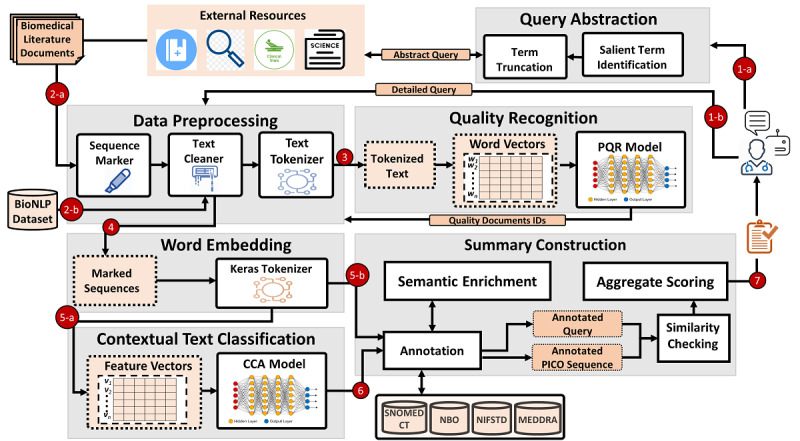
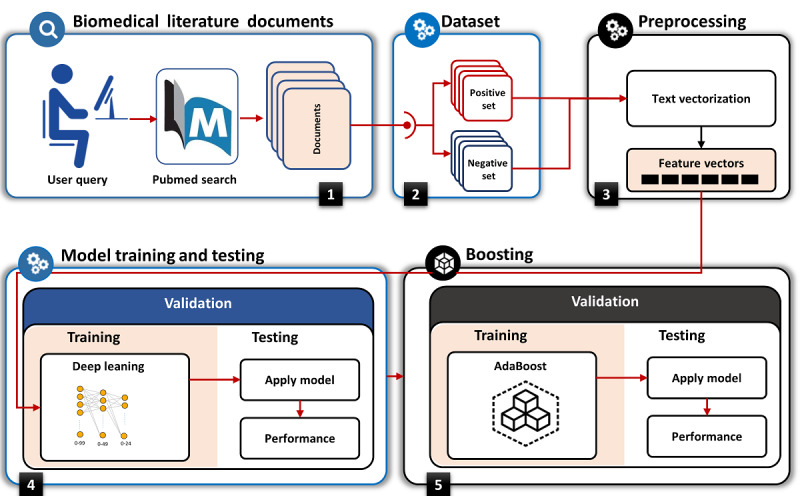
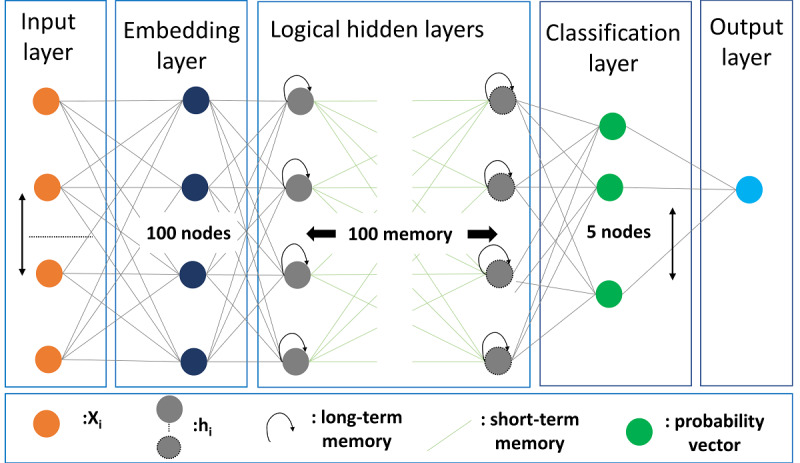
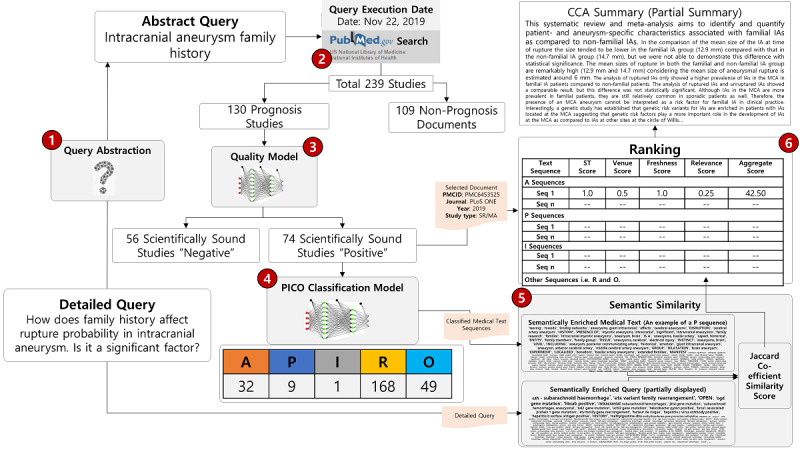
Background: Automatic text summarization (ATS) enables users to retrieve meaningful evidence from big data of biomedical repositories to make complex clinical decisions. Deep neural and recurrent networks outperform traditional machine-learning techniques in areas of natural language processing and computer vision; however, they are yet to be explored in the ATS domain, particularly for medical text summarization. Objective: Traditional approaches in ATS for biomedical text suffer from fundamental issues such as an inability to capture clinical context, quality of evidence, and purpose-driven selection of passages for the summary. We aimed to circumvent these limitations through achieving precise, succinct, and coherent information extraction from credible published biomedical resources, and to construct a simplified summary containing the most informative content that can offer a review particular to clinical needs. Methods: In our proposed approach, we introduce a novel framework, termed Biomed-Summarizer, that provides quality-aware Patient/Problem, Intervention, Comparison, and Outcome (PICO)-based intelligent and context-enabled summarization of biomedical text. Biomed-Summarizer integrates the prognosis quality recognition model with a clinical context–aware model to locate text sequences in the body of a biomedical article for use in the final summary. First, we developed a deep neural network binary classifier for quality recognition to acquire scientifically sound studies and filter out others. Second, we developed a bidirectional long-short term memory recurrent neural network as a clinical context–aware classifier, which was trained on semantically enriched features generated using a word-embedding tokenizer for identification of meaningful sentences representing PICO text sequences. Third, we calculated the similarity between query and PICO text sequences using Jaccard similarity with semantic enrichments, where the semantic enrichments are obtained using medical ontologies. Last, we generated a representative summary from the high-scoring PICO sequences aggregated by study type, publication credibility, and freshness score. Results: Evaluation of the prognosis quality recognition model using a large dataset of biomedical literature related to intracranial aneurysm showed an accuracy of 95.41% (2562/2686) in terms of recognizing quality articles. The clinical context–aware multiclass classifier outperformed the traditional machine-learning algorithms, including support vector machine, gradient boosted tree, linear regression, K-nearest neighbor, and naïve Bayes, by achieving 93% (16127/17341) accuracy for classifying five categories: aim, population, intervention, results, and outcome. The semantic similarity algorithm achieved a significant Pearson correlation coefficient of 0.61 (0-1 scale) on a well-known BIOSSES dataset (with 100 pair sentences) after semantic enrichment, representing an improvement of 8.9% over baseline Jaccard similarity. Finally, we found a highly positive correlation among the evaluations performed by three domain experts concerning different metrics, suggesting that the automated summarization is satisfactory. Conclusions: By employing the proposed method Biomed-Summarizer, high accuracy in ATS was achieved, enabling seamless curation of research evidence from the biomedical literature to use for clinical decision-making.
Overview
The claims and statistics of this paper haven’t been checked yet.
Free: it reads the open-access text and checks the first 5 claims that cite a source we can check. Create a free account to check every claim.
Integrity signals
Registry
Cites
Statistics
Figures
Verification
Claims the paper makes
The claims and statistics of this paper haven’t been checked yet.
Free: it reads the open-access text and checks the first 5 claims that cite a source we can check. Create a free account to check every claim.
Claims other papers make about this one
Each is checked against this paper’s own text: does it say what the citing paper says it does?
The check wasn’t confident either way, so it gives no verdict — never disputed.
In the citing paper
“Dataset adaptations: 60, 167 PubMedPICO”
From Data extraction methods for systematic review (semi)automation: Update of a living systematic review (2025) · cites this paper as [60]
Experimental — accuracy not yet measuredIn the citing paper
“labelled automatically matching intervention strings from clinical trial registration 42000 sentences”
From Data extraction methods for systematic review (semi)automation: Update of a living systematic review (2025) · cites this paper as [60]
Self-check
Percentages, sums and reported differences re-computed from the paper’s own numbers.
The self-check needs the paper’s full text.
Citations
Cites
Glove: Global Vectors for Word Representation
Pennington, J., Socher, R., & Manning, C. (2014) · Proceedings of the 2014 Conference on Empirical Methods in Natural Language Processing (EMNLP) · doi:10.3115/v1/d14-1162 · Cited by 34,071 · cited 1×
“…representing the frequency of its use [3], more powerful word-embedding techniques have recently been introduced, such as word2vec [11,12] and GloVe [13], to combat the issues of data sparseness and context-overlooking by generating a vector space, typically of several hundred dimensions [14].”
MethodFundamentals of Recurrent Neural Network (RNN) and Long Short-Term Memory (LSTM) Network
Sherstinsky, A. (2020) · Physica D: Nonlinear Phenomena · doi:10.1016/j.physd.2019.132306 · Cited by 5,680
The Automatic Creation of Literature Abstracts
Luhn, H. P. (1958) · IBM Journal of Research and Development · doi:10.1147/rd.22.0159 · Cited by 3,246 · cited 1×
“For such a task, some researchers have used statistical features such as term frequency, sentence position, and similarity with the title [25,26], whereas other methods incorporated semantic information extracted from external linguistic resources [26,27].”
BackgroundNLTK: the Natural Language Toolkit
Loper, E., & Bird, S. (2002) · Proceedings of the ACL-02 Workshop on Effective tools and methodologies for teaching natural language processing and computational linguistics - · doi:10.3115/1118108.1118117 · Cited by 3,218
Neural Summarization by Extracting Sentences and Words
Cheng, J., & Lapata, M. (2016) · Proceedings of the 54th Annual Meeting of the Association for Computational Linguistics (Volume 1: Long Papers) · doi:10.18653/v1/p16-1046 · Cited by 790 · cited 2×
“deep-learning approaches have been widely used in text summarization [3,46-49].”
MethodQuality in qualitative research
Kitto, S. C., Chesters, J., & Grbich, C. (2008) · Medical Journal of Australia · doi:10.5694/j.1326-5377.2008.tb01595.x · Cited by 728 · cited 1×
“Study types can be used to grade evidence concerning quality and other elements [34,51,52].”
MethodRecent automatic text summarization techniques: a survey
Gambhir, M., & Gupta, V. (2017) · Artificial Intelligence Review · doi:10.1007/s10462-016-9475-9 · Cited by 727 · cited 2×
“Extractive summarization approaches are classified into different categories such as statistical-, topic, graph, discourse, and machine learning–based approaches [5].”
BackgroundScikit-learn: Machine Learning Without Learning the Machinery
Varoquaux, G., Buitinck, L., Louppe, G., Grisel, O., Pedregosa, F., & Mueller, A. (2015) · GetMobile: Mobile Computing and Communications · doi:10.1145/2786984.2786995 · Cited by 650
Text Summarization Techniques: A Brief Survey
Allahyari, M., Pouriyeh, S., Assefi, M., Safaei, S., D., E., B., J., & Kochut, K. (2017) · International Journal of Advanced Computer Science and Applications · doi:10.14569/ijacsa.2017.081052 · Cited by 558
A comparison of word embeddings for the biomedical natural language processing
Wang, Y., Liu, S., Afzal, N., Rastegar-Mojarad, M., Wang, L., Shen, F., Kingsbury, P., & Liu, H. (2018) · Journal of Biomedical Informatics · doi:10.1016/j.jbi.2018.09.008 · Cited by 370
Research works printed but not linked: 12
- SchulzeFNevesMEntity-Supported Summarization of Biomedical AbstractsThe COLING 2016 Organizing CommitteeProceedings of the Fifth Workshop on Building and Evaluating Resources for Biomedical Text Mining (BioTxtM2016)December 2016Osaka, Japan4049
- Allahyari, M, 2017, arXiv, 1
- Khatri, C, 2018, arxiv, 1807.08000 · arXiv
- MikolovTYihWZweigGLinguistic Regularities in Continuous Space Word Representations Internet201306Proceedings of the 2013 Conference of the North American Chapter of the Association for Computational Linguistics: Human Language TechnologiesJune 2013Atlanta, GeorgiaAssociation for Computational Linguistics746751
- Moradi, M, 2019, arXiv, 1903.02861 · arXiv
- ZlabingerMAnderssonLHanburyAAnderssonMQuasnikVBrasseyJMedical entity corpus with pico elements and sentiment analysisEuropean Language Resources Association (ELRA)201805Eleventh International Conference on Language Resources and Evaluation (LREC 2018)2018Miyazaki, Japan
- Wallace, B, 2016, J Mach Learn Res, 17, 132
- Cao, Z, 2016, arXiv, 1604.00125 · arXiv
- Nallapati, R, 2016, arxiv, 1611.04230 · arXiv
- Cheng, J, 2016, arXiv, 1603.07252 · arXiv
- Loper, E, 2002, arXiv, 0205028
- Pedregosa, F, 2011, J Machine Learn Res, 2825
Cited by
Natural Language Processing for Smart Healthcare
Zhou, B., Yang, G., Shi, Z., & Ma, S. (2024) · IEEE Reviews in Biomedical Engineering · doi:10.1109/rbme.2022.3210270 · Cited by 230
“ease the access of medical knowledge [1], [83], [85], [134], [187], [189], [190] question answering, information retrieval, machine translation generate medical case-based questions [191] question generation construct simplified summaries [65] text summarization population screening identify target populations [192] i…”
BackgroundData extraction methods for systematic review (semi)automation: a living systematic review
Schmidt, L., Olorisade, B. K., McGuinness, L. A., Thomas, J., & Higgins, J. P. T. (2021) · F1000Research · doi:10.12688/f1000research.51117.1 · Cited by 106
Ensemble Multifeatured Deep Learning Models and Applications: A Survey
Abimannan, S., El-Alfy, E.-S. M., Chang, Y., Hussain, S., Shukla, S., & Satheesh, D. (2023) · IEEE Access · doi:10.1109/access.2023.3320042 · Cited by 119
“Word embeddings (e.g., Word2Vec, GloVe, and BERT) are high-dimensional vector representations of words that capture semantic and syntactic relationships between words within a given context [131].”
BackgroundHuang, E., Yang, J., Liao, K. Y.-K., Tseng, W. C. W., Lee, C. K., Gill, M., Compas, C. B., See, S. C. W., & Tsai, F. (2024) · Scientific Reports · doi:10.1038/s41598-024-66897-y · Cited by 109
Overview of the MEDIQA 2021 Shared Task on Summarization in the Medical Domain
Ben Abacha, A., Mrabet, Y., Zhang, Y., Shivade, C., Langlotz, C., & Demner-Fushman, D. (2021) · Proceedings of the 20th Workshop on Biomedical Language Processing · doi:10.18653/v1/2021.bionlp-1.8 · Cited by 68
“However, despite its importance, fewer efforts have tackled text summarization in the biomedical domain for both consumer and clinical text and its applications in Question Answering (QA) (Afantenos et al., 2005; Mishra et al., 2014; Afzal et al., 2020).”
Background
Metadata
- Authors
- Afzal, M., Alam, F., Malik, K. M., & Malik, G. M.
- Affiliations
- Oakland University (US)
- Henry Ford Health (US)
- Corresponding author
- Malik, Khalid Mahmood
- Venue
- Journal of Medical Internet Research
- Publisher
- JMIR Publications Inc.
- Published
- 2020-10-23
- Volume
- 22
- Issue
- 10
- Pages
- e19810
- ISSN
- 1438-8871 (ISSN-L)
- PMC
- PMC7647812
- OpenAlex
- W3086767710
- Cited by
- 65
- References
- 46
- Citations by year
- 2026: 11 · 2025: 8 · 2024: 16 · 2023: 14 · 2022: 12 · 2021: 4
- FWCI
- 2.43
- Type
- journal article
- Language
- en
- Open access
- gold
- doi.org
- Licence
- cc-by
- Locations
- Journal of Medical Internet Research (publishedVersion, cc-by)
- PubMed Central (publishedVersion, cc-by)
- PubMed (publishedVersion)
- DOAJ (DOAJ: Directory of Open Access Journals) (submittedVersion, cc-by-sa)
- Funders
- Brain Aneurysm Foundation
- Topics
- Health Sciences › Medicine › Health Informatics › Biomedical Text Mining and Ontologies
- Physical Sciences › Computer Science › Artificial Intelligence › Advanced Text Analysis Techniques
- Physical Sciences › Computer Science › Artificial Intelligence › Topic Modeling
- Keywords
- biomedical text summarization, PICO framework, bidirectional LSTM, semantic enrichment, medical ontologies, Jaccard similarity, query-document matching, intracranial aneurysm, clinical decision support, word embeddings, clinical decision support systems, evidence-based medicine
- MeSH terms
- Humans, Reproducibility of Results, Information Storage and Retrieval, Neural Networks, Computer
About these checks
Registry, retraction, Cites and statistics results are computed, not judged, with one exception: a printed reference that no index lists is read once by a model before it counts as a citation error. Claims are extracted by a model and kept only when their quote appears verbatim in the text; each cited source is then checked, with a model’s help, for whether it says what the claim relies on. Those verdicts can be wrong — read the claim’s quote and the cited source before relying on one.
Statistics and arithmetic are recomputed, not judged.
Confidence bands are shown only for fields calibrated on our annotated test set. None is calibrated yet, so no band is shown.
What counts as a claim ›How we measure confidence ›How we check this ›
Are you an author, or do you see a problem with this page? Request a review
Data sources
Bibliographic data: Semantic Scholar, OpenAlex, Crossref.
Contains information from the Semantic Scholar Academic Graph Datasets, made available under the ODC Attribution License (ODC-BY 1.0).
Semantic Scholar’s data is described in: Kinney, R., et al. (2023). The Semantic Scholar Open Data Platform. arXiv:2301.10140.
