

Factors Affecting the Implementation, Use, and Adoption of Real-Time Location System Technology for Persons Living With Cognitive Disabilities in Long-term Care Homes: Systematic Review
Open accessPublished version of a preprint
The DOI matches its Crossref record; 66 of the 66 references it cites were found in a registry or an index.
Abstract
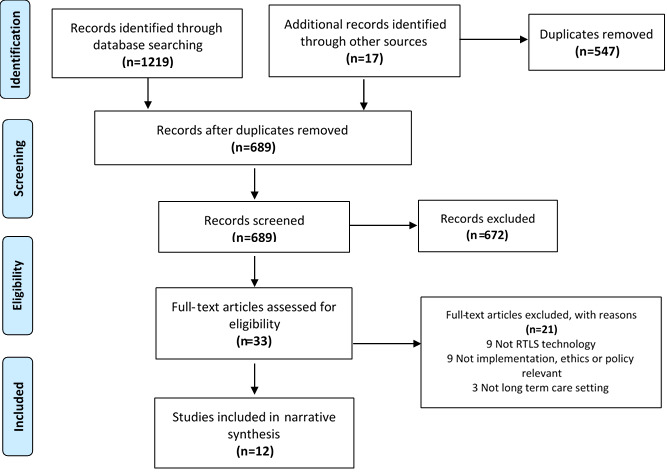
BACKGROUND: As the aging population continues to grow, the number of adults living with dementia or other cognitive disabilities in residential long-term care homes is expected to increase. Technologies such as real-time locating systems (RTLS) are being investigated for their potential to improve the health and safety of residents and the quality of care and efficiency of long-term care facilities. OBJECTIVE: The aim of this study is to identify factors that affect the implementation, adoption, and use of RTLS for use with persons living with dementia or other cognitive disabilities in long-term care homes. METHODS: We conducted a systematic review of the peer-reviewed English language literature indexed in MEDLINE, Embase, PsycINFO, and CINAHL from inception up to and including May 5, 2020. Search strategies included keywords and subject headings related to cognitive disability, residential long-term care settings, and RTLS. Study characteristics, methodologies, and data were extracted and analyzed using constant comparative techniques. RESULTS: A total of 12 publications were included in the review. Most studies were conducted in the Netherlands (7/12, 58%) and used a descriptive qualitative study design. We identified 3 themes from our analysis of the studies: barriers to implementation, enablers of implementation, and agency and context. Barriers to implementation included lack of motivation for engagement; technology ecosystem and infrastructure challenges; and myths, stories, and shared understanding. Enablers of implementation included understanding local workflows, policies, and technologies; usability and user-centered design; communication with providers; and establishing policies, frameworks, governance, and evaluation. Agency and context were examined from the perspective of residents, family members, care providers, and the long-term care organizations. CONCLUSIONS: There is a striking lack of evidence to justify the use of RTLS to improve the lives of residents and care providers in long-term care settings. More research related to RTLS use with cognitively impaired residents is required; this research should include longitudinal evaluation of end-to-end implementations that are developed using scientific theory and rigorous analysis of the functionality, efficiency, and effectiveness of these systems. Future research is required on the ethics of monitoring residents using RTLS and its impact on the privacy of residents and health care workers.
Overview
The claims and statistics of this paper haven’t been checked yet.
Free: it reads the open-access text and checks the first 5 claims that cite a source we can check. Create a free account to check every claim.
Integrity signals
Registry
Cites
Statistics
Figures
Verification
Claims the paper makes
The claims and statistics of this paper haven’t been checked yet.
Free: it reads the open-access text and checks the first 5 claims that cite a source we can check. Create a free account to check every claim.
Claims other papers make about this one
Each is checked against this paper’s own text: does it say what the citing paper says it does?
The source backs part of the claim, not all of it — or backs it for a different population, condition or comparison.
In the citing paper
“a more common finding is that surveillance is more widespread and used to supplement rather than to replace confinement and use of restraints (Grigorovich et al., 2021).”
From Algorithmic harms and digital ageism in the use of surveillance technologies in nursing homes (2022) · cites this paper as Grigorovich et al., 2021
Experimental — accuracy not yet measured
Self-check
Percentages, sums and reported differences re-computed from the paper’s own numbers.
The self-check needs the paper’s full text.
Citations
Cites
(1998) · Sage eBooks · Cited by 38,631
Older Adults' Reasons for Using Technology while Aging in Place
Peek, S. T. M., Luijkx, K. G., Rijnaard, M. D., Nieboer, M. E., van der Voort, C. S., Aarts, S., van Hoof, J., Vrijhoef, H. J. M., & Wouters, E. J. M. (2016) · Gerontology · doi:10.1159/000430949 · Cited by 19,690 · cited 1×
“With the anticipated aging of the population in many western countries [59-61], there is increasing interest in the potential of using technologies to improve the health, safety, and quality of life in long-term care homes while reducing the cost of care delivery.”
Diffusion of Innovations in Service Organizations: Systematic Review and Recommendations
GREENHALGH, T., ROBERT, G., MACFARLANE, F., BATE, P., & KYRIAKIDOU, O. (2004) · The Milbank Quarterly · doi:10.1111/j.0887-378x.2004.00325.x · Cited by 7,448 · cited 1×
“…process theory [46] informed data collection for 1 study [43], its absence in the study design and analysis makes it difficult to extract meaning and better understand and control the barriers and facilitators that Greenhalgh et al [47] suggested actively affect the technology effectiveness.”
Convention on the Rights of Persons with Disabilities
(2014) · Encyclopedia of Human Services and Diversity · doi:10.4135/9781483346663.n124 · Cited by 2,158
The SAGE Encyclopedia of Social Science Research Methods
Lewis-Beck, M., Bryman, A., & Futing Liao, T. (2004) · Sage eBooks · doi:10.4135/9781412950589 · Cited by 1,439
Development of a theory of implementation and integration: Normalization Process Theory
May, C. R., Mair, F., Finch, T., MacFarlane, A., Dowrick, C., Treweek, S., Rapley, T., Ballini, L., Ong, B. N., Rogers, A., et al. (2009) · Implementation Science · doi:10.1186/1748-5908-4-29 · Cited by 1,409 · cited 1×
“Although normalization process theory [46] informed data collection for 1 study [43], its absence in the study design and analysis makes it difficult to extract meaning and better understand and control the barriers and facilitators that Greenhalgh et al [47] suggested actively affect the…”
Ross, J., Stevenson, F., Lau, R., & Murray, E. (2016) · Implementation Science · doi:10.1186/s13012-016-0510-7 · Cited by 1,011 · cited 1×
“Implementation science advocates for a clear understanding and resolution of issues related to novel technologies (in their broadest sense, including artifacts such as hardware, software, processes, and policies) and the context and setting in which it is being applied [62,63].”
Implementation, context and complexity
May, C. R., Johnson, M., & Finch, T. (2016) · Implementation Science · doi:10.1186/s13012-016-0506-3 · Cited by 978 · cited 2×
“The selected studies were not overtly informed by implementation science theory [28].”
Östlund, U., Kidd, L., Wengström, Y., & Rowa-Dewar, N. (2011) · International Journal of Nursing Studies · doi:10.1016/j.ijnurstu.2010.10.005 · Cited by 742 · cited 1×
“This type of review strengthens the findings and generates more robust conclusions, thus making them more applicable to policy and practice [32].”
Towards a general theory of implementation
May, C. (2013) · Implementation Science · doi:10.1186/1748-5908-8-18 · Cited by 656 · cited 1×
“The interaction of agents such as organizations, care providers, and residents, their contexts, and their processes (both established and introduced by an intervention or novel technology) must be anticipated or, at the very least, accommodated in a successful implementation [28,29].”
Research works printed but not linked: 3
- Maykut P Morehouse R Beginning Qualitative Research: A philosophic Practice Guide 1994 London, UK The Falmer Press A
- LatourBVennCMorality and TechnologySage Publications201701132021-01-01https://journals.sagepub.com/doi/pdf/10.1177/026327602761899246 · DOI · Paper page
- Maguire C The struggle to keep up with data privacy regulations Law Journal Newsletters 2020-12-23 https://www.lawjournalnewsletters.com/2018/04/01/the-struggle-to-keep-up-with-data-privacy-regulations/?slreturn=20200730165959
Cited by
Algorithmic harms and digital ageism in the use of surveillance technologies in nursing homes
Berridge, C., & Grigorovich, A. (2022) · Frontiers in Sociology · doi:10.3389/fsoc.2022.957246 · Cited by 47
Self-citationNew assistive technologies in dementia and mild cognitive impairment care: A PubMed review
Lee-Cheong, S., Amanullah, S., & Jardine, M. (2022) · Asian Journal of Psychiatry · doi:10.1016/j.ajp.2022.103135 · Cited by 54
Indoor Location Data for Tracking Human Behaviours: A Scoping Review
Shum, L. C., Faieghi, R., Borsook, T. K., Faruk, T., Kassam, S., Nabavi, H., Spasojevic, S. S., Tung, J. Y., Khan, S. S., & Iaboni, A. (2022) · Sensors · doi:10.3390/s22031220 · Cited by 49
“Presently, there are a small number of review papers regarding the applications of RTLS in healthcare [1,10].”
BackgroundSelf-citationHaslam‐Larmer, L., Shum, L. C., Chu, C. H., McGilton, K., McArthur, C., Flint, A. J., Khan, S. S., & Iaboni, A. (2022) · Frontiers in Psychiatry · doi:10.3389/fpsyt.2022.1038008 · Cited by 21
Self-citationAn Auto-Encoder Multitask LSTM Model for Boundary Localization
Liu, Y., Chen, J., Tseng, Y., & Li, F. Y. (2022) · IEEE Sensors Journal · doi:10.1109/jsen.2022.3168253 · Cited by 18
Metadata
- Authors
- Grigorovich, A., Kulandaivelu, Y., Newman, K., Bianchi, A., Khan, S. S., Iaboni, A., & McMurray, J.
- Affiliations
- University Health Network (CA)
- Toronto Metropolitan University (CA)
- Wilfrid Laurier University (CA)
- Corresponding author
- McMurray, Josephine
- ORCID
- Venue
- Journal of Medical Internet Research
- Publisher
- JMIR Publications Inc.
- Published
- 2021-01-20
- Volume
- 23
- Issue
- 1
- Pages
- e22831
- ISSN
- 1438-8871 (ISSN-L)
- PMC
- PMC7857945
- OpenAlex
- W3124178379
- Cited by
- 33
- References
- 66
- Citations by year
- 2026: 8 · 2025: 7 · 2024: 6 · 2023: 7 · 2022: 5
- FWCI
- 0.93
- Type
- journal article
- Language
- en
- Open access
- gold
- doi.org
- Licence
- cc-by
- Locations
- Journal of Medical Internet Research (publishedVersion, cc-by)
- Europe PMC (PubMed Central) (publishedVersion, cc-by)
- PubMed Central (publishedVersion, cc-by)
- PubMed (publishedVersion)
- DOAJ (DOAJ: Directory of Open Access Journals) (submittedVersion, cc-by-sa)
- Funders
- AGE-WELL
- Government of Canada
- Topics
- Health Sciences › Medicine › Geriatrics and Gerontology › Geriatric Care and Nursing Homes
- Health Sciences › Medicine › Geriatrics and Gerontology › Technology Use by Older Adults
- Health Sciences › Health Professions › General Health Professions › Health Policy Implementation Science
- Keywords
- real-time location systems, long-term care facilities, dementia, cognitive disability, technology adoption, implementation barriers, implementation facilitators, resident safety, user-centered design, privacy
- MeSH terms
- Data Analysis, Computer Systems, Humans, Long-Term Care, Qualitative Research, Cognitive Dysfunction
About these checks
Registry, retraction, Cites and statistics results are computed, not judged, with one exception: a printed reference that no index lists is read once by a model before it counts as a citation error. Claims are extracted by a model and kept only when their quote appears verbatim in the text; each cited source is then checked, with a model’s help, for whether it says what the claim relies on. Those verdicts can be wrong — read the claim’s quote and the cited source before relying on one.
Statistics and arithmetic are recomputed, not judged.
Confidence bands are shown only for fields calibrated on our annotated test set. None is calibrated yet, so no band is shown.
What counts as a claim ›How we measure confidence ›How we check this ›
Are you an author, or do you see a problem with this page? Request a review
Data sources
Bibliographic data: Semantic Scholar, OpenAlex, Crossref.
Contains information from the Semantic Scholar Academic Graph Datasets, made available under the ODC Attribution License (ODC-BY 1.0).
Semantic Scholar’s data is described in: Kinney, R., et al. (2023). The Semantic Scholar Open Data Platform. arXiv:2301.10140.
