

Acceptance and Use of Home-Based Electronic Symptom Self-Reporting Systems in Patients With Cancer: Systematic Review
Open accessPublished version of a preprint
The DOI matches its Crossref record; 67 of the 67 references it cites were found in a registry or an index.
Abstract
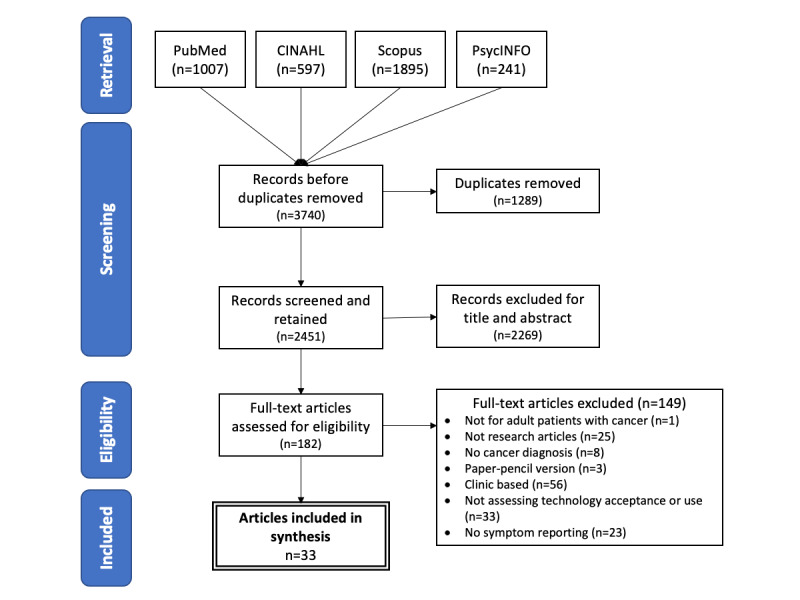
Background: Electronic symptom self-reporting systems (e-SRS) have been shown to improve symptoms and survival in patients with cancer. However, patient engagement in using e-SRS for voluntary symptom self-reporting is less optimal. Multiple factors can potentially affect patients’ acceptance and engagement in using home-based e-SRS. However, such factors have not been fully explored in cancer populations. Objective: The aim of this study is to understand the acceptance and use of home-based e-SRS by patients with cancer and identify associated facilitators and barriers. Methods: PubMed, CINAHL, Scopus, and PsycINFO (January 2010 to March 2020) were searched using a combination of Medical Subject Headings (MeSH) terms and keywords such as symptom self-reporting, electronic/technology, cancer, and their synonyms. Included studies focused on the use of home-based e-SRS by patients with cancer and their families. Studies on patients’ use of e-SRS in clinical settings only were excluded. Of the 3740 papers retrieved, 33 were included in the final review. Factors associated with patient acceptance and use of e-SRS were extracted and synthesized. Results: Most e-SRS were web based (22/33, 66%) or mobile app based (9/33, 27%). The e-SRS initial acceptance, represented by patient enrollment rates, ranged from 40% (22/55) to 100% (100/100). High e-SRS acceptance was rated by 69% (59/85) to 77.6% (337/434) of the patients after they used the system. The e-SRS use, measured by patients’ response rates to questionnaires (ranging from 1596/3521, 45.33% to 92%) or system log-on rates (ranging from 4/12, 33% to 99/100, 99%), declined over time in general patterns. Few studies (n=7) reported e-SRS use beyond 6 months, with the response rates ranging from 62% (40/64) to 85.1% (541/636) and the log-on rates ranging from 63.6% (103/162) to 77% (49/64). The availability of compatible devices and technical support, interactive system features, information accessibility, privacy, questionnaire quality, patient physical/psychosocial status, and age were associated with patient acceptance and use of home-based e-SRS. Conclusions: Acceptance and use of home-based e-SRS by patients with cancer varied significantly across studies, as assessed by a variety of approaches. The lack of access to technology has remained a barrier to e-SRS adoption. Interactive system features and personalized questionnaires may increase patient engagement. More studies are needed to further understand patients’ long-term use of home-based e-SRS behavior patterns to develop personalized interventions to support symptom self-management and self-reporting of patients with cancer for optimal health outcomes.
Overview
The claims and statistics of this paper haven’t been checked yet.
Free: it reads the open-access text and checks the first 5 claims that cite a source we can check. Create a free account to check every claim.
Integrity signals
Registry
Cites
Statistics
Figures
Verification
Claims the paper makes
The claims and statistics of this paper haven’t been checked yet.
Free: it reads the open-access text and checks the first 5 claims that cite a source we can check. Create a free account to check every claim.
Claims other papers make about this one
Each is checked against this paper’s own text: does it say what the citing paper says it does?
The source backs part of the claim, not all of it — or backs it for a different population, condition or comparison.
In the citing paper
“Factors like age, education, possession of smart device(s), the nature of the consultation (routine follow-up versus urgent need for physical examination), and experience with using technology could contribute to the acceptability of telehealth for cancer survivors [17].”
From Applying the Unified Theory of Acceptance and Use of Technology to Identify Factors Associated With Intention to Use Teledelivered Supportive Care Among Recently Diagnosed Breast Cancer Survivors During COVID-19 in Hong Kong: Cross-Sectional Survey (2024) · cites this paper as [17]
Experimental — accuracy not yet measured
Self-check
Percentages, sums and reported differences re-computed from the paper’s own numbers.
The self-check needs the paper’s full text.
Citations
Cites
Perceived usefulness, perceived ease of use, and user acceptance of information technology
Davis, F. D. (1989) · MIS Quarterly · doi:10.2307/249008 · Cited by 68,483 · cited 1×
“According to the widely adopted technology acceptance model, technology acceptance can be directly assessed by the person’s statements regarding her/his behavioral intention to the use of technology [60].”
BackgroundUser Acceptance of Information Technology: Toward A Unified View1
Venkatesh, V., Morris, M. G., Davis, G. B., & Davis, F. D. (2003) · MIS Quarterly · doi:10.2307/30036540 · Cited by 45,035 · cited 5×
“According to the UTAUT model, age, gender, and previous technology experiences potentially moderate the effects of determinants on the actual behavior of technology use [21].”
BackgroundMethodInfluentialUnderstanding Information Systems Continuance: An Expectation-Confirmation Model1
Bhattacherjee, A. (2001) · MIS Quarterly · doi:10.2307/3250921 · Cited by 8,767 · cited 1×
“The literature indicates that patients’ use of e-SRS for symptom self-reporting provides opportunities for clinicians to understand patients’ dynamic needs over time and facilitates productive interactions and interpersonal relationships between patients and clinicians [10,61].”
BackgroundSlim, K., Nini, E., Forestier, D., Kwiatkowski, F., Panis, Y., & Chipponi, J. (2003) · ANZ Journal of Surgery · doi:10.1046/j.1445-2197.2003.02748.x · Cited by 7,603 · cited 1×
“Therefore, this study only adopted the first 8 criteria of MINORS, including whether the study has a clear aim, clear inclusion and exclusion criteria, prospective data collection, appropriate endpoints, unbiased assessment, adequate study period, reasonable proportion of follow-up loss, and prospective sample size ca…”
MethodU.S. Department of Health and Human Services FDA Center for Drug Evaluation and Research, U.S. Department of Health and Human Services FDA Center for Biologics Evaluation and Research, & U.S. Department of Health and Human Services FDA Center for Devices and Radiological Health (2006) · Health and Quality of Life Outcomes · doi:10.1186/1477-7525-4-79 · Cited by 2,856
Confocal Imaging–Guided Laser Ablation of Basal Cell Carcinomas: An Ex Vivo Study
Sierra, H., Cordova, M., Chen, C.-S. J., & Rajadhyaksha, M. (2015) · Journal of Investigative Dermatology · doi:10.1038/jid.2014.371 · Cited by 1,703 · cited 6×
“The most commonly adopted symptom reporting instruments or questionnaires in home-based e-SRS were the National Cancer Institute-Common Terminology Criteria for Adverse Events or patient-reported outcome version of Common Terminology Criteria for Adverse Events (6/33, 19%) [27,28,30,38,46,48] and the European Organisa…”
BackgroundMethodInfluentialSelf-management: Enabling and empowering patients living with cancer as a chronic illness
McCorkle, R., Ercolano, E., Lazenby, M., Schulman-Green, D., Schilling, L. S., Lorig, K., & Wagner, E. H. (2011) · CA: A Cancer Journal for Clinicians · doi:10.3322/caac.20093 · Cited by 950 · cited 2×
“Informed by the chronic care model, patients with cancer and their families are expected to be in partnership with clinicians for joint management of the disease and related consequences to improve the quality of cancer care [10].”
BackgroundPatient compliance with paper and electronic diaries
Stone, A. A., Shiffman, S., Schwartz, J. E., Broderick, J. E., & Hufford, M. R. (2003) · Controlled Clinical Trials · doi:10.1016/s0197-2456(02)00320-3 · Cited by 910 · cited 1×
“For example, one study found that persons using paper diaries for tracking pain reported a high level of fake compliance (90% of patients reported the use of paper diaries for pain tracking, but only 32% actually used), whereas the electronic diaries group demonstrated 99% validated compliance [9].”
The Missing Voice of Patients in Drug-Safety Reporting
Basch, E. (2010) · New England Journal of Medicine · doi:10.1056/nejmp0911494 · Cited by 646 · cited 1×
“The importance of collecting patient-reported symptoms has been increasingly recognized in cancer care because patients with cancer often experience unpredictable subjective symptoms, such as severe nausea, fatigue, or pain, which can lead to unwarranted emergency room visits or hospital admissions [2-4].”
BackgroundO’Connor, S., Hanlon, P., O’Donnell, C. A., Garcia, S., Glanville, J., & Mair, F. S. (2016) · BMC Medical Informatics and Decision Making · doi:10.1186/s12911-016-0359-3 · Cited by 636
Cited by
Digital health and telehealth in cancer care: A scoping review of reviews
Shaffer, K. M., Turner, K. L., Siwik, C., Gonzalez, B. D., Upasani, R., Glazer, J. V., Ferguson, R. J., Joshua, C., & Low, C. A. (2023) · The Lancet Digital Health · doi:10.1016/s2589-7500(23)00049-3 · Cited by 263
Steindal, S. A., Nes, A. A. G., Godskesen, T., Holmen, H., Winger, A., Österlind, J., Dihle, A., & Klarare, A. (2023) · Journal of Medical Internet Research · doi:10.2196/43684 · Cited by 130
“Poor-quality electronic questionnaires, for example, that have an overload or overlap of questions or require reporting of symptoms that patients find irrelevant, may affect patients’ acceptability and use of remote self-reporting [90].”
Woolley, K. E., Bright, D., Ayres, T., Morgan, F. M., Little, K. E., & Davies, A. R. (2023) · Journal of Medical Internet Research · doi:10.2196/44181 · Cited by 79
“For instance, Chambers et al [22] noted that, in 1 primary study [40], individuals with a low to medium level of education were more motivated toward indirect consultation (eg, involving communication with a health professional via email) to reduce uncertainty.”
InfluentialArdito, V., Golubev, G., Ciani, O., & Tarricone, R. (2023) · JMIR Cancer · doi:10.2196/42092 · Cited by 56
Telerehabilitation solutions in patient pathways: An overview of systematic reviews
Nicolas, B., Leblong, É., Fraudet, B., Gallien, P., & Piette, P. (2024) · Digital Health · doi:10.1177/20552076241294110 · Cited by 62
“71”
Darley, A., Coughlan, B., & Furlong, E. (2021) · European Journal of Oncology Nursing · doi:10.1016/j.ejon.2021.102030 · Cited by 36
Butow, P. N., Havard, P. E., Butt, Z., Juraskova, Sharpe, L., Dhillon, H. M., Beatty, L., Beale, P. J., Cigolini, M., Kelly, B. J., et al. (2022) · Patient Education and Counseling · doi:10.1016/j.pec.2022.01.020 · Cited by 34
Lee, M., Kang, D., Kang, E., Kim, S.-Y., Kim, Y., Ahn, J. S., Park, S., Lee, Y.-Y., Oh, D., Noh, J. M., et al. (2023) · Supportive Care in Cancer · doi:10.1007/s00520-023-07779-3 · Cited by 34
“Or patients might not be able to report symptoms on a certain day because of their health condition [37].”
BackgroundGovindaraj, R., Agar, M. R., Currow, D. C., & Luckett, T. (2023) · Journal of Medical Internet Research · doi:10.2196/48483 · Cited by 32
“Regarding patient characteristics, patients who lack computer experience generally show lower willingness and adherence to ePROM self-reporting than patients with computer experience [54,75,77,95].”
Personalization in digital health interventions for older adults with cancer: A scoping review
Hwang, M., & Jiang, Y. (2023) · Journal of Geriatric Oncology · doi:10.1016/j.jgo.2023.101652 · Cited by 28
Self-citationBarriers and challenges of using health information technology in home care: a systematic review
Galavi, Z., Montazeri, M., & Ahmadian, L. (2022) · The International Journal of Health Planning and Management · doi:10.1002/hpm.3492 · Cited by 27
McClaine, S., Fedor, J., Bartel, C., Chen, L., Durica, K. C., & Low, C. A. (2024) · JMIR Cancer · doi:10.2196/57347 · Cited by 23
“Several studies have investigated patient adherence to daily or weekly symptom surveys on the patient’s smartphone or by email [5-9].”
Medina, J. C., Flix-Valle, A., Rodríguez-Ortega, A., Hernández‐Ribas, R., de Frutos, M. L., & Ochoa, C. (2022) · Cancers · doi:10.3390/cancers14040974 · Cited by 20
“Following reference guidelines [10,13], in the present s udy th acceptance rate of the digital platform was operationalized as percentage of enrolled patients, that is, number of participants who accepted the eHealth program divided by number of eligible patients to whom the program was proposed.”
BackgroundMethodInfluentialFridriksdóttir, N., Ingadóttir, B., Skuladottir, K., Zoëga, S., & Gunnarsdóttir, S. (2023) · JMIR Formative Research · doi:10.2196/50550 · Cited by 16
“This is in line with what other researchers have identified [29] and may not be surprising as older patients may experience age-related problems such as cognitive and functional issues affecting their ability to use technical solutions [62].”
BackgroundResultWickline, M. M., Wolpin, S. E., Cho, S., Tomashek, H., Louca, T., Frisk, T., Templin, J., Loechl, A., Goff, B. A., & Berry, D. L. (2022) · Gynecologic Oncology · doi:10.1016/j.ygyno.2022.09.010 · Cited by 15
Hewage, S. A., Senanayake, S. J., Brain, D., Allen, M. J., McPhail, S. M., Parsonage, W. A., Walters, T. E., & Kularatna, S. (2025) · JMIR mhealth and uhealth · doi:10.2196/58556 · Cited by 15
“Similar preferences for feedback and suggestions in mobile health apps have been reported in research on other chronic conditions such as HIV [57], cancer [58], and metabolic syndrome [59].”
Jiang, Y., Mason, M., Cho, Y., Chittiprolu, A., Zhang, X., Harden, K. L., Gong, Y., Harris, M. R., & Barton, D. L. (2022) · BMC Cancer · doi:10.1186/s12885-022-10026-3 · Cited by 16
“Therefore, it is important to assess older adults’ OAA treatment tolerability in a timely fashion and monitor for early signs and symptoms of toxicities from home [37], to intervene early to prevent the development of severe side effects and improve patient safety and health outcomes [16, 38].”
BackgroundSelf-citationJiang, Y., Hwang, M., Cho, Y., Friese, C. R., Hawley, S. T., Manojlovich, M., Krauss, J. C., & Gong, Y. (2024) · Journal of Medical Internet Research · doi:10.2196/47685 · Cited by 11
“…that existing home-based symptom self-reporting systems lack personalization features and only use questionnaires to collect patients’ self-reporting data, which could not meet patients’ various needs for self-reporting their safety concerns more conveniently and flexibly at any time [23].”
InfluentialSelf-citationThanthong, S., Kotronoulas, G., & Johnston, B. M. (2024) · Asia-Pacific Journal of Oncology Nursing · doi:10.1016/j.apjon.2024.100577 · Cited by 10
Digital health in geriatric oncology: A Young International Society of Geriatric Oncology review
Eochagáin, C. M., Senac, N. M. G., Cavanagh, M., Roy, M., Ciccone, A. S., Contreras, B., Testa, G. D., Velasco, R., Marinho, J. C. L., Serrano, A., et al. (2023) · Journal of Geriatric Oncology · doi:10.1016/j.jgo.2023.101649 · Cited by 10
Zhu, S., Dong, Y., Li, Y., Wang, H., Jiang, X., Guo, M., Fan, T., Song, Y., Ying, Z., & Han, Y. (2024) · Journal of Medical Internet Research · doi:10.2196/59061 · Cited by 10
“Consistent with other studies [36,57,58], ESMSs are easy to use, help patients with cancer accurately describe and continuously track their symptoms, provide them with practical self-care information, and do not interfere with their daily lives.”
Chen, L., Bartel, C., Cai, X., Cheng, Y., Perer, A., McClaine, S., Kairis, E., Durica, K. C., Huang, W., & Low, C. A. (2023) · JMIR Formative Research · doi:10.2196/46001 · Cited by 9
“These electronic symptom self-reporting systems vary in how often they assess symptoms, what instruments are used to assess symptoms, and what follow-up with providers or other features are available, but they have been shown to be generally acceptable and feasible [10-12].”
BackgroundHwang, M., Cho, Y., Gahn, K., Mason, H. L., Manojlovich, M., Gong, Y., & Jiang, Y. (2025) · Supportive Care in Cancer · doi:10.1007/s00520-025-09813-y · Cited by 8
“Meanwhile, several participants identified technology accessibility as a primary barrier to the initial adoption of DHTs, consistent with previous studies [28, 29].”
Self-citationHamasaki, T., Briand, C., Mahroug, A., & Sauvageau, A. (2025) · Disability and Rehabilitation Assistive Technology · doi:10.1080/17483107.2025.2526175 · Cited by 9
Paudel, R., Tramontano, A. C., Cronin, C. M., Wong, S. L., Dizon, D. S., Hazard-Jenkins, H. W., Bian, J. J., Osarogiagbon, R. U., Schrag, D., & Hassett, M. J. (2023) · JCO Oncology Practice · doi:10.1200/op.23.00339 · Cited by 7
Ghaben, S. J., Ludin, A. F. M., Ali, N. M., & Singh, D. K. A. (2025) · Digital Health · doi:10.1177/20552076241307476 · Cited by 6
“102,109 Tracking, a term used interchangeably with monitoring, is de fi ned by the PubMed mesh as ‘ Information relating to itemised coding of procedures and costs associated with healthcare delivery, used as a means for tracking healthcare utilisation, patterns of care and treatment outcomes ’ .”
Enhancing Safety via Medication Self-Management and Timely Reporting
Jiang, Y., & Gong, Y. (2021) · Studies in health technology and informatics · doi:10.3233/shti210773 · Cited by 6
“Electronic symptom reporting systems, allowing cancer patients to report their symptoms from home, have a low adoption rate from patients and the use tends to decline over time [11].”
BackgroundSelf-citationRelationship and Attachment to Digital Health Technology During Cancer Treatment
Darley, A., Furlong, E., Maguire, R., McCann, L., & Coughlan, B. (2024) · Seminars in Oncology Nursing · doi:10.1016/j.soncn.2024.151587 · Cited by 6
Springer, F., Hambsch, P. K., Mehnert-Theuerkauf, A., & Nicolay, N. H. (2025) · Frontiers in Oncology · doi:10.3389/fonc.2025.1546221 · Cited by 5
Serra-Blasco, M., Souto-Sampera, A., Medina, J. C., Flix-Valle, A., Ciria‐Suarez, L., Arizu-Onassis, A., Ruiz-Romeo, M., Jansen, F., Rodríguez, A., Pernas, S., et al. (2024) · Digital Health · doi:10.1177/20552076241257082 · Cited by 5
“51 Thus, a successful recruitment and implementation is anticipated.”
BackgroundAlievska, B. (2023) · MacSphere (McMaster University) · doi:10.71548/17702 · Cited by 5
Abdelwhab, Z. M., Elshwey, R., Adel, N., Eid, R., & Shash, E. (2025) · BMC Digital Health · doi:10.1186/s44247-025-00203-2 · Cited by 4
“This result aligns with research by Cho et al. [14], which high-lighted that caregivers play an integral role in navigating healthcare systems for chronic disease patients.”
InfluentialA Comprehensive Overview of Telemedicine
Heston, T. F., & Doarn, C. R. (2024) · Biomedical engineering · doi:10.5772/intechopen.1002138 · Cited by 4
Yu, Y., Shi, Y., Yang, E., Gahn, K., Mason, H. L., Jiang, Y., & Gong, Y. (2024) · PubMed · Cited by 4
Self-citationWei, Y., Lin, Z., Ou, B., Wu, J., Chen, G., Xu, G., Lin, X., Zheng, J., & Xiao, H. (2026) · Asia-Pacific Journal of Oncology Nursing · doi:10.1016/j.apjon.2026.100852 · Cited by 3
“56 Specifically, the Knowledge Base module of the NiS © system offers a structured, evidence-based repository that serves as the foundation for reliable symptom management guidance.”
Peters, S. T., Rutten, J. J. S., van Kooij, Y. E., Selles, R. W., Slijper, H. P., Hand-Wrist Study Group, & Wouters, R. M. (2026) · Quality of Life Research · doi:10.1007/s11136-026-04314-9 · Cited by 3
Ghaben, S. J., & Ludin, A. F. M. (2024) · Biomedical engineering · doi:10.5772/intechopen.1004756 · Cited by 3
Kelmendi, N., Langius‐Eklöf, A., Taloyan, M., Sundberg, K. K., Craftman, Å. G., & Nilsson, M. I. (2024) · BMC Family Practice · doi:10.1186/s12875-024-02669-x · Cited by 6
“Other studies using electronic systems for collecting patient-reported outcomes have shown usage adherence with a variation between 45 and 92% [41].”
Han, H. S., Lee, K. E., Suh, Y. J., Jee, H., Kim, B. J., Kim, H. S., Lee, K., Ryu, M., Baek, S. K., Park, I. H., et al. (2022) · Therapeutic Advances in Medical Oncology · doi:10.1177/17588359221132628 · Cited by 3
Yeung, N. C. Y., Lau, S. T. Y., Mak, W. W. S., Cheng, C., Chan, E. Y. Y., Siu, J. Y. M., & Cheung, P. S. Y. (2024) · JMIR Cancer · doi:10.2196/51072 · Cited by 2
Kudel, I., & Perry, T. (2022) · JMIR Cancer · doi:10.2196/29292 · Cited by 2
“There has been an increasing recognition that ePRO-associated benefits can only be accrued through durable patient engagement [14] and that current methods can be improved [15].”
de Almeida, A. T. S. D., Lima, L., & Martins, T. V. (2023) · Cancer Nursing · doi:10.1097/ncc.0000000000001250 · Cited by 2
He, S., Yang, F., Tang, L., Yang, J. P., Chen, S., Chen, Z., Wang, L., Zhang, Z., Ma, L., & Luo, X. (2025) · Supportive Care in Cancer · doi:10.1007/s00520-025-09308-w · Cited by 2
“…and more often when compared to reports by managing clinicians, which led to efforts to develop validated patient-reporting methods, for instance, patient-reported outcomes version of the Common Terminology Criteria for Adverse Events (PRO-CTCAE) created by National Cancer Institute (NCI) [22–24].”
Al-Dossary, M. M. (2026) · Journal of Intelligent Decision Making and Information Science · doi:10.17762/jidmis.v3.3708 · Cited by 2
“Cho et al. [12] found that a significant majority of e-SRS were either web-based (66”
InfluentialCho, Y., Smith, E., Zahrieh, D., Chow, S. L.-M., Williams, D. A., Arnault, D. S., & Jiang, Y. (2023) · JCO Clinical Cancer Informatics · doi:10.1200/cci.23.00007 · Cited by 2
Self-citationQuality of Person-Generated Healthy Walking Data: An Explorative Analysis
Kim, H., Im, E., & Ahn, G.-I. (2024) · Studies in health technology and informatics · doi:10.3233/shti231082 · Cited by 1
Gahn, K., Hwang, M., Cho, Y., Mason, H. L., Gong, Y., & Jiang, Y. (2024) · Studies in health technology and informatics · doi:10.3233/shti240177 · Cited by 1
“Previously published literature suggested several barriers hindering patient engagement in using technology for cancer MSE reporting, such as the lack of access to technology, low health literacy, and socioeconomic status [3].”
Self-citationHuang, H., Takemura, N., Abu‐Odah, H., Li, S., Mao, T., Ye, Z., & Yorke, J. (2026) · Journal of Medical Internet Research · doi:10.2196/83666 · Cited by 1
“…have been used to describe electronic symptom monitoring interventions, including, but not limited to, electronic symptom self-reporting systems [16], remote symptom monitoring systems [17], electronic patient-reported outcome–based symptom management [18], and patient symptom self-reporting…”
Effectiveness of telemedicine use to improve patient outcome in cancer patients: A narrative review
Arkandhi, A. J., & Harjaningsih, W. (2022) · Pharmacy Education · doi:10.46542/pe.2022.222.248253 · Cited by 1
Liekefett, L., Rumpf, H., & Bischof, G. (2023) · Suchttherapie · doi:10.1055/a-2109-2282 · Cited by 1
“Dies deckt sich mit Befunden aus systematischen Übersichtsarbeiten hinsichtlich der Nutzung von Telehealth-Angeboten bei anderen Erkrankungsbildern [15] bzw.”
BackgroundSmith, E., Cho, Y., Hillman, S. L., Scott, M. R., Harlos, E., Wills, R., Loprinzi, C. L., Wilson, C. M., & Zahrieh, D. M. (2024) · JNCI Cancer Spectrum · doi:10.1093/jncics/pkae002 · Cited by 1
“Lack of patient experience or confidence with using electronic devices and downloading apps, concerns about data security, and lack of access to reliable Internet resources are barriers to electronic data submission (5).”
BackgroundSelf-citationEffect of emotions and personalisation on cancer website reuse intentionsPreprint
Hadžidedić, S., Cristea, A. I., & Watson, D. G. (2023) · Durham Research Online (Durham University) · doi:10.48550/arxiv.2301.00886 · Cited by 1
Crafoord, M.-T. (2023) · Open Archive (Karolinska Institutet) · Cited by 1
Cho, Y. (2022) · Deep Blue (University of Michigan) · doi:10.7302/6859
Self-citationBillis, A., Lagakis, P., Petridis, G., Kartsidis, P. E., Mantziari, D., Poultourtzidis, I., Reppou, S. E., & Bamidis, P. D. (2025) · Springer eBooks · doi:10.1007/978-3-031-87158-0_9
Doolin, J. W., Dias, S. L., Cronin, C. M., Dizon, D. S., Hazard-Jenkins, H. W., Bian, J. J., Wong, S. L., Schrag, D., Paudel, R., Osarogiagbon, R. U., et al. (2025) · Journal for Healthcare Quality · doi:10.1097/jhq.0000000000000478
“2,3 To improve care and outcomes for patients with cancer, the National Cancer Institute Cancer established the Cancer Moonshot research initiative to prioritize symptom management.”
Freitas, K., Tsai, C.-L., & Wang, S. (2025) · Journal of Nursing Care Quality · doi:10.1097/ncq.0000000000000911
Thanthong, S. (2025) · Enlighten: Theses (The University of Glasgow) · doi:10.5525/gla.thesis.85258
Bui, K. L., Hyun, A., Purtell, L., Hoang, V. L., & Bonner, A. (2026) · BMJ Open · doi:10.1136/bmjopen-2025-111934
Springer, F., Nicolay, N. H., & Mehnert-Theuerkauf, A. (2026) · Forum · doi:10.1007/s12312-026-01587-6
Crafoord, M.-T., Fjell, M., & Gustavell, T. (2026) · Journal of Advanced Nursing · doi:10.1111/jan.70781
Metadata
- Authors
- Cho, Y., Zhang, H., Harris, M. R., Gong, Y., Smith, E. L., & Jiang, Y.
- Affiliations
- University of Michigan (US)
- The University of Texas Health Science Center at Houston (US)
- Corresponding author
- Jiang, Yun
- Venue
- Journal of Medical Internet Research
- Publisher
- JMIR Publications Inc.
- Published
- 2021-03-12
- Volume
- 23
- Issue
- 3
- Pages
- e24638
- ISSN
- 1438-8871 (ISSN-L)
- PMC
- PMC7998328
- OpenAlex
- W3134487450
- Cited by
- 53
- References
- 67
- Citations by year
- 2026: 6 · 2025: 10 · 2024: 14 · 2023: 14 · 2022: 8 · 2021: 1
- FWCI
- 1.90
- Type
- journal article
- Language
- en
- Open access
- gold
- doi.org
- Licence
- cc-by
- Locations
- Journal of Medical Internet Research (publishedVersion, cc-by)
- PubMed Central (publishedVersion, cc-by)
- PubMed (publishedVersion)
- DOAJ (DOAJ: Directory of Open Access Journals) (submittedVersion, cc-by-sa)
- Topics
- Health Sciences › Health Professions › General Health Professions › Mobile Health and mHealth Applications
- Health Sciences › Medicine › Oncology › Cancer survivorship and care
- Health Sciences › Medicine › Public Health, Environmental and Occupational Health › Telemedicine and Telehealth Implementation
- Keywords
- cancer patients, patient acceptance, patient engagement, technology acceptance, mobile health apps, response rate, barriers to use, patient education, family caregivers, patient-provider communication, patient-centered care
- MeSH terms
- Self-Management, Electronics, Humans, Neoplasms, Telemedicine, Self Report, Mobile Applications
About these checks
Registry, retraction, Cites and statistics results are computed, not judged, with one exception: a printed reference that no index lists is read once by a model before it counts as a citation error. Claims are extracted by a model and kept only when their quote appears verbatim in the text; each cited source is then checked, with a model’s help, for whether it says what the claim relies on. Those verdicts can be wrong — read the claim’s quote and the cited source before relying on one.
Statistics and arithmetic are recomputed, not judged.
Confidence bands are shown only for fields calibrated on our annotated test set. None is calibrated yet, so no band is shown.
What counts as a claim ›How we measure confidence ›How we check this ›
Are you an author, or do you see a problem with this page? Request a review
Data sources
Bibliographic data: Semantic Scholar, OpenAlex, Crossref.
Contains information from the Semantic Scholar Academic Graph Datasets, made available under the ODC Attribution License (ODC-BY 1.0).
Semantic Scholar’s data is described in: Kinney, R., et al. (2023). The Semantic Scholar Open Data Platform. arXiv:2301.10140.
