

Using an Extended Technology Acceptance Model to Understand the Factors Influencing Telehealth Utilization After Flattening the COVID-19 Curve in South Korea: Cross-sectional Survey Study
Open accessPublished version of a preprint
The DOI matches its Crossref record; 67 of the 67 references it cites were found in a registry or an index.
Abstract
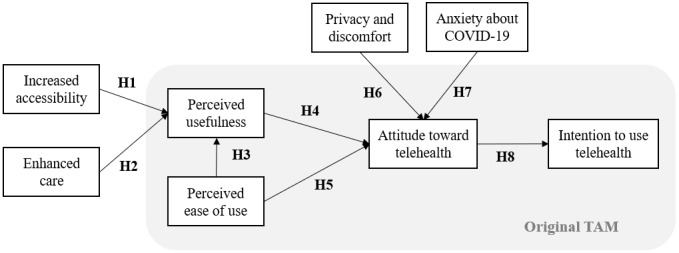
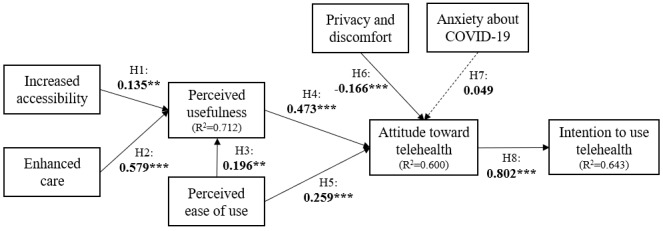
Background: Although telehealth is considered a key component in combating the worldwide crisis caused by COVID-19, the factors that influence its acceptance by the general population after the flattening of the COVID-19 curve remain unclear. Objective: We aimed to identify factors affecting telehealth acceptance, including anxiety related to COVID-19, after the initial rapid spread of the disease in South Korea. Methods: We proposed an extended technology acceptance model (TAM) and performed a cross-sectional survey of individuals aged ≥30 years. In total, 471 usable responses were collected. Confirmatory factor analysis was used to examine the validity of measurements, and the partial least squares (PLS) method was used to investigate factors influencing telehealth acceptance and the impacts of COVID-19. Results: PLS analysis showed that increased accessibility, enhanced care, and ease of telehealth use had positive effects on its perceived usefulness (P=.002, P<.001, and P<.001, respectively). Furthermore, perceived usefulness, ease, and privacy/discomfort significantly impacted the acceptance of telehealth (P<.001, P<.001, and P<.001, respectively). However, anxiety toward COVID-19 was not associated with telehealth acceptance (P=.112), and this insignificant relationship was consistent in the cluster (n=216, 46%) of respondents with chronic diseases (P=.185). Conclusions: Increased accessibility, enhanced care, usefulness, ease of use, and privacy/discomfort are decisive variables affecting telehealth acceptance in the Korean general population, whereas anxiety about COVID-19 is not. This study may lead to a tailored promotion of telehealth after the pandemic subsides.
Overview
The claims and statistics of this paper haven’t been checked yet.
Free: it reads the open-access text and checks the first 5 claims that cite a source we can check. Create a free account to check every claim.
Integrity signals
Registry
Cites
Statistics
Figures
Verification
Claims the paper makes
The claims and statistics of this paper haven’t been checked yet.
Free: it reads the open-access text and checks the first 5 claims that cite a source we can check. Create a free account to check every claim.
Claims other papers make about this one
Each is checked against this paper’s own text: does it say what the citing paper says it does?
The cited source says what the claim attributes to it.
In the citing paper
“However, our findings seem to be in line with those of An and colleagues [47] who showed that anxiety about COVID-19 was not associated with telehealth acceptance among individuals with chronic disease in South Korea.”
Self-check
Percentages, sums and reported differences re-computed from the paper’s own numbers.
The self-check needs the paper’s full text.
Citations
Cites
Evaluating Structural Equation Models with Unobservable Variables and Measurement Error
Fornell, C., & Larcker, D. F. (1981) · Journal of Marketing Research · doi:10.2307/3151312 · Cited by 109,314
Evaluating structural equation models with unobservable variables and measurement error
Fornell, C., & Larcker, D. F. (1981) · Journal of Marketing Research · doi:10.1177/002224378101800104 · Cited by 109,190 · cited 3×
“Table 4 presents the correlation matrix and square root of the AVE, which shows that the Fornell–Larcker criterion was fulfilled.”
MethodHu, L., & Bentler, P. M. (1999) · Structural Equation Modeling A Multidisciplinary Journal · doi:10.1080/10705519909540118 · Cited by 108,788 · cited 1×
“08, and showed an acceptable model fit [47].”
BackgroundPerceived usefulness, perceived ease of use, and user acceptance of information technology
Davis, F. D. (1989) · MIS Quarterly · doi:10.2307/249008 · Cited by 68,483 · cited 6×
“Attitude Toward Telehealth TAM stipulates that perceived usefulness and perceived ease of use are factors associated with people’s attitude toward a system [15].”
BackgroundMethodInfluentialA new criterion for assessing discriminant validity in variance-based structural equation modeling
Henseler, J., Ringle, C. M., & Sarstedt, M. (2015) · Journal of the Academy of Marketing Science · doi:10.1007/s11747-014-0403-8 · Cited by 38,459 · cited 6×
“According to Henseler et al [46], when testing the null hypothesis (H0: HTMT≥1) against the opposite hypothesis (H1: HTMT 1), if a CI contains the value 1, it indicates a lack of discriminant validity.”
BackgroundMethodInfluentialA Theoretical Extension of the Technology Acceptance Model: Four Longitudinal Field Studies
Venkatesh, V., & Davis, F. D. (2000) · Management Science · doi:10.1287/mnsc.46.2.186.11926 · Cited by 23,066 · cited 7×
“Venkatesh and Davis [26] Intention to use (UI)”
BackgroundMethodInfluentialWang, D., Hu, B., Hu, C., Zhu, F., Liu, X., Zhang, J., Wang, B., Xiang, H., Cheng, Z., Xiong, Y., et al. (2020) · JAMA · doi:10.1001/jama.2020.1585 · Cited by 20,148 · cited 1×
“In China where the first COVID-19 outbreak was documented, a significant proportion of cases were due to hospital-related transmission [2].”
BackgroundLa certeza de lo impredecible: Cultura Educación y Sociedad en tiempos de COVID19
Martínez González, M. (2020) · DSPACE System - Metalibrary (University of the Coast) · Cited by 18,463
Wang, C., Pan, R., Wan, X., Tan, Y., Xu, L., Ho, C. S., & Ho, R. C. (2020) · International Journal of Environmental Research and Public Health · doi:10.3390/ijerph17051729 · Cited by 9,923 · cited 1×
“2% worrying about their family members being exposed to COVID-19 [39].”
BackgroundUsing pls path modeling in new technology research: updated guidelines
Henseler, J., Hubona, G., & Ray, P. A. (2016) · Industrial Management & Data Systems · doi:10.1108/imds-09-2015-0382 · Cited by 7,173
Research works printed but not linked: 2
- Chin WW Commentary: Issues and Opinion on Structural Equation Modeling MIS Quarterly 1998 22 1 vii xvi
- Hair Jr JF Hult GTM Ringle C Sarstedt M A Primer on Partial Least Squares Structural Equation Modeling (2nd ed) 2016 Thousand Oaks, CA SAGE Publications
Cited by
Assessing Health Students' Attitudes and Usage of ChatGPT in Jordan: Validation Study
Sallam, M., Salim, N. A., Barakat, M., Al-Mahzoum, K., Al-Tammemi, A. B., Malaeb, D., Hallit, R., & Hallit, S. (2023) · JMIR Medical Education · doi:10.2196/48254 · Cited by 234
“The survey instrument development process involved an extensive literature review and expert validation, followed by item development and pilot testing to ensure clarity [25,26,45-49].”
European Respiratory Society statement on long COVID follow-up
Antoniou, K. M., Vasarmidi, E., Russell, A.-M., Andrejak, C., Crestani, B., Delcroix, M., Dinh-Xuan, A. T., Poletti, V., Sverzellati, N., Vitacca, M., et al. (2022) · European Respiratory Journal · doi:10.1183/13993003.02174-2021 · Cited by 159
“Tele-medicine/ tele-rehabilitation acceptance is related to increased accessibility, enhanced care, usefulness, ease of use and privacy/discomfort, whereas anxiety about COVID-19 is not [125].”
BackgroundZin, K. S. L. T., Kim, S., Kim, H.-S., & Feyissa, I. F. (2023) · Administrative Sciences · doi:10.3390/admsci13020042 · Cited by 103
Hussain, A., Ma, Z., Li, M., Jameel, A., Kanwel, S., Ahmad, S., & Ge, B. (2025) · BMC Nursing · doi:10.1186/s12912-024-02648-8 · Cited by 181
“An, You [75] utilized an extended TAM to investigate healthcare professionals’ acceptance of telemedicine during the COVID-19 pandemic.”
Understanding the Drivers of Ghanaian Citizens' Adoption Intentions of Mobile Health Services
Mensah, I. K. (2022) · Frontiers in Public Health · doi:10.3389/fpubh.2022.906106 · Cited by 56
What Drives People’s Behavioral Intention Toward Telemedicine? An Emerging Economy Perspective
Hossain, M. A., Amin, R., Masud, A. A., Hossain, M. I., Hossen, M. A., & Hossain, M. K. (2023) · SAGE Open · doi:10.1177/21582440231181394 · Cited by 54
“Recent studies have shown that users are more likely to feel extremely satisfied and inspired to continue using an information system if they believe it is useful (Amin et al., 2022; An et al., 2021; Yan et al., 2021).”
BackgroundResultAmin, R., Hossain, M. A., Uddin, M. M., Jony, M. T. I., & Kim, M. (2022) · Healthcare · doi:10.3390/healthcare10071327 · Cited by 56
“Similarly, when the users consider telemedicine successful in improving their health conditions, they are more likely to be satisfied with them [25,42,48].”
BackgroundAlsahli, S., Hor, S.-Y., & Lam, M. K. (2023) · JMIR mhealth and uhealth · doi:10.2196/50419 · Cited by 54
“Thus, the factors influencing technology acceptance and adoption have also likely changed [47], or new factors might have emerged.”
BackgroundHealthcare digital transformation through the adoption of artificial intelligence
Wong, B. K. M., Vengusamy, S., & Bastrygina, T. (2024) · Elsevier eBooks · doi:10.1016/b978-0-443-21598-8.00014-2 · Cited by 50
Role of Agile in Digital Public Health Transformation
Kokol, P., Vošner, H. B., Kokol, M., & Završnik, J. (2022) · Frontiers in Public Health · doi:10.3389/fpubh.2022.899874 · Cited by 45
Pramudita, E., Achmadi, H., & Nurhaida, H. (2023) · Journal of Innovation and Entrepreneurship · doi:10.1186/s13731-023-00336-6 · Cited by 59
“…user satisfaction (Kalinić et al., 2019; Lee et al., 2021), effort expectancy, which is often equated with perceived ease of use (PEU) in the TAM model, has been found to have a significant positive influence on customer satisfaction in telemedicine research (An et al., 2021; Yan et al., 2021).”
BackgroundResultChua, C. M. S., Mathews, J., Ong, M. S. B., Liew, K. K., & Shorey, S. (2023) · Women and Birth · doi:10.1016/j.wombi.2022.06.011 · Cited by 28
González-Sánchez, M., Ramírez-Expósito, M. J., & Martínez-Martos, J. M. (2025) · Life · doi:10.3390/life15040647 · Cited by 54
“The management of specific symptoms, such as dysphagia, dysarthria, cramping, and sleep disturbances, requires an individualized approach and the application of specific strategies, such as airway clearance techniques, noninvasive ventilation, and neuropathic pain management.”
Adoption of video consultations during the COVID-19 pandemic
Pereira, F. V., Tavares, J., & Oliveira, T. (2023) · Internet Interventions · doi:10.1016/j.invent.2023.100602 · Cited by 30
“The original TAM theory states that attitude positively influences intention to use [35], and this effect has also been proven in telemedicine (Kim and Park, 2012; Ahadzadeh et al., 2015; An et al., 2021).”
InfluentialDigital divides in telehealth accessibility for cancer care in the United States
Liu, L., Onega, T., Moen, E. L., Tosteson, A. N. A., Smith, R. E., Wang, Q., Cowan, L., & Wang, F. (2025) · npj Digital Medicine · doi:10.1038/s41746-025-01931-5 · Cited by 29
Online grocery shopping behavior during COVID-19 pandemic: An interdisciplinary explanation
Rout, K., Sahoo, P. R., Bhuyan, A., Tripathy, A., & Smrutirekha (2022) · Cogent Business & Management · doi:10.1080/23311975.2022.2084969 · Cited by 27
“…the premise of the COVID-19 pandemic, prior studies verified the impact of PEOU and PU on the usage intention of various virtual technology like online shopping (Koch et al., 2020), online learning (Sukendro et al., 2020); video conferencing (Pal & Vanijja, 2020) and telemedicine (An et al., 2021).”
BackgroundLiu, L., Alford‐Teaster, J., Onega, T., & Wang, F. (2023) · Cities · doi:10.1016/j.cities.2023.104364 · Cited by 25
Mun, M., Choi, S., & Woo, K. (2024) · BMC Nursing · doi:10.1186/s12912-024-01903-2 · Cited by 36
“Attitude toward telenursing was assessed via six items adapted from the tool utilized in previous research [33] and tailored to nursing students’ characteristics(e.g., “Using telenursing is a good idea for nurses.”
MethodResultInfluentialLu, Y., & Deng, Y. (2022) · Buildings · doi:10.3390/buildings12020104 · Cited by 24
“Scholars in many fields have used TAM to understand the acceptance of emerging technologies, such as virtual reality [25], telehealth [26], and intelligent contracts [27].”
BackgroundJang, M. (2023) · Informatics · doi:10.3390/informatics10040085 · Cited by 30
Li, W., Shen, S., Yang, J., Guo, J., & Tang, Q. (2022) · Frontiers in Public Health · doi:10.3389/fpubh.2022.853489 · Cited by 21
Virtual Care Prior to and During COVID-19: Cross-sectional Survey of Rural and Urban Adults
Rush, K. L., Seaton, C. L., Corman, K., Hawe, N., Li, E. P. H., Dow‐Fleisner, S., Hasan, K., Oelke, N. D., Currie, L. M., & Pesut, B. (2022) · JMIR Formative Research · doi:10.2196/37059 · Cited by 22
“Yet, contrary to this notion, in a survey of South Korean urban virtual care users, fear of COVID-19 exposure was not associated with virtual care acceptance [39].”
ResultGuntu, M., Lin, E.-J. D., Sezgın, E., Gregory, M. E., Huang, Y., & Linwood, S. L. (2022) · Telemedicine Journal and e-Health · doi:10.1089/tmj.2021.0372 · Cited by 22
“25 Although these survey instruments similarly cover dimensions of interpersonal communication, staff respectfulness, technical quality, and telehealth usefulness, our study un-iquely revealed that the patients’ experiences during the virtual AP also significantly influences patients’ satisfaction…”
Garbey, M., Joerger, G., Lesport, Q., Girma, H., McNett, S., Abu-Rub, M., & Kaminski, H. J. (2023) · JMIR Neurotechnology · doi:10.2196/43387 · Cited by 17
Eye Segmentation Method for Telehealth: Application to the Myasthenia Gravis Physical Examination
Lesport, Q., Joerger, G., Kaminski, H. J., Girma, H., McNett, S., Abu-Rub, M., & Garbey, M. (2023) · Sensors · doi:10.3390/s23187744 · Cited by 15
“Among the most widely used algorithms and the one we chose to use was OpenCV’s implementation of the Haar Cascade algorithm [27], based on the detector of R. Lienhart [28], which is a fast method and, overall, the most reliable for real-time detection.”
MethodWang, J., & Cao, Y. (2022) · Open Journal of Social Sciences · doi:10.4236/jss.2022.1012023 · Cited by 21
The Antecedents of Intention to Use Telemedicine
Khotimah, F. K. H., Fahmi, I., & Hartono, S. (2022) · Journal of Consumer Sciences · doi:10.29244/jcs.7.2.97-114 · Cited by 11
Munthali, S., Figge, C. J., Metz, K. L., Kane, J. C., Skavenski, S. V. W., Mwenge, M., Kohrt, B. A., Pedersen, G. A., Sikazwe, I. T., & Murray, L. K. (2022) · Frontiers in Public Health · doi:10.3389/fpubh.2022.906509 · Cited by 13
Suharini, E., Supriyadi, S., Syifauddin, M., Al-Hanif, E. T., Kurniawan, E., & Nugraha, S. B. (2023) · International Journal of Safety and Security Engineering · doi:10.18280/ijsse.130409 · Cited by 10
“[59] regarding the use of Telehealth innovations during the COVID-19 Pandemic.”
BackgroundStatus of Telenursing and Future Use Intentions in Home Health Care in the Post-COVID-19 Era
Park, Y., Heo, H., & Woo, K. (2024) · Home Health Care Management & Practice · doi:10.1177/10848223241228435 · Cited by 10
“The extent to which home care nurses believe that utilizing telenursing will enhance their individual job performance 23 Perceived ease of use The extent to which home care nurses believe that using telenursing will not require them to allocate extra effort 23”
Zhou, L., Li, Y., Yun, Z., Chen, X., Zhang, S., & Hu, X. (2024) · Seminars in Oncology Nursing · doi:10.1016/j.soncn.2024.151710 · Cited by 14
Torp, D. C., Sandbæk, A., & Prætorius, T. (2022) · Journal of Medical Internet Research · doi:10.2196/37223 · Cited by 11
“The COVID-19 pandemic, caused by SARS-CoV-2 infection, has spurred health care systems to rapidly change from delivering in-person care to using different types of web-based care [2-4] such as video consultations [5].”
Vaddhano, N. (2023) · International Journal of Economics Business and Management Research · doi:10.51505/ijebmr.2023.71201 · Cited by 23
“The Technology Acceptance Model has become a leading theory in explaining user adoption of new technologies, such as educational learning technology (Grani and Maranguni, 2019), fintech (Singh et al., 2020; Hu et al., 2019), telemedicine (Kamal et al., 2020; An et al., 2021), and other technologies.”
BackgroundAl-Shroby, W. A., Sohaibani, I. S., AlShlash, N. K., Alsalamah, N. A., & Alhraiwil, N. J. (2024) · Journal of Taibah University Medical Sciences · doi:10.1016/j.jtumed.2024.05.007 · Cited by 11
Driver, V. R., Couch, K. S., Eckert, K. A., Gibbons, G., Henderson, L., Lantis, J. C., Lullove, E. J., Michael, P., Neville, R. F., Ruotsi, L. C., et al. (2021) · Wound Repair and Regeneration · doi:10.1111/wrr.12975 · Cited by 8
“before any remote consultation begins, it is necessary to first confirm the patient's identity and obtain patient (or their caregiver's) consent.(37,67,68,72,74,76) Upon obtaining patient consent, a remote wound”
BackgroundNabelsi, V., & Lévesque-Chouinard, A. (2024) · JMIR Formative Research · doi:10.2196/52921 · Cited by 7
SMS and Telephone Communication as Tools to Reduce Missed Medical Appointments
Brancewicz, M., Robakowska, M., ŚLIWIŃSKI, M., & Rystwej, D. A. (2025) · Applied Sciences · doi:10.3390/app15179773 · Cited by 8
Almojaibel, A. A., Aldhahir, A. M., Aldilaijan, K., Almusally, R. M., AlAtrash, M., Alkhofi, M. A., Alghamdi, S. M., Alqurashi, Y. D., Alsubaiei, M. E., Alharkan, K. S., et al. (2025) · Frontiers in Digital Health · doi:10.3389/fdgth.2025.1659997 · Cited by 8
Chen, B., Yan, C., Wang, B., Zou, J., & Tu, S. (2024) · Heliyon · doi:10.1016/j.heliyon.2024.e26206 · Cited by 20
“Similarly, An MH et al. [30] confirmed that perceived ease of use significantly impacts the acceptance of telemedicine technology among the general population.”
BackgroundThe effect of social media engagement on telemedicine adoption: an empirical study
Dass, J., Yeravdekar, R., & Singh, A. K. (2024) · International Journal of Pharmaceutical and Healthcare Marketing · doi:10.1108/ijphm-08-2023-0072 · Cited by 9
Salsabila, I. M., & Sari, K. A. (2022) · Journal of Indonesian Health Policy and Administration · doi:10.7454/ihpa.v7i3.6090 · Cited by 15
Krisdina, S., Nurhayati, O. D., & Nugraheni, D. M. K. (2022) · E3S Web of Conferences · doi:10.1051/e3sconf/202235905003 · Cited by 18
“E-health and similar systems have been widely evaluated using previous technology acceptance theories [7][8] [17][18].”
BackgroundMethodResultInfluentialThe Use of M-Government and M-Health Applications during the COVID-19 Pandemic in Saudi Arabia
Allam, A. A., AbuAli, A. N., Ghabban, W. H., Alrowwad, A., Fallatah, N. A., Ameerbakhsh, O. Z., Alfadli, I., & Ghabban, F. M. (2022) · Journal of Software Engineering and Applications · doi:10.4236/jsea.2022.1511023 · Cited by 6
Bernardi, R. (2023) · Information & Management · doi:10.1016/j.im.2023.103835 · Cited by 12
Han, K., Yoon, J., & Jun, E. (2022) · Health Insurance Review & Assessment Service Research · doi:10.52937/hira.22.2.1.36 · Cited by 5
Evaluating and Optimizing MySejahtera App Analytics for Sustainable Digital Government Services
Ashar, A. M., Elias, N. F., Jenal, R., Lam, M. C., Appannan, M. R., & Iskandar, S. A. (2025) · IEEE Access · doi:10.1109/access.2025.3561357 · Cited by 9
“An et al. [38] demonstrated the model’s applicability in health contexts by investigating telehealth adoption using an extended TAM framework.”
Beerbaum, J., Robens, S., Fehring, L., Mortsiefer, A., & Meister, S. (2025) · JMIR Formative Research · doi:10.2196/58867 · Cited by 6
Kim, S. J., Lee, Y. E., & Chock, T. M. (2025) · Applied Sciences · doi:10.3390/app15137430 · Cited by 9
Baldemor, R. V. V., Ong, A. K. S., Mejia, E. J. B., Diaz, J. F. T., & Gumasing, M. J. J. (2025) · Computers in Human Behavior Reports · doi:10.1016/j.chbr.2025.100588 · Cited by 10
Vannelli, S., Visintin, F., & Gitto, S. (2025) · Journal of Medical Internet Research · doi:10.2196/60694 · Cited by 10
Türkyılmaz, S. (2023) · European journal of applied sciences · doi:10.14738/aivp.111.14101 · Cited by 6
An application of Nightingale’s environmental theory in telenursing
Heo, D., Foli, K. J., & Hass, Z. (2025) · Nursing Outlook · doi:10.1016/j.outlook.2025.102422 · Cited by 4
Safdar, U., Khan, M. A., Alvi, A. K., Aslam, M. S., & Ahmad, Z. (2025) · British Food Journal · doi:10.1108/bfj-08-2024-0835 · Cited by 10
Who Stays Digital? Patient-Level Predictors of Sustained Telehealth Use
Chandrasekaran, R. (2025) · Telemedicine Journal and e-Health · doi:10.1177/15305627251399715 · Cited by 3
“Despite extensive research on patients ’ initial telehealth acceptance, 21 – 25 factors associated with long-term willingness to continue telehealth use remain inadequately studied, especially among patients with firsthand telemedicine exposure.”
Telehealth during COVID-19: Perspectives on Usability by US Physicians
Dandapani, H. G., Davoodi, N. M., Serina, P. T., Keene, S., & Goldberg, E. M. (2023) · Journal of Brown Hospital Medicine · doi:10.56305/001c.77982 · Cited by 3
Why tele-consult? Role of affordability and accessibility in teleconsultation adoption
Kulkarni, G. R., Aashish, K., & Saurabh, P. (2025) · International Journal of Pharmaceutical and Healthcare Marketing · doi:10.1108/ijphm-08-2024-0083 · Cited by 5
Yeung, N. C. Y., Lau, S. T. Y., Mak, W. W. S., Cheng, C., Chan, E. Y. Y., Siu, J. Y. M., & Cheung, P. S. Y. (2024) · JMIR Cancer · doi:10.2196/51072 · Cited by 2
“However, our findings seem to be in line with those of An and colleagues [47] who showed that anxiety about COVID-19 was not associated with telehealth acceptance among individuals with chronic disease in South Korea.”
ResultHinkle, J. F., Bove, L. A., Roberto, A., Arms, T. E., Rowan, N. L., & Sigmon, L. B. (2023) · SAGE Open Nursing · doi:10.1177/23779608231187273 · Cited by 2
“An et al. (2021) analyzed the acceptance of telehealth while factoring in COVID concerns and found that perceived ease of use, usefulness, and accessibility, increased acceptance, while fear of COVID was not a significant variable.”
BackgroundHernandez, A. A., Adriano, M. C. D., Peralta, C. A. U., & Dupaya, J. P. R. E. (2024) · IEEE Control and System Graduate Research Colloquium (ICSGRC) · doi:10.1109/icsgrc62081.2024.10691269 · Cited by 3
“Several studies found that privacy predicts intention, mobile apps usage continuance, and SMATS [20, 21].”
BackgroundMalik, T., Ong, S. C., & Butt, M. D. (2025) · BMC Health Services Research · doi:10.1186/s12913-025-13820-4 · Cited by 9
“A key strength of the study lies in its exploration of patient comfort and technology use as predictors of tele-health acceptance [27].”
Heriana, C., & Said, F. B. M. (2023) · AIP conference proceedings · doi:10.1063/5.0164143 · Cited by 2
Jain, S. N., Choi, J. Y., Cooper, B., Renwick, B., Mohamed, M. M., & Makris, S. A. (2024) · Annals of Vascular Surgery · doi:10.1016/j.avsg.2023.11.035 · Cited by 2
Chinese physicians’ perceptions and willingness to use telemedicine during the COVID-19 pandemic
Hai, X., Zhang, J., Zhang, Y., & Pan, J. (2024) · Humanities and Social Sciences Communications · doi:10.1057/s41599-024-03816-6 · Cited by 3
“As a result, EE played a crucial role in facilitating physicians ’ adoption of telemedicine, which had the potential to signi fi cantly enhance the quality of healthcare services (Kohnke et al. 2014; Molfenter et al. 2021; An et al. 2021).”
Priyansyah, R. N., Fuady, I., & Pratamawaty, B. B. (2023) · Human Technology · doi:10.14254/1795-6889.2023.19-2.7 · Cited by 3
“In telehealth, attitude is defined as positive or negative feelings toward telehealth service usage (An et al., 2021).”
BackgroundResultInfluentialTorp, D. C., Sandbæk, A., & Prætorius, T. (2022) · doi:10.2196/preprints.37223 · Cited by 2
Factors influencing the use of TikTok for travel-related decision-making among young adults
Mabaso, N. S., Mpotaringa, M., & Tichaawa, T. (2026) · African Journal of Hospitality, Tourism and Leisure · doi:10.46222/ajhtl.19770720.735 · Cited by 1
Experience With and Awareness of Telemedicine Among Korean Outpatients During the COVID-19 Pandemic
Kim, S. H., Kang, S. Y., Sunwoo, S., Choi, W.-S., Kim, C., Park, Y.-K., Jung, S.-P., & Kim, Y. S. (2022) · Telemedicine Journal and e-Health · doi:10.1089/tmj.2021.0492 · Cited by 1
“18 Consistent with the results, most participants responded that establishing a system for telemedicine as well as enhanced care effectiveness and communication are required in the future.”
Heriana, C. (2023) · Medical Technology and Public Health Journal · doi:10.33086/mtphj.v7i1.4097 · Cited by 1
Telerobotic Intergroup Contact: Acceptance and Preferences in Israel and Palestine
Peled, A., Leinonen, T., & Hasler, B. S. (2024) · Behavioral Sciences · doi:10.3390/bs14090854 · Cited by 1
“For Israeli Jews, a study found positive attitudes toward robots [32]; the Technology Acceptance Model (TAM) predicts higher acceptance due to increased accessibility and previous exposure to novel technologies [33–35].”
BackgroundShin, H., Kim, K., Lee, H., & Lee, J. (2025) · BMC Health Services Research · doi:10.1186/s12913-025-13518-7 · Cited by 2
PERAN PERSEPSI KEMUDAHAN DAN KEGUNAAN DALAM MEMPENGARUHI PENERIMAAN TELEHEALTH OLEH PASIEN COVID-19
Pratondo, K., Zaid, Z., & Shinta, A. (2022) · Jurnal Endurance · doi:10.22216/jen.v7i1.844 · Cited by 2
Rush, K. L., Seaton, C. L., Corman, K., Hawe, N., Li, E., Dow‐Fleisner, S., Hasan, K., Oelke, N. D., Currie, L. M., & Pesut, B. (2022) · doi:10.2196/preprints.37059 · Cited by 1
Xie, X., Shi, L., & Bai, Q. (2021) · doi:10.2196/preprints.33757
Penilaian Publik terhadap Aplikasi Peduli Lindungi (Analisis Komparasi terhadap Aspek Demografi)
Priyansyah, R. N., & Fuady, I. (2023) · JURNAL IPTEKKOM Jurnal Ilmu Pengetahuan & Teknologi Informasi · doi:10.17933/iptekkom.25.1.2023.151-170
“Hasil ini mirip dengan penelitian lain tentang telehealth yang menemukan tingkat kecemasan privasi yang rendah (An et al. 2021, 8).”
BackgroundInfluentialIncreasing telemedicine adoption in Indonesia using extended UTAUT2 model
Salsabila, S., & Dachyar, M. (2024) · AIP conference proceedings · doi:10.1063/5.0218883
Halim, E., Natalia, S., Khosasi, T., Gui, A., Kartawiguna, D., & Poba‐Nzaou, P. (2024) · Research, Invention, and Innovation Congress: Innovative Electricals and Electronics (RI2C) · doi:10.1109/ri2c64012.2024.10784371
“Having already attempted numerous conventional options without success, they may be more willing to consider alternative solutions, especially if they originate from sources they regard as trustworthy [13].”
Acceptance of Virtual Reality Training for Chemotherapy Administration Among Nursing Students
Chang, C.-L., Tsai, S., Lu, C., Chan, C.-J., Huang, T., & Gautama, M. S. N. (2025) · CIN Computers Informatics Nursing · doi:10.1097/cin.0000000000001246 · Cited by 2
Integration of blockchain technology into telehealth framework
Anik, F. I., Sakib, N., & Ahamed, S. I. (2025) · Elsevier eBooks · doi:10.1016/b978-0-443-34174-8.00006-5 · Cited by 1
Utilizing Digital Information for Personalized Cholesterol Management
Halim, E., Steven, Putri, A. N. S., Halim, D. D., & Syamsuar, D. (2024) · International Conference on Informatics and Computing (ICIC) · doi:10.1109/icic64337.2024.10956936
“[6] The information about keeping cholesterol in check helped me improve my health care (PU2) Utilizing information from social media is useful for me to better monitor my cholesterol levels (PU3) Information on cholesterol from social media allows me to access treatment services more quickly(PU4)…”
InfluentialFactors Associated With Minorities’ Use of Telehealth During COVID-19
Miller, E., Harris, A., Abu-Alhaija, D. M., Okour, A., & Bakas, T. (2025) · Western Journal of Nursing Research · doi:10.1177/01939459251386264
Fitriani, W. R., Yansim, I., Ondiraja, N. H., Pehry, R. F., Harahap, N. C., & Hidayanto, A. N. (2025) · Telematics and Informatics Reports · doi:10.1016/j.teler.2025.100276 · Cited by 2
Determinants of Gig Economy Platform Adoption Among Healthcare Professionals
Frogeri, R. F., Hungaro, A. A., Pancote, A., Ortega, W., & Piurcosky, F. P. (2025) · IGI Global eBooks · doi:10.4018/979-8-3373-6082-9.ch007 · Cited by 1
Metadata
- Authors
- An, M. H., You, S. C., Park, R. W., & Lee, S.
- Affiliations
- Ajou University (KR)
- Corresponding author
- Lee, Seongwon
- Venue
- JMIR Medical Informatics
- Publisher
- JMIR Publications Inc.
- Published
- 2021-01-08
- Volume
- 9
- Issue
- 1
- Pages
- e25435
- ISSN
- 2291-9694 (ISSN-L)
- PMC
- PMC7801132
- OpenAlex
- W3118509192
- Cited by
- 84
- References
- 65
- Citations by year
- 2026: 1 · 2025: 21 · 2024: 18 · 2023: 20 · 2022: 22 · 2021: 2
- FWCI
- 13.43
- Type
- journal article
- Language
- en
- Open access
- gold
- doi.org
- Licence
- cc-by
- Locations
- JMIR Medical Informatics (publishedVersion, cc-by)
- PubMed Central (publishedVersion, cc-by)
- PubMed (publishedVersion)
- AJOU Open Repository (Ajou University) (submittedVersion)
- DOAJ (DOAJ: Directory of Open Access Journals) (submittedVersion, cc-by-sa)
- Funders
- National Research Foundation
- Korea Health Industry Development Institute (HI16C0992)
- National Research Foundation of Korea (NRF-2020R1I1A1A01072208, HI16C0992)
- Topics
- Health Sciences › Medicine › Public Health, Environmental and Occupational Health › Telemedicine and Telehealth Implementation
- Social Sciences › Decision Sciences › Information Systems and Management › Technology Adoption and User Behaviour
- Health Sciences › Medicine › Geriatrics and Gerontology › Technology Use by Older Adults
- Keywords
- telehealth acceptance, extended technology acceptance model, COVID-19 pandemic, perceived usefulness, perceived ease of use, privacy concerns, telehealth utilization, COVID-19 anxiety, chronic disease, South Korea
About these checks
Registry, retraction, Cites and statistics results are computed, not judged, with one exception: a printed reference that no index lists is read once by a model before it counts as a citation error. Claims are extracted by a model and kept only when their quote appears verbatim in the text; each cited source is then checked, with a model’s help, for whether it says what the claim relies on. Those verdicts can be wrong — read the claim’s quote and the cited source before relying on one.
Statistics and arithmetic are recomputed, not judged.
Confidence bands are shown only for fields calibrated on our annotated test set. None is calibrated yet, so no band is shown.
What counts as a claim ›How we measure confidence ›How we check this ›
Are you an author, or do you see a problem with this page? Request a review
Data sources
Bibliographic data: Semantic Scholar, OpenAlex, Crossref.
Contains information from the Semantic Scholar Academic Graph Datasets, made available under the ODC Attribution License (ODC-BY 1.0).
Semantic Scholar’s data is described in: Kinney, R., et al. (2023). The Semantic Scholar Open Data Platform. arXiv:2301.10140.
