

Using an Extended Technology Acceptance Model to Understand the Factors Influencing Telehealth Utilization After Flattening the COVID-19 Curve in South Korea: Cross-sectional Survey Study
Open accessPublished version of a preprint
The DOI matches its Crossref record; 67 of the 67 references it cites were found in a registry or an index.
Abstract
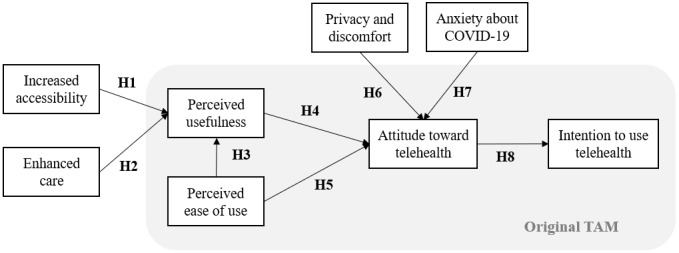
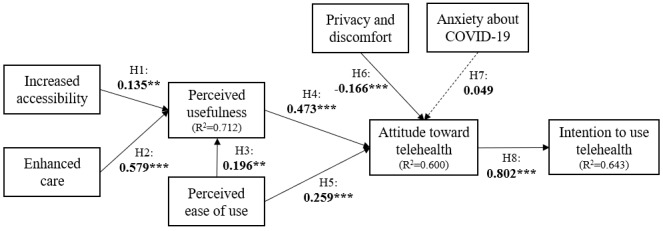
Background: Although telehealth is considered a key component in combating the worldwide crisis caused by COVID-19, the factors that influence its acceptance by the general population after the flattening of the COVID-19 curve remain unclear. Objective: We aimed to identify factors affecting telehealth acceptance, including anxiety related to COVID-19, after the initial rapid spread of the disease in South Korea. Methods: We proposed an extended technology acceptance model (TAM) and performed a cross-sectional survey of individuals aged ≥30 years. In total, 471 usable responses were collected. Confirmatory factor analysis was used to examine the validity of measurements, and the partial least squares (PLS) method was used to investigate factors influencing telehealth acceptance and the impacts of COVID-19. Results: PLS analysis showed that increased accessibility, enhanced care, and ease of telehealth use had positive effects on its perceived usefulness (P=.002, P<.001, and P<.001, respectively). Furthermore, perceived usefulness, ease, and privacy/discomfort significantly impacted the acceptance of telehealth (P<.001, P<.001, and P<.001, respectively). However, anxiety toward COVID-19 was not associated with telehealth acceptance (P=.112), and this insignificant relationship was consistent in the cluster (n=216, 46%) of respondents with chronic diseases (P=.185). Conclusions: Increased accessibility, enhanced care, usefulness, ease of use, and privacy/discomfort are decisive variables affecting telehealth acceptance in the Korean general population, whereas anxiety about COVID-19 is not. This study may lead to a tailored promotion of telehealth after the pandemic subsides.
Overview
The claims and statistics of this paper haven’t been checked yet.
Free: it reads the open-access text and checks the first 5 claims that cite a source we can check. Create a free account to check every claim.
Integrity signals
Registry
Cites
Statistics
Figures
Verification
Claims the paper makes
The claims and statistics of this paper haven’t been checked yet.
Free: it reads the open-access text and checks the first 5 claims that cite a source we can check. Create a free account to check every claim.
Claims other papers make about this one
Each is checked against this paper’s own text: does it say what the citing paper says it does?
The cited source says what the claim attributes to it.
In the citing paper
“However, our findings seem to be in line with those of An and colleagues [47] who showed that anxiety about COVID-19 was not associated with telehealth acceptance among individuals with chronic disease in South Korea.”
Self-check
Percentages, sums and reported differences re-computed from the paper’s own numbers.
The self-check needs the paper’s full text.
Citations
Cites
Evaluating Structural Equation Models with Unobservable Variables and Measurement Error
Fornell, C., & Larcker, D. F. (1981) · Journal of Marketing Research · doi:10.2307/3151312 · Cited by 109,314
Evaluating structural equation models with unobservable variables and measurement error
Fornell, C., & Larcker, D. F. (1981) · Journal of Marketing Research · doi:10.1177/002224378101800104 · Cited by 109,190 · cited 3×
“Table 4 presents the correlation matrix and square root of the AVE, which shows that the Fornell–Larcker criterion was fulfilled.”
MethodHu, L., & Bentler, P. M. (1999) · Structural Equation Modeling A Multidisciplinary Journal · doi:10.1080/10705519909540118 · Cited by 108,788 · cited 1×
“08, and showed an acceptable model fit [47].”
BackgroundPerceived usefulness, perceived ease of use, and user acceptance of information technology
Davis, F. D. (1989) · MIS Quarterly · doi:10.2307/249008 · Cited by 68,483 · cited 6×
“Attitude Toward Telehealth TAM stipulates that perceived usefulness and perceived ease of use are factors associated with people’s attitude toward a system [15].”
BackgroundMethodInfluentialA new criterion for assessing discriminant validity in variance-based structural equation modeling
Henseler, J., Ringle, C. M., & Sarstedt, M. (2015) · Journal of the Academy of Marketing Science · doi:10.1007/s11747-014-0403-8 · Cited by 38,459 · cited 6×
“According to Henseler et al [46], when testing the null hypothesis (H0: HTMT≥1) against the opposite hypothesis (H1: HTMT 1), if a CI contains the value 1, it indicates a lack of discriminant validity.”
BackgroundMethodInfluentialA Theoretical Extension of the Technology Acceptance Model: Four Longitudinal Field Studies
Venkatesh, V., & Davis, F. D. (2000) · Management Science · doi:10.1287/mnsc.46.2.186.11926 · Cited by 23,066 · cited 7×
“Venkatesh and Davis [26] Intention to use (UI)”
BackgroundMethodInfluentialWang, D., Hu, B., Hu, C., Zhu, F., Liu, X., Zhang, J., Wang, B., Xiang, H., Cheng, Z., Xiong, Y., et al. (2020) · JAMA · doi:10.1001/jama.2020.1585 · Cited by 20,148 · cited 1×
“In China where the first COVID-19 outbreak was documented, a significant proportion of cases were due to hospital-related transmission [2].”
BackgroundLa certeza de lo impredecible: Cultura Educación y Sociedad en tiempos de COVID19
Martínez González, M. (2020) · DSPACE System - Metalibrary (University of the Coast) · Cited by 18,463
Wang, C., Pan, R., Wan, X., Tan, Y., Xu, L., Ho, C. S., & Ho, R. C. (2020) · International Journal of Environmental Research and Public Health · doi:10.3390/ijerph17051729 · Cited by 9,923 · cited 1×
“2% worrying about their family members being exposed to COVID-19 [39].”
BackgroundUsing pls path modeling in new technology research: updated guidelines
Henseler, J., Hubona, G., & Ray, P. A. (2016) · Industrial Management & Data Systems · doi:10.1108/imds-09-2015-0382 · Cited by 7,173
Structural Equation Modeling and Regression: Guidelines for Research Practice
Gefen, D., Straub, D., & Boudreau, M.-C. (2000) · Communications of the Association for Information Systems · doi:10.17705/1cais.00407 · Cited by 6,416
Hair, J. F., Ringle, C. M., & Sarstedt, M. (2013) · Long Range Planning · doi:10.1016/j.lrp.2013.01.001 · Cited by 5,310 · cited 1×
“50, and the convergent validity of the measurement items was validated [45].”
BackgroundThe Technology Acceptance Model: Its past and its future in health care
Holden, R. J., & Karsh, B.-T. (2010) · Journal of Biomedical Informatics · doi:10.1016/j.jbi.2009.07.002 · Cited by 2,669 · cited 1×
“Many studies have demonstrated that when people perceive a technology as useful, the likelihood of accepting it increases [29,30].”
BackgroundRanney, M. L., Griffeth, V., & Jha, A. K. (2020) · New England Journal of Medicine · doi:10.1056/nejmp2006141 · Cited by 2,018 · cited 1×
“Due to the highly contagious nature of this novel virus and shortages in personal protective equipment, health care centers have become high-risk transmission areas, and health care workers are at high risk for contracting COVID-19 [1].”
BackgroundRoy, D., Tripathy, S., Kar, S. K., Sharma, N., Verma, S. K., & Kaushal, V. (2020) · Asian Journal of Psychiatry · doi:10.1016/j.ajp.2020.102083 · Cited by 1,759 · cited 3×
“Anxiety about COVID-19 was measured using items published by Roy et al [40].”
MethodCOVID-19 transforms health care through telemedicine: Evidence from the field
Mann, D. M., Chen, J., Chunara, R., Testa, P. A., & Nov, O. (2020) · Journal of the American Medical Informatics Association · doi:10.1093/jamia/ocaa072 · Cited by 1,361 · cited 1×
“Although there is little doubt about the considerable benefit of telehealth in terms of managing the crisis caused by COVID-19 [12], the long-term prospect of telehealth remains largely unclear.”
BackgroundBarak, A., Hen, L., Boniel-Nissim, M., & Shapira, N. (2008) · Journal of Technology in Human Services · doi:10.1080/15228830802094429 · Cited by 1,283 · cited 1×
“Telehealth was also found to be effective in certain fields, including psychological interventions [22] and home monitoring of respiratory conditions [23], and for chronic diseases including diabetes, heart disease, and chronic obstructive pulmonary diseases [24,25].”
BackgroundHartnett, K. P., Kite-Powell, A., DeVies, J., Coletta, M. A., Boehmer, T. K., Adjemian, J., Gundlapalli, A. V., & Practice, N. S. S. P. C. O. (2020) · MMWR Morbidity and Mortality Weekly Report · doi:10.15585/mmwr.mm6923e1 · Cited by 1,139
What does 'access to health care' mean?
Gulliford, M., Figueroa-Munoz, J., Morgan, M., Hughes, D., Gibson, B., Beech, R., & Hudson, M. (2002) · Journal of Health Services Research & Policy · doi:10.1258/135581902760082517 · Cited by 1,130 · cited 1×
“Facilitating access to health care increases the opportunity to obtain appropriate care services in situations where it is needed, and enhances the utilization of such services in terms of service availability and relevance, as well as physical and financial accessibility [18].”
BackgroundTuckson, R. V., Edmunds, M., & Hodgkins, M. L. (2017) · New England Journal of Medicine · doi:10.1056/nejmsr1503323 · Cited by 907
Chang, M. K. (1998) · Journal of Business Ethics · doi:10.1023/a:1005721401993 · Cited by 852 · cited 1×
“According to the theory of reasoned action, people’s beliefs such as perceived usefulness and perceived ease of use shapes an attitude, which, in turn, influences a behavior [28].”
BackgroundPatient Self-Management: A Key to Effectiveness and Efficiency in Care of Chronic Disease
Holman, H., & Lorig, K. (2004) · Public Health Reports® · doi:10.1016/j.phr.2004.04.002 · Cited by 585 · cited 1×
“It contradicted with previous findings, which demonstrated that one of the key elements of telehealth for patients with chronic diseases is increased accessibility [20,61].”
ResultStress and coping in the time of COVID-19: Pathways to resilience and recovery
Polizzi, C., Lynn, S. J., & Perry, A. (2020) · PubMed Central · doi:10.36131/cn20200204 · Cited by 520 · cited 1×
“People have been subjected to a number of public policies such as regional lockdowns, quarantine at home, physical distancing, and restricted travel [35,36].”
BackgroundGostin, L. O., & Wiley, L. F. (2020) · JAMA · doi:10.1001/jama.2020.5460 · Cited by 504
Kim, J. Y., Choe, P. G., Oh, Y., Oh, K. J., Kim, J., Park, S. J., Park, J. H., Na, H. K., & Oh, M.-D. (2020) · Journal of Korean Medical Science · doi:10.3346/jkms.2020.35.e61 · Cited by 404 · cited 1×
“The first patient with a confirmed COVID-19 diagnosis entered the country on January 19, 2020 [6].”
BackgroundPatient and clinician experiences with telehealth for patient follow-up care.
Donelan, K., Barreto, E. A., Sossong, S., Michael, C., Estrada, J., Cohen, A. B., Wozniak, J. R., & Schwamm, L. H. (2019) · PubMed · Cited by 403
A MODEL FOR ASSESSMENT OF TELEMEDICINE APPLICATIONS: MAST
Kidholm, K., Ekeland, A. G., Jensen, L. K., Rasmussen, J., Pedersen, C. D., Bowes, A., Flottorp, S. A., & Bech, M. (2012) · International Journal of Technology Assessment in Health Care · doi:10.1017/s0266462311000638 · Cited by 383 · cited 2×
“Kidholm et al [10] defined telehealth as “the delivery of health care services through the use of information and communication technologies in a situation where the actors are at different locations.””
BackgroundImplications for Telehealth in a Postpandemic Future: Regulatory and Privacy Issues
Shachar, C., Engel, J., & Elwyn, G. (2020) · JAMA · doi:10.1001/jama.2020.7943 · Cited by 358
Or, C. K. L., Karsh, B.-T., Severtson, D. J., Burke, L. J., Brown, R. L., & Brennan, P. F. (2011) · Journal of the American Medical Informatics Association · doi:10.1136/jamia.2010.007336 · Cited by 309 · cited 2×
“According to TAM, the intention to use a technology is influenced by one’s attitude toward it [16]; this intention predicts the actual usage behavior [31].”
BackgroundFor Telehealth To Succeed, Privacy And Security Risks Must Be Identified And Addressed
Hall, J. L., & McGraw, D. (2014) · Health Affairs · doi:10.1377/hlthaff.2013.0997 · Cited by 297 · cited 1×
“Generally, telehealth involves the digital collection, use, disclosure, and communication of health information over a network between health care providers and patients [32].”
BackgroundAdmissions to Veterans Affairs Hospitals for Emergency Conditions During the COVID-19 Pandemic
Baum, A., & Schwartz, M. D. (2020) · JAMA · doi:10.1001/jama.2020.9972 · Cited by 297 · cited 1×
“dramatically decreased during the initial phase of the pandemic [3,4].”
BackgroundFear from COVID-19 and technology adoption: the impact of Google Meet during Coronavirus pandemic
Al-Maroof, R. S., Salloum, S. A., Hassanien, A. E., & Shaalan, K. (2023) · Interactive Learning Environments · doi:10.1080/10494820.2020.1830121 · Cited by 279
Opportunities and challenges for telehealth within, and beyond, a pandemic
Blandford, A., Wesson, J., Amalberti, R., AlHazme, R., & Allwihan, R. (2020) · The Lancet Global Health · doi:10.1016/s2214-109x(20)30362-4 · Cited by 268 · cited 1×
“Moreover, an approachable user interface should be developed to encourage patients with digital literacy to accept telehealth [67].”
BackgroundPredictive factors of telemedicine service acceptance and behavioral intention of physicians
Rho, M. J., Choi, I. Y., & Lee, J. (2014) · International Journal of Medical Informatics · doi:10.1016/j.ijmedinf.2014.05.005 · Cited by 260
Tsai, J.-M., Cheng, M.-J., Tsai, H.-H., Hung, S.-W., & Chen, Y.-L. (2019) · International Journal of Information Management · doi:10.1016/j.ijinfomgt.2019.03.003 · Cited by 257
An analysis on the panic during COVID-19 pandemic through an online form
Nicomedes, C. J. C., & Avila, R. M. A. (2020) · Journal of Affective Disorders · doi:10.1016/j.jad.2020.06.046 · Cited by 244 · cited 1×
“A recent study investigating panic during the COVID-19 pandemic in the Philippines using the Health Anxiety Inventory reported that levels of avoidance behavior and symptoms of hypochondriasis differed between residents inside and outside Metro Manila [38]; this implies that anxieties about contracting COVID-19 may al…”
BackgroundEvaluating Effect, Composite, and Causal Indicators in Structural Equation Models1
Bollen, K. A. (2011) · MIS Quarterly · doi:10.2307/23044047 · Cited by 239
What Predicts Patients’ Adoption Intention Toward mHealth Services in China: Empirical Study
Deng, Z., Hong, Z., Ren, C., Zhang, W., & Xiang, F. (2018) · JMIR mHealth and uHealth · doi:10.2196/mhealth.9316 · Cited by 211
Gagnon, M.-P., Duplantie, J., Fortin, J.-P., & Landry, R. (2006) · Implementation Science · doi:10.1186/1748-5908-1-18 · Cited by 208 · cited 1×
“Individual, organizational, social, and legal factors such as policy, social norms, and trust in telehealth should be considered for the successful implementation of the telehealth system [70].”
BackgroundPolisena, J., Coyle, D., Coyle, K., & McGill, S. (2009) · International Journal of Technology Assessment in Health Care · doi:10.1017/s0266462309990201 · Cited by 184 · cited 1×
“Telehealth was also found to be effective in certain fields, including psychological interventions [22] and home monitoring of respiratory conditions [23], and for chronic diseases including diabetes, heart disease, and chronic obstructive pulmonary diseases [24,25].”
BackgroundKohnke, A., Cole, M. L., & Bush, R. (2014) · Journal of technology management & innovation · doi:10.4067/s0718-27242014000200003 · Cited by 181 · cited 1×
“The attitude toward telehealth is defined by positive or negative feelings related to using a telehealth service [27].”
BackgroundFactors influencing behavior intentions to telehealth by Chinese elderly: An extended TAM model
Zhou, M., Zhao, L., Kong, N., Campy, K. S., Qu, S., & Wang, S. (2019) · International Journal of Medical Informatics · doi:10.1016/j.ijmedinf.2019.04.001 · Cited by 180 · cited 6×
“Health information is highly confidential, so people may experience concerns about privacy intrusions and loss of control over information [19,33,34].”
BackgroundInfluentialTelemedicine effects: Cost, quality, and access
Bashshur, R. L. (1995) · Journal of Medical Systems · doi:10.1007/bf02257059 · Cited by 168 · cited 1×
“The enhanced accessibility of telehealth geographically, economically, and socially are benefits of telehealth [17,52].”
BackgroundHome telemonitoring for respiratory conditions: a systematic review.
Jaana, M., Paré, G., & Sicotte, C. (2009) · PubMed · Cited by 158
Ackerman, M. J., Filart, R., Burgess, L. P., Lee, I., & Poropatich, R. K. (2010) · Telemedicine and e-Health · doi:10.1089/tmj.2009.0153 · Cited by 144 · cited 1×
“Telehealth-related technologies such as data integration with electronic medical records, data connection from multiple sources [65], and biophysiological data measuring/monitoring tools should be improved [66].”
BackgroundAntypas, K., & Wangberg, S. C. (2014) · Journal of Medical Internet Research · doi:10.2196/jmir.3132 · Cited by 136
Security Concerns in Android mHealth Apps.
He, D., Naveed, M., Gunter, C. A., & Nahrstedt, K. (2014) · PubMed · Cited by 135
Hirani, S. P., Rixon, L., Beynon, M., Cartwright, M., Cleanthous, S., Selva, A., Sanders, C., & Newman, S. P. (2017) · Journal of Telemedicine and Telecare · doi:10.1177/1357633x16649531 · Cited by 134 · cited 10×
“Accessibility is the belief pertaining to how a health care system has facilitated the receipt of care from health care providers [17].”
BackgroundMethodInfluentialFactors influencing the acceptance of telemedicine for diabetes management
Rho, M. J., Kim, H. S., Chung, K., & Choi, I. Y. (2015) · Cluster Computing · doi:10.1007/s10586-014-0356-1 · Cited by 133 · cited 3×
“Rho et al [11] stated that telehealth is “the interchange of health information using telecommunications technology by geographically disconnected providers and patients with the intention to evaluate, diagnose, treat, or educate the patient.””
BackgroundMethodInfluentialUnmet healthcare needs of elderly people in Korea
Kim, Y., Lee, J., Moon, Y., Kim, K. J., Lee, K.-S., Choi, J., & Han, S. (2018) · BMC Geriatrics · doi:10.1186/s12877-018-0786-3 · Cited by 131 · cited 2×
“Kim et al [62] surveyed unmet health care needs such as economic hardship, scheduling conflict, and long waiting times among the Korean elderly, and 17.4% (economic accessibility, 9.2%; service acceptability, 6.5%; and scheduling conflict, 1.7”
BackgroundInfluentialChang, M. K. (2012) · Springer eBooks · doi:10.1007/978-94-007-4126-3_21 · Cited by 128
Are People With Chronic Diseases Interested in Using Telehealth? A Cross-Sectional Postal Survey
Edwards, L., Thomas, C., Gregory, A., Yardley, L., O'Cathain, A., Montgomery, A. A., & Salisbury, C. (2014) · Journal of Medical Internet Research · doi:10.2196/jmir.3257 · Cited by 116 · cited 2×
“It contradicted with previous findings, which demonstrated that one of the key elements of telehealth for patients with chronic diseases is increased accessibility [20,61].”
BackgroundResultMohktar, M. S., Redmond, S. J., Antoniades, N. C., Rochford, P. D., Pretto, J. J., Basilakis, J., Lovell, N. H., & McDonald, C. F. (2014) · Artificial Intelligence in Medicine · doi:10.1016/j.artmed.2014.12.003 · Cited by 116 · cited 1×
“A better health care service could involve preemptive treatment before the deterioration of health [63], and consultation with general physicians after normal clinic hours [64] could be considered.”
BackgroundGokalp, H., & Clarke, M. (2013) · Telemedicine and e-Health · doi:10.1089/tmj.2013.0109 · Cited by 110 · cited 1×
“Telehealth-related technologies such as data integration with electronic medical records, data connection from multiple sources [65], and biophysiological data measuring/monitoring tools should be improved [66].”
BackgroundPatient acceptance of a telemedicine service for rehabilitation care: A focus group study
Jansen-Kosterink, S. M., Weering, M. D.-V., & van Velsen, L. (2019) · International Journal of Medical Informatics · doi:10.1016/j.ijmedinf.2019.01.011 · Cited by 99 · cited 4×
“Access to health care is the interplay between the characteristics of persons, and social and physical environments, and the characteristics of health systems, institutions, and providers, and it plays a central role in the performance of a health care system [16].”
BackgroundInfluentialPrivacy and Security Concerns in Telehealth
Hale, T. M., & Kvedar, J. C. (2014) · The AMA Journal of Ethic · doi:10.1001/virtualmentor.2014.16.12.jdsc1-1412 · Cited by 88
Fineberg, H. V. (2020) · New England Journal of Medicine · doi:10.1056/nejme2007263 · Cited by 86
How Is COVID-19 Affecting South Korea? What Is Our Current Strategy?
Her, M. (2020) · Disaster Medicine and Public Health Preparedness · doi:10.1017/dmp.2020.69 · Cited by 85
The future of telemedicine visits after COVID-19: perceptions of primary care pediatricians
Grossman, Z., Chodick, G., Reingold, S. M., Chapnick, G., & Ashkenazi, S. (2020) · Israel Journal of Health Policy Research · doi:10.1186/s13584-020-00414-0 · Cited by 84 · cited 2×
“Some argue that telehealth may be abandoned after the COVID-19 curve is flattened [13,14].”
BackgroundNomura, A., Tanigawa, T., Muto, T., Oga, T., Fukushima, Y., Kiyosue, A., Miyazaki, M., Hida, E., & Satake, K. (2019) · Journal of Medical Internet Research · doi:10.2196/13520 · Cited by 71 · cited 1×
“Along with increased accessibility, enhanced care also has significant effects on the usefulness of telehealth, which is consistent with the results of previous studies [53,54].”
ResultEsmatjes, E., Jansà, M., Roca, D., Pérez-Ferre, N., del Valle, L., Martínez-Hervás, S., Ruiz de Adana, M., Linares, F., Batanero, R., Vázquez, F., et al. (2014) · Diabetes Technology & Therapeutics · doi:10.1089/dia.2013.0313 · Cited by 64
Consumer health informatics: Health information technology for consumers
Jimison, H. B., & Sher, P. P. (1995) · Journal of the American Society for Information Science · doi:10.1002/(sici)1097-4571(199512)46:10<729::aid-asi3>3.0.co;2-2 · Cited by 33
Consumer health informatics: Health information technology for consumers
Jimison, H. B., & Sher, P. P. (1995) · Journal of the American Society for Information Science · doi:10.1002/(sici)1097-4571(199512)46:10<783::aid-asi11>3.0.co;2-l · Cited by 33
Telehealth: Simply a pandemic response or here to stay?
Henry, S. B. (2020) · Journal of the American Medical Informatics Association · doi:10.1093/jamia/ocaa132 · Cited by 22
Watzlaf, V. J. M., DeAlmeida, D. R., Zhou, L., & Hartman, L. M. (2015) · International Journal of Telerehabilitation · doi:10.5195/ijt.2015.6186 · Cited by 19
Lessons from Temporary Telemedicine Initiated owing to Outbreak of COVID-19
Kim, H. (2020) · Healthcare Informatics Research · doi:10.4258/hir.2020.26.2.159 · Cited by 19
Impact of COVID-19 on Telehealth.
(2020) · PubMed Central · Cited by 3
Research works printed but not linked: 2
- Chin WW Commentary: Issues and Opinion on Structural Equation Modeling MIS Quarterly 1998 22 1 vii xvi
- Hair Jr JF Hult GTM Ringle C Sarstedt M A Primer on Partial Least Squares Structural Equation Modeling (2nd ed) 2016 Thousand Oaks, CA SAGE Publications
Cited by
Assessing Health Students' Attitudes and Usage of ChatGPT in Jordan: Validation Study
Sallam, M., Salim, N. A., Barakat, M., Al-Mahzoum, K., Al-Tammemi, A. B., Malaeb, D., Hallit, R., & Hallit, S. (2023) · JMIR Medical Education · doi:10.2196/48254 · Cited by 234
“The survey instrument development process involved an extensive literature review and expert validation, followed by item development and pilot testing to ensure clarity [25,26,45-49].”
European Respiratory Society statement on long COVID follow-up
Antoniou, K. M., Vasarmidi, E., Russell, A.-M., Andrejak, C., Crestani, B., Delcroix, M., Dinh-Xuan, A. T., Poletti, V., Sverzellati, N., Vitacca, M., et al. (2022) · European Respiratory Journal · doi:10.1183/13993003.02174-2021 · Cited by 159
“Tele-medicine/ tele-rehabilitation acceptance is related to increased accessibility, enhanced care, usefulness, ease of use and privacy/discomfort, whereas anxiety about COVID-19 is not [125].”
BackgroundZin, K. S. L. T., Kim, S., Kim, H.-S., & Feyissa, I. F. (2023) · Administrative Sciences · doi:10.3390/admsci13020042 · Cited by 103
Hussain, A., Ma, Z., Li, M., Jameel, A., Kanwel, S., Ahmad, S., & Ge, B. (2025) · BMC Nursing · doi:10.1186/s12912-024-02648-8 · Cited by 181
“An, You [75] utilized an extended TAM to investigate healthcare professionals’ acceptance of telemedicine during the COVID-19 pandemic.”
Understanding the Drivers of Ghanaian Citizens' Adoption Intentions of Mobile Health Services
Mensah, I. K. (2022) · Frontiers in Public Health · doi:10.3389/fpubh.2022.906106 · Cited by 56
Metadata
- Authors
- An, M. H., You, S. C., Park, R. W., & Lee, S.
- Affiliations
- Ajou University (KR)
- Corresponding author
- Lee, Seongwon
- Venue
- JMIR Medical Informatics
- Publisher
- JMIR Publications Inc.
- Published
- 2021-01-08
- Volume
- 9
- Issue
- 1
- Pages
- e25435
- ISSN
- 2291-9694 (ISSN-L)
- PMC
- PMC7801132
- OpenAlex
- W3118509192
- Cited by
- 84
- References
- 65
- Citations by year
- 2026: 1 · 2025: 21 · 2024: 18 · 2023: 20 · 2022: 22 · 2021: 2
- FWCI
- 13.43
- Type
- journal article
- Language
- en
- Open access
- gold
- doi.org
- Licence
- cc-by
- Locations
- JMIR Medical Informatics (publishedVersion, cc-by)
- PubMed Central (publishedVersion, cc-by)
- PubMed (publishedVersion)
- AJOU Open Repository (Ajou University) (submittedVersion)
- DOAJ (DOAJ: Directory of Open Access Journals) (submittedVersion, cc-by-sa)
- Funders
- National Research Foundation
- Korea Health Industry Development Institute (HI16C0992)
- National Research Foundation of Korea (NRF-2020R1I1A1A01072208, HI16C0992)
- Topics
- Health Sciences › Medicine › Public Health, Environmental and Occupational Health › Telemedicine and Telehealth Implementation
- Social Sciences › Decision Sciences › Information Systems and Management › Technology Adoption and User Behaviour
- Health Sciences › Medicine › Geriatrics and Gerontology › Technology Use by Older Adults
- Keywords
- telehealth acceptance, extended technology acceptance model, COVID-19 pandemic, perceived usefulness, perceived ease of use, privacy concerns, telehealth utilization, COVID-19 anxiety, chronic disease, South Korea
About these checks
Registry, retraction, Cites and statistics results are computed, not judged, with one exception: a printed reference that no index lists is read once by a model before it counts as a citation error. Claims are extracted by a model and kept only when their quote appears verbatim in the text; each cited source is then checked, with a model’s help, for whether it says what the claim relies on. Those verdicts can be wrong — read the claim’s quote and the cited source before relying on one.
Statistics and arithmetic are recomputed, not judged.
Confidence bands are shown only for fields calibrated on our annotated test set. None is calibrated yet, so no band is shown.
What counts as a claim ›How we measure confidence ›How we check this ›
Are you an author, or do you see a problem with this page? Request a review
Data sources
Bibliographic data: Semantic Scholar, OpenAlex, Crossref.
Contains information from the Semantic Scholar Academic Graph Datasets, made available under the ODC Attribution License (ODC-BY 1.0).
Semantic Scholar’s data is described in: Kinney, R., et al. (2023). The Semantic Scholar Open Data Platform. arXiv:2301.10140.
