

Using an Extended Technology Acceptance Model to Understand the Factors Influencing Telehealth Utilization After Flattening the COVID-19 Curve in South Korea: Cross-sectional Survey Study
Open accessPublished version of a preprint
The DOI matches its Crossref record; 67 of the 67 references it cites were found in a registry or an index.
Abstract
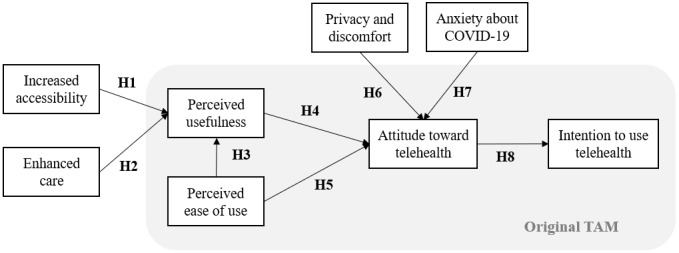
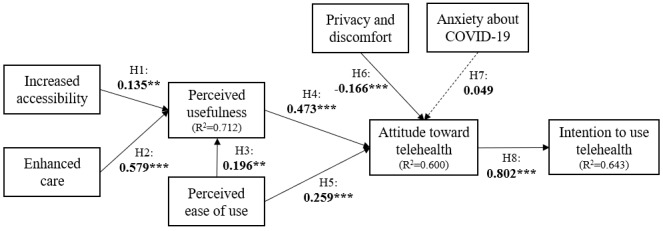
Background: Although telehealth is considered a key component in combating the worldwide crisis caused by COVID-19, the factors that influence its acceptance by the general population after the flattening of the COVID-19 curve remain unclear. Objective: We aimed to identify factors affecting telehealth acceptance, including anxiety related to COVID-19, after the initial rapid spread of the disease in South Korea. Methods: We proposed an extended technology acceptance model (TAM) and performed a cross-sectional survey of individuals aged ≥30 years. In total, 471 usable responses were collected. Confirmatory factor analysis was used to examine the validity of measurements, and the partial least squares (PLS) method was used to investigate factors influencing telehealth acceptance and the impacts of COVID-19. Results: PLS analysis showed that increased accessibility, enhanced care, and ease of telehealth use had positive effects on its perceived usefulness (P=.002, P<.001, and P<.001, respectively). Furthermore, perceived usefulness, ease, and privacy/discomfort significantly impacted the acceptance of telehealth (P<.001, P<.001, and P<.001, respectively). However, anxiety toward COVID-19 was not associated with telehealth acceptance (P=.112), and this insignificant relationship was consistent in the cluster (n=216, 46%) of respondents with chronic diseases (P=.185). Conclusions: Increased accessibility, enhanced care, usefulness, ease of use, and privacy/discomfort are decisive variables affecting telehealth acceptance in the Korean general population, whereas anxiety about COVID-19 is not. This study may lead to a tailored promotion of telehealth after the pandemic subsides.
Overview
The claims and statistics of this paper haven’t been checked yet.
Free: it reads the open-access text and checks the first 5 claims that cite a source we can check. Create a free account to check every claim.
Integrity signals
Registry
Cites
Statistics
Figures
Verification
Claims the paper makes
The claims and statistics of this paper haven’t been checked yet.
Free: it reads the open-access text and checks the first 5 claims that cite a source we can check. Create a free account to check every claim.
Claims other papers make about this one
Each is checked against this paper’s own text: does it say what the citing paper says it does?
The cited source says what the claim attributes to it.
In the citing paper
“However, our findings seem to be in line with those of An and colleagues [47] who showed that anxiety about COVID-19 was not associated with telehealth acceptance among individuals with chronic disease in South Korea.”
Self-check
Percentages, sums and reported differences re-computed from the paper’s own numbers.
The self-check needs the paper’s full text.
Citations
Cites
Evaluating Structural Equation Models with Unobservable Variables and Measurement Error
Fornell, C., & Larcker, D. F. (1981) · Journal of Marketing Research · doi:10.2307/3151312 · Cited by 109,314
Evaluating structural equation models with unobservable variables and measurement error
Fornell, C., & Larcker, D. F. (1981) · Journal of Marketing Research · doi:10.1177/002224378101800104 · Cited by 109,190 · cited 3×
“Table 4 presents the correlation matrix and square root of the AVE, which shows that the Fornell–Larcker criterion was fulfilled.”
MethodHu, L., & Bentler, P. M. (1999) · Structural Equation Modeling A Multidisciplinary Journal · doi:10.1080/10705519909540118 · Cited by 108,788 · cited 1×
“08, and showed an acceptable model fit [47].”
BackgroundPerceived usefulness, perceived ease of use, and user acceptance of information technology
Davis, F. D. (1989) · MIS Quarterly · doi:10.2307/249008 · Cited by 68,483 · cited 6×
“Attitude Toward Telehealth TAM stipulates that perceived usefulness and perceived ease of use are factors associated with people’s attitude toward a system [15].”
BackgroundMethodInfluentialA new criterion for assessing discriminant validity in variance-based structural equation modeling
Henseler, J., Ringle, C. M., & Sarstedt, M. (2015) · Journal of the Academy of Marketing Science · doi:10.1007/s11747-014-0403-8 · Cited by 38,459 · cited 6×
“According to Henseler et al [46], when testing the null hypothesis (H0: HTMT≥1) against the opposite hypothesis (H1: HTMT 1), if a CI contains the value 1, it indicates a lack of discriminant validity.”
BackgroundMethodInfluentialA Theoretical Extension of the Technology Acceptance Model: Four Longitudinal Field Studies
Venkatesh, V., & Davis, F. D. (2000) · Management Science · doi:10.1287/mnsc.46.2.186.11926 · Cited by 23,066 · cited 7×
“Venkatesh and Davis [26] Intention to use (UI)”
BackgroundMethodInfluentialWang, D., Hu, B., Hu, C., Zhu, F., Liu, X., Zhang, J., Wang, B., Xiang, H., Cheng, Z., Xiong, Y., et al. (2020) · JAMA · doi:10.1001/jama.2020.1585 · Cited by 20,148 · cited 1×
“In China where the first COVID-19 outbreak was documented, a significant proportion of cases were due to hospital-related transmission [2].”
BackgroundLa certeza de lo impredecible: Cultura Educación y Sociedad en tiempos de COVID19
Martínez González, M. (2020) · DSPACE System - Metalibrary (University of the Coast) · Cited by 18,463
Wang, C., Pan, R., Wan, X., Tan, Y., Xu, L., Ho, C. S., & Ho, R. C. (2020) · International Journal of Environmental Research and Public Health · doi:10.3390/ijerph17051729 · Cited by 9,923 · cited 1×
“2% worrying about their family members being exposed to COVID-19 [39].”
BackgroundUsing pls path modeling in new technology research: updated guidelines
Henseler, J., Hubona, G., & Ray, P. A. (2016) · Industrial Management & Data Systems · doi:10.1108/imds-09-2015-0382 · Cited by 7,173
Research works printed but not linked: 2
- Chin WW Commentary: Issues and Opinion on Structural Equation Modeling MIS Quarterly 1998 22 1 vii xvi
- Hair Jr JF Hult GTM Ringle C Sarstedt M A Primer on Partial Least Squares Structural Equation Modeling (2nd ed) 2016 Thousand Oaks, CA SAGE Publications
Cited by
Assessing Health Students' Attitudes and Usage of ChatGPT in Jordan: Validation Study
Sallam, M., Salim, N. A., Barakat, M., Al-Mahzoum, K., Al-Tammemi, A. B., Malaeb, D., Hallit, R., & Hallit, S. (2023) · JMIR Medical Education · doi:10.2196/48254 · Cited by 234
“The survey instrument development process involved an extensive literature review and expert validation, followed by item development and pilot testing to ensure clarity [25,26,45-49].”
European Respiratory Society statement on long COVID follow-up
Antoniou, K. M., Vasarmidi, E., Russell, A.-M., Andrejak, C., Crestani, B., Delcroix, M., Dinh-Xuan, A. T., Poletti, V., Sverzellati, N., Vitacca, M., et al. (2022) · European Respiratory Journal · doi:10.1183/13993003.02174-2021 · Cited by 159
“Tele-medicine/ tele-rehabilitation acceptance is related to increased accessibility, enhanced care, usefulness, ease of use and privacy/discomfort, whereas anxiety about COVID-19 is not [125].”
BackgroundZin, K. S. L. T., Kim, S., Kim, H.-S., & Feyissa, I. F. (2023) · Administrative Sciences · doi:10.3390/admsci13020042 · Cited by 103
Hussain, A., Ma, Z., Li, M., Jameel, A., Kanwel, S., Ahmad, S., & Ge, B. (2025) · BMC Nursing · doi:10.1186/s12912-024-02648-8 · Cited by 181
“An, You [75] utilized an extended TAM to investigate healthcare professionals’ acceptance of telemedicine during the COVID-19 pandemic.”
Understanding the Drivers of Ghanaian Citizens' Adoption Intentions of Mobile Health Services
Mensah, I. K. (2022) · Frontiers in Public Health · doi:10.3389/fpubh.2022.906106 · Cited by 56
Metadata
- Authors
- An, M. H., You, S. C., Park, R. W., & Lee, S.
- Affiliations
- Ajou University (KR)
- Corresponding author
- Lee, Seongwon
- Venue
- JMIR Medical Informatics
- Publisher
- JMIR Publications Inc.
- Published
- 2021-01-08
- Volume
- 9
- Issue
- 1
- Pages
- e25435
- ISSN
- 2291-9694 (ISSN-L)
- PMC
- PMC7801132
- OpenAlex
- W3118509192
- Cited by
- 84
- References
- 65
- Citations by year
- 2026: 1 · 2025: 21 · 2024: 18 · 2023: 20 · 2022: 22 · 2021: 2
- FWCI
- 13.43
- Type
- journal article
- Language
- en
- Open access
- gold
- doi.org
- Licence
- cc-by
- Locations
- JMIR Medical Informatics (publishedVersion, cc-by)
- PubMed Central (publishedVersion, cc-by)
- PubMed (publishedVersion)
- AJOU Open Repository (Ajou University) (submittedVersion)
- DOAJ (DOAJ: Directory of Open Access Journals) (submittedVersion, cc-by-sa)
- Funders
- National Research Foundation
- Korea Health Industry Development Institute (HI16C0992)
- National Research Foundation of Korea (NRF-2020R1I1A1A01072208, HI16C0992)
- Topics
- Health Sciences › Medicine › Public Health, Environmental and Occupational Health › Telemedicine and Telehealth Implementation
- Social Sciences › Decision Sciences › Information Systems and Management › Technology Adoption and User Behaviour
- Health Sciences › Medicine › Geriatrics and Gerontology › Technology Use by Older Adults
- Keywords
- telehealth acceptance, extended technology acceptance model, COVID-19 pandemic, perceived usefulness, perceived ease of use, privacy concerns, telehealth utilization, COVID-19 anxiety, chronic disease, South Korea
About these checks
Registry, retraction, Cites and statistics results are computed, not judged, with one exception: a printed reference that no index lists is read once by a model before it counts as a citation error. Claims are extracted by a model and kept only when their quote appears verbatim in the text; each cited source is then checked, with a model’s help, for whether it says what the claim relies on. Those verdicts can be wrong — read the claim’s quote and the cited source before relying on one.
Statistics and arithmetic are recomputed, not judged.
Confidence bands are shown only for fields calibrated on our annotated test set. None is calibrated yet, so no band is shown.
What counts as a claim ›How we measure confidence ›How we check this ›
Are you an author, or do you see a problem with this page? Request a review
Data sources
Bibliographic data: Semantic Scholar, OpenAlex, Crossref.
Contains information from the Semantic Scholar Academic Graph Datasets, made available under the ODC Attribution License (ODC-BY 1.0).
Semantic Scholar’s data is described in: Kinney, R., et al. (2023). The Semantic Scholar Open Data Platform. arXiv:2301.10140.
