

Utilizing Health Behavior Change and Technology Acceptance Models to Predict the Adoption of COVID-19 Contact Tracing Apps: Cross-sectional Survey Study
Open accessPublished version of a preprint
The DOI matches its Crossref record; 64 of the 64 references it cites were found in a registry or an index.
Abstract
Background: To combat the global COVID-19 pandemic, contact tracing apps have been discussed as digital health solutions to track infection chains and provide appropriate information. However, observational studies point to low acceptance in most countries, and few studies have yet examined theory-based predictors of app use in the general population to guide health communication efforts. Objective: This study utilizes established health behavior change and technology acceptance models to predict adoption intentions and frequency of current app use. Methods: We conducted a cross-sectional online survey between May and July 2020 in a German convenience sample (N=349; mean age 35.62 years; n=226, 65.3% female). To inspect the incremental validity of model constructs as well as additional variables (privacy concerns, personalization), hierarchical regression models were applied, controlling for covariates. Results: The theory of planned behavior and the unified theory of acceptance and use of technology predicted adoption intentions (R2=56%-63%) and frequency of current app use (R2=33%-37%). A combined model only marginally increased the predictive value by about 5%, but lower privacy concerns and higher threat appraisals (ie, anticipatory anxiety) significantly predicted app use when included as additional variables. Moreover, the impact of perceived usefulness was positive for adoption intentions but negative for frequency of current app use. Conclusions: This study identified several theory-based predictors of contact tracing app use. However, few constructs, such as social norms, have a consistent positive effect across models and outcomes. Further research is required to replicate these observations, and to examine the interconnectedness of these constructs and their impact throughout the pandemic. Nevertheless, the findings suggest that promulgating affirmative social norms and positive emotional effects of app use, as well as addressing health concerns, might be promising strategies to foster adoption intentions and app use in the general population.
Overview
The claims and statistics of this paper haven’t been checked yet.
Free: it reads the open-access text and checks the first 5 claims that cite a source we can check. Create a free account to check every claim.
Integrity signals
Registry
Cites
Statistics
Figures
Verification
Claims the paper makes
The claims and statistics of this paper haven’t been checked yet.
Free: it reads the open-access text and checks the first 5 claims that cite a source we can check. Create a free account to check every claim.
Claims other papers make about this one
Each is checked against this paper’s own text: does it say what the citing paper says it does?
The source backs part of the claim, not all of it — or backs it for a different population, condition or comparison.
In the citing paper
“Research has found that other telehealth-related perceptions (eg, privacy concerns), the specific characteristics of different teledelivered services (eg, expected durations and schedules of the services, the necessity to use cameras for the services, group- and individual-based delivery), and contextual factors (eg, severity of the pandemic situation, availability of specific types of teledeliver”
From Applying the Unified Theory of Acceptance and Use of Technology to Identify Factors Associated With Intention to Use Teledelivered Supportive Care Among Recently Diagnosed Breast Cancer Survivors During COVID-19 in Hong Kong: Cross-Sectional Survey (2024) · cites this paper as [18]
Experimental — accuracy not yet measuredThe cited source says what the claim attributes to it.
In the citing paper
“Specific to the pandemic situation, recent studies found that fear of COVID-19 transmission was associated with higher intentions to use contact tracing apps among the general population in Germany [18] and telehealth services among cancer patients in the United States [19].”
Self-check
Percentages, sums and reported differences re-computed from the paper’s own numbers.
The self-check needs the paper’s full text.
Citations
Cites
The theory of planned behavior
Ajzen, I. (1991) · Organizational Behavior and Human Decision Processes · doi:10.1016/0749-5978(91)90020-t · Cited by 90,587
Perceived usefulness, perceived ease of use, and user acceptance of information technology
Davis, F. D. (1989) · MIS Quarterly · doi:10.2307/249008 · Cited by 68,483 · cited 1×
“The UTAUT itself is based on the technology acceptance model [46] and the theory of reasoned action [47], a precursor of the TPB, and it also describes psychosocial variables associated with the adoption of (new) technology [48-50].”
User Acceptance of Information Technology: Toward A Unified View1
Venkatesh, V., Morris, M. G., Davis, G. B., & Davis, F. D. (2003) · MIS Quarterly · doi:10.2307/30036540 · Cited by 45,035 · cited 3×
“While the TPB has received tremendous attention in health research, its popularity in mHealth research is rivaled by UTAUT [45].”
(1980) · Medical Entomology and Zoology · Cited by 25,810
Venkatesh, V., Thong, J. Y. L., & Xu, X. (2012) · MIS Quarterly · doi:10.2307/41410412 · Cited by 15,756 · cited 4×
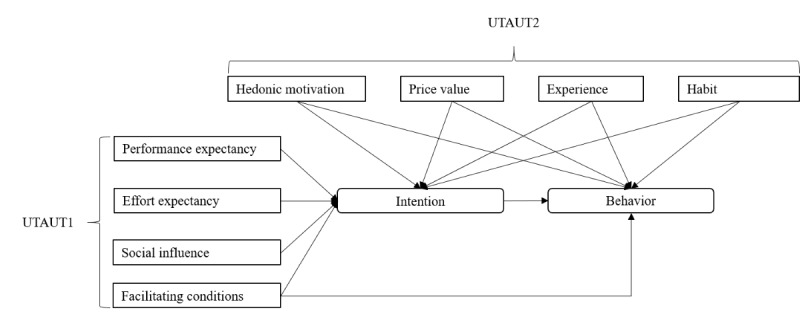
“These variables are performance expectancy, effort expectancy, social influence, and facilitating conditions in the first iteration (UTAUT1), with the addition of hedonic motivation, price value, habit, and experience in the second iteration (UTAUT2) [45,51] (Figure 2).”
InfluentialA test of missing completely at random for multivariate data with missing values
Little, R. J. A. (1988) · Journal of the American Statistical Association · doi:10.1080/01621459.1988.10478722 · Cited by 8,963 · cited 1×
“Overall, missing values were low (564/31,759, 1.8%), which the Little test [63] revealed to be missing completely at random ( χ =2538.4, P =.10).”
InfluentialHuman agency in social cognitive theory.
Bandura, A. (1989) · American Psychologist · doi:10.1037/0003-066x.44.9.1175 · Cited by 8,263 · cited 1×
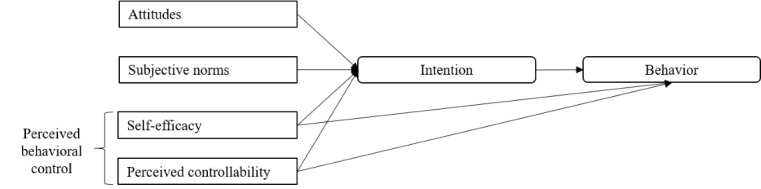
“These processes are detailed in health behavior models like the HBM [33], Bandura’s social cognitive theory [34], the PMT [35], and the theory of planned behavior (TPB) [36], which define several constructs associated with behavior change.”
Perceived Behavioral Control, Self‐Efficacy, Locus of Control, and the Theory of Planned Behavior 1
Ajzen, I. (2002) · Journal of Applied Social Psychology · doi:10.1111/j.1559-1816.2002.tb00236.x · Cited by 7,629 · cited 1×
“This construct comprises self-efficacy but also perceived controllability, which refers to the extent to which a person believes to be responsible for their behavioral performance within a specific setting [39].”
A Protection Motivation Theory of Fear Appeals and Attitude Change1
Rogers, R. W. (1975) · The Journal of Psychology · doi:10.1080/00223980.1975.9915803 · Cited by 6,805 · cited 2×
“These processes are detailed in health behavior models like the HBM [33], Bandura’s social cognitive theory [34], the PMT [35], and the theory of planned behavior (TPB) [36], which define several constructs associated with behavior change.”
Social Learning Theory and the Health Belief Model
Rosenstock, I. M., Strecher, V. J., & Becker, M. H. (1988) · Health Education Quarterly · doi:10.1177/109019818801500203 · Cited by 5,564 · cited 1×
“Social cognitive theory further adds the impact of efficacy expectancies [37] that comprise beliefs about the outcome of a behavior (ie, response efficacy, for instance, the belief that wearing masks significantly reduces infection risk) as well as one’s ability to perform within a specific setting…”
Research works printed but not linked: 5
- Kukuk L Analyzing adoption of contact tracing apps using UTAUT (Essay, Bachelor) 2020 33rd Twente Student Conference on IT July 3 Enschede, The Netherlands Enschede, The Netherlands University of Twente 1 8
- Sun Y Wang N Guo X Peng Z Understanding the acceptance of mobile health services: a comparison and integration of alternative models J Electron Commer Res 2013 14 2 183 200
- Champion VL Skinner CS Glanz K Rimer BK Viswanath K The health belief model Health Behavior and Health Education: Theory, Research, and Practice, 4th Ed 2008 San Francisco, CA Jossey-Bass 45 65
- Buck C Burster S App information privacy concerns 2017 23th Americas Conference on Information Systems (AMCIS) August 10-12 Boston, MA
- BuckCBursterSApp information privacy concerns201723th Americas Conference on Information Systems (AMCIS)August 10-12Boston, MA
Cited by
Explaining citizens’ resistance to use digital contact tracing apps: A mixed-methods study
Prakash, A. V., & Das, S. (2021) · International Journal of Information Management · doi:10.1016/j.ijinfomgt.2021.102468 · Cited by 120
“…relative advantage, perceived usefulness/performance expectancy were identified as the determinants of adoption of DCT apps (Duan & Deng, 2021; Fox et al., 2021; Hassandoust et al., 2021; Lin et al., 2021; Sharma et al., 2020; Tomczyk et al., 2021; Touzani et al., 2021; Trkman et al., 2021;).”
BackgroundWang, J., Li, X., Wang, P., Liu, Q., Deng, Z., & Jingzhi, W. (2021) · Sustainability · doi:10.3390/su14010010 · Cited by 108
Schretzlmaier, P., Hecker, A., & Ammenwerth, E. (2022) · JMIR Human Factors · doi:10.2196/34918 · Cited by 75
“To date, there have not been many studies that have used the UTAUT2 model to predict mHealth acceptance [41,43,44,60,62,64].”
BackgroundPredictors of contact tracing app adoption: Integrating the UTAUT, HBM and contextual factors
van der Waal, N. E., de Wit, J., Bol, N., Ebbers, W. E., Hooft, L., Metting, E., & van der Laan, L. N. (2022) · Technology in Society · doi:10.1016/j.techsoc.2022.102101 · Cited by 59
Chopdar, P. K. (2022) · Health Policy and Technology · doi:10.1016/j.hlpt.2022.100651 · Cited by 63
“Similarly, Tomczyk et al. [24] have used the theory of planned behavior and UTAUT to predict users ’ adoption of contact tracing applications.”
Metadata
- Authors
- Tomczyk, S., Barth, S., Schmidt, S., & Muehlan, H.
- Affiliations
- Universität Greifswald (DE)
- Corresponding author
- Tomczyk, Samuel
- Venue
- Journal of Medical Internet Research
- Publisher
- JMIR Publications Inc.
- Published
- 2021-05-19
- Volume
- 23
- Issue
- 5
- Pages
- e25447
- ISSN
- 1438-8871 (ISSN-L)
- PMC
- PMC8136409
- OpenAlex
- W3153907386
- Cited by
- 69
- References
- 61
- Citations by year
- 2026: 5 · 2025: 11 · 2024: 10 · 2023: 19 · 2022: 16 · 2021: 8
- FWCI
- 11.98
- Type
- journal article
- Language
- en
- Open access
- gold
- doi.org
- Licence
- cc-by
- Locations
- Journal of Medical Internet Research (publishedVersion, cc-by)
- PubMed Central (publishedVersion, cc-by)
- PubMed (publishedVersion)
- DOAJ (DOAJ: Directory of Open Access Journals) (submittedVersion, cc-by-sa)
- Topics
- Physical Sciences › Computer Science › Information Systems › COVID-19 Digital Contact Tracing
- Health Sciences › Health Professions › General Health Professions › Mobile Health and mHealth Applications
- Social Sciences › Decision Sciences › Information Systems and Management › Technology Adoption and User Behaviour
- Keywords
- COVID-19 contact tracing apps, technology acceptance model, health behavior change, adoption intention, privacy concerns, perceived usefulness, threat appraisal, anticipatory anxiety, social norms, digital health, health communication
- MeSH terms
- COVID-19, SARS-CoV-2, Adult, Cross-Sectional Studies, Female, Humans, Male, Surveys and Questionnaires, Models, Statistical, Health Behavior, Contact Tracing, Pandemics, Mobile Applications
About these checks
Registry, retraction, Cites and statistics results are computed, not judged, with one exception: a printed reference that no index lists is read once by a model before it counts as a citation error. Claims are extracted by a model and kept only when their quote appears verbatim in the text; each cited source is then checked, with a model’s help, for whether it says what the claim relies on. Those verdicts can be wrong — read the claim’s quote and the cited source before relying on one.
Statistics and arithmetic are recomputed, not judged.
Confidence bands are shown only for fields calibrated on our annotated test set. None is calibrated yet, so no band is shown.
What counts as a claim ›How we measure confidence ›How we check this ›
Are you an author, or do you see a problem with this page? Request a review
How to cite
Cite CoChat for the checks on this page, and the paper for its own findings.
- This page
- CoChat. (2026). Citation check: Utilizing Health Behavior Change and Technology Acceptance Models to Predict the Adoption of COVID-19 Contact Tracing Apps: Cross-sectional Survey Study. https://app.cochat.ai/papers/10.2196/25447
- The paper
- Tomczyk, S., Barth, S., Schmidt, S., & Muehlan, H. (2021). Utilizing Health Behavior Change and Technology Acceptance Models to Predict the Adoption of COVID-19 Contact Tracing Apps: Cross-sectional Survey Study. Journal of Medical Internet Research. https://doi.org/10.2196/25447
Data sources
Bibliographic data: Semantic Scholar, OpenAlex, Crossref.
Contains information from the Semantic Scholar Academic Graph Datasets, made available under the ODC Attribution License (ODC-BY 1.0).
Semantic Scholar’s data is described in: Kinney, R., et al. (2023). The Semantic Scholar Open Data Platform. arXiv:2301.10140.
