

A Compassion-Focused Ecological Momentary Intervention for Enhancing Resilience in Help-Seeking Youth: Uncontrolled Pilot Study
Open accessPublished version of a preprint
The DOI matches its Crossref record; 110 of the 110 references it cites were found in a registry or an index.
Abstract
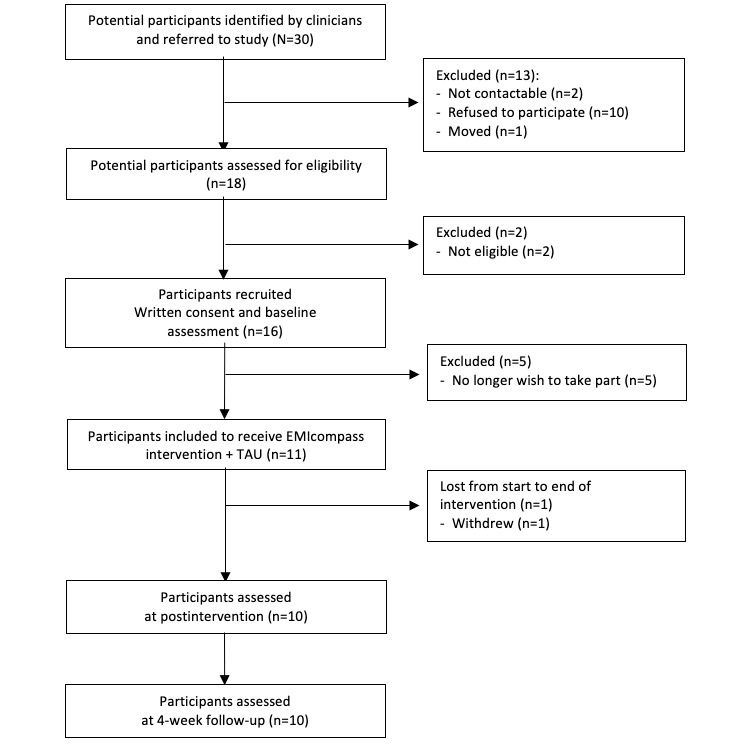
Background: Digital interventions offer new avenues for low-threshold prevention and treatment in young people. Ecological momentary interventions (EMIs) represent a powerful approach that allows for adaptive, real-time, and real-world delivery of intervention components in daily life by real-time processing of ecological momentary assessment (EMA) data. Compassion-focused interventions (CFIs) may be particularly amenable to translation into an EMI to strengthen emotional resilience and modify putative risk mechanisms, such as stress sensitivity, in the daily lives of young help-seeking individuals. Objective: This study aims to investigate the feasibility, safety, and initial therapeutic effects of a novel, accessible, transdiagnostic, ecological momentary CFI for improving emotional resilience to stress (EMIcompass). Methods: In this uncontrolled pilot study, help-seeking youth with psychotic, depressive, or anxiety symptoms were offered the EMIcompass intervention in addition to treatment as usual. The EMIcompass intervention consisted of a 3-week EMI (including enhancing, consolidating, and EMA-informed interactive tasks) administered through a mobile health app and three face-to-face sessions with a trained psychologist intended to provide guidance and training on the CFI exercises presented in the app (ie, training session, follow-up booster session, and review session). Results: In total, 10 individuals (mean age 20.3 years, SD 3.8; range 14-25) were included in the study. Most (8/10, 80%) participants were satisfied and reported a low burden of app usage. No adverse events were observed. In approximately one-third of all EMAs, individuals scored high on stress, negative affect, or threat anticipation during the intervention period, resulting in real-time, interactive delivery of the CFI intervention components in addition to weekly enhancing and daily consolidating tasks. Although the findings should be interpreted with caution because of the small sample size, reduced stress sensitivity, momentary negative affect, and psychotic experiences, along with increased positive affect, were found at postintervention and the 4-week follow-up. Furthermore, reductions in psychotic, anxiety, and depressive symptoms were found (r=0.30-0.65). Conclusions: Our findings provide evidence on the feasibility and safety of the EMIcompass intervention for help-seeking youth and lend initial support to beneficial effects on stress sensitivity and mental health outcomes. An exploratory randomized controlled trial is warranted to establish the feasibility and preliminary evidence of its efficacy.
Overview
The claims and statistics of this paper haven’t been checked yet.
Free: it reads the open-access text and checks the first 5 claims that cite a source we can check. Create a free account to check every claim.
Integrity signals
Registry
Cites
Statistics
Figures
Verification
Claims the paper makes
The claims and statistics of this paper haven’t been checked yet.
Free: it reads the open-access text and checks the first 5 claims that cite a source we can check. Create a free account to check every claim.
Claims other papers make about this one
Each is checked against this paper’s own text: does it say what the citing paper says it does?
The cited source says what the claim attributes to it.
In the citing paper
“Additionally, transformative digital mental health concepts such as ecological momentary assessment (EMA) and ecological momentary interventions (EMI) are on the rise and based on apps/smartphones [64–66].”
Self-check
Percentages, sums and reported differences re-computed from the paper’s own numbers.
The self-check needs the paper’s full text.
Citations
Cites
Kessler, R. C., Berglund, P., Demler, O., Jin, R., Merikangas, K. R., & Walters, E. E. (2005) · Archives of General Psychiatry · doi:10.1001/archpsyc.62.6.593 · Cited by 20,391 · cited 1×
“Most mental disorders first emerge in adolescence and young adulthood (three-fourths by the age of 24 years [1]), with an estimated lifetime prevalence of approximately 50% of any mental disorder in young age groups [1-5].”
BackgroundThe brief symptom inventory: an introductory report.
Derogatis, L. R., & Melisaratos, N. (1983) · Psychological Medicine · doi:10.1017/s0033291700048017 · Cited by 6,650 · cited 4×
“BSI: Brief Symptom Inventory CBT: cognitive behavioral therapy CFI: compassion-focused intervention EMA: ecological momentary assessment EMI: ecological momentary intervention ESM: experience sampling method mHealth: mobile health PQ: prodromal questionnaire RCT: randomized controlled trial Edited by J Torous; submitt…”
BackgroundMethodInfluentialMerikangas, K. R., He, J.-P., Burstein, M., Swanson, S. A., Avenevoli, S., Cui, L., Benjet, C., Georgiades, K., & Swendsen, J. (2010) · Journal of the American Academy of Child & Adolescent Psychiatry · doi:10.1016/j.jaac.2010.05.017 · Cited by 6,278 · cited 1×
“Most mental disorders first emerge in adolescence and young adulthood (three-fourths by the age of 24 years [1]), with an estimated lifetime prevalence of approximately 50% of any mental disorder in young age groups [1-5].”
BackgroundGlobal burden of disease in young people aged 10–24 years: a systematic analysis
Gore, F. M., Bloem, P. J., Patton, G. C., Ferguson, J., Joseph, V., Coffey, C., Sawyer, S. M., & Mathers, C. D. (2011) · The Lancet · doi:10.1016/s0140-6736(11)60512-6 · Cited by 2,301 · cited 1×
“Furthermore, the Global Burden of Disease study has reported that mental and substance use disorders in children and youth aged 10 to 24 years were the leading cause of overall disease burden in high-income countries [6-8].”
BackgroundNahum-Shani, I., Smith, S. N., Spring, B. J., Collins, L. M., Witkiewitz, K., Tewari, A., & Murphy, S. A. (2018) · Annals of Behavioral Medicine · doi:10.1007/s12160-016-9830-8 · Cited by 2,171 · cited 1×
“More recently, some authors have started to use the term just-in-time adaptive interventions, which emphasize EMI’s capability of adapting the delivery of intervention components to person and context based on experience sampling or other, for example, sensing data [47,48].”
BackgroundMeta-Analysis: Recent Developments in Quantitative Methods for Literature Reviews
Rosenthal, R., & DiMatteo, M. R. (2001) · Annual Review of Psychology · doi:10.1146/annurev.psych.52.1.59 · Cited by 1,780 · cited 2×
“aEffect size estimates are based on r described by Rosenthal and DiMatteo [102] using the following formula: r=Z/√number of pairs.”
MethodEldridge, S. M., Lancaster, G. A., Campbell, M. J., Thabane, L., Hopewell, S., Coleman, C. L., & Bond, C. M. (2016) · PLOS ONE · doi:10.1371/journal.pone.0150205 · Cited by 1,581 · cited 7×
“the effect size of initial therapeutic effects rather than statistical significance to provide the basis for a feasibility RCT [105].”
BackgroundInfluentialLifetime Prevalence of Psychotic and Bipolar I Disorders in a General Population
Perälä, J., Suvisaari, J., Saarni, S. I., Kuoppasalmi, K., Isometsä, E., Pirkola, S., Partonen, T., Tuulio-Henriksson, A., Hintikka, J., Kieseppä, T., et al. (2007) · Archives of General Psychiatry · doi:10.1001/archpsyc.64.1.19 · Cited by 1,516 · cited 1×
“Most mental disorders first emerge in adolescence and young adulthood (three-fourths by the age of 24 years [1]), with an estimated lifetime prevalence of approximately 50% of any mental disorder in young age groups [1-5].”
BackgroundHeron, K. E., & Smyth, J. M. (2010) · British Journal of Health Psychology · doi:10.1348/135910709x466063 · Cited by 1,438 · cited 1×
“They are based on fine-grained ecological momentary assessment (EMA) data acquired through cutting-edge digital technology [21,23,24,38,39,45,46].”
BackgroundIntroducing compassion-focused therapy
Gilbert, P. (2009) · Advances in Psychiatric Treatment · doi:10.1192/apt.bp.107.005264 · Cited by 1,435 · cited 13×
“This session was fully manualized based on previous research that used CFIs [67,68,74,78,94].”
BackgroundMethodInfluential
Research works printed but not linked: 2
- Gilbert P Compassion Focused Therapy (CBT Distinctive Features) 2010 London, United Kingdom Routledge 1 248
- Derogatis L BSI, Brief Symptom Inventory: Administration, Scoring & Procedures Manual 1993 Minneapolis, MN National Computer Systems A
Cited by
Götzl, C., Hiller, S., Rauschenberg, C., Schick, A., Fechtelpeter, J., Fischer-Abaigar, U., Koppe, G., Durstewitz, D., Reininghaus, U., & Krumm, S. (2022) · Child and Adolescent Psychiatry and Mental Health · doi:10.1186/s13034-022-00522-6 · Cited by 105
“…et al. found in an uncontrolled pilot EMI study, that within 3 weeks of using a compassion focused program (including, inter alia, EMA–informed interactive tasks), stress sensitivity, momentary negative affect, and psychotic experiences could be reduced in ten individuals aged 14–25 [34].”
BackgroundResultInfluentialSelf-citationDigital Mental Health Interventions for Young People Aged 16-25 Years: Scoping Review
Potts, C., Kealy, C., McNulty, J. M., Madrid‐Cagigal, A., Wilson, T., Mulvenna, M. D., O’Neill, S. M., Donohoe, G. J., & Barry, M. M. (2025) · Journal of Medical Internet Research · doi:10.2196/72892 · Cited by 75
“Ten interventions were used across more than one study, including Calm [71,120], EMIcompass [148,158], Grow It!”
Reininghaus, U., Paetzold, I., Rauschenberg, C., Hirjak, D., Banaschewski, T., Meyer-Lindenberg, A., Boehnke, J. R., Boecking, B., & Schick, A. (2023) · Schizophrenia Bulletin · doi:10.1093/schbul/sbac212 · Cited by 42
“18 While an uncontrolled pilot study found preliminary evidence on the feasibility, safety, and initial effects of this intervention, 18 evidence from an exploratory trial on feasibility and initial signals of efficacy is pending.”
BackgroundSelf-citationKolenik, T. (2022) · Internet of things · doi:10.1007/978-3-030-91181-2_7 · Cited by 60
Ecological Momentary Interventions in Public Mental Health Provision
Schulte‐Strathaus, J. C. C., Rauschenberg, C., Baumeister, H., & Reininghaus, U. (2022) · Studies in neuroscience, psychology and behavioral economics · doi:10.1007/978-3-030-98546-2_25 · Cited by 34
Self-citation
Metadata
- Authors
- Rauschenberg, C., Boecking, B., Paetzold, I., Schruers, K., Schick, A., van Amelsvoort, T., & Reininghaus, U.
- Affiliations
- Heidelberg University (DE)
- Charité – Universitätsmedizin Berlin (DE)
- Maastricht University (NL)
- King's College London (GB)
- Corresponding author
- Reininghaus, Ulrich
- ORCID
- Venue
- JMIR Mental Health
- Publisher
- JMIR Publications Inc.
- Published
- 2021-08-05
- Volume
- 8
- Issue
- 8
- Pages
- e25650
- ISSN
- 2368-7959 (ISSN-L)
- PMC
- PMC8380580
- OpenAlex
- W3187379416
- Cited by
- 63
- References
- 110
- Citations by year
- 2026: 19 · 2025: 7 · 2024: 11 · 2023: 6 · 2022: 15 · 2021: 5
- FWCI
- 7.90
- Type
- journal article
- Language
- en
- Open access
- gold
- doi.org
- Licence
- cc-by
- Locations
- JMIR Mental Health (publishedVersion, cc-by)
- PubMed Central (publishedVersion, cc-by)
- PubMed (publishedVersion)
- Research Publications (Maastricht University) (publishedVersion, cc-by)
- DOAJ (DOAJ: Directory of Open Access Journals) (submittedVersion)
- Research Portal (King's College London) (submittedVersion, other-oa)
- PsyArXiv (OSF Preprints) (submittedVersion, cc-by)
- PsyArXiv (OSF Preprints) (submittedVersion)
- Research Publications (Maastricht University) (submittedVersion, other-oa)
- Funders
- Deutsche Forschungsgemeinschaft (389624707)
- Nederlandse Organisatie voor Wetenschappelijk Onderzoek (451‐13‐022)
- Topics
- Social Sciences › Psychology › Applied Psychology › Digital Mental Health Interventions
- Social Sciences › Psychology › Clinical Psychology › Mindfulness and Compassion Interventions
- Social Sciences › Psychology › Experimental and Cognitive Psychology › Mental Health Research Topics
- Keywords
- compassion-focused interventions, ecological momentary intervention, ecological momentary assessment, psychological resilience, stress sensitivity, mobile health apps, digital mental health interventions, psychotic symptoms, depressive symptoms, anxiety symptoms, transdiagnostic treatment, feasibility and safety
About these checks
Registry, retraction, Cites and statistics results are computed, not judged, with one exception: a printed reference that no index lists is read once by a model before it counts as a citation error. Claims are extracted by a model and kept only when their quote appears verbatim in the text; each cited source is then checked, with a model’s help, for whether it says what the claim relies on. Those verdicts can be wrong — read the claim’s quote and the cited source before relying on one.
Statistics and arithmetic are recomputed, not judged.
Confidence bands are shown only for fields calibrated on our annotated test set. None is calibrated yet, so no band is shown.
What counts as a claim ›How we measure confidence ›How we check this ›
Are you an author, or do you see a problem with this page? Request a review
Data sources
Bibliographic data: Semantic Scholar, OpenAlex, Crossref.
Contains information from the Semantic Scholar Academic Graph Datasets, made available under the ODC Attribution License (ODC-BY 1.0).
Semantic Scholar’s data is described in: Kinney, R., et al. (2023). The Semantic Scholar Open Data Platform. arXiv:2301.10140.
