

Effects of a Novel, Transdiagnostic, Hybrid Ecological Momentary Intervention for Improving Resilience in Youth (EMIcompass): Protocol for an Exploratory Randomized Controlled Trial
Open accessPublished version of a preprint
The DOI matches its Crossref record; 128 of the 128 references it cites were found in a registry or an index.
Abstract
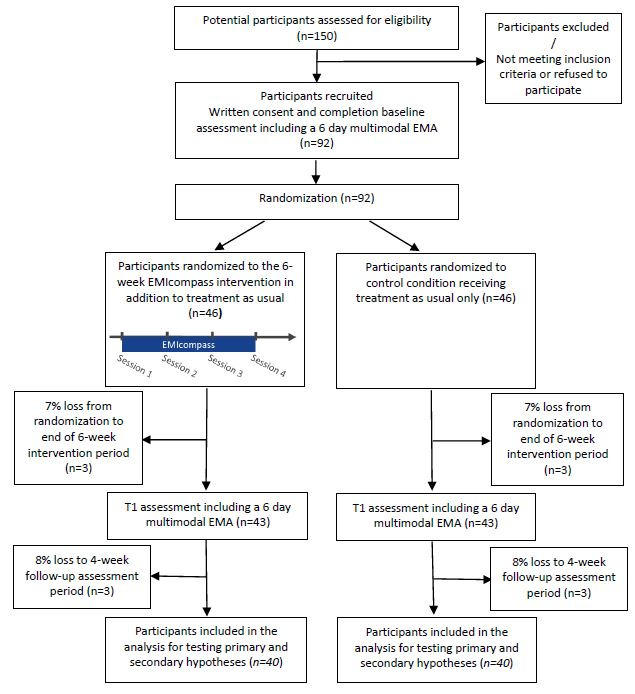
Background: Most mental disorders first emerge in youth and, in their early stages, surface as subthreshold expressions of symptoms comprising a transdiagnostic phenotype of psychosis, mania, depression, and anxiety. Elevated stress reactivity is one of the most widely studied mechanisms underlying psychotic and affective mental health problems. Thus, targeting stress reactivity in youth is a promising indicated and translational preventive strategy for adverse mental health outcomes that could develop later in life and for improving resilience. Compassion-focused interventions offer a wide range of innovative therapeutic techniques that are particularly amenable to being implemented as ecological momentary interventions (EMIs), a specific type of mobile health intervention, to enable youth to access interventions in a given moment and context in daily life. This approach may bridge the current gap in youth mental health care. Objective: This study aims to investigate the clinical feasibility, candidate underlying mechanisms, and initial signals of the efficacy of a novel, transdiagnostic, hybrid EMI for improving resilience to stress in youth—EMIcompass. Methods: In an exploratory randomized controlled trial, youth aged between 14 and 25 years with current distress, a broad Clinical High At-Risk Mental State, or the first episode of a severe mental disorder will be randomly allocated to the EMIcompass intervention (ie, EMI plus face-to-face training sessions) in addition to treatment as usual or a control condition of treatment as usual only. Primary (stress reactivity) and secondary candidate mechanisms (resilience, interpersonal sensitivity, threat anticipation, negative affective appraisals, and momentary physiological markers of stress reactivity), as well as primary (psychological distress) and secondary outcomes (primary psychiatric symptoms and general psychopathology), will be assessed at baseline, postintervention, and at the 4-week follow-up. Results: The first enrollment was in August 2019, and as of May 2021, enrollment and randomization was completed (N=92). We expect data collection to be completed by August 2021. Conclusions: This study is the first to establish feasibility, evidence on underlying mechanisms, and preliminary signals of the efficacy of a compassion-focused EMI in youth. If successful, a confirmatory randomized controlled trial will be warranted. Overall, our approach has the potential to significantly advance preventive interventions in youth mental health provision. Trial Registration: German Clinical Trials Register DRKS00017265; https://www.drks.de/drks_web/navigate.do?navigationId=trial.HTML&TRIAL_ID=DRKS00017265 International Registered Report Identifier (IRRID): DERR1-10.2196/27462
Overview
The claims and statistics of this paper haven’t been checked yet.
Free: it reads the open-access text and checks the first 5 claims that cite a source we can check. Create a free account to check every claim.
Integrity signals
Registry
Cites
Statistics
Figures
Verification
Claims the paper makes
The claims and statistics of this paper haven’t been checked yet.
Free: it reads the open-access text and checks the first 5 claims that cite a source we can check. Create a free account to check every claim.
Claims other papers make about this one
Each is checked against this paper’s own text: does it say what the citing paper says it does?
The source backs part of the claim, not all of it — or backs it for a different population, condition or comparison.
In the citing paper
“Although digital mental health interventions cannot replace personal interaction, they could be combined with a component of face-to-face or real-time interaction [66].”
From Interventions to build resilience and to ameliorate negative psychosocial effects of the COVID-19 pandemic on children and adolescents: a systematic review and meta-analysis (2024) · cites this paper as [66]
Experimental — accuracy not yet measuredThe cited source says what the claim attributes to it.
In the citing paper
“Additionally, transformative digital mental health concepts such as ecological momentary assessment (EMA) and ecological momentary interventions (EMI) are on the rise and based on apps/smartphones [64–66].”
Self-check
Percentages, sums and reported differences re-computed from the paper’s own numbers.
The self-check needs the paper’s full text.
Citations
Cites
Harris, P. A., Taylor, R., Thielke, R., Payne, J., Gonzalez, N., & Conde, J. G. (2009) · Journal of Biomedical Informatics · doi:10.1016/j.jbi.2008.08.010 · Cited by 51,384 · cited 1×
“Research Electronic Data Capture (REDCap) [94], a secure, web-based software platform hosted at the CIMH servers, will be used for data collection.”
Hamilton, M. (1960) · Journal of Neurology, Neurosurgery & Psychiatry · doi:10.1136/jnnp.23.1.56 · Cited by 32,817 · cited 1×
“These will be assessed using the following observer-rated measures: the Brief Psychiatric Rating Scale [104], including the Comprehensive Assessment of At-Risk Mental State [80], the Young Mania Rating Scale [105], the Hamilton Depression Rating Scale [85] and the Hamilton Anxiety Rating Scale [86].”
Development and validation of brief measures of positive and negative affect: The PANAS scales.
Watson, D., Clark, L. A., & Tellegen, A. (1988) · Journal of Personality and Social Psychology · doi:10.1037/0022-3514.54.6.1063 · Cited by 32,433 · cited 1×
“…scores from a representative sample of the German population [82]) or increased negative affect (ie, a mean negative affect score above 1.81 for men and 1.75 for women [82]) assessed using the Positive Affect and Negative Affect Scale [83] • Willingness to participate in the EMIcompass intervention”
InfluentialKessler, R. C., Berglund, P., Demler, O., Jin, R., Merikangas, K. R., & Walters, E. E. (2005) · Archives of General Psychiatry · doi:10.1001/archpsyc.62.6.593 · Cited by 20,391 · cited 2×
“Youth is a critical life period, and most mental disorders have their onset before the age of 25 years [1].”
Development of a new resilience scale: The Connor-Davidson Resilience Scale (CD-RISC)
Connor, K. M., & Davidson, J. R. T. (2003) · Depression and Anxiety · doi:10.1002/da.10113 · Cited by 11,793 · cited 1×
“Resilience will be measured using the Connor-Davidson Resilience Scale [99] and the Resilience Scale [100].”
The assessment of anxiety states by rating
HAMILTON, M. (1959) · British Journal of Medical Psychology · doi:10.1111/j.2044-8341.1959.tb00467.x · Cited by 11,455 · cited 2×
“These will be assessed using the following observer-rated measures: the Brief Psychiatric Rating Scale [104], including the Comprehensive Assessment of At-Risk Mental State [80], the Young Mania Rating Scale [105], the Hamilton Depression Rating Scale [85] and the Hamilton Anxiety Rating Scale [86].”
KESSLER, R. C., ANDREWS, G., COLPE, L. J., HIRIPI, E., MROCZEK, D. K., NORMAND, S.-L. T., WALTERS, E. E., & ZASLAVSKY, A. M. (2002) · Psychological Medicine · doi:10.1017/s0033291702006074 · Cited by 10,327 · cited 3×
“Strong psychometric properties have been reported with a reliability of Cronbach α >.90 [81].”
A Rating Scale for Mania: Reliability, Validity and Sensitivity
Young, R. C., Biggs, J. T., Ziegler, V. E., & Meyer, D. A. (1978) · British Journal of Psychiatry · doi:10.1192/bjp.133.5.429 · Cited by 8,744 · cited 1×
“These will be assessed using the following observer-rated measures: the Brief Psychiatric Rating Scale [104], including the Comprehensive Assessment of At-Risk Mental State [80], the Young Mania Rating Scale [105], the Hamilton Depression Rating Scale [85] and the Hamilton Anxiety Rating Scale [86].”
Development and validation of a brief screening version of the Childhood Trauma Questionnaire
Bernstein, D. P., Stein, J. A., Newcomb, M. D., Walker, E., Pogge, D., Ahluvalia, T., Stokes, J., Handelsman, L., Medrano, M., Desmond, D., et al. (2003) · Child Abuse & Neglect · doi:10.1016/s0145-2134(02)00541-0 · Cited by 6,419 · cited 1×
“Other study parameters will include basic sociodemographic characteristics, familial risk factors for psychopathology, and other parameters (including age, sex, alcohol or substance use, and childhood trauma [110]).”
Comparison of Beck Depression Inventories -IA and -II in psychiatric outpatients
Beck, A. T., Steer, R. A., Ball, R., & Ranieri, W. F. (1996) · Journal of Personality Assessment · doi:10.1207/s15327752jpa6703_13 · Cited by 5,965 · cited 1×
“In addition, the following self-report measures will be used: the Brief Symptom Inventory [106], the Beck Depression Inventory [107], and the Prodromal Questionnaire [108].”
Research works printed but not linked: 3
- Paetzold I Rauschenberg C Böcking B Reininghaus U EMIcompass. Ein mobiles Training zum Umgang mit Gefühlen. Manual für StudientherapeutInnen 2019 Mannheim Zentralinstitut für Seelische Gesundheit
- Derogatis L BSI, Brief Symptom Inventory: Administration, Scoring & Procedures Manual 1993 Minneapolis, MN National Computer Systems
- Reininghaus U Paetzold I Rauschenberg C Hirjak D Banaschewski T Meyer-Lindenberg A Böhnke JR Boecking B Schick A The effects of a novel, transdiagnostic, hybrid ecological momentary intervention for improving resilience in youth (EMIcompass): data analysis plan for an exploratory randomized controlled trial OSF Registries 2021 2021-08-06 https://archive.org/details/osf-registrations-a624y-v1 PMC8686407 34870613
Cited by
Artificial intelligence technologies and compassion in healthcare: A systematic scoping review
Morrow, E., Zidaru, T., Ross, F., Mason, C., Patel, K. D., Ream, M., & Stockley, R. (2023) · Frontiers in Psychology · doi:10.3389/fpsyg.2022.971044 · Cited by 250
“(Schick et al., 2021) such as encourage physical activity in bluegreen spaces (HEART by BioAsssist) (Gallos et al.”
BackgroundReininghaus, U., Paetzold, I., Rauschenberg, C., Hirjak, D., Banaschewski, T., Meyer-Lindenberg, A., Boehnke, J. R., Boecking, B., & Schick, A. (2023) · Schizophrenia Bulletin · doi:10.1093/schbul/sbac212 · Cited by 42
“15,27,59 Secondary candidate mechanisms assessed with EMA included threat anticipation, aberrant salience, interpersonal sensitivity, negative affective appraisals, self-compassion, emotional reactivity, and resilience.”
BackgroundSelf-citationEcological Momentary Interventions in Public Mental Health Provision
Schulte‐Strathaus, J. C. C., Rauschenberg, C., Baumeister, H., & Reininghaus, U. (2022) · Studies in neuroscience, psychology and behavioral economics · doi:10.1007/978-3-030-98546-2_25 · Cited by 34
Self-citationPsychosis-like experiences and resilience: A systematic and critical review of the literature.
DeLuca, J. S., Rouhakhtar, P. R., Klaunig, M. J., Akouri-Shan, L., Jay, S. Y., Todd, T. L., Sarac, C., Andorko, N. D., Herrera, S. N., Dobbs, M. F., et al. (2022) · Psychological Services · doi:10.1037/ser0000585 · Cited by 29
Wendel, F., Bender, S., Breitinger, E., Coenen, M., Hummel, J., Immich, G., Kirschneck, M., Klünder, V., Kunzler, A. M., Lieb, K., et al. (2024) · European Child & Adolescent Psychiatry · doi:10.1007/s00787-023-02280-y · Cited by 19
Paetzold, I., Schick, A., Rauschenberg, C., Hirjak, D., Banaschewski, T., Meyer‐Lindenberg, A., Butz, S., Floesser, C., Schültke, L., Boehnke, J. R., et al. (2022) · JMIR Formative Research · doi:10.2196/39511 · Cited by 19
“Further details on inclusion and exclusion criteria are provided in the study protocol [56].”
BackgroundMethodResultInfluentialSelf-citationA control theoretic approach to evaluate and inform ecological momentary interventions
Fechtelpeter, J., Rauschenberg, C., Jamalabadi, H., Boecking, B., van Amelsvoort, T., Reininghaus, U., Durstewitz, D., & Koppe, G. (2023) · doi:10.31234/osf.io/97teh · Cited by 16
“…been employed to enhance resilience in response to stress in youth at risk to develop, or with first episodes of, severe mental disorders (Rauschenberg et al., 2021; Reininghaus et al., 2023; Schick et al., 2021), and to reduce depression and anxiety (Schueller et al., 2017; Seppälä et al., 2019).”
BackgroundMethodSelf-citationRauschenberg, C., Schulte‐Strathaus, J. C. C., van Os, J., Goedhart, M., Schieveld, J. N. M., & Reininghaus, U. (2022) · Social Psychiatry and Psychiatric Epidemiology · doi:10.1007/s00127-022-02276-0 · Cited by 26
Self-citationNahum, M., Sinvani, R.-T., Afek, A., Ben-Avraham, R., Jordan, J. T., Ben‐Shachar, M. S., Yehuda, A. B., Cohen, N., Davidov, A., & Gilboa, Y. (2023) · Scientific Reports · doi:10.1038/s41598-023-40242-1 · Cited by 19
“…results suggest that incorporating ecological momentary interventions (EMIs 31 ) to improve or build resilience may help bridge the gap in current mental health care for youth and young adults by enabling better access to interventions “in each moment” and in an appropriate context in daily life 62”
BackgroundSinvani, R.-T., Fogel‐Grinvald, H., Afek, A., Ben-Avraham, R., Davidov, A., Cohen, N., Yehuda, A. B., Nahum, M., & Gilboa, Y. (2021) · Frontiers in Psychiatry · doi:10.3389/fpsyt.2021.672397 · Cited by 18
Paetzold, I., Schick, A., Rauschenberg, C., Hirjak, D., Banaschewski, T., Meyer‐Lindenberg, A., Boehnke, J. R., Boecking, B., & Reininghaus, U. (2023) · Behaviour Research and Therapy · doi:10.1016/j.brat.2023.104367 · Cited by 18
Self-citationTeixeira, R., de Freitas, C., Sanna, L., Prina, E., Turrini, G., Brizar, A. S., Gherdan, C., Kazlauskas, E., Dumarkaitė, A., Wasmus, H., et al. (2025) · Health Research Policy and Systems · doi:10.1186/s12961-025-01349-1 · Cited by 14
Self-citationPolygenic risk, familial liability and stress reactivity in psychosis: an experience sampling study
Schick, A., van Winkel, R., Lin, B. D., Luykx, J. J., de Zwarte, S. M. C., van Eijk, K. R., GROUP Investigators, Myin‐Germeys, I., & Reininghaus, U. (2022) · Psychological Medicine · doi:10.1017/s0033291721004761 · Cited by 15
“…& Morgan, 2013), and their impact on targetable mechanisms needs to be elucidated further as a basis for improving prevention (Rauschenberg et al., 2021a, 2021b; Reininghaus et al., 2016a), treatment (Schick et al., 2021; van Aubel et al., 2020) and, ultimately, outcomes of psychosis.”
Self-citationFechtelpeter, J., Rauschenberg, C., Götzl, C., Hiller, S., Wierzba, E., Emonds, N., Krumm, S., Reininghaus, U., Durstewitz, D., & Koppe, G. (2025) · npj Digital Medicine · doi:10.1038/s41746-025-02252-3 · Cited by 13
Self-citationPaetzold, I., Gugel, J., Schick, A., Kirtley, O. J., Achterhof, R., Hagemann, N., Hermans, K. S. F. M., Hiekkaranta, A. P., Lecei, A., Myin‐Germeys, I., et al. (2022) · European Child & Adolescent Psychiatry · doi:10.1007/s00787-022-02048-w · Cited by 17
“A first example of an intervention targeting threat anticipation as a candidate mechanism is EMIcompass, a hybrid compassion-focused intervention to enhance resilience in help-seeking youth, which is currently tested in an exploratory randomized controlled trial [52].”
BackgroundSelf-citationPostma, M. R., Vrancken, S., Daemen, M., der Meulen, I. H.-V., Volbragt, N., Delespaul, P., de Haan, L., van der Pluijm, M., Breedvelt, J., van der Gaag, M., et al. (2024) · BMC Public Health · doi:10.1186/s12889-024-19143-z · Cited by 11
“However, from the outset, EMIs used adaptive strategies, e.g., referred to as interactive tasks in recent studies [28, 29], and as such adaptation of the intervention is inherent to EMIs.”
BackgroundSelf-citationProspects for improved prevention and treatment of neuropsychiatric disorders: Neuroscience Applied
Meyer‐Lindenberg, A., Dickson, S. L., Millan, M. J., & Knudsen, G. M. (2022) · Neuroscience Applied · doi:10.1016/j.nsa.2022.100103 · Cited by 9
“The fi rst examples of such “ ecological momentary interventions ” are available and are being tested in clinical trials (Schick et al., 2021).”
Self-citationAder, L., Schick, A., Löffler, M., Löffler, A., Beiner, E., Eich, W., Vock, S., Sirazitdinov, A., Malone, C., Hesser, J., et al. (2023) · JMIR Research Protocols · doi:10.2196/43376 · Cited by 6
“Acceptability will be assessed in a debriefing questionnaire rating satisfaction with the intervention, ease of use, accessibility, and comprehensiveness [70,81,82].”
InfluentialSelf-citationPaetzold, I., Gugel, J., Schick, A., Rauschenberg, C., Hirjak, D., Boecking, B., Doi, L., Schwannauer, M., & Reininghaus, U. (2024) · Psychology and Psychotherapy Theory Research and Practice · doi:10.1111/papt.12565 · Cited by 7
“For the EMIcompass intervention, there is evidence from an uncontrolled pilot study (Rauschenberg, Boecking, et al., 2021) and an exploratory RCT (Reininghaus et al., 2023) suggesting feasibility, safety, and initial signals for reducing stress reactivity and improving quality of life.”
InfluentialSelf-citationWierzba, E., Schick, A., Rauschenberg, C., Fechtelpeter, J., Hiller, S., Götzl, C., Durstewitz, D., Krumm, S., Koppe, G., & Reininghaus, U. (2026) · Journal of Medical Internet Research · doi:10.2196/85552 · Cited by 1
“The content and design of the EMI components were informed by EMIs implemented in previous studies, that is, SELFIE [21,24], EMIcompass [20,25], and PerPAIN [26].”
Self-citationFleck, L., Wasmus, H., Schirmbeck, F. N., de Freitas, C., Teixeira, R., Sanna, L., de Graaff, A. M., Allegri, M. D., Nguyen, H. T., Boehnke, J. R., et al. (2025) · JMIR Research Protocols · doi:10.2196/77764 · Cited by 2
“Ecological momentary interventions (EMI) provide a unique opportunity for real-life and real-world transfer of therapeutic, preventive, or promotional principles, tailored to the person, moment, and context [8-12].”
Self-citationRugendo, E., Lyimo, G. S., Daya, R., Githinji, M., Kashamba, K., Njoki, F., Yusufu, I., Osborn, T., Chase, R. P., Sando, M., et al. (2025) · BMC Psychology · doi:10.1186/s40359-025-03837-z · Cited by 1
“Stress reactivity will be calculated as a within-person relation between stress and mean affect ratings [55].”
Self-citationGugel, J., Rauschenberg, C., Paetzold, I., Schick, A., Wierzba, E., Hirjak, D., Boehnke, J. R., Boecking, B., & Reininghaus, U. (2026) · Journal of Medical Internet Research · doi:10.2196/77150 · Cited by 3
“First, proximal effects in this study referred to the EMA following an EMI interactive task, resulting in varying time lags, as EMAs were scheduled at random within set blocks of time [36].”
InfluentialSelf-citationGugel, J., Paetzold, I., Rauschenberg, C., Schick, A., Hirjak, D., Boehnke, J. R., Boecking, B., & Reininghaus, U. (2025) · doi:10.2196/preprints.77150 · Cited by 1
Self-citationFechtelpeter, J., Rauschenberg, C., Jalalabadi, H., Boecking, B., van Amelsvoort, T., Reininghaus, U., Durstewitz, D., & Koppe, G. (2023) · doi:10.2196/preprints.51472
Self-citationPostma, M. R., Vrancken, S., Daemen, M., Meulen, I. H.-V. D., Volbragt, N., Delespaul, P., de Haan, L., van der Pluijm, M., Breedvelt, J., van der Gaag, M., et al. (2024) · Figshare · doi:10.6084/m9.figshare.26066107
Self-citationReininghaus, U., Wierzba, E., Schick, A., Hartmann, J., Nayman, S., Wasmus, H., Zimmermann, L., Gugel, J., Kessler, A. S., Benker, A., et al. (2026) · Research Square · doi:10.21203/rs.3.rs-9140363/v1
Self-citationGual-Montolio, P., Suso‐Ribera, C., Díaz-Sanahuja, L., García‐Palacios, A., Bretón-López, J. M., & Alonso-Olea, I. (2026) · Behavioral Sciences · doi:10.3390/bs16091546
“…grounded in CBT and transdiagnostic principles across a variety of populations and disorders (Daemen et al., 2021; Reininghaus et al., 2023, 2024; Schick et al., 2021), including mood and anxiety disorders (Bakker et al., 2018; Bush et al., 2014; Martínez-García et al., 2025; Schueller et al.,…”
Sedaghati, F., Stetsenko, A., McMillan, I. O., Dana, Z., & Nagra, H. (2026) · Journal of Clinical Medicine · doi:10.3390/jcm15197677
“Similar approaches have also been used in subclinical affective research, where changes in negative affect could be evaluated when sufficient negative affect was initially present [92,93].”
Influential
Metadata
- Authors
- Schick, A., Paetzold, I., Rauschenberg, C., Hirjak, D., Banaschewski, T., Meyer-Lindenberg, A., Boehnke, J. R., Boecking, B., & Reininghaus, U.
- Affiliations
- Heidelberg University (DE)
- University of Dundee (GB)
- Charité – Universitätsmedizin Berlin (DE)
- King's College London (GB)
- Corresponding author
- Reininghaus, Ulrich
- ORCID
- Venue
- JMIR Research Protocols
- Publisher
- JMIR Publications Inc.
- Published
- 2021-12-03
- Volume
- 10
- Issue
- 12
- Pages
- e27462
- ISSN
- 1929-0748 (ISSN-L)
- PMC
- PMC8686407
- OpenAlex
- W4200277043
- Cited by
- 30
- References
- 125
- Citations by year
- 2026: 5 · 2025: 5 · 2024: 4 · 2023: 7 · 2022: 7 · 2021: 2
- FWCI
- 4.49
- Type
- journal article
- Language
- en
- Open access
- gold
- doi.org
- Licence
- cc-by
- Locations
- JMIR Research Protocols (publishedVersion, cc-by)
- PubMed Central (publishedVersion, cc-by)
- PubMed (publishedVersion)
- Discovery Research Portal (University of Dundee) (acceptedVersion, cc-by)
- DOAJ (DOAJ: Directory of Open Access Journals) (submittedVersion)
- Research Portal (King's College London) (submittedVersion, other-oa)
- Funders
- Deutsche Forschungsgemeinschaft (389624707, 389626655)
- Bundesministerium für Bildung und Forschung (01EF1803A, grant 01EF1803A)
- Topics
- Social Sciences › Psychology › Applied Psychology › Digital Mental Health Interventions
- Social Sciences › Psychology › Experimental and Cognitive Psychology › Mental Health Research Topics
- Social Sciences › Psychology › Clinical Psychology › Mindfulness and Compassion Interventions
- Keywords
- ecological momentary intervention, compassion-focused therapy, resilience, stress reactivity, youth mental health, mobile health, clinical high risk, first-episode psychosis, depression, anxiety, mania, psychological distress, threat anticipation, interpersonal sensitivity, preventive interventions, feasibility, mechanisms of change, physiological stress indicators
About these checks
Registry, retraction, Cites and statistics results are computed, not judged, with one exception: a printed reference that no index lists is read once by a model before it counts as a citation error. Claims are extracted by a model and kept only when their quote appears verbatim in the text; each cited source is then checked, with a model’s help, for whether it says what the claim relies on. Those verdicts can be wrong — read the claim’s quote and the cited source before relying on one.
Statistics and arithmetic are recomputed, not judged.
Confidence bands are shown only for fields calibrated on our annotated test set. None is calibrated yet, so no band is shown.
What counts as a claim ›How we measure confidence ›How we check this ›
Are you an author, or do you see a problem with this page? Request a review
Data sources
Bibliographic data: Semantic Scholar, OpenAlex, Crossref.
Contains information from the Semantic Scholar Academic Graph Datasets, made available under the ODC Attribution License (ODC-BY 1.0).
Semantic Scholar’s data is described in: Kinney, R., et al. (2023). The Semantic Scholar Open Data Platform. arXiv:2301.10140.
