

The DOI matches its Crossref record; 84 of the 84 references it cites were found in a registry or an index; 14 of the 52 sources its claims cite were checked for support.
Delivering Mindfulness-Based Interventions for Insomnia, Pain, and Dysfunctional Eating Through a Text Messaging App: Three Randomized Controlled Trials Investigating the Effectiveness and Mediating Mechanisms.
Open accessPublished version of a preprint
Abstract
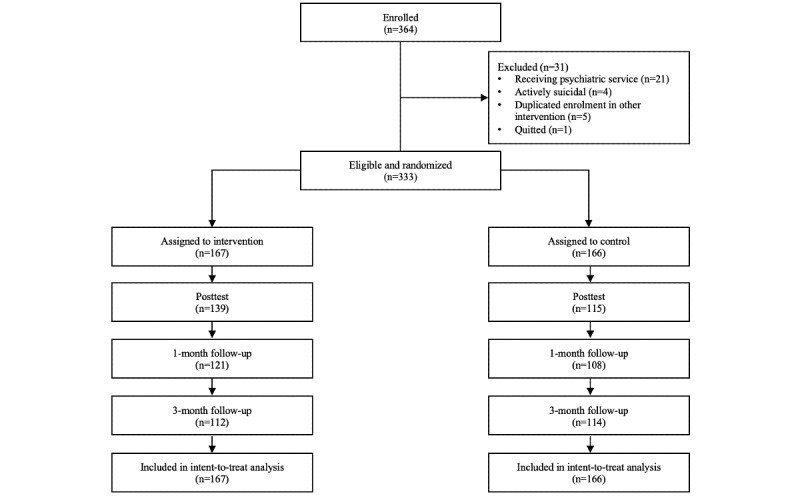
Background: Although text messaging has the potential to be the core intervention modality, it is often used as an adjunct only. To improve health and alleviate the distress related to insomnia, pain, and dysregulated eating of people living in urban areas, text messaging-based mindfulness-based interventions were designed and evaluated in 3 randomized controlled trials.Objective: This study investigated the effectiveness and mediating mechanisms of text messaging-based mindfulness-based interventions for people with distress related to insomnia, pain, or dysregulated eating.Methods: In these trials, 333, 235, and 351 participants were recruited online and randomized to intervention and wait-list control conditions for insomnia, pain, and dysregulated eating, respectively. Participants experienced 21 days of intervention through WhatsApp Messenger. Participants completed pre-, post-, 1-month follow-up, and 3-month follow-up self-report questionnaires online. The retention rates at postmeasurements were 83.2% (139/167), 77.1% (91/118), and 72.9% (129/177) for intervention groups of insomnia, pain, and dysregulated eating, respectively. Participants' queries were answered by a study technician. Primary outcomes included insomnia severity, presleep arousal, pain intensity, pain acceptance, and eating behaviors. Secondary outcomes included mindfulness, depression, anxiety, mental well-being, and functional impairments. Mindfulness, dysfunctional beliefs and attitudes about sleep, pain catastrophizing, and reactivity to food cues were hypothesized to mediate the relationship between the intervention and outcomes.Results: For all 3 studies, the intervention groups showed significant improvement on most outcomes at 1-month follow-up compared to their respective wait-list control groups; some primary outcomes (eg, insomnia, pain, dysregulated eating indicators) and secondary outcomes (eg, depression, anxiety symptoms) were sustained at 3-month follow-up. Medium-to-large effect sizes were found at postassessments in most outcomes in all studies. In the intervention for insomnia, mediation analyses showed that dysfunctional beliefs and attitudes about sleep mediated the effect of the intervention on all primary outcomes and most secondary outcomes at both 1-month and 3-month follow-ups, whereas mindfulness mediated the intervention effect on presleep arousal at 1-month and 3-month follow-ups. In the intervention for pain, pain catastrophizing mediated the effect of intervention on pain intensity and functioning at both 1-month and 3-month follow-ups, whereas mindfulness only mediated the effect of intervention on anxiety and depressive symptoms. In the intervention for dysregulated eating, power of food mediated the effect of intervention on both uncontrolled and emotional eating at both 1-month and 3-month follow-ups and mindfulness was found to mediate the effect on depressive symptoms at both 1-month and 3-month follow-ups.Conclusions: These 3 studies converged and provided empirical evidence that mindfulness-based interventions delivered through text messaging are effective in improving distress related to sleep, pain, and dysregulated eating. Text messaging has the potential to be a core intervention modality to improve various common health outcomes for people living a fast-paced lifestyle.Trial Registration: Clinical Research and Biostatistics Clinical Trials Registry CUHK_CCRB00559; https://tinyurl.com/24rkwarz.
Overview
CoChat Summary
## TL;DR
This paper reports three randomized controlled trials of mindfulness-based interventions delivered through WhatsApp for insomnia, chronic pain, and dysregulated eating. Compared with wait-list controls, the interventions improved most outcomes at 1 month, with some effects sustained at 3 months, and the authors identify condition-specific mediators for each problem area.
## Key findings
- Across all 3 trials, the intervention groups showed significant improvement on most outcomes at 1-month follow-up compared with wait-list controls; some primary and secondary outcomes were sustained at 3 months.
- In the insomnia trial, repeated-measures ANOVA found significant intervention-by-time effects for insomnia severity, somatic and cognitive presleep arousal, dysfunctional beliefs and attitudes about sleep, mindfulness, depression, anxiety, and mental well-being; functional adjustment was not significant.
- In the pain trial, there were significant intervention-by-time effects for pain acceptance, pain catastrophizing, mindfulness, depression, and mental well-being, but not for subjective pain intensity, functional adjustment, or anxiety.
- In the dysregulated eating trial, significant intervention-by-time effects were found for uncontrolled eating, emotional eating, mindfulness, and mental well-being; the paper reports medium-to-large posttest effect sizes in most outcomes across studies, but does not list all values in the text provided.
## Methods
- Three randomized controlled trials were conducted with online recruitment from the general public; 333, 235, and 351 participants were recruited for insomnia, pain, and dysregulated eating, respectively, and randomized to intervention or wait-list control.
- The intervention was a 21-day WhatsApp-delivered mindfulness-based program, with daily audio clips and psychoeducational articles; participants completed online self-report questionnaires at pretest, posttest, 1-month, and 3-month follow-up.
- Analyses used intent-to-treat repeated-measures ANOVA with multiple imputation for missing data, plus path analyses to test mediation by mindfulness and condition-specific reperceiving variables.
## Limitations
- The paper states that a wait-list control was used instead of an active control, so demand characteristics and placebo effects could not be ruled out.
- The study relied solely on self-report measures, which may lack objectivity for sleep, pain, and eating outcomes.
- The authors note limited generalizability because most participants were women, and they also report low questionnaire return rates at 3-month follow-up; these are stated limitations in the paper.
Model-written summary. Check it against the paper before relying on it.
Integrity signals
Registry
Cites
Statistics
Figures


Verification
Claims the paper makes
10 Valid · 0 Not valid · 22 Not checked · 105 Own results and interpretations
The sources with a verdict support this claim; the rest weren’t checked yet, have no full text we could read, or their verdicts aren’t rated yet.
In the paper
“In particular, MBIs were found to be effective in improving insomnia [12,13], pain [14-16], binge eating, and emotional eating [17,18].”
§ Delivering Mindfulness-Based Interventions for Insomnia, Pain, and Dysfunctional Eating Through a Text Messaging App: Three Randomized Controlled Trials Investigating the Effectiveness and Mediating Mechanisms > Introduction > Mindfulness-Based Interventions for Insomnia, Pain, and Dysregulated Eating
What the sources say
- Not checked — no full text of the sourcecites [17] source
- Supportedcites [18] source
The Discussion reports improvements in binge eating in 11 of 12 targeted studies and positive changes in emotional eating in 5 of 8. It describes the evidence for MBIs as strong for binge eating and moderate for emotional eating, supporting the citing sentence's broad claim. (LLM, conf=0.93)
plainstates a cause- Asserted: passes — The authors put it forward as true.
- Checkable: passes — It can be checked against evidence.
- Load-bearing: passes — The paper’s conclusions depend on it.
- Based: passes — The paper gives a reason why it holds.
The cited sources support only part of this claim — read each source’s verdict below.
In the paper
“Meta-analyses showed that MBIs have moderate effect size in reducing stress, psychological distress, depression, and anxiety among healthy individuals [19,20].”
§ Delivering Mindfulness-Based Interventions for Insomnia, Pain, and Dysfunctional Eating Through a Text Messaging App: Three Randomized Controlled Trials Investigating the Effectiveness and Mediating Mechanisms > Introduction > Mindfulness-Based Interventions for Insomnia, Pain, and Dysregulated Eating
What the sources say
- Partly supportedcites [19] sourceExperimental — accuracy not yet measured
The Results (Outcomes; page not available) report moderate average reductions in psychological distress, depression, and anxiety compared with passive controls. The Results (Study characteristics; page not available) identify the Perceived Stress Scale as a common measure of distress, but the paper does not report a separate moderate effect for stress. Its population is adults in nonclinical settings, including higher-risk groups, rather than healthy individuals exclusively. (LLM, conf=0.86)
- Supportedcites [20] source
The Impact of MBPs section (p. 16) reports moderate between-group effects for stress/psychological distress, depression, and anxiety. The meta-analysis studied nonclinical samples, matching the citing sentence’s reference to healthy individuals. (LLM, conf=0.95)
plainstates a cause- Asserted: passes — The authors put it forward as true.
- Checkable: passes — It can be checked against evidence.
- Load-bearing: unclear — It is unclear whether the paper’s conclusions depend on it.
- Based: passes — The paper gives a reason why it holds.
- Partly supported
The cited sources support only part of this claim — read each source’s verdict below.
In the paper
“Up till now, to the best of our knowledge, text messaging is mostly used as a reminder, self-monitoring tool, or as an adjunct to face-to-face intervention instead of being utilized as the core treatment modality, except in a few physical health intervention studies [29,34-38].”
§ Delivering Mindfulness-Based Interventions for Insomnia, Pain, and Dysfunctional Eating Through a Text Messaging App: Three Randomized Controlled Trials Investigating the Effectiveness and Mediating Mechanisms > Introduction > Text Messaging As the Core of Treatment Modality
What the sources say
- Not checked — no full text of the sourcecites [29] source
- Partly supportedcites [34] sourceExperimental — accuracy not yet measured
The review’s Findings report SMS self-monitoring in some weight-loss studies, and its Discussion considers SMS as one approach that could be used in combination with others. But the paper does not establish that text messaging is mostly used for reminders or as an adjunct to face-to-face treatment rather than as the core modality. Its scope is weight-loss interventions, not text-messaging interventions generally. (LLM, conf=0.84)
- Partly supportedcites [35] sourceExperimental — accuracy not yet measured
The Methods section describes text messages as clinic-appointment reminders added to treatment-partner psychoeducation, supporting the claim that messaging can serve as an adjunct rather than the core intervention. The passages provided do not establish that this is how text messaging is mostly used, describe its use for self-monitoring, or identify exceptions in physical-health studies. Page numbers were not supplied. (LLM, conf=0.82)
- Not checked — no full text of the sourcecites [36] source
- Supportedcites [37] source
The Methods > Intervention section describes a seven-day text message-based cervical cancer screening intervention delivered to participants. Face-to-face interviews were used to measure outcomes, not to deliver the intervention. The paper therefore supports its use as an example of a physical-health intervention with text messaging as the core modality; it does not, by itself, establish how commonly other studies used texting only as an adjunct. (LLM, conf=0.91)
- Partly supportedcites [38] sourceExperimental — accuracy not yet measured
The Methods (Educational Intervention; page unavailable) describe WhatsApp messages as the intervention for breast-cancer education, supporting this paper as an example of a messaging-based physical-health intervention. The Discussion (Use of WhatsApp; page unavailable) also describes other uses as communication rather than education. It does not establish that text messaging is mostly used for reminders, self-monitoring, or adjuncts to face-to-face treatment, and this study concerns education rather than treatment. (LLM, conf=0.82)
hedged- Asserted: passes — The authors put it forward as true.
- Checkable: passes — It can be checked against evidence.
- Load-bearing: passes — The paper’s conclusions depend on it.
- Based: passes — The paper gives a reason why it holds.
A result the paper reports from its own data — it cites no other source for it, so there is none to check. The quote shows it is in the paper.
In the paper
“For all 3 studies, the intervention groups showed significant improvement on most outcomes at 1-month follow-up compared to their respective wait-list control groups”
§ Delivering Mindfulness-Based Interventions for Insomnia, Pain, and Dysfunctional Eating Through a Text Messaging App: Three Randomized Controlled Trials Investigating the Effectiveness and Mediating Mechanisms > Abstract > Results
plainstates a cause- Asserted: passes — The authors put it forward as true.
- Checkable: passes — It can be checked against evidence.
- Load-bearing: passes — The paper’s conclusions depend on it.
- Based: passes — The paper gives a reason why it holds.
A result the paper reports from its own data — it cites no other source for it, so there is none to check. The quote shows it is in the paper.
In the paper
“Medium-to-large effect sizes were found at postassessments in most outcomes in all studies.”
§ Delivering Mindfulness-Based Interventions for Insomnia, Pain, and Dysfunctional Eating Through a Text Messaging App: Three Randomized Controlled Trials Investigating the Effectiveness and Mediating Mechanisms > Abstract > Results
plain- Asserted: passes — The authors put it forward as true.
- Checkable: passes — It can be checked against evidence.
- Load-bearing: passes — The paper’s conclusions depend on it.
- Based: passes — The paper gives a reason why it holds.
88 more claims
Create a free account to see all 137 claims and every source verdict.
- Probably not a substantial claim. 23
- It may state two separate claims as one. 26
Citations
Cites
The PHQ-9: Validity of a brief depression severity measure
Kroenke, K., Spitzer, R. L., & Williams, J. B. W. (2001) · Journal of General Internal Medicine · doi:10.1046/j.1525-1497.2001.016009606.x · Cited by 44,910
A Brief Measure for Assessing Generalized Anxiety Disorder: The GAD-7
Spitzer, R. L., Kroenke, K., Williams, J. B. W., & Löwe, B. (2006) · Archives of Internal Medicine · doi:10.1001/archinte.166.10.1092 · Cited by 31,765
Multiple Imputation for Nonresponse in Surveys
Rubin, D. B. (1987) · Wiley Series in Probability and Statistics · doi:10.1002/9780470316696 · Cited by 20,701
The benefits of being present: Mindfulness and its role in psychological well-being
Brown, K. W., & Ryan, R. M. (2003) · Journal of Personality and Social Psychology · doi:10.1037/0022-3514.84.4.822 · Cited by 13,448
The Pain Catastrophizing Scale: Development and validation.
Sullivan, M. J. L., Bishop, S. R., & Pivik, J. (1995) · Psychological Assessment · doi:10.1037//1040-3590.7.4.524 · Cited by 8,227
Validation of the Insomnia Severity Index as an outcome measure for insomnia research
Bastien, C. (2001) · Sleep Medicine · doi:10.1016/s1389-9457(00)00065-4 · Cited by 8,067 · cited 1×
“Severity of insomnia was measured with the Insomnia Severity Index [45].”
Hawker, G. A., Mian, S., Kendzerska, T., & French, M. (2011) · Arthritis Care & Research · doi:10.1002/acr.20543 · Cited by 4,924
The WHO-5 well-being index: A systematic review of the literature
Topp, C. W., Østergaard, S. D., Søndergaard, S., & Bech, P. (2015) · Psychotherapy and Psychosomatics · doi:10.1159/000376585 · Cited by 4,708
Shapiro, S. L., Carlson, L. E., Astin, J. A., & Freedman, B. (2006) · Journal of Clinical Psychology · doi:10.1002/jclp.20237 · Cited by 4,002
The Work and Social Adjustment Scale: a simple measure of impairment in functioning
Mundt, J. C., Marks, I. M., Shear, M. K., & Greist, J. M. (2002) · British Journal of Psychiatry · doi:10.1192/bjp.180.5.461 · Cited by 2,515
Research works printed but not linked: 4
- Hafner, M, 2017, Rand Health Q, 6, 11
- Kabat-Zinn, J, 2001, Mindfulness Meditation for Everyday Life
- Hong, YW, 2017, Efficacy of a Valued Living Program Delivered Through Instant Messaging Application in Promoting Mental Well-being of College Students in Hong Kong [master thesis]
- Kabat-Zinn, J, 2013, Full Catastrophe Living, Revised Edition: How to Cope with Stress, Pain and Illness Using Mindfulness Meditation
Cited by
Linardon, J., Messer, M., Goldberg, S. B., & Fuller‐Tyszkiewicz, M. (2023) · Clinical Psychology Review · doi:10.1016/j.cpr.2023.102370 · Cited by 102
Cheung, R. Y. M., Chan, S. K. C., Chui, H. T., Chan, W. M., & Ngai, S. Y. S. (2022) · Mindfulness · doi:10.1007/s12671-022-01998-1 · Cited by 29
“, 2021; see also Maltz, 1969) and health outcomes (Li et al., 2022).”
BackgroundSocial-Media-Based Mental Health Interventions: Meta-Analysis of Randomized Controlled Trials
Zhang, Q., Huang, Z., Sui, Y., Lin, F.-H., Guan, H., Li, L., Wang, K., & Neitzel, A. J. (2025) · Journal of Medical Internet Research · doi:10.2196/67953 · Cited by 16
Digital mental health interventions in Chinese: a scoping review
Liu, Y., Shen, V. W., Jaime, E., Zheng, W. Y., Han, J., & Hall, B. J. (2025) · npj Digital Medicine · doi:10.1038/s41746-025-02129-5 · Cited by 5
Ryan, E. C., O'Neill, D., & Smyth, S. (2025) · Journal of Contextual Behavioral Science · doi:10.1016/j.jcbs.2025.100871 · Cited by 8
Metadata
- Authors
- Li, A. C., Wong, K. K., Chio, F. H., Mak, W. W., & Poon, L. W.
- Affiliations
- Chinese University of Hong Kong (HK)
- Hong Kong Shue Yan University (CN)
- Corresponding author
- Mak, Winnie WS
- Venue
- Journal of Medical Internet Research
- Publisher
- JMIR Publications Inc.
- Published
- 2022-05-03
- Volume
- 24
- Issue
- 5
- Pages
- e30073
- ISSN
- 1438-8871 (ISSN-L)
- PMC
- PMC9115660
- OpenAlex
- W4225319079
- Cited by
- 17
- References
- 73
- Citations by year
- 2026: 2 · 2025: 9 · 2024: 3 · 2023: 1 · 2022: 2
- FWCI
- 3.42
- Type
- journal article
- Language
- en
- Open access
- gold
- doi.org
- Licence
- cc-by
- Locations
- Journal of Medical Internet Research (publishedVersion, cc-by)
- PubMed Central (publishedVersion, cc-by)
- PubMed (publishedVersion)
- DOAJ (DOAJ: Directory of Open Access Journals) (submittedVersion)
- Topics
- Social Sciences › Psychology › Clinical Psychology › Mindfulness and Compassion Interventions
- Social Sciences › Psychology › Applied Psychology › Digital Mental Health Interventions
- Health Sciences › Health Professions › General Health Professions › Mobile Health and mHealth Applications
- Keywords
- text messaging, mobile health, insomnia, pain, dysregulated eating, dysfunctional beliefs about sleep, pain catastrophizing, food cue reactivity, mindfulness, pain acceptance, dietary habits, depression, anxiety, mediation, WhatsApp Messenger, urban population, intervention retention, psychological well-being, functional disability, eating disorder prevention
- MeSH terms
- Humans, Sleep Initiation and Maintenance Disorders, Pain, Randomized Controlled Trials as Topic, Text Messaging, Mobile Applications, Mindfulness
About these checks
Registry, retraction, Cites and statistics results are computed, not judged, with one exception: a printed reference that no index lists is read once by a model before it counts as a citation error. Claims are extracted by a model and kept only when their quote appears verbatim in the text; each cited source is then checked, with a model’s help, for whether it says what the claim relies on. Those verdicts can be wrong — read the claim’s quote and the cited source before relying on one.
The claim verdicts this report counts are experimental: their accuracy is not yet measured.
A language model drew the claims from the paper on 2026-10-11, under version 3 of the claim definition (model deepseek-v4.1-flash, prompt extract-v3).
A second model labelled each claim on 2026-10-11 (model jev-1.13-20260917, definition revision gold-guideline-v0.2).
Cited sources are checked with a language model’s help (gpt-6-sol).
Statistics and arithmetic are recomputed, not judged.
Confidence bands are shown only for fields calibrated on our annotated test set. None is calibrated yet, so no band is shown.
What counts as a claim ›How we measure confidence ›How we check this ›
Are you an author, or do you see a problem with this page? Request a review
How to cite
Cite CoChat for the checks on this page, and the paper for its own findings.
- This page
- CoChat. (2026). Citation check: Delivering Mindfulness-Based Interventions for Insomnia, Pain, and Dysfunctional Eating Through a Text Messaging App: Three Randomized Controlled Trials Investigating the Effectiveness and Mediating Mechanisms. https://app.cochat.ai/papers/10.2196/30073
- The paper
- Li, A. C., Wong, K. K., Chio, F. H., Mak, W. W., & Poon, L. W. (2022). Delivering Mindfulness-Based Interventions for Insomnia, Pain, and Dysfunctional Eating Through a Text Messaging App: Three Randomized Controlled Trials Investigating the Effectiveness and Mediating Mechanisms. Journal of Medical Internet Research. https://doi.org/10.2196/30073
Data sources
Bibliographic data: Semantic Scholar, OpenAlex, Crossref.
Contains information from the Semantic Scholar Academic Graph Datasets, made available under the ODC Attribution License (ODC-BY 1.0).
Semantic Scholar’s data is described in: Kinney, R., et al. (2023). The Semantic Scholar Open Data Platform. arXiv:2301.10140.
