

mHealth Solutions for Perinatal Mental Health: Scoping Review and Appraisal Following the mHealth Index and Navigation Database Framework
Open accessPublished version of a preprint
The DOI matches its Crossref record; 84 of the 84 references it cites were found in a registry or an index.
Abstract
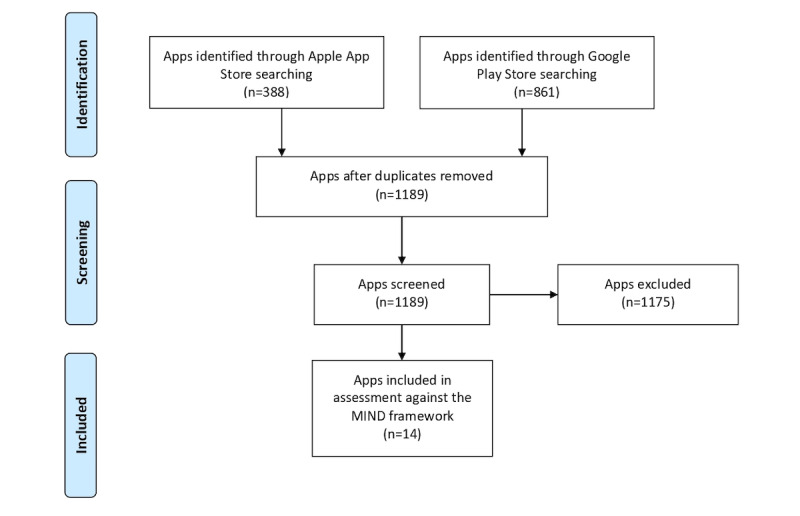
BACKGROUND: The ever-increasing pressure on health care systems has resulted in the underrecognition of perinatal mental disorders. Digital mental health tools such as apps could provide an option for accessible perinatal mental health screening and assessment. However, there is a lack of information regarding the availability and features of perinatal app options. OBJECTIVE: This study aims to evaluate the current state of diagnostic and screening apps for perinatal mental health available on the Google Play Store (Android) and Apple App Store (iOS) and to review their features following the mHealth Index and Navigation Database framework. METHODS: Following a scoping review approach, the Apple App Store and Google Play Store were systematically searched to identify perinatal mental health assessment apps. A total of 14 apps that met the inclusion criteria were downloaded and reviewed in a standardized manner using the mHealth Index and Navigation Database framework. The framework comprised 107 questions, allowing for a comprehensive assessment of app origin, functionality, engagement features, security, and clinical use. RESULTS: Most apps were developed by for-profit companies (n=10), followed by private individuals (n=2) and trusted health care companies (n=2). Out of the 14 apps, 3 were available only on Android devices, 4 were available only on iOS devices, and 7 were available on both platforms. Approximately one-third of the apps (n=5) had been updated within the last 180 days. A total of 12 apps offered the Edinburgh Postnatal Depression Scale in its original version or in rephrased versions. Engagement, input, and output features included reminder notifications, connections to therapists, and free writing features. A total of 6 apps offered psychoeducational information and references. Privacy policies were available for 11 of the 14 apps, with a median Flesch-Kincaid reading grade level of 12.3. One app claimed to be compliant with the Health Insurance Portability and Accountability Act standards and 2 apps claimed to be compliant with General Data Protection Regulation. Of the apps that could be accessed in full (n=10), all appeared to fulfill the claims stated in their description. Only 1 app referenced a relevant peer-reviewed study. All the apps provided a warning for use, highlighting that the mental health assessment result should not be interpreted as a diagnosis or as a substitute for medical care. Only 3 apps allowed users to export or email their mental health test results. CONCLUSIONS: These results indicate that there are opportunities to improve perinatal mental health assessment apps. To this end, we recommend focusing on the development and validation of more comprehensive assessment tools, ensuring data protection and safety features are adequate for the intended app use, and improving data sharing features between users and health care professionals for timely support.
Overview
The claims and statistics of this paper haven’t been checked yet.
Free: it reads the open-access text and checks the first 5 claims that cite a source we can check. Create a free account to check every claim.
Integrity signals
Registry
Cites
Statistics
Figures
Verification
Claims the paper makes
The claims and statistics of this paper haven’t been checked yet.
Free: it reads the open-access text and checks the first 5 claims that cite a source we can check. Create a free account to check every claim.
Claims other papers make about this one
Each is checked against this paper’s own text: does it say what the citing paper says it does?
The cited source says what the claim attributes to it.
In the citing paper
“Internet-based interventions could alleviate some pressure put on in-person health care services and overcome barriers to help-seeking, providing an alternative or complementary option for widespread perinatal mental health care provision (Spadaro et al., 2022).”
From App-based intervention for reducing depressive symptoms in postpartum women: Protocol for a feasibility randomized controlled trial (2023) · cites this paper as Spadaro et al., 2022
Self-check
Percentages, sums and reported differences re-computed from the paper’s own numbers.
The self-check needs the paper’s full text.
Citations
Cites
Preferred Reporting Items for Systematic Reviews and Meta-Analyses: the PRISMA statement
Moher, D., Liberati, A., Tetzlaff, J., Altman, D. G., & for the PRISMA Group (2009) · BMJ · doi:10.1136/bmj.b2535 · Cited by 83,823
Preferred Reporting Items for Systematic Reviews and Meta-Analyses: The PRISMA Statement
Moher, D., Liberati, A., Tetzlaff, J., Altman, D. G., & The PRISMA Group (2009) · PLoS Medicine · doi:10.1371/journal.pmed.1000097 · Cited by 64,042
PRISMA Extension for Scoping Reviews (PRISMA-ScR): Checklist and Explanation
Tricco, A. C., Lillie, E., Zarin, W., O'Brien, K. K., Colquhoun, H., Levac, D., Moher, D., Peters, M. D. J., Horsley, T., Weeks, L., et al. (2018) · Annals of Internal Medicine · doi:10.7326/m18-0850 · Cited by 43,565 · cited 1×
“We reported the review following the PRISMA-ScR (Preferred Reporting Items for Systematic Reviews and Meta-Analyses extension for Scoping Reviews) guidelines (Multimedia Appendix 1) [40].”
MethodA Brief Measure for Assessing Generalized Anxiety Disorder: The GAD-7
Spitzer, R. L., Kroenke, K., Williams, J. B. W., & Löwe, B. (2006) · Archives of Internal Medicine · doi:10.1001/archinte.166.10.1092 · Cited by 31,765 · cited 1×
“In addition to the EPDS, 1 app included the Patient Health Questionnaire–8-item scale [45], the Generalized Anxiety Disorder 7-item scale [46], the Insomnia Severity Index [47,48], the Perceived Stress Index [49], and questions about PTSD from the Mini-International Neuropsychiatric Interview [50] with attribution to…”
MethodDetection of Postnatal Depression: Development of the 10-item Edinburgh Postnatal Depression Scale
Cox, J. L., Holden, J. M., & Sagovsky, R. (1987) · British Journal of Psychiatry · doi:10.1192/bjp.150.6.782 · Cited by 14,183
(1998) · PubMed · Cited by 10,216
Validation of the Insomnia Severity Index as an outcome measure for insomnia research
Bastien, C. (2001) · Sleep Medicine · doi:10.1016/s1389-9457(00)00065-4 · Cited by 8,067 · cited 2×
“In addition to the EPDS, 1 app included the Patient Health Questionnaire–8-item scale [45], the Generalized Anxiety Disorder 7-item scale [46], the Insomnia Severity Index [47,48], the Perceived Stress Index [49], and questions about PTSD from the Mini-International Neuropsychiatric Interview [50] with attribution to…”
MethodFlesch, R. (1948) · Journal of Applied Psychology · doi:10.1037/h0057532 · Cited by 5,391 · cited 1×
“Reading level of the privacy policies of apps was calculated using an automatic text readability checker [41], as indicated in the MIND framework, resulting in a Flesh-Kincaid grade level [42], indicating a readability score corresponding to the US education grade level required for the reader to understand the text.”
MethodThe PHQ-8 as a measure of current depression in the general population
Kroenke, K., Strine, T. W., Spitzer, R. L., Williams, J. B. W., Berry, J. T., & Mokdad, A. H. (2009) · Journal of Affective Disorders · doi:10.1016/j.jad.2008.06.026 · Cited by 5,121 · cited 1×
“In addition to the EPDS, 1 app included the Patient Health Questionnaire–8-item scale [45], the Generalized Anxiety Disorder 7-item scale [46], the Insomnia Severity Index [47,48], the Perceived Stress Index [49], and questions about PTSD from the Mini-International Neuropsychiatric Interview [50]…”
MethodMorin, C. M., Belleville, G., Bélanger, L., & Ivers, H. (2011) · Sleep · doi:10.1093/sleep/34.5.601 · Cited by 4,620 · cited 2×
“In addition to the EPDS, 1 app included the Patient Health Questionnaire–8-item scale [45], the Generalized Anxiety Disorder 7-item scale [46], the Insomnia Severity Index [47,48], the Perceived Stress Index [49], and questions about PTSD from the Mini-International Neuropsychiatric Interview [50] with attribution to…”
Method
Research works printed but not linked: 1
- Anderson J Michalak E Lam R Depression in primary care: tools for screening, diagnosis, and measuring response to treatment BC Med J 2002 44 8 415 9
Cited by
Ur Rehman, M., Shafique, A., Azhar, Q.-U.-A., Jamal, S. S., Gheraibia, Y., & Usman, A. B. (2024) · Engineering Applications of Artificial Intelligence · doi:10.1016/j.engappai.2024.108047 · Cited by 73
Whitworth, K., Donnellan-Fernandez, R. E., & Fleet, J. (2023) · Women and Birth · doi:10.1016/j.wombi.2023.08.008 · Cited by 35
Lazarevic, N., Lecoq, M., Bœhm, C., & Caillaud, C. (2023) · International Journal of Environmental Research and Public Health · doi:10.3390/ijerph20021012 · Cited by 30
Exploring how informed mental health app selection may impact user engagement and satisfaction
Kopka, M., Camacho, E., Kwon, S., & Torous, J. B. (2023) · PLOS Digital Health · doi:10.1371/journal.pdig.0000219 · Cited by 31
Mobile health applications for self-management in chronic lung disease: a systematic review
Quach, S., Michaelchuk, W. W., Benoit, A., Oliveira, A., Packham, T., Goldstein, R. S., & Brooks, D. (2023) · Network Modeling Analysis in Health Informatics and Bioinformatics · doi:10.1007/s13721-023-00419-0 · Cited by 29
“Of all the available app evaluation tools that exist, the MIND framework demonstrated in this review and in the mental health space (Spadaro et al. 2022), that its extensive comprehensiveness can likely ensure all potential domains of app quality are accounted for (Lagan et al. 2020, 2021).”
Method
Metadata
- Authors
- Spadaro, B., Martin-Key, N. A., Funnell, E., & Bahn, S.
- Affiliations
- University of Cambridge (GB)
- Corresponding author
- Bahn, Sabine
- Venue
- JMIR mhealth and uhealth
- Publisher
- JMIR Publications Inc.
- Published
- 2022-01-17
- Volume
- 10
- Issue
- 1
- Pages
- e30724
- ISSN
- 2291-5222 (ISSN-L)
- PMC
- PMC8804959
- OpenAlex
- W3216104880
- Cited by
- 34
- References
- 84
- Citations by year
- 2026: 6 · 2025: 8 · 2024: 8 · 2023: 12
- FWCI
- 0.80
- Type
- journal article
- Language
- en
- Open access
- gold
- doi.org
- Licence
- cc-by
- Locations
- JMIR mhealth and uhealth (publishedVersion, cc-by)
- PubMed Central (publishedVersion, cc-by)
- PubMed (publishedVersion)
- DOAJ (DOAJ: Directory of Open Access Journals) (acceptedVersion)
- Funders
- Stanley Medical Research Institute (07R-1888)
- Topics
- Social Sciences › Psychology › Applied Psychology › Digital Mental Health Interventions
- Health Sciences › Medicine › Public Health, Environmental and Occupational Health › Maternal Mental Health During Pregnancy and Postpartum
- Health Sciences › Health Professions › General Health Professions › Mobile Health and mHealth Applications
- Keywords
- perinatal mental health, mobile health apps, perinatal depression screening, Edinburgh Postnatal Depression Scale, digital mental health tools, privacy policies, data protection compliance, psychoeducation
- MeSH terms
- Delivery of Health Care, Humans, Mental Health, Databases, Factual, Telemedicine, Mobile Applications
About these checks
Registry, retraction, Cites and statistics results are computed, not judged, with one exception: a printed reference that no index lists is read once by a model before it counts as a citation error. Claims are extracted by a model and kept only when their quote appears verbatim in the text; each cited source is then checked, with a model’s help, for whether it says what the claim relies on. Those verdicts can be wrong — read the claim’s quote and the cited source before relying on one.
Statistics and arithmetic are recomputed, not judged.
Confidence bands are shown only for fields calibrated on our annotated test set. None is calibrated yet, so no band is shown.
What counts as a claim ›How we measure confidence ›How we check this ›
Are you an author, or do you see a problem with this page? Request a review
How to cite
Cite CoChat for the checks on this page, and the paper for its own findings.
- This page
- CoChat. (2026). Citation check: mHealth Solutions for Perinatal Mental Health: Scoping Review and Appraisal Following the mHealth Index and Navigation Database Framework. https://app.cochat.ai/papers/10.2196/30724
- The paper
- Spadaro, B., Martin-Key, N. A., Funnell, E., & Bahn, S. (2022). mHealth Solutions for Perinatal Mental Health: Scoping Review and Appraisal Following the mHealth Index and Navigation Database Framework. JMIR mhealth and uhealth. https://doi.org/10.2196/30724
Data sources
Bibliographic data: Semantic Scholar, OpenAlex, Crossref.
Contains information from the Semantic Scholar Academic Graph Datasets, made available under the ODC Attribution License (ODC-BY 1.0).
Semantic Scholar’s data is described in: Kinney, R., et al. (2023). The Semantic Scholar Open Data Platform. arXiv:2301.10140.
