

Predicting acceptance of e-mental health interventions in patients with obesity by using an extended unified theory of acceptance model: Cross-sectional study
Open accessPublished version of a preprint
The DOI matches its Crossref record; 59 of the 59 references it cites were found in a registry or an index.
Abstract
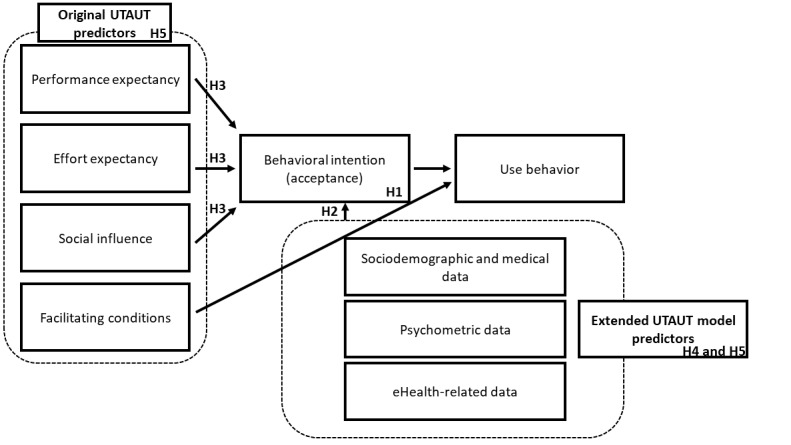
BACKGROUND The rapid increase in the number of people who are overweight and obese is a worldwide health problem. Obesity is often associated with physiological and mental health burdens. Owing to several barriers to face-to-face psychotherapy, a promising approach is to exploit recent developments and implement innovative e–mental health interventions that offer various benefits to patients with obesity and to the health care system. OBJECTIVE This study aims to assess the acceptance of e–mental health interventions in patients with obesity and explore its influencing predictors. In addition, the well-established Unified Theory of Acceptance and Use of Technology (UTAUT) model is compared with an extended UTAUT model in terms of variance explanation of acceptance. METHODS A cross-sectional web-based survey study was conducted from July 2020 to January 2021 in Germany. Eligibility requirements were adult age (≥18 years), internet access, good command of the German language, and BMI >30 kg/m2 (obesity). A total of 448 patients with obesity (grades I, II, and III) were recruited via specialized social media platforms. The impact of various sociodemographic, medical, and mental health characteristics was assessed. eHealth-related data and acceptance of e–mental health interventions were examined using a modified questionnaire based on the UTAUT. RESULTS Overall, the acceptance of e–mental health interventions in patients with obesity was moderate (mean 3.18, SD 1.11). Significant differences in the acceptance of e–mental health interventions among patients with obesity exist, depending on the grade of obesity, age, sex, occupational status, and mental health status. In an extended UTAUT regression model, acceptance was significantly predicted by the depression score (Patient Health Questionnaire-8; β=.07; P=.03), stress owing to constant availability via mobile phone or email (β=.06; P=.02), and confidence in using digital media (β=−0.058; P=.04) and by the UTAUT core predictors performance expectancy (β=.45; P<.001), effort expectancy (β=.22; P<.001), and social influence (β=.27; P<.001). The comparison between an extended UTAUT model (16 predictors) and the restrictive UTAUT model (performance expectancy, effort expectancy, and social influence) revealed a significant difference in explained variance (F13,431=2.366; P=.005). CONCLUSIONS The UTAUT model has proven to be a valuable instrument to predict the acceptance of e–mental health interventions in patients with obesity. The extended UTAUT model explained a significantly high percentage of variance in acceptance (in total 73.6%). On the basis of the strong association between acceptance and future use, new interventions should focus on these UTAUT predictors to promote the establishment of effective e–mental health interventions for patients with obesity who experience mental health burdens.
Overview
The claims and statistics of this paper haven’t been checked yet.
Free: it reads the open-access text and checks the first 5 claims that cite a source we can check. Create a free account to check every claim.
Integrity signals
Registry
Cites
Statistics
Figures
Verification
Claims the paper makes
The claims and statistics of this paper haven’t been checked yet.
Free: it reads the open-access text and checks the first 5 claims that cite a source we can check. Create a free account to check every claim.
Claims other papers make about this one
Each is checked against this paper’s own text: does it say what the citing paper says it does?
The cited source says what the claim attributes to it.
In the citing paper
“the user acceptance for eHealth modalities is a vital precondition for such interventions to be effective and integrated in clinical settings (52).”
From Efficacy of eHealth interventions to reduce depression symptoms in individuals with obesity: a systematic review of randomized controlled trials (2024) · cites this paper as [52]
Self-check
Percentages, sums and reported differences re-computed from the paper’s own numbers.
The self-check needs the paper’s full text.
Citations
Cites
Perceived usefulness, perceived ease of use, and user acceptance of information technology
Davis, F. D. (1989) · MIS Quarterly · doi:10.2307/249008 · Cited by 68,483
User Acceptance of Information Technology: Toward A Unified View1
Venkatesh, V., Morris, M. G., Davis, G. B., & Davis, F. D. (2003) · MIS Quarterly · doi:10.2307/30036540 · Cited by 45,035
(2000) · PubMed · Cited by 13,173
Ng, M., Fleming, T., Robinson, M., Thomson, B., Graetz, N., Margono, C., Mullany, E. C., Biryukov, S., Abbafati, C., Abera, S. F., et al. (2014) · The Lancet · doi:10.1016/s0140-6736(14)60460-8 · Cited by 11,952
The PHQ-8 as a measure of current depression in the general population
Kroenke, K., Strine, T. W., Spitzer, R. L., Williams, J. B. W., Berry, J. T., & Mokdad, A. H. (2009) · Journal of Affective Disorders · doi:10.1016/j.jad.2008.06.026 · Cited by 5,121
Overweight, Obesity, and Depression: A Systematic Review and Meta-analysis of Longitudinal Studies
Luppino, F. S., de Wit, L. M., Bouvy, P. F., Stijnen, T., Cuijpers, P., Penninx, B. W. J. H., & Zitman, F. G. (2010) · Archives of General Psychiatry · doi:10.1001/archgenpsychiatry.2010.2 · Cited by 4,322
What Reviewers Should Expect from Authors Regarding Common Method Bias in Organizational Research
Conway, J. M., & Lance, C. E. (2010) · Journal of Business and Psychology · doi:10.1007/s10869-010-9181-6 · Cited by 2,392
Obesity Stigma: Important Considerations for Public Health
Puhl, R. M., & Heuer, C. A. (2010) · American Journal of Public Health · doi:10.2105/ajph.2009.159491 · Cited by 1,917
Andersson, G., Cuijpers, P., Carlbring, P., Riper, H., & Hedman, E. (2014) · World Psychiatry · doi:10.1002/wps.20151 · Cited by 1,077
Morbidity and mortality associated with obesity
Abdelaal, M., le Roux, C. W., & Docherty, N. G. (2017) · Annals of Translational Medicine · doi:10.21037/atm.2017.03.107 · Cited by 1,052
Research works printed but not linked: 3
- Thiel A Paul T Entwicklung einer deutschsprachigen Version des Eating-Disorder-Inventory (EDI) [Development of a German-language version of the Eating Disorder Inventory (EDI)] Zeitschrift für Differentielle und Diagnostische Psychologie 1988 9 4 267 78
- Alam M Wang H Zapan B Using the UTAUT model to determine factors affecting acceptance and use of mobile health (mHealth) services in Bangladesh J Stud Soc Sci 2018 17 2 137 72
- Taiwo A Downe AG The theory of user acceptance and use of technology (UTAUT): a meta-analytic review of empirical findings J Theoretical Applied Inf Technol 2013 49 1 48 58
Cited by
Bäuerle, A., Mallien, C., Rassaf, T., Jahre, L. M., Rammos, C., Skoda, E., Teufel, M., & Lortz, J. (2023) · Journal of Cardiovascular Development and Disease · doi:10.3390/jcdd10040174 · Cited by 36
Stoppok, P., Teufel, M., Jahre, L. M., Rometsch, C., Müßgens, D., Bingel, U., Skoda, E., & Bäuerle, A. (2022) · JMIR Formative Research · doi:10.2196/37682 · Cited by 29
Drivers and barriers of patients’ acceptance of video consultation in cancer care
Nurtsch, A., Teufel, M., Jahre, L. M., Esber, A., Rausch, R., Tewes, M., Schöbel, C., Palm, S., Schüler, M., Schadendorf, D., et al. (2024) · Digital Health · doi:10.1177/20552076231222108 · Cited by 37
Bäuerle, A., Frewer, A.-L., Rentrop, V., Schüren, L. C., Niedergethmann, M., Lortz, J., Skoda, E., & Teufel, M. (2022) · Nutrients · doi:10.3390/nu14091968 · Cited by 29
Schröder, J., Bäuerle, A., Jahre, L. M., Skoda, E., Stettner, M., Kleinschnitz, C., Teufel, M., & Dinse, H. (2023) · Therapeutic Advances in Neurological Disorders · doi:10.1177/17562864231175730 · Cited by 27
Metadata
- Authors
- Rentrop, V., Damerau, M., Schweda, A., Steinbach, J., Schüren, L. C., Niedergethmann, M., Skoda, E.-M., Teufel, M., & Bäuerle, A.
- Affiliations
- Essen University Hospital (DE)
- Alfried Krupp Hospital (DE)
- Corresponding author
- Rentrop, Vanessa
- ORCID
- Venue
- JMIR Formative Research
- Publisher
- JMIR Publications Inc.
- Published
- 2022-03-17
- Volume
- 6
- Issue
- 3
- Pages
- e31229
- ISSN
- 2561-326X (ISSN-L)
- PMC
- PMC8972105
- OpenAlex
- W4200188339
- Cited by
- 42
- References
- 59
- Citations by year
- 2026: 5 · 2025: 9 · 2024: 18 · 2023: 5 · 2022: 5
- FWCI
- 6.29
- Type
- journal article
- Language
- en
- Open access
- gold
- doi.org
- Licence
- cc-by
- Locations
- JMIR Formative Research (publishedVersion, cc-by)
- PubMed Central (publishedVersion, cc-by)
- PubMed (publishedVersion)
- Universitätsbibliographie, Universität Duisburg-Essen (submittedVersion)
- DOAJ (DOAJ: Directory of Open Access Journals) (submittedVersion)
- DuEPublico (University of Duisburg-Essen) (submittedVersion, cc-by)
- Topics
- Social Sciences › Psychology › Applied Psychology › Digital Mental Health Interventions
- Health Sciences › Medicine › Public Health, Environmental and Occupational Health › Telemedicine and Telehealth Implementation
- Health Sciences › Health Professions › General Health Professions › Mobile Health and mHealth Applications
- Keywords
- digital mental health interventions, obesity, technology acceptance, UTAUT, extended UTAUT model, performance expectancy, effort expectancy, social influence, depression, perceived stress, e-health
About these checks
Registry, retraction, Cites and statistics results are computed, not judged, with one exception: a printed reference that no index lists is read once by a model before it counts as a citation error. Claims are extracted by a model and kept only when their quote appears verbatim in the text; each cited source is then checked, with a model’s help, for whether it says what the claim relies on. Those verdicts can be wrong — read the claim’s quote and the cited source before relying on one.
Statistics and arithmetic are recomputed, not judged.
Confidence bands are shown only for fields calibrated on our annotated test set. None is calibrated yet, so no band is shown.
What counts as a claim ›How we measure confidence ›How we check this ›
Are you an author, or do you see a problem with this page? Request a review
Data sources
Bibliographic data: Semantic Scholar, OpenAlex, Crossref.
Contains information from the Semantic Scholar Academic Graph Datasets, made available under the ODC Attribution License (ODC-BY 1.0).
Semantic Scholar’s data is described in: Kinney, R., et al. (2023). The Semantic Scholar Open Data Platform. arXiv:2301.10140.
