

The DOI matches its Crossref record; 44 of the 44 references it cites were found in a registry or an index.
Development of a Web-Based, Guided Self-help, Acceptance and Commitment Therapy–Based Intervention for Weight Loss Maintenance: Evidence-, Theory-, and Person-Based Approach
Open accessPublished version of a preprint
Abstract
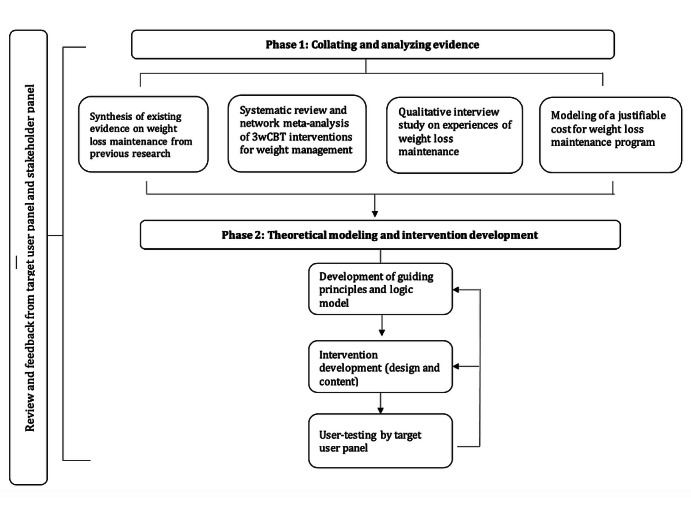
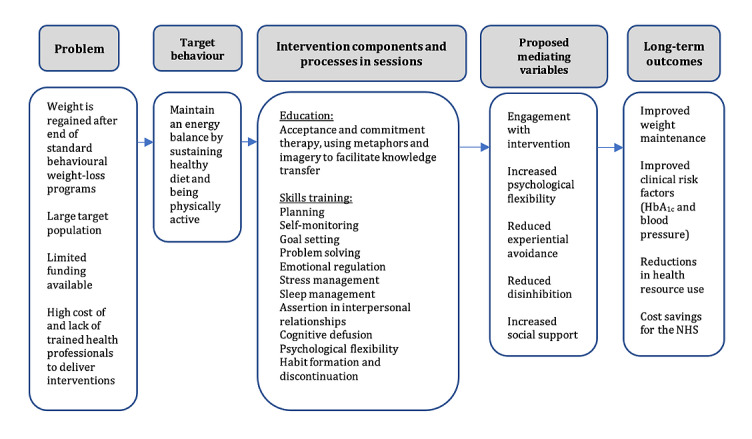
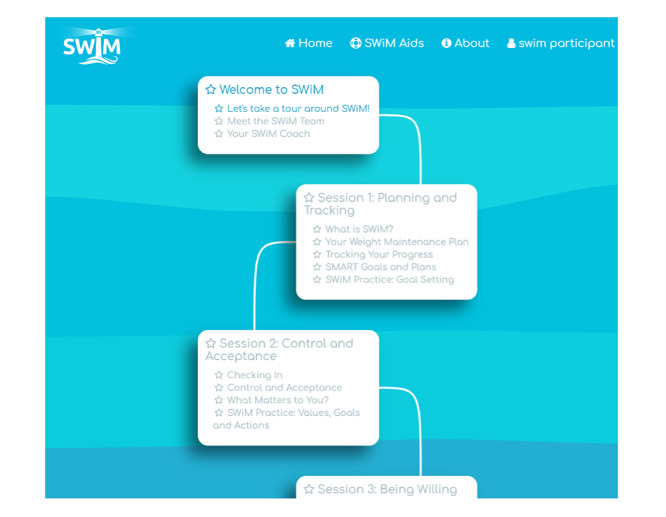
Background: The long-term impact and cost-effectiveness of weight management programs depend on posttreatment weight maintenance. There is growing evidence that interventions based on third-wave cognitive behavioral therapy, particularly acceptance and commitment therapy (ACT), could improve long-term weight management; however, these interventions are typically delivered face-to-face by psychologists, which limits the scalability of these types of intervention. Objective: The aim of this study is to use an evidence-, theory-, and person-based approach to develop an ACT-based intervention for weight loss maintenance that uses digital technology and nonspecialist guidance to minimize the resources needed for delivery at scale. Methods: Intervention development was guided by the Medical Research Council framework for the development of complex interventions in health care, Intervention Mapping Protocol, and a person-based approach for enhancing the acceptability and feasibility of interventions. Work was conducted in two phases: phase 1 consisted of collating and analyzing existing and new primary evidence and phase 2 consisted of theoretical modeling and intervention development. Phase 1 included a synthesis of existing evidence on weight loss maintenance from previous research, a systematic review and network meta-analysis of third-wave cognitive behavioral therapy interventions for weight management, a qualitative interview study of experiences of weight loss maintenance, and the modeling of a justifiable cost for a weight loss maintenance program. Phase 2 included the iterative development of guiding principles, a logic model, and the intervention design and content. Target user and stakeholder panels were established to inform each phase of development, and user testing of successive iterations of the prototype intervention was conducted. Results: This process resulted in a guided self-help ACT-based intervention called SWiM (Supporting Weight Management). SWiM is a 4-month program consisting of weekly web-based sessions for 13 consecutive weeks followed by a 4-week break for participants to reflect and practice their new skills and a final session at week 18. Each session consists of psychoeducational content, reflective exercises, and behavioral experiments. SWiM includes specific sessions on key determinants of weight loss maintenance, including developing skills to manage high-risk situations for lapses, creating new helpful habits, breaking old unhelpful habits, and learning to manage interpersonal relationships and their impact on weight management. A trained, nonspecialist coach provides guidance for the participants through the program with 4 scheduled 30-minute telephone calls and 3 further optional calls. Conclusions: This comprehensive approach facilitated the development of an intervention that is based on scientific theory and evidence for supporting people with weight loss maintenance and is grounded in the experiences of the target users and the context in which it is intended to be delivered. The intervention will be refined based on the findings of a planned pilot randomized controlled trial.
Overview
The claims and statistics of this paper haven’t been checked yet.
Free: it reads the open-access text and checks the first 5 claims that cite a source we can check. Create a free account to check every claim.
Integrity signals
Registry
Cites
Statistics
Figures

Verification
Claims the paper makes
The claims and statistics of this paper haven’t been checked yet.
Free: it reads the open-access text and checks the first 5 claims that cite a source we can check. Create a free account to check every claim.
Claims other papers make about this one
Each is checked against this paper’s own text: does it say what the citing paper says it does?
The check wasn’t confident either way, so it gives no verdict — never disputed.
In the citing paper
“Digital communication tools, such as telemedicine platforms, enable seamless communication and information sharing between providers, leading to better care coordination (57, 65).”
From Improving health literacy using the power of digital communications to achieve better health outcomes for patients and practitioners. (2023) · cites this paper as [65]
Experimental — accuracy not yet measuredThe check wasn’t confident either way, so it gives no verdict — never disputed.
In the citing paper
“These technologies have shown effectiveness in improving diagnostic accuracy, treatment planning and patient management (51, 57–59, 65).”
From Improving health literacy using the power of digital communications to achieve better health outcomes for patients and practitioners. (2023) · cites this paper as [65]
Experimental — accuracy not yet measured
Self-check
Percentages, sums and reported differences re-computed from the paper’s own numbers.
The self-check needs the paper’s full text.
Citations
Cites
Michie, S., van Stralen, M. M., & West, R. (2011) · Implementation Science · doi:10.1186/1748-5908-6-42 · Cited by 13,697
Developing and evaluating complex interventions: the new Medical Research Council guidance
Craig, P., Dieppe, P., Macintyre, S., Michie, S., Nazareth, I., & Petticrew, M. (2008) · BMJ · doi:10.1136/bmj.a1655 · Cited by 10,995
Motivational Interviewing: Helping People Change
Tober, G. (2013) · Alcohol and Alcoholism · doi:10.1093/alcalc/agt010 · Cited by 4,268
Planning Health Promotion Programs: An Intervention Mapping Approach
Hicking-Woodison, L. (2017) · Nursing Standard · doi:10.7748/ns.32.6.33.s38 · Cited by 1,841
Wing, R. R., Lang, W., Wadden, T. A., Safford, M., Knowler, W. C., Bertoni, A. G., Hill, J. O., Brancati, F. L., Peters, A., Wagenknecht, L., et al. (2011) · Diabetes Care · doi:10.2337/dc10-2415 · Cited by 1,828
Kwasnicka, D., Dombrowski, S. U., White, M., & Sniehotta, F. (2016) · Health Psychology Review · doi:10.1080/17437199.2016.1151372 · Cited by 1,476
Long-term weight-loss maintenance: a meta-analysis of US studies
Anderson, J. W., Konz, E. C., Frederich, R. C., & Wood, C. L. (2001) · The American Journal of Clinical Nutrition · doi:10.1093/ajcn/74.5.579 · Cited by 1,351
Dombrowski, S. U., Knittle, K., Avenell, A., Araujo-Soares, V., & Sniehotta, F. F. (2014) · BMJ · doi:10.1136/bmj.g2646 · Cited by 816
The third wave of cognitive behavioral therapy and the rise of process-based care
Hayes, S. C., & Hofmann, S. G. (2017) · World Psychiatry · doi:10.1002/wps.20442 · Cited by 613 · cited 2×
“In relation to weight management, it is hypothesized that developing these skills facilitates improved recognition of internal and external cues to overeat and behavioral responses that move a person toward their value-based goals [10].”
BackgroundTheories and techniques of behaviour change: Developing a cumulative science of behaviour change
Michie, S., & Johnston, M. (2012) · Health Psychology Review · doi:10.1080/17437199.2012.654964 · Cited by 522 · cited 2×
“In addition, coding for BCTs facilitates the comparison among behavior change interventions and evaluation of technique efficacy in systematic reviews [38-40].”
Method
Research works printed but not linked: 1
- Hayes, S, 2019, A Liberated Mind The Essential Guide to ACT
Cited by
Fitzpatrick, P. J. (2023) · Frontiers in Digital Health · doi:10.3389/fdgth.2023.1264780 · Cited by 416
Asbjørnsen, R. A., Hjelmesaeth, J. S., Smedsrød, M. L., Wentzel, J., Ollivier, M., Clark, M. M., van Gemert‐Pijnen, J. E. W. C., & Nes, L. S. (2022) · JMIR Human Factors · doi:10.2196/37372 · Cited by 33
Mueller, J., Richards, R., Jones, R. A., Whittle, F., Woolston, J., Stubbings, M., Sharp, S. J., Griffin, S. J., Bostock, J., Hughes, C. A., et al. (2022) · Obesity Facts · doi:10.1159/000524031 · Cited by 24
Self-citationMueller, J., Richards, R., Jones, R. A., Whittle, F., Woolston, J., Stubbings, M., Sharp, S. J., Griffin, S. J., Bostock, J., Hughes, C. A., et al. (2023) · International Journal of Obesity · doi:10.1038/s41366-022-01232-x · Cited by 13
“Intervention A detailed description of the intervention is provided elsewhere [15, 19].”
BackgroundSelf-citationKudlek, L., Jones, R. A. P., Hughes, C. A., Duschinsky, R., Hill, A. J., Richards, R., Thompson, M., Vincent, A., Griffin, S. J., & Ahern, A. L. (2023) · Appetite · doi:10.1016/j.appet.2023.107138 · Cited by 15
Self-citation
Metadata
- Authors
- Richards, R., Jones, R. A., Whittle, F., Hughes, C. A., Hill, A. J., Lawlor, E. R., Bostock, J., Bates, S., Breeze, P. R., Brennan, A., Thomas, C. V., Stubbings, M., Woolston, J., Griffin, S. J., & Ahern, A. L.
- Affiliations
- University of Cambridge (GB)
- University of Leeds (GB)
- University of Sheffield (GB)
- Corresponding author
- Richards, Rebecca
- ORCID
- Venue
- JMIR Formative Research
- Publisher
- JMIR Publications Inc.
- Published
- 2022-01-07
- Volume
- 6
- Issue
- 1
- Pages
- e31801
- ISSN
- 2561-326X (ISSN-L)
- PMC
- PMC8783282
- OpenAlex
- W3208184390
- Cited by
- 15
- References
- 43
- Citations by year
- 2025: 5 · 2024: 1 · 2023: 3 · 2022: 6
- FWCI
- 2.25
- Type
- journal article
- Language
- en
- Open access
- gold
- doi.org
- Licence
- cc-by
- Locations
- JMIR Formative Research (publishedVersion, cc-by)
- PubMed Central (publishedVersion, cc-by)
- PubMed (publishedVersion)
- ENLIGHTEN (Jurnal Bimbingan dan Konseling Islam) (acceptedVersion, cc-by-sa)
- White Rose Research Online (University of Leeds, The University of Sheffield, University of York) (acceptedVersion)
- DOAJ (DOAJ: Directory of Open Access Journals) (submittedVersion)
- Apollo (University of Cambridge) (submittedVersion, cc-by)
- Funders
- National Institute for Health and Care Research (RP-PG-0216-20010)
- Department of Health and Social Care
- Medical Research Council (MC_ UU_00006/6)
- Topics
- Social Sciences › Psychology › Applied Psychology › Digital Mental Health Interventions
- Social Sciences › Psychology › Clinical Psychology › Mindfulness and Compassion Interventions
- Health Sciences › Health Professions › General Health Professions › Mobile Health and mHealth Applications
- Keywords
- weight loss maintenance, acceptance and commitment therapy, guided self-help, online intervention, digital health interventions, third-wave cognitive behavioral therapy, intervention development, person-based approach, intervention mapping, logic model, behavioral experiments, habit change, interpersonal relationships, weight management, cost-effectiveness, scalability, SWIM, user testing, stakeholder engagement
About these checks
Registry, retraction, Cites and statistics results are computed, not judged, with one exception: a printed reference that no index lists is read once by a model before it counts as a citation error. Claims are extracted by a model and kept only when their quote appears verbatim in the text; each cited source is then checked, with a model’s help, for whether it says what the claim relies on. Those verdicts can be wrong — read the claim’s quote and the cited source before relying on one.
Statistics and arithmetic are recomputed, not judged.
Confidence bands are shown only for fields calibrated on our annotated test set. None is calibrated yet, so no band is shown.
What counts as a claim ›How we measure confidence ›How we check this ›
Are you an author, or do you see a problem with this page? Request a review
How to cite
Cite CoChat for the checks on this page, and the paper for its own findings.
- This page
- CoChat. (2026). Citation check: Development of a Web-Based, Guided Self-help, Acceptance and Commitment Therapy–Based Intervention for Weight Loss Maintenance: Evidence-, Theory-, and Person-Based Approach. https://app.cochat.ai/papers/10.2196/31801
- The paper
- Richards, R., Jones, R. A., Whittle, F., Hughes, C. A., Hill, A. J., Lawlor, E. R., Bostock, J., Bates, S., Breeze, P. R., Brennan, A., Thomas, C. V., Stubbings, M., Woolston, J., Griffin, S. J., & Ahern, A. L. (2022). Development of a Web-Based, Guided Self-help, Acceptance and Commitment Therapy–Based Intervention for Weight Loss Maintenance: Evidence-, Theory-, and Person-Based Approach. JMIR Formative Research. https://doi.org/10.2196/31801
Data sources
Bibliographic data: Semantic Scholar, OpenAlex, Crossref.
Contains information from the Semantic Scholar Academic Graph Datasets, made available under the ODC Attribution License (ODC-BY 1.0).
Semantic Scholar’s data is described in: Kinney, R., et al. (2023). The Semantic Scholar Open Data Platform. arXiv:2301.10140.
