

Evaluating User Feedback for an Artificial Intelligence–Enabled, Cognitive Behavioral Therapy–Based Mental Health App (Wysa): Qualitative Thematic Analysis
Open accessPublished version of a preprint
The DOI matches its Crossref record; 23 of the 25 references it cites were found in a registry or an index.
Abstract
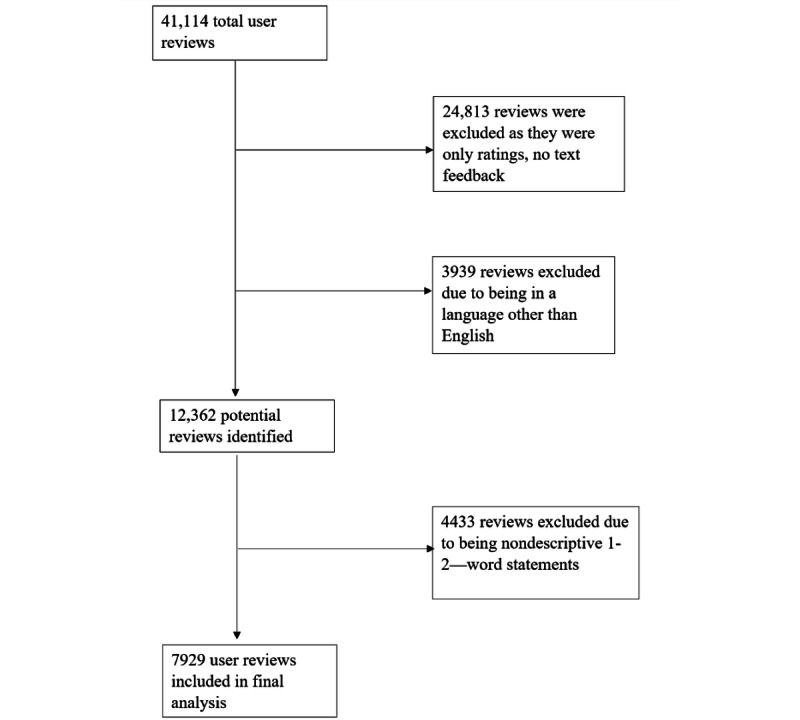
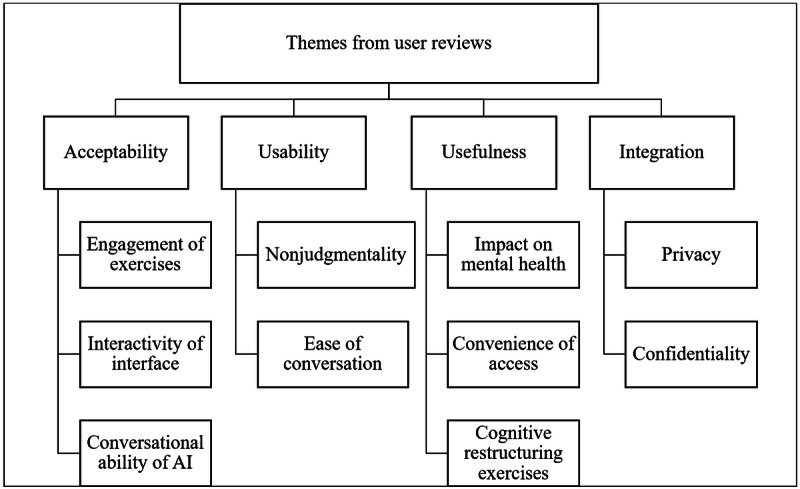
Background: Digital mental health apps are rapidly becoming a common source of accessible support across the world, but their effectiveness is often influenced by limited helpfulness and engagement. Objective: This study’s primary objective was to analyze feedback content to understand users’ experiences with engaging with a digital mental health app. As a secondary objective, an exploratory analysis captured the types of mental health app users. Methods: This study utilized a user-led approach to understanding factors for engagement and helpfulness in digital mental health by analyzing feedback (n=7929) reported on Google Play Store about Wysa, a mental health app (1-year period). The analysis of keywords in the user feedback categorized and evaluated the reported user experience into the core domains of acceptability, usability, usefulness, and integration. The study also captured key deficits and strengths of the app and explored salient characteristics of the types of users who benefit from accessible digital mental health support. Results: The analysis of user feedback found the app to be overwhelmingly positively reviewed (6700/7929, 84.50% 5-star rating). The themes of engaging exercises, interactive interface, and artificial intelligence (AI) conversational ability indicated the acceptability of the app, while the nonjudgmentality and ease of conversation highlighted its usability. The app’s usefulness was portrayed by themes such as improvement in mental health, convenient access, and cognitive restructuring exercises. Themes of privacy and confidentiality underscored users’ preference for the integrated aspects of the app. Further analysis revealed 4 predominant types of individuals who shared app feedback on the store. Conclusions: Users reported therapeutic elements of a comfortable, safe, and supportive environment through using the digital mental health app. Digital mental health apps may expand mental health access to those unable to access traditional forms of mental health support and treatments.
Overview
The claims and statistics of this paper haven’t been checked yet.
Free: it reads the open-access text and checks the first 5 claims that cite a source we can check. Create a free account to check every claim.
Integrity signals
Registry
Cites
Statistics
Figures
Verification
Claims the paper makes
The claims and statistics of this paper haven’t been checked yet.
Free: it reads the open-access text and checks the first 5 claims that cite a source we can check. Create a free account to check every claim.
Claims other papers make about this one
Each is checked against this paper’s own text: does it say what the citing paper says it does?
The source backs part of the claim, not all of it — or backs it for a different population, condition or comparison.
In the citing paper
“Many of the themes we developed are not new, but rather echo well-established user appreciation of rule-based chatbots’ always-available, non-judgmental listening ear and abilities to create a therapeutic alliance and reframe negative thoughts20,22.”
From “It happened to be the perfect thing”: experiences of generative AI chatbots for mental health (2024) · cites this paper as [20]
Experimental — accuracy not yet measuredThe cited source says what the claim attributes to it.
In the citing paper
“Meta-analyses indicate that the therapeutic effects are small and not sustained over time24, and users report frustration with responses that feel empty, generic20, nonsensical, repetitive and constrained19–22.”
From “It happened to be the perfect thing”: experiences of generative AI chatbots for mental health (2024) · cites this paper as [20]
In the citing paper
“Rule-based chatbot apps have more promising user engagement, with positive app store ratings19,20 and qualitative studies finding that users appreciate the human-like interaction and social support19–23.”
From “It happened to be the perfect thing”: experiences of generative AI chatbots for mental health (2024) · cites this paper as [20]
Self-check
Percentages, sums and reported differences re-computed from the paper’s own numbers.
The self-check needs the paper’s full text.
Citations
Cites
Perceived usefulness, perceived ease of use, and user acceptance of information technology
Davis, F. D. (1989) · MIS Quarterly · doi:10.2307/249008 · Cited by 68,483
Inkster, B., Sarda, S., & Subramanian, V. (2018) · doi:10.2196/preprints.12106 · Cited by 1,063
Mohr, D. C., Burns, M. N., Schueller, S. M., Clarke, G., & Klinkman, M. (2013) · General Hospital Psychiatry · doi:10.1016/j.genhosppsych.2013.03.008 · Cited by 693 · cited 1×
“provide important benefits, especially for supporting individuals with subclinical psychiatric symptoms [26].”
BackgroundJorm, A. F., Patten, S. B., Brugha, T. S., & Mojtabai, R. (2017) · World Psychiatry · doi:10.1002/wps.20388 · Cited by 556
User feedback in the appstore: An empirical study
Pagano, D., & Maalej, W. (2013) · 2013 21st IEEE International Requirements Engineering Conference (RE) · doi:10.1109/re.2013.6636712 · Cited by 540
Towards a consensus around standards for smartphone apps and digital mental health
Torous, J., Andersson, G., Bertagnoli, A., Christensen, H., Cuijpers, P., Firth, J., Haim, A., Hsin, H., Hollis, C., Lewis, S., et al. (2019) · World Psychiatry · doi:10.1002/wps.20592 · Cited by 325 · cited 2×
“The app has demonstrated efficacy in building mental resilience and promoting mental well-being through a text-based conversational interface [17].”
BackgroundInsights from user reviews to improve mental health apps
Alqahtani, F., & Orji, R. (2020) · Health Informatics Journal · doi:10.1177/1460458219896492 · Cited by 286 · cited 1×
“These user reviews are regarded as a comprehensive evaluation of the app from the user’s own perspective, which provides rich insights into the app user experience [13,14].”
BackgroundAccess And Cost Barriers To Mental Health Care, By Insurance Status, 1999–2010
Rowan, K., McAlpine, D. D., & Blewett, L. A. (2013) · Health Affairs · doi:10.1377/hlthaff.2013.0133 · Cited by 277
Kretzschmar, K., Tyroll, H., Pavarini, G., Manzini, A., Singh, I., & NeurOx Young People’s Advisory Group (2019) · Biomedical Informatics Insights · doi:10.1177/1178222619829083 · Cited by 270 · cited 1×
“The app is anonymous [20] and safe [21] and rates highly on measures of app quality [22].”
Background
Research works printed but not linked: 3
- Torous, J, 2018, Current Psychiatry, 17, 21
- Myers, A, 2020, AMIA Annu Symp Proc, 2020, 906
- 10.2196/12106 · doi:10.2196/12106 · Paper page
Cited by
Using Chatbots as AI Conversational Partners in Language Learning
Belda-Medina, J., & Calvo-Ferrer, J. R. (2022) · Applied Sciences · doi:10.3390/app12178427 · Cited by 306
Beatty, C., Malik, T., Meheli, S., & Sinha, C. (2022) · Frontiers in Digital Health · doi:10.3389/fdgth.2022.847991 · Cited by 224
Self-citation“It happened to be the perfect thing”: experiences of generative AI chatbots for mental health
Siddals, S., Torous, J., & Coxon, A. (2024) · npj Mental Health Research · doi:10.1038/s44184-024-00097-4 · Cited by 241
Alhuwaydi, A. M. (2024) · Risk Management and Healthcare Policy · doi:10.2147/rmhp.s461562 · Cited by 184
Li, L., Peng, W., & Rheu, M. M. J. (2024) · Telemedicine and e-Health · doi:10.1089/tmj.2023.0313 · Cited by 79
User perceptions and experiences of an AI-driven conversational agent for mental health support
Chaudry, B., & Debi, H. R. (2024) · mHealth · doi:10.21037/mhealth-23-55 · Cited by 129
Inkster, B., Kadaba, M., & Subramanian, V. (2023) · Frontiers in Global Women's Health · doi:10.3389/fgwh.2023.1084302 · Cited by 53
Sinha, C., Meheli, S., & Kadaba, M. (2022) · JMIR Formative Research · doi:10.2196/41913 · Cited by 63
Self-citationA framework of diversity, equity, and inclusion safeguards for chatbots
Abdelhalim, E., Anazodo, K. S., Gali, N., & Robson, K. (2024) · Business Horizons · doi:10.1016/j.bushor.2024.03.003 · Cited by 59
The Digital Therapeutic Alliance With Mental Health Chatbots: Diary Study and Thematic Analysis
Xu, Z., Lee, Y., Stasiak, K., Warren, J., & Lottridge, D. M. (2025) · JMIR Mental Health · doi:10.2196/76642 · Cited by 68
Gupta, M., Malik, T., & Sinha, C. (2022) · JMIR Research Protocols · doi:10.2196/36910 · Cited by 43
Self-citationEmotional Intelligence in Artificial Intelligence: A Review and Evaluation StudyPreprint
Vicci, H. (2024) · SSRN Electronic Journal · doi:10.2139/ssrn.4818285 · Cited by 50
Le, K. B. Q., & Cayrat, C. (2024) · Journal of service management · doi:10.1108/josm-09-2023-0408 · Cited by 36
AI-Led Mental Health Support (Wysa) for Health Care Workers During COVID-19: Service Evaluation
Chang, C. L., Sinha, C., Roy, M., & Wong, J. C. M. (2024) · JMIR Formative Research · doi:10.2196/51858 · Cited by 27
Self-citationIntelligent sensing devices and systems for personalized mental health
Xing, Y., Yang, Y., Yang, K., Lu, A., Xing, L., Mackie, K., & Guo, F. (2025) · Med-X · doi:10.1007/s44258-025-00057-3 · Cited by 28
Artificial Intelligence in Ophthalmology – Status Quo and Future Perspectives
Matos, P. A. W., Reimer, R. P., Rokohl, A. C., Caldeira, L., Heindl, L. M., & Hokamp, N. G. (2022) · Seminars in Ophthalmology · doi:10.1080/08820538.2022.2139625 · Cited by 27
AI-Driven Psychological Support and Cognitive Rehabilitation Strategies in Post-Cancer Care
Aburub, F. A. F., & Agha, A. S. A. A. (2024) · International Conference on Cyber Resilience (ICCR) · doi:10.1109/iccr61006.2024.10532962 · Cited by 24
Iglesias, M., Sinha, C., Vempati, R., Grace, S. E., Roy, M., Chapman, W. C., & Rinaldi, M. L. (2022) · Journal of Occupational and Environmental Medicine · doi:10.1097/jom.0000000000002762 · Cited by 27
Self-citationHumanizing The Role of Artificial Intelligence in Revolutionizing Emotional Intelligence
Subramani, K., & Manoharan, G. (2024) · International Conference on Computational Modelling, Simulation and Optimization (ICCMSO) · doi:10.1109/iccmso61761.2024.00056 · Cited by 19
Yoon, S., Goh, H., Low, X. C., Weng, J. H., & Heaukulani, C. (2024) · BMJ Health & Care Informatics · doi:10.1136/bmjhci-2024-101045 · Cited by 9
Kelly, S., Kaye, S.-A., White, K. M., & Oviedo-Trespalacios, O. (2025) · AI & SOCIETY · doi:10.1007/s00146-025-02334-6 · Cited by 17
Obremski, D., & Wienrich, C. (2024) · Journal of Computer and Communications · doi:10.4236/jcc.2024.124010 · Cited by 15
Cheng, A. L., Agarwal, M., Armbrecht, M. A., Abraham, J., Calfee, R. P., & Goss, C. W. (2023) · JMIR Formative Research · doi:10.2196/51422 · Cited by 10
Dropout and completion in iCBT for university students: Insights from a thematic analysis
Koelen, J. A., de Koning, L., Nottage, M., Klein, A. M., der Heijde, C. M. V., Vonk, P., & Wiers, R. W. H. J. (2025) · Internet Interventions · doi:10.1016/j.invent.2025.100831 · Cited by 13
Evaluating AI-Driven Mental Health Solutions: A Hybrid Fuzzy Multi-Criteria Decision-Making Approach
Ojo, Y., Makinde, O. A., Babatunde, O. V., Babatunde, G. B., & Okeowo, S. (2025) · AI · doi:10.3390/ai6010014 · Cited by 11
Geng, S., Inayoshi, R., Yang, C.-L., Sramek, Z., Umeda, Y., Kasahara, C., Sato, A. J., Hosio, S. J., & Yatani, K. (2025) · CHI Conference on Human Factors in Computing Systems · doi:10.1145/3706598.3713918 · Cited by 17
Interactive Robots: Therapy Robots
Akyazı, K. G., & BAŞTEMUR, Ş. (2023) · Psikiyatride Guncel Yaklasimlar - Current Approaches in Psychiatry · doi:10.18863/pgy.1242958 · Cited by 12
Heissler, R., Jonáš, J., Carre, N., Mostovoy, K., & Bunge, E. L. (2024) · Human Behavior and Emerging Technologies · doi:10.1155/2024/6738001 · Cited by 12
A Comprehensive Comparison and Evaluation of AI-Powered Healthcare Mobile Applications’ Usability
Alduhailan, H. W., Alshamari, M., & Wahsheh, H. A. (2025) · Healthcare · doi:10.3390/healthcare13151829 · Cited by 13
Legal Issues of the Use of Chatbot Apps for Mental Health Support
Gallese, C. (2022) · Communications in computer and information science · doi:10.1007/978-3-031-18697-4_21 · Cited by 11
Aghakhani, S., Carre, N., Mostovoy, K., Shafer, R. W., Baeza‐Hernandez, K., Entenberg, G. A., Testerman, A., & Bunge, E. L. (2023) · Frontiers in Digital Health · doi:10.3389/fdgth.2023.1251016 · Cited by 11
Ye, X., Shan, X., Tu, Y., & Zhang, Y. (2025) · CIN Computers Informatics Nursing · doi:10.1097/cin.0000000000001349 · Cited by 13
Harini, V. K., Bhavadharini, R. M., Upreti, C., & Alex, L. (2024) · Students Conference on Engineering and Systems · doi:10.1109/sces61914.2024.10652390 · Cited by 7
The Therapist in the Machine: Confronting AI’s Challenge to Clinical Social Work
Victor, B. G., & Goldkind, L. (2025) · Journal of Technology in Human Services · doi:10.1080/15228835.2025.2500827 · Cited by 8
Oliveira, A. D. A., & Eler, M. M. (2025) · Journal on Interactive Systems · doi:10.5753/jis.2025.5983 · Cited by 6
Adjei-Boateng, D., & Ikoh, C. L. (2025) · Cureus · doi:10.7759/cureus.85943 · Cited by 9
Papiernik, P., Dzula, S., Zimanyi, M., Millgate, E., Bouazzaoui, M., Buttimer, J., Warren, G., Cooper, E., Catarino, A., Mehew, S., et al. (2025) · JMIR Human Factors · doi:10.2196/76377 · Cited by 8
Bowman, R., Thieme, A., Cowan, B. R., & Doherty, G. J. (2025) · International Journal of Human-Computer Studies · doi:10.1016/j.ijhcs.2025.103618 · Cited by 3
Spontaneous use of ChatGPT for mental health support: an exploratory study
Diaz, L., & Huguet, A. (2026) · Journal of Public Health · doi:10.1007/s10389-025-02668-x · Cited by 12
Taylor, D., Buckley, O. E., & Aung, M. H. (2023) · Communications in computer and information science · doi:10.1007/978-3-031-35992-7_24 · Cited by 3
Ferrario, A., Sedláková, J., & Trachsel, M. (2024) · doi:10.2196/preprints.56569 · Cited by 3
Psikoterapide Yapay Zekâ ve Chatbot: Etik Kurallar ve Sınırlılıklar
Erdoğdu, M., Yıldızeli, S., & Mazman, I. (2024) · Türkiye Sağlık Enstitüleri Başkanlığı Dergisi · doi:10.5578/tusebdergisi.20240121 · Cited by 4
Davis, A., Landers, S. E., Sun, Y., Nguyen, V. O., Bolger, N. P., Lewis, R. A., & Rosenthal, S. L. (2025) · Clinical Pediatrics · doi:10.1177/00099228251371903 · Cited by 5
Conversational Agent Utilization Patterns of Individuals with Autism Spectrum Disorder
Aghakhani, S., Rousseau, A., Mizrahi, S., Tan, X., Dosovitsky, G., Mlodzianowski, L., Marshall, Z., & Bunge, E. L. (2024) · Journal of Technology in Behavioral Science · doi:10.1007/s41347-024-00451-5 · Cited by 2
Okuboyejo, S. R., Han, S., Jha, S., Eneja, C., & Orji, R. (2025) · International Journal of Human-Computer Interaction · doi:10.1080/10447318.2025.2476711 · Cited by 3
Reconfiguring Psy Expertise in the Digital Age: Two Cases from India
Lang, C. (2025) · Medicine Anthropology Theory · doi:10.17157/mat.12.1.9060 · Cited by 2
Understanding Behavioral Intention of Filipino Adults in Adopting Mental Health Chatbots
-, A. K. B. D. V., Quinto, E. J. M., & Elizaga, L. A. G. (2025) · Journal of Technology in Human Services · doi:10.1080/15228835.2025.2572758 · Cited by 2
To Bot or Not to Bot?: Analysing Mental Health Data Disclosures
Taylor, D., Melvin, C. L., Aung, M. H., & Asif, R. (2024) · Lecture notes in computer science · doi:10.1007/978-3-031-61379-1_7 · Cited by 1
Xian, C., Yan, A., Wang, Y., Tsang, E. Y.-H., Huang, L., & Xu, D. J. (2026) · JMIR Formative Research · doi:10.2196/85138 · Cited by 1
From promise to practice: artificial intelligence in mental health care in the MENA region
Hajj, S. E., Nsouli, A., Wehbe, M., Saad, G. A., & Maalouf, F. T. (2026) · Frontiers in Psychiatry · doi:10.3389/fpsyt.2026.1878052 · Cited by 2
Stoner, E., & Wilbanks, S. R. (2023) · Critical Reviews in Physical and Rehabilitation Medicine · doi:10.1615/critrevphysrehabilmed.2023048101 · Cited by 1
A Survey Study of Strategies for Improving User Interface in Mental Health
Wibowo, B. S., Santosa, P. I., & Alfarozi, S. A. I. (2024) · International Conference on Information Technology and Computing (ICITCOM) · doi:10.1109/icitcom62788.2024.10762638 · Cited by 1
Machine Learning Based-prediction of Health Application Effectiveness on Google Play Store
Ama, N. A. (2025) · Trends in Computer Science and Information Technology · doi:10.17352/tcsit.000101
Sinha, C., Meheli, S., & Kadaba, M. (2022) · doi:10.2196/preprints.41913 · Cited by 1
Self-citationYousafzai, A., Fatima, R., & Fatima, Z. (2025) · Research Square · doi:10.21203/rs.3.rs-7820094/v1 · Cited by 1
Revolutionizing Peer Support for Children with Chronic Illness Leveraging Technology
Gyamlani, M. (2023) · Psychology · doi:10.4236/psych.2023.1410095 · Cited by 1
This document will be updated.Preprint
Author (2024) · PsyArXiv (OSF Preprints) · doi:10.31234/osf.io/fnbm8
Navigating Ethical Challenges of AI Chatbots for Sex Therapy
Fu, M., & Chan, W. (2025) · Oxford University Press eBooks · doi:10.1093/9780198945215.003.0075 · Cited by 2
Towards a Deep Learning Post-traumatic Stress Disorder Dialogue System Based on Transformers
Ouerhani, N., Maalel, A., Drljača, D. P., & Ghézala, H. B. (2025) · Lecture notes in networks and systems · doi:10.1007/978-3-031-78925-0_10
AI Enhanced School Guidance Interventions: Promises, Threats, and Future Directions
Gomez, M. G. A. (2025) · Advances in computational intelligence and robotics book series · doi:10.4018/979-8-3373-0396-3.ch003
Yan, A., Xian, C., Wang, Y., Tsang, E. Y.-H., Huang, L., & Xu, D. J. (2025) · doi:10.2196/preprints.85138
Yang, Q., Du, X., Liu, X., & Ren, Z. (2025) · Information Communication & Society · doi:10.1080/1369118x.2025.2581013
From Dear Diary to Dear Chatbot: Technological Formats and Mental Health
Amos, M., Kayser, M., & Chen, S.-L. S. (2025) · Emerald Group Publishing Limited eBooks · doi:10.1108/s0163-239620250000061006
Alvarez, M. L. R., Reyes-Aguilar, A., & Meza, I. (2025) · TIES Revista de Tecnología e Innovación en Educación Superior · doi:10.22201/dgtic.26832968e.2025.14.116
Narimanpour, F., Pirnejad, H., Makhdoomi, K., Feizipour, H., & Niazkhani, Z. (2025) · BMC Psychology · doi:10.1186/s40359-025-03732-7 · Cited by 1
Therapeutic Alliance and Effectiveness of Digital Mental Health Interventions
Arakkal, M. A., & Thangal, M. R. (2026) · Wiley eBooks · doi:10.1002/9781394429660.ch5 · Cited by 1
Attoe, C., Szekely, R., Vega, M. O., Browne, E., Thomas, R., Kwan, C. W. T., Altchouler, P., De, A., Hariharan, N., Clay, G., et al. (2026) · Digital Health · doi:10.1177/20552076261428307
Shirvani, M. S., Crowley, J., Peng, C., Liu, J., Chao, T. W.-C., Martinez, S., Brandt, L., Kim, I.-J., & Yoon, D. (2026) · CHI Conference on Human Factors in Computing Systems · doi:10.1145/3772318.3790986 · Cited by 4
Designing an Inclusive Personalized Guided Mindfulness Chatbot for Stress Management
Naidu, S., Greeley, W., & Zhang, Q. (2025) · Artificial Intelligence x Humanities, Education, and Art (AIxHEART) · doi:10.1109/aixheart65685.2025.00026
The AI Revolution in Healthcare: Opportunities and Risks
Wood, D. W. (2026) · Springer eBooks · doi:10.1007/978-3-032-11814-1_23
Ethical Sensemaking in AI Mental Health Chatbots: An Analysis of User Reviews
Rahman, M. M., & Chaudry, B. (2026) · Designing Interactive Systems Conference · doi:10.1145/3800645.3813050
The Intersection of Social Work and AI: Shaping the Future of Pediatric Mental Health
Pliske, M. M. (2026) · Families in Society The Journal of Contemporary Social Services · doi:10.1177/10443894261448395
Calambur, V., Young, J., Razi, A., & Huh, J. (2026) · ACM Transactions on Computing for Healthcare · doi:10.1145/3817048
Powell, Z., Allen, A., Davis, C., Gisnarian, A., Jellesma, F., Ramos‐Cejudo, J., Salguero, J. M., Balcombe, L., Vorobev, A., Ivanova, E., et al. (2026) · Behaviour and Information Technology · doi:10.1080/0144929x.2026.2706675 · Cited by 1
Rehman, A. U., Alshammari, M. M., Alharbi, F. S., Ammar, O. H., & Al-smeiat, M. (2026) · Journal of Intellectual Capital · doi:10.1108/jic-04-2026-0228
Yang, H., Chang, F., Liu, Z., Zhang, W., & Cai, J. (2026) · Technology in Society · doi:10.1016/j.techsoc.2026.103535
Wan, M. W., Hill, F., Firth, J., & Churchman, A. (2026) · doi:10.2196/preprints.110917
Cantwell, S., & Goldkind, L. (2026) · Oxford University Press eBooks · doi:10.1093/9780197851364.003.1706
Liao, Y., Madeo, A. C., Allen, C. G., Frey, M. K., Espinel, W., Schlechter, C. R., Sharaf, R., Kawamoto, K., Fiol, G. D., & Kaphingst, K. A. (2026) · Journal of Medical Internet Research · doi:10.2196/97773
Cared for But Not Cared About? AI and the Moral Practice of Nursing
Kimani, R. W. (2026) · Nursing Philosophy · doi:10.1111/nup.70135
Development, validation and AI chatbot evaluation of the Adolescent Mental Health AI Response Tool
McBain, R. K., Cantor, J., Hollister, B., Kong, N., Salas, A., Breslau, J. A., Zhang, F., Zhang, L. A., Burnett, A., Rader, B. M., et al. (2026) · Nature Mental Health · doi:10.1038/s44220-026-00753-y
Metadata
- Authors
- Malik, T., Ambrose, A. J., & Sinha, C.
- Affiliations
- Columbia University (US)
- Corresponding author
- Malik, Tanya
- Venue
- JMIR Human Factors
- Publisher
- JMIR Publications Inc.
- Published
- 2022-04-12
- Volume
- 9
- Issue
- 2
- Pages
- e35668
- ISSN
- 2292-9495 (ISSN-L)
- PMC
- PMC9044157
- OpenAlex
- W4220854739
- Cited by
- 83
- References
- 25
- Citations by year
- 2026: 20 · 2025: 28 · 2024: 19 · 2023: 8 · 2022: 8
- FWCI
- 13.87
- Type
- journal article
- Language
- en
- Open access
- gold
- doi.org
- Licence
- cc-by
- Locations
- JMIR Human Factors (publishedVersion, cc-by)
- PubMed Central (publishedVersion, cc-by)
- PubMed (publishedVersion)
- DOAJ (DOAJ: Directory of Open Access Journals) (submittedVersion)
- Topics
- Social Sciences › Psychology › Applied Psychology › Digital Mental Health Interventions
- Health Sciences › Health Professions › General Health Professions › Mobile Health and mHealth Applications
- Health Sciences › Medicine › Public Health, Environmental and Occupational Health › Telemedicine and Telehealth Implementation
- Keywords
- mental health apps, Wysa, cognitive behavioral therapy, AI chatbots, user feedback, app engagement, acceptability, usability, helpfulness, privacy and confidentiality, user types, cognitive restructuring, access to mental health care
About these checks
Registry, retraction, Cites and statistics results are computed, not judged, with one exception: a printed reference that no index lists is read once by a model before it counts as a citation error. Claims are extracted by a model and kept only when their quote appears verbatim in the text; each cited source is then checked, with a model’s help, for whether it says what the claim relies on. Those verdicts can be wrong — read the claim’s quote and the cited source before relying on one.
Statistics and arithmetic are recomputed, not judged.
Confidence bands are shown only for fields calibrated on our annotated test set. None is calibrated yet, so no band is shown.
What counts as a claim ›How we measure confidence ›How we check this ›
Are you an author, or do you see a problem with this page? Request a review
Data sources
Bibliographic data: Semantic Scholar, OpenAlex, Crossref.
Contains information from the Semantic Scholar Academic Graph Datasets, made available under the ODC Attribution License (ODC-BY 1.0).
Semantic Scholar’s data is described in: Kinney, R., et al. (2023). The Semantic Scholar Open Data Platform. arXiv:2301.10140.
