

Evaluating User Feedback for an Artificial Intelligence–Enabled, Cognitive Behavioral Therapy–Based Mental Health App (Wysa): Qualitative Thematic Analysis
Open accessPublished version of a preprint
The DOI matches its Crossref record; 23 of the 25 references it cites were found in a registry or an index.
Abstract
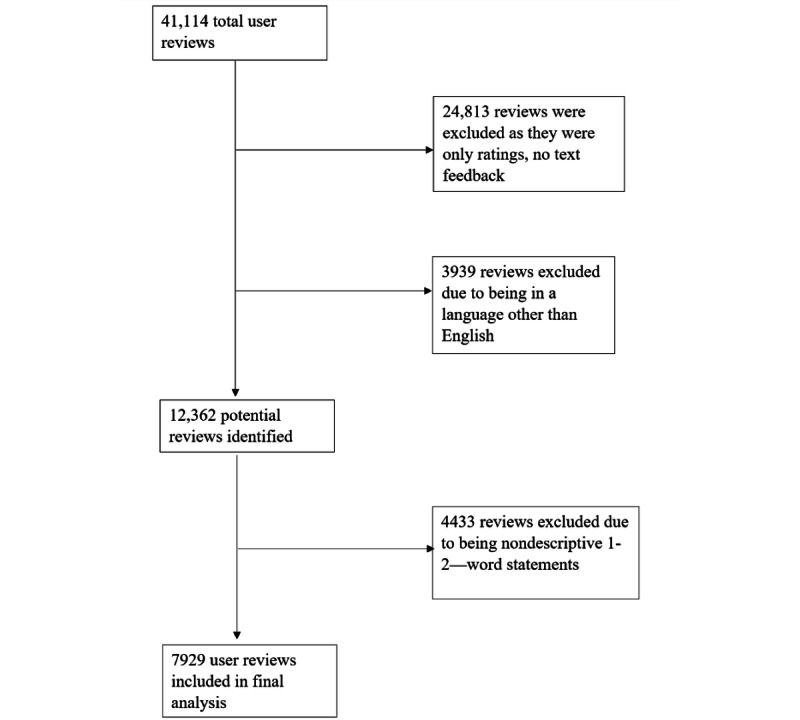
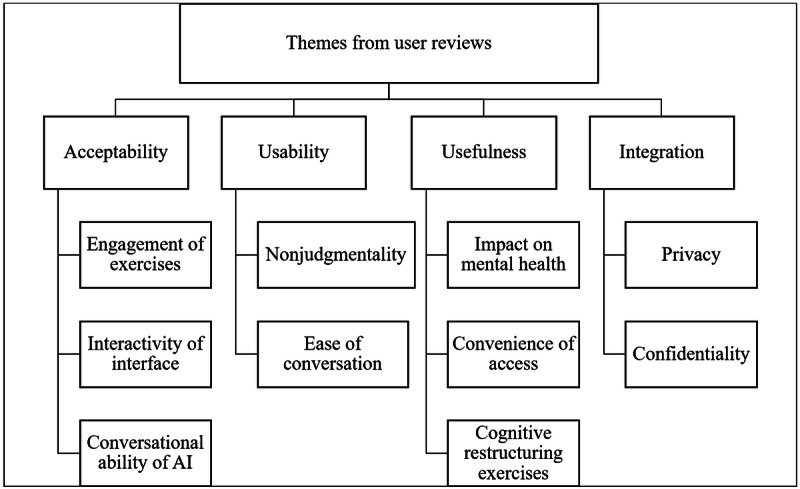
Background: Digital mental health apps are rapidly becoming a common source of accessible support across the world, but their effectiveness is often influenced by limited helpfulness and engagement. Objective: This study’s primary objective was to analyze feedback content to understand users’ experiences with engaging with a digital mental health app. As a secondary objective, an exploratory analysis captured the types of mental health app users. Methods: This study utilized a user-led approach to understanding factors for engagement and helpfulness in digital mental health by analyzing feedback (n=7929) reported on Google Play Store about Wysa, a mental health app (1-year period). The analysis of keywords in the user feedback categorized and evaluated the reported user experience into the core domains of acceptability, usability, usefulness, and integration. The study also captured key deficits and strengths of the app and explored salient characteristics of the types of users who benefit from accessible digital mental health support. Results: The analysis of user feedback found the app to be overwhelmingly positively reviewed (6700/7929, 84.50% 5-star rating). The themes of engaging exercises, interactive interface, and artificial intelligence (AI) conversational ability indicated the acceptability of the app, while the nonjudgmentality and ease of conversation highlighted its usability. The app’s usefulness was portrayed by themes such as improvement in mental health, convenient access, and cognitive restructuring exercises. Themes of privacy and confidentiality underscored users’ preference for the integrated aspects of the app. Further analysis revealed 4 predominant types of individuals who shared app feedback on the store. Conclusions: Users reported therapeutic elements of a comfortable, safe, and supportive environment through using the digital mental health app. Digital mental health apps may expand mental health access to those unable to access traditional forms of mental health support and treatments.
Overview
The claims and statistics of this paper haven’t been checked yet.
Free: it reads the open-access text and checks the first 5 claims that cite a source we can check. Create a free account to check every claim.
Integrity signals
Registry
Cites
Statistics
Figures
Verification
Claims the paper makes
The claims and statistics of this paper haven’t been checked yet.
Free: it reads the open-access text and checks the first 5 claims that cite a source we can check. Create a free account to check every claim.
Claims other papers make about this one
Each is checked against this paper’s own text: does it say what the citing paper says it does?
The source backs part of the claim, not all of it — or backs it for a different population, condition or comparison.
In the citing paper
“Many of the themes we developed are not new, but rather echo well-established user appreciation of rule-based chatbots’ always-available, non-judgmental listening ear and abilities to create a therapeutic alliance and reframe negative thoughts20,22.”
From “It happened to be the perfect thing”: experiences of generative AI chatbots for mental health (2024) · cites this paper as [20]
Experimental — accuracy not yet measuredThe cited source says what the claim attributes to it.
In the citing paper
“Meta-analyses indicate that the therapeutic effects are small and not sustained over time24, and users report frustration with responses that feel empty, generic20, nonsensical, repetitive and constrained19–22.”
From “It happened to be the perfect thing”: experiences of generative AI chatbots for mental health (2024) · cites this paper as [20]
In the citing paper
“Rule-based chatbot apps have more promising user engagement, with positive app store ratings19,20 and qualitative studies finding that users appreciate the human-like interaction and social support19–23.”
From “It happened to be the perfect thing”: experiences of generative AI chatbots for mental health (2024) · cites this paper as [20]
Self-check
Percentages, sums and reported differences re-computed from the paper’s own numbers.
The self-check needs the paper’s full text.
Citations
Cites
Perceived usefulness, perceived ease of use, and user acceptance of information technology
Davis, F. D. (1989) · MIS Quarterly · doi:10.2307/249008 · Cited by 68,483
Inkster, B., Sarda, S., & Subramanian, V. (2018) · doi:10.2196/preprints.12106 · Cited by 1,063
Mohr, D. C., Burns, M. N., Schueller, S. M., Clarke, G., & Klinkman, M. (2013) · General Hospital Psychiatry · doi:10.1016/j.genhosppsych.2013.03.008 · Cited by 693 · cited 1×
“provide important benefits, especially for supporting individuals with subclinical psychiatric symptoms [26].”
BackgroundJorm, A. F., Patten, S. B., Brugha, T. S., & Mojtabai, R. (2017) · World Psychiatry · doi:10.1002/wps.20388 · Cited by 556
User feedback in the appstore: An empirical study
Pagano, D., & Maalej, W. (2013) · 2013 21st IEEE International Requirements Engineering Conference (RE) · doi:10.1109/re.2013.6636712 · Cited by 540
Towards a consensus around standards for smartphone apps and digital mental health
Torous, J., Andersson, G., Bertagnoli, A., Christensen, H., Cuijpers, P., Firth, J., Haim, A., Hsin, H., Hollis, C., Lewis, S., et al. (2019) · World Psychiatry · doi:10.1002/wps.20592 · Cited by 325 · cited 2×
“The app has demonstrated efficacy in building mental resilience and promoting mental well-being through a text-based conversational interface [17].”
BackgroundInsights from user reviews to improve mental health apps
Alqahtani, F., & Orji, R. (2020) · Health Informatics Journal · doi:10.1177/1460458219896492 · Cited by 286 · cited 1×
“These user reviews are regarded as a comprehensive evaluation of the app from the user’s own perspective, which provides rich insights into the app user experience [13,14].”
BackgroundAccess And Cost Barriers To Mental Health Care, By Insurance Status, 1999–2010
Rowan, K., McAlpine, D. D., & Blewett, L. A. (2013) · Health Affairs · doi:10.1377/hlthaff.2013.0133 · Cited by 277
Kretzschmar, K., Tyroll, H., Pavarini, G., Manzini, A., Singh, I., & NeurOx Young People’s Advisory Group (2019) · Biomedical Informatics Insights · doi:10.1177/1178222619829083 · Cited by 270 · cited 1×
“The app is anonymous [20] and safe [21] and rates highly on measures of app quality [22].”
BackgroundNienhuis, J. B., Owen, J., Valentine, J. C., Winkeljohn Black, S., Halford, T. C., Parazak, S. E., Budge, S., & Hilsenroth, M. (2018) · Psychotherapy Research · doi:10.1080/10503307.2016.1204023 · Cited by 257
Users' experiences with chatbots: findings from a questionnaire study
Følstad, A., & Brandtzaeg, P. B. (2020) · Quality and User Experience · doi:10.1007/s41233-020-00033-2 · Cited by 252
A Solution-Focused Research Approach to Achieve an Implementable Revolution in Digital Mental Health
Mohr, D. C., Riper, H., & Schueller, S. M. (2018) · JAMA Psychiatry · doi:10.1001/jamapsychiatry.2017.3838 · Cited by 204 · cited 1×
“convenience and can serve as important alternatives to bridge the access gap [6].”
BackgroundTowards a Framework for Evaluating Mobile Mental Health Apps
Chan, S., Torous, J., Hinton, L., & Yellowlees, P. (2015) · Telemedicine and e-Health · doi:10.1089/tmj.2015.0002 · Cited by 163
Wasil, A. R., Venturo-Conerly, K. E., Shingleton, R. M., & Weisz, J. R. (2019) · Behaviour Research and Therapy · doi:10.1016/j.brat.2019.103498 · Cited by 160
Nicholas, J., Fogarty, A. S., Boydell, K., & Christensen, H. (2017) · Journal of Medical Internet Research · doi:10.2196/jmir.7273 · Cited by 158
The role of the therapist in offender treatment
Marshall, W. L., & Serran, G. A. (2004) · Psychology Crime and Law · doi:10.1080/10683160410001662799 · Cited by 148
Mental Health Mobile Apps: From Infusion to Diffusion in the Mental Health Social System
East, M. L., & Havard, B. (2015) · JMIR Mental Health · doi:10.2196/mental.3954 · Cited by 142
Is There an App for That? A Review of Popular Apps for Depression, Anxiety, and Well-Being
Wasil, A. R., Palermo, E. H., Lorenzo‐Luaces, L., & DeRubeis, R. J. (2021) · Cognitive and Behavioral Practice · doi:10.1016/j.cbpra.2021.07.001 · Cited by 103
Child mental health and psychosocial development.
(1977) · PsycEXTRA Dataset · doi:10.1037/e400972004-001 · Cited by 73
Conversational agents and the making of mental health recovery
Meadows, R., Hine, C., & Suddaby, E. (2020) · DIGITAL HEALTH · doi:10.1177/2055207620966170 · Cited by 40
Gowarty, M. A., Longacre, M. R., Vilardaga, R., Kung, N. J., Gaughan-Maher, A. E., & Brunette, M. F. (2021) · JMIR Mental Health · doi:10.2196/26873 · Cited by 26
Evaluating Commercially Available Mobile Apps for Depression Self-Management.
Myers, A., Chesebrough, L., Hu, R., Turchioe, M. R., Pathak, J., & Creber, R. M. (2020) · PubMed · Cited by 23
Research works printed but not linked: 3
- Torous, J, 2018, Current Psychiatry, 17, 21
- Myers, A, 2020, AMIA Annu Symp Proc, 2020, 906
- 10.2196/12106 · doi:10.2196/12106 · Paper page
Cited by
Using Chatbots as AI Conversational Partners in Language Learning
Belda-Medina, J., & Calvo-Ferrer, J. R. (2022) · Applied Sciences · doi:10.3390/app12178427 · Cited by 306
Beatty, C., Malik, T., Meheli, S., & Sinha, C. (2022) · Frontiers in Digital Health · doi:10.3389/fdgth.2022.847991 · Cited by 224
Self-citation“It happened to be the perfect thing”: experiences of generative AI chatbots for mental health
Siddals, S., Torous, J., & Coxon, A. (2024) · npj Mental Health Research · doi:10.1038/s44184-024-00097-4 · Cited by 241
Alhuwaydi, A. M. (2024) · Risk Management and Healthcare Policy · doi:10.2147/rmhp.s461562 · Cited by 184
Li, L., Peng, W., & Rheu, M. M. J. (2024) · Telemedicine and e-Health · doi:10.1089/tmj.2023.0313 · Cited by 79
Metadata
- Authors
- Malik, T., Ambrose, A. J., & Sinha, C.
- Affiliations
- Columbia University (US)
- Corresponding author
- Malik, Tanya
- Venue
- JMIR Human Factors
- Publisher
- JMIR Publications Inc.
- Published
- 2022-04-12
- Volume
- 9
- Issue
- 2
- Pages
- e35668
- ISSN
- 2292-9495 (ISSN-L)
- PMC
- PMC9044157
- OpenAlex
- W4220854739
- Cited by
- 83
- References
- 25
- Citations by year
- 2026: 20 · 2025: 28 · 2024: 19 · 2023: 8 · 2022: 8
- FWCI
- 13.87
- Type
- journal article
- Language
- en
- Open access
- gold
- doi.org
- Licence
- cc-by
- Locations
- JMIR Human Factors (publishedVersion, cc-by)
- PubMed Central (publishedVersion, cc-by)
- PubMed (publishedVersion)
- DOAJ (DOAJ: Directory of Open Access Journals) (submittedVersion)
- Topics
- Social Sciences › Psychology › Applied Psychology › Digital Mental Health Interventions
- Health Sciences › Health Professions › General Health Professions › Mobile Health and mHealth Applications
- Health Sciences › Medicine › Public Health, Environmental and Occupational Health › Telemedicine and Telehealth Implementation
- Keywords
- mental health apps, Wysa, cognitive behavioral therapy, AI chatbots, user feedback, app engagement, acceptability, usability, helpfulness, privacy and confidentiality, user types, cognitive restructuring, access to mental health care
About these checks
Registry, retraction, Cites and statistics results are computed, not judged, with one exception: a printed reference that no index lists is read once by a model before it counts as a citation error. Claims are extracted by a model and kept only when their quote appears verbatim in the text; each cited source is then checked, with a model’s help, for whether it says what the claim relies on. Those verdicts can be wrong — read the claim’s quote and the cited source before relying on one.
Statistics and arithmetic are recomputed, not judged.
Confidence bands are shown only for fields calibrated on our annotated test set. None is calibrated yet, so no band is shown.
What counts as a claim ›How we measure confidence ›How we check this ›
Are you an author, or do you see a problem with this page? Request a review
Data sources
Bibliographic data: Semantic Scholar, OpenAlex, Crossref.
Contains information from the Semantic Scholar Academic Graph Datasets, made available under the ODC Attribution License (ODC-BY 1.0).
Semantic Scholar’s data is described in: Kinney, R., et al. (2023). The Semantic Scholar Open Data Platform. arXiv:2301.10140.
