

Artificial Intelligence-Based Chatbots for Promoting Health Behavioral Changes: Systematic Review.
Open accessPublished version of a preprint
The DOI matches its Crossref record; 38 of the 38 references it cites were found in a registry or an index; 93 of the 113 sources its claims cite were checked for support.
Abstract
Artificial intelligence (AI)-based chatbots can offer personalized, engaging, and on-demand health promotion interventions. The aim of this systematic review was to evaluate the feasibility, efficacy, and intervention characteristics of AI chatbots for promoting health behavior change. A comprehensive search was conducted in 7 bibliographic databases (PubMed, IEEE Xplore, ACM Digital Library, PsycINFO, Web of Science, Embase, and JMIR publications) for empirical articles published from 1980 to 2022 that evaluated the feasibility or efficacy of AI chatbots for behavior change. The screening, extraction, and analysis of the identified articles were performed by following the PRISMA (Preferred Reporting Items for Systematic Reviews and Meta-Analyses) guidelines. Of the 15 included studies, several demonstrated the high efficacy of AI chatbots in promoting healthy lifestyles (n=6, 40%), smoking cessation (n=4, 27%), treatment or medication adherence (n=2, 13%), and reduction in substance misuse (n=1, 7%). However, there were mixed results regarding feasibility, acceptability, and usability. Selected behavior change theories and expert consultation were used to develop the behavior change strategies of AI chatbots, including goal setting, monitoring, real-time reinforcement or feedback, and on-demand support. Real-time user-chatbot interaction data, such as user preferences and behavioral performance, were collected on the chatbot platform to identify ways of providing personalize…
Overview
CoChat Summary
TL;DR
This systematic review found that AI-based chatbots showed efficacy for several health behavior changes, especially healthy lifestyles, smoking cessation, and medication/treatment adherence, but evidence was mixed for feasibility, acceptability, and usability. The authors caution that most included studies had moderate to high risk of internal validity issues and limited reporting of AI methods, so stronger RCTs are needed.
Key findings
- The review included 15 studies; AI chatbots were reported as efficacious for healthy lifestyles (6/15, 40%), smoking cessation (4/15, 27%), treatment or medication adherence (2/15, 13%), and reduction in substance misuse (1/15, 7%).
- Feasibility evidence was limited: 11/15 (73%) studies reported feasibility, but safety was only reported in 1/15 (7%) study, and engagement often declined over time.
- Acceptability was mixed: 7/15 (47%) studies reported acceptability/engagement, but the overall proportion of satisfied participants was less than 50%.
- Usability was also mixed: 11/15 (73%) studies reported usability, with ease of use generally low to moderate and 1/15 (7%) studies reporting technical issues for 82.3% of participants.
Methods
- Systematic review following PRISMA; searched 7 databases (PubMed, IEEE Xplore, ACM Digital Library, PsycINFO, Web of Science, Embase, JMIR publications) for empirical English-language articles from 1980 to 2022.
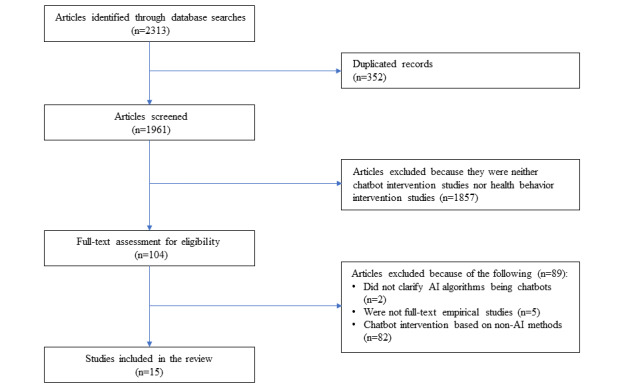
- Included studies had to evaluate AI-based chatbots for health behavior change; from 1961 records screened, 15 studies met inclusion criteria.
- The authors extracted study characteristics, intervention features, and outcomes; quality was assessed using the NIH quality assessment tool for controlled intervention studies and CONSORT-AI guidance.
Limitations
- The paper states that no meta-analysis was conducted because of heterogeneity in design, outcomes, and measures.
- The review states it did not cover a comprehensive set of behavioral outcomes because of strict inclusion criteria; the included studies focused on healthy lifestyle, smoking cessation, and treatment/medication adherence.
- The text makes evident that many included studies had pre-post designs without control groups, small samples in some studies, and limited description of AI techniques; the paper explicitly notes moderate to high internal validity risk and limited generalizability.
Model-written summary. Check it against the paper before relying on it.
Integrity signals
Registry
Cites
Statistics
Figures
Verification
Claims the paper makes
51 Valid · 5 Not valid · 6 Not checked · 114 Own results and interpretations
At least one cited source doesn’t support this claim or points to a different paper, and none confirmed it — see the verdicts below.
In the paper
“First, this review did not distinguish between AI-driven chatbots and other chatbots.”
§ Artificial Intelligence–Based Chatbots for Promoting Health Behavioral Changes: Systematic Review > Introduction > Prior Work
What the sources say
- Disputedcites [2] sourceExperimental — accuracy not yet measured
The Methods (Eligibility criteria; page unavailable) limit the review to interventions using AI chatbots, rather than chatbots generally. The Results (Summary of intervention and chatbot characteristics; page unavailable) further distinguish constrained from unconstrained chatbots. The paper therefore does not support the claim that it made no distinction between AI chatbots and other chatbots. (LLM, conf=0.84)
Checked by a reasoning model — may be wrong.
plain- Asserted: passes — The authors put it forward as true.
- Checkable: passes — It can be checked against evidence.
- Load-bearing: unclear — It is unclear whether the paper’s conclusions depend on it.
- Based: passes — The paper gives a reason why it holds.
- Disputed
Every source the paper cites for this claim was checked and supports it.
In the paper
“Second, the selected studies targeted only a limited set of behaviors, including physical activity, diet, and weight management.”
§ Artificial Intelligence–Based Chatbots for Promoting Health Behavioral Changes: Systematic Review > Introduction > Prior Work
What the sources say
- Supportedcites [2] source
The Methods (Eligibility criteria, Table 1; page not available) limit included studies to AI chatbot interventions for physical activity, diet, and/or weight management. The review’s selected studies therefore fall within the limited set of behaviors described in the claim. (LLM, conf=0.93)
plain- Asserted: passes — The authors put it forward as true.
- Checkable: passes — It can be checked against evidence.
- Load-bearing: passes — The paper’s conclusions depend on it.
- Based: passes — The paper gives a reason why it holds.
- Supported
The cited sources support only part of this claim — read each source’s verdict below.
In the paper
“The existing digital therapeutic and telehealth interventions with didactic components, which enable health care providers to communicate with patients via digital platforms (eg, email and video call), have encountered several challenges, including relatively low adherence, unsustainability, and inflexibility [3,4].”
§ Artificial Intelligence–Based Chatbots for Promoting Health Behavioral Changes: Systematic Review > Introduction > Background
What the sources say
- Not checked — no full text of the sourcecites [3] source
- Partly supportedcites [4] sourceExperimental — accuracy not yet measured
The Adherence and adverse events section reports low completion of computerised CBT: 10.4% with minimal support and 19.4% with telephone facilitation completed all five sessions. The paper does not establish that these interventions are unsustainable or inflexible; its Implications section instead says telephone-supported CBT could be offered at scale. Its findings also concern CBT for depression, not digital therapeutic and telehealth interventions generally. (LLM, conf=0.88)
plain- Asserted: passes — The authors put it forward as true.
- Checkable: passes — It can be checked against evidence.
- Load-bearing: passes — The paper’s conclusions depend on it.
- Based: passes — The paper gives a reason why it holds.
The cited sources support only part of this claim — read each source’s verdict below.
In the paper
“The overall conversational flexibility offered by AI chatbots in terms of communicating at anytime from anywhere offers a safe space to facilitate interactions with patients who feel or experience stigmatization while seeking health care services [5].”
§ Artificial Intelligence–Based Chatbots for Promoting Health Behavioral Changes: Systematic Review > Introduction > Background
What the sources say
- Partly supportedcites [5] sourceExperimental — accuracy not yet measured
The Discussion (Principal Findings; page unavailable) reports that participants felt more comfortable discussing issues with a robot because they did not expect it to judge them. The Discussion (Limitations and Directions for Future Research; page unavailable) suggests this could encourage discussion of sensitive issues and earlier help-seeking. The study concerns a social robot, however, and does not establish that AI chatbots offer flexible conversation anytime from anywhere or specifically facilitate interactions for patients experiencing stigmatization while seeking health care. (LLM, conf=0.88)
plainstates a cause- Asserted: passes — The authors put it forward as true.
- Checkable: passes — It can be checked against evidence.
- Load-bearing: unclear — It is unclear whether the paper’s conclusions depend on it.
- Based: passes — The paper gives a reason why it holds.
- Partly supported
The cited sources support only part of this claim — read each source’s verdict below.
In the paper
“Second, the AI algorithm uses machine learning (ML) and natural language processing (NLP) techniques to identify clinically meaningful patterns and understand user needs [7].”
§ Artificial Intelligence–Based Chatbots for Promoting Health Behavioral Changes: Systematic Review > Introduction > Background
What the sources say
- Partly supportedcites [7] sourceExperimental — accuracy not yet measured
The Introduction (Background; page unavailable) says conversational agents use machine learning and NLP to analyze user input and respond. It does not say they identify clinically meaningful patterns, and the Discussion (Principal Findings; page unavailable) notes that agents often had difficulty understanding users. (LLM, conf=0.86)
plainstates a cause- Asserted: passes — The authors put it forward as true.
- Checkable: passes — It can be checked against evidence.
- Load-bearing: unclear — It is unclear whether the paper’s conclusions depend on it.
- Based: passes — The paper gives a reason why it holds.
- Partly supported
90 more claims · 28 with their cited sources checked
Create a free account to see all 176 claims and every source verdict.
- It may state two separate claims as one. 66
- Probably not a substantial claim. 27
Claims other papers make about this one
Each is checked against this paper’s own text: does it say what the citing paper says it does?
The source backs part of the claim, not all of it — or backs it for a different population, condition or comparison.
In the citing paper
“It is notable that research into the use of AI for the delivery of personalized recommendations is sparse33”
From Impact of digital health interventions on glycemic control and weight management. (2025) · cites this paper as [33]
Experimental — accuracy not yet measuredThe source backs part of the claim, not all of it — or backs it for a different population, condition or comparison.
In the citing paper
“These findings align with those of another meta-analysis [122], showing the effectiveness of CAs in outcomes related to lifestyle changes, smoking cessation, substance misuse, and medication adherence.”
From Development and Evaluation of a Smartphone-Based Chatbot Coach to Facilitate a Balanced Lifestyle in Individuals With Headaches (BalanceUP App): Randomized Controlled Trial (2024) · cites this paper as [122]
Experimental — accuracy not yet measuredThe source backs part of the claim, not all of it — or backs it for a different population, condition or comparison.
In the citing paper
“For example, an AI-driven system might suggest lifestyle modifications, such as dietary changes or exercise routines that are optimized for an individual’s metabolism and cardiovascular risk (57).”
From Generative artificial intelligence in predictive analysis of diabetes and its complications: a narrative review (2025) · cites this paper as [57]
Experimental — accuracy not yet measuredThe source backs part of the claim, not all of it — or backs it for a different population, condition or comparison.
In the citing paper
“Chatbots provide real-time personalized health promotion, prevention, and screening (Aggarwal et al., 2023; Laranjo et al., 2018).”
From A chatbot-delivered intervention for optimizing social media use and reducing perceived isolation among rural-living LGBTQ+ youth: Development, acceptability, usability, satisfaction, and utility (2023) · cites this paper as Aggarwal et al., 2023
Experimental — accuracy not yet measuredThe source backs part of the claim, not all of it — or backs it for a different population, condition or comparison.
In the citing paper
“Chatbots are convenient artificial intelligence–operated conversational agents; they can be deployed within a social media site, do not require user download, and do not take up space in a user's device.”
From A chatbot-delivered intervention for optimizing social media use and reducing perceived isolation among rural-living LGBTQ+ youth: Development, acceptability, usability, satisfaction, and utility (2023) · cites this paper as Aggarwal et al., 2023
Experimental — accuracy not yet measured
Self-check
Percentages, sums and reported differences re-computed from the paper’s own numbers.
Each contradiction between two passages listed here was confirmed by an independent check.
Rated minor: it would not touch a result — a value no result rests on, a p-value that stays on the same side of the significance level, or a conflict that is clerical, resolved elsewhere in the paper, or outside its own findings.
In the paper
§ Artificial Intelligence–Based Chatbots for Promoting Health Behavioral Changes: Systematic Review > Results > Characteristics of the Reviewed Studies
“All 13 studies were distributed across low-income countries, with 4 (31%) from the United States, 2 (15%) from Australia, and 1 (8%) from each remaining country (ie, South Korea, Spain, the United Kingdom, Japan, France, Switzerland, and the Netherlands).”
§ Artificial Intelligence–Based Chatbots for Promoting Health Behavioral Changes: Systematic Review > Discussion > Limitations of the Reviewed Studies and Future Research Directions
“Out of the 13 studies that reported the geographical locations, all (100%) were conducted in the high-income countries;”
Rated minor: it would not touch a result — a value no result rests on, a p-value that stays on the same side of the significance level, or a conflict that is clerical, resolved elsewhere in the paper, or outside its own findings.
In the paper
§ Artificial Intelligence–Based Chatbots for Promoting Health Behavioral Changes: Systematic Review > Results > Characteristics of the Reviewed Studies
“Only 27% (4/15) of studies used randomized control trials (RCTs), and most of the studies (9/15, 60%) adopted a quasiexperimental design (ie, pre- and posttests) with no control group, followed by 7% (1/15) of studies with a cross-sectional design and 7% (1/15) of studies with a postexperimental research method.”
§ Artificial Intelligence–Based Chatbots for Promoting Health Behavioral Changes: Systematic Review > Results > Intervention Study Quality Assessment
“In the case of RCTs (4/15, 27%), this bias was minimized because of the experimental setting of the interventions; however, for non-RCT studies (11/14, 73%), there was a high risk of bias owing to the potential effect of confounding variables.”
Citations
Cites
PRISMA-P Group, Moher, D., Shamseer, L., Clarke, M., Ghersi, D., Liberati, A., Petticrew, M., Shekelle, P., & Stewart, L. A. (2015) · Systematic Reviews · doi:10.1186/2046-4053-4-1 · Cited by 26,223
How we design feasibility studies
Bowen, D. J., Kreuter, M., Spring, B., Cofta-Woerpel, L., Linnan, L., Weiner, D., Bakken, S., Kaplan, C. P., Squiers, L., Fabrizio, C., et al. (2009) · American Journal of Preventive Medicine · doi:10.1016/j.amepre.2009.02.002 · Cited by 4,021 · cited 1×
“Feasibility was defined as the demand of the intervention, that is, the actual use of the intervention and whether the intervention is doable in a certain setting [16].”
Conversational agents in healthcare: a systematic review
Laranjo, L., Dunn, A. G., Tong, H. L., Kocaballi, A. B., Chen, J., Bashir, R., Surian, D., Gallego, B., Magrabi, F., Lau, A. Y. S., et al. (2018) · Journal of the American Medical Informatics Association · doi:10.1093/jamia/ocy072 · Cited by 1,388 · cited 9×
“Artificial intelligence (AI)–driven chatbots (AI chatbots) are conversational agents that mimic human interaction through written, oral, and visual forms of communication with a user [1,2].”
InfluentialChatbots and Conversational Agents in Mental Health: A Review of the Psychiatric Landscape
Vaidyam, A. N., Wisniewski, H., Halamka, J. D., Kashavan, M. S., & Torous, J. B. (2019) · The Canadian Journal of Psychiatry · doi:10.1177/0706743719828977 · Cited by 1,048 · cited 1×
“…findings are consistent with the previous systematic literature reviews that reported that all the chatbot intervention studies were conducted in high-income countries [2,10,11,14], most studies were conducted with adults [2,7], and most studies did not focus on racial or ethnic minorities [2,14].”
Emotional Chatting Machine: Emotional Conversation Generation with Internal and External Memory
Zhou, H., Huang, M., Zhang, T., Zhu, X., & Liu, B. (2018) · Proceedings of the AAAI Conference on Artificial Intelligence · doi:10.1609/aaai.v32i1.11325 · Cited by 763
Liu, X., Rivera, S. C., Moher, D., Calvert, M. J., & Denniston, A. K. (2020) · BMJ · doi:10.1136/bmj.m3164 · Cited by 702
The Effectiveness of Artificial Intelligence Conversational Agents in Health Care: Systematic Review
Milne-Ives, M., de Cock, C., Lim, E., Shehadeh, M. H., de Pennington, N., Mole, G., Normando, E., & Meinert, E. (2020) · Journal of Medical Internet Research · doi:10.2196/20346 · Cited by 626 · cited 8×
“This finding is consistent with the previous systematic literature reviews that reported very few studies discussed participant safety or ethics in terms of adverse events [1,2,7,9] and data security or privacy [2,8].”
InfluentialAbd-Alrazaq, A. A., Rababeh, A., Alajlani, M., Bewick, B. M., & Househ, M. (2020) · Journal of Medical Internet Research · doi:10.2196/16021 · Cited by 503
Embodied conversational agents in clinical psychology: a scoping review
Provoost, S., Lau, H. M., Ruwaard, J., & Riper, H. (2017) · Journal of Medical Internet Research · doi:10.2196/jmir.6553 · Cited by 433 · cited 2×
“Of the extant systematic reviews on AI chatbots, 6 articles targeted at assessing efficacy of AI-chatbots in enhancing mental health outcomes [1,7,9-12], 2 examined the feasibility of AI-chatbots in health care settings [8,13], and 1 described the technical architectures and characteristics of the…”
Zhang, J., Oh, Y. J., Lange, P., Yu, Z., & Fukuoka, Y. (2020) · Journal of Medical Internet Research · doi:10.2196/22845 · Cited by 363 · cited 1×
“As specified in the AI chatbot design literature, user engagement is dependent on the chatbot’s ability to understand the user’s background, build a relation, be persuasive, and offer quick feedback [34].”
Research works printed but not linked: 1
- Radziwill, NM, 2017, arXiv
Cited by
Items 201–300 of 657
Digital Health Technologies for Screening and Identifying Unmet Social Needs: Scoping Review
Sezgın, E., Jackson, D., Boch, S. J., Davenport, M., Skeens, M. A., Dolcé, M., Frankin, B., Militello, L. K., Lyman, E., Kelleher, K. J., et al. (2025) · Journal of Medical Internet Research · doi:10.2196/78793 · Cited by 8
Gong, B., Yao, N., Xie, H., Huang, C., Tomoko, K., Berenbaum, H., & Mu, W. (2026) · Journal of Medical Internet Research · doi:10.2196/82677 · Cited by 20
“These findings are partially aligned with previous systematic reviews reporting that chatbots provided helpful information and were easy to use [95,96].”
Digital interventions in smoking cessation: a brief overview of systematic reviews and meta-analyses
Gliwska, E., & Mańczuk, M. (2024) · Nowotwory Journal of Oncology · doi:10.5603/njo.98341 · Cited by 7
“As mentioned previously, AI-delivered chatbots provide, among others, personalized services and conversation space without judging or scalability to large and varied populations [8].”
BackgroundSingh, S., Gambill, J. L., Attalla, M., Fatima, R., Gill, A. R., & Siddiqui, H. F. (2024) · Cureus · doi:10.7759/cureus.71651 · Cited by 13
Financial incentives for physical activity in adults: Systematic review and meta-analysis update
Salmani, B., Harry Prapavessis, A., Vanderloo, L. M., & Mitchell, M. (2025) · Preventive Medicine · doi:10.1016/j.ypmed.2025.108237 · Cited by 12
Validation of an Artificial Intelligence-Powered Virtual Assistant for Emergency Triage in Neurology
Alessandro, L., Crema, S., Castiglione, J. I., Dossi, D., Eberbach, F., Köhler, A., Laffue, A., Marone, A., Nagel, V., Rueda, J. M. P., et al. (2025) · The Neurologist · doi:10.1097/nrl.0000000000000594 · Cited by 7
AI Alignment with Changing and Influenceable Reward Functions
Carroll, M., Foote, D., Siththaranjan, A., Russell, S., & Dragan, A. (2024) · arXiv · doi:10.48550/arxiv.2405.17713 · Cited by 7
Designing an AI Chatbot for Team-Based Diabetes Care: An Iterative Human-in-the-Loop Approach
Tseng, Y.-C., Chen, S., Mah, K.-H., & Chen, Y.-C. (2025) · Lecture Notes in Computer Science · doi:10.1007/978-3-031-93736-1_17 · Cited by 5
Aggarwal, A., Chen, S., Lee, J., Tracy, A., Qiao, S., Li, X., & Yang, C. (2024) · Mental Health Science · doi:10.1002/mhs2.55 · Cited by 4
Self-citationLam, L. T.-M., & Lam, M. K. (2024) · JMIR Mental Health · doi:10.2196/51791 · Cited by 9
“With the latest development in the field of data science and artificial intelligence, it is also expected that greater health advancements could be achieved through personalized information provision for education and promotion [30].”
BackgroundJi, K., Han, J., Zhai, G., & Liu, J. (2024) · International Dental Journal · doi:10.1016/j.identj.2024.06.024 · Cited by 12
AdaptAI: A Personalized Solution to Sense Your Stress, Fix Your Mess, and Boost Productivity
Gadhvi, R., Petkar, S., Desai, P. P., Ramachandran, S., & Siddharth, S. (2025) · CHI Conference Extended Abstracts on Human Factors in Computing Systems (CHI EA) · doi:10.1145/3706599.3720284 · Cited by 9
Ndenkeh, J. J. N., Aidoo-Frimpong, G. A., Nelson, L. E., Peng, M. L., Balakrishnan, V., Barnhart, V., Davis, B., Prayer, J. D., Quamina, A., & Ni, Z. (2025) · PLOS Digital Health · doi:10.1371/journal.pdig.0000891 · Cited by 8
“…AI and chatbot technologies can enhance the personalization of health messages, ensuring they resonate with users’ unique circumstances and needs, as well as enhance engagement, thus increasing the likelihood of adopting desired health behaviors, such as PrEP uptake and adherence [26,27].”
Jang, J.-W., Yang, S., & Kim, H. (2026) · Energy & Environment · doi:10.1177/0958305x251343056 · Cited by 6
“30,31 In education, chatbots have been introduced to help reduce compulsive smartphone use among students.”
Gupta, A. K., Gupta, V., & Ojha, A. (2025) · Diabetes Technology and Obesity Medicine · doi:10.1089/dtom.2025.0034 · Cited by 7
Angyal, V., Bertalan, Á., Domján, P., & Dinya, E. (2025) · BMC Medical Informatics and Decision Making · doi:10.1186/s12911-025-03088-3 · Cited by 6
Goevaerts, W. F., Limpt, N. T. V., Kop, W. J., Kemps, H., & Lü, Y. (2025) · JMIR Formative Research · doi:10.2196/76978 · Cited by 6
“Similarly, a chatbot could learn a user’s preferred communication style [40] or detect behavioral lapses such as reduced physical activity and respond with tailored encouragement or barrier exploration.”
Fetrati, H., Chan, G., & Orji, R. (2025) · ACM Conference on Conversational User Interfaces (CUI) · doi:10.1145/3719160.3737619 · Cited by 7
Beyond the Bot: A Dual-Phase Framework for Evaluating AI Chatbot Simulations in Nursing Education
Olla, P., Wodwaski, N., & Long, T. K. (2025) · Nursing Reports · doi:10.3390/nursrep15080280 · Cited by 12
“These reviews advocate for the adoption of multi-stage evaluation frameworks that align with the World Health Organization (WHO) guidelines and other globally recognized digital health evaluation strategies [10–13].”
Living Sustainability: In-Context Interactive Environmental Impact Communication
Zhang, Z., Thavikulwat, P., Metzger, A. L., Mei, Y., Hähnlein, F., Englhardt, Z., Abowd, G. D., Patel, S., Schulz, A., Cheng, T., et al. (2025) · Proceedings of the ACM on Interactive Mobile Wearable and Ubiquitous Technologies · doi:10.1145/3749488 · Cited by 8
Montelaghi, A., Ciorciari, A. M., Roklicer, R., Jurak, G., & Carraro, A. (2025) · Artificial Intelligence Review · doi:10.1007/s10462-025-11361-0 · Cited by 7
“…activity goals, reminding users to move or complete scheduled workouts, provid - ing encouragement or positive reinforcement, answering questions about PA and health, and delivering tailored educational content based on user preferences and behavioral data (Aggarwal et al. 2023; Suta et al. 2020).”
What patients want from healthcare chatbots: insights from a mixed-methods study
Dellavalle, N. S., Ellis, J. R., Moore, A., Akerson, M., Andazola, M., Campbell, E. G., & DeCamp, M. W. (2025) · Journal of the American Medical Informatics Association · doi:10.1093/jamia/ocaf164 · Cited by 14
Ormeño-Arriagada, P., Márquez, G., Taramasco, C., Gatica, G., Vásconez, J. P., & Navarro, E. (2025) · Applied Sciences · doi:10.3390/app151910792 · Cited by 7
Critical Appraisal Tools for Evaluating Artificial Intelligence in Clinical Studies: Scoping Review
Cabello, J. B., García, V. R., Torralba, M., Fernandez, M. M., Ubeda, M., Ansuategi, E., Ramos-Ruperto, L., Emparanza, J. I., Urreta, I., Iglesias, M. T., et al. (2025) · Journal of Medical Internet Research · doi:10.2196/77110 · Cited by 14
Exploring artificial intelligence chatbots in pediatric fluoride education: a cross-sectional study
Karamüftüoğlu, N., Varol, E. A., & Bal, C. (2025) · Scientific Reports · doi:10.1038/s41598-025-28857-y · Cited by 10
“These findings align with recent evidence suggesting that AI-based conversational agents can generate patient-directed materials of acceptable quality when developed and evaluated under transparent, standardized methods and when readability levels are appropriately considered 1–3, 9, 10 .”
Hazhir, S., Langarizadeh, M., Bahariniya, S., Laktarashi, H. V., Hami, A., & Aghda, S. A. F. (2025) · BMC Public Health · doi:10.1186/s12889-025-25814-2 · Cited by 7
“This accessibility helps create a safe environment for patients, reducing stigma and thereby encouraging greater engagement [32].”
Tan, Q., Nie, Y., Son, P., Qian, Y., Staiano, A. E., Wang, F., Rosenkranz, R. R., & Chen, S. (2026) · JMIR Formative Research · doi:10.2196/83630 · Cited by 8
“Future research with emphasis on efficacy or effectiveness of the intervention should adopt the randomized controlled trial designs [23].”
InfluentialSağlam, H., Sezgin, G. P., Kaplan, T., & Kaplan, S. S. (2026) · BMC Oral Health · doi:10.1186/s12903-026-07728-6 · Cited by 8
“AI-based chatbots are software applications capable of interacting with humans through natural language and typically provide various services via text-based data [26–28].”
Large Language Models in Cardiovascular Prevention: A Narrative Review and Governance Framework
Santos, J. F., & Dores, H. (2026) · Diagnostics · doi:10.3390/diagnostics16030390 · Cited by 9
“Theoretical frameworks suggest that the generative nature of these models enables the simulation of motivational interviewing, delivering unique, context-aware responses that address specific patient barriers [49,50].”
Application of artificial intelligence in oral health management: challenges and opportunities
Li, H., Chen, S., Chang, B., Wang, X., He, Y., Xu, B., Sun, G., Yang, C., Li, G., Li, S., et al. (2026) · Frontiers in Medicine · doi:10.3389/fmed.2026.1700529 · Cited by 15
Leightley, D., Williamson, C., Korbacz, A., Ćurčin, V., Marshall, I. J., & Greenberg, N. L. (2026) · British Medical Bulletin · doi:10.1093/bmb/ldag007 · Cited by 10
Artificial Intelligence in Cardiovascular Medicine: A Giant Step in Personalized Medicine?
Jankauskas, S. S., Varzideh, F., Kansakar, U., & Santulli, G. (2026) · Journal of Personalized Medicine · doi:10.3390/jpm16040192 · Cited by 11
Application of Generative Artificial Intelligence in Dyslipidemia Care
Ahn, J., & Kim, B.-K. (2025) · Journal of Lipid and Atherosclerosis · doi:10.12997/jla.2025.14.1.77 · Cited by 8
Baumel, A. (2025) · Frontiers Digit. Health · doi:10.3389/fdgth.2025.1541676 · Cited by 6
Pelly, M. L., Fatehi, F., Liew, D., & Verdejo‐García, A. (2023) · JMIR Cardio · doi:10.2196/49892 · Cited by 7
“This builds on previous research findings that chatbots should provide real-time reinforcement and on-demand support [46].”
BackgroundExpert Insight Into the Use of eHealth Interventions to Aid Medication Adherence During COVID-19
Hassan, A., & Davies, N. (2024) · Patient Preference and Adherence · doi:10.2147/ppa.s437822 · Cited by 9
Conversational Engagement Using a Short Message Service Chatbot After Total Joint Arthroplasty
Rainey, J. P., Treu, E. A., Campbell, K. J., Blackburn, B. E., Pelt, C. E., Archibeck, M. J., Gililland, J. M., & Anderson, L. A. (2024) · Arthroplasty Today · doi:10.1016/j.artd.2024.101484 · Cited by 5
“[7-9 7-9] They can deliver clari fi cation regarding postoperative instructions and answer general questions that commonly arise during the postoperative recovery period.”
BackgroundLewis, B. A., Napolitano, M. A., Buman, M. P., Williams, D. M., & Nigg, C. R. (2024) · Journal of Behavioral Medicine · doi:10.1007/s10865-024-00533-y · Cited by 6
“Chatbots are conversational agents that seek to replicate human communication through speech, text, and visual forms (Aggarwal et al., 2023; Laranjo et al., 2018).”
Machine Learning and Artificial Intelligence in Modern Medicine
Rahmani, P., Mortazavi, P., Meybodi, H. R. A., Patrinos, G. P., Sarhangi, N., Nikfar, S., Larijani, B. A., Khodayari, N., & Hasanzad, M. (2024) · Springer eBooks · doi:10.1007/978-981-97-4974-4_4 · Cited by 7
Kim, M., Kim, E., Lee, H., Piao, M., Rosen, B. L., Allison, J. J., Zai, A., Nguyen, H. L., Shin, D., & Kahn, J. A. (2025) · Asian/Pacific Island Nursing Journal · doi:10.2196/71865 · Cited by 7
“Artificial intelligence (AI) chatbots have emerged as innovative tools for delivering personalized, leveraging advanced capabilities to address barriers in health communication [16].”
Wang, J., Min, H., Li, T., Li, J., Jiang, Y., Zhang, J., Wu, Y., & Sun, X. (2025) · Journal of Medical Internet Research · doi:10.2196/67303 · Cited by 10
“Aggarwal et al [54] included 15 empirical studies on AI chatbots that facilitate health behavior changes, including interventions like healthy lifestyles, smoking cessation, and medication adherence.”
AI-assisted care for older adults: a review of practical and ethical areas of concern
Choi, W. J., Ahn, B., Moorthy, G., & Do, K. (2025) · AI and Ethics · doi:10.1007/s43681-025-00776-8 · Cited by 9
Doudkin, A. A., Pataranutaporn, P., & Maes, P. (2025) · ACM Conference on Conversational User Interfaces (CUI) · doi:10.1145/3719160.3736610 · Cited by 10
“Parallel to this, conversational AI powered by LLMs presents innovative possibilities for directly encouraging PEB through personalized and adaptive dialogues [1, 27, 69].”
Eskandar, K. (2025) · Revista Española de Cirugía Ortopédica y Traumatología · doi:10.1016/j.recot.2025.09.005 · Cited by 8
The Role of Artificial Intelligence in Palliative Oncology: Zeroing in on Hematologic Malignancies
Thirugnanasambandam, R. P., Bauer, A., & D'Angelo, C. R. (2025) · ONCOLOGY · doi:10.46883/2025.25921057 · Cited by 4
Towett, G., Snead, R. S., Marczika, J., Ambalavanan, R., Mbogori-Kairichi, M., & Malioukis, A. (2025) · Digital Health · doi:10.1177/20552076251406654 · Cited by 13
Interventions for the prevention and management of cardiometabolic multiple long-term conditions
Valabhji, J., Hope, D. C. D., SAYED, N. A. E., Godia, P., Lawson, C. A., Seidu, S., & Khunti, K. (2026) · The Lancet · doi:10.1016/s0140-6736(26)00608-2 · Cited by 6
Performance of AI Chatbots in Preliminary Diagnosis of Maxillofacial Pathologies
Güler, R., & Yalcin, E. (2025) · Medical Science Monitor · doi:10.12659/msm.949076 · Cited by 4
“AI-powered chatbots are conversational agents that mimic human interaction using machine learning (ML) and NLP techniques through written, verbal, and visual communication forms [5].”
AI-empowered health coaching for university students: A mixed-method process evaluation
Bojić, I., Ong, Q. C., Ito, S., Liu, J., Lawate, A., Palaiyan, M., Nair, E., Lwin, M. O., Theng, Y. L., Chia, M., et al. (2025) · Computers in Biology and Medicine · doi:10.1016/j.compbiomed.2025.110271 · Cited by 6
Spanakis, M., Stamou, M., Boultadaki, S., Liantis, E., Lionis, C. D., Marinos, G., Mariolis, A. D., Matthaiou, A. Μ., Mihas, C. C., Mouchtouri, V. Α., et al. (2025) · Healthcare · doi:10.3390/healthcare13141706 · Cited by 8
Artificial Intelligence in Cardiovascular Health: Insights into Post-COVID Public Health Challenges
Naushad, Z., Malik, J., Mishra, A. K., Singh, S., Shrivastav, D., Sharma, C. K., Verma, V. V., Pal, R. K., Roy, B., & Sharma, V. K. (2025) · High Blood Pressure & Cardiovascular Prevention · doi:10.1007/s40292-025-00738-5 · Cited by 7
Benefits and challenges of artificial intelligence in the Colombian health system
Sinisterra, D. V., Barrientos, K. J., & Villota, M. A. L. (2024) · LatIA · doi:10.62486/latia202325 · Cited by 5
Seretlo, R. J., Smuts, H., & Mokgatle, M. M. (2024) · JMIR Formative Research · doi:10.2196/59963 · Cited by 4
“Aggarwal et al [46] found that participants view AI chatbots as a nonjudgmental space for engaging with sensitive information.”
BackgroundArtificial intelligence virtual assistants in primary eye care practice
Stuermer, L., Braga, S., Martín, R., & Wolffsohn, J. S. (2024) · Ophthalmic and Physiological Optics · doi:10.1111/opo.13435 · Cited by 9
Stephens, J. H., Northcott, C., Poirier, B., & Lewis, T. W. (2025) · Digital Health · doi:10.1177/20552076241288631 · Cited by 9
Chatbots as Tools for Psychoeducation and Self-Help in Mental Health
Sowbarnika, A., Patra, A., Kaur, L., Suresh, S., Srivastava, S., & Chawla, D. (2025) · Advances in medical technologies and clinical practice book series · doi:10.4018/979-8-3693-3112-5.ch003 · Cited by 8
Artificial intelligence chatbots in transfusion medicine: A cross‐sectional study
Srivastava, P., Tewari, A., & Al‐Riyami, A. Z. (2025) · Vox Sanguinis · doi:10.1111/vox.70009 · Cited by 9
“Their ability to interact in multiple languages, combined with accessibility and the capacity to process and analyse big data to generate large amounts of information at relatively high speeds [4], has contributed to their growing popularity among users seeking medical information [ 5].”
Artificial Intelligence-Based Medium of Islamic Instruction Design: An Empirical Literature Review
Serour, R. O. H., Elsheikh, S. H. M., Musolin, M. H., & Huda, M. (2025) · Lecture notes in networks and systems · doi:10.1007/978-3-031-96775-7_31 · Cited by 5
Chatbots for Promoting Healthy Habits and Scientific Culture
Galdames, I. S. (2023) · International Journal of Medical and Surgical Sciences · doi:10.32457/ijmss.v10i4.2413 · Cited by 5
Digital health technologies: Compounding the existing ethical challenges of the ‘right’ not to know
Armitage, R. C. (2024) · Journal of Evaluation in Clinical Practice · doi:10.1111/jep.13980 · Cited by 6
Isaacs, K. R., Shifflett, A., Patel, K. N., Karpisek, L., Cui, Y., Lawental, M., Wernette, G. T., Borsari, B. E., Chang, K., & Ma, T. (2024) · JMIR Formative Research · doi:10.2196/62915 · Cited by 4
Digital and innovative tools for better health and productivity at the workplace
Vazquez-Venegas, P. I., Devaux, M., Aihara, H., & Cecchini, M. (2024) · OECD health working papers · doi:10.1787/2ce05eb6-en · Cited by 10
Potential role of large language models and personalized medicine to innovate cardiac rehabilitation
Mishra, R., Patel, H., Jamal, A., & Singh, S. P. (2025) · World Journal of Clinical Cases · doi:10.12998/wjcc.v13.i19.98095 · Cited by 4
Osonuga, A., Olawade, D. B., Gore, M., Rotifa, O. B., Egbon, E., Chinwah, V., & Boussios, S. (2025) · Annals of Translational Medicine · doi:10.21037/atm-25-62 · Cited by 8
Pate, J. W., Fechner, R., Tagliaferri, S. D., Leake, H. B., & Saragiotto, B. T. (2024) · Paediatric and Neonatal Pain · doi:10.1002/pne2.12129 · Cited by 4
Comulada, W. S., McQueen, C., & Lang, C. M. (2025) · Frontiers in Public Health · doi:10.3389/fpubh.2025.1577076 · Cited by 4
Kim, D. D., Zhang, J., Sagae, K., DeVon, H. A., Hoffmann, T. J., Rountree, L., & Fukuoka, Y. (2025) · Journal of Medical Internet Research · doi:10.2196/73184 · Cited by 8
Lim, S., Yang, Q., Meng, J., & Rains, S. A. (2025) · Behaviour and Information Technology · doi:10.1080/0144929x.2025.2567989 · Cited by 3
“Emotional support or companionship ( n = 7; Aggarwal et al. 2023; Denecke and May 2023; Scholten, Kelders, and Van Gemert-Pijnen 2017; Vaidyam et al. 2019; Vai-dyam, Linggonegoro, and Torous 2021; Wilson and Mar-asoiu 2022; Xu et al. 2021) and task-related support ( n = 4; Boumans et al. 2022;…”
Self-image matters: Examining individual differences in resistance to loss framing messages
He, J., Calluso, C., Donato, C., Thouvarecq, R., & Iodice, P. (2025) · Journal of Retailing and Consumer Services · doi:10.1016/j.jretconser.2025.104583 · Cited by 4
An Exploratory Study of Chatbot-Based Mindfulness for Mental Health Support
Wang, Y., & Farb, N. A. S. (2025) · Mindfulness · doi:10.1007/s12671-025-02685-7 · Cited by 6
“Additionally, they can diminish stigma by providing anonymity and privacy, encouraging more open communication (Aggarwal et al., 2023).”
Generative-AI Based Health Advisory System for Patients with Chronic Diseases
Chuang, Y., Chang, R.-C., Cheng, Y., Huang, S., Yu, T., & Shu, K. (2025) · Mobile Networks and Applications · doi:10.1007/s11036-025-02472-7 · Cited by 4
Vanhée, L., & Scarpa, S. (2025) · Drug and Alcohol Review · doi:10.1111/dar.70057 · Cited by 4
Zhang, Q., Wong, A. K. C., & Hui, V. C. C. (2025) · Systematic Reviews · doi:10.1186/s13643-025-02996-9 · Cited by 3
“Several systematic reviews suggested that conversational agent-based interventions were efficacious in improving physical activity [4, 23, 24] and healthy diets [4] across a range of age groups.”
Hallock, R., Griebeler, M. L., Burguera, B. G., & Cabandugama, P. K. (2026) · Obesity and Endocrinology · doi:10.1093/obendo/wjaf018 · Cited by 5
Ma, H., Cui, H., Yu, H., Pei, R., Li, S., Wang, A., Tang, X., Liu, G., & Piao, M. (2026) · Digital Health · doi:10.1177/20552076261421367 · Cited by 6
“20 To meet the demands for convenience and accessibility, the intervention was developed on a WeChat mini program, in line with considerations similar to those of Chen et al. 14 This delivery way relieves the need for users to undergo the burdens of downloading, registration, and logging in.”
Experiences of Freelancers with AI and Chatbots
Eslami, F., & Hooshmandi, R. (2023) · AI and Tech in Behavioral and Social Sciences · doi:10.61838/kman.aitech.1.3.5 · Cited by 6
ChatGPT's Evolution in Reshaping Cognitive Behavioral Therapy
Chandra, P., Joshi, G., & Bhagwat, R. (2023) · IEEE Engineering Informatics · doi:10.1109/ieeeconf58110.2023.10520423 · Cited by 7
The Impact of AI Trust Violation on Trustworthiness: An Empirical Study Based on AI Chatbots
Wu, L., Xiang, P., Chen, Y., Li, J., Cao, Z., & Qi, J. (2024) · Communications in computer and information science · doi:10.1007/978-981-97-5803-6_27 · Cited by 3
Asif, M., Manan, A., Rehman, A. M. U., Asghar, M. N., & Umair, M. (2024) · Horizons of Information Technology and Engineering (HITE) · doi:10.1109/hite63532.2024.10777142 · Cited by 4
“The research related to the innovative use of AI-based chatbots for the intervention of behavior change was also seen [16].”
Digital Psychiatry: Opportunities, Challenges, and Future Directions
Sidani, L., Nadar, S. M., Tfaili, J., Rayes, S. E., Sharara, F., Elhage, J. C., & Fakhoury, M. (2024) · Journal of Psychiatric Practice · doi:10.1097/pra.0000000000000819 · Cited by 7
Do people prefer AI-generated patient educational materials over traditional ones?
Nitsch, K. E., & Ivatury, S. J. (2025) · Patient Education and Counseling · doi:10.1016/j.pec.2025.108672 · Cited by 6
Using Ecological Systems Theory to Enhance Community Health Literacy
Dickens, C., Suarez‐Balcazar, Y., Allen‐Meares, P., & Brazil, E. (2025) · HLRP Health Literacy Research and Practice · doi:10.3928/24748307-20241126-01 · Cited by 16
“For example, AI chatbots offer the potential to provide accessible information in the patient’s language; however, the possibility of misuse needs to be as - sessed (Aggarwal, 2023).”
Baseera, A., Scaria, J. M., Trivedi, A., Sharma, T., Yadav, A. M., & Nair, R. (2024) · IEEE International Conference on ICT in Business Industry & Government (ICTBIG) · doi:10.1109/ictbig64922.2024.10911856 · Cited by 7
“AI's moral implications make it difficult to deploy in medicine [1].”
Artificial intelligence chatbots as sources for patient education material on child abuse
Nguyen, L., Tran, V. H., Li, J., Baughn, D. L., Shotwell, J., Gushanas, K. L., Hasan, S., Falls, L., & Zhong, R. (2025) · Child Protection and Practice · doi:10.1016/j.chipro.2025.100167 · Cited by 6
Bracey, S., Bhuiyan, N., Pietropaolo, A., & Somani, B. K. (2025) · Current Opinion in Urology · doi:10.1097/mou.0000000000001301 · Cited by 4
Integrating AI-Powered Personalization via Neurobiologically Informed DBT in Smart Wellness Resorts
Gkintoni, E., Telonis, G., Tsimakis, A., Halkiopoulos, C., & Boutsinas, B. (2025) · Springer proceedings in business and economics · doi:10.1007/978-3-031-78471-2_40 · Cited by 12
Rolfzen, M. L., Shah, K. S., Rodriguez, E. S., Hoffman, J. T., Clauw, D. J., Mascha, E. J., Graff, V., & Bartels, K. (2025) · Regional Anesthesia & Pain Medicine · doi:10.1136/rapm-2025-106783 · Cited by 4
Martinengo, L., Ha, N. H. L., Tay, E. Y. J., Tong, S. C., & Sevdalis, N. (2025) · JMIR Research Protocols · doi:10.2196/72942 · Cited by 4
“Recent systematic reviews offer preliminary evidence that AI-based chatbots promote healthy lifestyle change [22-25]; smoking cessation [26,27]; and self-management of chronic disorders [6,21,28], such as hypertension [29].”
ZzzMate: Designing an Empathetic Chatbot for Addressing Self-Conscious Emotions for Sleep Adherence
Tang, X., Li, Z., Sun, X., Xu, X., & Zhang, M.-L. (2025) · International Journal of Human-Computer Interaction · doi:10.1080/10447318.2025.2589503 · Cited by 4
“Prior work on the design of chatbots has similarly highlighted the role of empathy in encouraging users to feel heard and validated, thereby boosting their motivation to follow recommended actions (Aggarwal et al., 2023; Ghandeharioun et al., 2019; Rahmanti et al., 2022).”
Smartphone Apps for Cannabis Cessation: Quality Assessment and Content Analysis
Seth, S., Kushwaha, S., Prashad, R., & Chaiton, M. (2026) · JMIR mhealth and uhealth · doi:10.2196/58908 · Cited by 3
Khan, K. S., Imran, A., & Idrees, R. N. (2024) · doi:10.53555/jptcp.v31i1.3954 · Cited by 5
AI-chatbots and oral oncology: A transformative frontier in patient support
Dhane, A. S., & Sarode, S. C. (2024) · Oral Oncology · doi:10.1016/j.oraloncology.2024.106701 · Cited by 3
Goto, H., Shiraishi, Y., & Okada, S. (2024) · Cureus · doi:10.7759/cureus.70614 · Cited by 3
Designing and Deploying Mobile Health Interventions
Turchioe, M. R., Lai, A. M., & Siek, K. A. (2024) · Cognitive informatics in biomedicine and healthcare · doi:10.1007/978-3-031-69947-4_12 · Cited by 3
Goto, H., Shiraishi, Y., & Okada, S. (2024) · Cureus · doi:10.7759/cureus.74262 · Cited by 5
Digital Technologies and Artificial Intelligence in Cardiac Rehabilitation: A Narrative Review
Hamilton, D. E., Xie, J. X., Chang, A. L., Beatty, A. L., & Golbus, J. R. (2025) · Journal of Cardiopulmonary Rehabilitation and Prevention · doi:10.1097/hcr.0000000000000935 · Cited by 6
Aggarwal, A., Qiao, S., Yang, C., Taylor, S., Tam, C. C., & Li, X. (2025) · PLOS Digital Health · doi:10.1371/journal.pdig.0000794 · Cited by 3
“Ultimately, assessing the cost-effectiveness and applicability of digitally delivered interventions in resource-limited settings, where healthcare resources are often limited, is vital [50,65].”
Self-citationNakayama, L. F., Ribeiro, L. Z., Ferraz, D., & Regatieri, C. V. (2024) · Springer eBooks · doi:10.1007/978-3-031-29358-0_16-1 · Cited by 3
Chatbot-Based Interventions for Mental Health SupportPreprint
Wang, Y., & Farb, N. A. S. (2024) · doi:10.31234/osf.io/xj7cz · Cited by 3
Teng, M., Yu, M. C. W., Jin, W., et al. (2024) · medRxiv · doi:10.1101/2024.12.17.24317999 · Cited by 3
Metadata
- Authors
- Aggarwal, A., Tam, C. C., Wu, D., Li, X., & Qiao, S.
- Affiliations
- University of South Carolina (US)
- Corresponding author
- Qiao, Shan
- Venue
- Journal of medical Internet research
- Publisher
- JMIR Publications Inc.
- Published
- 2023-02-24
- Volume
- 25
- Pages
- e40789
- ISSN
- 1438-8871 (ISSN-L)
- PMC
- PMC10007007
- OpenAlex
- W4321748146
- Cited by
- 683
- References
- 36
- Citations by year
- 2026: 239 · 2025: 263 · 2024: 135 · 2023: 46
- FWCI
- 34.57
- Type
- journal article
- Language
- en
- Open access
- gold
- doi.org
- Licence
- cc-by
- Locations
- Journal of Medical Internet Research (publishedVersion, cc-by)
- medRxiv (acceptedVersion)
- PubMed Central (publishedVersion, cc-by)
- PubMed (publishedVersion)
- DOAJ (DOAJ: Directory of Open Access Journals) (submittedVersion, cc-by-sa)
- Funders
- University of South Carolina (BDHSC-2021-14)
- National Institutes of Health
- National Institute of Allergy and Infectious Diseases (R01AI127203)
- Topics
- Health Sciences › Health Professions › General Health Professions › Mobile Health and mHealth Applications
- Social Sciences › Psychology › Applied Psychology › Digital Mental Health Interventions
- Health Sciences › Medicine › Health Informatics › Artificial Intelligence in Healthcare and Education
- Keywords
- AI chatbots, health behavior change, health promotion, smoking cessation, medication adherence, substance abuse, behaviour change theory, personalized interventions, feasibility and acceptability, chatbot usability, real-time feedback
- MeSH terms
- Artificial Intelligence, Delivery of Health Care, Health Promotion, Humans, Software, Health Behavior
About these checks
Registry, retraction, Cites and statistics results are computed, not judged, with one exception: a printed reference that no index lists is read once by a model before it counts as a citation error. Claims are extracted by a model and kept only when their quote appears verbatim in the text; each cited source is then checked, with a model’s help, for whether it says what the claim relies on. Those verdicts can be wrong — read the claim’s quote and the cited source before relying on one.
The claim verdicts this report counts are experimental: their accuracy is not yet measured.
A language model drew the claims from the paper on 2026-10-10, under version 3 of the claim definition (model deepseek-v4.1-flash, prompt extract-v3).
A second model labelled each claim on 2026-10-10 (model jev-1.13-20260917, definition revision gold-guideline-v0.2).
Cited sources are checked with a language model’s help (gpt-6-sol).
Statistics and arithmetic are recomputed, not judged.
Confidence bands are shown only for fields calibrated on our annotated test set. None is calibrated yet, so no band is shown.
What counts as a claim ›How we measure confidence ›How we check this ›
Are you an author, or do you see a problem with this page? Request a review
Data sources
Bibliographic data: Semantic Scholar, OpenAlex, Crossref.
Contains information from the Semantic Scholar Academic Graph Datasets, made available under the ODC Attribution License (ODC-BY 1.0).
Semantic Scholar’s data is described in: Kinney, R., et al. (2023). The Semantic Scholar Open Data Platform. arXiv:2301.10140.
