

Artificial Intelligence-Based Chatbots for Promoting Health Behavioral Changes: Systematic Review.
Open accessPublished version of a preprint
The DOI matches its Crossref record; 38 of the 38 references it cites were found in a registry or an index; 93 of the 113 sources its claims cite were checked for support.
Abstract
Artificial intelligence (AI)-based chatbots can offer personalized, engaging, and on-demand health promotion interventions. The aim of this systematic review was to evaluate the feasibility, efficacy, and intervention characteristics of AI chatbots for promoting health behavior change. A comprehensive search was conducted in 7 bibliographic databases (PubMed, IEEE Xplore, ACM Digital Library, PsycINFO, Web of Science, Embase, and JMIR publications) for empirical articles published from 1980 to 2022 that evaluated the feasibility or efficacy of AI chatbots for behavior change. The screening, extraction, and analysis of the identified articles were performed by following the PRISMA (Preferred Reporting Items for Systematic Reviews and Meta-Analyses) guidelines. Of the 15 included studies, several demonstrated the high efficacy of AI chatbots in promoting healthy lifestyles (n=6, 40%), smoking cessation (n=4, 27%), treatment or medication adherence (n=2, 13%), and reduction in substance misuse (n=1, 7%). However, there were mixed results regarding feasibility, acceptability, and usability. Selected behavior change theories and expert consultation were used to develop the behavior change strategies of AI chatbots, including goal setting, monitoring, real-time reinforcement or feedback, and on-demand support. Real-time user-chatbot interaction data, such as user preferences and behavioral performance, were collected on the chatbot platform to identify ways of providing personalize…
Overview
CoChat Summary
TL;DR
This systematic review found that AI-based chatbots showed efficacy for several health behavior changes, especially healthy lifestyles, smoking cessation, and medication/treatment adherence, but evidence was mixed for feasibility, acceptability, and usability. The authors caution that most included studies had moderate to high risk of internal validity issues and limited reporting of AI methods, so stronger RCTs are needed.
Key findings
- The review included 15 studies; AI chatbots were reported as efficacious for healthy lifestyles (6/15, 40%), smoking cessation (4/15, 27%), treatment or medication adherence (2/15, 13%), and reduction in substance misuse (1/15, 7%).
- Feasibility evidence was limited: 11/15 (73%) studies reported feasibility, but safety was only reported in 1/15 (7%) study, and engagement often declined over time.
- Acceptability was mixed: 7/15 (47%) studies reported acceptability/engagement, but the overall proportion of satisfied participants was less than 50%.
- Usability was also mixed: 11/15 (73%) studies reported usability, with ease of use generally low to moderate and 1/15 (7%) studies reporting technical issues for 82.3% of participants.
Methods
- Systematic review following PRISMA; searched 7 databases (PubMed, IEEE Xplore, ACM Digital Library, PsycINFO, Web of Science, Embase, JMIR publications) for empirical English-language articles from 1980 to 2022.
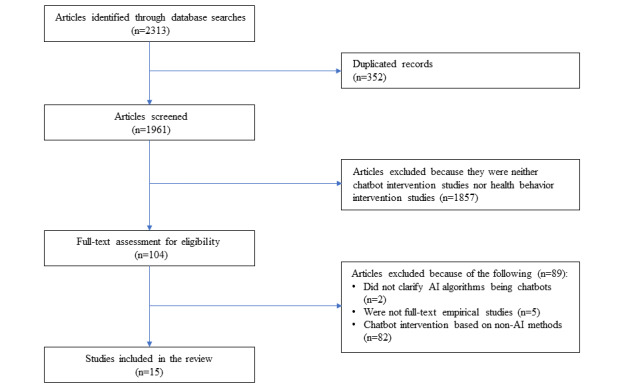
- Included studies had to evaluate AI-based chatbots for health behavior change; from 1961 records screened, 15 studies met inclusion criteria.
- The authors extracted study characteristics, intervention features, and outcomes; quality was assessed using the NIH quality assessment tool for controlled intervention studies and CONSORT-AI guidance.
Limitations
- The paper states that no meta-analysis was conducted because of heterogeneity in design, outcomes, and measures.
- The review states it did not cover a comprehensive set of behavioral outcomes because of strict inclusion criteria; the included studies focused on healthy lifestyle, smoking cessation, and treatment/medication adherence.
- The text makes evident that many included studies had pre-post designs without control groups, small samples in some studies, and limited description of AI techniques; the paper explicitly notes moderate to high internal validity risk and limited generalizability.
Model-written summary. Check it against the paper before relying on it.
Integrity signals
Registry
Cites
Statistics
Figures
Verification
Claims the paper makes
51 Valid · 5 Not valid · 6 Not checked · 114 Own results and interpretations
At least one cited source doesn’t support this claim or points to a different paper, and none confirmed it — see the verdicts below.
In the paper
“First, this review did not distinguish between AI-driven chatbots and other chatbots.”
§ Artificial Intelligence–Based Chatbots for Promoting Health Behavioral Changes: Systematic Review > Introduction > Prior Work
What the sources say
- Disputedcites [2] sourceExperimental — accuracy not yet measured
The Methods (Eligibility criteria; page unavailable) limit the review to interventions using AI chatbots, rather than chatbots generally. The Results (Summary of intervention and chatbot characteristics; page unavailable) further distinguish constrained from unconstrained chatbots. The paper therefore does not support the claim that it made no distinction between AI chatbots and other chatbots. (LLM, conf=0.84)
Checked by a reasoning model — may be wrong.
plain- Asserted: passes — The authors put it forward as true.
- Checkable: passes — It can be checked against evidence.
- Load-bearing: unclear — It is unclear whether the paper’s conclusions depend on it.
- Based: passes — The paper gives a reason why it holds.
- Disputed
Every source the paper cites for this claim was checked and supports it.
In the paper
“Second, the selected studies targeted only a limited set of behaviors, including physical activity, diet, and weight management.”
§ Artificial Intelligence–Based Chatbots for Promoting Health Behavioral Changes: Systematic Review > Introduction > Prior Work
What the sources say
- Supportedcites [2] source
The Methods (Eligibility criteria, Table 1; page not available) limit included studies to AI chatbot interventions for physical activity, diet, and/or weight management. The review’s selected studies therefore fall within the limited set of behaviors described in the claim. (LLM, conf=0.93)
plain- Asserted: passes — The authors put it forward as true.
- Checkable: passes — It can be checked against evidence.
- Load-bearing: passes — The paper’s conclusions depend on it.
- Based: passes — The paper gives a reason why it holds.
- Supported
The cited sources support only part of this claim — read each source’s verdict below.
In the paper
“The existing digital therapeutic and telehealth interventions with didactic components, which enable health care providers to communicate with patients via digital platforms (eg, email and video call), have encountered several challenges, including relatively low adherence, unsustainability, and inflexibility [3,4].”
§ Artificial Intelligence–Based Chatbots for Promoting Health Behavioral Changes: Systematic Review > Introduction > Background
What the sources say
- Not checked — no full text of the sourcecites [3] source
- Partly supportedcites [4] sourceExperimental — accuracy not yet measured
The Adherence and adverse events section reports low completion of computerised CBT: 10.4% with minimal support and 19.4% with telephone facilitation completed all five sessions. The paper does not establish that these interventions are unsustainable or inflexible; its Implications section instead says telephone-supported CBT could be offered at scale. Its findings also concern CBT for depression, not digital therapeutic and telehealth interventions generally. (LLM, conf=0.88)
plain- Asserted: passes — The authors put it forward as true.
- Checkable: passes — It can be checked against evidence.
- Load-bearing: passes — The paper’s conclusions depend on it.
- Based: passes — The paper gives a reason why it holds.
The cited sources support only part of this claim — read each source’s verdict below.
In the paper
“The overall conversational flexibility offered by AI chatbots in terms of communicating at anytime from anywhere offers a safe space to facilitate interactions with patients who feel or experience stigmatization while seeking health care services [5].”
§ Artificial Intelligence–Based Chatbots for Promoting Health Behavioral Changes: Systematic Review > Introduction > Background
What the sources say
- Partly supportedcites [5] sourceExperimental — accuracy not yet measured
The Discussion (Principal Findings; page unavailable) reports that participants felt more comfortable discussing issues with a robot because they did not expect it to judge them. The Discussion (Limitations and Directions for Future Research; page unavailable) suggests this could encourage discussion of sensitive issues and earlier help-seeking. The study concerns a social robot, however, and does not establish that AI chatbots offer flexible conversation anytime from anywhere or specifically facilitate interactions for patients experiencing stigmatization while seeking health care. (LLM, conf=0.88)
plainstates a cause- Asserted: passes — The authors put it forward as true.
- Checkable: passes — It can be checked against evidence.
- Load-bearing: unclear — It is unclear whether the paper’s conclusions depend on it.
- Based: passes — The paper gives a reason why it holds.
- Partly supported
The cited sources support only part of this claim — read each source’s verdict below.
In the paper
“Second, the AI algorithm uses machine learning (ML) and natural language processing (NLP) techniques to identify clinically meaningful patterns and understand user needs [7].”
§ Artificial Intelligence–Based Chatbots for Promoting Health Behavioral Changes: Systematic Review > Introduction > Background
What the sources say
- Partly supportedcites [7] sourceExperimental — accuracy not yet measured
The Introduction (Background; page unavailable) says conversational agents use machine learning and NLP to analyze user input and respond. It does not say they identify clinically meaningful patterns, and the Discussion (Principal Findings; page unavailable) notes that agents often had difficulty understanding users. (LLM, conf=0.86)
plainstates a cause- Asserted: passes — The authors put it forward as true.
- Checkable: passes — It can be checked against evidence.
- Load-bearing: unclear — It is unclear whether the paper’s conclusions depend on it.
- Based: passes — The paper gives a reason why it holds.
- Partly supported
90 more claims · 28 with their cited sources checked
Create a free account to see all 176 claims and every source verdict.
- It may state two separate claims as one. 66
- Probably not a substantial claim. 27
Claims other papers make about this one
Each is checked against this paper’s own text: does it say what the citing paper says it does?
The source backs part of the claim, not all of it — or backs it for a different population, condition or comparison.
In the citing paper
“It is notable that research into the use of AI for the delivery of personalized recommendations is sparse33”
From Impact of digital health interventions on glycemic control and weight management. (2025) · cites this paper as [33]
Experimental — accuracy not yet measuredThe source backs part of the claim, not all of it — or backs it for a different population, condition or comparison.
In the citing paper
“These findings align with those of another meta-analysis [122], showing the effectiveness of CAs in outcomes related to lifestyle changes, smoking cessation, substance misuse, and medication adherence.”
From Development and Evaluation of a Smartphone-Based Chatbot Coach to Facilitate a Balanced Lifestyle in Individuals With Headaches (BalanceUP App): Randomized Controlled Trial (2024) · cites this paper as [122]
Experimental — accuracy not yet measuredThe source backs part of the claim, not all of it — or backs it for a different population, condition or comparison.
In the citing paper
“For example, an AI-driven system might suggest lifestyle modifications, such as dietary changes or exercise routines that are optimized for an individual’s metabolism and cardiovascular risk (57).”
From Generative artificial intelligence in predictive analysis of diabetes and its complications: a narrative review (2025) · cites this paper as [57]
Experimental — accuracy not yet measuredThe source backs part of the claim, not all of it — or backs it for a different population, condition or comparison.
In the citing paper
“Chatbots provide real-time personalized health promotion, prevention, and screening (Aggarwal et al., 2023; Laranjo et al., 2018).”
From A chatbot-delivered intervention for optimizing social media use and reducing perceived isolation among rural-living LGBTQ+ youth: Development, acceptability, usability, satisfaction, and utility (2023) · cites this paper as Aggarwal et al., 2023
Experimental — accuracy not yet measuredThe source backs part of the claim, not all of it — or backs it for a different population, condition or comparison.
In the citing paper
“Chatbots are convenient artificial intelligence–operated conversational agents; they can be deployed within a social media site, do not require user download, and do not take up space in a user's device.”
From A chatbot-delivered intervention for optimizing social media use and reducing perceived isolation among rural-living LGBTQ+ youth: Development, acceptability, usability, satisfaction, and utility (2023) · cites this paper as Aggarwal et al., 2023
Experimental — accuracy not yet measured
Self-check
Percentages, sums and reported differences re-computed from the paper’s own numbers.
Each contradiction between two passages listed here was confirmed by an independent check.
Rated minor: it would not touch a result — a value no result rests on, a p-value that stays on the same side of the significance level, or a conflict that is clerical, resolved elsewhere in the paper, or outside its own findings.
In the paper
§ Artificial Intelligence–Based Chatbots for Promoting Health Behavioral Changes: Systematic Review > Results > Characteristics of the Reviewed Studies
“All 13 studies were distributed across low-income countries, with 4 (31%) from the United States, 2 (15%) from Australia, and 1 (8%) from each remaining country (ie, South Korea, Spain, the United Kingdom, Japan, France, Switzerland, and the Netherlands).”
§ Artificial Intelligence–Based Chatbots for Promoting Health Behavioral Changes: Systematic Review > Discussion > Limitations of the Reviewed Studies and Future Research Directions
“Out of the 13 studies that reported the geographical locations, all (100%) were conducted in the high-income countries;”
Rated minor: it would not touch a result — a value no result rests on, a p-value that stays on the same side of the significance level, or a conflict that is clerical, resolved elsewhere in the paper, or outside its own findings.
In the paper
§ Artificial Intelligence–Based Chatbots for Promoting Health Behavioral Changes: Systematic Review > Results > Characteristics of the Reviewed Studies
“Only 27% (4/15) of studies used randomized control trials (RCTs), and most of the studies (9/15, 60%) adopted a quasiexperimental design (ie, pre- and posttests) with no control group, followed by 7% (1/15) of studies with a cross-sectional design and 7% (1/15) of studies with a postexperimental research method.”
§ Artificial Intelligence–Based Chatbots for Promoting Health Behavioral Changes: Systematic Review > Results > Intervention Study Quality Assessment
“In the case of RCTs (4/15, 27%), this bias was minimized because of the experimental setting of the interventions; however, for non-RCT studies (11/14, 73%), there was a high risk of bias owing to the potential effect of confounding variables.”
Citations
Cites
PRISMA-P Group, Moher, D., Shamseer, L., Clarke, M., Ghersi, D., Liberati, A., Petticrew, M., Shekelle, P., & Stewart, L. A. (2015) · Systematic Reviews · doi:10.1186/2046-4053-4-1 · Cited by 26,223
How we design feasibility studies
Bowen, D. J., Kreuter, M., Spring, B., Cofta-Woerpel, L., Linnan, L., Weiner, D., Bakken, S., Kaplan, C. P., Squiers, L., Fabrizio, C., et al. (2009) · American Journal of Preventive Medicine · doi:10.1016/j.amepre.2009.02.002 · Cited by 4,021 · cited 1×
“Feasibility was defined as the demand of the intervention, that is, the actual use of the intervention and whether the intervention is doable in a certain setting [16].”
Conversational agents in healthcare: a systematic review
Laranjo, L., Dunn, A. G., Tong, H. L., Kocaballi, A. B., Chen, J., Bashir, R., Surian, D., Gallego, B., Magrabi, F., Lau, A. Y. S., et al. (2018) · Journal of the American Medical Informatics Association · doi:10.1093/jamia/ocy072 · Cited by 1,388 · cited 9×
“Artificial intelligence (AI)–driven chatbots (AI chatbots) are conversational agents that mimic human interaction through written, oral, and visual forms of communication with a user [1,2].”
InfluentialChatbots and Conversational Agents in Mental Health: A Review of the Psychiatric Landscape
Vaidyam, A. N., Wisniewski, H., Halamka, J. D., Kashavan, M. S., & Torous, J. B. (2019) · The Canadian Journal of Psychiatry · doi:10.1177/0706743719828977 · Cited by 1,048 · cited 1×
“…findings are consistent with the previous systematic literature reviews that reported that all the chatbot intervention studies were conducted in high-income countries [2,10,11,14], most studies were conducted with adults [2,7], and most studies did not focus on racial or ethnic minorities [2,14].”
Emotional Chatting Machine: Emotional Conversation Generation with Internal and External Memory
Zhou, H., Huang, M., Zhang, T., Zhu, X., & Liu, B. (2018) · Proceedings of the AAAI Conference on Artificial Intelligence · doi:10.1609/aaai.v32i1.11325 · Cited by 763
Liu, X., Rivera, S. C., Moher, D., Calvert, M. J., & Denniston, A. K. (2020) · BMJ · doi:10.1136/bmj.m3164 · Cited by 702
The Effectiveness of Artificial Intelligence Conversational Agents in Health Care: Systematic Review
Milne-Ives, M., de Cock, C., Lim, E., Shehadeh, M. H., de Pennington, N., Mole, G., Normando, E., & Meinert, E. (2020) · Journal of Medical Internet Research · doi:10.2196/20346 · Cited by 626 · cited 8×
“This finding is consistent with the previous systematic literature reviews that reported very few studies discussed participant safety or ethics in terms of adverse events [1,2,7,9] and data security or privacy [2,8].”
InfluentialAbd-Alrazaq, A. A., Rababeh, A., Alajlani, M., Bewick, B. M., & Househ, M. (2020) · Journal of Medical Internet Research · doi:10.2196/16021 · Cited by 503
Embodied conversational agents in clinical psychology: a scoping review
Provoost, S., Lau, H. M., Ruwaard, J., & Riper, H. (2017) · Journal of Medical Internet Research · doi:10.2196/jmir.6553 · Cited by 433 · cited 2×
“Of the extant systematic reviews on AI chatbots, 6 articles targeted at assessing efficacy of AI-chatbots in enhancing mental health outcomes [1,7,9-12], 2 examined the feasibility of AI-chatbots in health care settings [8,13], and 1 described the technical architectures and characteristics of the…”
Zhang, J., Oh, Y. J., Lange, P., Yu, Z., & Fukuoka, Y. (2020) · Journal of Medical Internet Research · doi:10.2196/22845 · Cited by 363 · cited 1×
“As specified in the AI chatbot design literature, user engagement is dependent on the chatbot’s ability to understand the user’s background, build a relation, be persuasive, and offer quick feedback [34].”
Research works printed but not linked: 1
- Radziwill, NM, 2017, arXiv
Cited by
Items 401–500 of 657
Borsari, B. E., Delacruz, J., Saiyed, A., Layton, J. F., Llanes, K. D., Mirzadegan, I. A., Cheng, J., Hargrave, A. S., Meacham, M. C., Catley, D., et al. (2026) · JMIR Formative Research · doi:10.2196/88125 · Cited by 2
Raipal, S., & Penkova, A. (2026) · Knowledge-Based Systems · doi:10.1016/j.knosys.2026.116241 · Cited by 1
Zuo, C., Pan, Y., Guo, R., Liang, M., Zhang, Y., Xia, Y., & Kong, Y. (2026) · Frontiers in Psychology · doi:10.3389/fpsyg.2026.1832938 · Cited by 1
“Artificial intelligence (AI) health assistants, from rule-based chatbots to large-language-model-powered conversational agents, are rapidly entering the public health toolkit (Laranjo et al., 2018; Aggarwal, 2023; Huo et al., 2025).”
Love, B., Ghosh, C., Shi, W., Quaack, K. R., & Mackert, M. (2026) · Cancer Control · doi:10.1177/10732748261454474 · Cited by 2
“18 AI systems offer potential advantages including personalized health communication, improved accessibility for users with limited health literacy, conversational interfaces that may reduce barriers for sensitive topics, and capacity for real-time adaptation to individual user needs and…”
Su, L., Xu, L., Tang, J., & Zuo, M. (2026) · BMC Nephrology · doi:10.1186/s12882-026-05048-z · Cited by 2
“Inaccurate, incomplete, or unclear AI-generated responses may pose text-level risks for patients with complex self-management needs [30–31].”
Khosravi, M., Zamaninasab, Z., Khosravi, F., Attar, M., & Arab‐Zozani, M. (2026) · Health Science Reports · doi:10.1002/hsr2.72634 · Cited by 2
“Chatbots also serve as a nonjudgmental platform for exchanging sensitive information [19].”
Lai, C.-Y., Yu, J., Lee, C., Wang, G., Perdana, S. A., Chen, T.-H., & Yeh, T. (2026) · Service Science · doi:10.1287/serv.2025.0067 · Cited by 1
Personalised AI Coaching Technology: A Systematic Mapping Review
Vitale, J., Cenacchi, F., Kraus, M., Orji, F. A., Richards, D., Orji, R., Conati, C., & Berkovsky, S. (2026) · ACM Transactions on Interactive Intelligent Systems · doi:10.1145/3820900 · Cited by 2
Marcantonio, T. L., Vowels, L. M., LeRoux, S., Bravo, M., Thrash, A., Mueller, A., Niolet, A., Hall, M., Döring, N. M., & Nadarzynski, T. (2026) · The Journal of Sex Research · doi:10.1080/00224499.2026.2686406 · Cited by 1
Chen, S., Duan, Y., & Zhao, Y. (2026) · International Journal of Human-Computer Interaction · doi:10.1080/10447318.2026.2683646 · Cited by 1
Forman, E. M., Hagerman, C. J., Hong, A. E., Huang, Z., McCausland, H. C., Sun, J. H., Taylor, L. N., Butryn, M. L., Chatterjee, P., Ehsani, R., et al. (2026) · Annals of Behavioral Medicine · doi:10.1093/abm/kaag038 · Cited by 3
Role of Open AI (Artificial Intelligence)–Innovations in Health Behavior Change Interventions
Kanekar, A. S. (2023) · Healthcare · doi:10.3390/healthcare11202710 · Cited by 9
The Role of AI in Elevating Hospital Service Quality: Framework, Development, and Applications
Abidi, M. H., Rehman, A. U., Mian, S. H., Alkhalefah, H., & Usmani, Y. S. (2023) · Advances in healthcare information systems and administration book series · doi:10.4018/979-8-3693-0679-6.ch012 · Cited by 10
AI-Driven Content Developing and Designing for Teaching Materials of Digital Healthcare
Muthmainnah, M., Yakin, A. M. A., Nurjannah, N., Mursidin, M., & Aqad, M. H. A. (2024) · Advances in medical diagnosis, treatment, and care (AMDTC) book series · doi:10.4018/979-8-3693-3679-3.ch015 · Cited by 2
Sacher, P. M., Fulton, E. A., Rogers, V., Wilson, J., Gramatica, M., Dent, J. E., Aarts, E. O., Eccleston, D., Greve, J. W. M., Palm‐Meinders, I. H., et al. (2024) · JMIR Formative Research · doi:10.2196/54723 · Cited by 3
“There is early evidence that generative artificial intelligence (AI) conversational agents can deliver automated, immediate, text-based behavior change interventions and positively impact lifestyle behaviors, including in populations living with overweight and obesity [58,59].”
Potential of Artificial Intelligence in Healthcare Sector
Khurana, S., Malik, A., Narwal, S., Agarwal, G., & Sangwan, K. (2024) · International Conference on Computational Intelligence and Computing Applications (ICCICA) · doi:10.1109/iccica60014.2024.10584926 · Cited by 5
“…settings, including diet counseling, quitting smoking, and cognitive behavioral therapy [38] by giving patients and their caregivers’ individualized, interactive information and assistance, artificial intelligence (AI) possesses the capability to significantly contribute to patient education [39].”
BackgroundSimoun, A., Fleet, A., Scharf, D. M., Pope, L. G., Spaeth‐Rublee, B., Goldman, M. L., & Pincus, H. A. (2024) · Translational Behavioral Medicine · doi:10.1093/tbm/ibae043 · Cited by 2
Investigating User Perceptions of Collaborative Agenda Setting in Virtual Health Counseling Session
Fallah, M., Nouraei, F., Yun, H. S., et al. (2024) · ACM International Conference on Intelligent Virtual Agents (IVA) · doi:10.1145/3652988.3673956 · Cited by 1
“…in healthcare underscores their multifaceted role [4] and their promise to deliver digital health Permission to make digital or hard copies of all or part of this work for personal or classroom use is granted without fee provided that copies are not made or distributed for profit or…”
Towards AI Chatbot Effectiveness: Crucial Elements Impacting User Engagement and Satisfaction
Lestarini, D., & Raflesia, S. P. (2024) · International Conference of Adisutjipto on Aerospace Electrical Engineering and Informatics (ICAAEEI) · doi:10.1109/icaaeei63658.2024.10899167 · Cited by 2
ARTIFICIAL INTELLIGENCE IN NURSING: DRIVING A NEW STANDARD IN PATIENT CARE
Bender, C., Hirata, R. P., Kronborg, T., & Cichosz, S. L. (2025) · Texto & Contexto - Enfermagem · doi:10.1590/1980-265x-tce-2025-e001en · Cited by 3
“Natural language processing tools and large language models, for example, can transcribe and organize patient notes, saving nurses valuable time for hands-on care 23,24 .”
Ekellem, E. A. F. (2024) · doi:10.36227/techrxiv.170555337.72740439/v1 · Cited by 1
Ekellem, E. A. F. (2024) · doi:10.36227/techrxiv.170555330.07605038/v1 · Cited by 1
Li, J., Steinberg, J., Mynatt, E. D., & Mishra, V. (2024) · doi:10.2196/preprints.67579 · Cited by 1
Bergam, S. J., Bergam, C., & Zanoni, B. C. (2025) · Research Square · doi:10.21203/rs.3.rs-6289967/v1 · Cited by 1
Sundaram, S., Adarsh, R., & Thapa, S. (2025) · medRxiv · doi:10.1101/2025.06.27.25330316 · Cited by 2
Tan, T. C., Roslan, N. E., Li, J. W., Zou, X., Chen, X., Ratnasari, R., & Santosa, A. (2023) · doi:10.2196/preprints.49239
Taşkın, S., Cesur, M. G., & Mustafa, U. Z. U. N. (2023) · SDÜ Tıp Fakültesi Dergisi · doi:10.17343/sdutfd.1369828 · Cited by 1
GPT-4 vs Bard: A Performance Evaluation in Statistics
de Souza, A. F., & Balestrassi, P. P. (2024) · doi:10.29327/1342182.1-4 · Cited by 1
Conversational Systems and Computational Intelligence, A Critical Analysis
Mir, Y. O. V., Pérez, P. Y. P., Pupo, I. P., Acuña, L. A., & Bello, R. (2024) · Studies in computational intelligence · doi:10.1007/978-3-031-50495-2_1
AI Chatbot for Generating Episodic Future Thinking (EFT) Cue Texts for Health
Ahmadi, S., & Fox, E. A. (2024) · IEEE International Conference on Artificial Intelligence for Medicine, Health and Care (AIMHC) · doi:10.1109/aimhc59811.2024.00027 · Cited by 4
“In recent years, an increasing number of populations have been targeted by Episodic Future Thinking (EFT) [4] as an intervention to treat maladaptive health behaviors that may lead to lifestyle diseases [5, 6, 7, 8].”
BackgroundSupporting Food Computing with Ontologies and Artificial Intelligence Methods for Sustainability
Adrian, W. T., Ignacyk, J., Pyrczak, K., et al. (2024) · IFIP advances in information and communication technology · doi:10.1007/978-3-031-61069-1_4
When AI Meets Art Therapy: Evaluating AI-Generated Art Through Art Therapists Insights (Preprint)Preprint
Shojaei, F., Shojaei, F., Torres, J. O., & Shih, P. C. (2024) · doi:10.2196/preprints.63038
Isaacs, K. R., Shifflett, A., Patel, K. N., Karpisek, L., Cui, Y., Lawental, M., Wernette, G. T., Borsari, B. E., Chang, K., & Ma, T. (2024) · doi:10.2196/preprints.62915
NestNeuro: Leveraging Chatbots for Vocal Screening
Oliveira, G., Pah, N. D., Ngo, Q. C., Papa, J. P., & Kumar, D. (2024) · Proceedings - IEEE Symposium on Computer-Based Medical Systems · doi:10.1109/cbms61543.2024.00038 · Cited by 1
A Structured Literature Review on Conversational Agents that Empower Health Interventions
Pietrantoni, N. (2023) · International Conference on Information Systems and Software Technologies (ICI2ST) · doi:10.1109/ici2st62251.2023.00024 · Cited by 1
The Use of Conversational Agents in Self-Management: A Retrospective AnalysisPreprint
Çolakoğlu, S., Durmus, M., Polat, Z. P., Yildiz, A., & Sezgın, E. (2024) · medRxiv · doi:10.1101/2024.09.01.24312881
Early Depression Detection Using Modern AI Techniques: Issues, Opportunities, and Challenges
Dey, S., & Singh, K. (2024) · Advances in computational intelligence and robotics book series · doi:10.4018/979-8-3693-6150-4.ch006
Borsari, B. E., Delacruz, J., Saiyed, A., Layton, J. F., Llanes, K. D., Kanzaveli, T., Tsvetovat, M., Cheng, J., Catley, D., & Satterfield, J. M. (2024) · doi:10.2196/preprints.67672
Scherer, J. N., Oliveira, G. R., Machado, F. M. R., Gomes, C. F., & Ornell, F. R. (2024) · Journal of Psychoactive Drugs · doi:10.1080/02791072.2024.2421921
“In general, chatbots are showing good applicability, acceptance, and effectiveness for use in the field of mental health (Aggarwal et al. 2023; Gaffney, Mansell, and Tai 2019; Singh et al. 2023).”
Artificial Intelligence (Not) Replacing Coaches: A Thematic Literature ReviewPreprint
Ezhikov, A. I. (2024) · doi:10.61726/9807.2024.81.43.001
Taylor, M., Ng, D., Pfisterer, K. J., Cafazzo, J. A., & Sherifali, D. (2025) · PLOS Digital Health · doi:10.1371/journal.pdig.0000701 · Cited by 1
“Outside of chronic disease management, chatbots appear to enhance engagement and motivation [36,37], and are positioned to provide personalized feedback [37], facilitate on-demand support [37], as well as gamification [38].”
Lorenzo, V. D., Famulari, R., & Ussorio, D. (2024) · RIVISTA SPERIMENTALE DI FRENIATRIA · doi:10.3280/rsf2024-003002
Bludo, G. Y., & Buabeng-Andoh, F. (2025) · Inproforum ... · doi:10.32725/978-80-7694-102-1.09
Transforming Healthcare: Exploring the Potential of Futuristic Healthcare Delivery System
Garg, V., Malhotra, C., Kumar, H., Bhardwaj, A., Bansal, R., & Saini, S. (2025) · Springer eBooks · doi:10.1007/978-981-97-0244-2_2
Artificial Intelligence in Endodontics
Herbst, S. R., & Hossein, M.-R. (2025) · Springer eBooks · doi:10.1007/978-3-031-84047-0_8
Savelidi, M., Savelidis, S., Christoforidis, C., Kleitsas, V., Tzanetopoulou, A., & Fasouraki, R. (2024) · European Journal of Engineering and Technology Research · doi:10.24018/ejeng.2024.1.cie.3237
“Existing bibliography strongly highlights the contribution of chatbots to facilitating data collection, encouraging participant engagement, and providing personalized interactions, particularly in psychology experiments and clinical trials [18]–[23].”
Sato, T., Sano, T., Kumakawa, E., Fujimura, K., & Yamashita, N. (2025) · CHI Conference Extended Abstracts on Human Factors in Computing Systems (CHI EA) · doi:10.1145/3706599.3720143
“In recent years, the use of chatbots has been widely researched as a means to motivate individuals and support behavior change (promote behavior modification) when human resources are insufficient [1, 6, 18, 21].”
Routine Change in Obesity and Type 2 Diabetes
Bassin, S. R., Vaca, R., & Srinath, R. (2025) · Springer eBooks · doi:10.1007/978-3-031-82888-1_29
The Missing Subject in Health Federated Learning: Preventive and Personalized Care
Diniz, J. M. (2025) · Studies in computational intelligence · doi:10.1007/978-3-031-78841-3_6 · Cited by 1
Suffoletto, B. P., & Preiksaitis, C. M. (2025) · doi:10.2196/preprints.76614
Personalized Support for People with Disabilities Through Generative AI
Malviya, R., & Rajput, S. (2025) · SpringerBriefs in modern perspectives on disability research. · doi:10.1007/978-981-96-6069-8_5 · Cited by 1
INTELIGÊNCIA ARTIFICIAL NA ENFERMAGEM: GUIANDO NOVOS PADRÕES NO CUIDADO AO PACIENTE
Bender, C., Hirata, R. P., Kronborg, T., & Cichosz, S. L. (2025) · Texto & Contexto - Enfermagem · doi:10.1590/1980-265x-tce-2025-e001pt · Cited by 1
First-Aid Medykit Assistant Chatbot using Natural Language Processing Techniques
Singh, S., Panda, S., Singh, A., & Bala, A. A. (2024) · International Conference on Communication, Computing and Energy Efficient Technologies (I3CEET) · doi:10.1109/i3ceet61722.2024.10993701 · Cited by 1
“Abhishek Aggarwal et al. [5] offer a thorough analysis of the findings from a selection of 15 studies on the effectiveness of AI chatbots as tools for behavior change interventions.”
Scalia, J. L., Laprise, J. K., Thrift, J. R., Farrell, C. L., & Sarasua, S. M. (2026) · JMIR AI · doi:10.2196/76400 · Cited by 1
“Consequently, chatbot-based and automated digital tools offer a cost-effective way to improve the accessibility of genetic services [12].”
InfluentialNavigating Ethical Challenges of AI Chatbots for Sex Therapy
Fu, M., & Chan, W. (2025) · Oxford University Press eBooks · doi:10.1093/9780198945215.003.0075 · Cited by 2
Oster, C., Leibbrandt, R. E., Hocking, J., Müller, A., Powers, D. M. W., Musolino, R., & Lange, B. S. (2026) · Patient Education and Counseling · doi:10.1016/j.pec.2026.109782 · Cited by 1
Künstliche Intelligenz zur Förderung von körperlicher Aktivität
Farrahi, V., Sánchez-Trigo, H., Schmidt, M., & Jaitner, T. (2025) · Springer eBooks · doi:10.1007/978-3-662-68950-9_18 · Cited by 1
Subramaniam, A., Hensley, E., Parikh, J., Gundala, A., Ford, S. H., Fernandez, O., Vuong, C., & Shah, N. (2023) · mHealth · doi:10.21037/mhealth-24-91
Estrella, T., Capdevila, L., Alfonso, C., & Losilla, J.-M. (2025) · doi:10.2196/preprints.78648
Eiroa-Solans, C., & Inzlicht, M. (2025) · SSRN Electronic Journal · doi:10.2139/ssrn.5294015
Oluwole, O. B., McGill, L., Gayle, K., O’Brien, J. A., Abebe, K. Z., Jonassaint, C. R., & Hamm, M. (2025) · JMIR Human Factors · doi:10.2196/73719 · Cited by 2
“Digital interventions incorporating chatbots have been recognized as an effective way to deliver behavioral coaching, track symptoms, and strengthen patient engagement [36].”
Gößwein, E., Smith-Spark, J. H., & Liebherr, M. (2025) · Proceedings of the Human Factors and Ergonomics Society Annual Meeting · doi:10.1177/10711813251358260
“Despite their growing importance across different sectors, uncertainty remains regarding their appropriate use (Aggarwal et al., 2023).”
Artificial Intelligence to Promote Physical Activity
Farrahi, V., Sánchez-Trigo, H., Schmidt, M., & Jaitner, T. (2025) · Springer eBooks · doi:10.1007/978-3-662-70155-3_18 · Cited by 1
Leveraging Artificial Intelligence (AI) to Enhance Nursing Care for Patients Undergoing Eye Surgery
Shamsizadeh, M. (2025) · Springer eBooks · doi:10.1007/978-3-031-83756-2_27
Walji, Z., Badhwar, R., Dave, P., & Park, J. (2025) · Proceedings of the Human Factors and Ergonomics Society Annual Meeting · doi:10.1177/10711813251360997 · Cited by 1
“These tools have also successfully promoted positive life-style changes, such as reducing physical inactivity and smoking (Aggarwal et al., 2023).”
Bisset, B., Kainkaryam, V., Marhamati, S. H., Moradi, A., Amin, R., & Houman, J. (2025) · doi:10.2196/preprints.81314
Nagare, P. V., & Shirke, P. (2025) · AIP conference proceedings · doi:10.1063/5.0289454
Kashefi, A., Bosschaerts, K., Ongenae, F., Marez, L. D., Murphy, S. L., Conradie, P. D., & Abeele, M. V. (2025) · SSRN Electronic Journal · doi:10.2139/ssrn.5357715
Chipiti, T., Kakou, M., Mokhetho, K. C., & Dlamini, Z. (2025) · Elsevier eBooks · doi:10.1016/b978-0-443-45495-0.00002-4
Artificial Intelligence in Patient Management
Conley, N. (2025) · Primary Care Clinics in Office Practice · doi:10.1016/j.pop.2025.07.005
Examining factors influencing chatbot adoption in Takaful industry: Malaysian evidence
Thaker, H. M. T., Lacheheb, Z., Lelchumanan, B., Duasa, J., & Hesary, F. T. (2025) · International Journal of Islamic and Middle Eastern Finance and Management · doi:10.1108/imefm-01-2025-0056 · Cited by 4
Carrilho, M., Pinto, D. C., Wagner, R., Rohden, S. F., de Arriaga, M. T., & Pinto, L. Q. (2025) · doi:10.2196/preprints.84492
Gavilanez, T. S., Zamora, N., Navarrete, J., et al. (2025) · Sustainability · doi:10.3390/su17198909
Zhuang, N., Ma, Y., Zhao, X., Ying, W., Chai, S., Weng, S., Xue, M., Mao, Y., & Yao, C. (2025) · INTERNATIONAL CONFERENCE ON MULTIMODAL INTERACTION · doi:10.1145/3716553.3750807
Lange, M., & Schaller, A. (2025) · Fehlzeiten-Report · doi:10.1007/978-3-662-71885-8_7
Vilanti, T., Luiro, K., Dahlqvist, I., Piipponen, J., Hemminki-Reijonen, U., Tkalcan, S., Ketamo, H., & Koivisto, J. (2025) · BMC Medical Education · doi:10.1186/s12909-025-08032-7 · Cited by 3
“AI chatbots, such as ChatGPT, have shown considerable promise in the field of education, highlighting the versatility and applicability of AI technologies across various domains [18, 19].”
РОЗМОВНИЙ ШТУЧНИЙ ІНТЕЛЕКТ В ОХОРОНІ ЗДОРОВ'Я: ПЕРЕВАГИ ТА ВАРІАНТИ ВИКОРИСТАННЯ
LOTOTSKA, L., & БРЕЙДАК, Ю. Г. (2025) · Вісник соціальної гігієни та організації охорони здоров я України · doi:10.11603/1681-2786.2025.3.15655
Impact of AI in Patient Engagement: Smart Revolution in Health Sector
Jenefa, L., & Jayakumar, M. (2025) · IGI Global eBooks · doi:10.4018/979-8-3373-1514-0.ch001
Designing Nutritional Interventions for Mental Health
Hendi, N. I., Abouelmagd, M. E., Sharkawy, A. M., Jasim, E. M., & Amin, A. M. (2025) · Nutritional neurosciences · doi:10.1007/978-981-95-1983-5_2
Anderson, J., Webb, L., Huynh, W., Ortega, M., Norris, W. K., & Anderson, R. E. (2025) · Research Square · doi:10.21203/rs.3.rs-7367961/v1
Kelly, M. M., Moore, P. S., Zai, A., & Allison, J. J. (2026) · JMIR AI · doi:10.2196/85419 · Cited by 4
“AI-based behavioral interventions also use these reinforcement strategies, including personalized reminders, goal tracking, and positive reinforcement, contributing to a user’s engagement and the potential for problematic over-reliance on the system [49].”
Teixeira, A. R., & Lopes, C. T. (2025) · Lecture notes in networks and systems · doi:10.1007/978-3-032-01130-5_11 · Cited by 1
Alzahrani, L. (2025) · International Journal of Recent Technology and Engineering (IJRTE) · doi:10.35940/ijrte.a1130.14041125
Smart and Digital Wellbeing Initiatives in Healthcare: The Way Forward
Varma, A., Saraiya, A. S., Tuli, K., Suresh, S., & Srivastava, S. (2025) · IGI Global eBooks · doi:10.4018/979-8-3373-7917-3.ch009 · Cited by 1
‘Giving and Receiving’—Peer Volunteers' Experiences of Online Perinatal Support: A Qualitative Study
Aayisha, Choolani, M. A., Chong, S. C., Chee, C. Y. I., Mathews, J., Goh, Y. S., Shah, L., Lim, L. H. K., Mörelius, E., Eriksson, J. G., et al. (2025) · Journal of Advanced Nursing · doi:10.1111/jan.70412
Generative-AI Based Health Management System for CKD Patients
Chuang, Y., Cheng, Y., Yu, T., Chang, R.-C., Chin, H.-H., & Deng, D. (2025) · IEEE International Conference on Wireless and Mobile Computing, Networking and Communications (WiMob) · doi:10.1109/wimob66857.2025.11257545
“However, concerns remain regarding accuracy, bias, and subgroup safety without external validation [12], Conversational AI chatbots provide real-time feedback and support for health behavior change, but accessibility features for older adults are often insufficient [13]–[18].”
Dwivedi, A., Yusufi, R., Derashri, A., Sharma, D., Vinchurkar, K., Patel, D., & Suryawanshi, M. V. (2025) · Elsevier eBooks · doi:10.1016/b978-0-443-43823-3.00012-1
Machine learning algorithms for predictive patient counseling
Patel, R., Singh, Y. R., Jadeja, P., & Prajapati, B. G. (2025) · Elsevier eBooks · doi:10.1016/b978-0-443-43823-3.00015-7
Hosseiniravandi, M., Sheykhotayefeh, M., & Khodaveisi, T. (2025) · مجله دانشگاه علوم پزشکی تربت حیدریه · doi:10.61882/jmsthums.13.3.78
Editorial: AI for health behavior change
Mogles, N. M., Joel-Edgar, S., Zhang, C., & Klein, M. C. A. (2025) · Frontiers in Digital Health · doi:10.3389/fdgth.2025.1735279
Wang, T., Lund, B. D., & Bai, T. (2025) · Public Library Quarterly · doi:10.1080/01616846.2025.2602380 · Cited by 1
Hay, E., Ireland, D., Claus, A. P., Rose, T., Strong, J., Westerman, D., Schlumpf, M., Vijayakumar, P., Burvill, L., & Andrews, N. E. (2025) · BMJ Open · doi:10.1136/bmjopen-2025-104984
“16 17 In addition, people perceive chatbots as offering a non-judgmental safe space to provide information, 18 which has been found to improve the self-expression of young people.”
Pérez-Maletzki, J., Roig‐Casasús, S., Díaz-Díaz, B., Martínez-Garrido, I., Hernández‐Guillén, D., & Blasco, J. (2025) · Physiotherapy · doi:10.1016/j.physio.2025.101872
Machine Learning for the Analysis of Healthy Lifestyle Data: Scoping Review and Guidelines
Estrella, T., Capdevila, L., Alfonso, C., & Losilla, J.-M. (2025) · JMIR Human Factors · doi:10.2196/78648
“Prior reviews have focused primarily on outcome effectiveness or AI chatbot interventions, often providing limited detail about the ML process involved [24].”
Huang, N. M., & Ho, S. S. (2025) · Science Communication · doi:10.1177/10755470251398722 · Cited by 1
Advancing Prediabetes Care with Personalised Conversational Agents
Sawad, A. B., Althubyani, M., Alharbi, S. A., Alorini, A., Jefry, W., Alotaibi, N. N., Narayan, B., Lin, S., Prasad, M., & Kocaballi, A. B. (2025) · IEEE International Conference on e-Business Engineering (ICEBE) · doi:10.1109/icebe68123.2025.00050
Chen, Y.-M., Chuang, C. F., Lin, Y.-C., Liu, P.-Y., Wu, Y. H., Yuan, C. W., Bi, N., Hsu, S.-H., Chang, H., Huang, M., et al. (2025) · ACM International Joint Conference on Pervasive and Ubiquitous Computing (UbiComp) · doi:10.1145/3714394.3754355
Metadata
- Authors
- Aggarwal, A., Tam, C. C., Wu, D., Li, X., & Qiao, S.
- Affiliations
- University of South Carolina (US)
- Corresponding author
- Qiao, Shan
- Venue
- Journal of medical Internet research
- Publisher
- JMIR Publications Inc.
- Published
- 2023-02-24
- Volume
- 25
- Pages
- e40789
- ISSN
- 1438-8871 (ISSN-L)
- PMC
- PMC10007007
- OpenAlex
- W4321748146
- Cited by
- 683
- References
- 36
- Citations by year
- 2026: 239 · 2025: 263 · 2024: 135 · 2023: 46
- FWCI
- 34.57
- Type
- journal article
- Language
- en
- Open access
- gold
- doi.org
- Licence
- cc-by
- Locations
- Journal of Medical Internet Research (publishedVersion, cc-by)
- medRxiv (acceptedVersion)
- PubMed Central (publishedVersion, cc-by)
- PubMed (publishedVersion)
- DOAJ (DOAJ: Directory of Open Access Journals) (submittedVersion, cc-by-sa)
- Funders
- University of South Carolina (BDHSC-2021-14)
- National Institutes of Health
- National Institute of Allergy and Infectious Diseases (R01AI127203)
- Topics
- Health Sciences › Health Professions › General Health Professions › Mobile Health and mHealth Applications
- Social Sciences › Psychology › Applied Psychology › Digital Mental Health Interventions
- Health Sciences › Medicine › Health Informatics › Artificial Intelligence in Healthcare and Education
- Keywords
- AI chatbots, health behavior change, health promotion, smoking cessation, medication adherence, substance abuse, behaviour change theory, personalized interventions, feasibility and acceptability, chatbot usability, real-time feedback
- MeSH terms
- Artificial Intelligence, Delivery of Health Care, Health Promotion, Humans, Software, Health Behavior
About these checks
Registry, retraction, Cites and statistics results are computed, not judged, with one exception: a printed reference that no index lists is read once by a model before it counts as a citation error. Claims are extracted by a model and kept only when their quote appears verbatim in the text; each cited source is then checked, with a model’s help, for whether it says what the claim relies on. Those verdicts can be wrong — read the claim’s quote and the cited source before relying on one.
The claim verdicts this report counts are experimental: their accuracy is not yet measured.
A language model drew the claims from the paper on 2026-10-10, under version 3 of the claim definition (model deepseek-v4.1-flash, prompt extract-v3).
A second model labelled each claim on 2026-10-10 (model jev-1.13-20260917, definition revision gold-guideline-v0.2).
Cited sources are checked with a language model’s help (gpt-6-sol).
Statistics and arithmetic are recomputed, not judged.
Confidence bands are shown only for fields calibrated on our annotated test set. None is calibrated yet, so no band is shown.
What counts as a claim ›How we measure confidence ›How we check this ›
Are you an author, or do you see a problem with this page? Request a review
Data sources
Bibliographic data: Semantic Scholar, OpenAlex, Crossref.
Contains information from the Semantic Scholar Academic Graph Datasets, made available under the ODC Attribution License (ODC-BY 1.0).
Semantic Scholar’s data is described in: Kinney, R., et al. (2023). The Semantic Scholar Open Data Platform. arXiv:2301.10140.
