

The DOI matches its Crossref record; 46 of the 46 references it cites were found in a registry or an index.
Comparing Adherence to the Experience Sampling Method Among Patients With Schizophrenia Spectrum Disorder and Unaffected Individuals: Observational Study From the Multicentric DiAPAson Project
Open accessPublished version of a preprint
Abstract
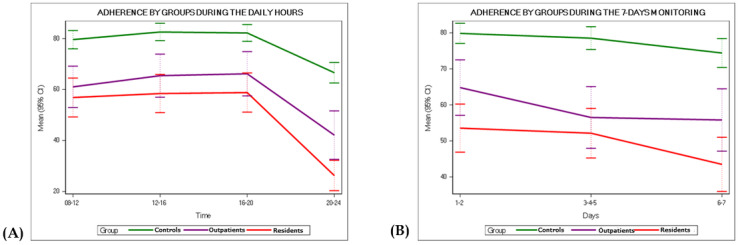
Background: The Experience Sampling Method (ESM) is a valid method of remotely recording activities and mood, but the predictors of adherence to ESM in patients with Schizophrenia Spectrum Disorder (SSD) are not known. Studies on adherence are significant as they highlight the strengths and weaknesses of ESM-based study designs and allow the development of recommendations and practical guidelines for implementing future studies or treatment plans. Objective: The aim of this study was to compare the adherence to ESM in patients with SSD and unaffected control individuals, investigate their patterns, and report the predictors of adherence. Methods: In total, 131 patients with SSD (74 in residential facilities and 57 outpatients) and 115 unaffected control individuals were recruited at 10 different centers in Italy as part of the DiAPAson project. Demographic information, symptom severity, disability level, and level of function were recorded for the clinical sample. Participants were evaluated for daily time use and mood through a smartphone-based ESM 8 times a day for 7 consecutive days. Adherence was measured by the response rate to ESM notifications. Results were analyzed using the chi-square test, ANOVA, Kruskal-Wallis test, and Friedman test, and a logistic regression model. Results: The overall adherence rate in this study was 50% for residents, 59% for outpatients, and 78% for unaffected control individuals. Indeed, patients with SSD had a lower rate of adherence to ESM than the unaffected control group (P≤.001), independent of time slot, day of monitoring, or day of the week. No differences in adherence rates between weekdays and weekends were found among the 3 groups. The adherence rate was the lowest in the late evening time slot (8 PM to 12 AM) and days 6-7 of the study for both patients with SSD and unaffected control individuals. The adherence rate among patients with SSD was not predicted by sociodemographic characteristics, cognitive function, or other clinical features. A higher adherence rate (ie, ≥70%) among patients with SSD was predicted by higher collaboration skills (odds ratio [OR] 2.952; P=.046) and self-esteem (OR 3.394; P=.03), and lower positive symptom severity (OR 0.835; P=.04). Conclusions: Adherence to ESM prompts for both patients with SSD and unaffected control individuals decreased during late evening and after 6 days of monitoring. Higher self-esteem and collaboration skills predicted higher adherence to ESM among patients with SSD, while higher positive symptom scores predicted lower adherence rates. This study provides important information to guide protocols for future studies using ESM. Future clinical or research studies should set ESM monitoring to waking hours, limit the number of days of monitoring, select patients with more collaborative skills and avoid those with marked positive symptoms, provide intensive training sessions, and improve participants’ self-confidence with technologies. International Registered Report Identifier (IRRID): RR2-10.1186/s12888-020-02588-y
Overview
The claims and statistics of this paper haven’t been checked yet.
Free: it reads the open-access text and checks the first 5 claims that cite a source we can check. Create a free account to check every claim.
Integrity signals
Registry
Cites
Statistics
Figures
Verification
Claims the paper makes
The claims and statistics of this paper haven’t been checked yet.
Free: it reads the open-access text and checks the first 5 claims that cite a source we can check. Create a free account to check every claim.
Claims other papers make about this one
Each is checked against this paper’s own text: does it say what the citing paper says it does?
The source backs part of the claim, not all of it — or backs it for a different population, condition or comparison.
In the citing paper
“Their findings suggested the ESM as a useful tool for supporting people with severe mental illness to reflect on their activity engagement, and for staff to gain insights into their daily lives in community settings where regular assessment may be challenging.”
From Contributions of a time use perspective in community mental health practice: a scoping review (2024) · cites this paper as [42]
Experimental — accuracy not yet measuredThe cited source says what the claim attributes to it.
In the citing paper
“In a series of mixed-method studies, Cristina Zarbo et al. (20), Zarbo et al. (41) and Zarbo et al. (42) investigated the feasibility of using smartphone-based brief questionnaire to prompt sampling of experiences of current activities and mood in real time at eight intervals daily (between 8am to midnight) over a week.”
From Contributions of a time use perspective in community mental health practice: a scoping review (2024) · cites this paper as [42]
Self-check
Percentages, sums and reported differences re-computed from the paper’s own numbers.
The self-check needs the paper’s full text.
Citations
Cites
The Brief Psychiatric Rating Scale.
Overall, J. E., & Gorham, D. R. (1962) · Psychological Reports · doi:10.2466/pr0.1962.10.3.799 · Cited by 11,090 · cited 1×
“…treatment, an assessment of collaboration skills, the Specific Levels of Functioning Scale (SLOF) [28], the Brief Psychiatric Rating Scale (BPRS) [29,30], the Brief Negative Symptom Scale (BNSS) [31,32], and the World Health Organization Disability Assessment Schedule 2.0 (WHODAS 2.0) [33,34].”
InfluentialEthical principles of psychologists and code of conduct
American Psychological Association (1992) · American Psychologist · doi:10.1037/0003-066x.47.12.1597 · Cited by 1,362
Rosenberg, M. (2011) · PsycTESTS Dataset · doi:10.1037/t01038-000 · Cited by 1,226
Experience sampling research in psychopathology: opening the black box of daily life
Myin-Germeys, I., Oorschot, M., Collip, D., Lataster, J., Delespaul, P., & van Os, J. (2009) · Psychological Medicine · doi:10.1017/s0033291708004947 · Cited by 817 · cited 1×
“…(ESM) has gained wide acceptance as a tool for the measurement of a range of psychological, psychophysiological, cognitive, and behavioral data in real-life settings among different populations [1-3], including patients with a diagnosis of Schizophrenia Spectrum Disorders (SSD) or psychosis [4-16].”
Emotional Reactivity to Daily Life Stress in Psychosis
Myin-Germeys, I., van Os, J., Schwartz, J. E., Stone, A. A., & Delespaul, P. A. (2001) · Archives of General Psychiatry · doi:10.1001/archpsyc.58.12.1137 · Cited by 653
Vachon, H., Viechtbauer, W., Rintala, A., & Myin-Germeys, I. (2019) · Journal of Medical Internet Research · doi:10.2196/14475 · Cited by 252 · cited 2×
“…[16,20], lower executive functioning [16], a higher number of lifetime suicide attempts [20], lower psychosocial function [10], male gender [21], older age [16], lower educational level [16], the timing of prompts [11,22], a higher number of assessments per day [21], and lower incentives…”
Self-stigma of people with schizophrenia as predictor of their adherence to psychosocial treatment.
Fung, K. M. T., Tsang, H. W. H., & Corrigan, P. W. (2008) · Psychiatric Rehabilitation Journal · doi:10.2975/32.2.2008.95.104 · Cited by 247 · cited 1×
“This result is consistent with those of studies reporting that higher self-esteem is associated with higher adherence to both medical and psychological treatments among patients with SSD [44,45].”
Determinants of occurrence and recovery from hallucinations in daily life
Delespaul, P., deVries, M., & van Os, J. (2002) · Social Psychiatry and Psychiatric Epidemiology · doi:10.1007/s001270200000 · Cited by 247 · cited 1×
“…(ESM) has gained wide acceptance as a tool for the measurement of a range of psychological, psychophysiological, cognitive, and behavioral data in real-life settings among different populations [1-3], including patients with a diagnosis of Schizophrenia Spectrum Disorders (SSD) or psychosis [4-16].”
Psychomotor Slowing in Schizophrenia
Morrens, M., Hulstijn, W., & Sabbe, B. (2007) · Schizophrenia Bulletin · doi:10.1093/schbul/sbl051 · Cited by 245 · cited 1×
“Moreover, many patients with SSD, especially those in residential settings, have some illness-or treatment-related cognitive difficulties, including psychomotor slowing commonly found in these individuals [42], and often do not own their own smartphone and were using a smartphone for the first time.”
Research works printed but not linked: 5
- Harvey, PD, 2021, Innov Clin Neurosci, 18, 24
- 2013, The Diagnostic and Statistical Manual of Mental Disorders, Fifth Edition
- Montemagni, C, 2015, J Psychopathol, 21, 287
- Morosini, P, 1995, J Rivista di Riabilitazione Psichiatrica e Psicosociale, 3, a
- Gold, LH, 2014, J Am Acad Psychiatry Law, 42, 173
Cited by
Zarbo, C., Rota, M., Calza, S., Crouter, S. E., Ekelund, U., Barlati, S., Bussi, R., Clerici, M., Placenti, R., Paulillo, G., et al. (2023) · BMJ Mental Health · doi:10.1136/bmjment-2023-300836 · Cited by 20
“…of antipsychotic medications and its relationship with PA, 22 the care needs of patients with SSD and its association with daily activities and mood monitored using the EMA, 23 the sleep-wake patterns 24 , and the adherence rate to EMA and accelerometer 25 26 and predictors of EMA adherence.”
BackgroundMethodSelf-citationZarbo, C., Zamparini, M., Patrono, A., Calini, C., Harvey, P. D., Casiraghi, L., Clerici, M., Malvezzi, M., Rocchetti, M., Starace, F., et al. (2023) · International Journal of Methods in Psychiatric Research · doi:10.1002/mpr.1992 · Cited by 8
Self-citationMartiadis, V., Raffone, F., Clemente, S., Massa, A., & Berardis, D. D. (2026) · Medicina · doi:10.3390/medicina62040704 · Cited by 6
“Planning is required for onboarding, prompt burden and staff support, especially in residential settings [11,36].”
Contributions of a time use perspective in community mental health practice: a scoping review
Fossey, E., Doroud, N., Harvey, C. A., Dun, C., Hitch, D., Farnworth, L., & Krupa, T. (2024) · Frontiers in Psychiatry · doi:10.3389/fpsyt.2024.1461705 · Cited by 5
Caselani, E., Martinelli, A., Grigis, C., Zamparini, M., Toffol, E., Harvey, P. D., Malvezzi, M., de Girolamo, G., & for the DIAPASON consortium (2025) · Cognitive Neuropsychiatry · doi:10.1080/13546805.2025.2482539 · Cited by 1
“Studies utilising ESM have revealed that individuals with SSD exhibit significantly greater emotional variability and instability than HC (Collip et al., 2013; Jones et al., 2021; Myin-Germeys et al., 2001; Myin-Germeys & van Os, 2007; Zarbo et al., 2023).”
Self-citation
Metadata
- Authors
- Zarbo, C., Zamparini, M., Nielssen, O., Casiraghi, L., Rocchetti, M., Starace, F., de Girolamo, G., & Collaborators, D.
- Affiliations
- Centro San Giovanni di Dio Fatebenefratelli (IT)
- Macquarie University (AU)
- University of Pavia (IT)
- Corresponding author
- Zarbo, Cristina
- ORCID
- Venue
- Journal of Medical Internet Research
- Publisher
- JMIR Publications Inc.
- Published
- 2023-07-18
- Volume
- 25
- Pages
- e42093
- ISSN
- 1438-8871 (ISSN-L)
- PMC
- PMC10394602
- OpenAlex
- W4384626739
- Cited by
- 9
- References
- 45
- Citations by year
- 2026: 5 · 2025: 1 · 2024: 1 · 2023: 2
- FWCI
- 2.33
- Type
- journal article
- Language
- en
- Open access
- gold
- doi.org
- Licence
- cc-by
- Locations
- Journal of Medical Internet Research (publishedVersion, cc-by)
- PubMed Central (publishedVersion, cc-by)
- PubMed (publishedVersion)
- BOA (University of Milano-Bicocca) (submittedVersion, cc-by)
- DOAJ (DOAJ: Directory of Open Access Journals) (submittedVersion, cc-by-sa)
- Funders
- Ministero della Salute (RF-2018-12365514, 2018-, RF-2018)
- Università degli Studi di Verona
- Università degli Studi di Brescia
- Topics
- Social Sciences › Psychology › Experimental and Cognitive Psychology › Mental Health Research Topics
- Health Sciences › Medicine › Psychiatry and Mental health › Schizophrenia research and treatment
- Health Sciences › Health Professions › General Health Professions › Mobile Health and mHealth Applications
- Keywords
- ecological momentary assessment, adherence, schizophrenia spectrum disorders, smartphone-based monitoring, daily time use, mood, predictors of adherence, collaboration skills, self-esteem, residential care, outpatients, cognitive function, disability severity, sociodemographic factors
- MeSH terms
- Smartphone, Ecological Momentary Assessment, Affect, Humans, Outpatients, Schizophrenia
About these checks
Registry, retraction, Cites and statistics results are computed, not judged, with one exception: a printed reference that no index lists is read once by a model before it counts as a citation error. Claims are extracted by a model and kept only when their quote appears verbatim in the text; each cited source is then checked, with a model’s help, for whether it says what the claim relies on. Those verdicts can be wrong — read the claim’s quote and the cited source before relying on one.
Statistics and arithmetic are recomputed, not judged.
Confidence bands are shown only for fields calibrated on our annotated test set. None is calibrated yet, so no band is shown.
What counts as a claim ›How we measure confidence ›How we check this ›
Are you an author, or do you see a problem with this page? Request a review
Data sources
Bibliographic data: Semantic Scholar, OpenAlex, Crossref.
Contains information from the Semantic Scholar Academic Graph Datasets, made available under the ODC Attribution License (ODC-BY 1.0).
Semantic Scholar’s data is described in: Kinney, R., et al. (2023). The Semantic Scholar Open Data Platform. arXiv:2301.10140.
