

The DOI matches its Crossref record; 74 of the 74 references it cites were found in a registry or an index; 39 of the 59 sources its claims cite were checked for support.
Experiences of Using Digital Mindfulness-Based Interventions: Rapid Scoping Review and Thematic Synthesis
Open accessPublished version of a preprint
Abstract
Background: Digital mindfulness-based interventions (MBIs) are a promising approach to deliver accessible and scalable mindfulness training and have been shown to improve a range of health outcomes. However, the success of digital MBIs is reliant on adequate engagement, which remains a crucial challenge. Understanding people’s experiences of using digital MBIs and identifying the core factors that facilitate or act as barriers to engagement is essential to inform intervention development and maximize engagement and outcomes. Objective: This study aims to systematically map the literature on people’s experiences of using digital MBIs that target psychosocial variables (eg, anxiety, depression, distress, and well-being) and identify key barriers to and facilitators of engagement. Methods: We conducted a scoping review to synthesize empirical qualitative research on people’s experiences of using digital MBIs. We adopted a streamlined approach to ensure that the evidence could be incorporated into the early stages of intervention development. The search strategy identified articles with at least one keyword related to mindfulness, digital, user experience, and psychosocial variables in their title or abstract. Inclusion criteria specified that articles must have a qualitative component, report on participants’ experiences of using a digital MBI designed to improve psychosocial variables, and have a sample age range that at least partially overlapped with 16 to 35 years. Qualitative data on user experience were charted and analyzed using inductive thematic synthesis to generate understandings that go beyond the content of the original studies. We used the Quality of Reporting Tool to critically appraise the included sources of evidence. Results: The search identified 510 studies, 22 (4.3%) of which met the inclusion criteria. Overall, the samples were approximately 78% female and 79% White; participants were aged between 16 and 69 years; and the most used measures in intervention studies were mindfulness, psychological flexibility, and variables related to mental health (including depression, anxiety, stress, and well-being). All studies were judged to be adequately reported. We identified 3 themes characterizing barriers to and facilitators of engagement: responses to own practice (ie, negative reactions to one’s own practice are common and can deplete motivation), making mindfulness a habit (ie, creating a consistent training routine is essential yet challenging), and leaning on others (ie, those engaging depend on someone else for support). Conclusions: The themes identified in this review provide crucial insights as to why people frequently stop engaging with digital MBIs. Researchers and developers should consider using person-based coparticipatory methods to improve acceptability of and engagement with digital MBIs, increase their effectiveness, and support their translation to real-world use. Such strategies must be grounded in relevant literature and meet the priorities and needs of the individuals who will use the interventions. © 2023 Journal of Medical Internet Research. All rights reserved.
Overview
CoChat Summary
TL;DR
This rapid scoping review and thematic synthesis found that engagement with digital mindfulness-based interventions (MBIs) is shaped by three recurring themes: reactions to one’s own practice, making mindfulness a habit, and leaning on others. The authors synthesized qualitative evidence from 22 studies and argue that digital MBIs should be designed with person-based, participatory methods to better support engagement.
Key findings
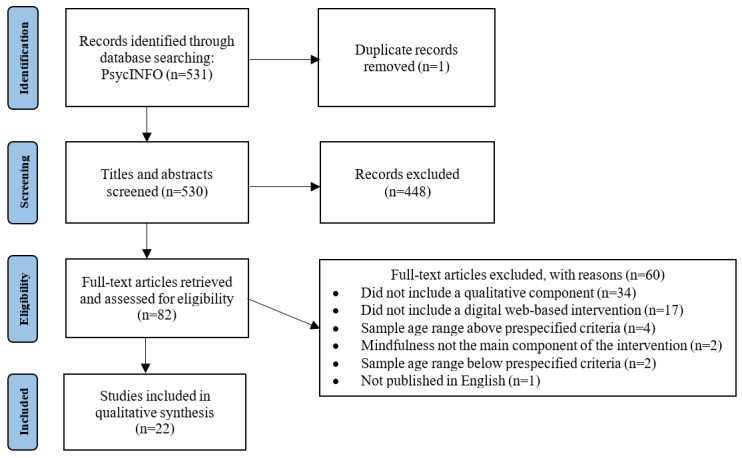
- The search identified 530 unique records; 82 (15.5%) were included in the full-text review and 22 (4.2%) in the qualitative synthesis.
- The included studies were published between 2010 and 2022; 17/22 (77%) were published from 2017 onward. Samples were approximately 78% female, 79% White, and ages ranged from 16 to 69 years (weighted mean age 26.4 years, weighted SD 8.8).
- Three themes characterized barriers and facilitators of engagement: responses to own practice, making mindfulness a habit, and leaning on others.
- The review notes that 21/22 (95%) studies included additional support; at least 19/22 (86%) included human support, and at least 12/22 (55%) included support beyond purely technical/administrative assistance.
Methods
- Rapid scoping review of empirical qualitative research on experiences using digital MBIs targeting psychosocial variables (eg, anxiety, depression, distress, well-being).
- Search strategy was limited to English-language papers and PsycINFO; inclusion required a qualitative component and samples whose age range overlapped at least partially with 16 to 35 years.
- Qualitative data from 22 studies were charted and synthesized using inductive thematic synthesis; study reporting was appraised with the Quality of Reporting Tool.
Limitations
- The paper states that restricting the search to PsycINFO may have omitted relevant studies or introduced selection bias.
- The authors note that the included studies were mostly of White adult female individuals from Western countries, so generalizability to underrepresented groups is unclear.
- The review excluded studies with samples entirely <16 years and/or >35 years, reflecting the authors’ intervention-development focus; this makes applicability to younger and older populations less certain.
- Evident from the text: the review’s evidence base is heterogeneous in intervention type and support level, and the authors say this prevents conclusions about the relative power of different support types.
Model-written summary. Check it against the paper before relying on it.
Integrity signals
Registry
Cites
Statistics
Figures
Verification
Claims the paper makes
30 Valid · 1 Not valid · 23 Not checked · 81 Own results and interpretations
Some cited sources support this claim and some don’t — read each source’s verdict below.
In the paper
“early evaluations of digital MBIs report beneficial effects that are comparable with those found in traditional in-person programs [8,9]”
§ Experiences of Using Digital Mindfulness-Based Interventions: Rapid Scoping Review and Thematic Synthesis > Introduction > Background
What the sources say
- Supportedcites [8] source
The Discussion reports that changes in stress, anxiety and depression following the online mindfulness course were comparable to those seen with mindfulness courses delivered in person. Its conclusion likewise says the observed effects compare with those of in-person courses. The paper calls for a future direct comparison, so this supports a comparison of reported effects, not a finding of equivalence from a head-to-head trial. (LLM, conf=0.94)
- Disputedcites [9] sourceExperimental — accuracy not yet measured
The Highlights report significant small-to-moderate benefits from online MBIs. But the Main findings (section 4.1) say effects on depression and anxiety were generally smaller than those found for face-to-face MBIs, suggesting they may not be equally effective. The authors caution that the comparison is premature because few online trials were available. (LLM, conf=0.86)
Checked by a reasoning model — may be wrong.
plain- Asserted: passes — The authors put it forward as true.
- Checkable: passes — It can be checked against evidence.
- Load-bearing: passes — The paper’s conclusions depend on it.
- Based: passes — The paper gives a reason why it holds.
- Supported
Every source the paper cites for this claim was checked and supports it.
In the paper
“there is evidence from meta-analyses of randomized controlled trials suggesting that MBIs can reduce depression and anxiety or stress in young people [2]”
§ Experiences of Using Digital Mindfulness-Based Interventions: Rapid Scoping Review and Thematic Synthesis > Introduction > Background
What the sources say
- Supportedcites [2] source
The Results (‘All RCTs’) report significantly greater reductions in Depression and Anxiety/Stress after MBIs than after control conditions across 33 randomized trials. The Discussion (‘RCTs with active control groups’) says those benefits remained significant in the 17 trials with active comparators, supporting the citing sentence’s cautious wording. (LLM, conf=0.94)
hedgedstates a cause- Asserted: passes — The authors put it forward as true.
- Checkable: passes — It can be checked against evidence.
- Load-bearing: unclear — It is unclear whether the paper’s conclusions depend on it.
- Based: passes — The paper gives a reason why it holds.
- Supported
The cited sources support only part of this claim — read each source’s verdict below.
In the paper
“the success of digital MBIs is reliant on adequate engagement, which remains a crucial challenge”
- Also stated in: § Background · plain
“the success of digital MBIs is reliant on adequate engagement, which remains a crucial challenge”
§ Experiences of Using Digital Mindfulness-Based Interventions: Rapid Scoping Review and Thematic Synthesis > Abstract > Background
What the sources say
- Partly supportedcites [12] sourceExperimental — accuracy not yet measured
The Results section ('Attrition, Participation and Engagement'; page unavailable) reports that participants sometimes engaged less than instructed or dropped out, and that one study linked slower completion with weaker outcomes. The Discussion says engagement is likely to affect outcomes, but that evidence for a dose-response relationship is not yet strong. Calling adequate engagement a requirement for success is more definite than the source supports. (LLM, conf=0.86)
plainstates a cause- Asserted: passes — The authors put it forward as true.
- Checkable: passes — It can be checked against evidence.
- Load-bearing: passes — The paper’s conclusions depend on it.
- Based: passes — The paper gives a reason why it holds.
- Also stated in: § Background · plain
Every source the paper cites for this claim was checked and supports it.
In the paper
“low engagement is a common issue in digital mental health interventions generally [13]”
§ Experiences of Using Digital Mindfulness-Based Interventions: Rapid Scoping Review and Thematic Synthesis > Introduction > Background
What the sources say
- Supportedcites [13] source
The Introduction (Background; page not provided) says engagement with digital mental health interventions is an ongoing issue, although it varies across studies. This supports the general claim that low engagement is a common issue. (LLM, conf=0.94)
plain- Asserted: passes — The authors put it forward as true.
- Checkable: passes — It can be checked against evidence.
- Load-bearing: passes — The paper’s conclusions depend on it.
- Based: passes — The paper gives a reason why it holds.
- Supported
Every source the paper cites for this claim was checked and supports it.
In the paper
“the success of digital MBIs is reliant on adequate engagement, which remains a crucial challenge”
- Also stated in: § Background · plain
“the success of digital MBIs is reliant on adequate engagement, which remains a crucial challenge”
§ Experiences of Using Digital Mindfulness-Based Interventions: Rapid Scoping Review and Thematic Synthesis > Abstract > Background
What the sources say
- Supportedcites [9] source
In §4.1 (page unavailable), the review says regular practice is important for developing mindfulness skills, reports adherence rates ranging from 35% to 92%, and raises the possibility that non-optimal adherence limited outcomes. Section 4.2 (page unavailable) likewise identifies adherence as important when considering the effectiveness of online MBIs. Together, these passages support the claim that engagement is important and remains a challenge. (LLM, conf=0.88)
- Supportedcites [12] source
The Results section (‘Attrition, Participation and Engagement’; page unavailable) reports that participants sometimes engaged less than instructed or dropped out, and that lower engagement was associated with weaker outcomes in one study. The Discussion says engagement is likely to play an important role in outcomes, supporting the claim that it is a challenge for digital MBIs. (LLM, conf=0.88)
plain- Asserted: passes — The authors put it forward as true.
- Checkable: passes — It can be checked against evidence.
- Load-bearing: passes — The paper’s conclusions depend on it.
- Based: passes — The paper gives a reason why it holds.
- Also stated in: § Background · plain
47 more claims · 6 with their cited sources checked
Create a free account to see all 135 claims and to verify the 2 references still open.
- Probably not a substantial claim. 49
- It may state two separate claims as one. 51
Citations
Cites
The PRISMA 2020 statement: An updated guideline for reporting systematic reviews
Page, M. J., McKenzie, J. E., Bossuyt, P. M., Boutron, I., Hoffmann, T. C., Mulrow, C. D., Shamseer, L., Tetzlaff, J. M., Akl, E. A., Brennan, S. E., et al. (2021) · BMJ · doi:10.1136/bmj.n71 · Cited by 108,283
PRISMA Extension for Scoping Reviews (PRISMA-ScR): Checklist and Explanation
Tricco, A. C., Lillie, E., Zarin, W., O'Brien, K. K., Colquhoun, H., Levac, D., Moher, D., Peters, M. D. J., Horsley, T., Weeks, L., et al. (2018) · Annals of Internal Medicine · doi:10.7326/m18-0850 · Cited by 43,565 · cited 1×
“…to the enhancing transparency in reporting the synthesis of qualitative research (ENTREQ) guidelines [24] in reporting this review, and the review itself was guided by the Cochrane rapid review methods recommendations [25] and PRISMA guidelines for scoping reviews [26] (Multimedia Appendix 1).”
MethodInterrater reliability: The kappa statistic
McHugh, M. L. (2012) · Biochemia Medica · doi:10.11613/bm.2012.031 · Cited by 19,877 · cited 1×
“Multimedia Appendix 7 [25,38,40-46] provides more details on our streamlined approach.”
Methods for the thematic synthesis of qualitative research in systematic reviews
Thomas, J., & Harden, A. (2008) · BMC Medical Research Methodology · doi:10.1186/1471-2288-8-45 · Cited by 9,312
Cochrane Handbook for Systematic Reviews of Interventions
Higgins, J. P. T., Green, S., & Ben Van Den, A. (2020) · International Coaching Psychology Review · doi:10.53841/bpsicpr.2020.15.2.123 · Cited by 5,670
Enhancing transparency in reporting the synthesis of qualitative research: ENTREQ
Tong, A., Flemming, K., McInnes, E., Oliver, S., & Craig, J. (2012) · BMC Medical Research Methodology · doi:10.1186/1471-2288-12-181 · Cited by 3,569 · cited 1×
“We adhere to the Enhancing Transparency in Reporting the Synthesis of Qualitative Research guidelines [24] in reporting this review, and the review itself was guided by the Cochrane Rapid Reviews Methods recommendations [25] and PRISMA-ScR (Preferred Reporting Items for Systematic Reviews and…”
Carmody, J., & Baer, R. A. (2008) · Journal of Behavioral Medicine · doi:10.1007/s10865-007-9130-7 · Cited by 1,823 · cited 1×
“Time spent practicing mindfulness at home is related to increases in levels of mindfulness and, in turn, improvements in psychological functioning [15].”
Yardley, L., Morrison, L., Bradbury, K., & Muller, I. (2015) · Journal of Medical Internet Research · doi:10.2196/jmir.4055 · Cited by 1,442 · cited 3×
“…combinations of factors identified across other literatures (e.g., on digital interventions or mindfulness interventions more broadly) are most influential in the specific context of digital MBIs, which is essential to make these interventions more persuasive, feasible, and relevant to users [20].”
BackgroundPersuasive System Design Does Matter: a Systematic Review of Adherence to Web-based Interventions
Kelders, S. M., Kok, R. N., Ossebaard, H. C., & Van Gemert-Pijnen, J. E. (2012) · Journal of Medical Internet Research · doi:10.2196/jmir.2104 · Cited by 1,308 · cited 1×
“For example, a systematic review of web-based interventions found that the inclusion of persuasive design principles, including tailoring (ie, provision of content or feedback adapted to factors relevant to a user), explained 55% of the variance in session completion across studies [70].”
Cochrane Rapid Reviews Methods Group offers evidence-informed guidance to conduct rapid reviews
Garritty, C., Gartlehner, G., Nussbaumer-Streit, B., King, V. J., Hamel, C., Kamel, C., Affengruber, L., & Stevens, A. (2021) · Journal of Clinical Epidemiology · doi:10.1016/j.jclinepi.2020.10.007 · Cited by 1,141 · cited 3×
“Multimedia Appendix 7 [25,38,40-46] provides more details on our streamlined approach.”
Research works printed but not linked: 3
- Page, MJ, 2019, Cochrane Handbook for Systematic Reviews of Interventions
- McDonagh, M, 2013, Methods Guide for Effectiveness and Comparative Effectiveness Reviews
- LefebvreCGlanville JBriscoe SFeatherstone RLittlewood AMarshall CMetzendorf M-INoel-StorrAPaynterRRaderTThomasJWielandLSHigginsJPTThomasJChandlerJCumpstonMLiTPageMJWelchVAChapter 4: Searching for and selecting studiesCochrane Handbook for Systematic Reviews of Interventions version 6.3 (updated February 2022)2022https://training.cochrane.org/hand book/current/chapter-04
Cited by
Torous, J., Linardon, J., Goldberg, S. B., Sun, S., Bell, I., Nicholas, J., Hassan, L., Hua, Y., Milton, A., & Firth, J. (2025) · World Psychiatry · doi:10.1002/wps.21299 · Cited by 323
Alkan, E., Kumar, G., Ravichandran, S., Kaushal, S. R., de Pablo, G. S., Alerci, L., Michaud-Feinberg, J., Gutiérrez-Rojas, L., Zorzi, C., Klauser, P., et al. (2025) · Psychiatry Research · doi:10.1016/j.psychres.2025.116473 · Cited by 19
Remskar, M., Ainsworth, B., Maynard, O., Malkowski, O. S., Birch, A., Burd, A., Caretu, T.-C., Assaad, L. E., Christodoulou-Tsiaoukkas, A., Menon, A., et al. (2025) · Mental health and physical activity · doi:10.1016/j.mhpa.2025.100680 · Cited by 13
Self-citationDrüge, M., Guthardt, L., Haller, E., Michalak, J., & Apolinário-Hagen, J. (2024) · Advances in Experimental Medicine and Biology · doi:10.1007/978-981-97-4402-2_11 · Cited by 11
Digital Tools for Seizure Monitoring and Self-Management in Epilepsy: A Narrative Review
Narodova, E. A. (2025) · Journal of Clinical Medicine · doi:10.3390/jcm14248701 · Cited by 16
“Integrating cognitive-behavioral therapy (CBT), mindfulness, and anxiety management tools into epilepsy apps has been shown to improve adherence and perceived quality of life [33,34].”
Metadata
- Authors
- Osborne, E. L., Ainsworth, B., Hooper, N., & Atkinson, M. J.
- Affiliations
- University of Bath (GB)
- University of Southampton (GB)
- Cardiff University (GB)
- Corresponding author
- Osborne, Emma Louise
- Venue
- Journal of Medical Internet Research
- Publisher
- JMIR Publications Inc.
- Published
- 2023-09-28
- Volume
- 25
- Pages
- e44220
- ISSN
- 1438-8871 (ISSN-L)
- PMC
- PMC10570895
- OpenAlex
- W4385468433
- Cited by
- 37
- References
- 72
- Citations by year
- 2026: 17 · 2025: 15 · 2024: 5
- FWCI
- 1.24
- Type
- journal article
- Language
- en
- Open access
- gold
- doi.org
- Licence
- cc-by
- Locations
- Journal of Medical Internet Research (publishedVersion, cc-by)
- PubMed Central (publishedVersion, cc-by)
- PubMed (publishedVersion)
- ORCA Online Research @Cardiff (Cardiff University) (acceptedVersion)
- ePrints Soton (University of Southampton) (acceptedVersion)
- ORCA Online Research @Cardiff (Cardiff University) (submittedVersion)
- DOAJ (DOAJ: Directory of Open Access Journals) (submittedVersion, cc-by-sa)
- ORCA Online Research @Cardiff (Cardiff University) (submittedVersion, cc-by)
- Funders
- Economic and Social Research Council (2232546, ES/P000630/1)
- Topics
- Social Sciences › Psychology › Applied Psychology › Digital Mental Health Interventions
- Social Sciences › Psychology › Clinical Psychology › Mindfulness and Compassion Interventions
- Health Sciences › Health Professions › General Health Professions › Mobile Health and mHealth Applications
- Keywords
- user experience, habit formation, social support, mental health, anxiety, depression, well-being, psychological flexibility, young adults, intervention development, acceptability, mental health apps, user-centered design, participatory design, co-design, user satisfaction
- MeSH terms
- Adolescent, Adult, Aged, Female, Humans, Male, Middle Aged, Qualitative Research, Young Adult, Mindfulness
About these checks
Registry, retraction, Cites and statistics results are computed, not judged, with one exception: a printed reference that no index lists is read once by a model before it counts as a citation error. Claims are extracted by a model and kept only when their quote appears verbatim in the text; each cited source is then checked, with a model’s help, for whether it says what the claim relies on. Those verdicts can be wrong — read the claim’s quote and the cited source before relying on one.
The claim verdicts this report counts are experimental: their accuracy is not yet measured.
A language model drew the claims from the paper on 2026-10-11, under version 3 of the claim definition (model deepseek-v4.1-flash, prompt extract-v3).
A second model labelled each claim on 2026-10-11 (model jev-1.13-20260917, definition revision gold-guideline-v0.2).
Cited sources are checked with a language model’s help (gpt-6-sol).
Statistics and arithmetic are recomputed, not judged.
Confidence bands are shown only for fields calibrated on our annotated test set. None is calibrated yet, so no band is shown.
What counts as a claim ›How we measure confidence ›How we check this ›
Are you an author, or do you see a problem with this page? Request a review
How to cite
Cite CoChat for the checks on this page, and the paper for its own findings.
- This page
- CoChat. (2026). Citation check: Experiences of Using Digital Mindfulness-Based Interventions: Rapid Scoping Review and Thematic Synthesis. https://app.cochat.ai/papers/10.2196/44220
- The paper
- Osborne, E. L., Ainsworth, B., Hooper, N., & Atkinson, M. J. (2023). Experiences of Using Digital Mindfulness-Based Interventions: Rapid Scoping Review and Thematic Synthesis. Journal of Medical Internet Research. https://doi.org/10.2196/44220
Data sources
Bibliographic data: Semantic Scholar, OpenAlex, Crossref.
Contains information from the Semantic Scholar Academic Graph Datasets, made available under the ODC Attribution License (ODC-BY 1.0).
Semantic Scholar’s data is described in: Kinney, R., et al. (2023). The Semantic Scholar Open Data Platform. arXiv:2301.10140.
