

The Potential of a Digital Weight Management Program to Support Specialist Weight Management Services in the UK National Health Service: Retrospective Analysis
Open accessPublished version of a preprint
The DOI matches its Crossref record; 31 of the 31 references it cites were found in a registry or an index.
Abstract
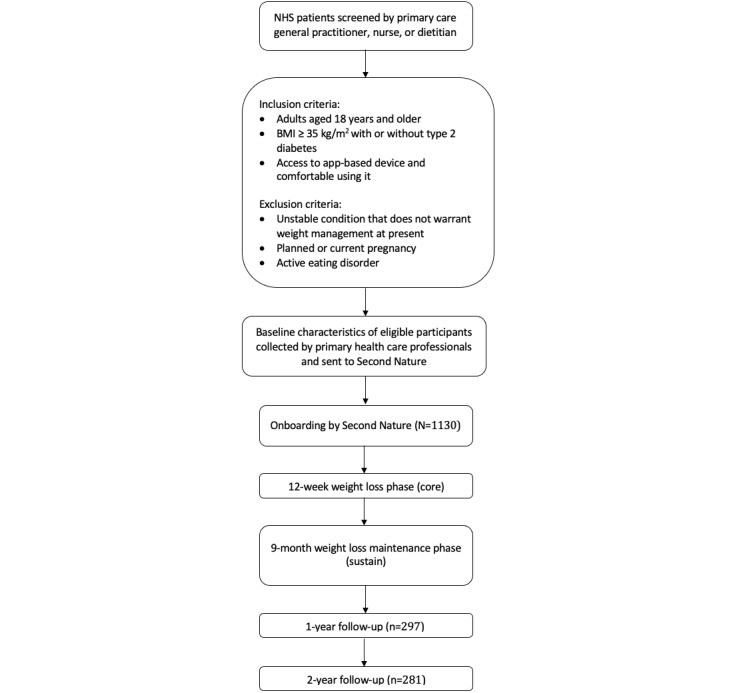
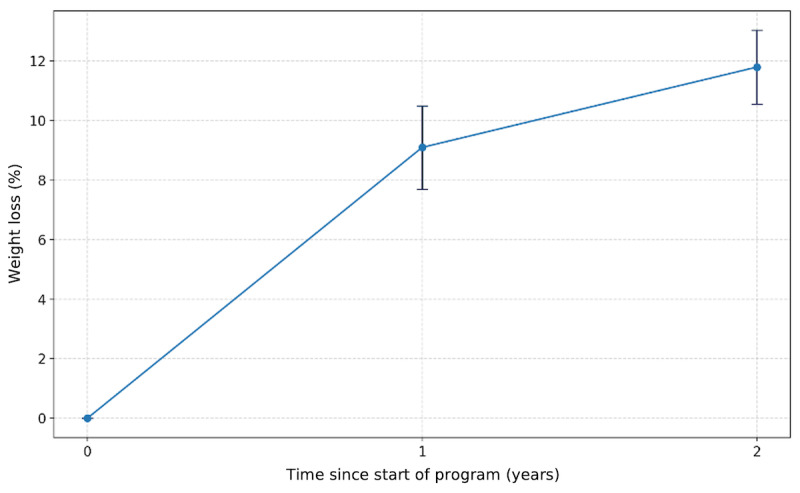
Background: Digital weight management interventions (DWMIs) have the potential to support existing specialist weight management services (SWMS) in the National Health Service (NHS) to increase access to treatment for people living with obesity and type 2 diabetes. At present, there is limited real-world evidence and long-term outcomes on the potential effectiveness of DWMIs to support such services. Objective: This study aimed to examine real-world data to evaluate the impact of Second Nature’s 12-month DWMI for patients living with obesity with or without type 2 diabetes, referred from NHS primary care services, on sustained weight loss over a 2-year period. Methods: Retrospective data were extracted in August 2023 for participants who participated in the program between January 1, 2017, and January 8, 2021. Eligible participants were adults with a BMI ≥35 kg/m2, with or without type 2 diabetes. The primary outcomes were weight change in kilograms and percentage weight change at 2 years. Secondary outcomes were weight loss at 1 year, program engagement, and the proportion of participants who achieved >5% and >10% weight loss. Differences in weight loss between baseline and the 1- and 2-year follow-up points were compared using paired 2-tailed t tests. Linear regression models were used to examine whether participants’ ethnicity, indices of multiple deprivation, presence of type 2 diabetes, or program engagement were associated with weight loss at 1 year or 2 years. Results: A total of 1130 participants with a mean baseline BMI of 46.3 (SD 31.6) kg/m2 were included in the analysis. Of these participants, 65% (740/1130) were female (mean age 49.9, SD 12.0 years), 18.1% (205/339) were from Black, Asian, mixed, or other ethnicities, and 78.2% (884/1130) had type 2 diabetes. A total of 281 (24.9%) participants recorded weight readings at 2 years from baseline, with a mean weight loss of 13.8 kg (SD 14.2 kg; P<.001) or 11.8% (SD 10.9%; P<.001). A total of 204 (18.1%) participants achieved ≥5% weight loss, and 130 (11.5%) participants reached ≥10% weight loss. Weight loss did not significantly differ by ethnicity, indices of multiple deprivation, presence of type 2 diabetes, or engagement in the program. Conclusions: The findings suggested that Second Nature’s DWMI has the potential to support people living with obesity and type 2 diabetes remotely to achieve clinically significant and sustained weight loss at 2 years from baseline. Further research is needed to compare the intervention to standard care and assess integration with multidisciplinary clinical teams and pharmacotherapy in order to support this study’s findings.
Overview
The claims and statistics of this paper haven’t been checked yet.
Free: it reads the open-access text and checks the first 5 claims that cite a source we can check. Create a free account to check every claim.
Integrity signals
Registry
Cites
Statistics
Figures
Verification
Claims the paper makes
The claims and statistics of this paper haven’t been checked yet.
Free: it reads the open-access text and checks the first 5 claims that cite a source we can check. Create a free account to check every claim.
Claims other papers make about this one
Each is checked against this paper’s own text: does it say what the citing paper says it does?
The source backs part of the claim, not all of it — or backs it for a different population, condition or comparison.
In the citing paper
“However, existing literature is limited, as the integration of digital platforms with pharmacological therapy for weight loss has yet to be extensively researched due to its novelty [28-30].”
From Impact of Digital Engagement on Weight Loss Outcomes in Obesity Management Among Individuals Using GLP-1 and Dual GLP-1/GIP Receptor Agonist Therapy: Retrospective Cohort Service Evaluation Study (2025) · cites this paper as [30]
Experimental — accuracy not yet measuredThe source backs part of the claim, not all of it — or backs it for a different population, condition or comparison.
In the citing paper
“Despite the rapid adoption of digital health technologies, there remains a substantial gap in understanding how these digital interventions can complement pharmacological treatments in obesity for improved clinical outcomes compared with pharmacological treatment alone.”
From Impact of Digital Engagement on Weight Loss Outcomes in Obesity Management Among Individuals Using GLP-1 and Dual GLP-1/GIP Receptor Agonist Therapy: Retrospective Cohort Service Evaluation Study (2025) · cites this paper as [30]
Experimental — accuracy not yet measured
Self-check
Percentages, sums and reported differences re-computed from the paper’s own numbers.
The self-check needs the paper’s full text.
Citations
Cites
Michie, S., van Stralen, M. M., & West, R. (2011) · Implementation Science · doi:10.1186/1748-5908-6-42 · Cited by 13,697
Prospective Studies Collaboration (2009) · The Lancet · doi:10.1016/s0140-6736(09)60318-4 · Cited by 4,807
Obesity in adults: a clinical practice guideline
Wharton, S., Lau, D. C. W., Vallis, M., Sharma, A. M., Biertho, L., Campbell-Scherer, D., Adamo, K., Alberga, A., Bell, R., Boulé, N., et al. (2020) · Canadian Medical Association Journal · doi:10.1503/cmaj.191707 · Cited by 1,506
Weight Loss and Improvement in Comorbidity: Differences at 5%, 10%, 15%, and Over
Ryan, D. H., & Yockey, S. R. (2017) · Current Obesity Reports · doi:10.1007/s13679-017-0262-y · Cited by 831
Abdullah, A., Peeters, A., de Courten, M., & Stoelwinder, J. (2010) · Diabetes Research and Clinical Practice · doi:10.1016/j.diabres.2010.04.012 · Cited by 824 · cited 1×
“Due to the complex and chronic nature of obesity and its associated conditions, such as type 2 diabetes [5-7], the annual cost to UK society is estimated to be US $68.6 billion, roughly equivalent to 2-3% of gross domestic product [8].”
BackgroundInfluentialAdams, J., Mytton, O., White, M., & Monsivais, P. (2016) · PLOS Medicine · doi:10.1371/journal.pmed.1001990 · Cited by 492 · cited 3×
“Consequently, such interventions risk exacerbating health inequalities and may be inequitable [30,31,45].”
BackgroundBeleigoli, A. M., Andrade, A. Q., Cançado, A. G., Paulo, M. N., Diniz, M. D. F. H., & Ribeiro, A. L. (2019) · Journal of Medical Internet Research · doi:10.2196/jmir.9609 · Cited by 278 · cited 2×
“…reviews have shown that DWMIs can be as effective as in-person interventions for weight loss and related outcomes for people with obesity [19-21], and the COVID-19 pandemic provided further evidence that existing intensive, in-person programs could be effectively transformed to deliver…”
BackgroundResultBackholer, K., Beauchamp, A., Ball, K., Turrell, G., Martin, J., Woods, J., & Peeters, A. (2014) · American Journal of Public Health · doi:10.2105/ajph.2014.302066 · Cited by 190 · cited 3×
“Consequently, such interventions risk exacerbating health inequalities and may be inequitable [30,31,45].”
BackgroundSorgente, A., Pietrabissa, G., Manzoni, G. M., Re, F., Simpson, S., Perona, S., Rossi, A., Cattivelli, R., Innamorati, M., Jackson, J. B., et al. (2017) · Journal of Medical Internet Research · doi:10.2196/jmir.6972 · Cited by 165 · cited 2×
“…reviews have shown that DWMIs can be as effective as in-person interventions for weight loss and related outcomes for people with obesity [19-21], and the COVID-19 pandemic provided further evidence that existing intensive, in-person programs could be effectively transformed to deliver…”
BackgroundResultSchippers, M., Adam, P. C. G., Smolenski, D. J., Wong, H. T. H., & de Wit, J. B. F. (2017) · Obesity Reviews · doi:10.1111/obr.12492 · Cited by 150
Research works printed but not linked: 3
- Coulton V Dodhia S Ells L Blackshaw J Tedstone A National mapping of weight management services: provision of tier 2 and tier 3 services in England Public Health England 2015 37
- Semaglutide for managing overweight and obesity National Institute for Health and Care Excellence 2023 2023-12-19 https://www.nice.org.uk/guidance/ta875 40080622
- Obesity: identification, assessment and management. Clinical guideline [CG189] National Institute for Health and Care Excellence 2023 2023-12-19 https://www.nice.org.uk/guidance/cg189 36719951
Cited by
Johnson, H., Huang, D., Liu, V., Ammouri, M. A., Jacobs, C., & El-Osta, A. (2025) · Journal of Medical Internet Research · doi:10.2196/69466 · Cited by 27
“However, existing literature is limited, as the integration of digital platforms with pharmacological therapy for weight loss has yet to be extensively researched due to its novelty [28-30].”
Obesity care in Chinese adults: from evidence to clinical practice
An, J., Jia, Q., Huang, Y., Cao, Y., Duan, Y., Zhang, H., & Li, S. (2025) · Precision Clinical Medicine · doi:10.1093/pcmedi/pbaf036 · Cited by 9
Talay, L., Hom, J., Scott, T., & Ahuja, N. K. (2025) · Healthcare · doi:10.3390/healthcare14010060 · Cited by 5
Johnson, H. H., Clift, A. K., Reisel, D., & Huang, D. R. (2026) · Journal of Medical Internet Research · doi:10.2196/83718 · Cited by 6
Hanson, P., Abdelhameed, F., Sahir, M., Parsons, N., Panesar, A., de la Fosse, M., Summers, C., Kaura, A., Randeva, H. S., Menon, V., et al. (2025) · Journal of Medical Internet Research · doi:10.2196/62661 · Cited by 3
Metadata
- Authors
- Richards, R., Wren, G., & Whitman, M.
- Affiliations
- University of Oxford (GB)
- Corresponding author
- Richards, Rebecca
- Venue
- JMIR Diabetes
- Publisher
- JMIR Publications Inc.
- Published
- 2024-01-24
- Volume
- 9
- Pages
- e52987
- ISSN
- 2371-4379 (ISSN-L)
- PMC
- PMC10851119
- OpenAlex
- W4389705372
- Cited by
- 9
- References
- 31
- Citations by year
- 2026: 1 · 2025: 8
- FWCI
- 3.17
- Type
- journal article
- Language
- en
- Open access
- gold
- doi.org
- Licence
- cc-by
- Locations
- JMIR Diabetes (publishedVersion, cc-by)
- PubMed Central (publishedVersion, cc-by)
- PubMed (publishedVersion)
- DOAJ (DOAJ: Directory of Open Access Journals) (submittedVersion, cc-by-sa)
- Topics
- Health Sciences › Health Professions › General Health Professions › Mobile Health and mHealth Applications
- Health Sciences › Medicine › Public Health, Environmental and Occupational Health › Obesity, Physical Activity, Diet
- Health Sciences › Medicine › Public Health, Environmental and Occupational Health › Obesity and Health Practices
- Keywords
- obesity, type 2 diabetes, sustained weight loss, program engagement, ethnicity, socioeconomic deprivation, primary care referral, second nature, National Health Service, real-world effectiveness, weight loss outcomes
About these checks
Registry, retraction, Cites and statistics results are computed, not judged, with one exception: a printed reference that no index lists is read once by a model before it counts as a citation error. Claims are extracted by a model and kept only when their quote appears verbatim in the text; each cited source is then checked, with a model’s help, for whether it says what the claim relies on. Those verdicts can be wrong — read the claim’s quote and the cited source before relying on one.
Statistics and arithmetic are recomputed, not judged.
Confidence bands are shown only for fields calibrated on our annotated test set. None is calibrated yet, so no band is shown.
What counts as a claim ›How we measure confidence ›How we check this ›
Are you an author, or do you see a problem with this page? Request a review
How to cite
Cite CoChat for the checks on this page, and the paper for its own findings.
- This page
- CoChat. (2026). Citation check: The Potential of a Digital Weight Management Program to Support Specialist Weight Management Services in the UK National Health Service: Retrospective Analysis. https://app.cochat.ai/papers/10.2196/52987
- The paper
- Richards, R., Wren, G., & Whitman, M. (2024). The Potential of a Digital Weight Management Program to Support Specialist Weight Management Services in the UK National Health Service: Retrospective Analysis. JMIR Diabetes. https://doi.org/10.2196/52987
Data sources
Bibliographic data: Semantic Scholar, OpenAlex, Crossref.
Contains information from the Semantic Scholar Academic Graph Datasets, made available under the ODC Attribution License (ODC-BY 1.0).
Semantic Scholar’s data is described in: Kinney, R., et al. (2023). The Semantic Scholar Open Data Platform. arXiv:2301.10140.
