

Implementing UK Oncology Nursing Society–Informed Digital Symptom Triage With Episode-Based Review in Routine NHS Acute Oncology: Service Evaluation
Open accessPublished version of a preprint
The DOI matches its Crossref record; 19 of the 19 references it cites were found in a registry or an index; 17 of the 22 sources its claims cite were checked for support.
Abstract
Background: Patients receiving systemic anticancer therapy (SACT) can deteriorate clinically between scheduled appointments; yet, acute oncology services often rely on reactive helplines with limited longitudinal symptom visibility. Objective: The aim of this study was to evaluate the feasibility, safety, and workflow integration of OncsCare, a digital symptom triage platform mapping patient-reported symptoms to UK Oncology Nursing Society (UKONS) acuity tiers with episode-based clinician review. Methods: This 10-week service evaluation (July to September 2025) implemented OncsCare within a UK tertiary acute oncology service. Patients completed daily symptom check-ins mapped to UKONS-informed green/amber/red tiers. Alerts were grouped into episode-level triage events using prespecified rules (48-hour window, symptom-domain continuity) to represent the operational workload. Outcomes included engagement, alert distribution, escalation pathways, timeliness of clinical response, and safety signals via structured case-finding. Results: Thirty-two patients participated (none withdrew) in this study. Daily check-in completion rate was 91.7% (1444/1574 expected patient-days). From 362 amber/red alerts, 62 episodes were generated; 38.7% (24/62) were clinically actionable, resulting in telephone management (n=12, 50%), acute care assessment (n=9, 37.5%), emergency referral (n=2, 8.3%), or admission (n=1, 4.2%). Median time to first clinical response for in-hours red alerts was 47 minutes. Predefined safety case-finding identified no intervention-attributable safety signals. Patients reported increased home reassurance (n=17, 85%), and clinicians reported improved situational awareness without increased workload. Conclusions: UKONS-informed digital triage with episode-based review demonstrated feasibility, with no intervention-attributable safety signals identified in this small single-center evaluation. This operational model addresses alert fragmentation and supports prospective multicenter evaluation.
Overview
CoChat Summary
TL;DR
This 10-week single-center NHS service evaluation found that OncsCare, a UKONS-informed digital symptom triage platform with episode-based clinician review, was feasible and acceptable in 32 patients receiving systemic anticancer therapy, with 91.7% daily check-in completion and no intervention-attributable safety signals. The authors conclude that larger multicenter evaluation is needed.
Key findings
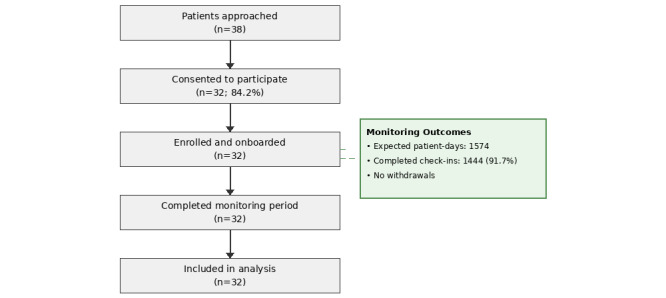
- Engagement was high: 32/38 approached patients consented (84.2%), none withdrew, and 1444/1574 expected patient-days had completed check-ins (91.7%; median 44 check-ins per participant, range 12-70).
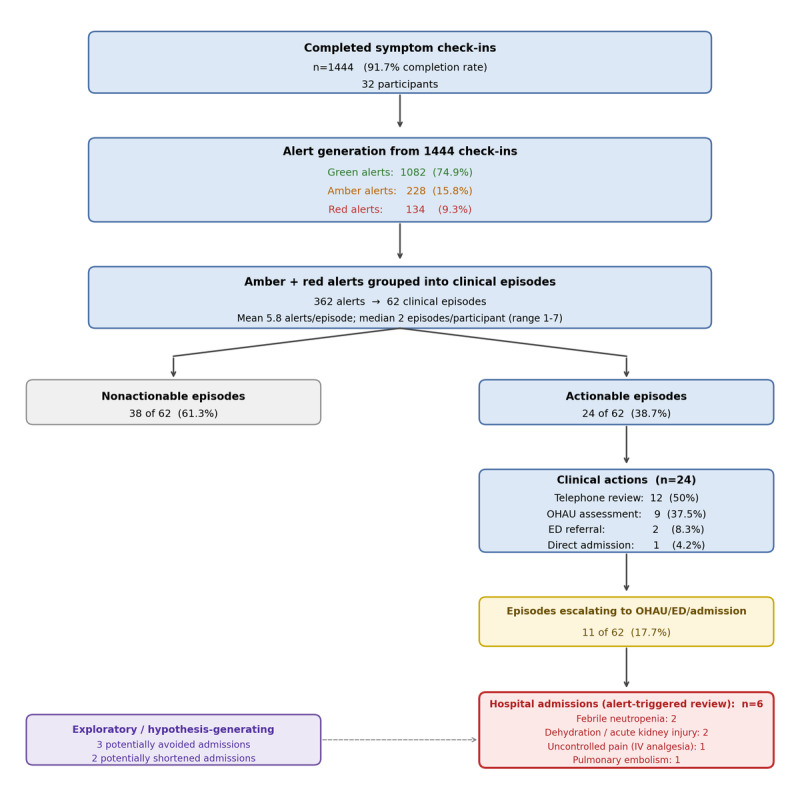
- Of 1444 check-ins, 1082 were green (74.9%), 228 amber (15.8%), and 134 red (9.3%); 362 amber/red alerts were grouped into 62 episodes (mean 5.8 alerts per episode, range 1-18), a 5.8-fold reduction in discrete review events, and 24/62 episodes (38.7%) were clinically actionable.
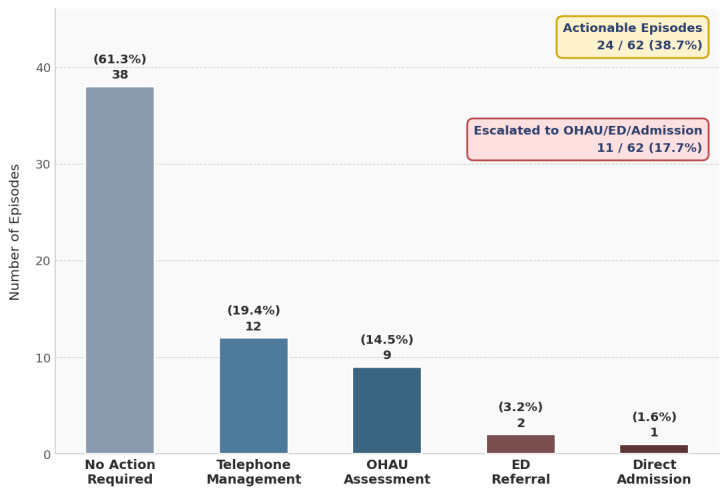
- Among 24 actionable episodes, actions were telephone management (n=12, 50%), OHAU assessment (n=9, 37.5%), ED referral (n=2, 8.3%), and direct admission (n=1, 4.2%); 11/62 episodes (17.7%) escalated to OHAU/ED/admission, and 6 admissions (9.7%) followed alert-triggered review. Median time to first clinical response for in-hours red alerts was 47 minutes (range 12 minutes to 6 hours), with no intervention-attributable safety signals identified.
- Patient feedback (20/32, 62.5%) reported reassurance (17/20, 85%), ease of use/low burden (20/20, 100%), clarity of symptom reporting (15/20, 75%), and confidence in timely response (14/20, 70%); clinicians reported improved situational awareness without increased workload.
Methods
- Design: 10-week quality improvement service evaluation (July 11 to September 19, 2025) within a UK tertiary acute oncology service at University Hospitals of Leicester NHS Trust; OncsCare was an adjunct to standard care, with RE-AIM applied prospectively and CFIR retrospectively.
- Participants/intervention: adults ≥18 years receiving active SACT, ECOG 0-2, with smartphone/tablet access and English consent; daily symptom check-ins mapped to UKONS-informed green/amber/red tiers, with amber/red alerts grouped into episodes using a 48-hour window and symptom-domain continuity; dashboard monitoring occurred weekdays 9 AM to 5 PM.
- Analysis: descriptive only (counts, proportions, medians, ranges); no inferential statistics due to the quality improvement design and absence of a contemporaneous comparator; safety signals were assessed via predefined case-finding cross-referenced against OHAU attendances, ED presentations, unplanned admissions, and dashboard audit logs.
Limitations
- The paper states limitations including 10-week duration, single-center design, modest sample size (n=32), no contemporaneous comparator, selection bias from pragmatic recruitment/smartphone ownership/English-language consent, and limited generalizability to digitally excluded populations, older adults with lower digital literacy, patients with limited English, and nontertiary centers.
- The paper also states potential confirmation/ascertainment bias because the lead author developed OncsCare, partially mitigated by independent adjudication of a random 21% sample (92.3% concordance for episode assignment, 84.6% for actionability); point-in-time daily check-ins cannot detect intraday deterioration; out-of-hours red alerts (65/134, 48.5%) were not captured by the dashboard workflow; only 38.7% of episodes were actionable; subtle harms may be undetected; and health economics were not evaluated.
- Evident from the text: the small number of actionable episodes (n=24), admissions (n=6), and same-day presentations (n=2) limits precision; the exploratory admission-avoidance/shortening analysis is counterfactual and subject to ascertainment bias; and episode grouping relied on rule-based logic rather than validated clinical algorithms.
Model-written summary. Check it against the paper before relying on it.
Integrity signals
Registry
Cites
Statistics
Figures
Verification
Claims the paper makes
11 Valid · 4 Not valid · 4 Not checked · 123 Own results and interpretations
The cited sources support only part of this claim — read each source’s verdict below.
In the paper
“the SYMPRO-Lung study showed improved 2-year survival for patients with lung cancer monitored with web-based symptom tools [6].”
§ Implementing UK Oncology Nursing Society–Informed Digital Symptom Triage With Episode-Based Review in Routine NHS Acute Oncology: Service Evaluation > Introduction
What the sources say
- Partly supportedcites [6] Denis F Basch E Septans A Bennouna J Urban T Dueck AC Letellier C Two-year survival comparing web-based symptom monitoring vs routine surveillance following treatment for lung cancer JAMA 2019 01 22 321 3 306 307 10.1001/jama.2018.18085 30667494 2721170 30667494 PMC6439676 sourceExperimental — accuracy not yet measured
The Results and Discussion in our copy (labeled Abstract; page unavailable) report improved survival after two years of web-based symptom monitoring for patients with lung cancer. The copy identifies the tool as the Sentinel PRO system but does not identify the trial as SYMPRO-Lung, so that study name is not supported. (LLM, conf=0.85)
plainstates a cause- Asserted: passes — The authors put it forward as true.
- Checkable: passes — It can be checked against evidence.
- Load-bearing: unclear — It is unclear whether the paper’s conclusions depend on it.
- Based: passes — The paper gives a reason why it holds.
- Partly supported
The cited sources support only part of this claim — read each source’s verdict below.
In the paper
“which have demonstrated improved symptom control, quality of life, and survival when structured symptom reporting is coupled with clinician response [3,4,7]”
§ Implementing UK Oncology Nursing Society–Informed Digital Symptom Triage With Episode-Based Review in Routine NHS Acute Oncology: Service Evaluation > Discussion > Principal Findings
What the sources say
- Supportedcites [3] Basch E Deal AM Kris MG Scher HI Hudis CA Sabbatini P Rogak L Bennett AV Dueck AC Atkinson TM Chou JF Dulko D Sit L Barz A Novotny P Fruscione M Sloan JA Schrag D Symptom monitoring with patient-reported outcomes during routine cancer treatment: a randomized controlled trial J Clin Oncol 2016 02 20 34 6 557 65 10.1200/JCO.2015.63.0830 26644527 JCO.2015.63.0830 26644527 PMC4872028 source
The Discussion reports improved symptom control in prior studies when patient reports were shared with clinicians. This trial’s Results report better health-related quality of life and higher one-year survival with symptom reporting and clinician alerts (75% versus 69%; P = .05). (LLM, conf=0.88)
- Partly supportedcites [4] Basch E Deal AM Dueck AC Scher HI Kris MG Hudis C Schrag D Overall survival results of a trial assessing patient-reported outcomes for symptom monitoring during routine cancer treatment JAMA 2017 07 11 318 2 197 198 10.1001/jama.2017.7156 28586821 2630810 28586821 PMC5817466 sourceExperimental — accuracy not yet measured
The Methods report structured symptom reporting with nurse alerts, and the Discussion reports clinical responses to those alerts. The paper reports improved quality of life and longer survival versus usual care, but our copy does not report improved symptom control as an outcome. Page numbers are unavailable in the indexed copy. (LLM, conf=0.88)
- Partly supportedcites [7] Absolom K Warrington L Hudson E Hewison J Morris C Holch P Carter R Gibson A Holmes M Clayton B Rogers Z McParland L Conner M Glidewell L Woroncow B Dawkins B Dickinson S Hulme C Brown J Velikova G Phase III randomized controlled trial of eRAPID: eHealth intervention during chemotherapy J Clin Oncol 2021 03 01 39 7 734 747 10.1200/JCO.20.02015 33417506 33417506 sourceExperimental — accuracy not yet measured
The Introduction (page unavailable) reports that prior electronic symptom-reporting trials in advanced cancer improved symptom control and survival. It does not report improved quality of life from those trials; the Discussion (page unavailable) instead reports improved physical well-being in the eRAPID trial and notes that clinician discussion of reports mattered for participants who benefited most. Thus the full combination of outcomes attributed to prior trials is not supported by this paper. (LLM, conf=0.84)
boostedstates a cause- Asserted: passes — The authors put it forward as true.
- Checkable: passes — It can be checked against evidence.
- Load-bearing: passes — The paper’s conclusions depend on it.
- Based: passes — The paper gives a reason why it holds.
- Supported
The cited sources support only part of this claim — read each source’s verdict below.
In the paper
“Retrospective CFIR mapping identified key adoption facilitators in the inner setting domain (leadership engagement, workflow compatibility) and outer setting domain (alignment with UKAOS policy framework) [9].”
§ Implementing UK Oncology Nursing Society–Informed Digital Symptom Triage With Episode-Based Review in Routine NHS Acute Oncology: Service Evaluation > Discussion > Implementation Science Framework Mapping
What the sources say
- Partly supportedcites [9] Damschroder LJ Aron DC Keith RE Kirsh SR Alexander JA Lowery JC Fostering implementation of health services research findings into practice: a consolidated framework for advancing implementation science Implement Sci 2009 08 07 4 50 10.1186/1748-5908-4-50 19664226 1748-5908-4-50 19664226 PMC2736161 sourceExperimental — accuracy not yet measured
The Results (Overview of the CFIR and Outer setting; page unavailable) define inner and outer settings, identify leadership engagement as an inner-setting construct, and include external policies in the outer setting. The source proposes a framework; it does not report the claimed retrospective mapping or identify workflow compatibility and alignment with UKAOS policy as adoption facilitators. (LLM, conf=0.88)
plainstates an association- Asserted: passes — The authors put it forward as true.
- Checkable: passes — It can be checked against evidence.
- Load-bearing: unclear — It is unclear whether the paper’s conclusions depend on it.
- Based: passes — The paper gives a reason why it holds.
- Partly supported
Every source the paper cites for this claim was checked and supports it.
In the paper
“The CFIR [9] was applied retrospectively to map determinants of adoption across 5 domains from qualitative clinician debrief data.”
§ Implementing UK Oncology Nursing Society–Informed Digital Symptom Triage With Episode-Based Review in Routine NHS Acute Oncology: Service Evaluation > Methods > Study Design
What the sources say
- Supportedcites [9] Damschroder LJ Aron DC Keith RE Kirsh SR Alexander JA Lowery JC Fostering implementation of health services research findings into practice: a consolidated framework for advancing implementation science Implement Sci 2009 08 07 4 50 10.1186/1748-5908-4-50 19664226 1748-5908-4-50 19664226 PMC2736161 source
The citation identifies the CFIR, which this paper describes in Results, ‘Overview of the CFIR,’ as comprising five major domains that influence implementation. The retrospective mapping of clinician debrief data describes the citing authors’ use of the framework, not an analysis attributed to this source. (LLM, conf=0.93)
plain- Asserted: passes — The authors put it forward as true.
- Checkable: passes — It can be checked against evidence.
- Load-bearing: unclear — It is unclear whether the paper’s conclusions depend on it.
- Based: passes — The paper gives a reason why it holds.
- Supported
The cited sources support only part of this claim — read each source’s verdict below.
In the paper
“Electronic patient-reported outcome (ePRO) systems have demonstrated that symptom monitoring with clinician response improves symptom control and survival [3,4].”
§ Implementing UK Oncology Nursing Society–Informed Digital Symptom Triage With Episode-Based Review in Routine NHS Acute Oncology: Service Evaluation > Introduction
What the sources say
- Supportedcites [3] Basch E Deal AM Kris MG Scher HI Hudis CA Sabbatini P Rogak L Bennett AV Dueck AC Atkinson TM Chou JF Dulko D Sit L Barz A Novotny P Fruscione M Sloan JA Schrag D Symptom monitoring with patient-reported outcomes during routine cancer treatment: a randomized controlled trial J Clin Oncol 2016 02 20 34 6 557 65 10.1200/JCO.2015.63.0830 26644527 JCO.2015.63.0830 26644527 PMC4872028 source
The Introduction reports that web-based symptom-reporting systems have improved symptom control and prompted clinicians to intensify symptom management. The Results report higher one-year survival with the study’s symptom-reporting system than with usual care (75.1% versus 68.6%); the Discussion describes nurses’ responses to symptom alerts. The symptom-control point is reported from prior studies, rather than measured as a separate outcome in this trial. (LLM, conf=0.88)
- Partly supportedcites [4] Basch E Deal AM Dueck AC Scher HI Kris MG Hudis C Schrag D Overall survival results of a trial assessing patient-reported outcomes for symptom monitoring during routine cancer treatment JAMA 2017 07 11 318 2 197 198 10.1001/jama.2017.7156 28586821 2630810 28586821 PMC5817466 sourceExperimental — accuracy not yet measured
The Methods and Results passages describe electronic symptom reporting with nurse alerts and show longer median survival in the PRO group than with usual care. The Discussion reports nurse responses to alerts, but presents early responsiveness as a potential mechanism; this paper does not establish that clinician response improved symptom control. (LLM, conf=0.86)
boostedstates a cause- Asserted: passes — The authors put it forward as true.
- Checkable: passes — It can be checked against evidence.
- Load-bearing: passes — The paper’s conclusions depend on it.
- Based: passes — The paper gives a reason why it holds.
- Supported
77 more claims · 1 with their cited sources checked
Create a free account to see all 142 claims and to verify the 1 reference still open.
- Probably not a substantial claim. 35
- It may state two separate claims as one. 37
- The quote only partly states this claim. 1
Self-check
Percentages, sums and reported differences re-computed from the paper’s own numbers.
Each contradiction between two passages listed here was confirmed by an independent check.
Rated major: it would touch a result — a value a result rests on, reported and recomputed p-values on opposite sides of the significance level, two passages that conflict with no sign which is right, or a cited work retracted before this paper was published.
In the paper
“Among the 24 actionable episodes, telephone clinical review with safety-netting advice was the most frequent (n=12, 50%), followed by OHAU assessment (n=9, 37.5%), ED referral (n=2, 8.3%), and direct admission (n=1, 4.2%). Overall, 11 of 62 episodes (17.7%) resulted in escalation to OHAU, ED, or admission.”
§ Implementing UK Oncology Nursing Society–Informed Digital Symptom Triage With Episode-Based Review in Routine NHS Acute Oncology: Service Evaluation > Results > Objective 2: Alert Distribution and Episode-Level Actionability
Reported 11 · recomputed 12
Rated minor: it would not touch a result — a value no result rests on, a p-value that stays on the same side of the significance level, or a conflict that is clerical, resolved elsewhere in the paper, or outside its own findings.
In the paper
§ Implementing UK Oncology Nursing Society–Informed Digital Symptom Triage With Episode-Based Review in Routine NHS Acute Oncology: Service Evaluation > Results > Baseline AO Service Context
“Approximately 70% of the calls were from patients receiving active SACT.”
§ Implementing UK Oncology Nursing Society–Informed Digital Symptom Triage With Episode-Based Review in Routine NHS Acute Oncology: Service Evaluation > Results > Baseline AO Service Context
“| | Oncology patients receiving active SACTb | ~70 | | | Hematology patients receiving active SACTc | ~30 |”
Citations
Cites
Damschroder, L. J., Aron, D. C., Keith, R. E., Kirsh, S. R., Alexander, J. A., & Lowery, J. C. (2009) · Implementation Science · doi:10.1186/1748-5908-4-50 · Cited by 14,496 · cited 3×
“Retrospective CFIR mapping identified key adoption facilitators in the inner setting domain (leadership engagement, workflow compatibility) and outer setting domain (alignment with UKAOS policy framework) [9].”
InfluentialEvaluating the public health impact of health promotion interventions: the RE-AIM framework.
Glasgow, R. E., Vogt, T. M., & Boles, S. M. (1999) · American Journal of Public Health · doi:10.2105/ajph.89.9.1322 · Cited by 7,217 · cited 3×
“Evaluation end points were prospectively informed by the RE-AIM (Reach, Effectiveness, Adoption, Implementation, Maintenance) framework [8], which underpins the 5 objectives below; implementation determinants were mapped retrospectively using the Consolidated Framework for Implementation Research…”
InfluentialOgrinc, G., Davies, L., Goodman, D., Batalden, P., Davidoff, F., & Stevens, D. (2016) · BMJ Quality & Safety · doi:10.1136/bmjqs-2015-004411 · Cited by 2,996 · cited 1×
“This manuscript follows SQUIRE (Standards for Quality Improvement Reporting Excellence) 2.0 reporting guidance [10].”
InfluentialeHEALS: The eHealth Literacy Scale
Norman, C. D., & Skinner, H. A. (2006) · Journal of Medical Internet Research · doi:10.2196/jmir.8.4.e27 · Cited by 2,680 · cited 2×
“Future implementations should adopt deliberate equity-focused strategies, including formal digital literacy assessment [13], alternative access modalities (SMS text message–based reporting, telephone check-ins), multilingual interfaces, and device loan programs.”
Basch, E., Deal, A. M., Kris, M. G., Scher, H. I., Hudis, C. A., Sabbatini, P., Rogak, L., Bennett, A. V., Dueck, A. C., Atkinson, T. M., et al. (2016) · Journal of Clinical Oncology · doi:10.1200/jco.2015.63.0830 · Cited by 2,593 · cited 2×
“The findings of this evaluation are consistent with prior trials of ePRO monitoring, which have demonstrated improved symptom control, quality of life, and survival when structured symptom reporting is coupled with clinician response [3,4,7].”
Basch, E., Deal, A. M., Dueck, A. C., Scher, H. I., Kris, M. G., Hudis, C., & Schrag, D. (2017) · JAMA · doi:10.1001/jama.2017.7156 · Cited by 2,302 · cited 2×
“The findings of this evaluation are consistent with prior trials of ePRO monitoring, which have demonstrated improved symptom control, quality of life, and survival when structured symptom reporting is coupled with clinician response [3,4,7].”
Moltu, C., Stefansen, J., Svisdahl, M., & Veseth, M. (2012) · Disability and Rehabilitation · doi:10.3109/09638288.2012.656792 · Cited by 1,247
Dueck, A. C., Mendoza, T. R., Mitchell, S. A., Reeve, B. B., Castro, K. M., Rogak, L. J., Atkinson, T. M., Bennett, A. V., Denicoff, A. M., O'Mara, A. M., et al. (2015) · JAMA Oncology · doi:10.1001/jamaoncol.2015.2639 · Cited by 1,030
Denis, F., Basch, E., Septans, A.-L., Bennouna, J., Urban, T., Dueck, A. C., & Letellier, C. (2019) · JAMA · doi:10.1001/jama.2018.18085 · Cited by 549 · cited 1×
“…trials have extended this evidence: the PRO-TECT trial demonstrated improved patient-reported outcomes across metastatic cancer types using electronic monitoring [5], and the SYMPRO-Lung study showed improved 2-year survival for patients with lung cancer monitored with web-based symptom tools [6].”
Basch, E., Schrag, D., Henson, S., Jansen, J., Ginos, B., Stover, A. M., Carr, P., Spears, P. A., Jonsson, M., Deal, A. M., et al. (2022) · JAMA · doi:10.1001/jama.2022.9265 · Cited by 413
Research works printed but not linked: 1
- A UK review of systemic anti-cancer therapy helplines: getting it right first time for cancer patients UK Acute Oncology Society 2026-05-10 https://www.ukacuteoncology.co.uk/application/files/7117/5260/7575/UKAOS_4_Nations_Report_v7_003_PDF_2.pdf
Metadata
- Authors
- Mohamed Azhar, M. S., Ray, R., Sharma, S., Chauhan, H., Robinson, M. R., Owoseni, Y., Vijay, A., & Hussain, S.
- Affiliations
- University Hospitals of Leicester NHS Trust (GB)
- ORCID
- Venue
- JMIR Cancer
- Publisher
- JMIR Publications Inc.
- Published
- 2026-05-21
- Volume
- 12
- Pages
- e92586
- ISSN
- 2369-1999 (ISSN-L)
- PMC
- PMC13237529
- OpenAlex
- W7160257153
- Cited by
- 0
- References
- 16
- FWCI
- 0.00
- Type
- journal article
- Language
- en
- Open access
- gold
- doi.org
- Licence
- cc-by
- Locations
- JMIR Cancer (publishedVersion, cc-by)
- PubMed (publishedVersion)
- PubMed Central (publishedVersion, cc-by)
- DOAJ (DOAJ: Directory of Open Access Journals) (submittedVersion, cc-by-sa)
- Topics
- Health Sciences › Medicine › Public Health, Environmental and Occupational Health › Telemedicine and Telehealth Implementation
- Health Sciences › Health Professions › General Health Professions › Mobile Health and mHealth Applications
- Health Sciences › Medicine › Oncology › Cancer survivorship and care
- Keywords
- systemic cancer therapy, patient-reported symptoms, clinician workload, safety signals
- MeSH terms
- Patient Reported Outcome Measures, Digital Health, Adult, Aged, Female, United Kingdom, Humans, Male, Middle Aged, Neoplasms, Oncology Nursing, Tertiary Health Care, Mobile Applications
About these checks
Registry, retraction, Cites and statistics results are computed, not judged, with one exception: a printed reference that no index lists is read once by a model before it counts as a citation error. Claims are extracted by a model and kept only when their quote appears verbatim in the text; each cited source is then checked, with a model’s help, for whether it says what the claim relies on. Those verdicts can be wrong — read the claim’s quote and the cited source before relying on one.
The claim verdicts this report counts are experimental: their accuracy is not yet measured.
A language model drew the claims from the paper on 2026-10-10, under version 3 of the claim definition (model deepseek-v4.1-flash, prompt extract-v3).
A second model labelled each claim on 2026-10-10 (model jev-1.13-20260917, definition revision gold-guideline-v0.2).
Cited sources are checked with a language model’s help (gpt-6-sol).
Statistics and arithmetic are recomputed, not judged.
Confidence bands are shown only for fields calibrated on our annotated test set. None is calibrated yet, so no band is shown.
What counts as a claim ›How we measure confidence ›How we check this ›
Are you an author, or do you see a problem with this page? Request a review
How to cite
Cite CoChat for the checks on this page, and the paper for its own findings.
- This page
- CoChat. (2026). Citation check: Implementing UK Oncology Nursing Society–Informed Digital Symptom Triage With Episode-Based Review in Routine NHS Acute Oncology: Service Evaluation. https://app.cochat.ai/papers/10.2196/92586
- The paper
- Mohamed Azhar, M. S., Ray, R., Sharma, S., Chauhan, H., Robinson, M. R., Owoseni, Y., Vijay, A., & Hussain, S. (2026). Implementing UK Oncology Nursing Society–Informed Digital Symptom Triage With Episode-Based Review in Routine NHS Acute Oncology: Service Evaluation. JMIR Cancer. https://doi.org/10.2196/92586
Data sources
Bibliographic data: Semantic Scholar, OpenAlex, Crossref.
Contains information from the Semantic Scholar Academic Graph Datasets, made available under the ODC Attribution License (ODC-BY 1.0).
Semantic Scholar’s data is described in: Kinney, R., et al. (2023). The Semantic Scholar Open Data Platform. arXiv:2301.10140.
