

The DOI matches its Crossref record; 34 of the 34 references it cites were found in a registry or an index.
Seeking Support on Facebook: A Content Analysis of Breast Cancer Groups
Open accessAbstract
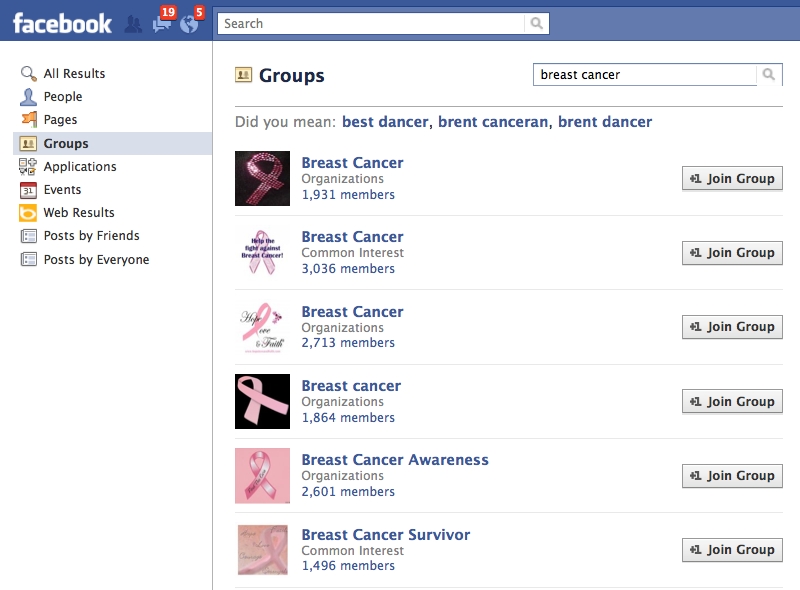
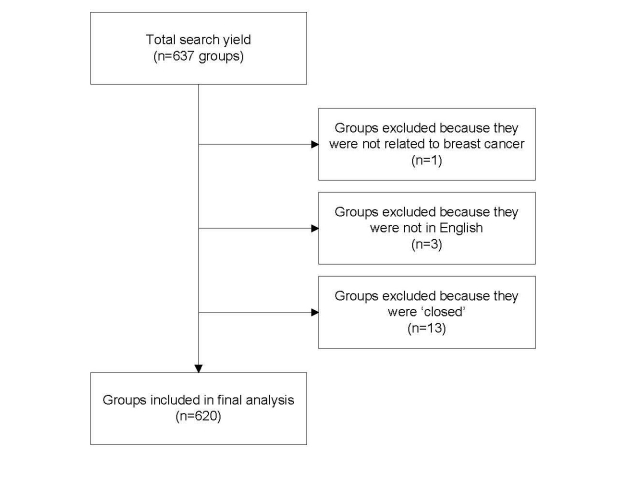
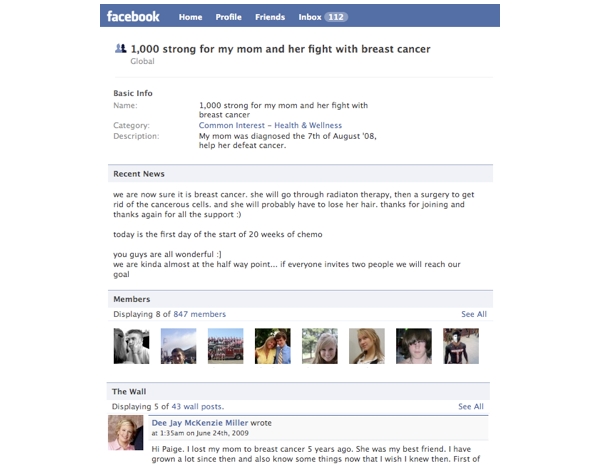
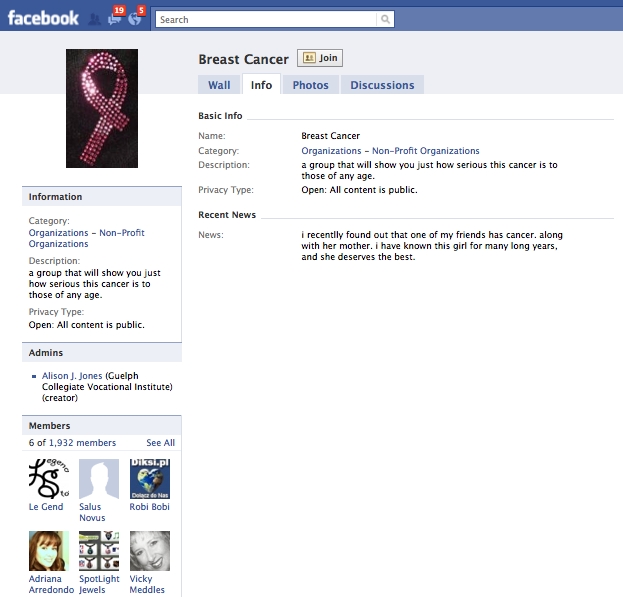
BACKGROUND: Social network sites have been growing in popularity across broad segments of Internet users, and are a convenient means to exchange information and support. Research on their use for health-related purposes is limited. OBJECTIVE: This study aimed to characterize the purpose, use, and creators of Facebook groups related to breast cancer. METHODS: We searched Facebook (www.Facebook.com) using the term breast cancer. We restricted our analysis to groups that were related to breast cancer, operated in English, and were publicly available. Two of us independently extracted information on the administrator and purpose of the group, as well as the number of user-generated contributions. We developed a coding scheme to guide content analysis. RESULTS: We found 620 breast cancer groups on Facebook containing a total of 1,090,397 members. The groups were created for fundraising (277/620, 44.7%), awareness (236, 38.1%), product or service promotion related to fundraising or awareness (61, 9%), or patient/caregiver support (46, 7%). The awareness groups as a whole contained by far the most members (n = 957,289). The majority of groups (532, 85.8%) had 25 wall posts or fewer. The support oriented groups, 47% (27/57) of which were established by high school or college students, were associated with the greatest number of user-generated contributions. CONCLUSIONS: Facebook groups have become a popular tool for awareness-raising, fundraising, and support-seeking related to breast cancer attracting over one million users. Given their popularity and reach, further research is warranted to explore the implications of social network sites as a health resource across various health conditions, cultures, ages, and socioeconomic groups.
Overview
The claims and statistics of this paper haven’t been checked yet.
Run the check — free, no account needed. It reads the open-access text and checks the sources it cites.
Integrity signals
Registry
Cites
Statistics
Figures
Verification
Claims the paper makes
The claims and statistics of this paper haven’t been checked yet.
Run the check — free, no account needed. It reads the open-access text and checks the sources it cites.
Claims other papers make about this one
Each is checked against this paper’s own text: does it say what the citing paper says it does?
In the citing paper
“Online health communities (OHCs)—Internet-based discussion forums where individuals converse with one another about health topics—are the most robust social media sources for peer-generated health information.[9–12]”
From Perceived healthcare provider reactions to patient and caregiver use of online health communities (2014) · cites this paper as [10]
Self-check
Percentages, sums and reported differences re-computed from the paper’s own numbers.
The self-check needs the paper’s full text.
Citations
Cites
Eysenck, H. J. (1985) · Behaviour Research and Therapy · doi:10.1016/0005-7967(85)90087-7 · Cited by 32,038
Social network sites: definition, history, and scholarship
boyd, D. M., & Ellison, N. B. (2007) · Journal of Computer-Mediated Communication · doi:10.1111/j.1083-6101.2007.00393.x · Cited by 16,251
Ellison, N. B., Steinfield, C., & Lampe, C. (2007) · Journal of Computer-Mediated Communication · doi:10.1111/j.1083-6101.2007.00367.x · Cited by 9,939
Bowling Alone: The Collapse and Revival of American Community
Shapiro, R. Y. (2000) · Political Science Quarterly · doi:10.2307/2657613 · Cited by 2,741
Information revelation and privacy in online social networks
Gross, R., & Acquisti, A. (2005) · Proceedings of the 2005 ACM workshop on Privacy in the electronic society · doi:10.1145/1102199.1102214 · Cited by 2,028
Park, N., Kee, K. F., & Valenzuela, S. (2009) · CyberPsychology & Behavior · doi:10.1089/cpb.2009.0003 · Cited by 1,737
Online Communities: Designing Usability, Supporting Sociability
Preece, J. J. (2000) · Industrial Management & Data Systems · doi:10.1108/imds.2000.100.9.459.3 · Cited by 1,390
Social network activity and social well-being
Burke, M., Marlow, C., & Lento, T. (2010) · Proceedings of the SIGCHI Conference on Human Factors in Computing Systems · doi:10.1145/1753326.1753613 · Cited by 1,109 · cited 2×
“Furthermore, Ellison et al [34] have shown that college students who are active on Facebook experience higher levels of both forms of social capital, and Burke and colleagues [35] have confirmed that these findings generalize to older users and English speakers outside the United States.”
BackgroundSociability and usability in online communities: Determining and measuring success
Preece, J. J. (2001) · Behaviour and Information Technology · doi:10.1080/01449290110084683 · Cited by 860
Who talks? The social psychology of illness support groups.
Davison, K. P., Pennebaker, J. W., & Dickerson, S. S. (2000) · American Psychologist · doi:10.1037/0003-066x.55.2.205 · Cited by 720
Research works printed but not linked: 1
- Bender, JL, 2008, Curr Oncol, 15, s107.es42
Cited by
Sorted by citations
Moorhead, S. A., Hazlett, D. E., Harrison, L., Carroll, J. K., Irwin, A., & Hoving, C. (2013) · Journal of Medical Internet Research · doi:10.2196/jmir.1933 · Cited by 2,517
Social media competitive analysis and text mining: A case study in the pizza industry
He, W., Zha, S., & Li, L. (2013) · International Journal of Information Management · doi:10.1016/j.ijinfomgt.2013.01.001 · Cited by 920
Social Media: A Review and Tutorial of Applications in Medicine and Health Care
Grajales III, F. J., Sheps, S., Ho, K., Novak-Lauscher, H., & Eysenbach, G. (2014) · Journal of Medical Internet Research · doi:10.2196/jmir.2912 · Cited by 737
Mohr, D. C., Burns, M. N., Schueller, S. M., Clarke, G., & Klinkman, M. (2013) · General Hospital Psychiatry · doi:10.1016/j.genhosppsych.2013.03.008 · Cited by 693
“ISGs are often used by patients as a source of information and support [29,30]; however, the quality of many of these studies remains poor.”
Knowledge sharing in online health communities: A social exchange theory perspective
Yan, Z., Wang, T., Chen, Y., & Zhang, H. (2016) · Information & Management · doi:10.1016/j.im.2016.02.001 · Cited by 587
Metadata
- Authors
- Bender, J. L., Jimenez-Marroquin, M.-C., & Jadad, A. R.
- Affiliations
- University Health Network (CA)
- Corresponding author
- Bender, Jacqueline L
- Venue
- Journal of Medical Internet Research
- Publisher
- JMIR Publications Inc.
- Published
- 2011-02-04
- Volume
- 13
- Issue
- 1
- Pages
- e16
- ISSN
- 1438-8871 (ISSN-L)
- PMC
- PMC3221337
- OpenAlex
- W2095995897
- Cited by
- 438
- References
- 34
- Citations by year
- 2026: 7 · 2025: 10 · 2024: 16 · 2023: 21 · 2022: 16 · 2021: 41 · 2020: 38 · 2019: 39 · 2018: 37 · 2017: 28 · 2016: 48 · 2015: 25 · 2014: 38 · 2013: 41 · 2012: 27
- FWCI
- 36.80
- Type
- journal article
- Language
- en
- Open access
- gold
- doi.org
- Licence
- cc-by
- Locations
- Journal of Medical Internet Research (publishedVersion, cc-by)
- Europe PMC (PubMed Central) (publishedVersion, cc-by)
- PubMed Central (publishedVersion, cc-by)
- PubMed (publishedVersion)
- DOAJ (DOAJ: Directory of Open Access Journals) (submittedVersion, cc-by-sa)
- Funders
- University of Toronto
- Topics
- Social Sciences › Health › Social Media in Health Education
- Health Sciences › Health Professions › General Health Professions › Health Literacy and Information Accessibility
- Social Sciences › Communication › Social Media and Politics
- Keywords
- breast cancer, Facebook groups, social network sites, online support, patient support, fundraising, awareness raising, user-generated content, health information seeking
- MeSH terms
- Breast Neoplasms, Female, Fund Raising, Health Promotion, Humans, Peer Group, Social Support, Internet
About these checks
Registry, retraction, Cites and statistics results are computed, not judged, with one exception: a printed reference that no index lists is read once by a model before it counts as a citation error. Claims are extracted by a model and kept only when their quote appears verbatim in the text; each cited source is then checked, with a model’s help, for whether it says what the claim relies on. Those verdicts can be wrong — read the claim’s quote and the cited source before relying on one.
Statistics and arithmetic are recomputed, not judged.
Confidence bands are shown only for fields calibrated on our annotated test set. None is calibrated yet, so no band is shown.
What counts as a claim ›How we measure confidence ›How we check this ›
Are you an author, or do you see a problem with this page? Request a review
