

The DOI matches its Crossref record; 73 of the 74 references it cites were found in a registry or an index.
Factors Influencing the Use of a Web-Based Application for Supporting the Self-Care of Patients with Type 2 Diabetes: A Longitudinal Study
Open accessAbstract
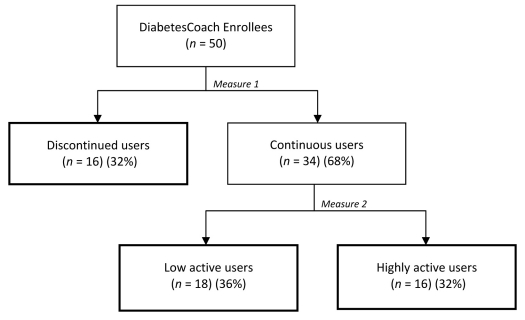
BACKGROUND: The take-up of eHealth applications in general is still rather low and user attrition is often high. Only limited information is available about the use of eHealth technologies among specific patient groups. OBJECTIVE: The aim of this study was to explore the factors that influence the initial and long-term use of a Web-based application (DiabetesCoach) for supporting the self-care of patients with type 2 diabetes. METHODS: A mixed-methods research design was used for a process analysis of the actual usage of the Web application over a 2-year period and to identify user profiles. Research instruments included log files, interviews, usability tests, and a survey. RESULTS: The DiabetesCoach was predominantly used for interactive features like online monitoring, personal data, and patient-nurse email contact. It was the continuous, personal feedback that particularly appealed to the patients; they felt more closely monitored by their nurse and encouraged to play a more active role in self-managing their disease. Despite the positive outcomes, usage of the Web application was hindered by low enrollment and nonusage attrition. The main barrier to enrollment had to do with a lack of access to the Internet (146/226, 65%). Although 68% (34/50) of the enrollees were continuous users, of whom 32% (16/50) could be defined as hardcore users (highly active), the remaining 32% (16/50) did not continue using the Web application for the full duration of the study period. Barriers to long-term use were primarily due to poor user-friendliness of the Web application (the absence of "push" factors or reminders) and selection of the "wrong" users; the well-regulated patients were not the ones who could benefit the most from system use because of a ceiling effect. Patients with a greater need for care seemed to be more engaged in long-term use; highly active users were significantly more often medication users than low/inactive users (P = .005) and had a longer diabetes duration (P = .03). CONCLUSION: Innovations in health care will diffuse more rapidly when technology is employed that is simple to use and has applicable components for interactivity. This would foresee the patients' need for continuous and personalized feedback, in particular for patients with a greater need for care. From this study several factors appear to influence increased use of eHealth technologies: (1) avoiding selective enrollment, (2) making use of participatory design methods, and (3) developing push factors for persistence. Further research should focus on the causal relationship between using the system's features and actual usage, as such a view would provide important evidence on how specific technology features can engage and captivate users.
Overview
The claims and statistics of this paper haven’t been checked yet.
Run the check — free, no account needed. It reads the open-access text and checks the sources it cites.
Integrity signals
Registry
Cites
Statistics
Figures
Verification
Claims the paper makes
The claims and statistics of this paper haven’t been checked yet.
Run the check — free, no account needed. It reads the open-access text and checks the sources it cites.
Claims other papers make about this one
Each is checked against this paper’s own text: does it say what the citing paper says it does?
In the citing paper
“While such technologies can be effective [1,2], one of the main problems is that users’ adoption and long-term use remains lower than expected [3-5].”
From Opening the Black Box of Electronic Health: Collecting, Analyzing, and Interpreting Log Data (2017) · cites this paper as [3]
In the citing paper
“The application was equipped with neither “push” factors nor an advanced decision support system providing feedback based on accumulated data and other personal profiles, which are advocated for long-term usage, according to relevant studies [62-65].”
From Long-Term Engagement With a Mobile Self-Management System for People With Type 2 Diabetes (2013) · cites this paper as [62]
In the citing paper
“Decrease in usage after gaining a sense of mastery over diabetes is in line with findings by relevant studies [30,32,62].”
From Long-Term Engagement With a Mobile Self-Management System for People With Type 2 Diabetes (2013) · cites this paper as [62]
In the citing paper
“The application was equipped with neither “push” factors nor an advanced decision support system providing feedback based on accumulated data and other personal profiles, which are advocated for long-term usage, according to relevant studies [62-65].”
From Long-Term Engagement With a Mobile Self-Management System for People With Type 2 Diabetes (2013) · cites this paper as [62]
Self-check
Percentages, sums and reported differences re-computed from the paper’s own numbers.
The self-check needs the paper’s full text.
Citations
Cites
Crossing the Quality Chasm: A New Health System for the 21st Century
Baker, A. (2001) · BMJ · doi:10.1136/bmj.323.7322.1192 · Cited by 10,779
Applied Longitudinal Data Analysis: Modeling Change and Event Occurrence
Singer, J. D., & Willett, J. B. (2003) · doi:10.1093/acprof:oso/9780195152968.001.0001 · Cited by 10,647
(1993) · Cited by 9,879
The critical incident technique.
Flanagan, J. C. (1954) · Psychological Bulletin · doi:10.1037/h0061470 · Cited by 8,191
Global estimates of the prevalence of diabetes for 2010 and 2030
Shaw, J. E., Sicree, R. A., & Zimmet, P. Z. (2010) · Diabetes Research and Clinical Practice · doi:10.1016/j.diabres.2009.10.007 · Cited by 7,216
SAGE Handbook of Mixed Methods in Social & Behavioral Research
Tashakkori, A., & Teddlie, C. (2010) · doi:10.4135/9781506335193 · Cited by 6,215
(1993) · Elsevier eBooks · doi:10.1016/c2009-0-21512-1 · Cited by 5,552
Rogelberg, S. G. (2007) · Sage eBooks · doi:10.4135/9781412952651.n55 · Cited by 5,309
Book Review: Protocol Analysis: Verbal Reports as Data
Venkatesan, M., Ericsson, K. A., & Simon, H. A. (1986) · Journal of Marketing Research · doi:10.2307/3151491 · Cited by 4,364
Patient Self-management of Chronic Disease in Primary Care
Bodenheimer, T. (2002) · JAMA · doi:10.1001/jama.288.19.2469 · Cited by 3,598 · cited 2×
“The introduction of the Internet into clinical practice has brought about many opportunities for self-care [2-7], as it can be used as a powerful medium for promoting a healthy lifestyle and for increasing understanding about the condition.”
Background
Research works printed but not linked: 2
- 2002, Am J Prev Med, 22, 10
- Wangberg, SC, 2008, Patient Prefer Adherence, 2, 57
Cited by
Sorted by citations
Items 101–175 of 175
Dehnavi, Z., Ayatollahi, H., Hemmat, M., & Abbasi, R. (2020) · Current Diabetes Reviews · doi:10.2174/1573399816666200719012849 · Cited by 13
Moulaei, K., Bahaadinbeigy, K., Mashoof, E., & Dinari, F. (2023) · BMC Medical Informatics and Decision Making · doi:10.1186/s12911-023-02308-y · Cited by 18
Determinants of Patients' Intention to Adopt Diabetes Self-Management Applications
Maniam, A., Dhillon, J. S., & Baghaei, N. (2015) · doi:10.1145/2808047.2808059 · Cited by 12
The Effects of Telenursing with Goal Attainment Scaling in Diabetic Patients: A Case Report
Higano, K., Shibayama, T., Ichikawa, M., Motomura, M., Shimano, H., Kawakami, Y., Furuya, K., & Kawaguchi, T. (2015) · International Journal of Nursing & Clinical Practices · doi:10.15344/2394-4978/2015/117 · Cited by 12
Development and Evaluation of Theory-Based Diabetes Support Services
Guo, S. H.-M., Lin, Y.-H., Chen, R., KAO, S.-F., & Chang, H.-K. (2012) · CIN Computers Informatics Nursing · doi:10.1097/nxn.0b013e318266ca22 · Cited by 11
Subramaniam, S., Dhillon, J. S., Ahmad, M. S., Leong Joyce, W. S., Teoh, C., & Huang, C. S. (2016) · Indian Journal of Science and Technology · doi:10.17485/ijst/2016/v9is(1)/106819 · Cited by 11
Patient use of online medical records: an application of technology acceptance framework
Mukhopadhyay, S., Basak, R., Carpenter, D., & Reithel, B. J. (2019) · Information and Computer Security · doi:10.1108/ics-07-2019-0076 · Cited by 10
Computer-based interactive health communications for people with chronic disease
Casey, L. M., Clough, B. A., Green, H. J., Usher, W. T., James, D. A., Rowlands, D. D., Laakso, E., & Mihuta, M. E. (2014) · Smart Homecare Technology and TeleHealth · doi:10.2147/shtt.s42684 · Cited by 10
Hill, J. N., Smith, B., Weaver, F. M., Nazi, K. M., Thomas, F. P., Goldstein, B., & Hogan, T. P. (2017) · Journal of Spinal Cord Medicine · doi:10.1080/10790268.2017.1293760 · Cited by 11
Xie, Z., Liu, H., & Or, C. K. (2023) · mHealth · doi:10.21037/mhealth-22-39 · Cited by 11
Promoting access to health information
Senteio, C. R. (2019) · Aslib Journal of Information Management · doi:10.1108/ajim-02-2019-0043 · Cited by 11
Hu, Q., Yao, Y., Han, J., Yang, X., & Parton, J. (2023) · SSM - Population Health · doi:10.1016/j.ssmph.2023.101577 · Cited by 9
Wilson, E. V., Balkan, S., & Lankton, N. K. (2014) · Communications of the Association for Information Systems · doi:10.17705/1cais.03473 · Cited by 10
Abd-Alrazaq, A. A., Safi, Z., Bewick, B. M., Househ, M. S., & Gardner, P. H. (2021) · Journal of Medical Internet Research · doi:10.2196/17500 · Cited by 9
Sparud‐Lundin, C., Josefsson, U., Berg, M., Hellström, A., Koinberg, I., Nolbris, M. J., Ranerup, A., & Skärsäter, I. (2013) · European Journal for Person Centered Healthcare · doi:10.5750/ejpch.v1i2.672 · Cited by 9
Web-Based Specialist Support for Spinal Cord Injury Person’s Care: Lessons Learned
Mea, V. D., Marin, D., Rosin, C., & Zampa, A. (2012) · International Journal of Telemedicine and Applications · doi:10.1155/2012/861860 · Cited by 9
Patient portal use: Persistent disparities from pre- to post-onset of the COVID-19 pandemic
Ahmed, N., Sanghavi, K. K., Mathur, S., & McCullers, A. (2023) · International Journal of Medical Informatics · doi:10.1016/j.ijmedinf.2023.105204 · Cited by 10
Benda, N. C., Zawtha, S., Anderson, K., Sharma, M., Lin, P. B., Zawtha, B., & Creber, R. M. (2022) · JMIR Formative Research · doi:10.2196/36260 · Cited by 9
Winder, R. E., Campbell, J., Akter, N., Aminu, A. Q., Lambert, J. D., Cockcroft, E., Thomas, C., Clark, C. E., Bryce, C., Sussex, J., et al. (2024) · Journal of Medical Internet Research · doi:10.2196/56528 · Cited by 8
Roelofsen, Y., van Vugt, M., Hendriks, S. H., van Hateren, K. J. J., Groenier, K. H., Snoek, F. J., Kleefstra, N., Huijsman, R., & Bilo, H. J. G. (2015) · Journal of Diabetes Research · doi:10.1155/2016/6343927 · Cited by 9
Internet Self-Management Uniform Reporting Framework
Burns, P., Jones, S. C., Iverson, D., & Caputi, P. (2013) · CIN Computers Informatics Nursing · doi:10.1097/01.ncn.0000432129.84397.a8 · Cited by 7
Pérez-Aldana, C. A., Lewinski, A. A., Johnson, C., Vorderstrasse, A. A., & Myneni, S. (2020) · JMIR Diabetes · doi:10.2196/21611 · Cited by 8
A realist review of factors critical for the implementation of eHealth in chronic disease management
Shahid, N., Parker, G., BIELECKI, J. M., Rac, V. E., & Berta, W. B. (2025) · BMC Health Services Research · doi:10.1186/s12913-025-12361-0 · Cited by 11
Xie, Z., Or, C. K., & Ye, X. (2025) · Applied Ergonomics · doi:10.1016/j.apergo.2025.104655 · Cited by 6
Vitale, E., Genovese, V. V., & Allenet, B. (2021) · Education thérapeutique du patient - Therapeutic patient education · doi:10.1051/tpe/2021007 · Cited by 7
Bridging the Digital Health Divide
Ahmed, N., Brown, J. D., Parau, C. A., McCullers, A., Sanghavi, K. K., Littlejohn, R., & Wesley, D. B. (2023) · Medical Care · doi:10.1097/mlr.0000000000001869 · Cited by 6
User interactivity in eHealth applications: A novel taxonomy
Hashim, M. J. (2016) · International Conference on Innovations in Information Technology · doi:10.1109/innovations.2016.7880023 · Cited by 6
Consumer Use of the Internet for Health Management
Lee, Y. J., & Ha, S. (2016) · Journal of Consumer Health on the Internet · doi:10.1080/15398285.2015.1127114 · Cited by 6
eHealth vs. Infection : participatory development of persuasive eHealth to support safe care
Jong, N. B.-D. (2016) · doi:10.3990/1.9789036541992 · Cited by 6
Hoe eHealth een katalysator kan zijn voor innovaties in de gezondheidszorg
van Gemert-Pijnen, J., Kelders, S. M., Nijland, N., van Velzen, L., & Wentzel, J. (2011) · Bijblijven · doi:10.1007/s12414-011-0066-z · Cited by 5
Self-citationSchutte, L., Mevissen, F. E. F., Meijer, S., Paulussen, T. G., van Empelen, P., & Kok, G. (2018) · Journal of Medical Internet Research · doi:10.2196/jmir.7053 · Cited by 5
Yap, K. Y., Chia, Y. M. F., Low, X. H., & Chan, A. (2014) · Supportive Care in Cancer · doi:10.1007/s00520-014-2266-4 · Cited by 5
Sieverink, F. (2017) · doi:10.3990/1.9789036544177 · Cited by 5
Vercell, A., Taylor, S., Yorke, J., & Dowding, D. (2022) · JMIR Nursing · doi:10.2196/39815 · Cited by 4
Sieverink, F., Kelders, S. M., Akkersdijk, S. M., Poel, M., Siemons, L., & van Gemert‐Pijnen, J. E. W. C. (2016) · University of Twente Research Information · Cited by 3
Self-citationPersonalized Healthcare Self-management Using Social Persuasion
Mukhtar, H., Ali, A., Lee, S., & Belaïd, D. (2012) · Lecture notes in computer science · doi:10.1007/978-3-642-30779-9_9 · Cited by 3
Hoey, H., Mlinac, A., Tran, C.-T., & Schlaeger, C. (2012) · Diabetes Technology & Therapeutics · doi:10.1089/dia.2012.0230 · Cited by 3
Personalized fertility care in the Internet era
Aarts, J. W. M. (2012) · Radboud Repository (Radboud University) · Cited by 3
The use, usability and persuasiveness of PAZIO, an online healthcare portal
Boven, R. I.-V. (2013) · Cited by 3
Technology as a Health Intervention and the Self-Efficacy of Men
Maxwell, K. D. (2015) · ScholarWorks (Walden University) · Cited by 3
Bray, E. A., George, A., Everett, B., Salamonson, Y., & Ramjan, L. M. (2023) · Topics in Spinal Cord Injury Rehabilitation · doi:10.46292/sci22-00049 · Cited by 2
Walker, J. A., Staab, E. M., Ridgway, J. P., Schmitt, J., Franco, M. I., Hunter, S. J., Motley, D., & Laiteerapong, N. (2024) · International Journal of Environmental Research and Public Health · doi:10.3390/ijerph21060692 · Cited by 3
Mixed-methods research on diabetes patient health education using digital technologies
Cenčič, A., Prosen, M., & Ličen, S. (2022) · Kontakt · doi:10.32725/kont.2022.017 · Cited by 3
Hussey, P., & Kennedy, M. A. (2014) · Health informatics · doi:10.1007/978-1-4471-2999-8_3 · Cited by 2
Sá, M. D. C., Oliveira, A., & Nabais, A. S. C. (2018) · EDULEARN proceedings · doi:10.21125/edulearn.2018.1858 · Cited by 2
Encouraging the Use of eHealth Services: A Survey of Patients' Experiences
Karisalmi, N., Viitanen, J., & Kujala, S. (2019) · Studies in health technology and informatics · doi:10.3233/978-1-61499-951-5-206 · Cited by 2
Web-based counselling to patients with haematological diseases
Högberg, K. M. (2015) · Diva portal (Dalarna University Library) · Cited by 2
E-health-interventie in de eerste lijn
Drost, H., Sprij, B., Kool, L., & Hoevenaars, A. (2013) · Huisarts en Wetenschap · doi:10.1007/s12445-013-0336-3 · Cited by 1
Dimitrov, D. V. (2013) · Advances in predictive, preventive and personalised medicine · doi:10.1007/978-94-007-5971-8_15 · Cited by 1
Web-based Lifestyle Management for Chronic Kidney Disease Patients in a Clinical Setting
Nauta, J. M., van der Boog, P. J. M., Slegten, J., Janssen, R., & Hettinga, M. (2013) · Data Archiving and Networked Services (DANS) · Cited by 1
Baek, J., Lin, S., Bolin, J. N., Ory, M. G., Flores, S., & Kash, B. A. (2021) · The Science of Diabetes Self-Management and Care · doi:10.1177/26350106211004885 · Cited by 1
Taking a Moment to Pay Respects to People with Type-2 Diabetes
Puziah, Y., & Al, H. H. A. (2016) · Diabetes Management · Cited by 1
Wang, H., Manning, S. E., Ho, A. F., & Sambamoorthi, U. (2022) · Journal of Racial and Ethnic Health Disparities · doi:10.1007/s40615-022-01307-5 · Cited by 1
Raaijmakers, L. G. M. (2014) · Research Publications (Maastricht University) · doi:10.26481/dis.20141210lr · Cited by 1
Benda, N. C., Zawtha, S., Anderson, K., Sharma, M., Lin, P. B., Zawtha, B., & Creber, R. M. (2022) · doi:10.2196/preprints.36260 · Cited by 1
iHealth: supporting health by technology
Ossebaard, H. C. (2012) · doi:10.3990/1.9789036533751 · Cited by 3
Rosenberger, E. M., Dabbs, A. D., DiMartini, A. F., Landsittel, D. P., Switzer, G. E., & Dew, M. A. (2015) · D-Scholarship@Pitt (University of Pittsburgh)
Børøsund, E. (2015) · NORA - Norwegian Open Research Archives
Alarnous, N. H. (2016) · Saint Mary's University Institutional Repository (Saint Mary's University)
Eckes, K. (2017) · UA Campus Repository (The University of Arizona)
Iamandi-Cioinaru, C., Corad, B., Blaj, G., & Marin, M. (2017) · Surgery Gastroenterology and Oncology · doi:10.21614/sgo-22-3-122
E-Health als aanvulling voor chronisch zieken
Talboom-Kamp, E. P. W. A. (2019) · Bohn Stafleu van Loghum eBooks · doi:10.1007/978-90-368-2161-2_12
Cuestionario pop [a] Carlos Iglesias: "'Un franco, 14 pesetas' es la 'peli' que más veces he visto"
Crespo, I. (2011) · Cinemanía
E-health-interventie in de eerste lijn
van Loghum, B. S. (2014) · Huisarts en Wetenschap · doi:10.1007/s12445-014-0083-0
Jong, N. B.-D., van Gemert-Pijnen, L. (. E. W. C. )., B, H. O.-K. A., & Kelders, S. M. (2024) · Routledge eBooks · doi:10.4324/9781003302049-14
Self-citationEfinger, L., Kheyar, M., Pomini, V., Berthoud, L., Wicki, R., & Debrot, A. (2024) · Biomedical engineering · doi:10.5772/intechopen.114361 · Cited by 1
Roessler, E., Zimmer, D., Grant, J. E., Pollack, H. A., Boodram, B., Schmitt, J., Friedman, E. E., Pagkas-Bather, J., Brewer, R., Ridgway, J. P., et al. (2025) · Frontiers in Public Health · doi:10.3389/fpubh.2025.1583546
Moulaei, K., Bahaadinbeigy, K., Mashoof, E., & Dinari, F. (2023) · Figshare · doi:10.6084/m9.figshare.24234221
Jayeoba, M., Yang, Y., Yu, J., & Jacobs, M. L. (2026) · Journal of Medical Internet Research · doi:10.2196/90645
Metadata
- Authors
- Nijland, N., van Gemert-Pijnen, J. E., Kelders, S. M., Brandenburg, B. J., & Seydel, E. R.
- Affiliations
- University of Twente (NL)
- Corresponding author
- Nijland, Nicol
- ORCID
- Kelders, Saskia M
- Venue
- Journal of Medical Internet Research
- Publisher
- JMIR Publications Inc.
- Published
- 2011-09-30
- Volume
- 13
- Issue
- 3
- Pages
- e71
- ISSN
- 1438-8871 (ISSN-L)
- PMC
- PMC3222177
- OpenAlex
- W2101939845
- Cited by
- 175
- References
- 74
- Citations by year
- 2026: 1 · 2025: 3 · 2024: 5 · 2023: 12 · 2022: 8 · 2021: 5 · 2020: 10 · 2019: 15 · 2018: 12 · 2017: 21 · 2016: 12 · 2015: 17 · 2014: 18 · 2013: 22 · 2012: 12
- FWCI
- 32.05
- Type
- journal article
- Language
- en
- Open access
- gold
- doi.org
- Licence
- other-oa
- Locations
- Journal of Medical Internet Research (publishedVersion, other-oa)
- Europe PMC (PubMed Central) (publishedVersion, cc-by)
- PubMed Central (publishedVersion, cc-by)
- PubMed (publishedVersion)
- DOAJ (DOAJ: Directory of Open Access Journals) (submittedVersion, cc-by-sa)
- University of Twente Research Information (submittedVersion, cc-by)
- Topics
- Health Sciences › Health Professions › General Health Professions › Mobile Health and mHealth Applications
- Health Sciences › Medicine › Public Health, Environmental and Occupational Health › Telemedicine and Telehealth Implementation
- Health Sciences › Medicine › Geriatrics and Gerontology › Technology Use by Older Adults
- Keywords
- type 2 diabetes, web application, digital health adoption, self-care, user attrition, user profiles, continuous feedback, nurse-patient communication, internet access barriers, ease of use, participatory design, diabetes duration, medication use, technology acceptance, patient engagement, personalized feedback, ceiling effect, health behavior change, diabetes self-management education
- MeSH terms
- Adult, Aged, Diabetes Mellitus, Type 2, Female, Humans, Male, Middle Aged, Patient Education as Topic, Patient Participation, Self Care, Social Support, User-Computer Interface, Disease Management, Internet, Access to Information, Electronic Mail, Consumer Health Information
About these checks
Registry, retraction, Cites and statistics results are computed, not judged, with one exception: a printed reference that no index lists is read once by a model before it counts as a citation error. Claims are extracted by a model and kept only when their quote appears verbatim in the text; each cited source is then checked, with a model’s help, for whether it says what the claim relies on. Those verdicts can be wrong — read the claim’s quote and the cited source before relying on one.
Statistics and arithmetic are recomputed, not judged.
Confidence bands are shown only for fields calibrated on our annotated test set. None is calibrated yet, so no band is shown.
What counts as a claim ›How we measure confidence ›How we check this ›
Are you an author, or do you see a problem with this page? Request a review
