

The DOI matches its Crossref record; 73 of the 74 references it cites were found in a registry or an index.
Factors Influencing the Use of a Web-Based Application for Supporting the Self-Care of Patients with Type 2 Diabetes: A Longitudinal Study
Open accessAbstract
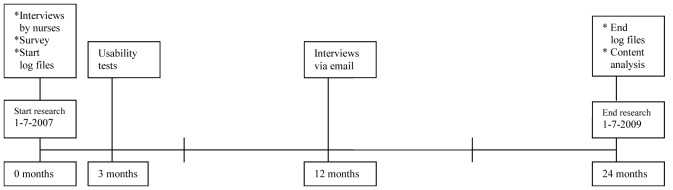
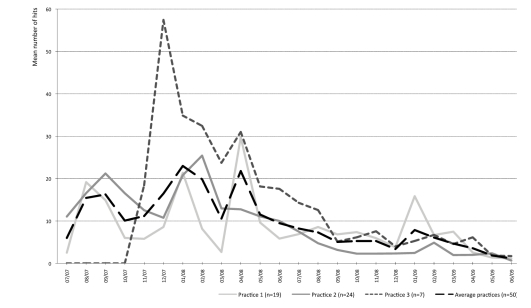
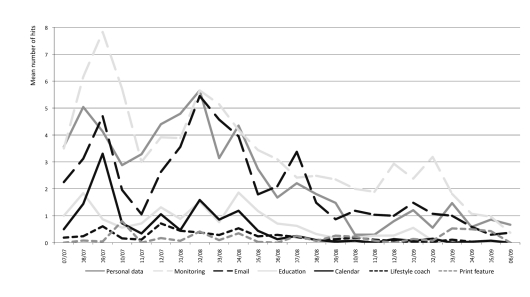
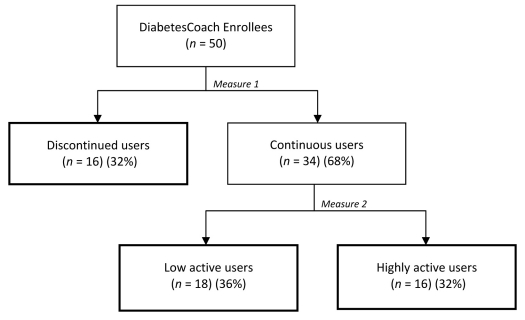
BACKGROUND: The take-up of eHealth applications in general is still rather low and user attrition is often high. Only limited information is available about the use of eHealth technologies among specific patient groups. OBJECTIVE: The aim of this study was to explore the factors that influence the initial and long-term use of a Web-based application (DiabetesCoach) for supporting the self-care of patients with type 2 diabetes. METHODS: A mixed-methods research design was used for a process analysis of the actual usage of the Web application over a 2-year period and to identify user profiles. Research instruments included log files, interviews, usability tests, and a survey. RESULTS: The DiabetesCoach was predominantly used for interactive features like online monitoring, personal data, and patient-nurse email contact. It was the continuous, personal feedback that particularly appealed to the patients; they felt more closely monitored by their nurse and encouraged to play a more active role in self-managing their disease. Despite the positive outcomes, usage of the Web application was hindered by low enrollment and nonusage attrition. The main barrier to enrollment had to do with a lack of access to the Internet (146/226, 65%). Although 68% (34/50) of the enrollees were continuous users, of whom 32% (16/50) could be defined as hardcore users (highly active), the remaining 32% (16/50) did not continue using the Web application for the full duration of the study period. Barriers to long-term use were primarily due to poor user-friendliness of the Web application (the absence of "push" factors or reminders) and selection of the "wrong" users; the well-regulated patients were not the ones who could benefit the most from system use because of a ceiling effect. Patients with a greater need for care seemed to be more engaged in long-term use; highly active users were significantly more often medication users than low/inactive users (P = .005) and had a longer diabetes duration (P = .03). CONCLUSION: Innovations in health care will diffuse more rapidly when technology is employed that is simple to use and has applicable components for interactivity. This would foresee the patients' need for continuous and personalized feedback, in particular for patients with a greater need for care. From this study several factors appear to influence increased use of eHealth technologies: (1) avoiding selective enrollment, (2) making use of participatory design methods, and (3) developing push factors for persistence. Further research should focus on the causal relationship between using the system's features and actual usage, as such a view would provide important evidence on how specific technology features can engage and captivate users.
Overview
The claims and statistics of this paper haven’t been checked yet.
Run the check — free, no account needed. It reads the open-access text and checks the sources it cites.
Integrity signals
Registry
Cites
Statistics
Figures
Verification
Claims the paper makes
The claims and statistics of this paper haven’t been checked yet.
Run the check — free, no account needed. It reads the open-access text and checks the sources it cites.
Claims other papers make about this one
Each is checked against this paper’s own text: does it say what the citing paper says it does?
The source backs part of the claim, not all of it — or backs it for a different population, condition or comparison.
In the citing paper
“The application was equipped with neither “push” factors nor an advanced decision support system providing feedback based on accumulated data and other personal profiles, which are advocated for long-term usage, according to relevant studies [62-65].”
From Long-Term Engagement With a Mobile Self-Management System for People With Type 2 Diabetes (2013) · cites this paper as [62]
Experimental — accuracy not yet measuredIn the citing paper
“While such technologies can be effective [1,2], one of the main problems is that users’ adoption and long-term use remains lower than expected [3-5].”
From Opening the Black Box of Electronic Health: Collecting, Analyzing, and Interpreting Log Data (2017) · cites this paper as [3]
In the citing paper
“The application was equipped with neither “push” factors nor an advanced decision support system providing feedback based on accumulated data and other personal profiles, which are advocated for long-term usage, according to relevant studies [62-65].”
From Long-Term Engagement With a Mobile Self-Management System for People With Type 2 Diabetes (2013) · cites this paper as [62]
In the citing paper
“Decrease in usage after gaining a sense of mastery over diabetes is in line with findings by relevant studies [30,32,62].”
From Long-Term Engagement With a Mobile Self-Management System for People With Type 2 Diabetes (2013) · cites this paper as [62]
Self-check
Percentages, sums and reported differences re-computed from the paper’s own numbers.
The self-check needs the paper’s full text.
Citations
Cites
Crossing the Quality Chasm: A New Health System for the 21st Century
Baker, A. (2001) · BMJ · doi:10.1136/bmj.323.7322.1192 · Cited by 10,779
Applied Longitudinal Data Analysis: Modeling Change and Event Occurrence
Singer, J. D., & Willett, J. B. (2003) · doi:10.1093/acprof:oso/9780195152968.001.0001 · Cited by 10,647
(1993) · Cited by 9,879
The critical incident technique.
Flanagan, J. C. (1954) · Psychological Bulletin · doi:10.1037/h0061470 · Cited by 8,191
Global estimates of the prevalence of diabetes for 2010 and 2030
Shaw, J. E., Sicree, R. A., & Zimmet, P. Z. (2010) · Diabetes Research and Clinical Practice · doi:10.1016/j.diabres.2009.10.007 · Cited by 7,216
SAGE Handbook of Mixed Methods in Social & Behavioral Research
Tashakkori, A., & Teddlie, C. (2010) · doi:10.4135/9781506335193 · Cited by 6,215
(1993) · Elsevier eBooks · doi:10.1016/c2009-0-21512-1 · Cited by 5,552
Rogelberg, S. G. (2007) · Sage eBooks · doi:10.4135/9781412952651.n55 · Cited by 5,309
Book Review: Protocol Analysis: Verbal Reports as Data
Venkatesan, M., Ericsson, K. A., & Simon, H. A. (1986) · Journal of Marketing Research · doi:10.2307/3151491 · Cited by 4,364
Patient Self-management of Chronic Disease in Primary Care
Bodenheimer, T. (2002) · JAMA · doi:10.1001/jama.288.19.2469 · Cited by 3,598 · cited 2×
“The introduction of the Internet into clinical practice has brought about many opportunities for self-care [2-7], as it can be used as a powerful medium for promoting a healthy lifestyle and for increasing understanding about the condition.”
Background
Research works printed but not linked: 2
- 2002, Am J Prev Med, 22, 10
- Wangberg, SC, 2008, Patient Prefer Adherence, 2, 57
Cited by
Sorted by citations
Good intentions are not enough: how informatics interventions can worsen inequality
Veinot, T. C., Mitchell, H., & Ancker, J. S. (2018) · Journal of the American Medical Informatics Association · doi:10.1093/jamia/ocy052 · Cited by 704
Kruse, C. S., Bolton, K., & Freriks, G. (2015) · Journal of Medical Internet Research · doi:10.2196/jmir.3171 · Cited by 379
Web 2.0 chronic disease self-management for older adults: a systematic review
Stellefson, M., Chaney, B., Barry, A. E., Chavarria, E., Tennant, B., Walsh-Childers, K., Sriram, P. S., & Zagora, J. (2013) · Journal of Medical Internet Research · doi:10.2196/jmir.2439 · Cited by 315
Sieverink, F., Kelders, S. M., & van Gemert-Pijnen, J. E. (2017) · Journal of Medical Internet Research · doi:10.2196/jmir.8578 · Cited by 331
Self-citationKruse, C. S., Argueta, D. A., Lopez, L., & Nair, A. (2015) · Journal of Medical Internet Research · doi:10.2196/jmir.3703 · Cited by 327
Metadata
- Authors
- Nijland, N., van Gemert-Pijnen, J. E., Kelders, S. M., Brandenburg, B. J., & Seydel, E. R.
- Affiliations
- University of Twente (NL)
- Corresponding author
- Nijland, Nicol
- ORCID
- Kelders, Saskia M
- Venue
- Journal of Medical Internet Research
- Publisher
- JMIR Publications Inc.
- Published
- 2011-09-30
- Volume
- 13
- Issue
- 3
- Pages
- e71
- ISSN
- 1438-8871 (ISSN-L)
- PMC
- PMC3222177
- OpenAlex
- W2101939845
- Cited by
- 175
- References
- 74
- Citations by year
- 2026: 1 · 2025: 3 · 2024: 5 · 2023: 12 · 2022: 8 · 2021: 5 · 2020: 10 · 2019: 15 · 2018: 12 · 2017: 21 · 2016: 12 · 2015: 17 · 2014: 18 · 2013: 22 · 2012: 12
- FWCI
- 32.05
- Type
- journal article
- Language
- en
- Open access
- gold
- doi.org
- Licence
- other-oa
- Locations
- Journal of Medical Internet Research (publishedVersion, other-oa)
- Europe PMC (PubMed Central) (publishedVersion, cc-by)
- PubMed Central (publishedVersion, cc-by)
- PubMed (publishedVersion)
- DOAJ (DOAJ: Directory of Open Access Journals) (submittedVersion, cc-by-sa)
- University of Twente Research Information (submittedVersion, cc-by)
- Topics
- Health Sciences › Health Professions › General Health Professions › Mobile Health and mHealth Applications
- Health Sciences › Medicine › Public Health, Environmental and Occupational Health › Telemedicine and Telehealth Implementation
- Health Sciences › Medicine › Geriatrics and Gerontology › Technology Use by Older Adults
- Keywords
- type 2 diabetes, web application, digital health adoption, self-care, user attrition, user profiles, continuous feedback, nurse-patient communication, internet access barriers, ease of use, participatory design, diabetes duration, medication use, technology acceptance, patient engagement, personalized feedback, ceiling effect, health behavior change, diabetes self-management education
- MeSH terms
- Adult, Aged, Diabetes Mellitus, Type 2, Female, Humans, Male, Middle Aged, Patient Education as Topic, Patient Participation, Self Care, Social Support, User-Computer Interface, Disease Management, Internet, Access to Information, Electronic Mail, Consumer Health Information
About these checks
Registry, retraction, Cites and statistics results are computed, not judged, with one exception: a printed reference that no index lists is read once by a model before it counts as a citation error. Claims are extracted by a model and kept only when their quote appears verbatim in the text; each cited source is then checked, with a model’s help, for whether it says what the claim relies on. Those verdicts can be wrong — read the claim’s quote and the cited source before relying on one.
Statistics and arithmetic are recomputed, not judged.
Confidence bands are shown only for fields calibrated on our annotated test set. None is calibrated yet, so no band is shown.
What counts as a claim ›How we measure confidence ›How we check this ›
Are you an author, or do you see a problem with this page? Request a review
