

The DOI matches its Crossref record; 58 of the 58 references it cites were found in a registry or an index.
Compliance With Mobile Ecological Momentary Assessment Protocols in Children and Adolescents: A Systematic Review and Meta-Analysis
Open accessAbstract
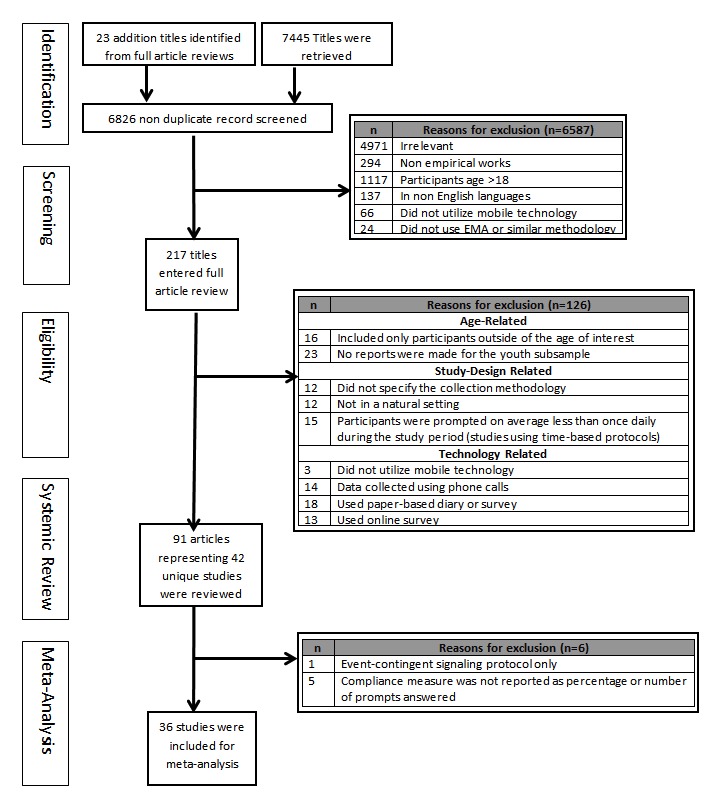
BACKGROUND: Mobile device-based ecological momentary assessment (mobile-EMA) is increasingly used to collect participants' data in real-time and in context. Although EMA offers methodological advantages, these advantages can be diminished by participant noncompliance. However, evidence on how well participants comply with mobile-EMA protocols and how study design factors associated with participant compliance is limited, especially in the youth literature. OBJECTIVE: To systematically and meta-analytically examine youth's compliance to mobile-EMA protocols and moderators of participant compliance in clinical and nonclinical settings. METHODS: Studies using mobile devices to collect EMA data among youth (age ≤18 years old) were identified. A systematic review was conducted to describe the characteristics of mobile-EMA protocols and author-reported factors associated with compliance. Random effects meta-analyses were conducted to estimate the overall compliance across studies and to explore factors associated with differences in youths' compliance. RESULTS: This review included 42 unique studies that assessed behaviors, subjective experiences, and contextual information. Mobile phones were used as the primary mode of EMA data collection in 48% (20/42) of the reviewed studies. In total, 12% (5/42) of the studies used wearable devices in addition to the EMA data collection platforms. About half of the studies (62%, 24/42) recruited youth from nonclinical settings. Most (98%, 41/42) studies used a time-based sampling protocol. Among these studies, most (95%, 39/41) prompted youth 2-9 times daily, for a study length ranging from 2-42 days. Sampling frequency and study length did not differ between studies with participants from clinical versus nonclinical settings. Most (88%, 36/41) studies with a time-based sampling protocol defined compliance as the proportion of prompts to which participants responded. In these studies, the weighted average compliance rate was 78.3%. The average compliance rates were not different between studies with clinical (76.9%) and nonclinical (79.2%; P=.29) and studies that used only a mobile-EMA platform (77.4%) and mobile platform plus additional wearable devices (73.0%, P=.36). Among clinical studies, the mean compliance rate was significantly lower in studies that prompted participants 2-3 times (73.5%) or 4-5 times (66.9%) compared with studies with a higher sampling frequency (6+ times: 89.3%). Among nonclinical studies, a higher average compliance rate was observed in studies that prompted participants 2-3 times daily (91.7%) compared with those that prompted participants more frequently (4-5 times: 77.4%; 6+ times: 75.0%). The reported compliance rates did not differ by duration of EMA period among studies from either clinical or nonclinical settings. CONCLUSIONS: The compliance rate among mobile-EMA studies in youth is moderate but suboptimal. Study design may affect protocol compliance differently between clinical and nonclinical participants; including additional wearable devices did not affect participant compliance. A more consistent compliance-related result reporting practices can facilitate understanding and improvement of participant compliance with EMA data collection among youth.
Overview
The claims and statistics of this paper haven’t been checked yet.
Run the check — free, no account needed. It reads the open-access text and checks the sources it cites.
Integrity signals
Registry
Cites
Statistics
Figures

Verification
Claims the paper makes
The claims and statistics of this paper haven’t been checked yet.
Run the check — free, no account needed. It reads the open-access text and checks the sources it cites.
Claims other papers make about this one
Each is checked against this paper’s own text: does it say what the citing paper says it does?
In the citing paper
“It has also previously been reported that more frequent assessments may not reduce compliance (106), or may even increase compliance (107), as long as questionnaires are kept brief (108).”
From Don't Miss the Moment: A Systematic Review of Ecological Momentary Assessment in Suicide Research (2022) · cites this paper as [107]
Self-check
Percentages, sums and reported differences re-computed from the paper’s own numbers.
The self-check needs the paper’s full text.
Citations
Cites
Measuring inconsistency in meta-analyses
Higgins, J. P. T., Thompson, S. G., Deeks, J. J., & Altman, D. G. (2003) · BMJ · doi:10.1136/bmj.327.7414.557 · Cited by 63,139
Liberati, A., Altman, D. G., Tetzlaff, J., Mulrow, C., Gøtzsche, P. C., Ioannidis, J. P. A., Clarke, M., Devereaux, P. J., Kleijnen, J., & Moher, D. (2009) · PLoS Medicine · doi:10.1371/journal.pmed.1000100 · Cited by 28,164
Dermyshi, E., Wang, Y., Yan, C., Hong, W., Qiu, G., Gong, X., & Zhang, T. (2017) · Neonatology · doi:10.1159/000454668 · Cited by 24,586
Digital Natives, Digital Immigrants Part 1
Prensky, M. (2001) · On the Horizon · doi:10.1108/10748120110424816 · Cited by 11,104
Liberati, A., Altman, D. G., Tetzlaff, J., Mulrow, C., Gøtzsche, P. C., Ioannidis, J. P. A., Clarke, M., Devereaux, P. J., Kleijnen, J., & Moher, D. (2009) · Journal of Clinical Epidemiology · doi:10.1016/j.jclinepi.2009.06.006 · Cited by 10,578
(2000) · Cited by 9,198
Ecological momentary assessment
Shiffman, S., Stone, A. A., & Hufford, M. R. (2008) · Annual Review of Clinical Psychology · doi:10.1146/annurev.clinpsy.3.022806.091415 · Cited by 6,454
Self-citationBaum, A., Revenson, T., & Singer, J. (2001) · Psychology Press eBooks · doi:10.4324/9781410600073 · Cited by 1,256
Patient compliance with paper and electronic diaries
Stone, A. A., Shiffman, S., Schwartz, J. E., Broderick, J. E., & Hufford, M. R. (2003) · Controlled Clinical Trials · doi:10.1016/s0197-2456(02)00320-3 · Cited by 910
Self-citationCapturing momentary, self-report data: A proposal for reporting guidelines
Stone, A. A., & Shiffman, S. (2002) · Annals of Behavioral Medicine · doi:10.1207/s15324796abm2403_09 · Cited by 807
Self-citation
Cited by
Sorted by citations
Wrzus, C., & Neubauer, A. B. (2023) · Assessment · doi:10.1177/10731911211067538 · Cited by 500
Short, C. E., DeSmet, A., Woods, C., Williams, S. L., Maher, C., Middelweerd, A., Müller, A. M., Wark, P. A., Vandelanotte, C., Poppe, L., et al. (2018) · Journal of Medical Internet Research · doi:10.2196/jmir.9397 · Cited by 400
Trull, T. J., & Ebner‐Priemer, U. (2019) · Journal of Abnormal Psychology · doi:10.1037/abn0000473 · Cited by 383
Compliance with ecological momentary assessment protocols in substance users: a meta-analysis
Jones, A., Remmerswaal, D., Verveer, I., Robinson, E., Franken, I. H. A., Wen, C. K. F., & Field, M. (2019) · Addiction · doi:10.1111/add.14503 · Cited by 319
Self-citationEcological momentary assessment methodology in chronic pain research: a systematic review
May, M., Junghaenel, D. U., Ono, M., Stone, A. A., & Schneider, S. (2018) · The Journal of Pain · doi:10.1016/j.jpain.2018.01.006 · Cited by 247
Self-citationAnnual Research Review: Ecological momentary assessment studies in child psychology and psychiatry
Russell, M. A., & Gajos, J. M. (2020) · Journal of Child Psychology and Psychiatry · doi:10.1111/jcpp.13204 · Cited by 252
Evaluation of Pressing Issues in Ecological Momentary Assessment
Stone, A. A., Schneider, S., & Smyth, J. M. (2022) · Annual Review of Clinical Psychology · doi:10.1146/annurev-clinpsy-080921-083128 · Cited by 247
Self-citationThe Design of Ecological Momentary Assessment Technologies
Doherty, K., Balaskas, A., & Doherty, G. J. (2020) · Interacting with Computers · doi:10.1093/iwcomp/iwaa019 · Cited by 202
van Roekel, E., Keijsers, L., & Chung, J. M. (2019) · Journal of Research on Adolescence · doi:10.1111/jora.12471 · Cited by 191
Bickman, L. (2020) · Administration and Policy in Mental Health and Mental Health Services Research · doi:10.1007/s10488-020-01065-8 · Cited by 184
Don't Miss the Moment: A Systematic Review of Ecological Momentary Assessment in Suicide Research
Kivelä, L., van der Does, W. A. J., Riese, H., & Antypa, N. (2022) · Frontiers in Digital Health · doi:10.3389/fdgth.2022.876595 · Cited by 163
Bagot, K. S., Matthews, S. A., Mason, M., Squeglia, L. M., Fowler, J., Gray, K., Herting, M., May, A., Colrain, I., Godino, J., et al. (2018) · Developmental Cognitive Neuroscience · doi:10.1016/j.dcn.2018.03.008 · Cited by 145
Williams, M., Lewthwaite, H., Fraysse, F., Gajewska, A., Ignatavicius, J., & Ferrar, K. (2020) · Journal of Medical Internet Research · doi:10.2196/17023 · Cited by 141
Kirtley, O. J., Lafit, G., Achterhof, R., Hiekkaranta, A. P., & Myin‐Germeys, I. (2021) · Advances in Methods and Practices in Psychological Science · doi:10.1177/2515245920924686 · Cited by 146
Degroote, L., DeSmet, A., Bourdeaudhuij, I. D., Dyck, D. V., & Crombez, G. (2020) · International Journal of Behavioral Nutrition and Physical Activity · doi:10.1186/s12966-020-00932-9 · Cited by 146
Challenges and solutions for N-of-1 design studies in health psychology
Kwasnicka, D., Inauen, J., Nieuwenboom, W., Nurmi, J., Schneider, A., Short, C., Dekkers, T., Williams, A. J., Bierbauer, W., Haukkala, A., et al. (2019) · Health Psychology Review · doi:10.1080/17437199.2018.1564627 · Cited by 111
Domin, A., Spruijt‐Metz, D., Theisen, D., Ouzzahra, Y., & Vögele, C. (2021) · JMIR mhealth and uhealth · doi:10.2196/24308 · Cited by 126
Self-citationCzyz, E. K., King, C. A., & Nahum-Shani, I. (2018) · Psychiatry Research · doi:10.1016/j.psychres.2018.06.031 · Cited by 112
Glenn, C. R., Kleiman, E. M., Kearns, J. C., Santee, A. C., Esposito, E. C., Conwell, Y., & Alpert-Gillis, L. J. (2022) · Journal of Clinical Child & Adolescent Psychology · doi:10.1080/15374416.2020.1741377 · Cited by 104
Perski, O., Keller, J., Kale, D., Asare, B. Y.-A., Schneider, V., Powell, D., Naughton, F., ten Hoor, G. T., Verboon, P., & Kwasnicka, D. (2022) · Health Psychology Review · doi:10.1080/17437199.2022.2112258 · Cited by 99
Ricard, B. J., Marsch, L. A., Crosier, B. S., & Hassanpour, S. (2018) · Journal of Medical Internet Research · doi:10.2196/11817 · Cited by 101
Katapally, T. R., Bhawra, J., Leatherdale, S. T., Ferguson, L. J., Longo, J., Rainham, D. G. C., Larouche, R., & Osgood, N. D. (2018) · JMIR Public Health and Surveillance · doi:10.2196/publichealth.8953 · Cited by 87
Gruet, M. (2018) · Frontiers in Physiology · doi:10.3389/fphys.2018.01285 · Cited by 82
Mason, T. B., Do, B., Wang, S., & Dunton, G. F. (2020) · Appetite · doi:10.1016/j.appet.2019.104465 · Cited by 74
Kleiman, E. M., Glenn, C. R., & Liu, R. T. (2019) · Journal of Clinical Child & Adolescent Psychology · doi:10.1080/15374416.2019.1666400 · Cited by 68
Overcoming compliance bias in self-report studies: A cross-study analysis
van Berkel, N., Gonçalves, J., Hosio, S. J., Sarsenbayeva, Z., Velloso, E., & Kostakos, V. (2019) · International Journal of Human-Computer Studies · doi:10.1016/j.ijhcs.2019.10.003 · Cited by 69
So You Want to Do ESM? 10 Essential Topics for Implementing the Experience-Sampling Method
Fritz, J., Piccirillo, M. L., Cohen, Z. D., Frumkin, M. R., Kirtley, O. J., Moeller, J., Neubauer, A. B., Norris, L. A., Schuurman, N. K., Snippe, E., et al. (2024) · Advances in Methods and Practices in Psychological Science · doi:10.1177/25152459241267912 · Cited by 106
Yaroslavsky, I., Allard, E. S., & Sánchez-López, Á. (2018) · Journal of Affective Disorders · doi:10.1016/j.jad.2018.11.036 · Cited by 72
Jaso, B. A., Kraus, N. I., & Heller, A. S. (2021) · Psychological Methods · doi:10.1037/met0000312 · Cited by 72
Ottenstein, C., & Werner, L. (2022) · Assessment · doi:10.1177/10731911211032718 · Cited by 52
SEMA3: A free smartphone platform for daily life surveys
O'Brien, S. T., Dozo, N., Hinton, J. D. X., Moeck, E. K., Susanto, R., Jayaputera, G., Sinnott, R., Vu, D. Q., Álvarez‐Jiménez, M., Gleeson, J., et al. (2024) · Behavior Research Methods · doi:10.3758/s13428-024-02445-w · Cited by 70
Just-in-time adaptive ecological momentary assessment (JITA-EMA)
Schneider, S., Junghaenel, D. U., Smyth, J. M., Wen, C. K. F., & Stone, A. A. (2023) · Behavior Research Methods · doi:10.3758/s13428-023-02083-8 · Cited by 65
Self-citationKolar, D. R., Neumayr, C., Roth, M., Voderholzer, U., Perthes, K., & Schlegl, S. (2019) · European Eating Disorders Review · doi:10.1002/erv.2706 · Cited by 49
Liao, P., Dempsey, W., Sarker, H., Hossain, S. M., Al’Absi, M., Klasnja, P., & Murphy, S. A. (2018) · Proceedings of the ACM on Interactive Mobile Wearable and Ubiquitous Technologies · doi:10.1145/3287057 · Cited by 52
Drug use patterns and predictors among homeless youth: Results of an ecological momentary assessment
Maria, D. S., Padhye, N. S., Yang, Y., Gallardo, K. R., Santos, G., Jung, J., & Businelle, M. S. (2017) · The American Journal of Drug and Alcohol Abuse · doi:10.1080/00952990.2017.1407328 · Cited by 49
Berrouiguet, S., Ramírez, D., Barrigón, M. L., Moreno-Muñoz, P., Camacho, R. C., Baca‐García, E., & Artés-Rodrı́guez, A. (2018) · JMIR mhealth and uhealth · doi:10.2196/mhealth.9472 · Cited by 46
Rothenberg, W. A., Giunta, L. D., Lansford, J. E., Lunetti, C., Fiasconaro, I., Basili, E., Thartori, E., Favini, A., Pastorelli, C., Eisenberg, N., et al. (2019) · Journal of Youth and Adolescence · doi:10.1007/s10964-019-01071-6 · Cited by 54
Ziesemer, K., König, L. M., Boushey, C. J., Villinger, K., Wahl, D. R., Butscher, S., Müller, J., Reiterer, H., Schupp, H. T., & Renner, B. (2020) · JMIR mhealth and uhealth · doi:10.2196/15430 · Cited by 55
Contextual Analysis to Understand Compliance with Smartphone-based Ecological Momentary Assessment
Boukhechba, M., Cai, L., Chow, P. I., Fua, K., Gerber, M. S., Teachman, B. A., & Barnes, L. E. (2018) · International Conference on Pervasive Computing Technologies for Healthcare · doi:10.1145/3240925.3240967 · Cited by 45
Shevchenko, Y., Kuhlmann, T., & Reips, U. (2021) · Behavior Research Methods · doi:10.3758/s13428-020-01527-9 · Cited by 43
Sanjuan, P. M., Pearson, M., Poremba, C., Amaro, H. D. L. A., & Leeman, L. (2018) · Drug and Alcohol Dependence · doi:10.1016/j.drugalcdep.2018.11.019 · Cited by 44
Using ecological momentary assessments to predict relapse after adult substance use treatment
Scott, C. K., Dennis, M. L., & Gustafson, D. H. (2018) · Addictive Behaviors · doi:10.1016/j.addbeh.2018.02.025 · Cited by 43
Lalloo, C., Hundert, A. S., Harris, L., Phạm, Q., Campbell, F. A., Chorney, J. M. L., Dick, B. D., Simmonds, M. K., Cafazzo, J. A., & Stinson, J. (2019) · JMIR mhealth and uhealth · doi:10.2196/11838 · Cited by 41
Chung, I. Y., Jung, M., Lee, S. B., Lee, J. W., Park, Y. R., Cho, D., Chung, H., Youn, S., Min, Y. H., Park, H. J., et al. (2019) · Journal of Medical Internet Research · doi:10.2196/13463 · Cited by 38
Ecological Momentary Assessment and Mood Disorders in Children and Adolescents: a Systematic Review
Baltasar-Tello, I., Miguélez‐Fernández, C., Peñuelas‐Calvo, I., & Carballo, J. J. (2018) · Current Psychiatry Reports · doi:10.1007/s11920-018-0913-z · Cited by 38
Lazarides, C., Ward, E. B., Buß, C., Chen, W., Voelkle, M. C., Gillen, D. L., Wadhwa, P. D., & Entringer, S. (2020) · Psychoneuroendocrinology · doi:10.1016/j.psyneuen.2020.104848 · Cited by 39
Yao, L., Yang, Y.-Q., Wang, Z., Pan, X., & Xu, L. (2023) · BMJ Open · doi:10.1136/bmjopen-2022-069523 · Cited by 32
Miguélez‐Fernández, C., de León-Martínez, S., Baltasar-Tello, I., Peñuelas‐Calvo, I., Barrigón, M. L., Sedano-Capdevila, A., Delgado‐Gómez, D., Baca‐García, E., & Carballo, J. J. (2018) · ADHD Attention Deficit and Hyperactivity Disorders · doi:10.1007/s12402-018-0261-1 · Cited by 39
Santa Maria, D., Padhye, N., Businelle, M., Yang, Y., Jones, J., Sims, A., & Lightfoot, M. (2021) · Journal of Medical Internet Research · doi:10.2196/26704 · Cited by 36
“Fourth, there may have also been reactivity to EMAs [52] similar to a Hawthorne Effect—HIV health risk behaviors went down over time in both groups, potentially because participants were thinking about their health more due to the EMAs and the generic health messages.”
Boettner, B. L., Browning, C. R., & Calder, C. A. (2019) · Journal of Research on Adolescence · doi:10.1111/jora.12474 · Cited by 36
Kwaśnicka, D., Kale, D., Schneider, V., Keller, J., Asiamah-Asare, B. K. Y., Powell, D., Naughton, F., ten Hoor, G. A., Verboon, P., & Perski, O. (2021) · BMJ Open · doi:10.1136/bmjopen-2020-046435 · Cited by 40
Brick, T. R., Mundie, J., Weaver, J., Fraleigh, R. D., & Oravecz, Z. (2020) · JMIR Formative Research · doi:10.2196/16072 · Cited by 35
Gansner, M., Nisenson, M., Carson, N. J., & Torous, J. B. (2020) · Psychiatry Research · doi:10.1016/j.psychres.2020.113428 · Cited by 36
Nam, S., Griggs, S. A., Ash, G. I., Dunton, G. F., Huang, S., Batten, J., Parekh, N., & Whittemore, R. (2021) · Diabetes Research and Clinical Practice · doi:10.1016/j.diabres.2021.108745 · Cited by 33
It’s about time: The role of temporal variability in improving assessment of executive functioning
McKinney, T. L., Euler, M. J., & Butner, J. (2019) · The Clinical Neuropsychologist · doi:10.1080/13854046.2019.1704434 · Cited by 36
Murray, A. L., Brown, R., Zhu, X., Speyer, L. G., Yang, Y., Xiao, Z., Ribeaud, D., & Eisner, M. (2022) · Journal of Affective Disorders · doi:10.1016/j.jad.2022.11.014 · Cited by 46
Ecological momentary assessment of mind-wandering: meta-analysis and systematic review
Kawashima, I., Hinuma, T., & Tanaka, S. (2023) · Scientific Reports · doi:10.1038/s41598-023-29854-9 · Cited by 32
Alexithymia – Not autism – is associated with frequency of social interactions in adults
Gerber, A. S., Girard, J. M., Scott, S., & Lerner, M. D. (2019) · Behaviour Research and Therapy · doi:10.1016/j.brat.2019.103477 · Cited by 34
Adolescents’ Online Coping: When Less Is More but None Is Worse
Modecki, K. L., Duvenage, M., Uink, B. N., Barber, B. L., & Donovan, C. L. (2021) · Clinical Psychological Science · doi:10.1177/21677026211028983 · Cited by 36
Gershon, A., Kaufmann, C. N., Torous, J. B., Depp, C. A., & Ketter, T. A. (2019) · Journal of Psychiatric Research · doi:10.1016/j.jpsychires.2019.05.026 · Cited by 32
Goldschmidt, A. B., Smith, K. E., Lavender, J. M., Engel, S., & Haedt-Matt, A. A. (2018) · Journal of Psychiatric Research · doi:10.1016/j.jpsychires.2018.12.018 · Cited by 28
Stone, A. A., Schneider, S., Smyth, J. M., Junghaenel, D. U., Wen, C. K. F., Couper, M. P., & Goldstein, S. (2023) · PLoS ONE · doi:10.1371/journal.pone.0282591 · Cited by 30
Self-citationMulvaney, S. A., Vaala, S., Hood, K. K., Lybarger, C., Carroll, R., Williams, L., Schmidt, D. C., Johnson, K., Dietrich, M. S., & Laffel, L. (2018) · Diabetes Technology & Therapeutics · doi:10.1089/dia.2018.0064 · Cited by 29
Predicting Sexual Behaviors Among Homeless Young Adults: Ecological Momentary Assessment Study
Maria, D. S., Padhye, N. S., Yang, Y., Gallardo, K. R., & Businelle, M. S. (2018) · JMIR Public Health and Surveillance · doi:10.2196/publichealth.9020 · Cited by 30
Poelman, M. P., van Lenthe, F. J., Scheider, S., & Kamphuis, C. B. M. (2020) · JMIR Research Protocols · doi:10.2196/15283 · Cited by 29
Massar, S. A. A., Chua, X. Y., Soon, C. S., Ng, A., Ong, J. L., Chee, N. I. Y. N., Lee, T.-S. W., Ghosh, A., & Chee, M. W. L. (2021) · npj Digital Medicine · doi:10.1038/s41746-021-00466-9 · Cited by 30
Lazarides, C., Moog, N. K., Verner, G., Voelkle, M. C., Henrich, W., Heim, C. C., Braun, T., Wadhwa, P. D., Buß, C., & Entringer, S. (2021) · Psychological Medicine · doi:10.1017/s0033291721002221 · Cited by 33
Mölsä, M., Lax, M., Korhonen, J., Gumpel, T. P., & Söderberg, P. (2022) · Frontiers in Psychology · doi:10.3389/fpsyg.2022.844698 · Cited by 26
Maharjan, R., Doherty, K., Rohani, D. A., Bækgaard, P., & Bardram, J. E. (2022) · ACM Transactions on Interactive Intelligent Systems · doi:10.1145/3484508 · Cited by 29
Advances and Controversies in Diet and Physical Activity Measurement in Youth
Spruijt‐Metz, D., Wen, C. K. F., Bell, B. M., Intille, S. S., Huang, J. S., & Baranowski, T. (2018) · American Journal of Preventive Medicine · doi:10.1016/j.amepre.2018.06.012 · Cited by 29
Self-citationDomoff, S. E., Banga, C. A., Borgen, A. L., Foley, R. P., Robinson, C. A., Avery, K., & Gentile, D. A. (2021) · Human Behavior and Emerging Technologies · doi:10.1002/hbe2.247 · Cited by 28
Bourke, M., Hilland, T. A., & Craike, M. J. (2021) · Psychology and Health · doi:10.1080/08870446.2021.1965603 · Cited by 30
Fonseca, L. M., Strong, R. W., Singh, S. M., Bulger, J., Cleveland, M. J., Grinspoon, E. A., Janess, K., Jung, L., Miller, K. M., Passell, E. J., et al. (2023) · JMIR Diabetes · doi:10.2196/39750 · Cited by 28
Tseng, W., Naim, R., Chue, A. E., Shaughnessy, S., Meigs, J. M., Pine, D. S., Leibenluft, E., Kircanski, K., & Brotman, M. A. (2023) · Journal of Child Psychology and Psychiatry · doi:10.1111/jcpp.13794 · Cited by 30
Illusory Feelings, Elusive Habits: People Overlook Habits in Explanations of Behavior
Mazar, A., & Wood, W. (2022) · Psychological Science · doi:10.1177/09567976211045345 · Cited by 26
Snoozy: A Chatbot-Based Sleep Diary for Children Aged Eight to Twelve
Aarts, T., Markopoulos, P., Giling, L., Văcărețu, T., & Pillen, S. (2022) · ACM International Conference on Interaction Design and Children (IDC) · doi:10.1145/3501712.3529718 · Cited by 26
Pebdani, R. N., Zeidan, A., Low, L., & Baillie, A. (2022) · Higher Education Research & Development · doi:10.1080/07294360.2022.2128075 · Cited by 27
Mobile Ecological Momentary Assessment of Postconcussion Symptoms and Recovery Outcomes
Sufrinko, A. M., Howie, E. K., Charek, D. B., Elbin, R. J., Collins, M. W., & Kontos, A. P. (2019) · Journal of Head Trauma Rehabilitation · doi:10.1097/htr.0000000000000474 · Cited by 25
Demers, M., & Winstein, C. (2020) · Topics in Stroke Rehabilitation · doi:10.1080/10749357.2020.1856557 · Cited by 18
Battaglia, B., Lee, L., Jia, S. S., Partridge, S. R., & Allman-Farinelli, M. A. (2022) · Healthcare · doi:10.3390/healthcare10071329 · Cited by 23
Ambulatory Assessment of Adolescent Coping: It's a Complicated Process
Duvenage, M., Uink, B. N., Zimmer‐Gembeck, M. J., Barber, B. L., Donovan, C. L., & Modecki, K. L. (2019) · Journal of Research on Adolescence · doi:10.1111/jora.12468 · Cited by 26
Martinez, G. J., Mattingly, S. M., Robles-Granda, P., Saha, K., Sirigiri, A., Young, J., Chawla, N. V., Choudhury, M. D., D’Mello, S. K., Mark, G. J., et al. (2021) · JMIR mhealth and uhealth · doi:10.2196/22218 · Cited by 25
Naim, R., Smith, A. R., Chue, A. E., Grassie, H. L., Linke, J. O., Dombek, K., Shaughnessy, S., McNeil, C., Cardinale, E. M., Agorsor, C. F., et al. (2021) · Development and Psychopathology · doi:10.1017/s0954579421000717 · Cited by 24
Objective and subjective sleep health in adolescence: Associations with puberty and affect
Kirshenbaum, J. S., Coury, S. M., Colich, N. L., Manber, R., & Gotlib, I. H. (2022) · Journal of Sleep Research · doi:10.1111/jsr.13805 · Cited by 25
Chmurzyńska, A., Młodzik-Czyżewska, M. A., Malinowska, A. M., Czarnocińska, J., & Wiebe, D. J. (2018) · Nutrients · doi:10.3390/nu10111692 · Cited by 23
Psihogios, A. M., Li, Y., Ahmed, A., Huang, J. Y., Kersun, L. S., Schwartz, L. A., & Barakat, L. P. (2020) · Pediatric Blood & Cancer · doi:10.1002/pbc.28767 · Cited by 24
Dzubur, E., Huh, J., Maher, J. P., Intille, S. S., & Dunton, G. F. (2018) · Translational Behavioral Medicine · doi:10.1093/tbm/ibx002 · Cited by 22
Schleicher, M., Unnikrishnan, V., Neff, P. K. A., Simoes, J. P., Probst, T., Pryss, R. C., Schlee, W., & Spiliopoulou, M. (2020) · Scientific Reports · doi:10.1038/s41598-020-79527-0 · Cited by 23
Turner-McGrievy, G. M., Yang, C.-H., Monroe, C., Pellegrini, C., & West, D. S. (2021) · Journal of Technology in Behavioral Science · doi:10.1007/s41347-021-00203-9 · Cited by 22
Fatori, D., Argeu, A., Brentani, H., Chiesa, A., Fracolli, L., Matijasevich, A., Miguel, E. C., & Polanczyk, G. (2020) · JMIR mHealth and uHealth · doi:10.2196/13686 · Cited by 21
The use of ecological momentary assessment to evaluate real-world aided outcomes with children
Glista, D., O’Hagan, R., Eeckhoutte, M. V., Lai, Y., & Scollie, S. D. (2021) · International Journal of Audiology · doi:10.1080/14992027.2021.1881629 · Cited by 22
Digital Phenotyping in Child and Adolescent Psychiatry: A Perspective
Nisenson, M., Lin, V., & Gansner, M. (2021) · Harvard Review of Psychiatry · doi:10.1097/hrp.0000000000000310 · Cited by 23
Coughlin, L. N., Nahum-Shani, I. B., Bonar, E. E., Philyaw-Kotov, M. L., Rabbi, M., Klasnja, P., & Walton, M. A. (2021) · Substance Use & Misuse · doi:10.1080/10826084.2021.1972314 · Cited by 24
Santee, A. C., & Starr, L. R. (2021) · Clinical Psychological Science · doi:10.1177/21677026211045684 · Cited by 22
Goodell, E. M. A., Nordeck, C. D., Finan, P. H., Vandrey, R. G., Dunn, K. E., & Thrul, J. (2021) · Internet Interventions · doi:10.1016/j.invent.2021.100460 · Cited by 22
Mereish, E. H., Padovano, H. T., Parlette, B., & Miranda, R. (2022) · Journal of Clinical Child & Adolescent Psychology · doi:10.1080/15374416.2022.2093208 · Cited by 22
Browning, C. R., Pinchak, N. P., Calder, C. A., & Boettner, B. L. (2024) · Annual Review of Sociology · doi:10.1146/annurev-soc-091523-013249 · Cited by 21
Katapally, T. R., Hammami, N., & Chu, L. M. (2021) · PLoS ONE · doi:10.1371/journal.pone.0259486 · Cited by 21
Lalloo, C., Nishat, F., Zempsky, W. T., Bakshi, N., Badawy, S. M., Ko, Y. J., Dampier, C., Stinson, J., & Palermo, T. M. (2022) · Journal of Medical Internet Research · doi:10.2196/40096 · Cited by 23
A collaborative realist review of remote measurement technologies for depression in young people
Walsh, A. E. L., Naughton, G., Sharpe, T., Zajkowska, Z., Malys, M. K., van Heerden, A. C., & Mondelli, V. (2024) · Nature Human Behaviour · doi:10.1038/s41562-023-01793-5 · Cited by 28
Metadata
- Authors
- Wen, C. K. F., Schneider, S., Stone, A. A., & Spruijt-Metz, D.
- Affiliations
- University of Southern California (US)
- Corresponding author
- Wen, Cheng K Fred
- Venue
- Journal of Medical Internet Research
- Publisher
- JMIR Publications Inc.
- Published
- 2017-04-26
- Volume
- 19
- Issue
- 4
- Pages
- e132
- ISSN
- 1438-8871 (ISSN-L)
- PMC
- PMC5425774
- OpenAlex
- W2609643912
- Cited by
- 350
- References
- 58
- Citations by year
- 2026: 49 · 2025: 37 · 2024: 43 · 2023: 40 · 2022: 40 · 2021: 52 · 2020: 33 · 2019: 28 · 2018: 26 · 2017: 1
- FWCI
- 3.80
- Type
- journal article
- Language
- en
- Open access
- gold
- doi.org
- Licence
- cc-by
- Locations
- Journal of Medical Internet Research (publishedVersion, cc-by)
- Europe PMC (PubMed Central) (publishedVersion, cc-by)
- PubMed Central (publishedVersion, cc-by)
- PubMed (publishedVersion)
- Funders
- National Science Foundation (1521722)
- University of Southern California
- National Institutes of Health (U24OD023176)
- Directorate for Computer and Information Science and Engineering
- National Institute on Aging (R01AG042407)
- National Institute of Arthritis and Musculoskeletal and Skin Diseases (R01AR066200)
- National Center for Complementary and Integrative Health (R01AT008330)
- Topics
- Social Sciences › Psychology › Experimental and Cognitive Psychology › Mental Health Research Topics
- Health Sciences › Health Professions › General Health Professions › Mobile Health and mHealth Applications
- Social Sciences › Psychology › Applied Psychology › Digital Mental Health Interventions
- Keywords
- participant compliance, youth, children and adolescents, mobile phone data collection, wearable devices, sampling frequency, informed consent
- MeSH terms
- Ecological Momentary Assessment, Adolescent, Child, Data Collection, Humans, Patient Compliance, Research Design, Cell Phone
About these checks
Registry, retraction, Cites and statistics results are computed, not judged, with one exception: a printed reference that no index lists is read once by a model before it counts as a citation error. Claims are extracted by a model and kept only when their quote appears verbatim in the text; each cited source is then checked, with a model’s help, for whether it says what the claim relies on. Those verdicts can be wrong — read the claim’s quote and the cited source before relying on one.
Statistics and arithmetic are recomputed, not judged.
Confidence bands are shown only for fields calibrated on our annotated test set. None is calibrated yet, so no band is shown.
What counts as a claim ›How we measure confidence ›How we check this ›
Are you an author, or do you see a problem with this page? Request a review
