

The DOI matches its Crossref record; 36 of the 37 references it cites were found in a registry or an index.
Validation of Physical Activity Tracking via Android Smartphones Compared to ActiGraph Accelerometer: Laboratory-Based and Free-Living Validation Studies
Open accessAbstract
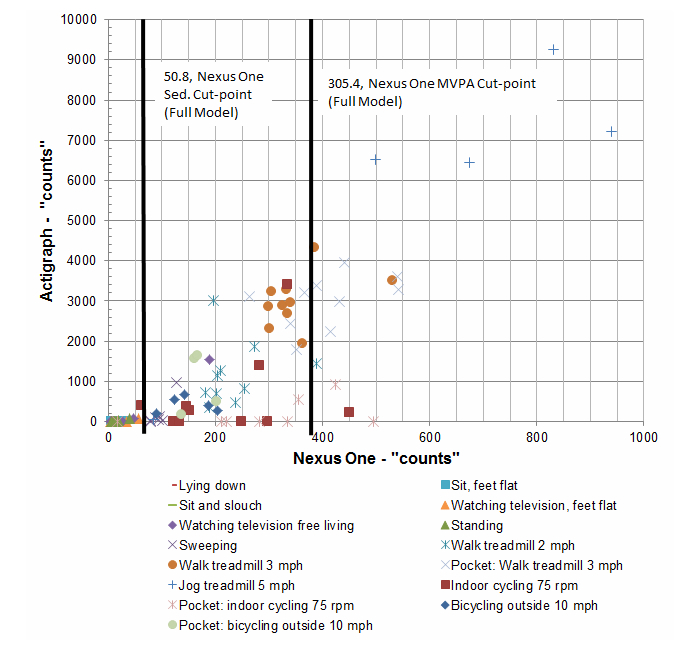
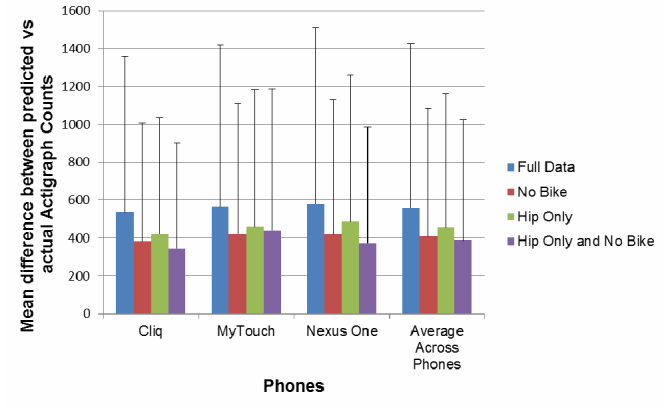
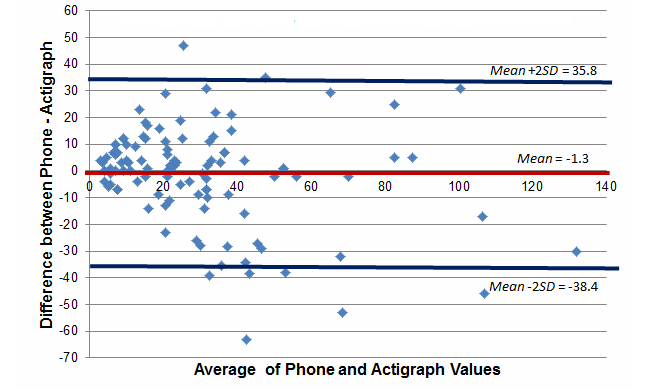
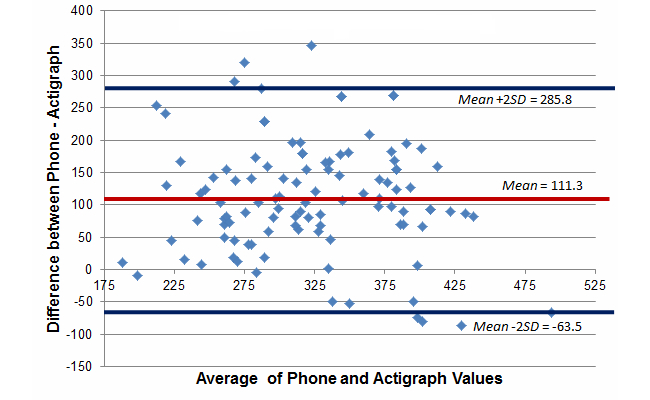
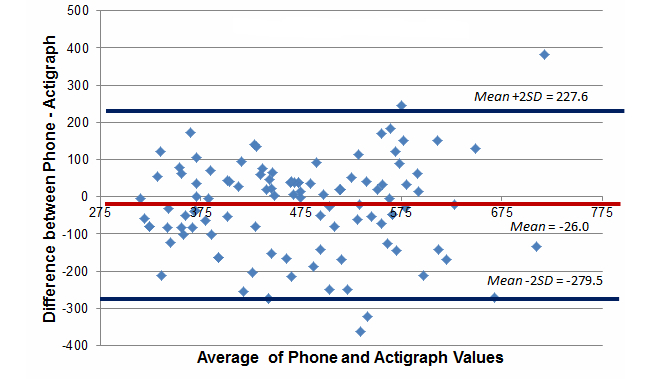
BACKGROUND: There is increasing interest in using smartphones as stand-alone physical activity monitors via their built-in accelerometers, but there is presently limited data on the validity of this approach. OBJECTIVE: The purpose of this work was to determine the validity and reliability of 3 Android smartphones for measuring physical activity among midlife and older adults. METHODS: A laboratory (study 1) and a free-living (study 2) protocol were conducted. In study 1, individuals engaged in prescribed activities including sedentary (eg, sitting), light (sweeping), moderate (eg, walking 3 mph on a treadmill), and vigorous (eg, jogging 5 mph on a treadmill) activity over a 2-hour period wearing both an ActiGraph and 3 Android smartphones (ie, HTC MyTouch, Google Nexus One, and Motorola Cliq). In the free-living study, individuals engaged in usual daily activities over 7 days while wearing an Android smartphone (Google Nexus One) and an ActiGraph. RESULTS: Study 1 included 15 participants (age: mean 55.5, SD 6.6 years; women: 56%, 8/15). Correlations between the ActiGraph and the 3 phones were strong to very strong (ρ=.77-.82). Further, after excluding bicycling and standing, cut-point derived classifications of activities yielded a high percentage of activities classified correctly according to intensity level (eg, 78%-91% by phone) that were similar to the ActiGraph's percent correctly classified (ie, 91%). Study 2 included 23 participants (age: mean 57.0, SD 6.4 years; women: 74%, 17/23). Within the free-living context, results suggested a moderate correlation (ie, ρ=.59, P<.001) between the raw ActiGraph counts/minute and the phone's raw counts/minute and a strong correlation on minutes of moderate-to-vigorous physical activity (MVPA; ie, ρ=.67, P<.001). Results from Bland-Altman plots suggested close mean absolute estimates of sedentary (mean difference=-26 min/day of sedentary behavior) and MVPA (mean difference=-1.3 min/day of MVPA) although there was large variation. CONCLUSIONS: Overall, results suggest that an Android smartphone can provide comparable estimates of physical activity to an ActiGraph in both a laboratory-based and free-living context for estimating sedentary and MVPA and that different Android smartphones may reliably confer similar estimates.
Overview
The claims and statistics of this paper haven’t been checked yet.
Run the check — free, no account needed. It reads the open-access text and checks the sources it cites.
Integrity signals
Registry
Cites
Statistics
Figures
Verification
Claims the paper makes
The claims and statistics of this paper haven’t been checked yet.
Run the check — free, no account needed. It reads the open-access text and checks the sources it cites.
Claims other papers make about this one
Each is checked against this paper’s own text: does it say what the citing paper says it does?
In the citing paper
“Smartphones are capable of accurately measuring physical activity in controlled and uncontrolled settings (30)”
From Which Components of a Smartphone Walking App Help Users to Reach Personalized Step Goals? Results From an Optimization Trial (2020) · cites this paper as [30]
Self-check
Percentages, sums and reported differences re-computed from the paper’s own numbers.
The self-check needs the paper’s full text.
Citations
Cites
STATISTICAL METHODS FOR ASSESSING AGREEMENT BETWEEN TWO METHODS OF CLINICAL MEASUREMENT
Martin Bland, J., & Altman, D. (1986) · The Lancet · doi:10.1016/s0140-6736(86)90837-8 · Cited by 47,965
Beckett, A. H., Rowland, M., & TURNER, P. (1965) · The Lancet · doi:10.1016/s0140-6736(65)91037-8 · Cited by 16,917
Applied Longitudinal Data Analysis: Modeling Change and Event Occurrence
Singer, J. D., & Willett, J. B. (2003) · doi:10.1093/acprof:oso/9780195152968.001.0001 · Cited by 10,647
‘Small Changes' to Diet and Physical Activity Behaviors for Weight Management
Hills, A. P., Byrne, N. M., Lindstrom, R. C., & Hill, J. O. (2013) · Obesity Facts · doi:10.1159/000345030 · Cited by 9,526
Compendium of physical activities: an update of activity codes and MET intensities
AINSWORTH, B. E., HASKELL, W. L., WHITT, M. C., IRWIN, M. L., SWARTZ, A. M., STRATH, S. J., O???BRIEN, W. L., BASSETT, D. R., SCHMITZ, K. H., EMPLAINCOURT, P. O., et al. (2000) · Medicine & Science in Sports & Exercise · doi:10.1097/00005768-200009001-00009 · Cited by 8,497
Physical Activity in the United States Measured by Accelerometer
TROIANO, R. P., BERRIGAN, D., DODD, K. W., MÂSSE, L. C., TILERT, T., & MCDOWELL, M. (2008) · Medicine & Science in Sports & Exercise · doi:10.1249/mss.0b013e31815a51b3 · Cited by 7,638
Calibration of the Computer Science and Applications, Inc. accelerometer
FREEDSON, P. S., MELANSON, E., & SIRARD, J. (1998) · Medicine & Science in Sports & Exercise · doi:10.1097/00005768-199805000-00021 · Cited by 3,825
Activity recognition using cell phone accelerometers
Kwapisz, J. R., Weiss, G. M., & Moore, S. A. (2011) · ACM SIGKDD Explorations Newsletter · doi:10.1145/1964897.1964918 · Cited by 2,912 · cited 3×
“Some studies have explored the utility of ecological momentary assessment (EMA) via smartphones [9], activity recognition using machine learning/neural network analyses [10-13], and activity classification via an iPod Touch for older adults [14].”
Amount of Time Spent in Sedentary Behaviors in the United States, 2003-2004
Matthews, C. E., Chen, K. Y., Freedson, P. S., Buchowski, M. S., Beech, B. M., Pate, R. R., & Troiano, R. P. (2008) · American Journal of Epidemiology · doi:10.1093/aje/kwm390 · Cited by 2,631
Physical Activity Assessments for Health-Related Research
Welk, G. J. (2002) · Medical Entomology and Zoology · Cited by 688
Research works printed but not linked: 4
- 2008, Physical Activity Guidelines Advisory Committee Report
- Lau, Sl, 2010, Future Network and Mobile Summit’, 10
- Vankipuram, M, 2012, AMIA Annu Symp Proc, 2012, 931
- Tudor-Locke, C, 2012, Prev Chronic Dis, 9, E113
Cited by
Sorted by citations
Items 101–137 of 137
Wang, Y., Koenig, L. M., & Reiterer, H. (2020) · arXiv (Cornell University)
McHugh, D. D. (2020) · Scholarship@Western (Western University)
Ho, J., Goggins, W. B., Mo, P. K. H., & Chan, E. Y. Y. (2021) · Research Square · doi:10.21203/rs.3.rs-698317/v1
mHealth: O uso de smartphones para aplicações biomédicas
Wurzel, P. M., & Evald, P. J. D. D. O. (2021) · Disciplinarum Scientia | Naturais e Tecnológicas · doi:10.37779/nt.v22i1.3686
Smith, C. A., Yu, D., Maestre, J. F., Backonja, U., Boyd, A. D., Buis, L. R., Chaudhry, B. M., Huh, J., Hussain, S. A., Jones, L. M., et al. (2020) · doi:10.2196/preprints.19980
Kamronn, S., Hansen, L. K., & Larsen, J. E. (2018) · doi:10.2196/preprints.10745
Paying people to be healthy: Limited time offerPreprint
Spilsbury, S., Wilk, P., Taylor, C. M., Harry Prapavessis, A., & Mitchell, M. (2022) · Research Square · doi:10.21203/rs.3.rs-1723426/v1
Physical Activity in Patients with Breast Cancer
Saito, T., & Ono, R. (2022) · Springer eBooks · doi:10.1007/978-981-19-6710-8_13
APTIDÃO FÍSICA, SAÚDE MENTAL E NUTRIÇÃO NO ADOLESCENTE
da Silva, L. P., Lima, G. D. S. O., Noleto, D. C. D. S., & do Nascimento, M. A. (2023) · doi:10.22533/at.ed.3512328097
EXERCÍCIO FÍSICO E ANSIEDADE NO ADOLESCENTE
Rabelo, A. S., de Oliveira, K. H. D. S., Abreu, L. M. S., Correia, M. B., & RIBEIRO, F. B. (2023) · doi:10.22533/at.ed.3512328092
Exercício físico e saúde do adolescente
Dias, C. J. M., Filho, C. A. A. D., Mostarda, C. T., & Costa, H. A. (2023) · doi:10.22533/at.ed.351232809
DEFINIÇÕES E CLASSIFICAÇÃO DA ADOLESCÊNCIA
Pereira, M. E. V., Oliveira, N. G., Ribeiro, P. R. F., da Silva, T. M. C., & Dias, C. J. M. (2023) · doi:10.22533/at.ed.3512328091
ASPECTOS ETIOPATOGÊNICOS DO CÂNCER DE TESTÍCULO EM ADOLESCENTES E SEU IMPACTO NA SAÚDE MENTAL
Filho, C. A. A. D., Ferreira, F. D., Ferreira, F. R. D., Carneiro, J. G. P., Neto, J. C. G. P., & Cardoso, M. E. S. (2023) · doi:10.22533/at.ed.3512328096
EXERCÍCIO FÍSICO E ADOLESCÊNCIA
Soares, N. D. J. S., Pires, F. D. O., & Cavalcante, L. F. P. (2023) · doi:10.22533/at.ed.3512328093
COMPORTAMENTO PARENTAL ASSOCIADO A FATORES DE RISCO CARDIOVASCULAR EM ADOLESCENTES
Costa, H. A., Rabelo, A. S., Costa, V. D. A. M., da Silva, F. E. L., & Pinto, B. F. P. (2023) · doi:10.22533/at.ed.3512328098
ASPECTOS E FATORES ASSOCIADOS À OBESIDADE NA ADOLESCÊNCIA
Durans, L. H. F., Miranda, T. D. C., Silva, H. N. D. S. E., Santos, E. R. V., Leitão, S., & Mostarda, C. T. (2023) · doi:10.22533/at.ed.3512328099 · Cited by 1
DIABETES MELLITUS TIPO 2 EM ADOLESCENTES E OS RISCOS DO DESENVOLVIMENTO DE INSUFICIÊNCIA CARDÍACA
Filho, C. A. A. D., de Carvalho, R. G. V., Carneiro, J. G. P., Neto, J. C. G. P., Rocha, L. T. S., & Rodrigues, P. A. V. (2023) · doi:10.22533/at.ed.3512328095
HIPERTENSÃO ARTERIAL NO ADOLESCENTE
Soares, N. D. J. S., Pires, F. D. O., & Cavalcante, L. F. P. (2023) · doi:10.22533/at.ed.3512328094
TREINAMENTO DE FORÇA, CRESCIMENTO E DESENVOLVIMENTO EM CRIANÇAS E ADOLESCENTES
Marques, R. F., & Ribeiro, R. M. (2023) · doi:10.22533/at.ed.35123280910
Costa, P. H. V., da Silva, L. V. T. T., de Jesus, T. P. D., Dario, D. M., Torriani‐Pasin, C., & Polese, J. C. (2024) · Journal of Bodywork and Movement Therapies · doi:10.1016/j.jbmt.2024.07.055
Pressure Sensor Array-Camera Based Activity Level Monitoring at Home: A Feasibility Study
Amma, A. K. A. N. S., Chen, L., Fisher, R. B., & Mitra, S. (2024) · International Conference on Sensing Technology · doi:10.1109/icst62759.2024.10992172
Takeji, Y., Nomura, A., Tada, H., Usui, S., Sakata, K., Tabuchi, T., & Takamura, M. (2025) · Journal of the American Heart Association · doi:10.1161/jaha.124.040402
Pearson, E., Harry Prapavessis, A., Higgins, C., Petrella, R., White, L., & Mitchell, M. (2020) · Figshare · doi:10.6084/m9.figshare.13257522
Pearson, E., Harry Prapavessis, A., Higgins, C., Petrella, R., White, L., & Mitchell, M. (2020) · Figshare · doi:10.6084/m9.figshare.13257510
Pearson, E., Harry Prapavessis, A., Higgins, C., Petrella, R., White, L., & Mitchell, M. (2020) · Figshare · doi:10.6084/m9.figshare.13257519
Pearson, E., Harry Prapavessis, A., Higgins, C., Petrella, R., White, L., & Mitchell, M. (2020) · Figshare · doi:10.6084/m9.figshare.13257531
Pearson, E., Harry Prapavessis, A., Higgins, C., Petrella, R., White, L., & Mitchell, M. (2020) · Figshare · doi:10.6084/m9.figshare.13257528
Pearson, E., Harry Prapavessis, A., Higgins, C., Petrella, R., White, L., & Mitchell, M. (2020) · Figshare · doi:10.6084/m9.figshare.13257516
Pearson, E., Harry Prapavessis, A., Higgins, C., Petrella, R., White, L., & Mitchell, M. (2020) · Figshare · doi:10.6084/m9.figshare.13257525
Savi, D., Graziano, L., Giordani, B., Schiavetto, S., Vito, C. D., Migliara, G., Simmonds, N. J., Palange, P., & Elborn, J. S. (2020) · Figshare · doi:10.6084/m9.figshare.13172544
Pearson, E., Harry Prapavessis, A., Higgins, C., Petrella, R., White, L., & Mitchell, M. (2020) · Figshare · doi:10.6084/m9.figshare.13257507
Ho, J. Y., Goggins, W. B., Mo, P. K. H., & Chan, E. Y. Y. (2022) · Figshare · doi:10.6084/m9.figshare.20070868
Pearson, E., Harry Prapavessis, A., Higgins, C., Petrella, R., White, L., & Mitchell, M. (2020) · Figshare · doi:10.6084/m9.figshare.13257513
Winbush, A., McDuff, D., Jiang, A., Barakat, A., Nelson, B., Heneghan, C., Hernandez, J., & Allen, N. B. (2026) · BMC Digital Health · doi:10.1186/s44247-026-00263-y
Watanabe, K., Inoue, A., Sakuraya, A., Imamura, K., Yoshikawa, T., & Tsutsumi, A. (2026) · Journal of Medical Internet Research · doi:10.2196/96072 · Cited by 1
Chen, T., Lu, T., Chang, H., & Lin, Y. (2026) · Chronobiology International · doi:10.1080/07420528.2026.2712429
Silsupadol, P., O’Brien, S. R., Bautista, S., Turner, I., Torbitt, M., Mooney, K., MacDonald, G., & Lugade, V. A. (2026) · Gait & Posture · doi:10.1016/j.gaitpost.2026.110680
Metadata
- Authors
- Hekler, E. B., Buman, M. P., Grieco, L., Rosenberger, M., Winter, S. J., Haskell, W., & King, A. C.
- Affiliations
- Arizona State University (US)
- Stanford University (US)
- Corresponding author
- Hekler, Eric B
- Venue
- JMIR mhealth and uhealth
- Publisher
- JMIR Publications Inc.
- Published
- 2015-04-15
- Volume
- 3
- Issue
- 2
- Pages
- e36
- ISSN
- 2291-5222 (ISSN-L)
- PMC
- PMC4414958
- OpenAlex
- W2124775720
- Cited by
- 137
- References
- 37
- Citations by year
- 2026: 7 · 2025: 3 · 2024: 6 · 2023: 17 · 2022: 8 · 2021: 12 · 2020: 28 · 2019: 13 · 2018: 15 · 2017: 15 · 2016: 8 · 2015: 5
- FWCI
- 10.56
- Type
- journal article
- Language
- en
- Open access
- gold
- doi.org
- Licence
- cc-by
- Locations
- JMIR mhealth and uhealth (publishedVersion, cc-by)
- Europe PMC (PubMed Central) (publishedVersion, cc-by)
- PubMed Central (publishedVersion, cc-by)
- PubMed (publishedVersion)
- DOAJ (DOAJ: Directory of Open Access Journals) (submittedVersion, cc-by-sa)
- Funders
- National Heart, Lung, and Blood Institute (RC1HL099340)
- Topics
- Health Sciences › Medicine › Public Health, Environmental and Occupational Health › Physical Activity and Health
- Physical Sciences › Computer Science › Computer Vision and Pattern Recognition › Context-Aware Activity Recognition Systems
- Health Sciences › Health Professions › General Health Professions › Mobile Health and mHealth Applications
- Keywords
- physical activity monitoring, smartphone accelerometer, Android smartphones, ActiGraph, accelerometer validity, reliability statistics, moderate-to-vigorous physical activity, sedentary behavior, activity intensity classification, free-living physical activity, middle-aged and older adults, Bland-Altman agreement, wearable devices, step count
About these checks
Registry, retraction, Cites and statistics results are computed, not judged, with one exception: a printed reference that no index lists is read once by a model before it counts as a citation error. Claims are extracted by a model and kept only when their quote appears verbatim in the text; each cited source is then checked, with a model’s help, for whether it says what the claim relies on. Those verdicts can be wrong — read the claim’s quote and the cited source before relying on one.
Statistics and arithmetic are recomputed, not judged.
Confidence bands are shown only for fields calibrated on our annotated test set. None is calibrated yet, so no band is shown.
What counts as a claim ›How we measure confidence ›How we check this ›
Are you an author, or do you see a problem with this page? Request a review
