

The DOI matches its Crossref record; 36 of the 37 references it cites were found in a registry or an index.
Validation of Physical Activity Tracking via Android Smartphones Compared to ActiGraph Accelerometer: Laboratory-Based and Free-Living Validation Studies
Open accessAbstract
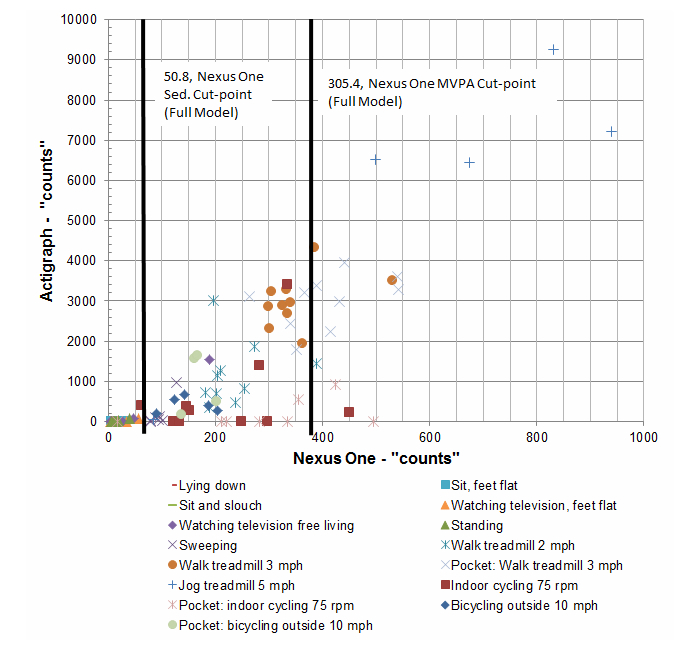
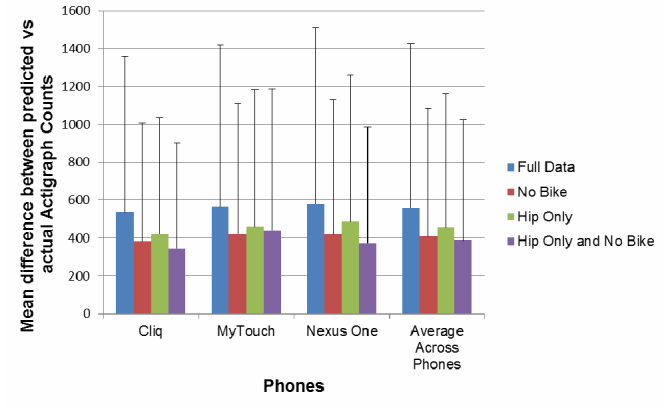
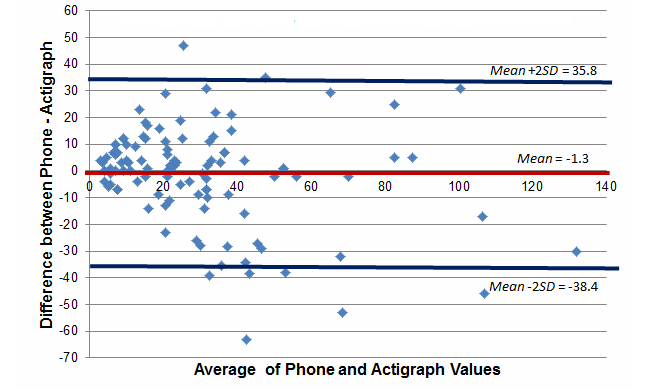
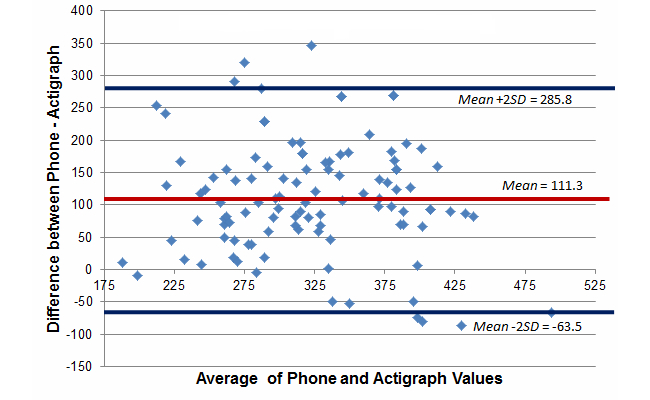
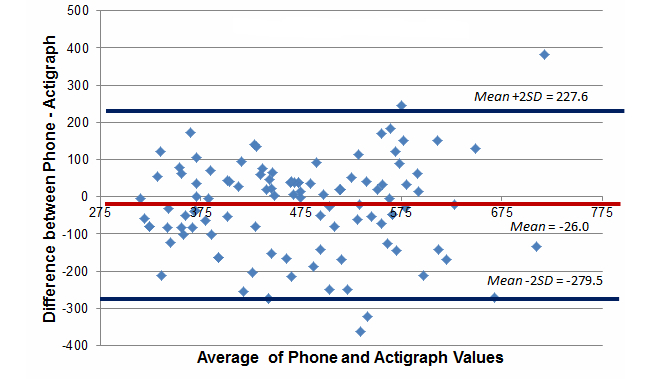
BACKGROUND: There is increasing interest in using smartphones as stand-alone physical activity monitors via their built-in accelerometers, but there is presently limited data on the validity of this approach. OBJECTIVE: The purpose of this work was to determine the validity and reliability of 3 Android smartphones for measuring physical activity among midlife and older adults. METHODS: A laboratory (study 1) and a free-living (study 2) protocol were conducted. In study 1, individuals engaged in prescribed activities including sedentary (eg, sitting), light (sweeping), moderate (eg, walking 3 mph on a treadmill), and vigorous (eg, jogging 5 mph on a treadmill) activity over a 2-hour period wearing both an ActiGraph and 3 Android smartphones (ie, HTC MyTouch, Google Nexus One, and Motorola Cliq). In the free-living study, individuals engaged in usual daily activities over 7 days while wearing an Android smartphone (Google Nexus One) and an ActiGraph. RESULTS: Study 1 included 15 participants (age: mean 55.5, SD 6.6 years; women: 56%, 8/15). Correlations between the ActiGraph and the 3 phones were strong to very strong (ρ=.77-.82). Further, after excluding bicycling and standing, cut-point derived classifications of activities yielded a high percentage of activities classified correctly according to intensity level (eg, 78%-91% by phone) that were similar to the ActiGraph's percent correctly classified (ie, 91%). Study 2 included 23 participants (age: mean 57.0, SD 6.4 years; women: 74%, 17/23). Within the free-living context, results suggested a moderate correlation (ie, ρ=.59, P<.001) between the raw ActiGraph counts/minute and the phone's raw counts/minute and a strong correlation on minutes of moderate-to-vigorous physical activity (MVPA; ie, ρ=.67, P<.001). Results from Bland-Altman plots suggested close mean absolute estimates of sedentary (mean difference=-26 min/day of sedentary behavior) and MVPA (mean difference=-1.3 min/day of MVPA) although there was large variation. CONCLUSIONS: Overall, results suggest that an Android smartphone can provide comparable estimates of physical activity to an ActiGraph in both a laboratory-based and free-living context for estimating sedentary and MVPA and that different Android smartphones may reliably confer similar estimates.
Overview
The claims and statistics of this paper haven’t been checked yet.
Run the check — free, no account needed. It reads the open-access text and checks the sources it cites.
Integrity signals
Registry
Cites
Statistics
Figures
Verification
Claims the paper makes
The claims and statistics of this paper haven’t been checked yet.
Run the check — free, no account needed. It reads the open-access text and checks the sources it cites.
Claims other papers make about this one
Each is checked against this paper’s own text: does it say what the citing paper says it does?
In the citing paper
“Smartphones are capable of accurately measuring physical activity in controlled and uncontrolled settings (30)”
From Which Components of a Smartphone Walking App Help Users to Reach Personalized Step Goals? Results From an Optimization Trial (2020) · cites this paper as [30]
Self-check
Percentages, sums and reported differences re-computed from the paper’s own numbers.
The self-check needs the paper’s full text.
Citations
Cites
STATISTICAL METHODS FOR ASSESSING AGREEMENT BETWEEN TWO METHODS OF CLINICAL MEASUREMENT
Martin Bland, J., & Altman, D. (1986) · The Lancet · doi:10.1016/s0140-6736(86)90837-8 · Cited by 47,965
Beckett, A. H., Rowland, M., & TURNER, P. (1965) · The Lancet · doi:10.1016/s0140-6736(65)91037-8 · Cited by 16,917
Applied Longitudinal Data Analysis: Modeling Change and Event Occurrence
Singer, J. D., & Willett, J. B. (2003) · doi:10.1093/acprof:oso/9780195152968.001.0001 · Cited by 10,647
‘Small Changes' to Diet and Physical Activity Behaviors for Weight Management
Hills, A. P., Byrne, N. M., Lindstrom, R. C., & Hill, J. O. (2013) · Obesity Facts · doi:10.1159/000345030 · Cited by 9,526
Compendium of physical activities: an update of activity codes and MET intensities
AINSWORTH, B. E., HASKELL, W. L., WHITT, M. C., IRWIN, M. L., SWARTZ, A. M., STRATH, S. J., O???BRIEN, W. L., BASSETT, D. R., SCHMITZ, K. H., EMPLAINCOURT, P. O., et al. (2000) · Medicine & Science in Sports & Exercise · doi:10.1097/00005768-200009001-00009 · Cited by 8,497
Physical Activity in the United States Measured by Accelerometer
TROIANO, R. P., BERRIGAN, D., DODD, K. W., MÂSSE, L. C., TILERT, T., & MCDOWELL, M. (2008) · Medicine & Science in Sports & Exercise · doi:10.1249/mss.0b013e31815a51b3 · Cited by 7,638
Calibration of the Computer Science and Applications, Inc. accelerometer
FREEDSON, P. S., MELANSON, E., & SIRARD, J. (1998) · Medicine & Science in Sports & Exercise · doi:10.1097/00005768-199805000-00021 · Cited by 3,825
Activity recognition using cell phone accelerometers
Kwapisz, J. R., Weiss, G. M., & Moore, S. A. (2011) · ACM SIGKDD Explorations Newsletter · doi:10.1145/1964897.1964918 · Cited by 2,912 · cited 3×
“Some studies have explored the utility of ecological momentary assessment (EMA) via smartphones [9], activity recognition using machine learning/neural network analyses [10-13], and activity classification via an iPod Touch for older adults [14].”
Amount of Time Spent in Sedentary Behaviors in the United States, 2003-2004
Matthews, C. E., Chen, K. Y., Freedson, P. S., Buchowski, M. S., Beech, B. M., Pate, R. R., & Troiano, R. P. (2008) · American Journal of Epidemiology · doi:10.1093/aje/kwm390 · Cited by 2,631
Physical Activity Assessments for Health-Related Research
Welk, G. J. (2002) · Medical Entomology and Zoology · Cited by 688
Neighborhood built environment and income: Examining multiple health outcomes
Sallis, J. F., Saelens, B. E., Frank, L. D., Conway, T. L., Slymen, D. J., Cain, K. L., Chapman, J. E., & Kerr, J. (2009) · Social Science & Medicine · doi:10.1016/j.socscimed.2009.01.017 · Cited by 655
(2009) · Nutrition Reviews · doi:10.1111/j.1753-4887.2008.00136.x · Cited by 593
Objective Light-Intensity Physical Activity Associations With Rated Health in Older Adults
Buman, M. P., Hekler, E. B., Haskell, W. L., Pruitt, L., Conway, T. L., Cain, K. L., Sallis, J. F., Saelens, B. E., Frank, L. D., & King, A. C. (2010) · American Journal of Epidemiology · doi:10.1093/aje/kwq249 · Cited by 528
Accelerometer Assessment of Physical Activity in Active, Healthy Older Adults
Copeland, J. L., & Esliger, D. (2009) · Journal of Aging and Physical Activity · doi:10.1123/japa.17.1.17 · Cited by 407
Too much sitting: a novel and important predictor of chronic disease risk?: Figure 1
Owen, N., Bauman, A., & Brown, W. (2009) · British Journal of Sports Medicine · doi:10.1136/bjsm.2008.055269 · Cited by 400
King, A. C., Hekler, E. B., Grieco, L. A., Winter, S. J., Sheats, J. L., Buman, M. P., Banerjee, B., Robinson, T. N., & Cirimele, J. (2013) · PLoS ONE · doi:10.1371/journal.pone.0062613 · Cited by 330
Tudor-Locke, C. E., Camhi, S. M., & Troiano, R. P. (2012) · Preventing Chronic Disease · doi:10.5888/pcd9.110332 · Cited by 319
Estimating Activity and Sedentary Behavior from an Accelerometer on the Hip or Wrist
Rosenberger, M. E., Haskell, W. L., Albinali, F., Mota, S., Nawyn, J., & Intille, S. S. (2013) · Medicine & Science in Sports & Exercise · doi:10.1249/mss.0b013e31827f0d9c · Cited by 258
Assessment of Physical Activity Using Wearable Monitors
Freedson, P. S., Bowles, H. R., Troiano, R. P., & Haskell, W. L. (2011) · Medicine & Science in Sports & Exercise · doi:10.1249/mss.0b013e3182399b7e · Cited by 250
An Activity Recognition System For Mobile Phones
Győrbíró, N., Fábián, Á., & Hományi, G. (2008) · Mobile Networks and Applications · doi:10.1007/s11036-008-0112-y · Cited by 232
Evaluation of the Revised Physical Activity Readiness Questionnaire in older adults
Cardinal, B. J., ESTERS, J., & Cardinal, M. K. (1996) · Medicine & Science in Sports & Exercise · doi:10.1097/00005768-199604000-00011 · Cited by 212
The mobile fitness coach: Towards individualized skill assessment using personalized mobile devices
Kranz, M., Möller, A., Hammerla, N., Diewald, S., Plötz, T., Olivier, P. L., & Roalter, L. (2012) · Pervasive and Mobile Computing · doi:10.1016/j.pmcj.2012.06.002 · Cited by 206
Refined Two-Regression Model for the ActiGraph Accelerometer
Crouter, S. E., Kuffel, E. E., Haas, J. D., Frongillo, E. A., & Bassett, D. R. (2010) · Medicine & Science in Sports & Exercise · doi:10.1249/mss.0b013e3181c37458 · Cited by 176
Understanding and Interpreting Educational Research
Martella, R. C., Nelson, J. R., Morgan, R. L., & Marchand‐Martella, N. E. (2013) · Cited by 174
Hekler, E. B., Buman, M. P., Haskell, W. L., Conway, T. L., Cain, K. L., Sallis, J. F., Saelens, B. E., Frank, L. D., Kerr, J., & King, A. C. (2012) · Journal of Physical Activity and Health · doi:10.1123/jpah.9.2.225 · Cited by 162
Use of Accelerometry to Measure Physical Activity in Older Adults at Risk for Mobility Disability
Pruitt, L. A., Glynn, N. W., King, A. C., Guralnik, J. M., Aiken, E. K., Miller, G., & Haskell, W. L. (2008) · Journal of Aging and Physical Activity · doi:10.1123/japa.16.4.416 · Cited by 143
New Horizons in Sensor Development
Intille, S. S., Lester, J., Sallis, J. F., & Duncan, G. E. (2011) · Medicine & Science in Sports & Exercise · doi:10.1249/mss.0b013e3182399c7d · Cited by 116
Comment on “Estimating Activity and Sedentary Behavior from an Accelerometer on the Hip and Wrist”
Freedson, P. S., & John, D. (2013) · Medicine & Science in Sports & Exercise · doi:10.1249/mss.0b013e31827f024d · Cited by 93
Loprinzi, P. D., Lee, H. J., Cardinal, B. J., Crespo, C. J., Andersen, R. E., & Smit, E. (2012) · Research Quarterly for Exercise and Sport · doi:10.1080/02701367.2012.10599877 · Cited by 82
Movement recognition using the accelerometer in smartphones
Lau, S. L., & David, K. (2010) · Future Network & Mobile Summit · Cited by 82
iLearn on the iPhone: Real-Time Human Activity Classification on Commodity Mobile Phones
Saponas, S., Lester, J., Froehlich, J. E., Fogarty, J. A., & Landay, J. A. (2008) · Cited by 79
Computational Methods for Estimating Energy Expenditure in Human Physical Activities
LIU, S., Gao, R. X., & Freedson, P. S. (2012) · Medicine & Science in Sports & Exercise · doi:10.1249/mss.0b013e31825e825a · Cited by 78
Dale, L. P., Maddison, R., Jiang, Y., Dalleck, L. C., & Löf, M. (2013) · Journal of Medical Internet Research · doi:10.2196/jmir.2419 · Cited by 48
Realizing Effective Behavioral Management of Health: The Metamorphosis of Behavioral Science Methods
Hekler, E. B., Klasnja, P., Traver, V., & Hendriks, M. (2013) · IEEE Pulse · doi:10.1109/mpul.2013.2271681 · Cited by 45
Vankipuram, M., McMahon, S., & Fleury, J. (2012) · PubMed Central · Cited by 30
Simple classification of walking activities using commodity smart phones
Fitz-Walter, Z., & Tjondronegoro, D. (2009) · doi:10.1145/1738826.1738911 · Cited by 6
Research works printed but not linked: 4
- 2008, Physical Activity Guidelines Advisory Committee Report
- Lau, Sl, 2010, Future Network and Mobile Summit’, 10
- Vankipuram, M, 2012, AMIA Annu Symp Proc, 2012, 931
- Tudor-Locke, C, 2012, Prev Chronic Dis, 9, E113
Cited by
Sorted by citations
Large-scale physical activity data reveal worldwide activity inequality
Althoff, T., Sosič, R., Hicks, J. L., King, A. C., Delp, S. L., & Leskovec, J. (2017) · Nature · doi:10.1038/nature23018 · Cited by 1,000
Digital health is a cultural transformation of traditional healthcare
Meskó, B., Drobni, Z. D., Bényei, É., Gergely, B., & Győrffy, Z. (2017) · mHealth · doi:10.21037/mhealth.2017.08.07 · Cited by 734
Sullivan, A. N., & Lachman, M. E. (2017) · Frontiers in Public Health · doi:10.3389/fpubh.2016.00289 · Cited by 458
Ding, D., Varela, A. R., Bauman, A. E., Ekelund, U., Lee, I.-M. M., Heath, G. W., Katzmarzyk, P. T., Reis, R. S., & Pratt, M. (2019) · British Journal of Sports Medicine · doi:10.1136/bjsports-2019-101001 · Cited by 225
McCarthy, H., POTTS, H. W. W., & Fisher, A. (2020) · Journal of Medical Internet Research · doi:10.2196/23701 · Cited by 218
Metadata
- Authors
- Hekler, E. B., Buman, M. P., Grieco, L., Rosenberger, M., Winter, S. J., Haskell, W., & King, A. C.
- Affiliations
- Arizona State University (US)
- Stanford University (US)
- Corresponding author
- Hekler, Eric B
- Venue
- JMIR mhealth and uhealth
- Publisher
- JMIR Publications Inc.
- Published
- 2015-04-15
- Volume
- 3
- Issue
- 2
- Pages
- e36
- ISSN
- 2291-5222 (ISSN-L)
- PMC
- PMC4414958
- OpenAlex
- W2124775720
- Cited by
- 137
- References
- 37
- Citations by year
- 2026: 7 · 2025: 3 · 2024: 6 · 2023: 17 · 2022: 8 · 2021: 12 · 2020: 28 · 2019: 13 · 2018: 15 · 2017: 15 · 2016: 8 · 2015: 5
- FWCI
- 10.56
- Type
- journal article
- Language
- en
- Open access
- gold
- doi.org
- Licence
- cc-by
- Locations
- JMIR mhealth and uhealth (publishedVersion, cc-by)
- Europe PMC (PubMed Central) (publishedVersion, cc-by)
- PubMed Central (publishedVersion, cc-by)
- PubMed (publishedVersion)
- DOAJ (DOAJ: Directory of Open Access Journals) (submittedVersion, cc-by-sa)
- Funders
- National Heart, Lung, and Blood Institute (RC1HL099340)
- Topics
- Health Sciences › Medicine › Public Health, Environmental and Occupational Health › Physical Activity and Health
- Physical Sciences › Computer Science › Computer Vision and Pattern Recognition › Context-Aware Activity Recognition Systems
- Health Sciences › Health Professions › General Health Professions › Mobile Health and mHealth Applications
- Keywords
- physical activity monitoring, smartphone accelerometer, Android smartphones, ActiGraph, accelerometer validity, reliability statistics, moderate-to-vigorous physical activity, sedentary behavior, activity intensity classification, free-living physical activity, middle-aged and older adults, Bland-Altman agreement, wearable devices, step count
About these checks
Registry, retraction, Cites and statistics results are computed, not judged, with one exception: a printed reference that no index lists is read once by a model before it counts as a citation error. Claims are extracted by a model and kept only when their quote appears verbatim in the text; each cited source is then checked, with a model’s help, for whether it says what the claim relies on. Those verdicts can be wrong — read the claim’s quote and the cited source before relying on one.
Statistics and arithmetic are recomputed, not judged.
Confidence bands are shown only for fields calibrated on our annotated test set. None is calibrated yet, so no band is shown.
What counts as a claim ›How we measure confidence ›How we check this ›
Are you an author, or do you see a problem with this page? Request a review
