

The DOI matches its Crossref record; 85 of the 85 references it cites were found in a registry or an index.
Finding a Depression App: A Review and Content Analysis of the Depression App Marketplace
Open accessAbstract
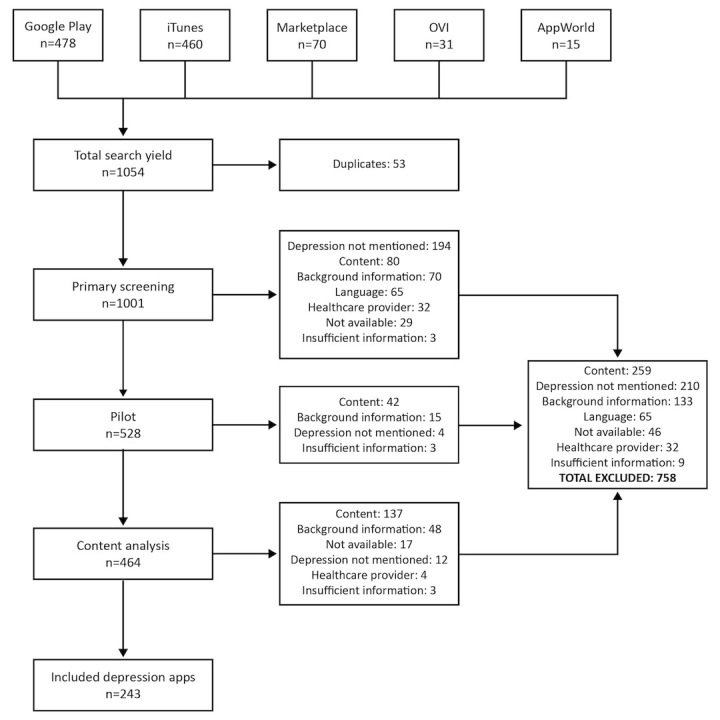
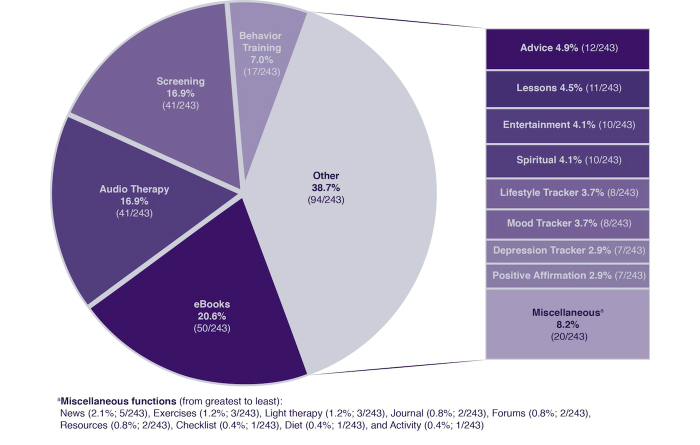
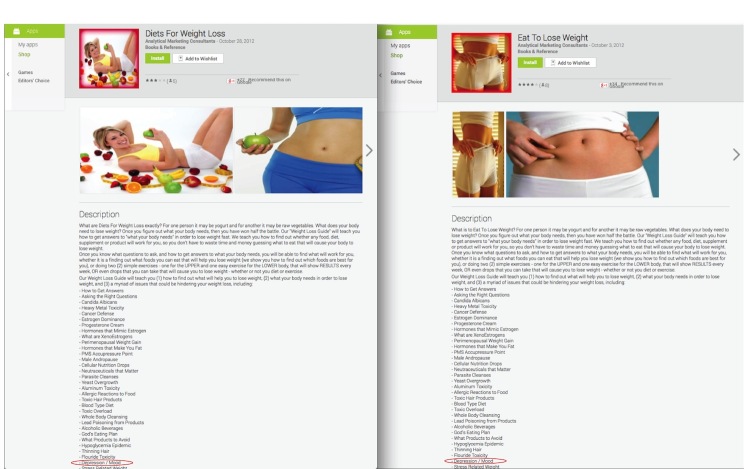
BACKGROUND: Depression is highly prevalent and causes considerable suffering and disease burden despite the existence of wide-ranging treatment options. Mobile phone apps offer the potential to help close this treatment gap by confronting key barriers to accessing support for depression. OBJECTIVES: Our goal was to identify and characterize the different types of mobile phone depression apps available in the marketplace. METHODS: A search for depression apps was conducted on the app stores of the five major mobile phone platforms: Android, iPhone, BlackBerry, Nokia, and Windows. Apps were included if they focused on depression and were available to people who self-identify as having depression. Data were extracted from the app descriptions found in the app stores. RESULTS: Of the 1054 apps identified by the search strategy, nearly one-quarter (23.0%, 243/1054) unique depression apps met the inclusion criteria. Over one-quarter (27.7%, 210/758) of the excluded apps failed to mention depression in the title or description. Two-thirds of the apps had as their main purpose providing therapeutic treatment (33.7%, 82/243) or psychoeducation (32.1%, 78/243). The other main purpose categories were medical assessment (16.9%, 41/243), symptom management (8.2%, 20/243), and supportive resources (1.6%, 4/243). A majority of the apps failed to sufficiently describe their organizational affiliation (65.0%, 158/243) and content source (61.7%, 150/243). There was a significant relationship (χ(2) 5=50.5, P<.001) between the main purpose of the app and the reporting of content source, with most medical assessment apps reporting their content source (80.5%, 33/41). A fifth of the apps featured an e-book (20.6%, 50/243), audio therapy (16.9%, 41/243), or screening (16.9%, 41/243) function. Most apps had a dynamic user interface (72.4%, 176/243) and used text as the main type of media (51.9%, 126/243), and over a third (14.4%, 35/243) incorporated more than one form of media. CONCLUSION: Without guidance, finding an appropriate depression app may be challenging, as the search results yielded non-depression-specific apps to depression apps at a 3:1 ratio. Inadequate reporting of organization affiliation and content source increases the difficulty of assessing the credibility and reliability of the app. While certification and vetting initiatives are underway, this study demonstrates the need for standardized reporting in app stores to help consumers select appropriate tools, particularly among those classified as medical devices.
Overview
The claims and statistics of this paper haven’t been checked yet.
Run the check — free, no account needed. It reads the open-access text and checks the sources it cites.
Integrity signals
Registry
Cites
Statistics
Figures
Verification
Claims the paper makes
The claims and statistics of this paper haven’t been checked yet.
Run the check — free, no account needed. It reads the open-access text and checks the sources it cites.
Claims other papers make about this one
Each is checked against this paper’s own text: does it say what the citing paper says it does?
The cited source says what the claim attributes to it.
In the citing paper
“over 90% of available apps for depression can be found in either of these stores [46].”
From Apps with maps-anxiety and depression mobile apps with evidence-based frameworks: Systematic search of major app stores (2020) · cites this paper as [46]
In the citing paper
“Research on consumer smartphone applications for mental health (Larsen et al. 2019;Shen et al. 2015) suggests that few future consumer VR applications that will be released on ordinary digital marketplaces can be expected to be evidence-based and effective.”
From Better, Virtually: the Past, Present, and Future of Virtual Reality Cognitive Behavior Therapy (2021) · cites this paper as Shen et al. 2015
In the citing paper
“Alternatively, predictive models that combine information from physiological and behavioural signals to estimate the patient’s future mood, stress level, and self-reported health (one or a few days in advance) can be automatically inferred [89].”
From Current state and future directions of technology-based ecological momentary assessment and intervention for major depressive disorder: a systematic review (2019) · cites this paper as [89]
In the citing paper
“Building on recent advances of machine learning, recent studies obtained promising results by means of model personalisation for stress recognition [88] and deep learning for mood prediction [89] using a combination of behavioural and physiological markers in non-clinical populations.”
From Current state and future directions of technology-based ecological momentary assessment and intervention for major depressive disorder: a systematic review (2019) · cites this paper as [89]
In the citing paper
“Unfortunately, although the consumer app stores offer over 200 depression-specific apps, judging the credibility and efficacy of those apps is difficult without clinical validation [69].”
From MoodHacker Mobile Web App With Email for Adults to Self-Manage Mild-to-Moderate Depression: Randomized Controlled Trial (2016) · cites this paper as [69]
Self-check
Percentages, sums and reported differences re-computed from the paper’s own numbers.
The self-check needs the paper’s full text.
Citations
Cites
The Measurement of Observer Agreement for Categorical Data
Landis, J. R., & Koch, G. G. (1977) · Biometrics · doi:10.2307/2529310 · Cited by 81,148
The CES-D Scale: A Self-Report Depression Scale for Research in the General Population
Radloff, L. S. (1977) · Applied Psychological Measurement · doi:10.1177/014662167700100306 · Cited by 53,267
The PHQ-9: Validity of a brief depression severity measure
Kroenke, K., Spitzer, R. L., & Williams, J. B. W. (2001) · Journal of General Internal Medicine · doi:10.1046/j.1525-1497.2001.016009606.x · Cited by 44,910
Development and validation of a geriatric depression screening scale: a preliminary report
Yesavage, J. A., Brink, T. L., Rose, T. L., Lum, O., Huang, V., Adey, M., & Leirer, V. O. (1982) · Journal of Psychiatric Research · doi:10.1016/0022-3956(82)90033-4 · Cited by 15,025
Detection of Postnatal Depression: Development of the 10-item Edinburgh Postnatal Depression Scale
Cox, J. L., Holden, J. M., & Sagovsky, R. (1987) · British Journal of Psychiatry · doi:10.1192/bjp.150.6.782 · Cited by 14,183
A self-rating depression scale
ZUNG, W. W. K. (1965) · Archives of General Psychiatry · doi:10.1001/archpsyc.1965.01720310065008 · Cited by 9,813
Murray, C. J. L., Vos, T., Lozano, R., Naghavi, M., Flaxman, A. D., Michaud, C., Ezzati, M., Shibuya, K., Salomon, J. A., Abdalla, S., et al. (2012) · The Lancet · doi:10.1016/s0140-6736(12)61689-4 · Cited by 8,888
Comparison of Beck Depression Inventories -IA and -II in psychiatric outpatients
Beck, A. T., Steer, R. A., Ball, R., & Ranieri, W. F. (1996) · Journal of Personality Assessment · doi:10.1207/s15327752jpa6703_13 · Cited by 5,965
Rush, A. J., Trivedi, M. H., Ibrahim, H. M., Carmody, T. J., Arnow, B., Klein, D. N., Markowitz, J. C., Ninan, P. T., Kornstein, S., Manber, R., et al. (2003) · Biological Psychiatry · doi:10.1016/s0006-3223(02)01866-8 · Cited by 3,829
Cognitive Stimulation in Patients with Dementia: Randomized Controlled Trial
Mapelli, D., Rosa, E. D., Nocita, R., & Sava, D. (2013) · Dementia and Geriatric Cognitive Disorders Extra · doi:10.1159/000353457 · Cited by 3,477
Research works printed but not linked: 4
- App store sales top $10 billion in 2013 press release20142014-03-30Cupertino, CAApple Inchttps://www.apple.com/pr/library/2014/01/07App-Store-Sales-Top-10-Billion-in-2013.html6OT5C6Ym0
- Lippman, H, 2013, J Fam Pract, 62, 362
- 10.3899/jrheum.081101 · DOI
- Huang, TL, 2008, Altern Ther Health Med, 14, 38
Cited by
Sorted by citations
Items 201–282 of 282
Rashidi, H. H., Sadeghian, E., Shamsaei, F., Tapak, L., & Seyedi, M. (2024) · Journal of Psychiatric and Mental Health Nursing · doi:10.1111/jpm.13088 · Cited by 3
Harris, E. C., Conelea, C. A., Shyne, M. T., & Bernstein, G. A. (2021) · Journal of Child and Adolescent Psychopharmacology · doi:10.1089/cap.2020.0124 · Cited by 3
Lindhiem, O. J., & Harris, J. L. (2018) · Springer eBooks · doi:10.1007/978-3-319-69638-6_18 · Cited by 3
Chiou, W., Lai, S.-C., & Huang, D. (2019) · Lecture notes in computer science · doi:10.1007/978-3-030-22219-2_2 · Cited by 3
Christinaki, E., Papastylianou, T., Carletto, S., González-Martínez, S., Ostacoli, L., Ottaviano, M., Poli, R., & Citi, L. (2020) · EAI Endorsed Transactions on Bioengineering and Bioinformatics · doi:10.4108/eai.16-10-2020.166661 · Cited by 3
mSexHealth: An Overview of Mobile Sexual Health Applications
Jurin, T., Šoštarić, M., Jokić‐Begić, N., & Korajlija, A. L. (2022) · Journal of Sex & Marital Therapy · doi:10.1080/0092623x.2022.2079576 · Cited by 3
Ramírez, R. B., Arellano, R. M., Gómez, L., Larios, V. M., & Sandoval, C. G. (2016) · Journal of Software Engineering and Applications · doi:10.4236/jsea.2016.910035 · Cited by 3
Financial services Apps: What makes the difference between a great and a ghastly review?
Vella, J. M., Wallström, Å., & Farshid, M. (2017) · Journal of Financial Services Marketing · doi:10.1057/s41264-017-0031-8 · Cited by 3
Mining User Experience Dimensions from Mental Illness Apps
Hussain, J., & Lee, S. (2017) · Lecture notes in computer science · doi:10.1007/978-3-319-66188-9_2 · Cited by 3
Stein, J., & Knaevelsrud, C. (2018) · Springer eBooks · doi:10.1007/978-3-319-97046-2_19 · Cited by 3
Outils numériques en psychiatrie et art-thérapie, quels points de rencontre possibles ?
Salles, J., Charras, M., & Schmitt, L. (2019) · Annales Médico-psychologiques revue psychiatrique · doi:10.1016/j.amp.2019.11.009 · Cited by 3
DeForte, S., Huang, Y., Bourgeois, T., Hussain, S.-A., & Lin, S. M. (2020) · JMIR mhealth and uhealth · doi:10.2196/18392 · Cited by 3
Pacheco, C. R., & Scheeringa, M. S. (2022) · The Cognitive Behaviour Therapist · doi:10.1017/s1754470x22000368 · Cited by 3
Smartphone apps based psychotherapy in India: Potential benefits and pitfalls
Parmar, A., & Sharma, P. (2016) · Asian Journal of Psychiatry · doi:10.1016/j.ajp.2016.02.008 · Cited by 3
Liu, L., Tydeman, F. A. S., Xie, W., & Wang, Y. (2025) · Annual International Conference of the IEEE Engineering in Medicine and Biology Society (EMBC) · doi:10.1109/embc58623.2025.11251628 · Cited by 2
Digital mental health needs a purpose-driven approach
Househ, M. S., Shah, H. A., Tariq, Z. U. A., Hassan, D. A., Khalifa, M., Schneider, J., Hamdi, M., Abd-Alrazaq, A. A., Ahmad, A., Solaiman, B., et al. (2026) · Nature Human Behaviour · doi:10.1038/s41562-025-02380-6 · Cited by 3
Smartphone Application Content for Prevention and Improvement of Adolescents’ Depression
Park, J., Bak, H.-W., Ham, S.-H., Cho, J.-S., Yoon, H.-J., Park, J.-S., Seo, D.-Y., & Gwon, J. (2016) · Communications in computer and information science · doi:10.1007/978-3-319-40542-1_55 · Cited by 2
Separating Features From Functionality in Vaccination Apps: Computational Analysis
Shaw, G., Jr., Nadkarni, D., Phann, E., Sielaty, R., Ledenyi, M., Abnowf, R., Xu, Q., Arredondo, P., & Chen, S. (2022) · JMIR Formative Research · doi:10.2196/36818 · Cited by 3
Franco, P., Olhaberry, M., Muzard, A., Lara, M. A., & Cuijpers, P. J. (2022) · Depression and personality · doi:10.1007/978-3-031-13029-8_8 · Cited by 2
The Role of Technology in the Treatment of Depression
Pedrelli, P., Bentley, K. H., Howe, E. S., & Shapero, B. G. (2018) · Springer eBooks · doi:10.1007/978-3-319-97241-1_14 · Cited by 2
Informing the Design of Mental Health Smartphone Apps for Adolescents
Fausett, C. M., Lee, J., Godwin, E. M., Palmer, E. M., & Fouquet, S. D. (2020) · Proceedings of the International Symposium on Human Factors and Ergonomics in Health Care · doi:10.1177/2327857920091012 · Cited by 2
Ménard, F., Ouellet‐Morin, I., & Guay, S. (2021) · Santé mentale au Québec · doi:10.7202/1081518ar · Cited by 2
Toledo‐Rodriguez, M., & Boillat, T. (2022) · Health informatics · doi:10.1007/978-3-030-94212-0_13 · Cited by 2
Mind over Matter: Using Technology to Improve Wellness
Pomputius, A. F. (2018) · Medical Reference Services Quarterly · doi:10.1080/02763869.2018.1439222 · Cited by 2
Michaelis, M., Burgess, S., Junne, F., Rothermund, E., Gündel, H., Zipfel, S., Wolf, M., & Rieger, M. A. (2021) · Frontiers in Psychiatry · doi:10.3389/fpsyt.2021.508622 · Cited by 4
Mobile Mental Health for Depression Assistance
Rodrigues, J. M., Oliveira, F., Ribeiro, C. P., & Santos, R. C. (2021) · Advances in psychology, mental health, and behavioral studies (APMHBS) book series · doi:10.4018/978-1-7998-8634-1.ch002 · Cited by 2
Polhemus, A. M., Simblett, S. K., Dawe‐Lane, E., Gilpin, G., Elliott, B., Jilka, S., Novák, J. M., Nica, R. I., Temesi, G., & Wykes, T. (2022) · doi:10.2196/preprints.40133 · Cited by 2
Munteanu, T., Kannis‐Dymand, L., Millear, P. M. R., & Jones, M. (2024) · Cyberpsychology Journal of Psychosocial Research on Cyberspace · doi:10.5817/cp2024-4-6 · Cited by 1
Coenen, T., Maerevoet, M., Chen, S., Brouwer, M. D., Hoecke, S. V., Koster, E. H. W., Abeele, M. V., & Bombeke, K. (2025) · JMIR mhealth and uhealth · doi:10.2196/67141 · Cited by 3
Diagnostica la depresión antes
Campagne, D. M. (2017) · Medicina de Familia SEMERGEN · doi:10.1016/j.semerg.2017.04.013 · Cited by 1
E-Mental Health Anwendungen für depressive und suizidale Menschen: eine Übersicht
Eichenberg, C. (2019) · Psychotherapie Forum · doi:10.1007/s00729-019-00123-3 · Cited by 1
Song, M. J., Tabi, K., & Krausz, M. R. (2020) · Springer eBooks · doi:10.1007/978-3-319-70134-9_106-1 · Cited by 1
Yokomitsu, K., Takashina, H. N., Takebayashi, Y., & Muranaka, S. (2023) · JMIR Research Protocols · doi:10.2196/44469 · Cited by 1
Mandelbaum, M. M., Rumelt, A. M. A., Wein, S. N., & Vidair, H. B. (2024) · Journal of Child and Family Studies · doi:10.1007/s10826-024-02789-z · Cited by 1
Shi, Z., Chung, D., Du, Y., Zhang, J., Raina, S., & Matarić, M. J. (2025) · ACM International Conference on Interaction Design and Children (IDC) · doi:10.1145/3713043.3728841 · Cited by 5
Parametric Transfer Learning Based on the Fisher Divergence for Well-Being Prediction
Christinaki, E., Papastylianou, T., Poli, R., & Citi, L. (2019) · IEEE International Conference on Bioinformatics and Bioengineering (BIBE) · doi:10.1109/bibe.2019.00059 · Cited by 1
Dodson, J. L., Preux, N. S., Thang, J., & Eikey, E. V. (2020) · Lecture notes in computer science · doi:10.1007/978-3-030-43687-2_19 · Cited by 1
Finding & evaluating community policing apps in Asia
Zhang, M., Bandara, A. K., Price, B. A., & Nuseibeh, B. (2020) · University of Limerick Institutional Repository (University of Limerick) · doi:10.34961/638 · Cited by 1
Huang, D., Lai, S.-C., Lo, L., Hong, T.-H., & Chiou, W. (2020) · Lecture notes in computer science · doi:10.1007/978-3-030-60114-0_45 · Cited by 1
Depression Management: A Descriptive Evaluation of Depression Apps in the Google Play Store
Okuboyejo, S. R., & Meyer, J. M. (2019) · TEM Journal · doi:10.18421/tem83-17 · Cited by 1
Gilani, S. M., Tanvy, A., Pasha, M. F., & Thanzami, V. (2022) · Hawaii International Conference on System Sciences (HICSS) · doi:10.24251/hicss.2022.472 · Cited by 1
Seabrook, H. J. (2016) · Libraries and Cultural Resources (University of Calgary) · doi:10.11575/prism/26524 · Cited by 1
Colombo, D. (2020) · Tesis Doctorals en Xarxa (Consorci de Serveis Universitaris de Catalunya) · doi:10.6035/14109.2020.762821 · Cited by 1
Pung, A., Fletcher, S. L., & Gunn, J. M. (2018) · doi:10.2196/preprints.10035 · Cited by 1
Jamal, R., & Kullar, M. (2022) · doi:10.31234/osf.io/c957d · Cited by 1
Yokomitsu, K., Oimatsu, R., Toh, S. H. Y., & Sündermann, O. (2024) · doi:10.2196/preprints.60871 · Cited by 1
Informal Learning Using Tablet Computers and Apps: A Multi-Method Study of Older Adults
Diabetes, S.-M., & Seabrook, H. J. (2016)
Pandey, V. K., Saikia, A., & Paul, S. (2018) · International Journal on Natural Language Computing · doi:10.5121/ijnlc.2018.7506
Impact of Psychoeducational Campaign “DEEP” in Portuguese University Students
Durán, L., & Almeida, A. M. P. (2020) · Iberian Conference on Information Systems and Technologies (CISTI) · doi:10.23919/cisti49556.2020.9140878
An Innovative Humour Design Concept for Depression
Wang, H., & Li, X. (2020) · Human-computer interaction series · doi:10.1007/978-3-030-53483-7_5
Supporting Family Care: A Systematic App ReviewPreprint
Bidenko, K., & Bohnet-Joschko, S. (2021) · Research Square · doi:10.21203/rs.3.rs-829714/v1
Weiß, T., & Strahringer, S. (2021) · Complex Systems Informatics and Modeling Quarterly · doi:10.7250/csimq.2021-28.02
Jang, C. W., Bang, M. H., & Yoo, M. (2021) · doi:10.2196/preprints.30633
Chien, T., Kan, W., Yeh, Y.-T., & Kuo, S. (2020) · doi:10.2196/preprints.18195
Myin‐Germeys, I., de Thurah, L., Weermeijer, J. D. M., Bonnier, R., van Aubel, E., & Kiekens, G. (2022) · Tijdschrift voor Geneeskunde · doi:10.47671/tvg.77.21.188
Mayer, G., Hummel, S., Oetjen, N., Gronewold, N., Bubolz, S., Slawik, M., Blankenhagel, K. J., Zarnekow, R., Hilbel, T., & Schultz, J. (2021) · doi:10.2196/preprints.32151
McMickens, C. L., & Landers, A. J. (2018) · Springer eBooks · doi:10.1007/978-3-319-90350-7_10
Robinson, R. F., Narsinghani, R., & Nguyen, E. (2021) · doi:10.2196/preprints.28160 · Cited by 1
Song, M. J., Tabi, K., & Krausz, M. R. (2021) · Springer eBooks · doi:10.1007/978-3-030-57296-9_106
New Research in Obsessive-Compulsive Disorder and Major Depression
Aouizerate, B., & Haffen, É. (2019) · MDPI eBooks · doi:10.3390/books978-3-03921-091-6
Sleep Apps for Youth: A Scoping Review of What is Available and What is Needed (Preprint)Preprint
Maich, K. H. G., Abu-Jazar, R., Burnett, R., Cosgrove, C., Maich, W. T., Stinson, J., Lalloo, C., & Carney, C. E. (2019) · doi:10.2196/preprints.13379
Chapman, C., Champion, K. E., Birrell, L., Deen, H., Brierley, M., Stapinski, L. A., KAY‐LAMBKIN, F. J., Newton, N. C., & Teesson, M. (2018) · doi:10.2196/preprints.10442
Robinson, R. F., Nguyen, E., & narsinghan, R. (2022) · doi:10.2196/preprints.39083 · Cited by 1
Exploring the role of health apps in supporting young people with depression: a mixed methods study
Martinengo, L. (2021) · DR-NTU (Nanyang Technological University) · doi:10.32657/10356/157124
Henry, N., Donkin, L., Williams, M. N., & Pedersen, M. (2022) · doi:10.2196/preprints.39869
Yafie, E., Septiani, D. I., Maulidia, L. N., Azizah, A. R., Alif, A., & Haqqi, Y. A. (2022) · doi:10.1109/icet56879.2022.9990629
Niemann, A., Hüer, T., Neumann, A., Wasem, J., Schnell‐Inderst, P., & Neusser, S. (2023) · PubMed Central · doi:10.3205/000317
Infectious Disease-Related Applications
Isa, R., Nordin, M. F., Othman, R., & Mohadis, H. M. (2023) · International Journal on Perceptive and Cognitive Computing · doi:10.31436/ijpcc.v9i2.402
Raftopoulou, A.-V. K., & Dritsas, I. (2023) · Creative Education · doi:10.4236/ce.2023.1413171
Time-Series Signals of Affect and Neural Dynamics with Technology to Identify Depression Risk
Jamal, R., & Kullar, M. (2023) · Journal of Student Research · doi:10.47611/jsrhs.v12i4.5142 · Cited by 1
Ramos, N., Besoaín, F., Cancino, N., Gallardo, I., Albornoz, P. D., Fresno, A., Spencer, R., Schott, S., Núñez, D., Salgado, C., et al. (2024) · JMIR Research Protocols · doi:10.2196/52324
Wen, C., Luo, W., Liu, Y., Luo, X., Li, J., & Zhang, J. (2024) · Medicine · doi:10.1097/md.0000000000039387
‘A happier, healthier you’: Fair Play and the promise of a future self
Kagen, M. (2024) · Journal of Gaming & Virtual Worlds · doi:10.1386/jgvw_00103_1
Mitozo, G. T., & Oselame, M. D. N. (2025) · Brazilian Journal of Music Therapy · doi:10.51914/brjmt.34.2022.402
Evaluation of medical education mobile apps with MARS and MARuL in a TPACK informed model
Rezaei, M. S., Owrangi, S., & Jafari, S. (2025) · Scientific Reports · doi:10.1038/s41598-025-31973-4
Domhardt, M., Messner, E.-M., Eder, A.-S., Engler, S., Sander, L., Baumeister, H., & Terhorst, Y. (2021) · Figshare · doi:10.6084/m9.figshare.16614635
Andrews, J. A., Craven, M. P., Lang, A. R., Guo, B., Morriss, R. K., & Hollis, C. P. (2021) · Figshare · doi:10.6084/m9.figshare.16807603
Santhosh, V. N., Vas, R., Bannur, S., Shreya, S., Sakthi, K., Venkatesh, U., Kumar, V., & Bera, O. P. (2026) · Nicotine & Tobacco Research · doi:10.1093/ntr/ntag035
Evaluation of a Unified Protocol (UP)-Based Emotion Regulation Training Application
Yun, S.-Y., Ryoo, S., & An, D. (2026) · Journal of Digital Contents Society · doi:10.9728/dcs.2026.27.5.1413
Mobile applications for ophthalmology: a quantitative and qualitative analysis
Faramarzi, S., Ghaddaripouri, K., Sanaei, P., Zare, Z., & Yazdani, A. (2026) · BMC Health Services Research · doi:10.1186/s12913-026-15199-2
Explaining value creation in mental health IT configurations: An integrated framework
Olivera, W., Mathiassen, L., Baird, A. M., & Xia, Y. (2026) · Information & Management · doi:10.1016/j.im.2026.104451
Metadata
- Authors
- Shen, N., Levitan, M.-J., Johnson, A., Bender, J. L., Hamilton-Page, M., Jadad, A. (. R., & Wiljer, D.
- Affiliations
- Centre for Addiction and Mental Health (CA)
- Toronto General Hospital (CA)
- Corresponding author
- Wiljer, David
- Venue
- JMIR mHealth and uHealth
- Publisher
- JMIR Publications Inc.
- Published
- 2015-02-16
- Volume
- 3
- Issue
- 1
- Pages
- e16
- ISSN
- 2291-5222 (ISSN-L)
- PMC
- PMC4376135
- OpenAlex
- W1973546009
- Cited by
- 282
- References
- 85
- Citations by year
- 2026: 5 · 2025: 10 · 2024: 14 · 2023: 10 · 2022: 22 · 2021: 40 · 2020: 41 · 2019: 33 · 2018: 45 · 2017: 26 · 2016: 29 · 2015: 7
- FWCI
- 4.95
- Type
- journal article
- Language
- en
- Open access
- gold
- doi.org
- Licence
- cc-by
- Locations
- JMIR mhealth and uhealth (publishedVersion, cc-by)
- Europe PMC (PubMed Central) (publishedVersion, cc-by)
- PubMed Central (publishedVersion, cc-by)
- PubMed (publishedVersion)
- DOAJ (DOAJ: Directory of Open Access Journals) (submittedVersion, cc-by-sa)
- Funders
- University Health Network
- University of Toronto
- Topics
- Social Sciences › Psychology › Applied Psychology › Digital Mental Health Interventions
- Health Sciences › Health Professions › General Health Professions › Mobile Health and mHealth Applications
- Health Sciences › Medicine › Psychiatry and Mental health › Mental Health Treatment and Access
- Keywords
- mobile health apps, depression, app descriptions, psychoeducation, e-books, sound therapy, depression screening, user interface design, mental health treatment gap, app store security
About these checks
Registry, retraction, Cites and statistics results are computed, not judged, with one exception: a printed reference that no index lists is read once by a model before it counts as a citation error. Claims are extracted by a model and kept only when their quote appears verbatim in the text; each cited source is then checked, with a model’s help, for whether it says what the claim relies on. Those verdicts can be wrong — read the claim’s quote and the cited source before relying on one.
Statistics and arithmetic are recomputed, not judged.
Confidence bands are shown only for fields calibrated on our annotated test set. None is calibrated yet, so no band is shown.
What counts as a claim ›How we measure confidence ›How we check this ›
Are you an author, or do you see a problem with this page? Request a review
