

The DOI matches its Crossref record; 85 of the 85 references it cites were found in a registry or an index.
Finding a Depression App: A Review and Content Analysis of the Depression App Marketplace
Open accessAbstract
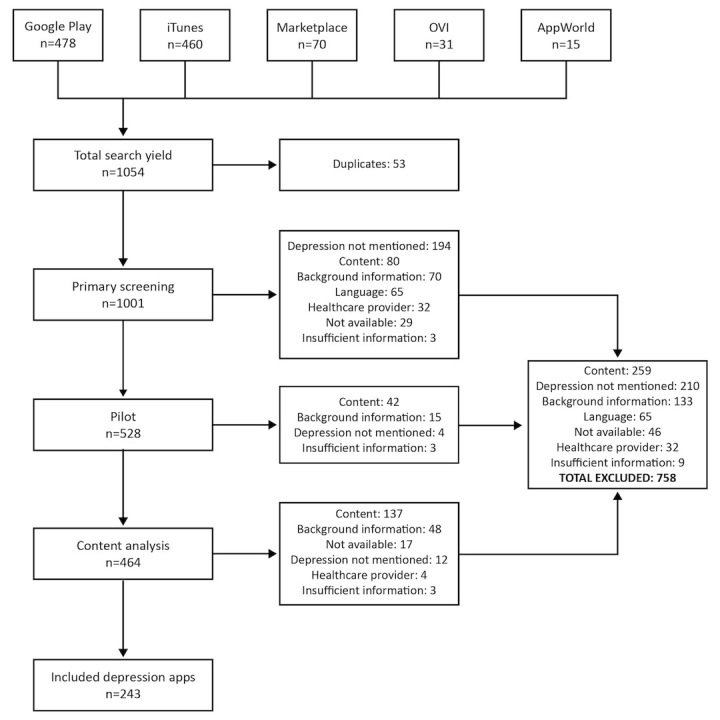
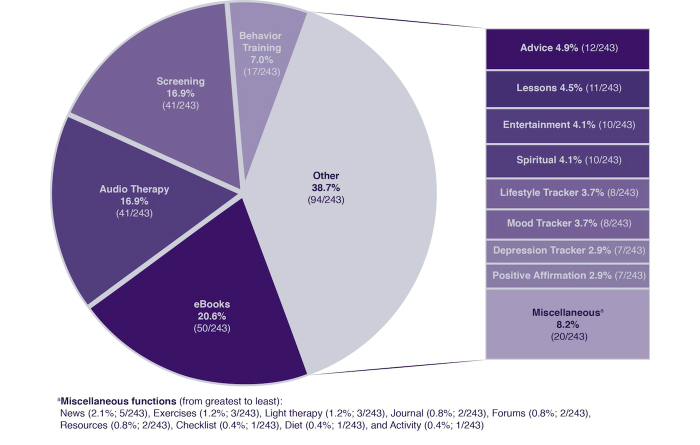
BACKGROUND: Depression is highly prevalent and causes considerable suffering and disease burden despite the existence of wide-ranging treatment options. Mobile phone apps offer the potential to help close this treatment gap by confronting key barriers to accessing support for depression. OBJECTIVES: Our goal was to identify and characterize the different types of mobile phone depression apps available in the marketplace. METHODS: A search for depression apps was conducted on the app stores of the five major mobile phone platforms: Android, iPhone, BlackBerry, Nokia, and Windows. Apps were included if they focused on depression and were available to people who self-identify as having depression. Data were extracted from the app descriptions found in the app stores. RESULTS: Of the 1054 apps identified by the search strategy, nearly one-quarter (23.0%, 243/1054) unique depression apps met the inclusion criteria. Over one-quarter (27.7%, 210/758) of the excluded apps failed to mention depression in the title or description. Two-thirds of the apps had as their main purpose providing therapeutic treatment (33.7%, 82/243) or psychoeducation (32.1%, 78/243). The other main purpose categories were medical assessment (16.9%, 41/243), symptom management (8.2%, 20/243), and supportive resources (1.6%, 4/243). A majority of the apps failed to sufficiently describe their organizational affiliation (65.0%, 158/243) and content source (61.7%, 150/243). There was a significant relationship (χ(2) 5=50.5, P<.001) between the main purpose of the app and the reporting of content source, with most medical assessment apps reporting their content source (80.5%, 33/41). A fifth of the apps featured an e-book (20.6%, 50/243), audio therapy (16.9%, 41/243), or screening (16.9%, 41/243) function. Most apps had a dynamic user interface (72.4%, 176/243) and used text as the main type of media (51.9%, 126/243), and over a third (14.4%, 35/243) incorporated more than one form of media. CONCLUSION: Without guidance, finding an appropriate depression app may be challenging, as the search results yielded non-depression-specific apps to depression apps at a 3:1 ratio. Inadequate reporting of organization affiliation and content source increases the difficulty of assessing the credibility and reliability of the app. While certification and vetting initiatives are underway, this study demonstrates the need for standardized reporting in app stores to help consumers select appropriate tools, particularly among those classified as medical devices.
Overview
The claims and statistics of this paper haven’t been checked yet.
Run the check — free, no account needed. It reads the open-access text and checks the sources it cites.
Integrity signals
Registry
Cites
Statistics
Figures
Verification
Claims the paper makes
The claims and statistics of this paper haven’t been checked yet.
Run the check — free, no account needed. It reads the open-access text and checks the sources it cites.
Claims other papers make about this one
Each is checked against this paper’s own text: does it say what the citing paper says it does?
The cited source says what the claim attributes to it.
In the citing paper
“over 90% of available apps for depression can be found in either of these stores [46].”
From Apps with maps-anxiety and depression mobile apps with evidence-based frameworks: Systematic search of major app stores (2020) · cites this paper as [46]
In the citing paper
“Research on consumer smartphone applications for mental health (Larsen et al. 2019;Shen et al. 2015) suggests that few future consumer VR applications that will be released on ordinary digital marketplaces can be expected to be evidence-based and effective.”
From Better, Virtually: the Past, Present, and Future of Virtual Reality Cognitive Behavior Therapy (2021) · cites this paper as Shen et al. 2015
In the citing paper
“Alternatively, predictive models that combine information from physiological and behavioural signals to estimate the patient’s future mood, stress level, and self-reported health (one or a few days in advance) can be automatically inferred [89].”
From Current state and future directions of technology-based ecological momentary assessment and intervention for major depressive disorder: a systematic review (2019) · cites this paper as [89]
In the citing paper
“Building on recent advances of machine learning, recent studies obtained promising results by means of model personalisation for stress recognition [88] and deep learning for mood prediction [89] using a combination of behavioural and physiological markers in non-clinical populations.”
From Current state and future directions of technology-based ecological momentary assessment and intervention for major depressive disorder: a systematic review (2019) · cites this paper as [89]
In the citing paper
“Unfortunately, although the consumer app stores offer over 200 depression-specific apps, judging the credibility and efficacy of those apps is difficult without clinical validation [69].”
From MoodHacker Mobile Web App With Email for Adults to Self-Manage Mild-to-Moderate Depression: Randomized Controlled Trial (2016) · cites this paper as [69]
Self-check
Percentages, sums and reported differences re-computed from the paper’s own numbers.
The self-check needs the paper’s full text.
Citations
Cites
The Measurement of Observer Agreement for Categorical Data
Landis, J. R., & Koch, G. G. (1977) · Biometrics · doi:10.2307/2529310 · Cited by 81,148
The CES-D Scale: A Self-Report Depression Scale for Research in the General Population
Radloff, L. S. (1977) · Applied Psychological Measurement · doi:10.1177/014662167700100306 · Cited by 53,267
The PHQ-9: Validity of a brief depression severity measure
Kroenke, K., Spitzer, R. L., & Williams, J. B. W. (2001) · Journal of General Internal Medicine · doi:10.1046/j.1525-1497.2001.016009606.x · Cited by 44,910
Development and validation of a geriatric depression screening scale: a preliminary report
Yesavage, J. A., Brink, T. L., Rose, T. L., Lum, O., Huang, V., Adey, M., & Leirer, V. O. (1982) · Journal of Psychiatric Research · doi:10.1016/0022-3956(82)90033-4 · Cited by 15,025
Detection of Postnatal Depression: Development of the 10-item Edinburgh Postnatal Depression Scale
Cox, J. L., Holden, J. M., & Sagovsky, R. (1987) · British Journal of Psychiatry · doi:10.1192/bjp.150.6.782 · Cited by 14,183
A self-rating depression scale
ZUNG, W. W. K. (1965) · Archives of General Psychiatry · doi:10.1001/archpsyc.1965.01720310065008 · Cited by 9,813
Murray, C. J. L., Vos, T., Lozano, R., Naghavi, M., Flaxman, A. D., Michaud, C., Ezzati, M., Shibuya, K., Salomon, J. A., Abdalla, S., et al. (2012) · The Lancet · doi:10.1016/s0140-6736(12)61689-4 · Cited by 8,888
Comparison of Beck Depression Inventories -IA and -II in psychiatric outpatients
Beck, A. T., Steer, R. A., Ball, R., & Ranieri, W. F. (1996) · Journal of Personality Assessment · doi:10.1207/s15327752jpa6703_13 · Cited by 5,965
Rush, A. J., Trivedi, M. H., Ibrahim, H. M., Carmody, T. J., Arnow, B., Klein, D. N., Markowitz, J. C., Ninan, P. T., Kornstein, S., Manber, R., et al. (2003) · Biological Psychiatry · doi:10.1016/s0006-3223(02)01866-8 · Cited by 3,829
Cognitive Stimulation in Patients with Dementia: Randomized Controlled Trial
Mapelli, D., Rosa, E. D., Nocita, R., & Sava, D. (2013) · Dementia and Geriatric Cognitive Disorders Extra · doi:10.1159/000353457 · Cited by 3,477
Research works printed but not linked: 4
- App store sales top $10 billion in 2013 press release20142014-03-30Cupertino, CAApple Inchttps://www.apple.com/pr/library/2014/01/07App-Store-Sales-Top-10-Billion-in-2013.html6OT5C6Ym0
- Lippman, H, 2013, J Fam Pract, 62, 362
- 10.3899/jrheum.081101 · DOI
- Huang, TL, 2008, Altern Ther Health Med, 14, 38
Cited by
Sorted by citations
Firth, J., Torous, J., Nicholas, J., Carney, R., Pratap, A., Rosenbaum, S., & Sarris, J. (2017) · World Psychiatry · doi:10.1002/wps.20472 · Cited by 1,097
Firth, J., Torous, J., Nicholas, J., Carney, R., Rosenbaum, S., & Sarris, J. (2017) · Journal of Affective Disorders · doi:10.1016/j.jad.2017.04.046 · Cited by 675
An overview of and recommendations for more accessible digital mental health services
Lattie, E. G., Stiles-Shields, C., & Graham, A. K. (2022) · Nature Reviews Psychology · doi:10.1038/s44159-021-00003-1 · Cited by 446
Mobile Apps for Bipolar Disorder: A Systematic Review of Features and Content Quality
Nicholas, J., Larsen, M. E., Proudfoot, J., & Christensen, H. (2015) · Journal of Medical Internet Research · doi:10.2196/jmir.4581 · Cited by 438
The Use and Effectiveness of Mobile Apps for Depression: Results From a Fully Remote Clinical Trial
Arean, P. A., Hallgren, K. A., Jordan, J. T., Gazzaley, A., Atkins, D. C., Heagerty, P. J., & Anguera, J. A. (2016) · Journal of Medical Internet Research · doi:10.2196/jmir.6482 · Cited by 376
Evaluating mobile phone applications for health behaviour change: A systematic review
McKay, F. H., Cheng, C. C., Wright, A., Shill, J., Stephens, H., & Uccellini, M. (2016) · Journal of Telemedicine and Telecare · doi:10.1177/1357633x16673538 · Cited by 367
Huckvale, K., Torous, J., & Larsen, M. E. (2019) · JAMA Network Open · doi:10.1001/jamanetworkopen.2019.2542 · Cited by 312
IntelliCare: An Eclectic, Skills-Based App Suite for the Treatment of Depression and Anxiety
Mohr, D. C., Tomasino, K. N., Lattie, E. G., Palac, H. L., Kwasny, M. J., Weingardt, K., Karr, C. J., Kaiser, S. M., Rossom, R. C., Bardsley, L. R., et al. (2017) · Journal of Medical Internet Research · doi:10.2196/jmir.6645 · Cited by 301
A Systematic Review of Cognitive Behavioral Therapy and Behavioral Activation Apps for Depression
Huguet, A., Rao, S., McGrath, P. J., Wozney, L., Wheaton, M., Conrod, J., & Rozario, S. (2016) · PLOS ONE · doi:10.1371/journal.pone.0154248 · Cited by 328
A systematic assessment of smartphone tools for suicide prevention
Larsen, M. E., Nicholas, J., & Christensen, H. (2016) · PLoS ONE · doi:10.1371/journal.pone.0152285 · Cited by 289
Morris, R. R., Kouddous, K., Kshirsagar, R., & Schueller, S. M. (2018) · Journal of Medical Internet Research · doi:10.2196/10148 · Cited by 273
Mobile mental health: a challenging research agenda
Olff, M. (2015) · European Journal of Psychotraumatology · doi:10.3402/ejpt.v6.27882 · Cited by 258
Van Ameringen, M., Turna, J., Khalesi, Z., Pullia, K., & Patterson, B. (2017) · Depression and Anxiety · doi:10.1002/da.22657 · Cited by 234
“Over one-third of depression apps in the public domain are endorsed as therapeutic treatment interventions (Shen et al., 2015).”
BackgroundInfluentialAnxiety: There is an app for that. A systematic review of anxiety apps: SUCALA et al.
Sucala, M., Cuijpers, P., Muench, F., Cardoș, R., Soflau, R., Dobrean, A., Achimas-Cadariu, P., & David, D. (2017) · Depression and Anxiety · doi:10.1002/da.22654 · Cited by 232
Creber, R. M., Maurer, M. S., Turchioe, M. R., Hiraldo, G., Hickey, K. T., & Iribarren, S. (2016) · JMIR mhealth and uhealth · doi:10.2196/mhealth.5882 · Cited by 255
Radesky, J. S., Kistin, C., Eisenberg, S., Gross, J., Block, G., Zuckerman, B., & Silverstein, M. (2016) · Journal of Developmental & Behavioral Pediatrics · doi:10.1097/dbp.0000000000000357 · Cited by 246
The Most Popular Smartphone Apps for Weight Loss: A Quality Assessment
Chen, J., Cade, J. E., & Allman-Farinelli, M. (2015) · JMIR mHealth and uHealth · doi:10.2196/mhealth.4334 · Cited by 219
Quantifying App Store Dynamics: Longitudinal Tracking of Mental Health Apps
Larsen, M. E., Nicholas, J., & Christensen, H. (2016) · JMIR mHealth and uHealth · doi:10.2196/mhealth.6020 · Cited by 177
Reviewing the data security and privacy policies of mobile apps for depression
O'Loughlin, K., Neary, M., Adkins, E. C., & Schueller, S. M. (2019) · Internet Interventions · doi:10.1016/j.invent.2018.12.001 · Cited by 179
Stawarz, K., Preist, C., Tallon, D., Wiles, N., & Coyle, D. (2018) · Journal of Medical Internet Research · doi:10.2196/10120 · Cited by 198
Schueller, S. M., Neary, M., O'Loughlin, K., & Adkins, E. C. (2018) · Journal of Medical Internet Research · doi:10.2196/10141 · Cited by 167
Colombo, D., Fernández-Álvarez, J., Patané, A., Semonella, M., Kwiatkowska, M., García-Palacios, A., Cipresso, P., Riva, G., & Botella, C. (2019) · Journal of Clinical Medicine · doi:10.3390/jcm8040465 · Cited by 194
Lindner, P., Miloff, A., Hamilton, W., Reuterskiöld, L., Andersson, G., Powers, M. B., & Carlbring, P. (2017) · Cognitive Behaviour Therapy · doi:10.1080/16506073.2017.1280843 · Cited by 187
Mobile Health Technology Interventions for Suicide Prevention: Systematic Review
Melia, R., Francis, K., Hickey, E., Bogue, J., Duggan, J., O'Sullivan, M., & Young, K. (2020) · JMIR mHealth and uHealth · doi:10.2196/12516 · Cited by 166
Birney, A. J., Gunn, R., Russell, J. K., & Ary, D. V. (2016) · JMIR mHealth and uHealth · doi:10.2196/mhealth.4231 · Cited by 159
“Unfortunately, although the consumer app stores offer over 200 depression-specific apps, judging the credibility and efficacy of those apps is difficult without clinical validation [69].”
Mobile Apps for Medication Management: Review and Analysis
Tabi, K., Randhawa, A. S., Choi, F., Mithani, Z., Albers, F., Schnieder, M., Nikoo, M., Vigo, D., Jang, K. L., Demlová, R., et al. (2019) · JMIR mhealth and uhealth · doi:10.2196/13608 · Cited by 178
Martinengo, L., van Galen, L. S., Lum, E., Kowalski, M., Subramaniam, M., & Car, J. (2019) · BMC Medicine · doi:10.1186/s12916-019-1461-z · Cited by 167
Ethical perspectives on recommending digital technology for patients with mental illness
Bauer, M., Glenn, T., Monteith, S., Bauer, R., Whybrow, P. C., & Geddes, J. R. (2017) · International Journal of Bipolar Disorders · doi:10.1186/s40345-017-0073-9 · Cited by 137
Better, Virtually: the Past, Present, and Future of Virtual Reality Cognitive Behavior Therapy
Lindner, P. (2021) · International Journal of Cognitive Therapy · doi:10.1007/s41811-020-00090-7 · Cited by 120
McKay, F. H., Slykerman, S., & Dunn, M. (2018) · JMIR mhealth and uhealth · doi:10.2196/11130 · Cited by 117
The Digital Psychiatrist: In Search of Evidence-Based Apps for Anxiety and Depression
Marshall, J. M., Dunstan, D. A., & Bartik, W. (2019) · Frontiers in Psychiatry · doi:10.3389/fpsyt.2019.00831 · Cited by 107
Stawarz, K., Preist, C., & Coyle, D. (2019) · JMIR Mental Health · doi:10.2196/12546 · Cited by 107
Sequeira, L., Perrotta, S., LaGrassa, J., Merikangas, K. R., Kreindler, D. M., Kundur, D., Courtney, D., Szatmári, P., Battaglia, M., & Strauss, J. (2019) · Journal of Affective Disorders · doi:10.1016/j.jad.2019.11.156 · Cited by 113
Bry, L. J., Chou, T., Miguel, E. M., & Comer, J. S. (2017) · Behavior Therapy · doi:10.1016/j.beth.2017.07.008 · Cited by 108
A Review on the Mobile Applications Developed for COVID-19: An Exploratory Analysis
Islam, M. N., Islam, I., Munim, K. M., & Islam, A. K. M. N. (2020) · IEEE Access · doi:10.1109/access.2020.3015102 · Cited by 105
Beyond Dr. Google: the evidence on consumer-facing digital tools for diagnosis
Millenson, M. L., Baldwin, J. L., Zipperer, L., & Singh, H. (2018) · Diagnosis · doi:10.1515/dx-2018-0009 · Cited by 91
Powell, A. C., Torous, J. B., Chan, S. R., Raynor, G., Shwarts, E., Shanahan, M. E., & Landman, A. (2016) · JMIR mhealth and uhealth · doi:10.2196/mhealth.5176 · Cited by 103
Subhi, Y., Bube, S. H., Bojsen, S. R., Thomsen, A. S. S., & Konge, L. (2015) · JMIR mhealth and uhealth · doi:10.2196/mhealth.4169 · Cited by 93
Marshall, J. M., Dunstan, D. A., & Bartik, W. (2020) · JMIR Mental Health · doi:10.2196/16525 · Cited by 83
“These two marketplaces attract more than three times as much revenue from downloads as their next competitor, the Windows Store [45], and over 90% of available apps for depression can be found in either of these stores [46].”
BackgroundMental health apps in a college setting: openness, usage, and attitudes.
Kern, A., Hong, V., Song, J., Lipson, S., & Eisenberg, D. (2018) · mHealth · doi:10.21037/mhealth.2018.06.01 · Cited by 96
Smartphone apps for managing alcohol consumption: a literature review
Colbert, S., Thornton, L. K., & RICHMOND, R. L. (2020) · Addiction Science & Clinical Practice · doi:10.1186/s13722-020-00190-x · Cited by 95
Immediate Mood Scaler: Tracking Symptoms of Depression and Anxiety Using a Novel Mobile Mood Scale
Nahum, M., Vleet, T. V., Sohal, V. S., Mirzabekov, J. J., Rao, V. R., Wallace, D. L., Lee, M. B., Dawes, H. E., Stark‐Inbar, A., Jordan, J. T., et al. (2017) · JMIR mhealth and uhealth · doi:10.2196/mhealth.6544 · Cited by 97
Hwang, W. J., & Jo, H. H. (2019) · International Journal of Environmental Research and Public Health · doi:10.3390/ijerph16214270 · Cited by 86
Wasil, A. R., Gillespie, S., Patel, R., Petre, A., Venturo-Conerly, K. E., Shingleton, R. M., Weisz, J. R., & DeRubeis, R. J. (2020) · Journal of Consulting and Clinical Psychology · doi:10.1037/ccp0000604 · Cited by 86
Osma, J., Barrera, A. Z., & Ramphos, E. (2016) · Cyberpsychology, Behavior, and Social Networking · doi:10.1089/cyber.2015.0549 · Cited by 88
Yellowlees, P., Chan, S. R., & Parish, M. B. (2015) · International Review of Psychiatry · doi:10.3109/09540261.2015.1082987 · Cited by 76
Terhorst, Y., Rathner, E.-M., Baumeister, H., & Sander, L. (2018) · Verhaltenstherapie · doi:10.1159/000481692 · Cited by 84
Marshall, J. M., Dunstan, D. A., & Bartik, W. J. (2019) · Australian & New Zealand Journal of Psychiatry · doi:10.1177/0004867419876700 · Cited by 93
Functionality of Top-Rated Mobile Apps for Depression: Systematic Search and Evaluation
Qu, C., Sas, C., Roquet, C. D., & Doherty, G. J. (2019) · JMIR Mental Health · doi:10.2196/15321 · Cited by 84
Connolly, S. L., Hogan, T. P., Shimada, S. L., & Miller, C. J. (2020) · Journal of Technology in Behavioral Science · doi:10.1007/s41347-020-00165-4 · Cited by 78
An Assessment Framework for e-Mental Health Apps in Canada: Results of a Modified Delphi Process
Zelmer, J., van Hoof, K., Notarianni, M., van Mierlo, T., Schellenberg, M., & Tannenbaum, C. (2018) · JMIR mHealth and uHealth · doi:10.2196/10016 · Cited by 62
Sinha Deb, K., Tuli, A., Sood, M., Chadda, R., Verma, R., Kumar, S., Ganesh, R., & Singh, P. (2018) · PLOS ONE · doi:10.1371/journal.pone.0203353 · Cited by 79
Smartphone Applications for Mental Health
Radovic, A., Vona, P. L., Santostefano, A. M., Ciaravino, S., Miller, E., & Stein, B. D. (2016) · Cyberpsychology, Behavior, and Social Networking · doi:10.1089/cyber.2015.0619 · Cited by 78
Dol, J., Richardson, B., Murphy, G. T., Aston, M., McMillan, D., & Campbell-Yeo, M. (2020) · JBI Evidence Synthesis · doi:10.11124/jbisrir-d-19-00191 · Cited by 77
Moshi, M. R., Tooher, R. L., & Merlin, T. (2018) · International Journal of Technology Assessment in Health Care · doi:10.1017/s026646231800051x · Cited by 74
Smartphone Applications to Support Tuberculosis Prevention and Treatment: Review and Evaluation
Iribarren, S., Schnall, R., Stone, P. W., & Carballo‐Diéguez, A. (2016) · JMIR mhealth and uhealth · doi:10.2196/mhealth.5022 · Cited by 72
A health app developer’s guide to law and policy: a multi-sector policy analysis
Parker, L., Karliychuk, T., Gillies, D., Mintzes, B., Raven, M., & Grundy, Q. (2017) · BMC Medical Informatics and Decision Making · doi:10.1186/s12911-017-0535-0 · Cited by 71
Smartphone-Based Psychotherapeutic Micro-Interventions to Improve Mood in a Real-World Setting
Meinlschmidt, G., Lee, J.-H., Stalujanis, E., Belardi, A., Oh, M., Jung, E. K., Kim, H.-C., Alfano, J., Yoo, S.-S., & Tegethoff, M. (2016) · Frontiers in Psychology · doi:10.3389/fpsyg.2016.01112 · Cited by 68
Is There an App for That? A Review of Popular Apps for Depression, Anxiety, and Well-Being
Wasil, A. R., Palermo, E. H., Lorenzo‐Luaces, L., & DeRubeis, R. J. (2021) · Cognitive and Behavioral Practice · doi:10.1016/j.cbpra.2021.07.001 · Cited by 80
What might get in the way: Barriers to the use of apps for depression
Stiles-Shields, C., Montague, E., Lattie, E. G., Kwasny, M. J., & Mohr, D. C. (2017) · DIGITAL HEALTH · doi:10.1177/2055207617713827 · Cited by 68
Integrating digital phenotyping in clinical characterization of individuals with mood disorders
Brietzke, E. M., Hawken, E. R., Idzikowski, M. A., Pong, J., Kennedy, S. H., & Soares, C. N. (2019) · Neuroscience & Biobehavioral Reviews · doi:10.1016/j.neubiorev.2019.07.009 · Cited by 74
Alyami, M. M., Giri, B., Alyami, H., & Sundram, F. (2017) · Evidence-Based Mental Health · doi:10.1136/eb-2017-102664 · Cited by 69
mHealth Assessment and Intervention of Depression and Anxiety in Older Adults
Grossman, J. T., Frumkin, M. R., Rodebaugh, T. L., & Lenze, E. J. (2020) · Harvard Review of Psychiatry · doi:10.1097/hrp.0000000000000255 · Cited by 68
Innovation process of mHealth: An overview of FDA-approved mobile medical applications
Onodera, R., & Sengoku, S. (2018) · International Journal of Medical Informatics · doi:10.1016/j.ijmedinf.2018.07.004 · Cited by 64
A Review of Free iPhone Applications Designed to Target Anxiety and Worry
Kertz, S. J., MacLaren Kelly, J., Stevens, K. T., Schrock, M., & Danitz, S. B. (2017) · Journal of Technology in Behavioral Science · doi:10.1007/s41347-016-0006-y · Cited by 56
Rubanovich, C. K., Mohr, D. C., & Schueller, S. M. (2017) · JMIR Mental Health · doi:10.2196/mental.7603 · Cited by 63
Bidargaddi, N. P., Musiat, P., Winsall, M., Vogl, G., Blake, V., Quinn, S. J., Orlowski, S., Antezana, G., & Schrader, G. D. (2017) · Journal of Medical Internet Research · doi:10.2196/jmir.6775 · Cited by 61
Stiles-Shields, C., Montague, E., Kwasny, M. J., & Mohr, D. C. (2019) · Psychological Services · doi:10.1037/ser0000261 · Cited by 59
Teepe, G. W., Fonseca, A. D., Kleim, B., Jacobson, N. C., Salamanca-Sanabria, A., Car, L. T., Fleisch, E., & Kowatsch, T. (2021) · Journal of Medical Internet Research · doi:10.2196/29412 · Cited by 65
Lemon, C. A., Huckvale, K., Carswell, K., & Torous, J. B. (2020) · International Journal of Technology Assessment in Health Care · doi:10.1017/s0266462319003507 · Cited by 57
Martínez, P., Rojas, G., Martínez, V., Lara, M. A., & Pérez, J. C. (2018) · Journal of Affective Disorders · doi:10.1016/j.jad.2018.02.079 · Cited by 51
Domhardt, M., Messner, E.-M., Eder, A.-S., Engler, S., Sander, L. B., Baumeister, H., & Terhorst, Y. (2021) · Child and Adolescent Psychiatry and Mental Health · doi:10.1186/s13034-021-00401-6 · Cited by 43
The role of digital mental health resources to treat trauma symptoms in Australia during COVID-19.
Marshall, J. M., Dunstan, D. A., & Bartik, W. J. (2020) · Psychological Trauma Theory Research Practice and Policy · doi:10.1037/tra0000627 · Cited by 49
Supporting Self-Management in Bipolar Disorder: Mixed-Methods Knowledge Translation Study
Michalak, E. E., Morton, E. E., Barnes, S. J., Hole, R., CREST.BD, & Murray, G. (2019) · JMIR Mental Health · doi:10.2196/13493 · Cited by 50
Burger, F., Neerincx, M. A., & Brinkman, W. (2019) · Journal of Medical Internet Research · doi:10.2196/12599 · Cited by 49
Systematic evaluation of content and quality of English and German pain apps in European app stores
Terhorst, Y., Meßner, E.-M., Schultchen, D., Paganini, S., Portenhauser, A. A., Eder, A.-S., Bauer, M., Papenhoff, M. C., Baumeister, H., & Sander, L. (2021) · Internet Interventions · doi:10.1016/j.invent.2021.100376 · Cited by 42
Mobile App Use by Primary Care Patients to Manage Their Depressive Symptoms: Qualitative Study
Pung, A., Fletcher, S. L., & Gunn, J. M. (2018) · Journal of Medical Internet Research · doi:10.2196/10035 · Cited by 42
Lee, Y.-L., Cui, Y., Tu, M.-H., Chen, Y.-C., & Chang, P. (2018) · JMIR mHealth and uHealth · doi:10.2196/10173 · Cited by 38
User Perspectives of Mood-Monitoring Apps Available to Young People: Qualitative Content Analysis
Widnall, E., Grant, C., Wang, T., Cross, L., Velupillai, S. U., Roberts, A., Stewart, R. J., Simonoff, E. A., & Downs, J. M. (2020) · JMIR mhealth and uhealth · doi:10.2196/18140 · Cited by 43
Baumel, A., Torous, J. B., Edan, S., & Kane, J. M. (2020) · Journal of Affective Disorders · doi:10.1016/j.jad.2020.05.011 · Cited by 40
Funnell, E. L., Spadaro, B., Martin-Key, N. A., Metcalfe, T., & Bahn, S. (2022) · Frontiers in Psychiatry · doi:10.3389/fpsyt.2022.857304 · Cited by 41
Therapy and E-therapy—Preparing Future Psychiatrists in the Era of Apps and Chatbots
Gratzer, D., & Goldbloom, D. S. (2020) · Academic Psychiatry · doi:10.1007/s40596-019-01170-3 · Cited by 40
Burchert, S., Kerber, A., Zimmermann, J., & Knaevelsrud, C. (2021) · PLoS ONE · doi:10.1371/journal.pone.0244955 · Cited by 41
Self-Control in Cyberspace: Applying Dual Systems Theory to a Review of Digital Self-Control Tools
Lyngs, U., Lukoff, K., Slovák, P., Binns, R., Slack, A., Inzlicht, M., Kleek, M. G. V., & Shadbolt, N. (2019) · Research Portal (King's College London) · doi:10.48550/arxiv.1902.00157 · Cited by 42
Fagernäs, S., Hamilton, W., Espinoza, N., Miloff, A., Carlbring, P., & Lindner, P. (2021) · Internet Interventions · doi:10.1016/j.invent.2021.100370 · Cited by 38
Expert Involvement Predicts mHealth App Downloads: Multivariate Regression Analysis of Urology Apps
Azevedo, N. P., Osório, L., Cavadas, V., Fraga, A. M., Carrasquinho, E., de Oliveira, E. C., Castelo-Branco, M., & Roobol, M. J. (2016) · JMIR mhealth and uhealth · doi:10.2196/mhealth.5738 · Cited by 37
Callan, J. A., Jacob, J. D., Siegle, G. J., Dey, A. K., Thase, M. E., Dabbs, A. D., Kazantzis, N., Rotondi, A. J., Tamres, L. K., Slyke, A. V., et al. (2020) · Cognitive Therapy and Research · doi:10.1007/s10608-020-10159-4 · Cited by 41
Use of Computer and Mobile Technologies in the Treatment of Depression
Callan, J. A., Wright, J. H., Siegle, G. J., Howland, R. H., & Kepler, B. B. (2016) · Archives of Psychiatric Nursing · doi:10.1016/j.apnu.2016.10.002 · Cited by 41
Parker, L. M., Bero, L. A., Gillies, D. M., Raven, M. K., & Grundy, Q. (2018) · International Journal of Health Policy and Management · doi:10.15171/ijhpm.2018.117 · Cited by 37
From Ancient Contemplative Practice to the App Store
Lukoff, K., Lyngs, U., Gueorguieva, S., Dillman, E., Hiniker, A., & Munson, S. A. (2020) · Designing Interactive Systems Conference · doi:10.1145/3357236.3395444 · Cited by 53
Tokgöz, P., Hrynyschyn, R., Hafner, J., Schönfeld, S., & Dockweiler, C. (2021) · JMIR Mental Health · doi:10.2196/26268 · Cited by 36
“A review from 2015 identified 82 mobile apps for depression treatment [79].”
Mo, Y., Gong, W., Wang, Y., Sheng, X., & Xu, D. R. (2018) · JMIR mhealth and uhealth · doi:10.2196/11508 · Cited by 36
Hendrikoff, L., Kambeitz‐Ilankovic, L., Pryss, R. C., Senner, F., Falkai, P., Pogarell, O. M., Hasan, A., & Peters, H. (2018) · Journal of Psychiatric Research · doi:10.1016/j.jpsychires.2018.11.025 · Cited by 38
Mehrotra, S., Sudhir, P. M., Rao, G. N., Thirthalli, J., & Srikanth, T. K. (2018) · Behavioral Sciences · doi:10.3390/bs8040036 · Cited by 34
Apps for Depression: Are They Ready to Work?
Porras‐Segovia, A., Díaz-Oliván, I., Gutiérrez-Rojas, L., Dunne, H., Moreno, M., & Baca‐García, E. (2020) · Current Psychiatry Reports · doi:10.1007/s11920-020-1134-9 · Cited by 34
Lobo, E. H., Frølich, A., Kensing, F., Rasmussen, L. J., Livingston, P. M., Grundy, J., & Abdelrazek, M. (2020) · Research in Nursing & Health · doi:10.1002/nur.22096 · Cited by 32
Bowie-DaBreo, D., Sas, C., Iles‐Smith, H., & Sünram‐Lea, S. I. (2022) · CHI Conference on Human Factors in Computing Systems · doi:10.1145/3491102.3517498 · Cited by 36
Featherall, J. T., Lapin, B. R., Chaitoff, A. M., Havele, S. A., Thompson, N. R., & Katzan, I. L. (2018) · Journal of Medical Internet Research · doi:10.2196/jmir.7766 · Cited by 33
Brandt, L. R., Hidalgo, L., Diez-Canseco, F., Araya, R., Mohr, D. C., Menezes, P. R., & Miranda, J. J. (2019) · JMIR Mental Health · doi:10.2196/11701 · Cited by 32
McCall, T., Ali, M. O., Yu, F., Fontelo, P. A., & Khairat, S. (2021) · JMIR Formative Research · doi:10.2196/24393 · Cited by 31
Metadata
- Authors
- Shen, N., Levitan, M.-J., Johnson, A., Bender, J. L., Hamilton-Page, M., Jadad, A. (. R., & Wiljer, D.
- Affiliations
- Centre for Addiction and Mental Health (CA)
- Toronto General Hospital (CA)
- Corresponding author
- Wiljer, David
- Venue
- JMIR mHealth and uHealth
- Publisher
- JMIR Publications Inc.
- Published
- 2015-02-16
- Volume
- 3
- Issue
- 1
- Pages
- e16
- ISSN
- 2291-5222 (ISSN-L)
- PMC
- PMC4376135
- OpenAlex
- W1973546009
- Cited by
- 282
- References
- 85
- Citations by year
- 2026: 5 · 2025: 10 · 2024: 14 · 2023: 10 · 2022: 22 · 2021: 40 · 2020: 41 · 2019: 33 · 2018: 45 · 2017: 26 · 2016: 29 · 2015: 7
- FWCI
- 4.95
- Type
- journal article
- Language
- en
- Open access
- gold
- doi.org
- Licence
- cc-by
- Locations
- JMIR mhealth and uhealth (publishedVersion, cc-by)
- Europe PMC (PubMed Central) (publishedVersion, cc-by)
- PubMed Central (publishedVersion, cc-by)
- PubMed (publishedVersion)
- DOAJ (DOAJ: Directory of Open Access Journals) (submittedVersion, cc-by-sa)
- Funders
- University Health Network
- University of Toronto
- Topics
- Social Sciences › Psychology › Applied Psychology › Digital Mental Health Interventions
- Health Sciences › Health Professions › General Health Professions › Mobile Health and mHealth Applications
- Health Sciences › Medicine › Psychiatry and Mental health › Mental Health Treatment and Access
- Keywords
- mobile health apps, depression, app descriptions, psychoeducation, e-books, sound therapy, depression screening, user interface design, mental health treatment gap, app store security
About these checks
Registry, retraction, Cites and statistics results are computed, not judged, with one exception: a printed reference that no index lists is read once by a model before it counts as a citation error. Claims are extracted by a model and kept only when their quote appears verbatim in the text; each cited source is then checked, with a model’s help, for whether it says what the claim relies on. Those verdicts can be wrong — read the claim’s quote and the cited source before relying on one.
Statistics and arithmetic are recomputed, not judged.
Confidence bands are shown only for fields calibrated on our annotated test set. None is calibrated yet, so no band is shown.
What counts as a claim ›How we measure confidence ›How we check this ›
Are you an author, or do you see a problem with this page? Request a review
