

The DOI matches its Crossref record; 53 of the 53 references it cites were found in a registry or an index.
Efficacy of Mobile Apps to Support the Care of Patients With Diabetes Mellitus: A Systematic Review and Meta-Analysis of Randomized Controlled Trials
Open accessAbstract
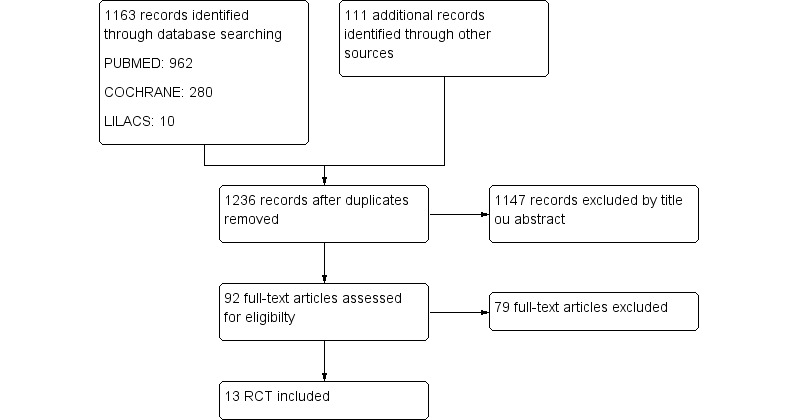
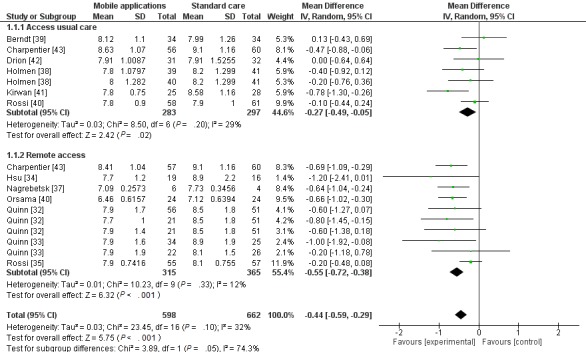
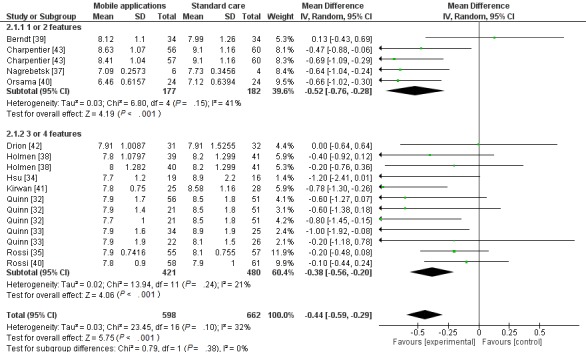
BACKGROUND: Diabetes Mellitus (DM) is a chronic disease that is considered a global public health problem. Education and self-monitoring by diabetic patients help to optimize and make possible a satisfactory metabolic control enabling improved management and reduced morbidity and mortality. The global growth in the use of mobile phones makes them a powerful platform to help provide tailored health, delivered conveniently to patients through health apps. OBJECTIVE: The aim of our study was to evaluate the efficacy of mobile apps through a systematic review and meta-analysis to assist DM patients in treatment. METHODS: We conducted searches in the electronic databases MEDLINE (Pubmed), Cochrane Register of Controlled Trials (CENTRAL), and LILACS (Latin American and Caribbean Health Sciences Literature), including manual search in references of publications that included systematic reviews, specialized journals, and gray literature. We considered eligible randomized controlled trials (RCTs) conducted after 2008 with participants of all ages, patients with DM, and users of apps to help manage the disease. The meta-analysis of glycated hemoglobin (HbA1c) was performed in Review Manager software version 5.3. RESULTS: The literature search identified 1236 publications. Of these, 13 studies were included that evaluated 1263 patients. In 6 RCTs, there were a statistical significant reduction (P<.05) of HbA1c at the end of studies in the intervention group. The HbA1c data were evaluated by meta-analysis with the following results (mean difference, MD -0.44; CI: -0.59 to -0.29; P<.001; I²=32%).The evaluation favored the treatment in patients who used apps without significant heterogeneity. CONCLUSIONS: The use of apps by diabetic patients could help improve the control of HbA1c. In addition, the apps seem to strengthen the perception of self-care by contributing better information and health education to patients. Patients also become more self-confident to deal with their diabetes, mainly by reducing their fear of not knowing how to deal with potential hypoglycemic episodes that may occur.
Overview
The claims and statistics of this paper haven’t been checked yet.
Run the check — free, no account needed. It reads the open-access text and checks the sources it cites.
Integrity signals
Registry
Cites
Statistics
Figures
Verification
Claims the paper makes
The claims and statistics of this paper haven’t been checked yet.
Run the check — free, no account needed. It reads the open-access text and checks the sources it cites.
Claims other papers make about this one
Each is checked against this paper’s own text: does it say what the citing paper says it does?
The source backs part of the claim, not all of it — or backs it for a different population, condition or comparison.
In the citing paper
“Despite this, the majority of mobile applications for the management of T2D focus solely on the measurement and control of blood glucose or in combination with diet, blood pressure control and weight or physical activity in a way that is not very detailed [35,36].”
From Impact of a primary care-based mobile health intervention to ‘sit less and move more’ on HbA1c, blood pressure, and other clinical outcomes in office employees with type 2 diabetes: A randomized controlled trial (2025) · cites this paper as [35]
Experimental — accuracy not yet measured
Self-check
Percentages, sums and reported differences re-computed from the paper’s own numbers.
The self-check needs the paper’s full text.
Citations
Cites
Liberati, A., Altman, D. G., Tetzlaff, J., Mulrow, C., Gøtzsche, P. C., Ioannidis, J. P. A., Clarke, M., Devereaux, P. J., Kleijnen, J., & Moher, D. (2009) · PLoS Medicine · doi:10.1371/journal.pmed.1000100 · Cited by 28,164
Cochrane Handbook for Systematic Reviews of Interventions: Cochrane Book Series
(2008) · doi:10.1002/9780470712184 · Cited by 25,048
(1993) · New England Journal of Medicine · doi:10.1056/nejm199309303291401 · Cited by 24,667
Liberati, A., Altman, D. G., Tetzlaff, J., Mulrow, C., Gotzsche, P. C., Ioannidis, J. P. A., Clarke, M., Devereaux, P. J., Kleijnen, J., & Moher, D. (2009) · BMJ · doi:10.1136/bmj.b2700 · Cited by 17,648
Turner, R. C., Fox, C., Matthews, McElroy, H. H., Cull, C. A., Holman, R. R., Neil, P., Hadden, D. R., Wright, D., Manley, E., et al. (1998) · The Lancet · Cited by 8,419
Stearne, M. R., Palmer, S. L., Hammersley, M. S., Franklin, S. L., Spivey, R. S., Lévy, J., Tidy, C. R., Bell, N. J., Steemson, J., Barrow, B. A., et al. (1998) · UCL Discovery (University College London) · Cited by 4,803
Economic Costs of Diabetes in the U.S. in 2002
American Diabetes Association (2003) · Diabetes Care · doi:10.2337/diacare.26.3.917 · Cited by 4,147
Gupta, A., & Uribarri, J. (2016) · Hormone Research in Paediatrics · doi:10.1159/000444053 · Cited by 4,023
Research works printed but not linked: 3
- International Diabetes Federation20152016-07-04IDF Diabetes Atlas, Seventh Edition http://www.diabetesatlas.org/resources/2015-atlas.html
- Lee, E, 2011, Stud Health Technol Inform, 169, 23
- 10.1056/NEJM199309303291401 · DOI · Paper page
Cited by
Sorted by citations
Greenwood, D. A., Gee, P. M., Fatkin, K. J., & Peeples, M. (2017) · Journal of Diabetes Science and Technology · doi:10.1177/1932296817713506 · Cited by 526
Shan, R., Sarkar, S., & Martin, S. S. (2019) · Diabetologia · doi:10.1007/s00125-019-4864-7 · Cited by 339
Prescribable mHealth apps identified from an overview of systematic reviews
Byambasuren, O., Sanders, S., Beller, E., & Glasziou, P. (2018) · npj Digital Medicine · doi:10.1038/s41746-018-0021-9 · Cited by 291
Villinger, K., Wahl, D. R., Boeing, H., Schupp, H. T., & Renner, B. (2019) · Obesity Reviews · doi:10.1111/obr.12903 · Cited by 310
Timpel, P., Oswald, S., Schwarz, P. E. H., & Harst, L. (2020) · Journal of Medical Internet Research · doi:10.2196/16791 · Cited by 243
Metadata
- Authors
- Bonoto, B. C., de Araújo, V. E., Godói, I. P., de Lemos, L. L. P., Godman, B., Bennie, M., Diniz, L. M., & Junior, A. A. G.
- Affiliations
- Universidade Federal de Minas Gerais (BR)
- Karolinska University Hospital (SE)
- University of Strathclyde (GB)
- Corresponding author
- Bonoto, Bráulio Cezar
- ORCID
- Venue
- JMIR mhealth and uhealth
- Publisher
- JMIR Publications Inc.
- Published
- 2017-03-01
- Volume
- 5
- Issue
- 3
- Pages
- e4
- ISSN
- 2291-5222 (ISSN-L)
- PMC
- PMC5352856
- OpenAlex
- W2592184816
- Cited by
- 294
- References
- 53
- Citations by year
- 2026: 19 · 2025: 34 · 2024: 24 · 2023: 32 · 2022: 35 · 2021: 39 · 2020: 33 · 2019: 40 · 2018: 28 · 2017: 10
- FWCI
- 5.35
- Type
- journal article
- Language
- en
- Open access
- gold
- doi.org
- Licence
- cc-by
- Locations
- JMIR mhealth and uhealth (publishedVersion, cc-by)
- PubMed Central (publishedVersion, cc-by)
- PubMed (publishedVersion)
- Strathprints: The University of Strathclyde institutional repository (University of Strathclyde) (submittedVersion, cc-by)
- DOAJ (DOAJ: Directory of Open Access Journals) (submittedVersion, cc-by-sa)
- Funders
- Academy of Medical Sciences (AMS-NAF1-GuerraJunior)
- Universidade Federal de Minas Gerais
- Medical Research Council (MR/K007017/1)
- Topics
- Health Sciences › Health Professions › General Health Professions › Mobile Health and mHealth Applications
- Health Sciences › Medicine › Endocrinology, Diabetes and Metabolism › Diabetes Management and Education
- Physical Sciences › Computer Science › Information Systems › Mobile Learning in Education
- Keywords
- diabetes mellitus, mobile health apps, HbA1c, glycemic control, diabetes self-management, patient education, hypoglycemia, diabetes self-care
About these checks
Registry, retraction, Cites and statistics results are computed, not judged, with one exception: a printed reference that no index lists is read once by a model before it counts as a citation error. Claims are extracted by a model and kept only when their quote appears verbatim in the text; each cited source is then checked, with a model’s help, for whether it says what the claim relies on. Those verdicts can be wrong — read the claim’s quote and the cited source before relying on one.
Statistics and arithmetic are recomputed, not judged.
Confidence bands are shown only for fields calibrated on our annotated test set. None is calibrated yet, so no band is shown.
What counts as a claim ›How we measure confidence ›How we check this ›
Are you an author, or do you see a problem with this page? Request a review
