

The DOI matches its Crossref record; 51 of the 52 references it cites were found in a registry or an index.
Text Messaging and Mobile Phone Apps as Interventions to Improve Adherence in Adolescents With Chronic Health Conditions: A Systematic Review
Open accessAbstract
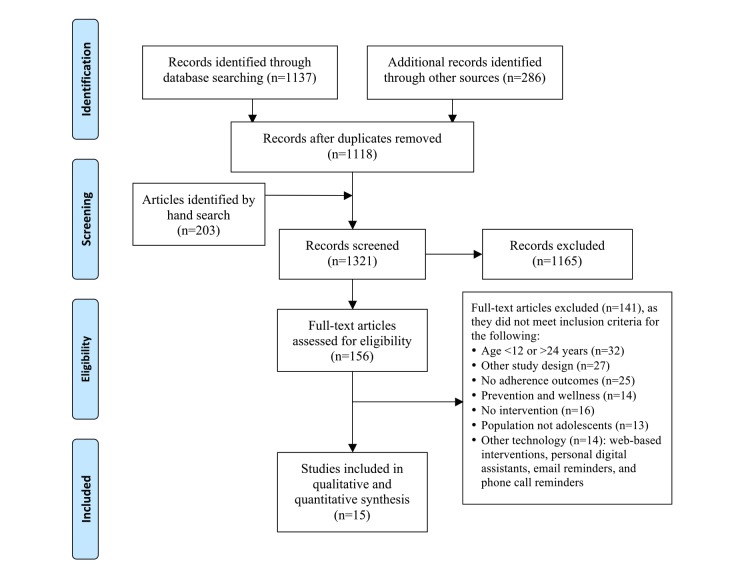
BACKGROUND: The number of adolescents with chronic health conditions (CHCs) continues to increase. Medication nonadherence is a global challenge among adolescents across chronic conditions and is associated with poor health outcomes. While there has been growing interest in the use of mHealth technology to improve medication adherence among adolescents with CHCs, particularly text messaging and mobile phone apps, there has been no prior systematic review of their efficacy. OBJECTIVE: The purpose of this review was to systematically evaluate the most recent evidence for the efficacy of text messaging and mobile phone apps as interventions to promote medication adherence among adolescents with CHCs. METHODS: PubMed, Embase, CENTRAL, PsycINFO, Web of Science, Google Scholar, and additional databases were searched from 1995 until November 2015. An additional hand search of related themes in the Journal of Medical Internet Research was also conducted. The Preferred Reporting Results of Systematic Reviews and Meta-Analyses guidelines were followed. Two reviewers independently screened titles/abstracts, assessed full-text articles, extracted data from included articles, and assessed their quality using Grades of Recommendation, Assessment, Development, and Evaluation criteria. Included studies were described in original research articles that targeted adherence in adolescents with CHCs (12-24 years-old). RESULTS: Of the 1423 records examined, 15 met predefined criteria: text messaging (n=12) and mobile phone apps (n=3). Most studies were performed in the United States (11/15, 73%), were randomized-controlled trials (8/15, 53%), had a sample size <50 (11/15, 73%), and included adherence self-report and/or biomarkers (9/15, 60%). Only four studies were designed based on a theoretical framework. Approaches for text messaging and mobile phone app interventions varied across studies. Seven articles (7/15, 47%) reported significant improvement in adherence with moderate to large standardized mean differences. Most of the included studies were of low or moderate quality. Studies varied in sample size, methods of adherence assessment, and definition of adherence, which prohibited performing a meta-analysis. CONCLUSIONS: The use of text messaging and mobile phone app interventions to improve medication adherence among adolescents with CHCs has shown promising feasibility and acceptability, and there is modest evidence to support the efficacy of these interventions. Further evaluation of short- and long-term efficacy and cost-effectiveness of these interventions is warranted given the early and evolving state of the science.
Overview
The claims and statistics of this paper haven’t been checked yet.
Run the check — free, no account needed. It reads the open-access text and checks the sources it cites.
Integrity signals
Registry
Cites
Statistics
Figures
Verification
Claims the paper makes
The claims and statistics of this paper haven’t been checked yet.
Run the check — free, no account needed. It reads the open-access text and checks the sources it cites.
Claims other papers make about this one
Each is checked against this paper’s own text: does it say what the citing paper says it does?
The source backs part of the claim, not all of it — or backs it for a different population, condition or comparison.
In the citing paper
“The evidence for utilizing IMI on AYA with chronic conditions points to their feasibility and effectiveness [20].”
From Feasibility and potential efficacy of a guided internet- and mobile-based CBT for adolescents and young adults with chronic medical conditions and comorbid depression or anxiety symptoms (youthCOACHCD): a randomized controlled pilot trial (2022) · cites this paper as [20]
Experimental — accuracy not yet measured
Self-check
Percentages, sums and reported differences re-computed from the paper’s own numbers.
The self-check needs the paper’s full text.
Citations
Cites
Preferred Reporting Items for Systematic Reviews and Meta-Analyses: the PRISMA statement
Moher, D., Liberati, A., Tetzlaff, J., Altman, D. G., & for the PRISMA Group (2009) · BMJ · doi:10.1136/bmj.b2535 · Cited by 83,823
PRISMA-P Group, Moher, D., Shamseer, L., Clarke, M., Ghersi, D., Liberati, A., Petticrew, M., Shekelle, P., & Stewart, L. A. (2015) · Systematic Reviews · doi:10.1186/2046-4053-4-1 · Cited by 26,223
Preferred Reporting Items for Systematic Reviews and Meta-Analyses: The PRISMA Statement
Moher, D., Liberati, A., Tetzlaff, J., & Altman, D. G. (2009) · Journal of Clinical Epidemiology · doi:10.1016/j.jclinepi.2009.06.005 · Cited by 19,575
Update on Key Emerging Challenges in Cystic Fibrosis
Jennings, M. T., Riekert, K. A., & Boyle, M. (2014) · Medical Principles and Practice · doi:10.1159/000357646 · Cited by 3,671
Adolescence: A foundation for future health
Sawyer, S. M., Afifi, R. A., Bearinger, L. H., Blakemore, S.-J., Dick, B., Ezeh, A. C., & Patton, G. C. (2012) · The Lancet · doi:10.1016/s0140-6736(12)60072-5 · Cited by 2,635
DiMatteo, M. R. (2004) · Medical Care · doi:10.1097/01.mlr.0000114908.90348.f9 · Cited by 2,169
Eysenbach, G., & CONSORT-EHEALTH Group (2011) · Journal of Medical Internet Research · doi:10.2196/jmir.1923 · Cited by 1,863 · cited 1×
“Nevertheless, consistent use of Web-based and mobile health interventions reporting guidelines [58] would enhance comparative research across studies [59].”
Impact of Medication Adherence on Hospitalization Risk and Healthcare Cost
Sokol, M. C., McGuigan, K. A., Verbrugge, R. R., & Epstein, R. S. (2005) · Medical Care · doi:10.1097/01.mlr.0000163641.86870.af · Cited by 1,729
Patient Adherence and Medical Treatment Outcomes: A Meta-Analysis
Robin DiMatteo, M., Giordani, P. J., Lepper, H. S., & Croghan, T. W. (2002) · Medical Care · doi:10.1097/00005650-200209000-00009 · Cited by 1,490
Dynamics of Obesity and Chronic Health Conditions Among Children and Youth
Van Cleave, J. (2010) · JAMA · doi:10.1001/jama.2010.104 · Cited by 693
Design of an mHealth app for the self-management of adolescent type 1 diabetes: a pilot study
Cafazzo, J. A., Casselman, M., Hamming, N., Katzman, D. K., & Palmert, M. R. (2012) · Journal of Medical Internet Research · doi:10.2196/jmir.2058 · Cited by 676
Franklin, V. L., Waller, A., Pagliari, C., & Greene, S. A. (2006) · Diabetic Medicine · doi:10.1111/j.1464-5491.2006.01989.x · Cited by 543
Kahana, S., Drotar, D., & Frazier, T. (2008) · Journal of Pediatric Psychology · doi:10.1093/jpepsy/jsm128 · Cited by 334
Inpatient Growth and Resource Use in 28 Children's Hospitals
Berry, J. G., Hall, M., Hall, D. E., Kuo, D. Z., Cohen, E., Agrawal, R., Mandl, K. D., Clifton, H., & Neff, J. M. (2012) · Archives of Pediatrics and Adolescent Medicine · doi:10.1001/jamapediatrics.2013.432 · Cited by 294
Kyngäs, H. A., Kroll, T., & Duffy, M. E. (2000) · Journal of Adolescent Health · doi:10.1016/s1054-139x(99)00042-7 · Cited by 265
Majeed-Ariss, R., Baildam, E., Campbell, M., Chieng, A., Fallon, D., Hall, A., McDonagh, J. E., Stones, S. R., Thomson, W., & Swallow, V. (2015) · Journal of Medical Internet Research · doi:10.2196/jmir.5043 · Cited by 251
Medication Adherence and Health Care Utilization in Pediatric Chronic Illness: A Systematic Review
McGrady, M. E., & Hommel, K. A. (2013) · PEDIATRICS · doi:10.1542/peds.2013-1451 · Cited by 227
Adherence to Pediatric Medical Regimens
Rapoff, M. A. (2010) · Issues in Clinical Child Psychology · doi:10.1007/978-1-4419-0570-3 · Cited by 219
Hanghøj, S., & Boisen, K. A. (2013) · Journal of Adolescent Health · doi:10.1016/j.jadohealth.2013.08.009 · Cited by 211
Badawy, S. M., & Kuhns, L. M. (2017) · JMIR mHealth and uHealth · doi:10.2196/mhealth.6837 · Cited by 211
Self-citationDowshen, N., Kuhns, L. M., Johnson, A. K., Holoyda, B. J., & Garofalo, R. (2012) · Journal of Medical Internet Research · doi:10.2196/jmir.2015 · Cited by 208
Self-citationImproved Adherence and Outcomes for Pediatric Liver Transplant Recipients by Using Text Messaging
Miloh, T., Annunziato, R. A., Arnon, R., Warshaw, J. K., Parkar, S., Suchy, F. J., Iyer, K. R., & Kerkar, N. N. (2009) · PEDIATRICS · doi:10.1542/peds.2009-0415 · Cited by 207
Dean, A. J., Walters, J., & Hall, A. (2010) · Archives of Disease in Childhood · doi:10.1136/adc.2009.175125 · Cited by 205
Smith, J. M., Martz, K. L., & Blydt‐Hansen, T. D. (2013) · Pediatric Transplantation · doi:10.1111/petr.12034 · Cited by 187
Improving Asthma Control Through Telemedicine: A Study of Short-Message Service
Ostojic, V., Cvoriscec, B., Ostojic, S. B., Reznikoff, D., Stipic-Markovic, A., & Tudjman, Z. (2005) · Telemedicine and e-Health · doi:10.1089/tmj.2005.11.28 · Cited by 183
Garofalo, R., Kuhns, L. M., Hotton, A., Johnson, A. K., Muldoon, A. L., & Rice, D. (2015) · AIDS and Behavior · doi:10.1007/s10461-015-1192-x · Cited by 170
Self-citationAdherence and health‐related quality of life in adolescent liver transplant recipients
Fredericks, E. M., Magee, J. C., Opipari‐Arrigan, L., Shieck, V. L., Well, A. M., & Lopez, M. J. (2008) · Pediatric Transplantation · doi:10.1111/j.1399-3046.2008.00901.x · Cited by 165
The Efficacy of Adherence Interventions for Chronically Ill Children: A Meta-Analytic Review
Graves, M. M., Roberts, M. C., Rapoff, M. A., & Boyer, A. (2009) · Journal of Pediatric Psychology · doi:10.1093/jpepsy/jsp072 · Cited by 162
Systematic review of publication bias in studies on publication bias
Dubben, H.-H., & Beck‐Bornholdt, H. (2005) · BMJ · doi:10.1136/bmj.38478.497164.f7 · Cited by 153
Pai, A. L. H., & McGrady, M. E. (2014) · Journal of Pediatric Psychology · doi:10.1093/jpepsy/jsu038 · Cited by 139
A pilot test of a tailored mobile and web-based diabetes messaging system for adolescents
Mulvaney, S. A., Anders, S., Smith, A. K., Pittel, E. J., & Johnson, K. B. (2012) · Journal of Telemedicine and Telecare · doi:10.1258/jtt.2011.111006 · Cited by 128
Ting, T. V., Kudalkar, D., Nelson, S. M., Cortina, S., Pendl, J. D., Budhani, S., NEVILLE, J., Taylor, J., Huggins, J., Drotar, D., et al. (2011) · The Journal of Rheumatology · doi:10.3899/jrheum.110771 · Cited by 120
Badawy, S. M., Thompson, A. A., & Liem, R. I. (2016) · Pediatric Blood & Cancer · doi:10.1002/pbc.25905 · Cited by 119
Self-citationBadawy, S. M., & Kuhns, L. M. (2016) · JMIR mhealth and uhealth · doi:10.2196/mhealth.6425 · Cited by 104
Self-citationTechnology-mediated interventions for enhancing medication adherence
Mistry, N., Keepanasseril, A., Wilczynski, N. L., Nieuwlaat, R., Ravall, M., Haynes, R. B., & the Patient Adherence Review Team (2015) · Journal of the American Medical Informatics Association · doi:10.1093/jamia/ocu047 · Cited by 102
Badawy, S. M., Thompson, A. A., Lai, J., Penedo, F. J., Rychlik, K. L., & Liem, R. I. (2016) · Pediatric Blood & Cancer · doi:10.1002/pbc.26369 · Cited by 91
Self-citationProblem of nonadherence in chronically ill adolescents: strategies for assessment and intervention
Smith, B. A., & Shuchman, M. (2005) · Current Opinion in Pediatrics · doi:10.1097/01.mop.0000176443.26872.6e · Cited by 90
Badawy, S. M., Thompson, A. A., Penedo, F. J., Lai, J., Rychlik, K. L., & Liem, R. I. (2017) · European Journal Of Haematology · doi:10.1111/ejh.12878 · Cited by 90
Self-citationCreary, S. E., Gladwin, M. T., Byrne, M., Hildesheim, M. E., & Krishnamurti, L. (2014) · Pediatric Blood & Cancer · doi:10.1002/pbc.24931 · Cited by 73
Hammonds, T. L., Rickert, K., Goldstein, C. M., Gathright, E. C., Gilmore, S., Derflinger, B., Bennett, B. L., Sterns, A. A., Drew, B. L., & Hughes, J. W. (2014) · Journal of American College Health · doi:10.1080/07448481.2014.975716 · Cited by 72
Drug Compliance in Adolescents
Staples, B. B., & Bravender, T. D. (2002) · Pediatric Drugs · doi:10.2165/00128072-200204080-00003 · Cited by 61
Boker, A., Feetham, H. J., Armstrong, A. W., Purcell, P. L., & Jacobe, H. T. (2012) · Journal of the American Academy of Dermatology · doi:10.1016/j.jaad.2012.02.031 · Cited by 59
Augestad, K. M., Berntsen, G., Lassen, K., Bellika, J. G., Wootton, R., & Lindsetmo, R. O. (2011) · Journal of the American Medical Informatics Association · doi:10.1136/amiajnl-2011-000411 · Cited by 56
Evidence-Based Practice: Toward Optimizing Clinical Outcomes
Chiappelli, F. (2010) · Springer eBooks · doi:10.1007/978-3-642-05025-1 · Cited by 53
Improved hydroxyurea effect with the use of text messaging in children with sickle cell anemia
Estepp, J. H., Winter, B., Johnson, M. R., Smeltzer, M. P., Howard, S. C., & Hankins, J. S. (2014) · Pediatric Blood & Cancer · doi:10.1002/pbc.25177 · Cited by 52
McGrady, M. E., Ryan, J. L., Gutierrez‐Colina, A. M., Fredericks, E. M., Towner, E., & Pai, A. L. H. (2015) · Child Care Health and Development · doi:10.1111/cch.12271 · Cited by 44
Louch, G., Dalkin, S. M., Bodansky, J., & Conner, M. T. (2012) · Psychology Health & Medicine · doi:10.1080/13548506.2012.689841 · Cited by 34
Acne Smart Club: An Educational Program for Patients with Acne
Fabbrocini, G., Izzo, R., Donnarumma, M., Marasca, C., & Monfrecola, G. (2014) · Dermatology · doi:10.1159/000362809 · Cited by 23
McGrady, M. E., & Hommel, K. A. (2015) · Journal of Pediatric Psychology · doi:10.1093/jpepsy/jsv083 · Cited by 20
McGrady, M. E., Ryan, J. L., Brown, G. A., & Cushing, C. C. (2015) · Journal of Pediatric Psychology · doi:10.1093/jpepsy/jsv025 · Cited by 18
Text Messaging Improves Participation in Laboratory Testing in Adolescent Liver Transplant Patients.
McKenzie, R., Berquist, W. E., Foley, M. A., Park, K. T., Windsheimer, J. E., & Litt, I. F. (2015) · PubMed · Cited by 18
DiMatteo (2002) · doi:10.1097/01.mlr.0000024612.61915.2d
Research works printed but not linked: 2
- Lipsey, M, 2001, Practical meta-analysis (Applied Social Research Methods)
- McKenzie, RB, 2015, J Particip Med, 7
Cited by
Sorted by citations
Ming, L. C., Untong, N., Aliudin, N. A., Osili, N., Kifli, N., Tan, C. S., Goh, K. W., Ng, P. W., Al‐Worafi, Y. M., Lee, K. S., et al. (2020) · JMIR mhealth and uhealth · doi:10.2196/19796 · Cited by 570
An Effective Model of Diabetes Care and Education: The ADCES7 Self-Care Behaviors™
Kolb, L. E. (2021) · The Science of Diabetes Self-Management and Care · doi:10.1177/0145721720978154 · Cited by 287
Badawy, S. M., & Radovic, A. (2020) · JMIR Pediatrics and Parenting · doi:10.2196/20049 · Cited by 242
Self-citationIdentification of barriers to insulin therapy and approaches to overcoming them
Russell‐Jones, D., Pouwer, F., & Khunti, K. (2018) · Diabetes, Obesity and Metabolism · doi:10.1111/dom.13132 · Cited by 238
Overdijkink, S. B., Velu, A. V., Rosman, A. N., van Beukering, M. D. M., Kok, M., & Steegers‐Theunissen, R. P. M. (2018) · JMIR mhealth and uhealth · doi:10.2196/mhealth.8834 · Cited by 218
Metadata
- Authors
- Badawy, S. M., Barrera, L., Sinno, M. G., Kaviany, S., O’Dwyer, L. C., & Kuhns, L. M.
- Affiliations
- Northwestern University (US)
- Lurie Children's Hospital (US)
- University of Kansas (US)
- Advocate Children's Hospital (US)
- Corresponding author
- Badawy, Sherif M
- Venue
- JMIR mHealth and uHealth
- Publisher
- JMIR Publications Inc.
- Published
- 2017-05-15
- Volume
- 5
- Issue
- 5
- Pages
- e66
- ISSN
- 2291-5222 (ISSN-L)
- PMC
- PMC5447825
- OpenAlex
- W2616486323
- Cited by
- 207
- References
- 51
- Citations by year
- 2026: 8 · 2025: 10 · 2024: 18 · 2023: 17 · 2022: 31 · 2021: 34 · 2020: 40 · 2019: 22 · 2018: 21 · 2017: 6
- FWCI
- 4.29
- Type
- journal article
- Language
- en
- Open access
- gold
- doi.org
- Licence
- cc-by
- Locations
- JMIR mhealth and uhealth (publishedVersion, cc-by)
- Europe PMC (PubMed Central) (publishedVersion, cc-by)
- PubMed Central (publishedVersion, cc-by)
- PubMed (publishedVersion)
- DOAJ (DOAJ: Directory of Open Access Journals) (submittedVersion, cc-by-sa)
- Funders
- National Institutes of Health (UL1TR001422)
- Agency for Healthcare Research and Quality (K12HS023011)
- National Center for Advancing Translational Sciences
- Topics
- Health Sciences › Health Professions › General Health Professions › Mobile Health and mHealth Applications
- Health Sciences › Medicine › Family Practice › Medication Adherence and Compliance
- Health Sciences › Medicine › Pediatrics, Perinatology and Child Health › Adolescent and Pediatric Healthcare
- Keywords
- medication adherence, adolescents, chronic disease, text messaging, mobile phone app, mobile health intervention, adherence interventions, intervention efficacy, feasibility and acceptability, adherence measurement, theoretical framework, cost-effectiveness, health equity, health literacy
About these checks
Registry, retraction, Cites and statistics results are computed, not judged, with one exception: a printed reference that no index lists is read once by a model before it counts as a citation error. Claims are extracted by a model and kept only when their quote appears verbatim in the text; each cited source is then checked, with a model’s help, for whether it says what the claim relies on. Those verdicts can be wrong — read the claim’s quote and the cited source before relying on one.
Statistics and arithmetic are recomputed, not judged.
Confidence bands are shown only for fields calibrated on our annotated test set. None is calibrated yet, so no band is shown.
What counts as a claim ›How we measure confidence ›How we check this ›
Are you an author, or do you see a problem with this page? Request a review
