

ProjectQ: an open source software framework for quantum computing
Open accessThe DOI matches its Crossref record; 17 of the 18 references it cites were found in a registry or an index.
Abstract
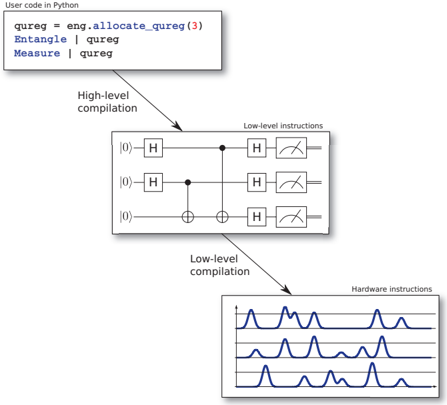
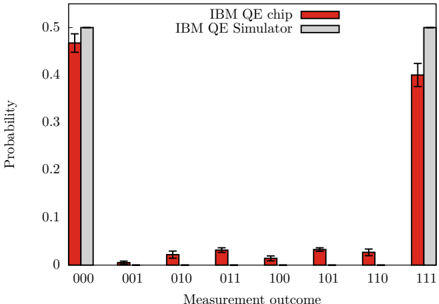
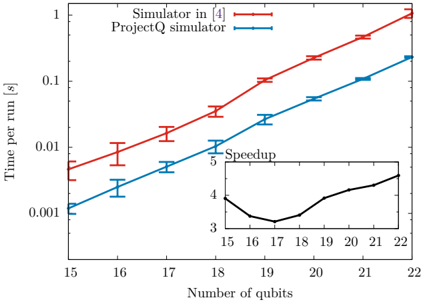
We introduce ProjectQ, an open source software effort for quantum computing. The first release features a compiler framework capable of targeting various types of hardware, a high-performance simulator with emulation capabilities, and compiler plug-ins for circuit drawing and resource estimation. We introduce our Python-embedded domain-specific language, present the features, and provide example implementations for quantum algorithms. The framework allows testing of quantum algorithms through simulation and enables running them on actual quantum hardware using a back-end connecting to the IBM Quantum Experience cloud service. Through extension mechanisms, users can provide back-ends to further quantum hardware, and scientists working on quantum compilation can provide plug-ins for additional compilation, optimization, gate synthesis, and layout strategies.
Overview
The claims and statistics of this paper haven’t been checked yet.
Free: it reads the open-access text and checks the first 5 claims that cite a source we can check. Create a free account to check every claim.
Integrity signals
Registry
Cites
Statistics
Figures



Verification
Claims the paper makes
The claims and statistics of this paper haven’t been checked yet.
Free: it reads the open-access text and checks the first 5 claims that cite a source we can check. Create a free account to check every claim.
Self-check
Percentages, sums and reported differences re-computed from the paper’s own numbers.
The self-check needs the paper’s full text.
Citations
Cites
A fast quantum mechanical algorithm for database search
Grover, L. K. (1996) · Proceedings of the twenty-eighth annual ACM symposium on Theory of computing - STOC '96 · doi:10.1145/237814.237866 · Cited by 8,830
Algorithms for quantum computation: discrete logarithms and factoring
Shor, P. W. (2002) · Proceedings 35th Annual Symposium on Foundations of Computer Science · doi:10.1109/sfcs.1994.365700 · Cited by 8,713
Elementary gates for quantum computation
Barenco, A., Bennett, C. H., Cleve, R., DiVincenzo, D. P., Margolus, N., Shor, P., Sleator, T., Smolin, J. A., & Weinfurter, H. (1995) · Physical Review A · doi:10.1103/physreva.52.3457 · Cited by 4,311
Quantum Computation with Ions in Thermal Motion
Sørensen, A., & Mølmer, K. (1999) · Physical Review Letters · doi:10.1103/physrevlett.82.1971 · Cited by 1,112
Quipper: a scalable quantum programming language
Green, A. S., Lumsdaine, P. L., Ross, N. J., Selinger, P., & Valiron, B. (2013) · Proceedings of the 34th ACM SIGPLAN Conference on Programming Language Design and Implementation · doi:10.1145/2491956.2462177 · Cited by 334
Circuit for Shor's algorithm using 2n+3 qubits
Beauregard, S. (2003) · Quantum Information and Computation · doi:10.26421/qic3.2-8 · Cited by 206
Addition on a Quantum Computer
Draper, T. G. (2000) · arXiv (Cornell University) · doi:10.48550/arxiv.quant-ph/0008033 · Cited by 185
0.5 petabyte simulation of a 45-qubit quantum circuit
Häner, T., & Steiger, D. S. (2017) · Proceedings of the International Conference for High Performance Computing, Networking, Storage and Analysis · doi:10.1145/3126908.3126947 · Cited by 180
Self-citationA software methodology for compiling quantum programs
Häner, T., Steiger, D. S., Svore, K., & Troyer, M. (2018) · Quantum Science and Technology · doi:10.1088/2058-9565/aaa5cc · Cited by 170
Self-citationQuipper: a scalable quantum programming language
Green, A. S., Lumsdaine, P. L., Ross, N. J., Selinger, P., & Valiron, B. (2013) · ACM SIGPLAN Notices · doi:10.1145/2499370.2462177 · Cited by 156
Cited by
Items 401–500 of 559
GUPPY: Pythonic Quantum-Classical Programming
Koch, M., Lawrence, A., Singhal, K., Sivarajah, S., & Duncan, R. (2025) · arXiv · doi:10.48550/arxiv.2510.12582 · Cited by 2
Quff: A Dynamically Typed Hybrid Quantum-Classical Programming Language
Wright, C. J., Luján, M., Petoumenos, P., & Goodacre, J. (2024) · ACM SIGPLAN International Conference on Managed Programming Languages and Runtimes (MPLR) · doi:10.1145/3679007.3685063 · Cited by 2
An HPC-Inspired Blueprint for a Technology-Agnostic Quantum Middle Layer
Markidis, S., Netzer, G., Pennati, L., & Peng, I. B. (2025) · International Conference for High Performance Computing, Networking, Storage and Analysis (SC) · doi:10.1145/3731599.3767554 · Cited by 2
Quantum Emulator Benchmarking Made Easy
Leonteva, A. O., Outteryck, M., & Masella, G. (2026) · Communications in computer and information science · doi:10.1007/978-3-032-13852-1_28 · Cited by 2
Communication-Partition Co-Optimization for Quantum Circuit Simulation on CPU+GPU Clusters
Jiao, C., Zhang, W., & Shen, L. (2026) · IEEE Transactions on Parallel and Distributed Systems · doi:10.1109/tpds.2026.3678345 · Cited by 2
Quantum Simulation Tools: A Comprehensive Survey
Devani, Z., Kanudawala, Z., Thakar, R., Padh, C., & Trivedi, H. (2026) · Studies in computational intelligence · doi:10.1007/978-981-95-6276-3_7 · Cited by 2
HybridQC: Hardware-Grounded Simulation of Tightly Integrated Hybrid Quantum-Classical Systems
Christou, P., Kan, S., & Mao, Y. (2026) · doi:10.1145/3828523.3857132 · Cited by 2
Effect of Pure Dephasing Quantum Noise in the Quantum Search Algorithm Using Atos Quantum Assembly
da Silva, M. H. F., de Jesus, G. F., & Cruz, C. (2024) · Entropy · doi:10.3390/e26080668 · Cited by 2
Song, G., & Seo, H. (2024) · Electronics · doi:10.3390/electronics13163167 · Cited by 2
Optimized quantum leading zero detector circuits
Orts, F. J., Ortega, G., Combarro, E. F., Rúa, I. F., & Garzón, E. M. (2022) · Quantum Information Processing · doi:10.1007/s11128-022-03784-3 · Cited by 2
Chen, K. (2023) · Highlights in Science Engineering and Technology · doi:10.54097/hset.v38i.5876 · Cited by 2
HybriD-GM: Um Modelo Paralelo para Computação Quântica direcionado às Arquiteturas Híbridas
Ávila, A., Moura, B., Bastos, R., Santos, H., Lucca, G., Cruz, A. P., Xavier‐de‐Souza, S., Yamin, A., & Reiser, R. (2024) · Simpósio em Sistemas Computacionais de Alto Desempenho (SSCAD) · doi:10.5753/sscad.2024.244757 · Cited by 2
Partonic collinear structure by quantum computing
Xing, H., & Li, T. (2024) · International Workshop on Deep-Inelastic Scattering and Related Subjects (DIS) · doi:10.22323/1.469.0029 · Cited by 2
Quantum Education at Minority Serving Institutions: Insights from Faculty Perspectives
Sodagari, S., & Rezaei, A. (2025) · IEEE Integrated STEM Education Conference (ISEC) · doi:10.1109/isec64801.2025.11147311 · Cited by 2
The dawn of quantum programming
Ross, N. J. (2018) · doi:10.22331/qv-2018-06-14-4 · Cited by 2
Quantum implementation of the Shor-code on multiple simulator platforms
Neumann, N. M. P., Nauta, J., & Phillipson, F. (2019) · doi:10.1117/12.2532539 · Cited by 2
Automatic accuracy management of quantum programs via (near-)symbolic resource estimation.
Meuli, G., Soeken, M., Roetteler, M., & Häner, T. (2020) · Cited by 2
Self-citationQuantum Resource Counts for Operations Constructed from an Addition Circuit
Miller, S. (2020) · IEEE Computer Society Annual Symposium on VLSI · doi:10.1109/isvlsi49217.2020.00035 · Cited by 2
Optimized exploration of quantum circuits space based on sub-circuits equivalences
Khalfaoui, K., Kerkouche, E., Boudjedaa, T., & Chaoui, A. (2023) · Quantum Information Processing · doi:10.1007/s11128-022-03803-3 · Cited by 2
JuliVQC.jl: an efficient variational quantum circuit simulator for near-term quantum algorithms
Liao, W.-Y., Wang, X., Xu, X.-Y., Ding, C., Zhang, S., Huang, H.-L., & Guo, C. (2025) · The European Physical Journal Special Topics · doi:10.1140/epjs/s11734-025-01628-6 · Cited by 2
Una revisión de herramientas para Programación Cuántica
Marrero, L., Olsowy, V., Fernández Sosa, J. F., Tesone, F., Corbalán, L. C., Thomas, P. J., & Pesado, P. M. (2024) · El Servicio de Difusión de la Creación Intelectual (National University of La Plata) · Cited by 2
Qumin, a minimalist quantum programming languagePreprint
Singh, A., Giannakis, K., & Andronikos, T. (2017) · arXiv (Cornell University) · doi:10.48550/arxiv.1704.04460 · Cited by 2
Variational Quantum Information Processing
Fontalvo, J. R. (2019) · Digital Access to Scholarship at Harvard (DASH) (Harvard University) · Cited by 2
Entanglement Generation in Quantum Networks: Towards a universal and scalable quantum internet
Dahlberg, A. (2021) · Research Repository (Delft University of Technology) · doi:10.4233/uuid:f4ba6396-f4c0-4f8c-95be-2620d62e4387 · Cited by 2
Binary Field Montgomery Multiplication on Quantum Computers.Preprint
Jang, K., Song, G., Kim, H., Kwon, H., Lee, W., Hu, Z. H., & Seo, H. (2021) · IACR Cryptology ePrint Archive · Cited by 2
Quantum Software Analytics: Opportunities and ChallengesPreprint
Hoang, T., Dam, H. K., Bi, T., Lu, Q., Xing, Z., Zhu, L., Nguyen, L. D., & Chen, S. (2023) · arXiv (Cornell University) · doi:10.48550/arxiv.2307.11305 · Cited by 2
Validating Quantum State Preparation Programs (Extended Version)Preprint
Li, L., Sharma, A., Tagba, Z. D., Frett, S., & Potanin, A. A. (2025) · arXiv (Cornell University) · doi:10.48550/arxiv.2501.05616 · Cited by 2
Quantum Design Automation: Foundations, Challenges, and the Road AheadPreprint
Wu, F., Guo, J., Xia, T., Kong, L., Zhang, F., Wang, Z., Dai, A., Wang, Z., Yang, Z., Deng, H., et al. (2025) · arXiv (Cornell University) · doi:10.48550/arxiv.2511.10479 · Cited by 2
AriaQuanta: A Quantum Software for Quantum ComputingPreprint
Cheraghi, A., & Yeganeh, H. D. (2025) · arXiv (Cornell University) · doi:10.48550/arxiv.2504.06024 · Cited by 2
Huang, P.-H., Li, X.-R., Chuang, C., Tu, C.-H., & Hung, S. (2026) · arXiv (Cornell University) · doi:10.48550/arxiv.2603.26232 · Cited by 2
A Three-Layer Architecture for Fault-Tolerant Quantum ComputingPreprint
Wang, Z., You, Z., Huang, Y., Li, T., Li, Y., Yuan, X., & Yao, Y. (2026) · arXiv (Cornell University) · doi:10.48550/arxiv.2606.22418 · Cited by 2
Variational quantum simulation of the quantum critical regime
Shi, Z.-Q., Xie, X.-D., & Zhang, D.-B. (2023) · Chinese Physics B · doi:10.1088/1674-1056/accb43 · Cited by 1
Scalable and Differentiable Simulator for Quantum Computational Chemistry
Xu, Z., Shang, H., Fan, Y., Zeng, X., Zhang, Y., & Guo, C. (2024) · IEEE International Parallel and Distributed Processing Symposium (IPDPS) · doi:10.1109/ipdps57955.2024.00028 · Cited by 1
Optimization Techniques on Quantum and Classical Systems: A Comprehensive Comparative Study
Shaik, H., Rajitha, M., Priyamvada, K., & Bhargavi, R. N. (2025) · E3S Web of Conferences · doi:10.1051/e3sconf/202561602024 · Cited by 1
Elsman, M., & Henriksen, T. (2025) · ACM SIGPLAN International Workshop on Libraries, Languages and Compilers for Array Programming (ARRAY) · doi:10.1145/3736112.3736143 · Cited by 1
MKV: a new block cipher for the post-quantum cryptography transition
Nguyen, B. C., Nguyen, V. L., Nguyen, T. A., Tran, S. N., Tran, D.-M., & Hoang, D. L. (2025) · Математические вопросы криптографии · doi:10.4213/mvk497 · Cited by 1
AI-Enabled Framework for Energy Sustainability Evaluation and Enhancement of Wireless Networks
Narottama, B., Aïssa, S., & Mohamed, Z. (2025) · IEEE Transactions on Green Communications and Networking · doi:10.1109/tgcn.2025.3614481 · Cited by 1
Temporal Planning for Compilation of Quantum Approximate Optimization Algorithm Circuits
Frank, J. D., Binh, M., Venturelli, D., & Rieffel, E. G. (2017) · NASA STI Repository (National Aeronautics and Space Administration) · Cited by 1
SoK: A Systematic Review of Malware Ontologies and Taxonomies and Implications for the Quantum Era
Molade, D., Ormrod, D., Thinyane, M., Arachchilage, N. A. G., & Slay, J. (2025) · arXiv (Cornell University) · doi:10.48550/arxiv.2509.19650 · Cited by 1
Quantum Software: From Engineering to Interaction
Alipour, M. (2025) · doi:10.1109/cbdcom68404.2025.00030 · Cited by 1
CLINE: Improving Control Flow Compilation of Quantum Programs with Control Line Encoding
Wu, A., Lu, L., Yin, J., Leng, J., & Guo, M. (2026) · IEEE International Symposium on High-Performance Computer Architecture (HPCA) · doi:10.1109/hpca68181.2026.11408609 · Cited by 1
Improved Quantum Cryptanalysis of MD5 and SHA-1
Jang, K., Seo, H., & Chattopadhyay, A. (2026) · IEEE Access · doi:10.1109/access.2026.3680947 · Cited by 1
Validating Quantum State Preparation Programs
Li, L., Sharma, A., Tagba, Z. D., Frett, S., & Potanin, A. (2026) · Lecture notes in computer science · doi:10.1007/978-3-032-22720-1_16 · Cited by 2
Quantum Implementation of SHA-1
Yoon, S., Song, G., Jang, K., Cha, S., & Seo, H. (2026) · Lecture notes in computer science · doi:10.1007/978-981-95-6857-4_14 · Cited by 1
Quantum Computing Applications in Engineering: Current Status and Future Prospects
Rukmanikanthan, S., Dullah, H., Teoh, Y. X., & Ahmed, A. N. (2026) · Archives of Computational Methods in Engineering · doi:10.1007/s11831-026-10569-9 · Cited by 1
Wang, C.-C., Wang, Y., Lin, Y.-C., Tu, C.-H., & Hung, S. (2026) · ACM Symposium on Applied Computing · doi:10.1145/3748522.3779713 · Cited by 1
Review on Quantum Computing Tools and Algorithms
Madhu, M., & Dixit, S. (2020) · Lecture notes on data engineering and communications technologies · doi:10.1007/978-3-030-37051-0_80 · Cited by 1
Lessons Learnt in the Implementation of Quantum Circuit Simulation Using Decision Diagrams
Grurl, T., Fub, J., & Wille, R. (2021) · IEEE International Symposium on Multiple-Valued Logic (ISMVL) · doi:10.1109/ismvl51352.2021.00024 · Cited by 1
Quick Quantum Circuit Simulation
Evans, D. (2021) · Journal of Computer Science Research · doi:10.30564/jcsr.v3i4.3567 · Cited by 1
Quantum Netlist Compiler (QNC)
Aktar, S., Badawy, A. A., & Santhi, N. (2022) · IEEE High Performance Extreme Computing Conference · doi:10.1109/hpec55821.2022.9926351 · Cited by 1
Quantum computing based high-energy nuclear physics
Li, T., Xing, H., & Zhang, D.-B. (2023) · Acta Physica Sinica · doi:10.7498/aps.72.20230907 · Cited by 1
Quantum-Accelerated Flight Selection: Probing Grover's Algorithm and Quantum Device Efficiency
Hire, J. V., Gawande, V., & Dhande, S. (2024) · International Journal of Innovative Science and Research Technology (IJISRT) · doi:10.38124/ijisrt/ijisrt24aug998 · Cited by 1
Software Flow for Quantum Computing
Bhattacharjee, D., Saha, A., Li, J., Phalak, K., Chatterjee, A., Pope, J., Ghosh, S., & Chattopadhyay, A. (2025) · Communications in computer and information science · doi:10.1007/978-3-031-81981-0_18 · Cited by 1
An Efficient Quantum Solver for Multidimensional Partial Differential Equations
Chaudhary, M., Islam, I., Levy, D., Nobel, A., Kneidel, D., Jha, V., & El‐Araby, E. (2025) · Communications in computer and information science · doi:10.1007/978-3-031-85884-0_6 · Cited by 1
Generation and Uses of Distributed Entanglement in Quantum Information
Eldredge, Z. (2019) · University Libraries (University of Maryland) · doi:10.13016/6b1j-tsik · Cited by 1
Simulation of Lennard-Jones Potential on a Quantum ComputerPreprint
Prabhat, & Behera, B. K. (2021) · arXiv (Cornell University) · doi:10.13140/rg.2.2.24765.08167 · Cited by 1
Architecting Quantum Computer Systems in the Presence of Noise
Ding, Y. (2021) · Knowledge@UChicago (University of Chicago) · doi:10.6082/uchicago.3393 · Cited by 1
Entrelazamiento y correlaciones en sistemas fermiónicos
Tullio, M. R. D. (2021) · El Servicio de Difusión de la Creación Intelectual (National University of La Plata) · doi:10.35537/10915/130069 · Cited by 1
Algorithmic Strategies for seizing Quantum Computing
Pérez-Salinas, A. (2021) · Dipòsit Digital de la Universitat de Barcelona (Universitat de Barcelona) · doi:10.48550/arxiv.2112.15175 · Cited by 1
Transformations for accelerator-based quantum circuit simulation in HaskellPreprint
Moawad, Y., Vanderbauwhede, W. A., & Steijl, R. (2022) · arXiv (Cornell University) · doi:10.48550/arxiv.2210.12703 · Cited by 1
DisQ: A Model of Distributed Quantum Processors (Extended Version)Preprint
Chang, L., Yavvari, S., Cleaveland, R., Basu, S., Tao, R., & Li, L. (2024) · arXiv (Cornell University) · doi:10.48550/arxiv.2407.09710 · Cited by 1
Report for the ASCR Workshop on Basic Research Needs in Quantum Computing and Networking - 2023
Sandia National Laboratories (SNL-NM), A., Lougovski, P., Parekh, O., Broz, J., Byrd, M., Chapman, J., Chembo, Y. K., de Jong, W. A., Figueroa, E. V., Humble, T. S., et al. (2024) · OSTI OAI (U.S. Department of Energy Office of Scientific and Technical Information) · doi:10.2172/2430035 · Cited by 1
Automated Auxiliary Qubit Allocation in High-Level Quantum ProgrammingPreprint
Rosa, E. C. R., Marchi, J., Duzzioni, E. I., & de Santiago, R. (2024) · arXiv (Cornell University) · doi:10.48550/arxiv.2412.20543 · Cited by 1
Low-Level and NUMA-Aware Optimization for High-Performance Quantum SimulationPreprint
Rezaei, A., Jaulmes, L., Bahna, M., Brown, O. T., & Barbalace, A. (2025) · arXiv (Cornell University) · doi:10.48550/arxiv.2506.09198 · Cited by 1
Quantum algorithms for simulating quantum systems
McArdle, S. (2021) · Oxford University Research Archive (ORA) (University of Oxford) · doi:10.5287/ora-5jkno46ge · Cited by 1
QuTech Central Controller: A Quantum Control Architecture for a Surface-17 Logical Qubit
Moreira, M. S. (2019) · Research Repository (Delft University of Technology) · Cited by 1
Designs, Protocols, and Software Tools for Quantum Enhanced Networks
DiAdamo, S., Nötzel, J., & München, T. U. (2022) · mediaTUM (Technical University of Munich) · Cited by 1
Simulation of, and with, first generation quantum computers
Jones, T. (2022) · Oxford University Research Archive (ORA) (University of Oxford) · doi:10.5287/ora-zrerqmjew · Cited by 1
Speed-oriented quantum circuit backendPreprint
Wilkening, S. (2026) · arXiv (Cornell University) · doi:10.48550/arxiv.2604.21656 · Cited by 1
HPC-vQPU: A Service-Export Architecture for Virtual QPUs on Batch-Scheduled HPC SystemsPreprint
Liu, S., Elahi, P. J., & Varetto, U. (2026) · arXiv (Cornell University) · doi:10.48550/arxiv.2605.28845 · Cited by 1
ORBIT-Q: Dual-axis benchmarking of autonomous agents in scientific quantum programmingPreprint
Zhang, S.-X., & Chen, Y.-Q. (2026) · arXiv (Cornell University) · doi:10.48550/arxiv.2607.03105 · Cited by 1
ConteXtuAlity: an open source Python package for contextuality
Vallée, K. (2026) · arXiv (Cornell University) · doi:10.48550/arxiv.2609.17294 · Cited by 1
Representation-Dependent Recoverability in Quantum CompilationPreprint
Yang, J., Li, Y., & Deng, X.-H. (2026) · arXiv (Cornell University) · doi:10.48550/arxiv.2609.29210 · Cited by 1
Wrangling Rogues: Managing Experimental Post-Moore ArchitecturesPreprint
Powell, W., Riedy, J., Young, J., & Conte, T. M. (2018) · arXiv (Cornell University) · doi:10.48550/arxiv.1808.06334
Architectures and automation for beyond-CMOS technologies
Bhattacharjee, D. (2018) · doi:10.32657/10220/47437
Software and Algorithms for Quantum Computing
Steiger, D. S. (2018) · Repository for Publications and Research Data (ETH Zurich) · doi:10.3929/ethz-b-000322770
Self-citationDecision Diagram-Based Simulation
Zulehner, A., & Wille, R. (2020) · Springer eBooks · doi:10.1007/978-3-030-41753-6_5
Combining Operations in DD-Based Simulation
Zulehner, A., & Wille, R. (2020) · Springer eBooks · doi:10.1007/978-3-030-41753-6_6
Classical and Quantum Data Interaction in Programming Languages: A Runtime ArchitecturePreprint
Rosa, E. C. R., & de Santiago, R. (2020) · arXiv (Cornell University) · doi:10.48550/arxiv.2006.00131
Qsimulation V2.0: An Optimized Quantum Simulator
Wu, H., Deng, Y., Xu, M., & Du, W. (2020) · Lecture notes in computer science · doi:10.1007/978-3-030-64276-1_16
High-performance parallel classical scheme for simulating shallow quantum circuitsPreprint
Zhang, S., Bao, J., Sun, Y., Li, L., Sun, H., & Zhang, X. (2021) · arXiv (Cornell University) · doi:10.48550/arxiv.2103.00693
Advantages and learning for quantum modelling
Liu, Q. (2021) · DR-NTU (Nanyang Technological University) · doi:10.32657/10356/152073
Design and Optimization in Near-term Quantum Computation
Bapat, A. (2021) · University Libraries (University of Maryland) · doi:10.13016/1xzd-wupy
Simulation Tests of Tokyo Quantum Network
Ceylan, O. S., & Yılmaz, İ. (2021) · IOP Conference Series Materials Science and Engineering · doi:10.1088/1757-899x/1187/1/012023
An Extensible Computing Platform for Heavy Quantum Simulation WorkloadsPreprint
García, A., Ranilla, J., Alvarez, R. A., & Meijueiro, L. (2021) · Preprints.org · doi:10.20944/preprints202112.0356.v1
Modern Approaches to Topological Quantum Error Correction
Parrado-Rodríguez, P. (2022) · Cronfa (Swansea University) · doi:10.23889/suthesis.60302
Q-rMinRank attack: The first quantum approach for key recovery attacks on RainbowPreprint
Cho, S.-M., & Seo, S.-H. (2022) · arXiv (Cornell University) · doi:10.48550/arxiv.2206.10898
Quantum Accelerators for High-performance Computing Systems
Humble, T. S., Britt, K. A., & Mohiyaddin, F. A. (2023) · OSTI OAI (U.S. Department of Energy Office of Scientific and Technical Information)
TornadoQSim: An Open-source High-Performance and Modular Quantum Circuit Simulation FrameworkPreprint
Kubicek, A., Stratikopoulos, A., Fumero, J. J., Foutris, N., & Kotselidis, C. (2023) · arXiv (Cornell University) · doi:10.48550/arxiv.2305.14398
Quantum Implementation of Core Operations in Classic McEliece
Oh, Y., Jang, K., Lim, S., Yang, Y., & Seo, H. (2023) · International Conference on Platform Technology and Service · doi:10.1109/platcon60102.2023.10255218
Kuantum Programlama Açısından Kuantum Derleyicilerin Karşılaştırmalı Analizi ve IBMQ Uygulaması
Karaköse, M., Yetış, H., Küçük, O., Ogdu, C. U., & Yaman, O. (2023) · Adıyaman Üniversitesi Mühendislik Bilimleri Dergisi · doi:10.54365/adyumbd.1334196
Dabhade, P. N. V. D., Niranjane, P., Deshkar, P. A., Chole, V., Janwe, N. J., & Chaudhari, N. (2024) · Journal of Electrical Systems · doi:10.52783/jes.1792
(2024) · SciPost Physics Core · doi:10.21468/scipost.report.9597
Bozhko, I., Козел, Н. Б., & Четвериков, Г. Г. (2018) · Bionics of Intelligence · doi:10.30837/bi.2018.2(91).16
Architectures for Quantum Information Processing
Upadhyay, S., Alam, M., & Ghosh, S. (2024) · Springer eBooks · doi:10.1007/978-981-97-9314-3_64
A Haskell Adiabatic DSL: Solving Classical Optimization Problems on Quantum Hardware
Li, L., Young, D., Graves, J. B., Dissanayake, C., & Sabry, A. (2025) · Proceedings of the ACM on Programming Languages · doi:10.1145/3747521 · Cited by 1
Natarajan, V. (2025) · Springer eBooks · doi:10.1007/978-981-96-5051-4_2
Leveraging Towards the Efficacy of Open Source Quantum Computing Frameworks for Recommended Systems
Bhattacharyya, A., Debbarma, M. K., & Barik, R. K. (2025) · International Conference on Networks and Cryptology (NETCRYPT) · doi:10.1109/netcrypt65877.2025.11102299
Ghasemian, E., Tavassoly, M. K., & Rostami, H. (2025) · Neurocomputing · doi:10.1016/j.neucom.2025.131588
Tools for Quantum Programming: A Review
Marrero, L., Olsowy, V., Sosa, J. F., Tesone, F., Corbalán, L. C., Thomas, P. J., & Pesado, P. M. (2025) · Communications in computer and information science · doi:10.1007/978-3-032-00718-6_13
Metadata
- Authors
- Steiger, D. S., Häner, T., & Troyer, M.
- Affiliations
- ETH Zurich (CH)
- Venue
- Quantum
- Published
- 2018-01-31
- Volume
- 2
- Pages
- 49
- ISSN
- 2521-327X (ISSN-L)
- OpenAlex
- W2566002283
- Cited by
- 428
- References
- 18
- Citations by year
- 2026: 23 · 2025: 53 · 2024: 48 · 2023: 52 · 2022: 47 · 2021: 70 · 2020: 59 · 2019: 41 · 2018: 25
- FWCI
- 27.47
- Type
- journal article
- Language
- en
- Open access
- gold
- doi.org
- Locations
- Quantum (publishedVersion, cc-by)
- Repository for Publications and Research Data (ETH Zurich) (publishedVersion, cc-by)
- arXiv (Cornell University) (acceptedVersion)
- DOAJ (DOAJ: Directory of Open Access Journals) (submittedVersion, cc-by-sa)
- arXiv (Cornell University) (cc-by)
- ETH Zürich Research Collection
- Funders
- National Science Foundation
- Microsoft Research
- Schweizerischer Nationalfonds zur Förderung der Wissenschaftlichen Forschung
- Eidgenössische Technische Hochschule Zürich
- Topics
- Physical Sciences › Computer Science › Artificial Intelligence › Quantum Computing Algorithms and Architecture
- Physical Sciences › Computer Science › Hardware and Architecture › Parallel Computing and Optimization Techniques
- Physical Sciences › Physics and Astronomy › Atomic and Molecular Physics, and Optics › Quantum Information and Cryptography
- Keywords
- quantum computing software, quantum circuit compilation, quantum circuit simulation, domain-specific languages, quantum algorithms, IBM Quantum Experience, gate synthesis, circuit optimization, resource estimation, open source software
About these checks
Registry, retraction, Cites and statistics results are computed, not judged, with one exception: a printed reference that no index lists is read once by a model before it counts as a citation error. Claims are extracted by a model and kept only when their quote appears verbatim in the text; each cited source is then checked, with a model’s help, for whether it says what the claim relies on. Those verdicts can be wrong — read the claim’s quote and the cited source before relying on one.
Statistics and arithmetic are recomputed, not judged.
Confidence bands are shown only for fields calibrated on our annotated test set. None is calibrated yet, so no band is shown.
What counts as a claim ›How we measure confidence ›How we check this ›
Are you an author, or do you see a problem with this page? Request a review
Data sources
Bibliographic data: Semantic Scholar, OpenAlex, Crossref.
Contains information from the Semantic Scholar Academic Graph Datasets, made available under the ODC Attribution License (ODC-BY 1.0).
Semantic Scholar’s data is described in: Kinney, R., et al. (2023). The Semantic Scholar Open Data Platform. arXiv:2301.10140.
