

ProjectQ: an open source software framework for quantum computing
Open accessThe DOI matches its Crossref record; 17 of the 18 references it cites were found in a registry or an index.
Abstract
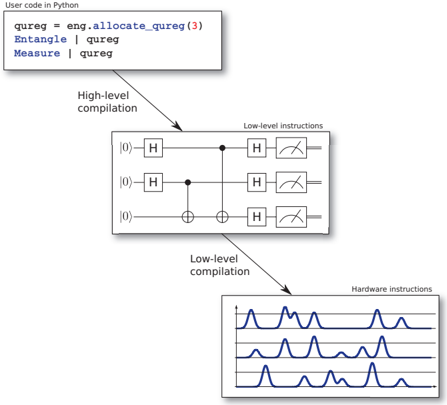
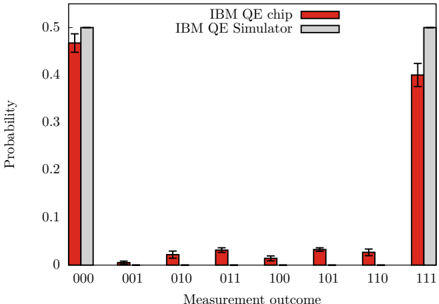
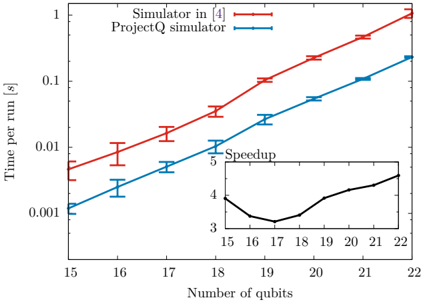
We introduce ProjectQ, an open source software effort for quantum computing. The first release features a compiler framework capable of targeting various types of hardware, a high-performance simulator with emulation capabilities, and compiler plug-ins for circuit drawing and resource estimation. We introduce our Python-embedded domain-specific language, present the features, and provide example implementations for quantum algorithms. The framework allows testing of quantum algorithms through simulation and enables running them on actual quantum hardware using a back-end connecting to the IBM Quantum Experience cloud service. Through extension mechanisms, users can provide back-ends to further quantum hardware, and scientists working on quantum compilation can provide plug-ins for additional compilation, optimization, gate synthesis, and layout strategies.
Overview
The claims and statistics of this paper haven’t been checked yet.
Free: it reads the open-access text and checks the first 5 claims that cite a source we can check. Create a free account to check every claim.
Integrity signals
Registry
Cites
Statistics
Figures



Verification
Claims the paper makes
The claims and statistics of this paper haven’t been checked yet.
Free: it reads the open-access text and checks the first 5 claims that cite a source we can check. Create a free account to check every claim.
Self-check
Percentages, sums and reported differences re-computed from the paper’s own numbers.
The self-check needs the paper’s full text.
Citations
Cites
A fast quantum mechanical algorithm for database search
Grover, L. K. (1996) · Proceedings of the twenty-eighth annual ACM symposium on Theory of computing - STOC '96 · doi:10.1145/237814.237866 · Cited by 8,830
Algorithms for quantum computation: discrete logarithms and factoring
Shor, P. W. (2002) · Proceedings 35th Annual Symposium on Foundations of Computer Science · doi:10.1109/sfcs.1994.365700 · Cited by 8,713
Elementary gates for quantum computation
Barenco, A., Bennett, C. H., Cleve, R., DiVincenzo, D. P., Margolus, N., Shor, P., Sleator, T., Smolin, J. A., & Weinfurter, H. (1995) · Physical Review A · doi:10.1103/physreva.52.3457 · Cited by 4,311
Quantum Computation with Ions in Thermal Motion
Sørensen, A., & Mølmer, K. (1999) · Physical Review Letters · doi:10.1103/physrevlett.82.1971 · Cited by 1,112
Quipper: a scalable quantum programming language
Green, A. S., Lumsdaine, P. L., Ross, N. J., Selinger, P., & Valiron, B. (2013) · Proceedings of the 34th ACM SIGPLAN Conference on Programming Language Design and Implementation · doi:10.1145/2491956.2462177 · Cited by 334
Circuit for Shor's algorithm using 2n+3 qubits
Beauregard, S. (2003) · Quantum Information and Computation · doi:10.26421/qic3.2-8 · Cited by 206
Addition on a Quantum Computer
Draper, T. G. (2000) · arXiv (Cornell University) · doi:10.48550/arxiv.quant-ph/0008033 · Cited by 185
0.5 petabyte simulation of a 45-qubit quantum circuit
Häner, T., & Steiger, D. S. (2017) · Proceedings of the International Conference for High Performance Computing, Networking, Storage and Analysis · doi:10.1145/3126908.3126947 · Cited by 180
Self-citationA software methodology for compiling quantum programs
Häner, T., Steiger, D. S., Svore, K., & Troyer, M. (2018) · Quantum Science and Technology · doi:10.1088/2058-9565/aaa5cc · Cited by 170
Self-citationQuipper: a scalable quantum programming language
Green, A. S., Lumsdaine, P. L., Ross, N. J., Selinger, P., & Valiron, B. (2013) · ACM SIGPLAN Notices · doi:10.1145/2499370.2462177 · Cited by 156
Cited by
Items 501–559 of 559
Quantum Simulation Programming via TypingPreprint
Li, L., Zahariev, F. E., Dissanayake, C., Swanepoel, J., Sabry, A., & Gordon, M. S. (2025) · arXiv (Cornell University) · doi:10.48550/arxiv.2509.17343
Pulse-Driven Spin Paradigm for Noise-Aware Quantum Classification
Riascos-Moreno, C., Álvarez-Meza, A. M., & Castellanos-Dominguez, G. (2025) · Computers · doi:10.3390/computers14110475
Giri, U., & Amsaad, F. (2025) · IEEE National Aerospace and Electronics Conference (NAECON) · doi:10.1109/naecon65708.2025.11235372
Traq: Estimating the Quantum Cost of Classical ProgramsPreprint
Peduri, A., Khan, J. K. A., Barthe, G., & Walter, M. (2025) · arXiv (Cornell University) · doi:10.48550/arxiv.2509.01508
QUANTUM SOFTWARE TESTING AND QUANTUM CRYPTOGRAPHY EDUCATION
Kaur, K. (2024) · Maryland Shared Open Access Repository (USMAI Consortium) · doi:10.13016/m2lhcl-2o6v
A Verified Optimizer for Quantum Circuits -- Software Artifact
Hietala, K., Rand, R. W., Hung, S.-H., Wu, X., & Hicks, M. (2020) · Zenodo (CERN European Organization for Nuclear Research) · doi:10.5281/zenodo.4074285
Refining quantum algorithms for each era of quantum computing
Meister, R. (2023) · Oxford University Research Archive (ORA) (University of Oxford) · doi:10.5287/ora-xvrj2pxa7
Entwicklung einer generischen Architektur für Quanten-Services in der Cloud
Singer, K. (2019) · OPUS Publication Server of the University of Stuttgart (University of Stuttgart) · doi:10.18419/opus-10623 · Cited by 1
Undetermined, U. (. (2019) · Research Repository (Delft University of Technology)
Gómez, F. J. O. (2020) · LA Referencia (Red Federada de Repositorios Institucionales de Publicaciones Científicas)
(2019) · OAPEN (The OAPEN Foundation)
Optimization of the D-MORPH method for implementing quantum gates
Zhdanov, K. (2018) · Research Repository Saint Petersburg State University (Saint Petersburg State University)
HybriD-GM: parallel model for quantum computing targeted to hybrid architectures
Avila, A. B. D. (2020) · LA Referencia (Red Federada de Repositorios Institucionales de Publicaciones Científicas)
LTIQ Un Calcolo Lineare per Q#
Guerra, A. (2021) · AMS Degree Thesis (University of Bologna)
Estimation of gradients and analysis of gradient-based optimizers for variational quantum algorithms
Wierichs, D. (2023) · Kölner Universitäts PublikationsServer (Universität zu Köln)
Study and implementation of the Deutsch-Jozsa quantum algorithm
Muriel Molina, M. (2022) · Repositorio de Patentes de la Universidad de Almería (Universidad de Almería)
Hybrid Schrödinger-Feynman Simulation of Quantum Circuits with Decision Diagrams
Bauer, H. (2021) · University Library Linz repository (Johannes Kepler Universitat Linz)
Programmatic Representation of Quantum Many Body Systems
Luo, X. (2024) · UWSpace (University of Waterloo)
Priyadarshini, S., Jatoth, C., Doriya, R., & Buyya, R. (2025) · Optics Communications · doi:10.1016/j.optcom.2025.132549
Parallelizing program execution on distributed quantum systems via compiler/hardware co-design
de Ronde, F. W. M., Knapen, A., Wong, S., & Feld, S. (2026) · Physica Scripta · doi:10.1088/1402-4896/aeb748
TorchQuantumDistributedPreprint
Knitter, O., Mei, J., Yamada, M., & Roetteler, M. (2025) · arXiv (Cornell University) · doi:10.48550/arxiv.2511.19291
Riu Vicente, J. (2019) · UPCommons institutional repository (Universitat Politècnica de Catalunya)
LogosQ: A High-Performance and Type-Safe Quantum Computing Library in RustPreprint
An, S., Wang, J., & Slavakis, K. (2025) · doi:10.36227/techrxiv.176703990.05707186/v1
Introduction to Quantum Computing
Mehta, S., & Iwendi, C. (2026) · Wiley eBooks · doi:10.1002/9781394238118.ch3
Generic Assurance Topics for Any Type of Programmable Content
Sharp, J., & Ashmore, R. (2022) · Safety-Critical Systems eJournal · doi:10.65391/r1517
Investigating Retargetability Claims for Quantum CompilersPreprint
Southall, L., Ammermann, J., Kelmendi, R., Eichhorn, D., & Schaefer, I. (2026) · arXiv (Cornell University) · doi:10.48550/arxiv.2601.16779
Applications of Quantum Arithmetic Designs
Wang, S., & Chattopadhyay, A. (2026) · Computer architecture and design methodologies · doi:10.1007/978-981-95-6039-4_4
Introduction of Advanced Algorithms in Software Engineering: A Computational Theory View
Nazar, S. (2025) · GlobeIS International Journal of Global Information Systems · doi:10.66395/globeis.5
Comparative analysis of quantum emulation for high-performance computing centers
Bravo-Montes, J. A., Bastante, M., Allouche, C., Cheah, S., Lambert, C., Gazda, A., Botella, G., Barrio, A. A. D., & García-Herrero, F. (2026) · SIMULATION · doi:10.1177/00375497261430860
Itoko, T. (2021) · Institutional Repositories DataBase (IRDB) · doi:10.15068/0002000758
ZHAO, P. (2023) · Institutional Repositories DataBase (IRDB)
Towards a formal compilation stack-frame in quantum computing
Borgna, A. (2023) · theses.fr (ABES) · doi:10.70675/48a49448z2a77z4bdaz9a11z6b16257bb4a5
Circuit compilation and error mitigation for near-term quantum computing
Niu, S. (2022) · theses.fr (ABES) · doi:10.70675/4b9fc4d0z9683z4a8dz8643zc514443d2d75
Krebbers, R. (2026) · Lecture notes in computer science · doi:10.1007/978-3-032-22720-1
Blain, D. (2026) · arXiv (Cornell University) · doi:10.48550/arxiv.2604.06712
Scaling quantum compilation with graph rewriting
Mondada, L. (2025) · Oxford University Research Archive (ORA) (University of Oxford) · doi:10.5287/ora-pvky10dbm
Q-ST: A Comprehensive Review of Quantum Software and Toolchains, Ecosystems, and Technologies
Hassan, S., & Giri, K. J. (2026) · Archives of Computational Methods in Engineering · doi:10.1007/s11831-026-10615-6
Li, Z., Guan, J., & Ying, M. (2026) · Lecture notes in computer science · doi:10.1007/978-3-032-26204-2_30
Sampaio, A., & Stoelinga, M. I. A. (2026) · Lecture notes in computer science · doi:10.1007/978-3-032-26204-2
Quantum-Native Maximum Likelihood Detection in Random Access Channel with Overloaded MIMOPreprint
Iizumi, H., Ishikawa, N., Uehashi, S., Nakamura, K., Umeda, S., & Koike-Akino, T. (2026) · arXiv (Cornell University) · doi:10.48550/arxiv.2605.19389
Quantum Machine Learning for Cybersecurity: Toward Smarter Intrusion Detection Systems
Rehman, M. U., Rehan, K., Abrar, M., & Rehan, I. (2026) · IEEE Transactions on Consumer Electronics · doi:10.1109/tce.2026.3697692
A Review Study of Quantum Computing
Kaur, G., Kour, S., & Kaur, S. (2026) · IJARCCE · doi:10.17148/ijarcce.2026.155261
Quantum Computing Explained: A Beginner's Guide to the Future of Processing
John, W. M. (2025) · International Journal of Information Technology Research Studies (IJITRS) · doi:10.63090/ijitrs/3139.3209.0013
Concrete Quantum Sieve for Shortest Vector Problem With Application to Lattice-Based Cryptography
Kim, H., Jang, K., Baksi, A., Wang, S., Chakraborty, S., Chattopadhyay, A., & Seo, H. (2026) · IEEE Access · doi:10.1109/access.2026.3706759
Saini, S., Saini, M., Tuli, H. S., Saini, J., Nagpal, S., Duhan, P., & Bansal, P. (2026) · De Gruyter eBooks · doi:10.1515/9783112214275-015
Accelerated Quantum Algorithm Prototyping: Modular Simulation and Noise Modelling with CUDA Support
Marevac, E., Kadušić, E., Zivic, N. S., & Ruland, C. (2026) · Journal of Advances in Information Technology · doi:10.12720/jait.17.6.1188-1210
Chen, Y., Liu, Q., Wang, Y., Mendl, C. B., & Seidl, H. (2026) · arXiv (Cornell University) · doi:10.48550/arxiv.2607.09976
Larssen, F., Pennati, L., Åsgrim, E. M., Peng, I. B., & Markidis, S. (2026) · arXiv (Cornell University) · doi:10.48550/arxiv.2608.01467
QPanda 3.0: A scalable and high performance compilation framework for large scale quantum programs
Zou, T.-R., Yuan, F., Wang, J., Fu, J., Zhao, S.-B., Yu, L., Zhao, D.-Y., Wang, H., Zhao, C.-Y., Ma, Y., et al. (2026) · Quantum Review Letters · doi:10.1016/j.qrl.2026.08.001
A survey on Quantum Key Distribution: Foundations and future directions
Zhang, X., Kar, P., Kwong, C. F., Chieng, D. H. T., & Guerra-Manzanares, A. (2026) · Computer Communications · doi:10.1016/j.comcom.2026.108652
MillionQAOA: A Dividable QAOA Framework for Solving Million-Vertex-Scale Max-Cut Problems
Li, X.-R., Huang, P.-H., Tu, C.-H., & Hung, S. (2026) · Proceedings of the International Conference on Parallel Processing · doi:10.1145/3832810.3832900
Quantum Computing in Next-Gen Smart Grid Operations: A Comprehensive ReviewPreprint
Ullah, M. H. (2026) · arXiv (Cornell University) · doi:10.48550/arxiv.2609.18847
Quantum Artificial Intelligence Integration for 6G Networks
Zeydan, E., Türk, Y., de Alwis, C., Aydeger, A., Ranaweera, P. S., & Liyanage, M. (2026) · IEEE Open Journal of the Communications Society · doi:10.1109/ojcoms.2026.3732807
QSimAdv: A Late-Bound, Vendor-Agnostic Architecture for High-Performance Quantum-Circuit SimulationPreprint
Liu, S., Elahi, P. J., Sun, W., Lyu, S., Shan, X., & Varetto, U. (2026) · arXiv (Cornell University) · doi:10.48550/arxiv.2608.16940
Cicero, A. (2026) · Chalmers Research (Chalmers University of Technology)
GPU-Accelerated Host-Aware Dead-Measurement Detection in Hybrid Quantum–Classical Programs
Chen, Y., Liu, Q., Wang, Y., Mendl, C. B., & Seidl, H. (2026) · Lecture notes in computer science · doi:10.1007/978-3-032-40374-2_19
The Gene Is Not the Gate: Conceptualizing the Semantic Genome of Quantum Software
Yu, J., Duan, Y., Zhao, Z., Yue, X., & Li, Z. (2026) · doi:10.1145/3844178.3844646
oracq: A Modular Framework for Implementing and Analyzing Quantum Scientific Computing AlgorithmsPreprint
Chen, Z.-Y., Tan, M., & Guo, G. (2026) · arXiv (Cornell University) · doi:10.48550/arxiv.2610.41431
Exploring the potential of quantum computing on current and future technologies
Sharma, C., & Sood, S. K. (2026) · Computer Science Review · doi:10.1016/j.cosrev.2026.101092
Metadata
- Authors
- Steiger, D. S., Häner, T., & Troyer, M.
- Affiliations
- ETH Zurich (CH)
- Venue
- Quantum
- Published
- 2018-01-31
- Volume
- 2
- Pages
- 49
- ISSN
- 2521-327X (ISSN-L)
- OpenAlex
- W2566002283
- Cited by
- 428
- References
- 18
- Citations by year
- 2026: 23 · 2025: 53 · 2024: 48 · 2023: 52 · 2022: 47 · 2021: 70 · 2020: 59 · 2019: 41 · 2018: 25
- FWCI
- 27.47
- Type
- journal article
- Language
- en
- Open access
- gold
- doi.org
- Locations
- Quantum (publishedVersion, cc-by)
- Repository for Publications and Research Data (ETH Zurich) (publishedVersion, cc-by)
- arXiv (Cornell University) (acceptedVersion)
- DOAJ (DOAJ: Directory of Open Access Journals) (submittedVersion, cc-by-sa)
- arXiv (Cornell University) (cc-by)
- ETH Zürich Research Collection
- Funders
- National Science Foundation
- Microsoft Research
- Schweizerischer Nationalfonds zur Förderung der Wissenschaftlichen Forschung
- Eidgenössische Technische Hochschule Zürich
- Topics
- Physical Sciences › Computer Science › Artificial Intelligence › Quantum Computing Algorithms and Architecture
- Physical Sciences › Computer Science › Hardware and Architecture › Parallel Computing and Optimization Techniques
- Physical Sciences › Physics and Astronomy › Atomic and Molecular Physics, and Optics › Quantum Information and Cryptography
- Keywords
- quantum computing software, quantum circuit compilation, quantum circuit simulation, domain-specific languages, quantum algorithms, IBM Quantum Experience, gate synthesis, circuit optimization, resource estimation, open source software
About these checks
Registry, retraction, Cites and statistics results are computed, not judged, with one exception: a printed reference that no index lists is read once by a model before it counts as a citation error. Claims are extracted by a model and kept only when their quote appears verbatim in the text; each cited source is then checked, with a model’s help, for whether it says what the claim relies on. Those verdicts can be wrong — read the claim’s quote and the cited source before relying on one.
Statistics and arithmetic are recomputed, not judged.
Confidence bands are shown only for fields calibrated on our annotated test set. None is calibrated yet, so no band is shown.
What counts as a claim ›How we measure confidence ›How we check this ›
Are you an author, or do you see a problem with this page? Request a review
Data sources
Bibliographic data: Semantic Scholar, OpenAlex, Crossref.
Contains information from the Semantic Scholar Academic Graph Datasets, made available under the ODC Attribution License (ODC-BY 1.0).
Semantic Scholar’s data is described in: Kinney, R., et al. (2023). The Semantic Scholar Open Data Platform. arXiv:2301.10140.
