

Tomographically reconstructed master equations for any open quantum dynamics
Open accessThe DOI matches its Crossref record; 56 of the 56 references it cites were found in a registry or an index.
Abstract
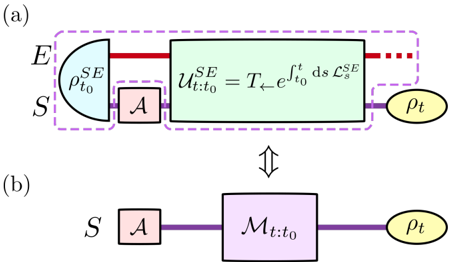
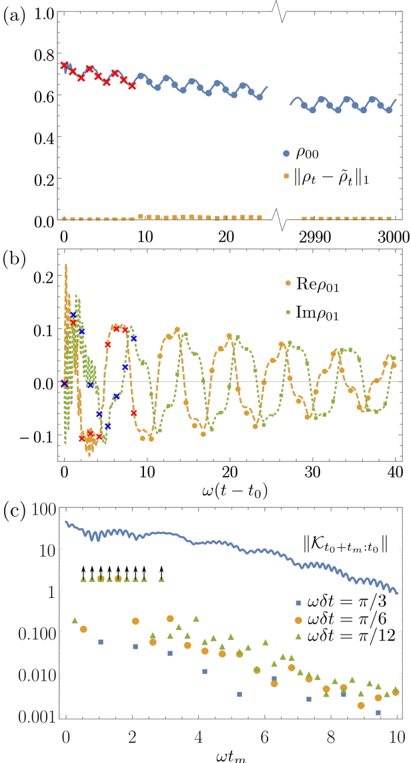
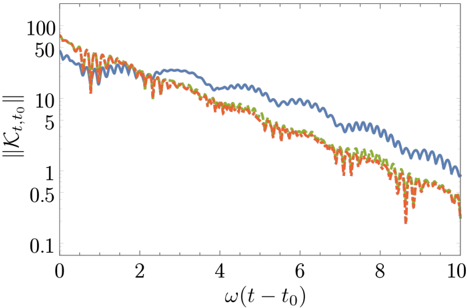
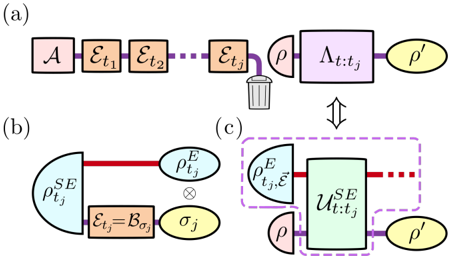
Memory effects in open quantum dynamics are often incorporated in the equation of motion through a superoperator known as the memory kernel, which encodes how past states affect future dynamics. However, the usual prescription for determining the memory kernel requires information about the underlying system-environment dynamics. Here, by deriving the transfer tensor method from first principles, we show how a memory kernel master equation, for any quantum process, can be entirely expressed in terms of a family of completely positive dynamical maps. These can be reconstructed through quantum process tomography on the system alone, either experimentally or numerically, and the resulting equation of motion is equivalent to a generalised Nakajima-Zwanzig equation. For experimental settings, we give a full prescription for the reconstruction procedure, rendering the memory kernel operational. When simulation of an open system is the goal, we show how our procedure yields a considerable advantage for numerically calculating dynamics, even when the system is arbitrarily periodically (or transiently) driven or initially correlated with its environment. Namely, we show that the long time dynamics can be efficiently obtained from a set of reconstructed maps over a much shorter time.
Overview
The claims and statistics of this paper haven’t been checked yet.
Free: it reads the open-access text and checks the first 5 claims that cite a source we can check. Create a free account to check every claim.
Integrity signals
Registry
Cites
Statistics
Figures
Verification
Claims the paper makes
The claims and statistics of this paper haven’t been checked yet.
Free: it reads the open-access text and checks the first 5 claims that cite a source we can check. Create a free account to check every claim.
Self-check
Percentages, sums and reported differences re-computed from the paper’s own numbers.
The self-check needs the paper’s full text.
Citations
Cites
On the generators of quantum dynamical semigroups
Lindblad, G. (1976) · Communications in Mathematical Physics · doi:10.1007/bf01608499 · Cited by 7,548
The Theory of Open Quantum Systems
Breuer, H.-P., & Petruccione, F. (2007) · doi:10.1093/acprof:oso/9780199213900.001.0001 · Cited by 5,938
Theory of open quantum systems
Xu, R., & Yan, Y. (2002) · The Journal of Chemical Physics · doi:10.1063/1.1474579 · Cited by 5,922
Completely positive dynamical semigroups of N -level systems
Gorini, V., Kossakowski, A., & Sudarshan, E. C. G. (1976) · Journal of Mathematical Physics · doi:10.1063/1.522979 · Cited by 3,998
Many-Body Localization and Thermalization in Quantum Statistical Mechanics
Nandkishore, R., & Huse, D. A. (2015) · Annual Review of Condensed Matter Physics · doi:10.1146/annurev-conmatphys-031214-014726 · Cited by 2,376
Dynamical Decoupling of Open Quantum Systems
Viola, L., Knill, E., & Lloyd, S. (1999) · Physical Review Letters · doi:10.1103/physrevlett.82.2417 · Cited by 1,808
Dynamics of non-Markovian open quantum systems
de Vega, I., & Alonso, D. (2017) · Reviews of Modern Physics · doi:10.1103/revmodphys.89.015001 · Cited by 1,234
Prescription for experimental determination of the dynamics of a quantum black box
Chuang, I. L., & Nielsen, M. A. (1997) · Journal of Modern Optics · doi:10.1080/09500349708231894 · Cited by 949
Tanimura, Y. (2006) · Journal of the Physical Society of Japan · doi:10.1143/jpsj.75.082001 · Cited by 891
Concepts and Methods in the Theory of Open Quantum Systems
Breuer, H.-P., & Petruccione, F. (2003) · Lecture Notes in Physics · doi:10.1007/3-540-44874-8_4 · Cited by 746
Research works printed but not linked: 2
- A. Strathearn, P. Kirton, D. Kilda, J. Keeling, and B. W. Lovett, arXiv:1711.09641 (2017b). · arXiv
- V. Prepeliţă, M. Doroftei, and T. Vasilache, Balkan J. Geom. Appl. 3, 111 (1998).
Cited by
Non-Markovian quantum processes: Complete framework and efficient characterization
Pollock, F. A., Rodríguez-Rosario, C., Frauenheim, T., Paternostro, M., & Modi, K. (2018) · Physical Review A · doi:10.1103/physreva.97.012127 · Cited by 334
Self-citationQuantum Stochastic Processes and Quantum non-Markovian Phenomena
Milz, S., & Modi, K. (2021) · PRX Quantum · doi:10.1103/prxquantum.2.030201 · Cited by 174
Self-citationJørgensen, M. R., & Pollock, F. A. (2019) · Physical Review Letters · doi:10.1103/physrevlett.123.240602 · Cited by 161
Self-citationCompletely Positive Divisibility Does Not Mean Markovianity
Milz, S., Kim, M. S., Pollock, F. A., & Modi, K. K. (2019) · Physical Review Letters · doi:10.1103/physrevlett.123.040401 · Cited by 159
Self-citationNon-Markovian Quantum Process Tomography
White, G. A. L., Pollock, F. A., Hollenberg, L. C. L., Modi, K. K., & Hill, C. D. (2022) · PRX Quantum · doi:10.1103/prxquantum.3.020344 · Cited by 150
Self-citation
Metadata
- Authors
- Pollock, F. A., & Modi, K.
- Affiliations
- Monash University (AU)
- Venue
- Quantum
- Published
- 2018-07-11
- Volume
- 2
- Pages
- 76
- ISSN
- 2521-327X (ISSN-L)
- OpenAlex
- W2607611777
- Cited by
- 56
- References
- 56
- Citations by year
- 2026: 3 · 2025: 3 · 2024: 10 · 2023: 3 · 2022: 8 · 2021: 8 · 2020: 9 · 2019: 10 · 2018: 2
- FWCI
- 3.35
- Type
- journal article
- Language
- en
- Open access
- gold
- doi.org
- Locations
- Quantum (publishedVersion, cc-by)
- arXiv (Cornell University) (submittedVersion)
- Monash University Research Portal (Monash University) (submittedVersion, other-oa)
- DOAJ (DOAJ: Directory of Open Access Journals) (submittedVersion, cc-by-sa)
- arXiv (Cornell University) (cc-by)
- Funders
- Australian Research Council (FT160100073)
- Topics
- Physical Sciences › Physics and Astronomy › Atomic and Molecular Physics, and Optics › Quantum Mechanics and Applications
- Physical Sciences › Physics and Astronomy › Statistical and Nonlinear Physics › Advanced Thermodynamics and Statistical Mechanics
- Physical Sciences › Physics and Astronomy › Atomic and Molecular Physics, and Optics › Quantum Information and Cryptography
- Keywords
- memory kernel, open quantum systems, quantum master equation, quantum process tomography, Nakajima-Zwanzig equation, periodically driven systems, memory effects
About these checks
Registry, retraction, Cites and statistics results are computed, not judged, with one exception: a printed reference that no index lists is read once by a model before it counts as a citation error. Claims are extracted by a model and kept only when their quote appears verbatim in the text; each cited source is then checked, with a model’s help, for whether it says what the claim relies on. Those verdicts can be wrong — read the claim’s quote and the cited source before relying on one.
Statistics and arithmetic are recomputed, not judged.
Confidence bands are shown only for fields calibrated on our annotated test set. None is calibrated yet, so no band is shown.
What counts as a claim ›How we measure confidence ›How we check this ›
Are you an author, or do you see a problem with this page? Request a review
How to cite
Cite CoChat for the checks on this page, and the paper for its own findings.
- This page
- CoChat. (2026). Citation check: Tomographically reconstructed master equations for any open quantum dynamics. https://app.cochat.ai/papers/10.22331/q-2018-07-11-76
- The paper
- Pollock, F. A., & Modi, K. (2018). Tomographically reconstructed master equations for any open quantum dynamics. Quantum. https://doi.org/10.22331/q-2018-07-11-76
Data sources
Bibliographic data: Semantic Scholar, OpenAlex, Crossref.
Contains information from the Semantic Scholar Academic Graph Datasets, made available under the ODC Attribution License (ODC-BY 1.0).
Semantic Scholar’s data is described in: Kinney, R., et al. (2023). The Semantic Scholar Open Data Platform. arXiv:2301.10140.
