

Tomographically reconstructed master equations for any open quantum dynamics
Open accessThe DOI matches its Crossref record; 56 of the 56 references it cites were found in a registry or an index.
Abstract
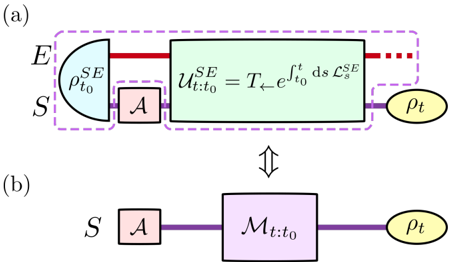
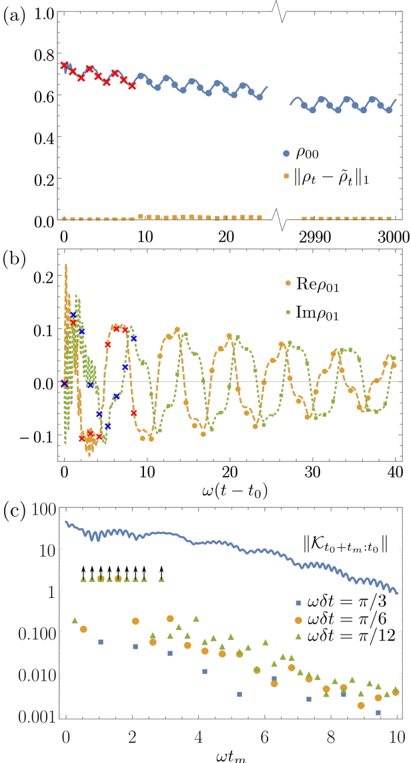
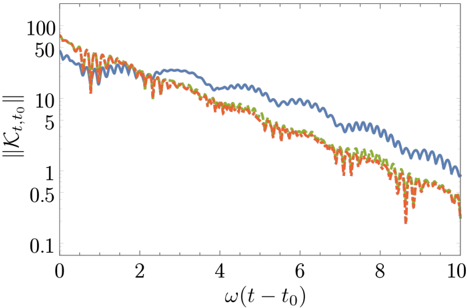
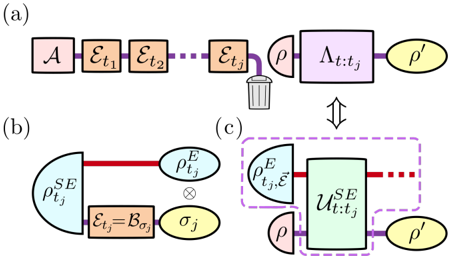
Memory effects in open quantum dynamics are often incorporated in the equation of motion through a superoperator known as the memory kernel, which encodes how past states affect future dynamics. However, the usual prescription for determining the memory kernel requires information about the underlying system-environment dynamics. Here, by deriving the transfer tensor method from first principles, we show how a memory kernel master equation, for any quantum process, can be entirely expressed in terms of a family of completely positive dynamical maps. These can be reconstructed through quantum process tomography on the system alone, either experimentally or numerically, and the resulting equation of motion is equivalent to a generalised Nakajima-Zwanzig equation. For experimental settings, we give a full prescription for the reconstruction procedure, rendering the memory kernel operational. When simulation of an open system is the goal, we show how our procedure yields a considerable advantage for numerically calculating dynamics, even when the system is arbitrarily periodically (or transiently) driven or initially correlated with its environment. Namely, we show that the long time dynamics can be efficiently obtained from a set of reconstructed maps over a much shorter time.
Overview
The claims and statistics of this paper haven’t been checked yet.
Free: it reads the open-access text and checks the first 5 claims that cite a source we can check. Create a free account to check every claim.
Integrity signals
Registry
Cites
Statistics
Figures
Verification
Claims the paper makes
The claims and statistics of this paper haven’t been checked yet.
Free: it reads the open-access text and checks the first 5 claims that cite a source we can check. Create a free account to check every claim.
Self-check
Percentages, sums and reported differences re-computed from the paper’s own numbers.
The self-check needs the paper’s full text.
Citations
Cites
On the generators of quantum dynamical semigroups
Lindblad, G. (1976) · Communications in Mathematical Physics · doi:10.1007/bf01608499 · Cited by 7,548
The Theory of Open Quantum Systems
Breuer, H.-P., & Petruccione, F. (2007) · doi:10.1093/acprof:oso/9780199213900.001.0001 · Cited by 5,938
Theory of open quantum systems
Xu, R., & Yan, Y. (2002) · The Journal of Chemical Physics · doi:10.1063/1.1474579 · Cited by 5,922
Completely positive dynamical semigroups of N -level systems
Gorini, V., Kossakowski, A., & Sudarshan, E. C. G. (1976) · Journal of Mathematical Physics · doi:10.1063/1.522979 · Cited by 3,998
Many-Body Localization and Thermalization in Quantum Statistical Mechanics
Nandkishore, R., & Huse, D. A. (2015) · Annual Review of Condensed Matter Physics · doi:10.1146/annurev-conmatphys-031214-014726 · Cited by 2,376
Dynamical Decoupling of Open Quantum Systems
Viola, L., Knill, E., & Lloyd, S. (1999) · Physical Review Letters · doi:10.1103/physrevlett.82.2417 · Cited by 1,808
Dynamics of non-Markovian open quantum systems
de Vega, I., & Alonso, D. (2017) · Reviews of Modern Physics · doi:10.1103/revmodphys.89.015001 · Cited by 1,234
Prescription for experimental determination of the dynamics of a quantum black box
Chuang, I. L., & Nielsen, M. A. (1997) · Journal of Modern Optics · doi:10.1080/09500349708231894 · Cited by 949
Tanimura, Y. (2006) · Journal of the Physical Society of Japan · doi:10.1143/jpsj.75.082001 · Cited by 891
Concepts and Methods in the Theory of Open Quantum Systems
Breuer, H.-P., & Petruccione, F. (2003) · Lecture Notes in Physics · doi:10.1007/3-540-44874-8_4 · Cited by 746
Research works printed but not linked: 2
- A. Strathearn, P. Kirton, D. Kilda, J. Keeling, and B. W. Lovett, arXiv:1711.09641 (2017). · arXiv
- V. Prepeliţȃ, M. Doroftei, and T. Vasilache, Balkan J. Geom. Appl. 3, 111 (1998).
Cited by
Non-Markovian quantum processes: Complete framework and efficient characterization
Pollock, F. A., Rodríguez-Rosario, C., Frauenheim, T., Paternostro, M., & Modi, K. (2018) · Physical Review A · doi:10.1103/physreva.97.012127 · Cited by 334
Self-citationQuantum Stochastic Processes and Quantum non-Markovian Phenomena
Milz, S., & Modi, K. (2021) · PRX Quantum · doi:10.1103/prxquantum.2.030201 · Cited by 174
Self-citationJørgensen, M. R., & Pollock, F. A. (2019) · Physical Review Letters · doi:10.1103/physrevlett.123.240602 · Cited by 161
“Exact simulation often requires numerical methods, e.g., discrete path integrals [10 – 14], memory kernels [15 – 21], hierarchical equations of motion [22,23], and others [24 – 26].”
MethodSelf-citationCompletely Positive Divisibility Does Not Mean Markovianity
Milz, S., Kim, M. S., Pollock, F. A., & Modi, K. K. (2019) · Physical Review Letters · doi:10.1103/physrevlett.123.040401 · Cited by 161
Self-citationNon-Markovian Quantum Process Tomography
White, G. A. L., Pollock, F. A., Hollenberg, L. C. L., Modi, K. K., & Hill, C. D. (2022) · PRX Quantum · doi:10.1103/prxquantum.3.020344 · Cited by 153
“This motivates the idea of Markov order [38, 73]: the number of previous time steps in the process which are relevant to the present.”
Self-citationMachine Learning Non-Markovian Quantum Dynamics
Luchnikov, I. A., Vintskevich, S., Grigoriev, D. A., & Filippov, S. N. (2020) · Physical Review Letters · doi:10.1103/physrevlett.124.140502 · Cited by 128
“A recently proposed transfer tensor method [29–31] uses a finite set of reconstructed maps { Φ( t i ) } Ki =1 to learn the Nakajima-Zwanzig equation [32, 33] ddt (cid:37) S ( t ) = (cid:82) t 0 K ( t − t (cid:48) ) (cid:37) ( t (cid:48) ) dt (cid:48) with a memory kernel K that gives rise to…”
MethodTight, robust, and feasible quantum speed limits for open dynamics
Campaioli, F., Pollock, F. A., & Modi, K. (2019) · Quantum · doi:10.22331/q-2019-08-05-168 · Cited by 92
“, in the form of the Nakajima-Zwanzig equation, ρ̇t = Ltρt + ∫ t t0 dsKt,sρs + Jt,t0 , where Lt is a time-local generator like that of the Lindblad master equation, the memory kernelKt,s accounts for the effect of memory, and Jt,t0 accounts for initial correlations between system and environment [64].”
Self-citationAn Introduction to Operational Quantum Dynamics
Milz, S., Pollock, F. A., & Modi, K. K. (2017) · Open Systems & Information Dynamics · doi:10.1142/s1230161217400169 · Cited by 119
Self-citationModelling non-markovian quantum processes with recurrent neural networks
Banchi, L., Grant, E., Rocchetto, A., & Severini, S. (2018) · New Journal of Physics · doi:10.1088/1367-2630/aaf749 · Cited by 109
Taranto, P., Pollock, F. A., Milz, S., Tomamichel, M., & Modi, K. K. (2019) · Physical Review Letters · doi:10.1103/physrevlett.122.140401 · Cited by 93
Self-citationStructure of quantum stochastic processes with finite Markov order
Taranto, P., Milz, S., Pollock, F. A., & Modi, K. K. (2019) · Physical Review A · doi:10.1103/physreva.99.042108 · Cited by 75
Self-citationHigher-Order Quantum OperationsPreprint
Taranto, P., Milz, S., Murao, M., Quintino, M. T., & Modi, K. K. (2025) · arXiv (Cornell University) · doi:10.48550/arxiv.2503.09693 · Cited by 71
Self-citationTensor-network-based machine learning of non-Markovian quantum processes
Guo, C., Modi, K. K., & Poletti, D. (2020) · Physical Review A · doi:10.1103/physreva.102.062414 · Cited by 64
Self-citationResource theories of multi-time processes: A window into quantum non-Markovianity
Berk, G. D., Garner, A. J. P., Yadin, B., Modi, K. K., & Pollock, F. A. (2021) · Quantum · doi:10.22331/q-2021-04-20-435 · Cited by 73
“More importantly, the process tensor enables the systematic exploration of the rich structure of quantum non-Markovian memory [37–48].”
BackgroundSelf-citationA Taxonomy of Small Markovian Errors
Blume-Kohout, R., Silva, M. P. D., Nielsen, E., Proctor, T. J., Rudinger, K., Sarovar, M., & Young, K. (2022) · PRX Quantum · doi:10.1103/prxquantum.3.020335 · Cited by 84
Initial system-environment correlations via the transfer-tensor method
Buser, M., Cerrillo, J., Schaller, G., & Cao, J. (2017) · Physical Review A · doi:10.1103/physreva.96.062122 · Cited by 54
Vrugt, M. T., & Wittkowski, R. (2019) · Physical review. E · doi:10.1103/physreve.99.062118 · Cited by 64
Almost Markovian processes from closed dynamics
Figueroa–Romero, P., Modi, K. K., & Pollock, F. A. (2019) · Quantum · doi:10.22331/q-2019-04-30-136 · Cited by 49
“The locality constraint, along with monotonicity of non-Markovianity under coarse graining, have further important consequences for a broad class of open systems studies where master equations are employed [48].”
BackgroundSelf-citationCorrelation-Picture Approach to Open-Quantum-System Dynamics
Alipour, S., Rezakhani, A. T., Babu, A. P., Mølmer, K., Möttönen, M., & Ala-Nissila, T. (2020) · Physical Review X · doi:10.1103/physrevx.10.041024 · Cited by 46
Non-Markovian memory strength bounds quantum process recoverability
Taranto, P., Pollock, F. A., & Modi, K. K. (2021) · npj Quantum Information · doi:10.1038/s41534-021-00481-4 · Cited by 50
Self-citationNon-Markovian Noise Characterization with the Transfer Tensor Method
Chen, Y., Ma, K., Zheng, Y.-C., Allcock, J., Zhang, S., & Hsieh, C. (2020) · Physical Review Applied · doi:10.1103/physrevapplied.13.034045 · Cited by 42
Correlation-picture approach to open-quantum-system dynamics
Alipour, S., Rezakhani, A., Babu, A., Mølmer, K., Möttönen, M., & Ala-Nissilä, T. (2020) · Aaltodoc (Aalto University) · Cited by 38
What can unitary sequences tell us about multi-time physics?
White, G. A. L., Pollock, F. A., Hollenberg, L. C. L., Hill, C. D., & Modi, K. K. (2025) · Quantum · doi:10.22331/q-2025-04-08-1695 · Cited by 44
“Above, one choice leads to multi-time entanglement, while another leads to two-time entanglement, which can be related to the complexity of quantum dynamics [11], including for quantum master equations [38].”
Self-citationGeneralized quantum master equation: A tutorial review and recent advances
Brian, D., & Sun, X. Y. (2021) · Chinese Journal of Chemical Physics · doi:10.1063/1674-0068/cjcp2109157 · Cited by 35
Dominic, A. J., Cao, S., Montoya−Castillo, A., & Huang, X. (2023) · Journal of the American Chemical Society · doi:10.1021/jacs.3c01095 · Cited by 40
Markovianization with approximate unitary designs
Figueroa–Romero, P., Pollock, F. A., & Modi, K. K. (2021) · Communications Physics · doi:10.1038/s42005-021-00629-w · Cited by 31
Self-citationDiscrete memory kernel for multitime correlations in non-Markovian quantum processes
Jørgensen, M. R., & Pollock, F. A. (2020) · Physical Review A · doi:10.1103/physreva.102.052206 · Cited by 26
Self-citationLuchnikov, I. A., Kiktenko, E. O., Gavreev, M. A., Ouerdane, H., Filippov, S. N., & Fedorov, A. K. (2022) · Physical Review Research · doi:10.1103/physrevresearch.4.043002 · Cited by 31
“[50] Felix A Pollock and Kavan Modi, “Tomographically reconstructed master equations for any open quantum dynamics,” Quantum 2, 76 (2018).”
BackgroundMemory kernel and divisibility of Gaussian collisional models
Camasca, R. R., & Landi, G. T. (2021) · Physical Review A · doi:10.1103/physreva.103.022202 · Cited by 23
Universal construction of decoders from encoding black boxes
Yoshida, S., Soeda, A., & Murao, M. (2023) · Quantum · doi:10.22331/q-2023-03-20-957 · Cited by 18
Process Tensor Approaches to Non-Markovian Quantum Dynamics
Keeling, J., Stoudenmire, E. M., Bañuls, M. C., & Reichman, D. R. (2026) · Physical Review X · doi:10.1103/1ncg-11hz · Cited by 23
“[117], by explicitly constructing the discretized memory kernel in terms of transfer tensors that can be extracted from a knowledge of the dynamical maps—as provided by the influence functional—at different times.”
Sampling Complexity of Open Quantum Systems
Aloisio, I. A., White, G. A. L., Hill, C. D., & Modi, K. K. (2023) · PRX Quantum · doi:10.1103/prxquantum.4.020310 · Cited by 22
Self-citationMemory effects in quantum processes
Taranto, P. (2020) · International Journal of Quantum Information · doi:10.1142/s0219749919410028 · Cited by 22
Learning and forecasting open quantum dynamics with correlated noise
Zhang, X., Wu, Z., White, G. A. L., Xiang, Z., Hu, S., Peng, Z., Liu, Y., Zheng, D. N., Fu, X., Huang, A., et al. (2025) · Communications Physics · doi:10.1038/s42005-025-01944-2 · Cited by 24
Self-citationReduced Dynamics of Full Counting Statistics
Pollock, F. A., Gull, E., Modi, K. K., & Cohen, G. (2022) · SciPost Physics · doi:10.21468/scipostphys.13.2.027 · Cited by 17
“[67] (reproduced in Appendix B), one can recursively define a family of transfer tensors on a set of discrete times {tj} through”
BackgroundSelf-citationDenoising and Extension of Response Functions in the Time Domain
Kemper, A. F., Yang, C., & Gull, E. (2024) · Physical Review Letters · doi:10.1103/physrevlett.132.160403 · Cited by 14
Sayer, T., & Montoya−Castillo, A. (2024) · The Journal of Chemical Physics · doi:10.1063/5.0185578 · Cited by 14
Wu, A., Cerrillo, J., & Cao, J. (2024) · Nanophotonics · doi:10.1515/nanoph-2023-0831 · Cited by 17
Memory Effects in Quantum Processes
Taranto, P. (2019) · Figshare · doi:10.26180/5cd01e27b8c91 · Cited by 13
Cemin, G., Carnazza, F., Andergassen, S., Martius, G., Carollo, F., & Lesanovsky, I. (2024) · Physical Review Applied · doi:10.1103/physrevapplied.21.l041001 · Cited by 17
“A more general approach is to fit an OQS dynamics by learning the Nakajima-Zwanzig equation [34, 35] through transfer tensor techniques [36–38] or by learning convolutionless master equations [39].”
MethodTransfer-tensor description of memory effects in open-system dynamics and multi-time statistics
Gherardini, S., Smirne, A., Huelga, S. F., & Caruso, F. (2022) · Quantum Science and Technology · doi:10.1088/2058-9565/ac4422 · Cited by 14
Capturing Long-Range Memory Structures with Tree-Geometry Process Tensors
Dowling, N., Modi, K. K., Muñoz, R. N., Singh, S., & White, G. A. L. (2024) · Physical Review X · doi:10.1103/physrevx.14.041018 · Cited by 20
“One could also connect this with master equation descriptions of open quantum system dynamics, which can be derived exactly from the process tensor [119].”
BackgroundSelf-citationExtracting dynamical maps of non-Markovian open quantum systems
Strachan, D. J., Purkayastha, A., & Clark, S. R. (2024) · The Journal of Chemical Physics · doi:10.1063/5.0228428 · Cited by 14
Babu, A. P., Alipour, S., Rezakhani, A. T., & Ala-Nissilä, T. (2024) · Physical Review Research · doi:10.1103/physrevresearch.6.013243 · Cited by 11
Unifying methods for optimal control in non-Markovian quantum systems via process tensors
Ortega-Taberner, C., O'Neill, E., Butler, E. P., Fux, G. E., & Eastham, P. R. (2024) · The Journal of Chemical Physics · doi:10.1063/5.0226031 · Cited by 18
Finite-Dimensional Stinespring Curves Can Approximate Any Dynamics
Ende, F. V. (2024) · Open Systems & Information Dynamics · doi:10.1142/s1230161224500045 · Cited by 8
Energy fluctuation relations and repeated quantum measurements
Gherardini, S., Buffoni, L., Giachetti, G., Trombettoni, A., & Ruffo, S. (2022) · Chaos Solitons & Fractals · doi:10.1016/j.chaos.2022.111890 · Cited by 9
Xu, X., Guo, C., & Chen, R. (2024) · The Journal of Chemical Physics · doi:10.1063/5.0226167 · Cited by 7
On the discretization error of the discrete generalized quantum master equation
Peng, R., Lindoy, L. P., & Lee, J. (2025) · The Journal of Chemical Physics · doi:10.1063/5.0293127 · Cited by 5
Preparations and weak-field phase control can witness initial correlations
Nahar, S., & Vinjanampathy, S. (2019) · Physical Review A · doi:10.1103/physreva.100.062120 · Cited by 4
Equilibration and Typicality in Quantum Processes
ROMERO, P. F. (2021) · arXiv (Cornell University) · doi:10.26180/13684795 · Cited by 4
Non-Markovian Quantum Control via Model Maximum Likelihood Estimation and Reinforcement LearningPreprint
Neema, T., Jha, S., & Sahai, T. (2024) · arXiv (Cornell University) · doi:10.48550/arxiv.2402.05084 · Cited by 3
“Finding the exact form of the kernel can be accomplished through determining a series of transfer tensors [26, 27, 28, 29].”
BackgroundGeorge Sudarshan and Quantum Dynamics
Modi, K. K. (2019) · Open Systems & Information Dynamics · doi:10.1142/s1230161219500136 · Cited by 2
Self-citationQuantum scarring enhances non-Markovianity of subsystem dynamics
Banerjee, A. (2026) · New Journal of Physics · doi:10.1088/1367-2630/ae5ea1 · Cited by 2
“…qualitatively similar results, it would be very interesting to investigate subsystem non-Markovianity in scarred and other closed quantum many-body systems using approaches based on process tensors or properties of the extracted dynamical maps underlying subsystem dynamics, see e.g. [70– 77]).”
The transfer tensor method: An analytical study case
Morillas-Rozas, M., López-García, A., Rivero, G. R., Cao, J., & Cerrillo, J. (2026) · The Journal of Chemical Physics · doi:10.1063/5.0340784 · Cited by 1
Não Markovianidade em modelos colisionais Gaussianos
Camasca, R. R. (2020) · Digital Library of Theses and Dissertations (Universidade de São Paulo) · doi:10.11606/d.43.2020.tde-21012021-022723
(2022) · SciPost Physics · doi:10.21468/scipost.report.5289
(2021) · SciPost Physics · doi:10.21468/scipost.report.4095
(2022) · SciPost Physics · doi:10.21468/scipost.report.5275
(2022) · SciPost Physics · doi:10.21468/scipost.report.4152
White, G. A. L. (2024) · arXiv (Cornell University) · doi:10.48550/arxiv.2405.05416 · Cited by 2
Advances in Quantum Machine Learning
Grant, E. (2024) · UCL Discovery (University College London)
Borrelli, R., & Takahashi, H. (2026) · The Journal of Chemical Physics · doi:10.1063/5.0332266
“…states can be propagated by the discrete NZ equation, The same information can be cast into the transfer-tensor form of Cerrillo and Cao, 15,66,72,73 which yields the propagation rule Most importantly, if the bath correlation time is finite, the kernel (or transfer tensors) falls off as a…”
Metadata
- Authors
- Pollock, F. A., & Modi, K.
- Affiliations
- Monash University (AU)
- Venue
- Quantum
- Published
- 2018-07-11
- Volume
- 2
- Pages
- 76
- ISSN
- 2521-327X (ISSN-L)
- OpenAlex
- W2607611777
- Cited by
- 56
- References
- 56
- Citations by year
- 2026: 3 · 2025: 3 · 2024: 10 · 2023: 3 · 2022: 8 · 2021: 8 · 2020: 9 · 2019: 10 · 2018: 2
- FWCI
- 3.35
- Type
- journal article
- Language
- en
- Open access
- gold
- doi.org
- Locations
- Quantum (publishedVersion, cc-by)
- arXiv (Cornell University) (submittedVersion)
- Monash University Research Portal (Monash University) (submittedVersion, other-oa)
- DOAJ (DOAJ: Directory of Open Access Journals) (submittedVersion, cc-by-sa)
- arXiv (Cornell University) (cc-by)
- Funders
- Australian Research Council (FT160100073)
- Topics
- Physical Sciences › Physics and Astronomy › Atomic and Molecular Physics, and Optics › Quantum Mechanics and Applications
- Physical Sciences › Physics and Astronomy › Statistical and Nonlinear Physics › Advanced Thermodynamics and Statistical Mechanics
- Physical Sciences › Physics and Astronomy › Atomic and Molecular Physics, and Optics › Quantum Information and Cryptography
- Keywords
- memory kernel, open quantum systems, quantum master equation, quantum process tomography, Nakajima-Zwanzig equation, periodically driven systems, memory effects
About these checks
Registry, retraction, Cites and statistics results are computed, not judged, with one exception: a printed reference that no index lists is read once by a model before it counts as a citation error. Claims are extracted by a model and kept only when their quote appears verbatim in the text; each cited source is then checked, with a model’s help, for whether it says what the claim relies on. Those verdicts can be wrong — read the claim’s quote and the cited source before relying on one.
Statistics and arithmetic are recomputed, not judged.
Confidence bands are shown only for fields calibrated on our annotated test set. None is calibrated yet, so no band is shown.
What counts as a claim ›How we measure confidence ›How we check this ›
Are you an author, or do you see a problem with this page? Request a review
Data sources
Bibliographic data: Semantic Scholar, OpenAlex, Crossref.
Contains information from the Semantic Scholar Academic Graph Datasets, made available under the ODC Attribution License (ODC-BY 1.0).
Semantic Scholar’s data is described in: Kinney, R., et al. (2023). The Semantic Scholar Open Data Platform. arXiv:2301.10140.
