

The DOI matches its Crossref record; 78 of the 89 references it cites were found in a registry or an index; 37 of the 67 sources its claims cite were checked for support.
Tight, robust, and feasible quantum speed limits for open dynamics
Open accessAbstract
Starting from a geometric perspective, we derive a quantum speed limit for arbitrary open quantum evolution, which could be Markovian or non-Markovian, providing a fundamental bound on the time taken for the most general quantum dynamics. Our methods rely on measuring angles and distances between (mixed) states represented as generalized Bloch vectors. We study the properties of our bound and present its form for closed and open evolution, with the latter in both Lindblad form and in terms of a memory kernel. Our speed limit is provably robust under composition and mixing, features that largely improve the effectiveness of quantum speed limits for open evolution of mixed states. We also demonstrate that our bound is easier to compute and measure than other quantum speed limits for open evolution, and that it is tighter than the previous bounds for almost all open processes. Finally, we discuss the usefulness of quantum speed limits and their impact in current research.
Overview
CoChat Summary
TL;DR
The paper derives a geometric quantum speed limit (QSL) for arbitrary open quantum dynamics using generalized Bloch vectors and the Hilbert-Schmidt norm, yielding a bound that is robust under composition and mixing. It argues this bound is tighter and more feasible than several existing open-dynamics QSLs for almost all processes.
Key findings
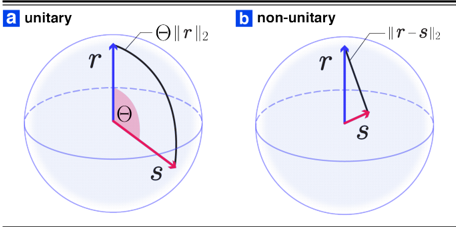
- The proposed bound is \(T_D = \|\rho-\sigma\| / \overline{\|\dot{\rho}_t\|}\), where the numerator is the Hilbert-Schmidt norm between initial and final states and the denominator is the orbit-averaged speed.
- The bound is robust under composition and under mixing: it is invariant under pure depolarization when the dynamics satisfies \(\dot{\rho}'_t = \dot{\rho}_t\), including unitary and unital maps, and more generally for completely positive maps with a fixed point.
- Analytically, \(T_D\) is tighter than Sun’s, Del Campo’s, and Deffner’s bounds for all allowed \(\rho,\sigma\) (Deffner’s under the condition that one state is pure). Numerically, it outperforms Mondal’s bound in 94% of 5000 sampled orbits, with average difference \(0.56 \pm 0.28\) (the text also reports \(0.57 \pm 0.28\) earlier).
- Feasibility is improved because the distance depends only on the overlap \(\mathrm{tr}[\rho\sigma]\), measurable via controlled-SWAP, and the speed can be estimated from finite-time increments using Eq. (12).
Methods
- Theoretical derivation: states are represented as generalized Bloch vectors; the distance \(D(\rho,\sigma)=\|r-s\|_2=\sqrt{d/(d-1)}\|\rho-\sigma\|_{\mathrm{HS}}\) is used to derive the QSL from the inequality between geodesic distance and path length.
- The paper analyzes the bound’s form for unitary evolution, Lindblad dynamics (pure dephasing, pure depolarization, purity change), memory-kernel/Nakajima-Zwanzig dynamics, and underlying system-environment unitary evolution.
- Numerical comparison: 5000 orbits sampled from Haar-random total Hamiltonians \(H\), environment states \(\gamma_E\), and initial system states \(\rho_0\), with system/environment dimensions uniformly sampled between 2 and 10 and \(\tau=1\); additionally, \(3\times10^6\) initial/final states from Bures and Ginibre ensembles are used to compare with Deffner’s bound.
Limitations
- The paper states that an attainable speed limit for arbitrary processes is yet to be found.
- The derivation lower-bounds the true geodesic distance by the Euclidean straight-line distance in the generalized Bloch ball, so the bound intrinsically underestimates the actual optimal evolution time; using triangle inequalities or temporal discretization for memory kernels further reduces tightness.
- The comparison with Mondal’s bound is numerical and sampled, not exhaustive; the text also notes that Pires’s infinite family of bounds is disregarded from direct comparison.
Model-written summary. Check it against the paper before relying on it.
Integrity signals
Registry
Cites
Statistics
Figures


Verification
Claims the paper makes
18 Valid · 4 Not valid · 24 Not checked · 74 Own results and interpretations
Some cited sources support this claim and some don’t — read each source’s verdict below.
In the paper
“Among all the QSL bounds known so far one can make a clear-cut distinction between the type of distances that have been used: either they require evaluating the overlap tr[ρσ] between the initial and the final states [49][50][51], or they require to calculate √ ρ and √ σ (or similar functions) [30,33,48].”
§ Tight, robust, and feasible quantum speed limits for open dynamics > 5 Feasibility
What the sources say
- Not checked yetcites [49][50][51]
- Disputedcites [30] 30. D. Mondal, C. Datta, and S. Sazim, "Quantum coherence sets the quantum speed limit for mixed states," Phys. Lett. A 380, 689 (2015). sourceExperimental — accuracy not yet measured
The paper does discuss QSL bounds based on the Bures angle, which involves a matrix square root (Section 3, p. 4). But it also derives a QSL from a different, operation-dependent distance based on |Tr(ρU)| (Sections 2–3, pp. 2–3). That distance is neither Tr(ρσ) nor a calculation of √ρ and √σ, contrary to the claimed exhaustive distinction. (LLM, conf=0.85)
Checked by a reasoning model — may be wrong.
- Supportedcites [33] 33. D. P. Pires, M. Cianciaruso, L. C. Céleri, G. Adesso, and D. O. Soares-Pinto, "General- ized Geometric Quantum Speed Limits," Phys. Rev. X 6, 021031 (2016). source
The cited paper supports the square-root-distance part of the sentence. In “Measures of distinguishability” (p. 6), it defines a measure using tr(√ρ₁√ρ₂), and in “Generalized Mandelstam–Tamm bounds” (p. 9), it uses that measure to formulate a quantum speed limit. The citation does not need to establish the sentence’s classification of all known bounds. (LLM, conf=0.92)
- Supportedcites [48] 48. S. Deffner and E. Lutz, "Quantum Speed Limit for Non-Markovian Dynamics," Phys. Rev. Lett 111, 010402 (2013). source
The paper gives a mixed-state fidelity involving square roots of the states (Quantum speed limits in open system dynamics, p. 1) and develops a speed-limit bound using relative purity (p. 2). It therefore exemplifies the types of state comparison identified by the grouped citations; it does not need to establish the citing authors’ survey of all known bounds. (LLM, conf=0.87)
boosted- Asserted: passes — The authors put it forward as true.
- Checkable: passes — It can be checked against evidence.
- Load-bearing: passes — The paper’s conclusions depend on it.
- Based: passes — The paper gives a reason why it holds.
The cited sources support only part of this claim — read each source’s verdict below.
In the paper
“This looseness is often a consequence of the choice of the distance used to derive the bounds: Different distances result in different speed limits, and a suitable choice that reflects the features of the considered evolution is the key to performance [33,46,51].”
§ Tight, robust, and feasible quantum speed limits for open dynamics > 1 Introduction
What the sources say
- Partly supportedcites [33] 33. D. P. Pires, M. Cianciaruso, L. C. Céleri, G. Adesso, and D. O. Soares-Pinto, "General- ized Geometric Quantum Speed Limits," Phys. Rev. X 6, 021031 (2016). sourceExperimental — accuracy not yet measured
Our copy supports the narrower part of the sentence: Section III B (p. 6) says that defining a speed of evolution 'requires one to choose a measure of distinguishability', and Section IV (pp. 8-9) shows that the trace distance and the Renyi relative entropy 'lead to two different generalizations of the Mandelstam-Tamm bound ... but yield tighter bounds in the case of mixed states', i.e. different distances give different and sometimes tighter speed limits. The causal attribution is not the paper's: the Introduction (p. 1) explains the looseness of the Mandelstam-Tamm and Margolus-Levitin bounds for mixed states by the bounding quantities Delta E and E_av - E_min not being genuine measures of asymmetry, and footnote 9 (p. 9) adds that Delta E 'is not [quasi-convex] and therefore can increase under mixing'. Accordingly the paper's remedy is to replace the upper-bounding function by an asymmetry measure (p. 7; Conclusion, p. 11), not to pick a distance matched to the features of the considered evolution — that 'key to performance' claim is not stated in our copy. (LLM, conf=0.72)
- Not matchedcites [46] 46. I. Bengtsson and K. Zyczkowski, Geometry of quantum states : an introduction to quantum en- tanglement (Cambridge University Press, 2008) p. 419.
Couldn’t be matched to a paper in Crossref, so it can’t be checked.
- Not matchedcites [51] 51. F. Campaioli, F. A. Pollock, F. C. Binder, and K. Modi, "Tightening Quantum Speed Limits for Almost All States," Phys. Rev. Lett. 120, 060409 (2017).
Couldn’t be matched to a paper in Crossref, so it can’t be checked.
hedgedstates a possible cause- Asserted: passes — The authors put it forward as true.
- Checkable: passes — It can be checked against evidence.
- Load-bearing: passes — The paper’s conclusions depend on it.
- Based: passes — The paper gives a reason why it holds.
- Partly supported
The cited sources support only part of this claim — read each source’s verdict below.
In the paper
“Here, for the sake of clarity, we consider the case of pure dephasing of a single qubit, described by the Lindblad equation ρt = γ(σ z ρ t σ z -ρ t ), as done in Ref. [49].The instantaneous speed reads ρt = √ 2 γ r 2 1 (t) + r 2 2 (t), where r t = (r 1 (t), r 2 (t), r 3 (t)) is the Bloch vector associated to ρ t .”
§ Tight, robust, and feasible quantum speed limits for open dynamics > 4.2 Lindblad dynamics
What the sources say
- Partly supportedcites [49] 49. A. del Campo, I. L. Egusquiza, M. B. Plenio, and S. F. Huelga, "Quantum Speed Limits in Open System Dynamics," Phys. Rev. Lett. 110, 050403 (2013). sourceExperimental — accuracy not yet measured
Our copy does establish the model the citation is attached to: the single-qubit Markovian pure-dephasing generator L†ρ₀ = -γρ₀ + γσ_z ρ₀ σ_z (Quantum speed limits in open system dynamics, p. 4, with the initial product state |c⟩ = (|0⟩+|1⟩)/√2 giving the orthogonalization time t_p = 1/2γ), and it defines the speed of evolution as the Hilbert-Schmidt norm, v = √tr[(∂_t ρ)²] (p. 6) and v = √tr[(L†ρ₀)²] (p. 2). What our copy does not state is the claim's closed-form instantaneous speed √2 γ √(r₁²(t)+r₂²(t)) in terms of the time-dependent Bloch-vector components: the paper's bound is deliberately referred 'exclusively to the initial state and the dynamical map' (p. 2), and the only Bloch-vector decomposition it works out (r_i, i=1,2,3, with s(t)=e^{-8γt}) is for decoherence in an isotropic environment (p. 6), not pure dephasing. So the setup and the norm definition are supported; the specific time-t expression attributed is not found (searched: instantaneous speed/Bloch components r₁(t), r₂(t), pure dephasing single qubit, Hilbert-Schmidt norm of ρ̇). Note also that many formula blocks in our copy appear as undecoded placeholders, so the exact expression could in principle sit inside one of them. (LLM, conf=0.70)
plainstates an association- Asserted: passes — The authors put it forward as true.
- Checkable: passes — It can be checked against evidence.
- Load-bearing: unclear — It is unclear whether the paper’s conclusions depend on it.
- Based: passes — The paper gives a reason why it holds.
- Partly supported
The cited sources support only part of this claim — read each source’s verdict below.
In the paper
“The distance term in many QSLs requires the square root of the initial and final states, thus the solution of the eigenvalue problem for the initial state ρ and final state σ [3,30,33,48].”
§ Tight, robust, and feasible quantum speed limits for open dynamics > 1 Introduction
What the sources say
- Partly supportedcites [3] 3. S. Deffner and E. Lutz, "Energy-time uncer- tainty relation for driven quantum systems," J. Phys. A Math. Theor. 46, 335302 (2013). sourceExperimental — accuracy not yet measured
The discussion of fidelity (p. 3) says that square roots make the Bures-distance term difficult to handle, and the Mandelstam–Tamm bound section (p. 3) expresses a density operator in terms of its eigenvalues. The paper does not explicitly say that evaluating the distance requires solving eigenvalue problems for both the initial and final states; that added requirement is not established by our copy. (LLM, conf=0.82)
- Partly supportedcites [30] 30. D. Mondal, C. Datta, and S. Sazim, "Quantum coherence sets the quantum speed limit for mixed states," Phys. Lett. A 380, 689 (2015). sourceExperimental — accuracy not yet measured
Section 3 (p. 4) describes existing QSL bounds based on the Bures angle and gives a distance expression containing a square root of the initial state. It does not say that these bounds require separate square roots of both endpoint states or explicitly require solving an eigenvalue problem for each. (LLM, conf=0.82)
- Partly supportedcites [33] 33. D. P. Pires, M. Cianciaruso, L. C. Céleri, G. Adesso, and D. O. Soares-Pinto, "General- ized Geometric Quantum Speed Limits," Phys. Rev. X 6, 021031 (2016). sourceExperimental — accuracy not yet measured
In “Measures of distinguishability” (p. 6), the paper defines a Rényi distinguishability measure using the square roots of both states; “Generalized Mandelstam–Tamm Bounds” (p. 9) uses that measure in a QSL. It does not state that many QSL distance terms require square roots, or that calculating them requires solving eigenvalue problems for both states. (LLM, conf=0.82)
- Partly supportedcites [48] 48. S. Deffner and E. Lutz, "Quantum Speed Limit for Non-Markovian Dynamics," Phys. Rev. Lett 111, 010402 (2013). sourceExperimental — accuracy not yet measured
The discussion of open-system dynamics (p. 1) gives a fidelity-based distance measure containing matrix square roots, supporting the claim for one kind of QSL. It does not say that many QSLs require square roots of both endpoint states or explicitly require solving eigenvalue problems for both ρ and σ. (LLM, conf=0.85)
plainstates a cause- Asserted: passes — The authors put it forward as true.
- Checkable: passes — It can be checked against evidence.
- Load-bearing: passes — The paper’s conclusions depend on it.
- Based: passes — The paper gives a reason why it holds.
- Partly supported
Every source the paper cites for this claim was checked and supports it.
In the paper
“In the case of semigroup dynamics, ρt becomes a function of the Lindblad operators [49].”
§ Tight, robust, and feasible quantum speed limits for open dynamics > 4.2 Lindblad dynamics
What the sources say
- Supportedcites [49] 49. A. del Campo, I. L. Egusquiza, M. B. Plenio, and S. F. Huelga, "Quantum Speed Limits in Open System Dynamics," Phys. Rev. Lett. 110, 050403 (2013). source
In “Decay of an open quantum system” (p. 2), the paper states that semigroup dynamics has a generator in Lindblad form and gives the evolution as ρ_t = e^{tL}ρ_0. Its derivation from the Lindblad master equation (p. 2) also expresses a speed bound through that generator. This supports the claim that the state’s rate of change depends on the Lindblad operators. (LLM, conf=0.87)
plainstates an association- Asserted: passes — The authors put it forward as true.
- Checkable: passes — It can be checked against evidence.
- Load-bearing: unclear — It is unclear whether the paper’s conclusions depend on it.
- Based: passes — The paper gives a reason why it holds.
- Supported
61 more claims · 14 with their cited sources checked
Create a free account to see all 120 claims and to verify the 13 references still open.
- It may state two separate claims as one. 42
- The quote only partly states this claim. 3
- Probably not a substantial claim. 11
Claims other papers make about this one
Each is checked against this paper’s own text: does it say what the citing paper says it does?
The cited source says what the claim attributes to it.
In the citing paper
“A general expression for the QSLT of an open systems can be written as 29,31 ,”
From Quantum speed limit time in a relativistic frame (2022) · cites this paper as [31]
Experimental — accuracy not yet measured
Self-check
Percentages, sums and reported differences re-computed from the paper’s own numbers.
Each contradiction between two passages listed here was confirmed by an independent check.
Rated minor: it would not touch a result — a value no result rests on, a p-value that stays on the same side of the significance level, or a conflict that is clerical, resolved elsewhere in the paper, or outside its own findings.
In the paper
§ Tight, robust, and feasible quantum speed limits for open dynamics > 5 Feasibility
“with an average difference of 0.57 ± 0.28 (see Fig. 3 b for the details about the numerical study)”
§ Tight, robust, and feasible quantum speed limits for open dynamics > 5 Feasibility
“with an average difference µ = 0.56 ± 0.28.”
Rated minor: it would not touch a result — a value no result rests on, a p-value that stays on the same side of the significance level, or a conflict that is clerical, resolved elsewhere in the paper, or outside its own findings.
In the paper
§ Tight, robust, and feasible quantum speed limits for open dynamics > C Extending the validity of bound by Deffner et al.
“Additionally, we have directly compared our bound T D to T Deffner numerically in Fig. 3 c, sampling 3 • 10 6 initial and final states from the Bures and the Ginebre ensembles.”
§ Tight, robust, and feasible quantum speed limits for open dynamics > C Extending the validity of bound by Deffner et al.
“(b) Numerical estimation of relative tightness between TD and T Deffner , obtained sampling 3 • 10 6 initial and final states from the Bures and the Ginibre ensembles.”
Citations
Cites
The Theory of Open Quantum Systems
Breuer, H.-P., & Petruccione, F. (2007) · doi:10.1093/acprof:oso/9780199213900.001.0001 · Cited by 5,938
Theory of open quantum systems
Xu, R., & Yan, Y. (2002) · The Journal of Chemical Physics · doi:10.1063/1.1474579 · Cited by 5,922
Giovannetti, V., Lloyd, S., & Maccone, L. (2011) · Nature Photonics · doi:10.1038/nphoton.2011.35 · Cited by 3,894 · cited 1×
“Such bounds are typically applied to estimate the speed of computational gates [5, 6], the precision in quantum metrology [7–11], the performance in quantum optimal control [4, 12–19], and the charging power in quantum thermodynamics [20, 21].”
BackgroundUltimate physical limits to computation
Lloyd, S. (2000) · Nature · doi:10.1038/35023282 · Cited by 1,120 · cited 1×
“Such bounds are typically applied to estimate the speed of computational gates [5, 6], the precision in quantum metrology [7–11], the performance in quantum optimal control [4, 12–19], and the charging power in quantum thermodynamics [20, 21].”
BackgroundThe role of quantum information in thermodynamics—a topical review
Goold, J., Huber, M., Riera, A., Rio, L. D., & Skrzypczyk, P. (2016) · Journal of Physics A: Mathematical and Theoretical · doi:10.1088/1751-8113/49/14/143001 · Cited by 918 · cited 1×
“For these reasons, they have received particular attention from the quantum information community in recent years [24–43].”
BackgroundThe maximum speed of dynamical evolution
Margolus, N., & Levitin, L. B. (1998) · Physica D: Nonlinear Phenomena · doi:10.1016/s0167-2789(98)00054-2 · Cited by 887 · cited 1×
“Quantum speed limits (QSLs) set a lower bound on the time required for a quantum system to evolve between two given states [1–4].”
BackgroundStatistical distance and Hilbert space
Wootters, W. K. (1981) · Physical Review D · doi:10.1103/physrevd.23.357 · Cited by 793 · cited 1×
“Usually, to generalize QSL for when the initial and final states are not pure, the Fubini-Study distance, mentioned in the introduction, is replaced by the Bures distance [3, 55]:”
BackgroundThe elusive Heisenberg limit in quantum-enhanced metrology
Demkowicz-Dobrzański, R., Kołodyński, J., & Guţă, M. (2012) · Nature Communications · doi:10.1038/ncomms2067 · Cited by 773 · cited 1×
“Such bounds are typically applied to estimate the speed of computational gates [5, 6], the precision in quantum metrology [7–11], the performance in quantum optimal control [4, 12–19], and the charging power in quantum thermodynamics [20, 21].”
BackgroundQuantum Metrology in Non-Markovian Environments
Chin, A. W., Huelga, S. F., & Plenio, M. B. (2012) · Physical Review Letters · doi:10.1103/physrevlett.109.233601 · Cited by 645 · cited 1×
“Such bounds are typically applied to estimate the speed of computational gates [5, 6], the precision in quantum metrology [7–11], the performance in quantum optimal control [4, 12–19], and the charging power in quantum thermodynamics [20, 21].”
BackgroundQuantum speed limits: from Heisenberg’s uncertainty principle to optimal quantum control
Deffner, S., & Campbell, S. (2017) · Journal of Physics A: Mathematical and Theoretical · doi:10.1088/1751-8121/aa86c6 · Cited by 585 · cited 2×
“Besides their practical relevance, speed limit bounds stand as a fundamental result for both classical and quantum systems [22, 23], providing an operational interpretation of the largely discussed time-energy uncertainty relations [4].”
Background
Research works printed but not linked: 2
- G. Fubini, ``Sulle metriche definite da una forma Hermitiana,'' Atti Istit. Veneto 63, 502 (1904).
- E. Study, ``Kürzeste Wege im komplexen Gebiet,'' Math. Ann. 60, 321 (1905).
Cited by
Ultimate speed limits to the growth of operator complexity
Hörnedal, N., Carabba, N., Matsoukas-Roubeas, A. S., & del Campo, A. (2022) · Communications Physics · doi:10.1038/s42005-022-00985-1 · Cited by 114
“Additional efforts have been devoted to exploring the role of underlying dynamics, generalizing early results from isolated systems to open [5, 6, 7, 8] and classical processes [9, 10, 11].”
BackgroundUnifying Quantum and Classical Speed Limits on Observables
García-Pintos, L. P., Nicholson, S. B., Green, J. R., del Campo, A., & Gorshkov, A. V. (2022) · Physical Review X · doi:10.1103/physrevx.12.011038 · Cited by 97
Universal Bound on Energy Cost of Bit Reset in Finite Time
Zhen, Y.-Z., Egloff, D., Modi, K. K., & Dahlsten, O. (2021) · Physical Review Letters · doi:10.1103/physrevlett.127.190602 · Cited by 66
“In essence, the changes to the state of a system must occur in finite time, which depends on the distance between the initial and the final states and the speed, i.e., the system’s energetics [69].”
Self-citationO’Connor, E., Guarnieri, G., & Campbell, S. (2021) · Physical Review A · doi:10.1103/physreva.103.022210 · Cited by 68
“Extending the notion of QSLs to open quantum systems has, however, proven to be a more formidable task, with the geometric approach bearing the most fruit [29–50], see also the reviews [51, 52].”
BackgroundProbing Quantum Speed Limits with Ultracold Gases
del Campo, A. (2021) · Physical Review Letters · doi:10.1103/physrevlett.126.180603 · Cited by 56
Metadata
- Authors
- Campaioli, F., Pollock, F. A., & Modi, K.
- Affiliations
- Monash University (AU)
- Venue
- Quantum
- Published
- 2019-08-05
- Volume
- 3
- Pages
- 168
- ISSN
- 2521-327X (ISSN-L)
- OpenAlex
- W2965682822
- Semantic Scholar
- c9b8aa1a1f4cc4011787699333cc1bb4840981be
- Cited by
- 92
- References
- 89
- Citations by year
- 2026: 4 · 2025: 17 · 2024: 11 · 2023: 14 · 2022: 15 · 2021: 15 · 2020: 10 · 2019: 6
- FWCI
- 5.31
- Type
- journal article
- Language
- en
- Open access
- gold
- doi.org
- Locations
- Quantum (publishedVersion, cc-by)
- Monash University Research Portal (Monash University) (publishedVersion, other-oa)
- arXiv (Cornell University) (submittedVersion)
- RMIT Research Repository (RMIT University Library) (submittedVersion, cc-by)
- DOAJ (DOAJ: Directory of Open Access Journals) (submittedVersion, cc-by-sa)
- Figshare (submittedVersion)
- arXiv (Cornell University) (cc-by)
- Funders
- Australian Research Council (FT160100073)
- Topics
- Physical Sciences › Computer Science › Artificial Intelligence › Quantum Computing Algorithms and Architecture
- Physical Sciences › Physics and Astronomy › Atomic and Molecular Physics, and Optics › Quantum Information and Cryptography
- Physical Sciences › Physics and Astronomy › Atomic and Molecular Physics, and Optics › Quantum Mechanics and Applications
- Keywords
- quantum speed limit, open quantum dynamics, non-Markovian dynamics, Markovian dynamics, mixed states, Lindblad dynamics, memory kernel
About these checks
Registry, retraction, Cites and statistics results are computed, not judged, with one exception: a printed reference that no index lists is read once by a model before it counts as a citation error. Claims are extracted by a model and kept only when their quote appears verbatim in the text; each cited source is then checked, with a model’s help, for whether it says what the claim relies on. Those verdicts can be wrong — read the claim’s quote and the cited source before relying on one.
The claim verdicts this report counts are experimental: their accuracy is not yet measured.
A language model drew the claims from the paper on 2026-09-29, under version 3 of the claim definition (model deepseek-v4.1-flash, prompt extract-v3).
A second model labelled each claim on 2026-09-29 (model jev-1.13-20260917, definition revision gold-guideline-v0.2).
Cited sources are checked with a language model’s help (gpt-6-sol and qwen3.8-omni-flash).
Statistics and arithmetic are recomputed, not judged.
Confidence bands are shown only for fields calibrated on our annotated test set. None is calibrated yet, so no band is shown.
What counts as a claim ›How we measure confidence ›How we check this ›
Are you an author, or do you see a problem with this page? Request a review
How to cite
Cite CoChat for the checks on this page, and the paper for its own findings.
- This page
- CoChat. (2026). Citation check: Tight, robust, and feasible quantum speed limits for open dynamics. https://app.cochat.ai/papers/10.22331/q-2019-08-05-168
- The paper
- Campaioli, F., Pollock, F. A., & Modi, K. (2019). Tight, robust, and feasible quantum speed limits for open dynamics. Quantum. https://doi.org/10.22331/q-2019-08-05-168
Data sources
Bibliographic data: Semantic Scholar, OpenAlex, Crossref.
Contains information from the Semantic Scholar Academic Graph Datasets, made available under the ODC Attribution License (ODC-BY 1.0).
Semantic Scholar’s data is described in: Kinney, R., et al. (2023). The Semantic Scholar Open Data Platform. arXiv:2301.10140.
