

Simulation of quantum circuits by low-rank stabilizer decompositions
Open accessThe DOI matches its Crossref record; 60 of the 60 references it cites were found in a registry or an index.
Abstract
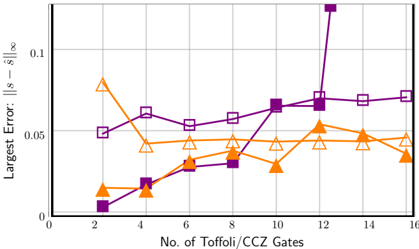
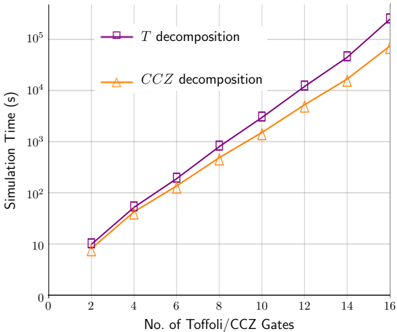
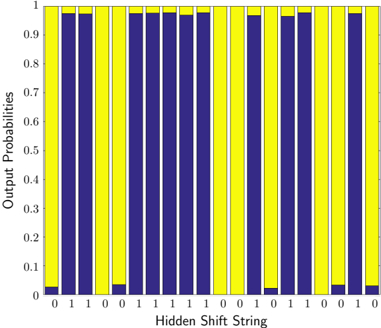
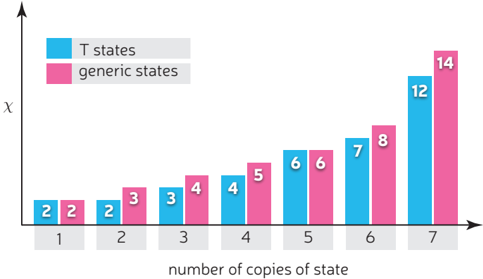
Recent work has explored using the stabilizer formalism to classically simulate quantum circuits containing a few non-Clifford gates. The computational cost of such methods is directly related to the notion of s t a b i l i z e r rank , which for a pure state ψ is defined to be the smallest integer χ such that ψ is a superposition of χ stabilizer states. Here we develop a comprehensive mathematical theory of the stabilizer rank and the related approximate stabilizer rank. We also present a suite of classical simulation algorithms with broader applicability and significantly improved performance over the previous state-of-the-art. A new feature is the capability to simulate circuits composed of Clifford gates and arbitrary diagonal gates, extending the reach of a previous algorithm specialized to the Clifford+T gate set. We implemented the new simulation methods and used them to simulate quantum algorithms with 40-50 qubits and over 60 non-Clifford gates, without resorting to high-performance computers. We report a simulation of the Quantum Approximate Optimization Algorithm in which we process superpositions of χ ∼ 10 6 stabilizer states and sample from the full n -bit output distribution, improving on previous simulations which used ∼ 10 3 stabilizer states and sampled only from single-qubit marginals. We also simulated instances of the Hidden Shift algorithm with circuits including up to 64 T gates or 16 CCZ gates; these simulations showcase the performance gains available by optimizing the decomposition of a circuit's non-Clifford components.
Overview
The claims and statistics of this paper haven’t been checked yet.
Free: it reads the open-access text and checks the first 5 claims that cite a source we can check. Create a free account to check every claim.
Integrity signals
Registry
Cites
Statistics
Figures
Verification
Claims the paper makes
The claims and statistics of this paper haven’t been checked yet.
Free: it reads the open-access text and checks the first 5 claims that cite a source we can check. Create a free account to check every claim.
Claims other papers make about this one
Each is checked against this paper’s own text: does it say what the citing paper says it does?
The cited source says what the claim attributes to it.
In the citing paper
“Simulation of such logical circuits is challenging because of the high connectivity (rendering tensor networks inefficient) and large numbers of non-Cliffords50.”
From Logical quantum processor based on reconfigurable atom arrays (2024) · cites this paper as [50]
The cited source says what the claim attributes to it.
In the citing paper
“state-of-the-art Clifford + T simulators can handle roughly 16 CCZ gates50.”
From Logical quantum processor based on reconfigurable atom arrays (2024) · cites this paper as [50]
Self-check
Percentages, sums and reported differences re-computed from the paper’s own numbers.
The self-check needs the paper’s full text.
Citations
Cites
Boyd, S., & Vandenberghe, L. (2004) · doi:10.1017/cbo9780511804441 · Cited by 56,601
Quantum Computation and Quantum Information
Nielsen, M. A., Chuang, I., & Grover, L. K. (2002) · American Journal of Physics · doi:10.1119/1.1463744 · Cited by 21,895
Quantum Computing in the NISQ era and beyond
Preskill, J. (2018) · Quantum · doi:10.22331/q-2018-08-06-79 · Cited by 8,830 · cited 1×
“As a main application of our simulation algorithms we envision verification of noisy intermediatesize quantum circuits [49] in the regime when a brute-force classical simulation may be impractical [3, 35, 44].”
MethodProbability Inequalities for Sums of Bounded Random Variables
Hoeffding, W. (1963) · Journal of the American Statistical Association · doi:10.1080/01621459.1963.10500830 · Cited by 4,852
Gottesman, D., & Chuang, I. L. (1999) · Nature · doi:10.1038/46503 · Cited by 1,860 · cited 1×
“[28]).”
Universal quantum computation with ideal Clifford gates and noisy ancillas
Bravyi, S., & Kitaev, A. (2005) · Physical Review A · doi:10.1103/physreva.71.022316 · Cited by 1,525 · cited 2×
“It is known that stabilizer operations augmented with preparation of certain single-qubit “magic states” become computationally universal [12].”
BackgroundSelf-citationImproved simulation of stabilizer circuits
Aaronson, S., & Gottesman, D. (2004) · Physical Review A · doi:10.1103/physreva.70.052328 · Cited by 1,515 · cited 4×
“i noise models [27] only requires quantum circuits composed of Cliord gates and Pauli measurements{which can be easily simulated classically for thousands of qubits using the Gottesman-Knill theorem [2,6]. Furthermore, it is known that Cliord circuits can be promoted to universal quantum computation when provided with…”
BackgroundMethodInfluentialQiskit: An Open-source Framework for Quantum Computing
Aleksandrowicz, G., Alexander, T., Barkoutsos, P. K., Bello, L., Ben-Haim, Y., Bucher, D., Cabrera-Hernández, F. J., Carballo-Franquis, J., Chen, A., Chen, C.-F., et al. (2019) · Zenodo (CERN European Organization for Nuclear Research) · doi:10.5281/zenodo.2562110 · Cited by 1,434
Qiskit: An Open-source Framework for Quantum Computing
Aleksandrowicz, G., Alexander, T., Barkoutsos, P. K., et al. (2019) · Zenodo (CERN European Organization for Nuclear Research) · doi:10.5281/zenodo.2562111 · Cited by 1,314
Characterizing quantum supremacy in near-term devices
Boixo, S., Isakov, S. V., Smelyanskiy, V. N., Babbush, R., Ding, N., Jiang, Z., Bremner, M. J., Martinis, J. M., & Neven, H. (2018) · Nature Physics · doi:10.1038/s41567-018-0124-x · Cited by 1,175 · cited 1×
“Several tensor-based simulators have been developed [17, 39, 48] for geometrically local shallow quantum circuits that include only nearest-neighbor gates on a 2D grid of qubits [9].”
BackgroundTheory of fault-tolerant quantum computation
Gottesman, D. (1998) · Physical Review A · doi:10.1103/physreva.57.127 · Cited by 947 · cited 1×
“For example, quantum error correction based on stabilizer codes and Pauli noise models [27] only requires quantum circuits composed of Clifford gates and Pauli measurements–which can be easily simulated classically for thousands of qubits using the Gottesman-Knill theorem [2, 6].”
MethodEfficient Z gates for quantum computing
McKay, D. C., Wood, C. J., Sheldon, S., Chow, J. M., & Gambetta, J. M. (2017) · Physical Review A · doi:10.1103/physreva.96.022330 · Cited by 557 · cited 1×
“From the experimental perspective, single-qubit Z-rotations are often the most reliable elementary operations [43].”
BackgroundSimulating Quantum Computation by Contracting Tensor Networks
Markov, I. L., & Shi, Y. (2008) · SIAM Journal on Computing · doi:10.1137/050644756 · Cited by 472 · cited 1×
“In certain special cases the memory footprint can be reduced by recasting the simulation problem as a tensor network contraction [1, 8, 40].”
BackgroundApplication of a Resource Theory for Magic States to Fault-Tolerant Quantum Computing
Howard, M., & Campbell, E. (2017) · Physical Review Letters · doi:10.1103/physrevlett.118.090501 · Cited by 387 · cited 2×
“s of simulation methods uses Monte Carlo sampling over quasiprobability distributions, where the distribution can be over either a discrete phase space [20,47,56], over the class of stabilizer states [32] or over stabilizer operations [7]. These quasiprobability methods are a natural method for simulating noisy circui…”
MethodSelf-citationNegative quasi-probability as a resource for quantum computation
Veitch, V., Ferrie, C., Gross, D., & Emerson, J. (2012) · New Journal of Physics · doi:10.1088/1367-2630/14/11/113011 · Cited by 377 · cited 1×
“A over similar class of simulation methods uses Monte Carlo sampling quasiprobability distributions, where the distribution can be over either a discrete phase space [20, 47, 56], over the class of stabilizer states [32] or over stabilizer operations [7].”
MethodMonte Carlo errors with less errors
Wolff, U. (2004) · Computer Physics Communications · doi:10.1016/s0010-4655(03)00467-3 · Cited by 359
The Clifford group forms a unitary 3-design
Webb, Z. (2016) · Quantum Information and Computation · doi:10.26421/qic16.15-16-8 · Cited by 351 · cited 2×
“We will use that the stabilizer states form a projective 3-design [38, 57, 59].”
BackgroundMethodImproved Classical Simulation of Quantum Circuits Dominated by Clifford Gates
Bravyi, S., & Gosset, D. (2016) · Physical Review Letters · doi:10.1103/physrevlett.116.250501 · Cited by 320 · cited 10×
“48m with certain polynomial prefactors [11].”
BackgroundMethodInfluentialSelf-citationAverage-Case Complexity Versus Approximate Simulation of Commuting Quantum Computations
Bremner, M. J., Montanaro, A., & Shepherd, D. J. (2016) · Physical Review Letters · doi:10.1103/physrevlett.117.080501 · Cited by 299 · cited 1×
“[15]).”
Trading Classical and Quantum Computational Resources
Bravyi, S., Smith, G., & Smolin, J. A. (2016) · Physical Review X · doi:10.1103/physrevx.6.021043 · Cited by 299 · cited 5×
“into a superposition of stabilizer states. A reader interested only in the application for simulation of quantum circuits may wish to proceed to Sections2.2,2.3. Definition 1 (Exact stabilizer rank, χ[14]). Suppose ψis a pure n-qubit state. The exact stabilizer rank χ(ψ) is the smallest integer ksuch that ψcan be writt…”
BackgroundMethodResultInfluentialSelf-citationClassical simulation of quantum computation, the gottesman-Knill theorem, and slightly beyond
den Nest, M. V. (2010) · Quantum Information and Computation · doi:10.26421/qic10.3-4-6 · Cited by 236 · cited 1×
“Previously known results on canonical decompositions of Clifford circuits [25, 42, 54] imply that any n-qubit stabilizer state φ can be expressed as |φ〉 = ωUCUH |s〉, (42)”
BackgroundComplexity-Theoretic Foundations of Quantum Supremacy Experiments
Aaronson, S., & Chen, L. (2016) · arXiv · doi:10.48550/arxiv.1612.05903 · Cited by 218 · cited 1×
“In certain special cases the memory footprint can be reduced by recasting the simulation problem as a tensor network contraction [1, 8, 40].”
BackgroundMassively parallel quantum computer simulator
De Raedt, K., Michielsen, K., De Raedt, H., Trieu, B., Arnold, G., Richter, M., Lippert, T., Watanabe, H., & Ito, N. (2007) · Computer Physics Communications · doi:10.1016/j.cpc.2006.08.007 · Cited by 213 · cited 1×
“Vector-based simulators [19, 30, 52] represent n-qubit quantum states by complex vectors of size 2 stored in a classical memory.”
BackgroundEstimating Outcome Probabilities of Quantum Circuits Using Quasiprobabilities
Pashayan, H., Wallman, J. J., & Bartlett, S. D. (2015) · Physical Review Letters · doi:10.1103/physrevlett.115.070501 · Cited by 210 · cited 3×
“r the stabilizer state decomposition, which improves the performance of the Metropolis step. Let us brie y comment on how simulators based on the stabilizer rank compare with quasiprobability methods [20,37,47]. The latter use a discrete Wigner function representation of quantum states and Monte Carlo sampling to appr…”
MethodLow-overhead constructions for the fault-tolerant Toffoli gate
Jones, C. (2013) · Physical Review A · doi:10.1103/physreva.87.022328 · Cited by 204 · cited 1×
“This regime may be important for verification of first fault-tolerant quantum circuits where logical nonClifford gates are expected to be scarce due to their high implementation cost [23, 34].”
BackgroundThe Clifford group fails gracefully to be a unitary 4-designPreprint
Zhu, H., Kueng, R., Grassl, M., & Gross, D. (2016) · arXiv (Cornell University) · doi:10.48550/arxiv.1609.08172 · Cited by 201 · cited 3×
“We will use that the stabilizer states form a projective 3-design [38, 57, 59].”
BackgroundMethod0.5 petabyte simulation of a 45-qubit quantum circuit
Häner, T., & Steiger, D. S. (2017) · Proceedings of the International Conference for High Performance Computing, Networking, Storage and Analysis · doi:10.1145/3126908.3126947 · Cited by 180
Truncations of random unitary matrices
Zyczkowski, K., & Sommers, H.-J. (2000) · Journal of Physics A: Mathematical and General · doi:10.1088/0305-4470/33/10/307 · Cited by 168 · cited 1×
“[60]), p(y) = (2 − 1)(1− y)2 n−2.”
Transversal numbers of uniform hypergraphs
Alon, N. (1990) · Graphs and Combinatorics · doi:10.1007/bf01787474 · Cited by 168 · cited 2×
“uced from Ref. [29], it is not explicitly shown, so we provide the details here. Examples 4.27 and 4.28 of Ref. [29], show that σ n,4 ∝Π n,4 + a nΠ n,4P ⊗n [4] Π n,4, (82) σ n,5 ∝Π n,5 + b nΠ n,5P ⊗n [5] Π n,5. where a nand b nare positive constants and P [4] and P [5] are projectors onto a stabilizer code P [4] = 1 4…”
BackgroundInfluentialFast simulation of stabilizer circuits using a graph-state representation
Anders, S., & Briegel, H. J. (2006) · Physical Review A · doi:10.1103/physreva.73.022334 · Cited by 163 · cited 1×
“i noise models [27] only requires quantum circuits composed of Cliord gates and Pauli measurements{which can be easily simulated classically for thousands of qubits using the Gottesman-Knill theorem [2,6]. Furthermore, it is known that Cliord circuits can be promoted to universal quantum computation when provided with…”
MethodConvex geometry of quantum resource quantification
Regula, B. (2017) · Journal of Physics A Mathematical and Theoretical · doi:10.1088/1751-8121/aa9100 · Cited by 152 · cited 1×
“4 is a special case of results found in the literature on general resource theories [50].”
BackgroundQubit stabilizer states are complex projective 3-designsPreprint
Kueng, R., & Gross, D. (2015) · arXiv (Cornell University) · doi:10.48550/arxiv.1510.02767 · Cited by 137 · cited 2×
“We will use that the stabilizer states form a projective 3-design [38, 57, 59].”
BackgroundMethodWigner Function Negativity and Contextuality in Quantum Computation on Rebits
Delfosse, N., Allard Guerin, P., Bian, J., & Raussendorf, R. (2015) · Physical Review X · doi:10.1103/physrevx.5.021003 · Cited by 135 · cited 3×
“r the stabilizer state decomposition, which improves the performance of the Metropolis step. Let us brie y comment on how simulators based on the stabilizer rank compare with quasiprobability methods [20,37,47]. The latter use a discrete Wigner function representation of quantum states and Monte Carlo sampling to appr…”
BackgroundMethodA Quantum Approximate Optimization Algorithm Applied to a Bounded Occurrence Constraint Problem
Farhi, E., Goldstone, J., & Gutmann, S. (2014) · arXiv · doi:10.48550/arxiv.1412.6062 · Cited by 131 · cited 4×
“3, this line contains a local maximum and a local minimum of E(β, γ) (we note that β = π/4 is also the choice made by Farhi et al. [22]).”
BackgroundMethodInfluentialOn the geometry of stabilizer states
García, H. J., Markov, I. L., & Cross, A. W. (2014) · Quantum Information and Computation · doi:10.26421/qic14.7-8-9 · Cited by 128 · cited 1×
“A first step was made by Garcia, Markov and Cross [25, 26], who proposed and studied the decomposition of states into a superposition of stabilizer states.”
MethodQuantum Algorithms for Some Hidden Shift Problems
van Dam, W., Hallgren, S., & Ip, L. (2006) · SIAM Journal on Computing · doi:10.1137/s009753970343141x · Cited by 126 · cited 1×
“tabilizer states for n= 50 qubits. 2.4.2 The hidden shift algorithm In this section, we describe the results of simulations applied to a family of quantum circuits that solve the Hidden Shift Problem [53] for non-linear Boolean functions [51]. These circuits are identical to those simulated in [11] and further details…”
MethodInfluentialShorter Stabilizer Circuits via Bruhat Decomposition and Quantum Circuit Transformations
Maslov, D., & Roetteler, M. (2018) · IEEE Transactions on Information Theory · doi:10.1109/tit.2018.2825602 · Cited by 123 · cited 1×
“Previously known results on canonical decompositions of Clifford circuits [25, 42, 54] imply that any n-qubit stabilizer state φ can be expressed as |φ〉 = ωUCUH |s〉, (42)”
BackgroundqHiPSTER: The Quantum High Performance Software Testing Environment
Smelyanskiy, M., Sawaya, N. P. D., & Aspuru‐Guzik, A. (2016) · arXiv (Cornell University) · doi:10.48550/arxiv.1601.07195 · Cited by 109 · cited 2×
“This belief is partly supported by the fact that state-of-the-art classical simulators employing modern supercomputers are still limited to a few dozens of qubits [17, 30, 48, 52].”
BackgroundSurface code implementation of block code state distillation
Fowler, A. G., Devitt, S. J., & Jones, C. (2013) · Scientific Reports · doi:10.1038/srep01939 · Cited by 99 · cited 1×
“This regime may be important for verification of first fault-tolerant quantum circuits where logical nonClifford gates are expected to be scarce due to their high implementation cost [23, 34].”
BackgroundPost hoc Verification of Quantum Computation
Fitzsimons, J. F., Hajdušek, M., & Morimae, T. (2018) · Physical Review Letters · doi:10.1103/physrevlett.120.040501 · Cited by 91
GHZ extraction yield for multipartite stabilizer states
Bravyi, S. B., Fattal, D. A., & Gottesman, D. (2006) · Journal of Mathematical Physics · doi:10.1063/1.2203431 · Cited by 87 · cited 1×
“In particular, we apply the classification of entanglement in three-partite stabilizer states [13] to derive conditions for the multiplicativity of F (ψ).”
MethodSelf-citationNabben, R., & Varga, R. S. (1994) · SIAM Journal on Matrix Analysis and Applications · doi:10.1137/s0895479892228237 · Cited by 82 · cited 3×
“stabilizer rank of the magic states which uses the machinery of ultra-metric matrices [41, 45].”
BackgroundMethodInverse of Strictly Ultrametric Matrices are of Stieltjes Type
Martı́nez, S., Michon, G., & Martı́n, J. S. (1994) · SIAM Journal on Matrix Analysis and Applications · doi:10.1137/s0895479891217011 · Cited by 81 · cited 3×
“stabilizer rank of the magic states which uses the machinery of ultra-metric matrices [41, 45].”
BackgroundMethodCatalysis and activation of magic states in fault-tolerant architectures
Campbell, E. T. (2011) · Physical Review A · doi:10.1103/physreva.83.032317 · Cited by 78 · cited 1×
“[16] or Lemma 2 of Ref.”
Self-citationSimulation of low-depth quantum circuits as complex undirected graphical models
Boixo, S., Isakov, S. V., Smelyanskiy, V., & Neven, H. (2017) · arXiv (Cornell University) · doi:10.48550/arxiv.1712.05384 · Cited by 72 · cited 1×
“In certain special cases the memory footprint can be reduced by recasting the simulation problem as a tensor network contraction [1, 8, 40].”
BackgroundClassical Simulation of Intermediate-Size Quantum Circuits
Chen, J., Zhang, F., Huang, C., Newman, M., & Shi, Y. (2018) · arXiv (Cornell University) · doi:10.48550/arxiv.1805.01450 · Cited by 70 · cited 3×
“These methods enabled simulations of systems with more than 100 qubits [17].”
BackgroundMethodContextuality bounds the efficiency of classical simulation of quantum processesPreprint
Karanjai, A., Wallman, J. J., & Bartlett, S. D. (2018) · arXiv (Cornell University) · doi:10.48550/arxiv.1802.07744 · Cited by 63 · cited 1×
“In contrast to stabilizer rank simulators, quasi-probability methods do not directly apply to stabilizer operations on qubits since the latter are not known to have a non-negative Wigner function representation [20, 36].”
MethodSimulating quantum computers with probabilistic methods
Van den Nest, M. (2011) · Quantum Information and Computation · doi:10.26421/qic11.9-10-5 · Cited by 55 · cited 3×
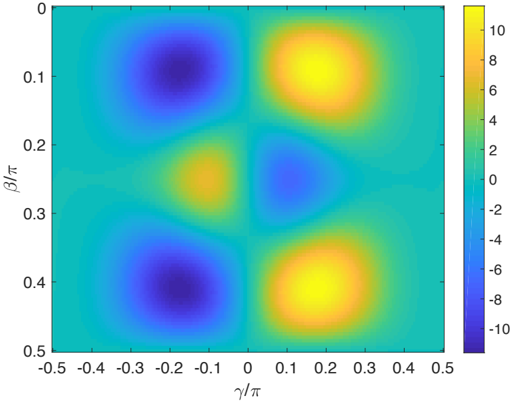
“Figure 3: The expected value of the cost function E(β, γ) computed using the Monte Carlo method by Van den Nest [55].”
MethodInfluentialComplexity-Theoretic Foundations of Quantum Supremacy Experiments
Aaronson, S., & Chen, L. (2016) · arXiv (Cornell University) · doi:10.14288/1.0343134 · Cited by 54
Local Hamiltonians Whose Ground States Are Hard to Approximate
Eldar, L., & Harrow, A. W. (2017) · 2017 IEEE 58th Annual Symposium on Foundations of Computer Science (FOCS) · doi:10.1109/focs.2017.46 · Cited by 53 · cited 1×
“[18, 21] to show that P (x) is the uniqiue steady state of M and its mixing time is at most poly(n).”
BackgroundUnbiased simulation of near-Clifford quantum circuits
Bennink, R. S., Ferragut, E. M., Humble, T. S., Laska, J. A., Nutaro, J. J., Pleszkoch, M. G., & Pooser, R. C. (2017) · Physical Review A · doi:10.1103/physreva.95.062337 · Cited by 49 · cited 1×
“A similar class of simulation methods uses Monte Carlo sampling over quasiprobability distributions, where the distribution can be over either a discrete phase space [20, 47, 56], over the class of stabilizer states [32] or over stabilizer operations [7].”
MethodqTorch: The quantum tensor contraction handler
Fried, E. S., Sawaya, N. P. D., Cao, Y., Kivlichan, I. D., Romero, J., & Aspuru-Guzik, A. (2018) · PLOS ONE · doi:10.1371/journal.pone.0208510 · Cited by 48 · cited 1×
“[24].”
Pareto-Efficient Quantum Circuit Simulation Using Tensor Contraction Deferral
Pednault, E., Gunnels, J. A., Nannicini, G., Horesh, L., Magerlein, T., Solomonik, E., Draeger, E. W., Holland, E. T., & Wisnieff, R. (2017) · arXiv · doi:10.48550/arxiv.1710.05867 · Cited by 48 · cited 2×
“This belief is partly supported by the fact that state-of-the-art classical simulators employing modern supercomputers are still limited to a few dozens of qubits [17, 30, 48, 52].”
BackgroundKocia, L., & Love, P. J. (2017) · Physical Review A · doi:10.1103/physreva.96.062134 · Cited by 42 · cited 1×
“Let us briefly comment on how simulators based on the stabilizer rank compare with quasiprobability methods [20, 37, 47].”
BackgroundQuantum algorithms for highly non-linear Boolean functions
Rötteler, M. (2010) · ACM-SIAM Symposium on Discrete Algorithms (SODA) · doi:10.1137/1.9781611973075.37 · Cited by 42 · cited 2×
“In this section, we describe the results of simulations applied to a family of quantum circuits that solve the Hidden Shift Problem [53] for non-linear Boolean functions [51].”
MethodQuantum Supremacy Circuit Simulation on Sunway TaihuLightPreprint
Li, R., Wu, B., Ying, M., et al. (2018) · arXiv (Cornell University) · doi:10.48550/arxiv.1804.04797 · Cited by 22 · cited 1×
“Several tensor-based simulators have been developed [17, 39, 48] for geometrically local shallow quantum circuits that include only nearest-neighbor gates on a 2D grid of qubits [9].”
BackgroundQuantum ground state isoperimetric inequalities for the energy spectrum of local HamiltoniansPreprint
Crosson, E., & Bowen, J. (2017) · arXiv (Cornell University) · doi:10.48550/arxiv.1703.10133 · Cited by 16 · cited 1×
“[18, 21] to show that P (x) is the uniqiue steady state of M and its mixing time is at most poly(n).”
BackgroundEfficient Inner-product Algorithm for Stabilizer StatesPreprint
García, H. J., Markov, I. L., & Cross, A. W. (2012) · arXiv (Cornell University) · doi:10.48550/arxiv.1210.6646 · Cited by 15 · cited 3×
“Previously known results on canonical decompositions of Clifford circuits [25, 42, 54] imply that any n-qubit stabilizer state φ can be expressed as |φ〉 = ωUCUH |s〉, (42)”
BackgroundMethodExplicit lower bounds on strong quantum simulationPreprint
Huang, C., Newman, M., & Szegedy, M. (2018) · arXiv (Cornell University) · doi:10.48550/arxiv.1804.10368 · Cited by 10 · cited 1×
“However, it is expected [33] that for general”
BackgroundEfficient classical verification of quantum computations
Jozsa, R., & Strelchuk, S. (2017) · Cambridge University Engineering Department Publications Database · doi:10.48550/arxiv.1705.02817 · Cited by 4 · cited 1×
“As a main application of our simulation algorithms we envision verification of noisy intermediatesize quantum circuits [49] in the regime when a brute-force classical simulation may be impractical [3, 35, 44].”
Method
Research works printed but not linked: 2
- 3. Dorit Aharonov, Michael Ben-Or, Elad Eban, and Urmila Mahadev. Interactive proofs for quantum computations. arXiv preprint arXiv:1704.04487, 2017. · arXiv
- 29. David Gross, Sepehr Nezami, and Michael Walter. Schur-Weyl duality for the Clifford group with applications: Property testing, a robust Hudson theorem, and de Finetti representations. arXiv preprint arXiv:1712.08628, 2017. · arXiv
Cited by
Logical quantum processor based on reconfigurable atom arrays
Bluvstein, D., Evered, S. J., Geim, A. A., Li, S. H., Zhou, H., Manovitz, T., Ebadi, S., Cain, M., Kalinowski, M., Hangleiter, D., et al. (2024) · Nature · doi:10.1038/s41586-023-06927-3 · Cited by 1,119
“Simulation of such logical circuits is challenging because of the high connectivity (rendering tensor networks inefficient) and large numbers of non-Cliffords 50 .”
BackgroundEvidence for the utility of quantum computing before fault tolerance
Kim, Y., Eddins, A., Anand, S., Wei, K. X., van den Berg, E., Rosenblatt, S., Nayfeh, H., Wu, Y., Zaletel, M., Temme, K., et al. (2023) · Nature · doi:10.1038/s41586-023-06096-3 · Cited by 1,050
“On the other hand, the classical simulations may also be improved by methods besides the pure-state tensor networks considered here, such as Heisenberg operator evolution methods, which have recently been applied to non-Clifford simulations 38 .”
MethodStim: a fast stabilizer circuit simulator
Gidney, C. (2021) · Quantum · doi:10.22331/q-2021-07-06-497 · Cited by 415
The future of quantum computing with superconducting qubits
Bravyi, S., Dial, O., Gambetta, J. M., Gil, D., & Nazario, Z. (2022) · Journal of Applied Physics · doi:10.1063/5.0082975 · Cited by 334
“This is far beyond the limit of existing classical algorithms that can simulate Clifford+ T circuits with about 50 T -gates 84,85 .”
BackgroundSelf-citationQulacs: a fast and versatile quantum circuit simulator for research purpose
Suzuki, Y., Kawase, Y., Masumura, Y., Hiraga, Y., Nakadai, M., Chen, J., Nakanishi, K. M., Mitarai, K., Imai, R., Tamiya, S., et al. (2021) · Quantum · doi:10.22331/q-2021-10-06-559 · Cited by 295
Metadata
- Authors
- Bravyi, S., Browne, D., Calpin, P., Campbell, E., Gosset, D., & Howard, M.
- Affiliations
- IBM (United States) (US)
- University College London (GB)
- University of Sheffield (GB)
- Venue
- Quantum
- Published
- 2019-09-02
- Volume
- 3
- Pages
- 181
- ISSN
- 2521-327X (ISSN-L)
- OpenAlex
- W2885845431
- Cited by
- 302
- References
- 45
- Citations by year
- 2026: 46 · 2025: 90 · 2024: 47 · 2023: 34 · 2022: 38 · 2021: 24 · 2020: 13 · 2019: 10
- FWCI
- 9.69
- Type
- journal article
- Language
- en
- Open access
- gold
- doi.org
- Locations
- Quantum (publishedVersion, cc-by)
- ARAN (University of Galway Research Repository) (Ollscoil na Gaillimhe – University of Galway) (acceptedVersion, cc-by-nc-nd)
- arXiv (Cornell University) (submittedVersion)
- DOAJ (DOAJ: Directory of Open Access Journals) (submittedVersion)
- ARAN (University of Galway Research Repository) (Ollscoil na Gaillimhe – University of Galway) (submittedVersion, cc-by)
- arXiv (Cornell University) (cc-by)
- Funders
- Engineering and Physical Sciences Research Council (M013243/1, EP/M013243/1, EP/M024261/1, EP/L015242/, EP/L015242/1)
- Topics
- Physical Sciences › Computer Science › Artificial Intelligence › Quantum Computing Algorithms and Architecture
- Physical Sciences › Physics and Astronomy › Atomic and Molecular Physics, and Optics › Quantum many-body systems
- Physical Sciences › Physics and Astronomy › Atomic and Molecular Physics, and Optics › Quantum Mechanics and Applications
- Keywords
- stabilizer states, classical simulation of quantum circuits, non-Clifford gates, Clifford gates, quantum approximate optimization algorithm, T-gate, CCZ gate
About these checks
Registry, retraction, Cites and statistics results are computed, not judged, with one exception: a printed reference that no index lists is read once by a model before it counts as a citation error. Claims are extracted by a model and kept only when their quote appears verbatim in the text; each cited source is then checked, with a model’s help, for whether it says what the claim relies on. Those verdicts can be wrong — read the claim’s quote and the cited source before relying on one.
Statistics and arithmetic are recomputed, not judged.
Confidence bands are shown only for fields calibrated on our annotated test set. None is calibrated yet, so no band is shown.
What counts as a claim ›How we measure confidence ›How we check this ›
Are you an author, or do you see a problem with this page? Request a review
Data sources
Bibliographic data: Semantic Scholar, OpenAlex, Crossref.
Contains information from the Semantic Scholar Academic Graph Datasets, made available under the ODC Attribution License (ODC-BY 1.0).
Semantic Scholar’s data is described in: Kinney, R., et al. (2023). The Semantic Scholar Open Data Platform. arXiv:2301.10140.
