

Simulation of quantum circuits by low-rank stabilizer decompositions
Open accessThe DOI matches its Crossref record; 60 of the 60 references it cites were found in a registry or an index.
Abstract
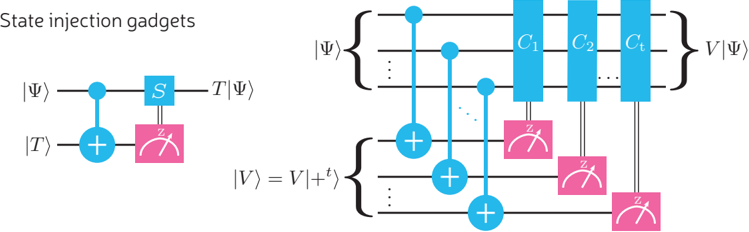
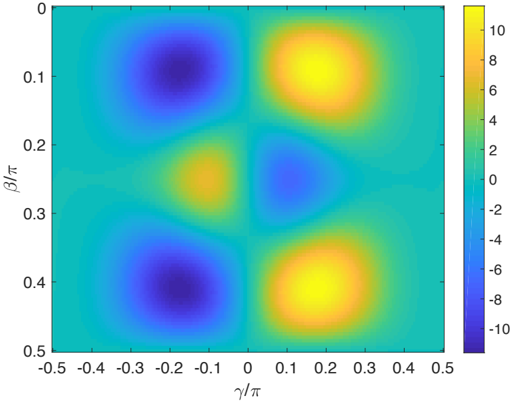
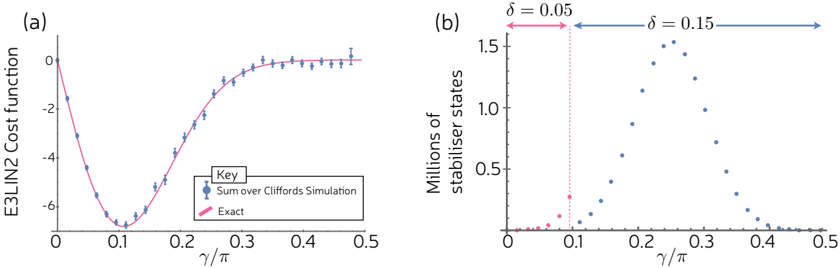
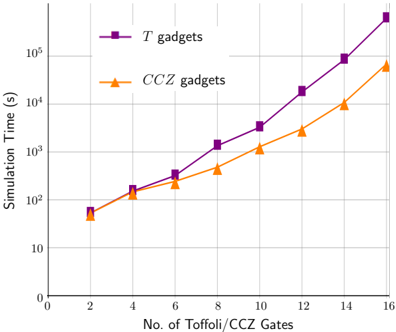
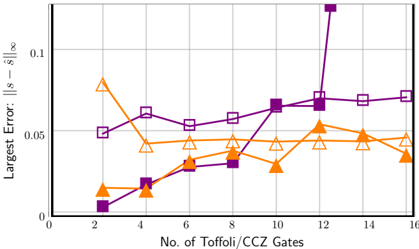
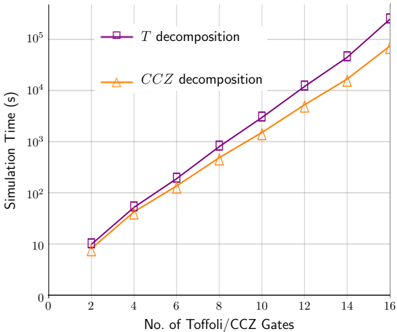
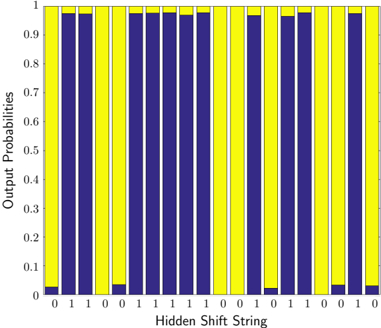
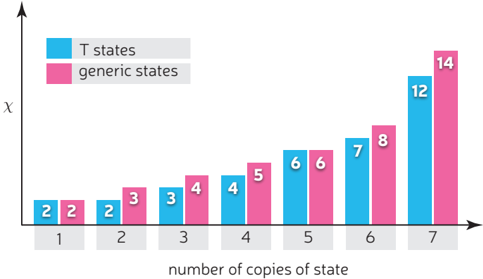
Recent work has explored using the stabilizer formalism to classically simulate quantum circuits containing a few non-Clifford gates. The computational cost of such methods is directly related to the notion of s t a b i l i z e r rank , which for a pure state ψ is defined to be the smallest integer χ such that ψ is a superposition of χ stabilizer states. Here we develop a comprehensive mathematical theory of the stabilizer rank and the related approximate stabilizer rank. We also present a suite of classical simulation algorithms with broader applicability and significantly improved performance over the previous state-of-the-art. A new feature is the capability to simulate circuits composed of Clifford gates and arbitrary diagonal gates, extending the reach of a previous algorithm specialized to the Clifford+T gate set. We implemented the new simulation methods and used them to simulate quantum algorithms with 40-50 qubits and over 60 non-Clifford gates, without resorting to high-performance computers. We report a simulation of the Quantum Approximate Optimization Algorithm in which we process superpositions of χ ∼ 10 6 stabilizer states and sample from the full n -bit output distribution, improving on previous simulations which used ∼ 10 3 stabilizer states and sampled only from single-qubit marginals. We also simulated instances of the Hidden Shift algorithm with circuits including up to 64 T gates or 16 CCZ gates; these simulations showcase the performance gains available by optimizing the decomposition of a circuit's non-Clifford components.
Overview
The claims and statistics of this paper haven’t been checked yet.
Free: it reads the open-access text and checks the first 5 claims that cite a source we can check. Create a free account to check every claim.
Integrity signals
Registry
Cites
Statistics
Figures
Verification
Claims the paper makes
The claims and statistics of this paper haven’t been checked yet.
Free: it reads the open-access text and checks the first 5 claims that cite a source we can check. Create a free account to check every claim.
Claims other papers make about this one
Each is checked against this paper’s own text: does it say what the citing paper says it does?
The cited source says what the claim attributes to it.
In the citing paper
“Simulation of such logical circuits is challenging because of the high connectivity (rendering tensor networks inefficient) and large numbers of non-Cliffords50.”
From Logical quantum processor based on reconfigurable atom arrays (2024) · cites this paper as [50]
The cited source says what the claim attributes to it.
In the citing paper
“state-of-the-art Clifford + T simulators can handle roughly 16 CCZ gates50.”
From Logical quantum processor based on reconfigurable atom arrays (2024) · cites this paper as [50]
Self-check
Percentages, sums and reported differences re-computed from the paper’s own numbers.
The self-check needs the paper’s full text.
Citations
Cites
Boyd, S., & Vandenberghe, L. (2004) · doi:10.1017/cbo9780511804441 · Cited by 56,601
Quantum Computation and Quantum Information
Nielsen, M. A., Chuang, I., & Grover, L. K. (2002) · American Journal of Physics · doi:10.1119/1.1463744 · Cited by 21,895
Quantum Computing in the NISQ era and beyond
Preskill, J. (2018) · Quantum · doi:10.22331/q-2018-08-06-79 · Cited by 8,830 · cited 1×
“As a main application of our simulation algorithms we envision verification of noisy intermediatesize quantum circuits [49] in the regime when a brute-force classical simulation may be impractical [3, 35, 44].”
MethodProbability Inequalities for Sums of Bounded Random Variables
Hoeffding, W. (1963) · Journal of the American Statistical Association · doi:10.1080/01621459.1963.10500830 · Cited by 4,852
Gottesman, D., & Chuang, I. L. (1999) · Nature · doi:10.1038/46503 · Cited by 1,860 · cited 1×
“[28]).”
Universal quantum computation with ideal Clifford gates and noisy ancillas
Bravyi, S., & Kitaev, A. (2005) · Physical Review A · doi:10.1103/physreva.71.022316 · Cited by 1,525 · cited 2×
“It is known that stabilizer operations augmented with preparation of certain single-qubit “magic states” become computationally universal [12].”
BackgroundSelf-citationImproved simulation of stabilizer circuits
Aaronson, S., & Gottesman, D. (2004) · Physical Review A · doi:10.1103/physreva.70.052328 · Cited by 1,515 · cited 4×
“i noise models [27] only requires quantum circuits composed of Cliord gates and Pauli measurements{which can be easily simulated classically for thousands of qubits using the Gottesman-Knill theorem [2,6]. Furthermore, it is known that Cliord circuits can be promoted to universal quantum computation when provided with…”
BackgroundMethodInfluentialQiskit: An Open-source Framework for Quantum Computing
Aleksandrowicz, G., Alexander, T., Barkoutsos, P. K., Bello, L., Ben-Haim, Y., Bucher, D., Cabrera-Hernández, F. J., Carballo-Franquis, J., Chen, A., Chen, C.-F., et al. (2019) · Zenodo (CERN European Organization for Nuclear Research) · doi:10.5281/zenodo.2562110 · Cited by 1,434
Qiskit: An Open-source Framework for Quantum Computing
Aleksandrowicz, G., Alexander, T., Barkoutsos, P. K., et al. (2019) · Zenodo (CERN European Organization for Nuclear Research) · doi:10.5281/zenodo.2562111 · Cited by 1,314
Characterizing quantum supremacy in near-term devices
Boixo, S., Isakov, S. V., Smelyanskiy, V. N., Babbush, R., Ding, N., Jiang, Z., Bremner, M. J., Martinis, J. M., & Neven, H. (2018) · Nature Physics · doi:10.1038/s41567-018-0124-x · Cited by 1,175 · cited 1×
“Several tensor-based simulators have been developed [17, 39, 48] for geometrically local shallow quantum circuits that include only nearest-neighbor gates on a 2D grid of qubits [9].”
Background
Research works printed but not linked: 2
- 3. Dorit Aharonov, Michael Ben-Or, Elad Eban, and Urmila Mahadev. Interactive proofs for quantum computations. arXiv preprint arXiv:1704.04487, 2017. · arXiv
- 29. David Gross, Sepehr Nezami, and Michael Walter. Schur-Weyl duality for the Clifford group with applications: Property testing, a robust Hudson theorem, and de Finetti representations. arXiv preprint arXiv:1712.08628, 2017. · arXiv
Cited by
Logical quantum processor based on reconfigurable atom arrays
Bluvstein, D., Evered, S. J., Geim, A. A., Li, S. H., Zhou, H., Manovitz, T., Ebadi, S., Cain, M., Kalinowski, M., Hangleiter, D., et al. (2024) · Nature · doi:10.1038/s41586-023-06927-3 · Cited by 1,119
“Simulation of such logical circuits is challenging because of the high connectivity (rendering tensor networks inefficient) and large numbers of non-Cliffords 50 .”
BackgroundEvidence for the utility of quantum computing before fault tolerance
Kim, Y., Eddins, A., Anand, S., Wei, K. X., van den Berg, E., Rosenblatt, S., Nayfeh, H., Wu, Y., Zaletel, M., Temme, K., et al. (2023) · Nature · doi:10.1038/s41586-023-06096-3 · Cited by 1,050
“On the other hand, the classical simulations may also be improved by methods besides the pure-state tensor networks considered here, such as Heisenberg operator evolution methods, which have recently been applied to non-Clifford simulations 38 .”
MethodStim: a fast stabilizer circuit simulator
Gidney, C. (2021) · Quantum · doi:10.22331/q-2021-07-06-497 · Cited by 415
The future of quantum computing with superconducting qubits
Bravyi, S., Dial, O., Gambetta, J. M., Gil, D., & Nazario, Z. (2022) · Journal of Applied Physics · doi:10.1063/5.0082975 · Cited by 334
“This is far beyond the limit of existing classical algorithms that can simulate Clifford+ T circuits with about 50 T -gates 84,85 .”
BackgroundSelf-citationQulacs: a fast and versatile quantum circuit simulator for research purpose
Suzuki, Y., Kawase, Y., Masumura, Y., Hiraga, Y., Nakadai, M., Chen, J., Nakanishi, K. M., Mitarai, K., Imai, R., Tamiya, S., et al. (2021) · Quantum · doi:10.22331/q-2021-10-06-559 · Cited by 295
Information scrambling in quantum circuits
Mi, X., Roushan, P., Quintana, C., Mandrà, S., Marshall, J., Neill, C., Arute, F., Arya, K., Atalaya, J., Babbush, R., et al. (2021) · Science · doi:10.1126/science.abg5029 · Cited by 283
“Similarly, it is possible to sample approximate amplitudes by only selecting the dominant stabilizer states in the Clifford expansion [64, 65].”
BackgroundLeone, L., Oliviero, S. F. E., & Hamma, A. (2022) · Physical Review Letters · doi:10.1103/physrevlett.128.050402 · Cited by 276
Building a Fault-Tolerant Quantum Computer Using Concatenated Cat Codes
Chamberland, C., Noh, K., Arrangoiz-Arriola, P., Campbell, E. T., Hann, C. T., Iverson, J., Putterman, H., Bohdanowicz, T. C., Flammia, S. T., Keller, A., et al. (2022) · PRX Quantum · doi:10.1103/prxquantum.3.010329 · Cited by 281
Self-citationChallenges and Opportunities of Near-Term Quantum Computing Systems
Corcoles, A. D., Kandala, A., Javadi-Abhari, A., McClure, D. T., Cross, A. W., Temme, K., Nation, P. D., Steffen, M., & Gambetta, J. M. (2020) · Proceedings of the IEEE · doi:10.1109/jproc.2019.2954005 · Cited by 203
Takagi, R., & Regula, B. (2019) · Physical Review X · doi:10.1103/physrevx.9.031053 · Cited by 190
“One should also note that the generalized robustness can be computed exactly for certain classes of states in quantum resource theories such as entanglement and Schmidt number k entanglement [34,106,107], coherence and multilevel coherence [34,82,108,109], magic [34,110], and in several cases can be cast as a semidefi…”
BackgroundLiu, Z.-W., & Winter, A. (2022) · PRX Quantum · doi:10.1103/prxquantum.3.020333 · Cited by 166
“• Stabilizer extent [7]: The stabilizer extent for pure state ψ is defined as ξ(ψ) :=”
BackgroundMethodInfluentialQuantum advantage with noisy shallow circuits
Bravyi, S., Gosset, D., König, R., & Tomamichel, M. (2020) · Nature Physics · doi:10.1038/s41567-020-0948-z · Cited by 144
Self-citationQuantifying Quantum Speedups: Improved Classical Simulation From Tighter Magic Monotones
Seddon, J. R., Regula, B., Pashayan, H., Ouyang, Y., & Campbell, E. T. (2021) · PRX Quantum · doi:10.1103/prxquantum.2.010345 · Cited by 205
“In magic theory, ξ is the stabilizer extent [25].”
BackgroundInfluentialSelf-citationQuantum convolutional neural network for image classification
Chen, G., Chen, Q., Long, S., Zhu, W., Yuan, Z., & Wu, Y. (2022) · Pattern Analysis and Applications · doi:10.1007/s10044-022-01113-z · Cited by 147
“Bravyi[2] proposed a method to classically simulate quantum circuits with non-Clifford gates, The computational cost was found related to the stabilizer rank, i.”
MethodQuantifying magic for multi-qubit operations
Seddon, J. R., & Campbell, E. T. (2019) · Proceedings of the Royal Society A Mathematical Physical and Engineering Sciences · doi:10.1098/rspa.2019.0251 · Cited by 168
Self-citationQuantifying nonstabilizerness of matrix product states
Haug, T., & Piroli, L. (2023) · Physical review. B./Physical review. B · doi:10.1103/physrevb.107.035148 · Cited by 225
Stabilizer entropies and nonstabilizerness monotones
Haug, T., & Piroli, L. (2023) · Quantum · doi:10.22331/q-2023-08-28-1092 · Cited by 230
“Finally, we consider the min-relative entropy of magic [5, 35].”
BackgroundRobustness of Magic and Symmetries of the Stabiliser Polytope
Heinrich, M., & Gross, D. (2019) · Quantum · doi:10.22331/q-2019-04-08-132 · Cited by 190
Scalable Measures of Magic Resource for Quantum Computers
Haug, T., & Kim, M. S. (2023) · PRX Quantum · doi:10.1103/prxquantum.4.010301 · Cited by 104
Universal variational quantum computation
Biamonte, J. (2021) · Physical Review A · doi:10.1103/physreva.103.l030401 · Cited by 102
“The crux lies in the fact that we are only allowed some polynomial in lnn non-Clifford gates (which opens an avenue for classical simulation, see [17, 18]).”
BackgroundEfficiently Computable Bounds for Magic State Distillation
Wang, X., Wilde, M. M., & Su, Y. (2020) · Physical Review Letters · doi:10.1103/physrevlett.124.090505 · Cited by 162
Conformal field theories are magical
White, C. D., Cao, C., & Swingle, B. (2021) · Physical Review B · doi:10.1103/physrevb.103.075145 · Cited by 93
Stabilizer entropies are monotones for magic-state resource theory
Leone, L., & Bittel, L. (2024) · Physical Review A · doi:10.1103/physreva.110.l040403 · Cited by 172
No-Go Theorems for Quantum Resource Purification
Fang, K., & Liu, Z.-W. (2020) · Physical Review Letters · doi:10.1103/physrevlett.125.060405 · Cited by 130
Begušić, T., Gray, J., & Chan, G. K.-L. (2024) · Science Advances · doi:10.1126/sciadv.adk4321 · Cited by 89
Quantifying nonstabilizerness through entanglement spectrum flatness
Tirrito, E., Tarabunga, P. S., Lami, G., Chanda, T., Leone, L., Oliviero, S. F. E., Dalmonte, M., Collura, M., & Hamma, A. (2024) · Physical Review A · doi:10.1103/physreva.109.l040401 · Cited by 172
Classical variational simulation of the Quantum Approximate Optimization Algorithm
Medvidović, M., & Carleo, G. (2021) · npj Quantum Information · doi:10.1038/s41534-021-00440-z · Cited by 79
A survey on the complexity of learning quantum states
Anshu, A., & Arunachalam, S. (2023) · Nature Reviews Physics · doi:10.1038/s42254-023-00662-4 · Cited by 215
“It is known that ‘Clifford+ T ’circuits are universal for quantum computation, and they have received much attention in fault-tolerance, circuit compilation and circuit simulation 23–30 .”
Nonstabilizerness via Matrix Product States in the Pauli Basis
Tarabunga, P. S., Tirrito, E., Bañuls, M. C., & Dalmonte, M. (2024) · Physical Review Letters · doi:10.1103/physrevlett.133.010601 · Cited by 150
Chamberland, C., & Noh, K. (2020) · npj Quantum Information · doi:10.1038/s41534-020-00319-5 · Cited by 71
Efficient Quantum Algorithms for Stabilizer Entropies
Haug, T., Lee, S., & Kim, M. S. (2024) · Physical Review Letters · doi:10.1103/physrevlett.132.240602 · Cited by 134
“We now provide efficient bounds on three magic monotones, namely the robustness of magic R [8], stabilizer extent ξ [50] and the stabilizer fidelity F 2 [50] (see SM E).”
BackgroundADAPT: Mitigating Idling Errors in Qubits via Adaptive Dynamical Decoupling
Das, P., Tannu, S., Dangwal, S., & Qureshi, M. (2021) · IEEE/ACM International Symposium on Microarchitecture (MICRO) · doi:10.1145/3466752.3480059 · Cited by 109
“For the purpose of simulations, we use Qiskit Extended Stabilizer Simulator (based on [5]).”
MethodBenchmarking one-shot distillation in general quantum resource theories
Regula, B., Bu, K., Takagi, R., & Liu, Z.-W. (2020) · Physical Review A · doi:10.1103/physreva.101.062315 · Cited by 75
“by the so-called Clifford magic states within the resource theory of magic [45], constituting a whole class of pure states for which the two quantifiers are equal.”
BackgroundFast quantum circuit cutting with randomized measurements
Lowe, A., Medvidović, M., Hayes, A., Riordan, L. J. O. A., Bromley, T. R., Arrazola, J. M., & Killoran, N. (2023) · Quantum · doi:10.22331/q-2023-03-02-934 · Cited by 141
Phase transition in magic with random quantum circuits
Niroula, P., White, C. D., Wang, Q., Johri, S., Zhu, D., Monroe, C. R., Noel, C., & Gullans, M. J. (2024) · Nature Physics · doi:10.1038/s41567-024-02637-3 · Cited by 156
“Non-stabilizer input states or non-Clifford gates, by contrast, are believed to be exponentially difficult to simulate on classical computers 3,4 .”
Dynamical Magic Transitions in Monitored Clifford+ T Circuits
Bejan, M., McLauchlan, C., & Béri, B. (2024) · PRX Quantum · doi:10.1103/prxquantum.5.030332 · Cited by 121
Fundamental limitations on distillation of quantum channel resources
Regula, B., & Takagi, R. (2021) · Nature Communications · doi:10.1038/s41467-021-24699-0 · Cited by 90
Nonstabilizerness determining the hardness of direct fidelity estimation
Leone, L., Oliviero, S. F. E., & Hamma, A. (2023) · Physical Review A · doi:10.1103/physreva.107.022429 · Cited by 85
Experimental demonstration of logical magic state distillation
Rodriguez, P. S., Robinson, J. M., Jepsen, N., He, Z., Duckering, C., Zhao, C., Wu, K.-H., Campo, J., Bagnall, K. R., Kwon, M., et al. (2025) · Nature · doi:10.1038/s41586-025-09367-3 · Cited by 246
“While methods such as extended Clifford simulation could be used [65], existing open-source implementations only support up to 64 physical qubits [66].”
Resource theory of quantum scrambling
Garcia, R. J., Bu, K., & Jaffe, A. (2023) · Proceedings of the National Academy of Sciences · doi:10.1073/pnas.2217031120 · Cited by 79
Statistical complexity of quantum circuits
Bu, K., Koh, D. E., Li, L., Luo, Q., & Zhang, Y. (2022) · Physical Review A · doi:10.1103/physreva.105.062431 · Cited by 82
Efficient Unitary Designs with a System-Size Independent Number of Non-Clifford Gates
Haferkamp, J., Montealegre‐Mora, F., Heinrich, M., Eisert, J., Gross, D., & Roth, I. (2022) · Communications in Mathematical Physics · doi:10.1007/s00220-022-04507-6 · Cited by 145
Characterization of solvable spin models via graph invariants
Chapman, A., & Flammia, S. T. (2020) · Quantum · doi:10.22331/q-2020-06-04-278 · Cited by 88
Complexity of frustration: A new source of non-local non-stabilizerness
Odavić, J., Haug, T., Torre, G., Hamma, A., Franchini, F., & Giampaolo, S. M. (2023) · SciPost Physics · doi:10.21468/scipostphys.15.4.131 · Cited by 94
“Smolin, "Trading Classical and Quantum Computational Resources" Physical Review X 6, 021043 (2016) [32] S.”
Efficient Classical Simulation of Clifford Circuits with Nonstabilizer Input States
Bu, K., & Koh, D. E. (2019) · Physical Review Letters · doi:10.1103/physrevlett.123.170502 · Cited by 70
Short-depth QAOA circuits and quantum annealing on higher-order ising models
Pelofske, E., Bärtschi, A., & Eidenbenz, S. (2024) · npj Quantum Information · doi:10.1038/s41534-024-00825-w · Cited by 97
Liu, Y., Singh, S., Smith, K. C., Crane, E., Martyn, J. M., Eickbusch, A., Schuckert, A., Li, R. D., Sinanan-Singh, J., Soley, M. B., et al. (2026) · PRX Quantum · doi:10.1103/4rf7-9tfx · Cited by 171
Simulating Z 2 lattice gauge theory on a quantum computer
Charles, C., Gustafson, E., Hardt, E., Herren, F., Hogan, N., Lamm, H., Starecheski, S., de Water, R. S. V., & Wagman, M. L. (2024) · Physical review. E · doi:10.1103/physreve.109.015307 · Cited by 88
“Such classical algorithms can be extended further to some cases where some non-Clifford gates are allowed [156, 157].”
Simulating quantum circuits with ZX-calculus reduced stabiliser decompositions
Kissinger, A., & van de Wetering, J. (2022) · Quantum Science and Technology · doi:10.1088/2058-9565/ac5d20 · Cited by 97
“This is the same family of circuits considered in [8, 9].”
BackgroundMethodInfluentialCatalysis in quantum information theory
Lipka-Bartosik, P., Wilming, H., & Ng, N. H. Y. (2024) · Reviews of Modern Physics · doi:10.1103/revmodphys.96.025005 · Cited by 105
Gu, A., Leone, L., Ghosh, S., Eisert, J., Yelin, S. F., & Quek, Y. (2024) · Physical Review Letters · doi:10.1103/physrevlett.132.210602 · Cited by 77
Improved upper bounds on the stabilizer rank of magic states
Qassim, H., Pashayan, H., & Gosset, D. (2021) · Quantum · doi:10.22331/q-2021-12-20-606 · Cited by 65
“[3, 5] for m = 2, 3, 4, 5, 7 and the bound obtained from Eq.”
BackgroundSelf-citationSymmetry-protected sign problem and magic in quantum phases of matter
Ellison, T. D., Kato, K., Liu, Z.-W., & Hsieh, T. H. (2021) · Quantum · doi:10.22331/q-2021-12-28-612 · Cited by 75
“[49] Sergey Bravyi, Dan Browne, Padraic Calpin, Earl Campbell, David Gosset, and Mark Howard, “Simulation of quantum circuits by low-rank stabilizer decompositions,” Quantum 3, 181 (2019).”
BackgroundCAFQA: A Classical Simulation Bootstrap for Variational Quantum Algorithms
Ravi, G. S., Gokhale, P., Ding, Y., Kirby, W., Smith, K. N., Baker, J. M., Love, P. J., Hoffmann, H., Brown, K. R., & Chong, F. T. (2022) · International Conference on Architectural Support for Programming Languages and Operating Systems (ASPLOS) · doi:10.1145/3567955.3567958 · Cited by 99
“Simulation beyond Cliffords: Prior work has shown that efficient classical simulation can be extended beyond Clifford-only circuits to constrained Clifford+T circuits wherein T refers to the singlequbit 45-degree phase shift [11, 12].”
BackgroundStabilizer Tensor Networks: Universal Quantum Simulator on a Basis of Stabilizer States
Masot-Llima, S., & García-Sáez, A. (2024) · Physical Review Letters · doi:10.1103/physrevlett.133.230601 · Cited by 94
“We are particularly interested in entanglement [12] and stabilizer rank [13, 14], for their relation to tensor networks (TN) and the stabilizer formalism, respectively.”
No-Go Theorems for Quantum Resource Purification: New Approach and Channel Theory
Fang, K., & Liu, Z.-W. (2022) · PRX Quantum · doi:10.1103/prxquantum.3.010337 · Cited by 48
“Notably, resource theory is helpful for finding good bounds on the T -count in certain cases [23, 87].”
BackgroundInfluentialLower Bound for the T Count Via Unitary Stabilizer Nullity
Jiang, J., & Wang, X. (2023) · Physical Review Applied · doi:10.1103/physrevapplied.19.034052 · Cited by 52
“We present numerical results of using the state-stabilizer nullity, the unitary-stabilizer nullity, and the stabilizer extent [7] to derive lower bounds for the T count.”
BackgroundMethodInfluentialError Mitigation and Quantum-Assisted Simulation in the Error Corrected Regime
Lostaglio, M., & Ciani, A. (2021) · Physical Review Letters · doi:10.1103/physrevlett.127.200506 · Cited by 35
“We suggest that similar approaches can be envisioned to boost alternative simulation methods based on the stabilizer rank [32, 34, 35, 39, 40] or on generalized Wigner functions [41, 42].”
MethodDetecting Magic States via Characteristic Functions
Dai, H., Fu, S., & Luo, S. (2022) · International Journal of Theoretical Physics · doi:10.1007/s10773-022-05027-8 · Cited by 45
Stabilizer extent is not multiplicative
Heimendahl, A., Montealegre‐Mora, F., Vallentin, F., & Gross, D. (2021) · Quantum · doi:10.22331/q-2021-02-24-400 · Cited by 55
“which coincides with the dual formulation given in [8].”
BackgroundMethodInfluentialQuantum magic and multipartite entanglement in the structure of nuclei
Brökemeier, F., Hengstenberg, S. M., Keeble, J. W. T., Robin, C., Rocco, F., & Savage, M. J. (2025) · Physical Review C · doi:10.1103/physrevc.111.034317 · Cited by 59
“Other measures such as, for example, the mana [76] and thauma [77], the robustness of magic [78], stabilizer extent [79], stabilizer norm [80] and stabilizer nullity [81], are related to the minimum number of stabilizer states required to expand 1 A number of properties of nuclei can be comfortably…”
Framework for resource quantification in infinite-dimensional general probabilistic theories
Lami, L., Regula, B., Takagi, R., & Ferrari, G. (2021) · Physical Review A · doi:10.1103/physreva.103.032424 · Cited by 49
Quantifying Qubit Magic Resource with Gottesman-Kitaev-Preskill Encoding
Hahn, O., Ferraro, A., Hultquist, L., Ferrini, G., & García-Álvarez, L. (2022) · Physical Review Letters · doi:10.1103/physrevlett.128.210502 · Cited by 43
“…of Magic [22], the dyadic negativity, the mixed state extent, and the generalized robustness [23] have been de-fined for general density matrices, while the stabilizer rank or extent [24–26], the stabilizer nullity, and the dyadic monotone [27] only account for the magic content of pure states.”
One T Gate Makes Distribution Learning Hard
Hinsche, M., Ioannou, M., Nietner, A., Haferkamp, J., Quek, Y., Hangleiter, D., Seifert, J., Eisert, J., & Sweke, R. (2023) · Physical Review Letters · doi:10.1103/physrevlett.130.240602 · Cited by 78
Quantum circuit design for objective function maximization in gate-model quantum computers
Gyöngyösi, L., & Imre, S. (2019) · Quantum Information Processing · doi:10.1007/s11128-019-2326-2 · Cited by 40
“In [35], the authors propose a simulation of quantum circuits by low-rank stabilizer decompositions.”
BackgroundEfficient simulatability of continuous-variable circuits with large Wigner negativity
García-Álvarez, L., Calcluth, C., Ferraro, A., & Ferrini, G. (2020) · Physical Review Research · doi:10.1103/physrevresearch.2.043322 · Cited by 43
Probing quantum complexity via universal saturation of stabilizer entropies
Haug, T., Aolita, L., & Kim, M. S. (2025) · Quantum · doi:10.22331/q-2025-07-21-1801 · Cited by 52
“A wide range of magic monotones have been proposed, such as stabilizer rank [3], min-relative entropy of magic [4, 9] and log-free robustness of magic [2, 4].”
Fast Estimation of Outcome Probabilities for Quantum Circuits
Pashayan, H., Reardon-Smith, O., Korzekwa, K., & Bartlett, S. D. (2022) · PRX Quantum · doi:10.1103/prxquantum.3.020361 · Cited by 54
“[8] and our Lemma 7 can been seen as an analogue of the sparsifica-tion tail bound of Ref.”
BackgroundMethodInfluentialTensor Network Quantum Virtual Machine for Simulating Quantum Circuits at Exascale
Nguyen, T., Lyakh, D. I., Dumitrescu, E., Clark, D., Larkin, J., & McCaskey, A. (2022) · ACM Transactions on Quantum Computing · doi:10.1145/3547334 · Cited by 50
“There exist a wide variety of simulation techniques that have been developed for this purpose, ranging from the state vector [9, 16, 18] or density matrix [22] simulators to Clifford-based [2, 5–7, 12] and tensor-based simulators [15, 19, 23, 24, 31].”
BackgroundExplicit Lower Bounds on Strong Quantum Simulation
Huang, C., Newman, M., & Szegedy, M. (2020) · IEEE Transactions on Information Theory · doi:10.1109/tit.2020.3004427 · Cited by 51
“Regarding strong simulation of Clifford+T circuits with low T -count, a non-monotone strong simulator has been constructed by Bravyi and Gosset [10] (and extended in [15]) with a relevant exponential factor of 2, t being the number of T -gates (also called T -count) of a given circuit.”
BackgroundMethodResultInfluentialMagic-Induced Computational Separation in Entanglement Theory
Gu, A., Oliviero, S. F. E., & Leone, L. (2025) · PRX Quantum · doi:10.1103/prxquantum.6.020324 · Cited by 83
“This means that, in contrast with t -doped state simulation algorithms which can only operate efficiently under the assumption that t scales logarithmically in n [AG04, BBC + 19], our efficiency results regarding ED states hold far beyond this classical simulation limit.”
InfluentialJust Like the Real Thing: Fast Weak Simulation of Quantum Computation
Hillmich, S., Markov, I. L., & Wille, R. (2020) · ACM/IEEE Design Automation Conference (DAC) · doi:10.1109/dac18072.2020.9218555 · Cited by 38
Bell Sampling from Quantum Circuits
Hangleiter, D., & Gullans, M. J. (2024) · Physical Review Letters · doi:10.1103/physrevlett.133.020601 · Cited by 28
“Using Clifford+ T simulators [e.g. 47–49] we can now produce samples from and compute outcome probabilities of ∣ ˆ ψ ⟩ in time O ( 2 t ) .”
MethodLIMDD: A Decision Diagram for Simulation of Quantum Computing Including Stabilizer States
Vinkhuijzen, L., Coopmans, T. J., Elkouss, D., Dunjko, V., & Laarman, A. (2023) · Quantum · doi:10.22331/q-2023-09-11-1108 · Cited by 59
“In Section 5, we give procedures for analyzing and simulating quantum circuits using LIMDD s and conclude in Section 7 with evidence that LIMDD -based simulation can be powerful than modern techniques using low-rank stabilizer decomposition [10].”
BackgroundMethodInfluentialFourier expansion in variational quantum algorithms
Nemkov, N. A., Kiktenko, E. O., & Fedorov, A. K. (2023) · Physical Review A · doi:10.1103/physreva.108.032406 · Cited by 53
“[40] Sergey Bravyi, Dan Browne, Padraic Calpin, Earl Campbell, David Gosset, and Mark Howard, “Simulation of quantum circuits by low-rank stabilizer decompositions,” Quantum 3 (Sep, 2019) 181, arXiv:1808.”
BackgroundNonstabilizerness of permutationally invariant systems
Passarelli, G., Fazio, R., & Lucignano, P. (2024) · Physical Review A · doi:10.1103/physreva.110.022436 · Cited by 46
Complexity of Quantum Circuits via Sensitivity, Magic, and Coherence
Bu, K., Garcia, R. J., Jaffe, A., Koh, D. E., & Li, L. (2024) · Communications in Mathematical Physics · doi:10.1007/s00220-024-05030-6 · Cited by 52
Classical simulations of noisy variational quantum circuits
Fontana, E., Rudolph, M. S., Duncan, R., Rungger, I., & Cîrstoiu, C. (2025) · npj Quantum Information · doi:10.1038/s41534-024-00955-1 · Cited by 143
“Notably,inthenoise-lesssetting,simulating acircuitwith m non-Clifford gates, as considered here, requires O ð exp ð m ÞÞ time 27 .”
InfluentialSimulating quench dynamics on a digital quantum computer with data-driven error mitigation
Sopena, A., Gordon, M. H., Sierra, G., & López, E. (2021) · Quantum Science and Technology · doi:10.1088/2058-9565/ac0e7a · Cited by 32
Quantum error mitigation by Pauli check sandwiching
Gonzales, A., Shaydulin, R., Saleem, Z. H., & Suchara, M. (2023) · Scientific Reports · doi:10.1038/s41598-023-28109-x · Cited by 26
“This cost can be reduced to exponential in the number of non-Clifford gates (and only polynomial in the number of qubits) by leveraging the extended stabilizer formalism [37].”
BackgroundFast Stabiliser Simulation with Quadratic Form Expansions
de Beaudrap, N., & Herbert, S. (2022) · Quantum · doi:10.22331/q-2022-09-15-803 · Cited by 35
Family of Quantum Codes with Exotic Transversal Gates
Kubischta, E., & Teixeira, I. (2023) · Physical Review Letters · doi:10.1103/physrevlett.131.240601 · Cited by 65
Phase transition in stabilizer entropy and efficient purity estimation
Leone, L., Oliviero, S. F. E., Esposito, G., & Hamma, A. (2024) · Physical Review A · doi:10.1103/physreva.109.032403 · Cited by 40
“Indeed, while stabilizer states – the orbit of the Clifford group [20] – can be simulated classically in polynomial time [8], the cost of the simulation scales exponentially in the number of non-stabilizer resources [21, 22], i.e. unitary gates outside the Clifford group [8].”
BackgroundStabilizer Rényi entropy on qudits
Wang, Y., & Li, Y. (2023) · Quantum Information Processing · doi:10.1007/s11128-023-04186-9 · Cited by 43
“Manymagicmeasureshavebeenputforwardinrecentyears,suchasmin-relative entropyofmagic[32],max-relativeentropyofmagic[32],freerobustnessofmagic [33], stabilizer extent [34], stabilizer fidelity [34] and stabilizer rank [5, 34, 35].”
Magic of quantum hypergraph states
Chen, J., Yan, Y., & Zhou, Y. (2024) · Quantum · doi:10.22331/q-2024-05-21-1351 · Cited by 49
Magic Resources of the Heisenberg Picture
Dowling, N., Kos, P., & Turkeshi, X. (2025) · Physical Review Letters · doi:10.1103/p7xt-s9nz · Cited by 88
From stabilizer states to SIC-POVM fiducial states
Feng, L., & Luo, S. (2022) · Theoretical and Mathematical Physics · doi:10.1134/s004057792212008x · Cited by 29
Anticoncentration in Clifford Circuits and Beyond: From Random Tensor Networks to Pseudomagic States
Magni, B., Christopoulos, A., Luca, A. D., & Turkeshi, X. (2025) · Physical Review X · doi:10.1103/p8dn-glcw · Cited by 65
“…X = ( a ( i ) j ) i,j = 1 ,...,N and Z = ( b The preceding discussion provides an indication of why Clifford operations are efficiently simulatable in poly ( N ) resources [34–36], as they map stabilizer S tableau describing ∣ Ψ ⟩ into stabilizer tableau S ↦ S ′ describing ∣ Ψ ′ ⟩ = C ∣ Ψ ⟩ .”
How to Simulate Quantum Measurement without Computing Marginals
Bravyi, S. B., Gosset, D., & Liu, Y. (2022) · Physical Review Letters · doi:10.1103/physrevlett.128.220503 · Cited by 64
“[19], the above discussion ignores the cost of computing the CH-form of stabilizer states in the decomposition Eq.”
BackgroundMethodInfluentialSelf-citationTight constraints on probabilistic convertibility of quantum states
Regula, B. (2022) · Quantum · doi:10.22331/q-2022-09-22-817 · Cited by 36
“Importantly, the bound only depends on the overlap F()) of the target state, which in many resource theories satisfies F()⊗<) = F()) and is therefore simple to compute for many-copy target states (this includes the theories of entanglement [74], coherence, athermality, and magic when ) is a state of up to 3 qubits [75…”
BackgroundHandbook for Quantifying Robustness of Magic
Hamaguchi, H., Hamada, K., & Yoshioka, N. (2024) · Quantum · doi:10.22331/q-2024-09-05-1461 · Cited by 59
“As a direct corollary, we also obtain that the stabilizer fidelity defined as F STAB ( | ψ ⟩ ) = max | ϕ ⟩∈S n |⟨ ψ | ϕ ⟩| 2 [25] can be shown to be computed exponentially faster as well (see Appendix B for details): It has been recognized that the stabilizer fidelity cannot be computed with…”
BackgroundMethodQuantum nonlocal nonstabilizerness
Qian, D., & Wang, J. (2025) · Physical Review A · doi:10.1103/physreva.111.052443 · Cited by 53
Quantum magic and computational complexity in the neutrino sector
Chernyshev, I., Robin, C., & Savage, M. J. (2025) · Physical Review Research · doi:10.1103/physrevresearch.7.023228 · Cited by 57
Ding, Y.-M., Wang, Z., & Yan, Z. (2025) · PRX Quantum · doi:10.1103/pyzr-jmvw · Cited by 67
Gravitational Backreaction is Magical
Cao, C., Cheng, G., Hamma, A., Leone, L., Munizzi, W., & Oliviero, S. F. E. (2025) · PRX Quantum · doi:10.1103/z3vr-w5c5 · Cited by 111
“Empirically, the amount of nonstabi-lizerness or non-Gaussianity [41, 43, 59–64] present in a quantum process appears to correlate with the hardness of classical simulations [65], e.g. in stabilizer and match-gate simulations [66–72] as well as in Monte Carlo sampling [73].”
Clifford-based Circuit Cutting for Quantum Simulation
Smith, K. N., Perlin, M. A., Gokhale, P., Frederick, P., Owusu-Antwi, D., Rines, R., Omole, V., & Chong, F. T. (2023) · Proceedings - International Symposium on Computer Architecture/Proceedings · doi:10.1145/3579371.3589352 · Cited by 43
“Qiskit Extended Stabilizer Simulator: A Clifford+T simulator that is an implementation of [5].”
The Fermionic Quantum Emulator
Rubin, N. C., Gunst, K., White, A., Freitag, L., Throssell, K., Chan, G. K., Babbush, R., & Shiozaki, T. (2021) · Quantum · doi:10.22331/q-2021-10-27-568 · Cited by 32
Classical simulation of non-Gaussian fermionic circuits
Dias, B., & König, R. (2024) · Quantum · doi:10.22331/q-2024-05-21-1350 · Cited by 91
“[18] under the term stabilizer extent: For a state Ψ ∈ (C2)⊗n it is defined as”
BackgroundMethodInfluentialEfficient mutual magic and magic capacity with matrix product states
Tarabunga, P. S., & Haug, T. (2025) · SciPost Physics · doi:10.21468/scipostphys.19.4.085 · Cited by 55
“Several measures of magic have been proposed in quantum information theory, such as the min-relative entropy of magic [11, 12], the relative entropy of magic [2], the robustness of magic [12, 13], and the basis-minimized sta-bilizerness asymmetry [14].”
A Quantum Planner for Robot Motion
Chella, A., Gaglio, S., Pilato, G., Vella, F., & Zammuto, S. (2022) · Mathematics · doi:10.3390/math10142475 · Cited by 29
Metadata
- Authors
- Bravyi, S., Browne, D., Calpin, P., Campbell, E., Gosset, D., & Howard, M.
- Affiliations
- IBM (United States) (US)
- University College London (GB)
- University of Sheffield (GB)
- Venue
- Quantum
- Published
- 2019-09-02
- Volume
- 3
- Pages
- 181
- ISSN
- 2521-327X (ISSN-L)
- OpenAlex
- W2885845431
- Cited by
- 302
- References
- 45
- Citations by year
- 2026: 46 · 2025: 90 · 2024: 47 · 2023: 34 · 2022: 38 · 2021: 24 · 2020: 13 · 2019: 10
- FWCI
- 9.69
- Type
- journal article
- Language
- en
- Open access
- gold
- doi.org
- Locations
- Quantum (publishedVersion, cc-by)
- ARAN (University of Galway Research Repository) (Ollscoil na Gaillimhe – University of Galway) (acceptedVersion, cc-by-nc-nd)
- arXiv (Cornell University) (submittedVersion)
- DOAJ (DOAJ: Directory of Open Access Journals) (submittedVersion)
- ARAN (University of Galway Research Repository) (Ollscoil na Gaillimhe – University of Galway) (submittedVersion, cc-by)
- arXiv (Cornell University) (cc-by)
- Funders
- Engineering and Physical Sciences Research Council (M013243/1, EP/M013243/1, EP/M024261/1, EP/L015242/, EP/L015242/1)
- Topics
- Physical Sciences › Computer Science › Artificial Intelligence › Quantum Computing Algorithms and Architecture
- Physical Sciences › Physics and Astronomy › Atomic and Molecular Physics, and Optics › Quantum many-body systems
- Physical Sciences › Physics and Astronomy › Atomic and Molecular Physics, and Optics › Quantum Mechanics and Applications
- Keywords
- stabilizer states, classical simulation of quantum circuits, non-Clifford gates, Clifford gates, quantum approximate optimization algorithm, T-gate, CCZ gate
About these checks
Registry, retraction, Cites and statistics results are computed, not judged, with one exception: a printed reference that no index lists is read once by a model before it counts as a citation error. Claims are extracted by a model and kept only when their quote appears verbatim in the text; each cited source is then checked, with a model’s help, for whether it says what the claim relies on. Those verdicts can be wrong — read the claim’s quote and the cited source before relying on one.
Statistics and arithmetic are recomputed, not judged.
Confidence bands are shown only for fields calibrated on our annotated test set. None is calibrated yet, so no band is shown.
What counts as a claim ›How we measure confidence ›How we check this ›
Are you an author, or do you see a problem with this page? Request a review
Data sources
Bibliographic data: Semantic Scholar, OpenAlex, Crossref.
Contains information from the Semantic Scholar Academic Graph Datasets, made available under the ODC Attribution License (ODC-BY 1.0).
Semantic Scholar’s data is described in: Kinney, R., et al. (2023). The Semantic Scholar Open Data Platform. arXiv:2301.10140.
