

Error mitigation on a near-term quantum photonic device
Open accessThe DOI matches its Crossref record; 51 of the 51 references it cites were found in a registry or an index.
Abstract
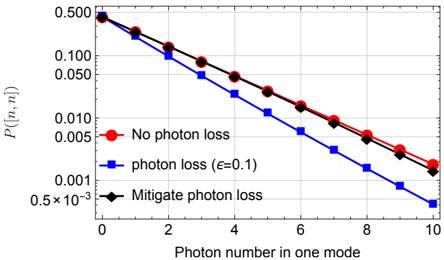
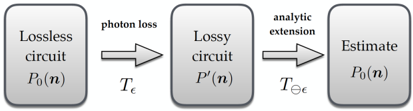
Photon loss is destructive to the performance of quantum photonic devices and therefore suppressing the effects of photon loss is paramount to photonic quantum technologies. We present two schemes to mitigate the effects of photon loss for a Gaussian Boson Sampling device, in particular, to improve the estimation of the sampling probabilities. Instead of using error correction codes which are expensive in terms of their hardware resource overhead, our schemes require only a small amount of hardware modifications or even no modification. Our loss-suppression techniques rely either on collecting additional measurement data or on classical post-processing once the measurement data is obtained. We show that with a moderate cost of classical post processing, the effects of photon loss can be significantly suppressed for a certain amount of loss. The proposed schemes are thus a key enabler for applications of near-term photonic quantum devices.
Overview
The claims and statistics of this paper haven’t been checked yet.
Free: it reads the open-access text and checks the first 5 claims that cite a source we can check. Create a free account to check every claim.
Integrity signals
Registry
Cites
Statistics
Figures
Verification
Claims the paper makes
The claims and statistics of this paper haven’t been checked yet.
Free: it reads the open-access text and checks the first 5 claims that cite a source we can check. Create a free account to check every claim.
Claims other papers make about this one
Each is checked against this paper’s own text: does it say what the citing paper says it does?
The source backs part of the claim, not all of it — or backs it for a different population, condition or comparison.
In the citing paper
“Symmetry verification is especially useful for ansatze that preserve symmetries such as particle and spin number [11, 243, 244].”
From Variational quantum algorithms (2021) · cites this paper as [243]
Experimental — accuracy not yet measured
Self-check
Percentages, sums and reported differences re-computed from the paper’s own numbers.
The self-check needs the paper’s full text.
Citations
Cites
Quantum Computing in the NISQ era and beyond
Preskill, J. (2018) · Quantum · doi:10.22331/q-2018-08-06-79 · Cited by 8,830 · cited 3×
“Tμ(P )([1, 1]) = P ([1, 1]) + { − 2P ([1, 1]) + 2P ([2, 1]) + 2P ([1, 2]) } μ+ { P ([1, 1])− 4P ([2, 1])− 4P ([1, 2])”
BackgroundQuantum supremacy using a programmable superconducting processor
Arute, F., Arya, K., Babbush, R., Bacon, D., Bardin, J. C., Barends, R., Biswas, R., Boixo, S., Brandao, F. G. S. L., Buell, D. A., et al. (2019) · Nature · doi:10.1038/s41586-019-1666-5 · Cited by 7,720 · cited 3×
“+3P ([1, 3])− 8P ([4, 1])− 12P ([3, 2])− 12P ([2, 3])− 8P ([1, 4]) + 5P ([5, 1]) + 8P ([4, 2])”
MethodA variational eigenvalue solver on a photonic quantum processor
Peruzzo, A., McClean, J., Shadbolt, P., Yung, M.-H., Zhou, X.-Q., Love, P. J., Aspuru-Guzik, A., & O’Brien, J. L. (2014) · Nature Communications · doi:10.1038/ncomms5213 · Cited by 4,552
Weedbrook, C., Pirandola, S., García-Patrón, R., Cerf, N. J., Ralph, T. C., Shapiro, J. H., & Lloyd, S. (2012) · Reviews of Modern Physics · doi:10.1103/revmodphys.84.621 · Cited by 3,664 · cited 1×
“The output multimode Gaussian state is characterized by a 2M -component vector d and a 2M × 2M covariance matrix σ [43].”
MethodSurface codes: Towards practical large-scale quantum computation
Fowler, A. G., Mariantoni, M., Martinis, J. M., & Cleland, A. N. (2012) · Physical Review A · doi:10.1103/physreva.86.032324 · Cited by 3,059 · cited 6×
“, about a thousand or more physical qubits are needed to construct a single fault-tolerant logical qubit [1].”
BackgroundInfluentialThe theory of variational hybrid quantum-classical algorithms
McClean, J. R., Romero, J., Babbush, R., & Aspuru-Guzik, A. (2016) · New Journal of Physics · doi:10.1088/1367-2630/18/2/023023 · Cited by 2,227 · cited 1×
“Moreover, inherent noise resilience of quantum algorithms can lead to error mitigation [27, 28, 29].”
BackgroundExperimental realization of any discrete unitary operator
Reck, M., Zeilinger, A., Bernstein, H. J., & Bertani, P. (1994) · Physical Review Letters · doi:10.1103/physrevlett.73.58 · Cited by 2,155 · cited 2×
“However, in the realistic implementation the photon loss is not uniform, and the situation becomes even worse if the interferometer is implemented using the Reck’s decomposition [47].”
MethodA Quantum Approximate Optimization Algorithm
Farhi, E., Goldstone, J., & Gutmann, S. (2014) · arXiv · doi:10.48550/arxiv.1411.4028 · Cited by 1,789
Error Mitigation for Short-Depth Quantum Circuits
Temme, K., Bravyi, S., & Gambetta, J. M. (2017) · Physical Review Letters · doi:10.1103/physrevlett.119.180509 · Cited by 1,379 · cited 4×
“Another error mitigation technique that is capable of improving the estimation of expectation values is called quasi-probability decomposition technique, in which a noise-free circuit is simulated by a collection of randomly selected noisy circuits following a particular quasiprobability distribution [16, 19].”
BackgroundMethodInfluentialOptimal design for universal multiport interferometers
Clements, W. R., Humphreys, P. C., Metcalf, B. J., Kolthammer, W. S., & Walsmley, I. A. (2016) · Optica · doi:10.1364/optica.3.001460 · Cited by 1,216 · cited 1×
“This is a good approximation to a realistic linear interferometer if it is implemented using the Clements’ decomposition [46] (see Appendix A for more details).”
Method
Research works printed but not linked: 4
- [22] X. Bonet-Monroig, R. Sagastizabal, M. Singh, and T. E. O'Brien, Low-cost error mitigation by symmetry verification, Phys. Rev. A 98 , 062339 (2018). - · DOI · Paper page
- [26] M. Cerezo, K. Sharma, A. Arrasmith, and P. J. Coles, Variational quantum state eigensolver, arXiv:2004.01372. - · arXiv
- [31] M. R. Geller, and M. Sun, Efficient correction of multiqubit measurement errors, arXiv:2001.09980. - · arXiv
- [32] L. Funcke, T. Hartung, K. Jansen, S. Kühn, P. Stornati, and X. Wang, Measurement error mitigation in quantum computers through classical bit-flip correction, arXiv:2007.03663. - · arXiv
Cited by
Variational quantum algorithms
Cerezo, M., Arrasmith, A., Babbush, R., Benjamin, S. C., Endo, S., Fujii, K., McClean, J. R., Mitarai, K., Yuan, X., Cincio, L., et al. (2021) · Nature Reviews Physics · doi:10.1038/s42254-021-00348-9 · Cited by 3,385
“[219] introduced a method to mitigate expectation values against correlated measurement errors, while [220] implemented an error mitigation technique to suppress the effects of photon loss for a Gaussian Boson sampling device.”
MethodLiu, Y., Singh, S., Smith, K. C., Crane, E., Martyn, J. M., Eickbusch, A., Schuckert, A., Li, R. D., Sinanan-Singh, J., Soley, M. B., et al. (2026) · PRX Quantum · doi:10.1103/4rf7-9tfx · Cited by 171
Can Error Mitigation Improve Trainability of Noisy Variational Quantum Algorithms?
Wang, S., Czarnik, P., Arrasmith, A., Cerezo, M., Cincio, Ł., & Coles, P. J. (2024) · Quantum · doi:10.22331/q-2024-03-14-1287 · Cited by 133
Zimborás, Z., Koczor, B., Holmes, Z., Borrelli, E.-M., Gilyén, A., Huang, H.-Y., Cai, Z., Acín, A., Aolita, L., Banchi, L., et al. (2025) · arXiv (Cornell University) · doi:10.48550/arxiv.2501.05694 · Cited by 119
Experimental Quantum State Measurement with Classical Shadows
Zhang, T., Sun, J., Fang, X.-X., Zhang, X.-M., Yuan, X., & Lu, H. (2021) · Physical Review Letters · doi:10.1103/physrevlett.127.200501 · Cited by 106
Universal Compiling and (No-)Free-Lunch Theorems for Continuous-Variable Quantum Learning
Volkoff, T. J., Holmes, Z., & Sornborger, A. T. (2021) · PRX Quantum · doi:10.1103/prxquantum.2.040327 · Cited by 45
“[13] Daiqin Su, Robert Israel, Kunal Sharma, Haoyu Qi, Ish Dhand, and Kamil Brádler, “Error mitigation on a near-term quantum photonic device,” arXiv preprint arXiv:2008.”
BackgroundExperimentally Finding Dense Subgraphs Using a Time-Bin Encoded Gaussian Boson Sampling Device
Sempere-Llagostera, S., Patel, R. B., Walmsley, I. A., & Kolthammer, W. S. (2022) · Physical Review X · doi:10.1103/physrevx.12.031045 · Cited by 38
Locality and Error Mitigation of Quantum CircuitsPreprint
Tran, M. C., Sharma, K., & Temme, K. (2023) · arXiv (Cornell University) · doi:10.48550/arxiv.2303.06496 · Cited by 36
Self-citationPhotonic Quantum ComputersPreprint
AbuGhanem, M. (2024) · arXiv (Cornell University) · doi:10.48550/arxiv.2409.08229 · Cited by 34
Error-mitigated photonic variational quantum eigensolver using a single-photon ququart
Lee, D., Lee, J., Hong, S., Lim, H., Cho, Y., Han, S.-W., Shin, H., Rehman, J. U., & Kim, Y. (2022) · Optica · doi:10.1364/optica.441163 · Cited by 33
Quantum error mitigation for rotation-symmetric bosonic codes with symmetry expansion
Endo, S., Suzuki, Y., Tsubouchi, K., Asaoka, R., Yamamoto, K., Matsuzaki, Y., & Tokunaga, Y. (2025) · Physical Review A · doi:10.1103/physreva.111.062402 · Cited by 22
“There exist diverse QEM methods such as extrapolation [36–38], probabilistic error cancellation [37, 39, 40], virtual distillation [41– 43], and quantum subspace expansion [44, 45].”
Variational Quantum-Classical Algorithms: A Review of Theory, Applications, and Opportunities
Adebayo, P., Basaky, F., & Osaghae, E. (2023) · UMYU Scientifica · doi:10.56919/usci.2324.008 · Cited by 18
Toward scalable fault-tolerant photonic quantum computers
AbuGhanem, M. (2026) · The Journal of Supercomputing · doi:10.1007/s11227-025-08132-7 · Cited by 17
Mitigating photon loss in linear optical quantum circuits
Mills, J., & Mezher, R. (2026) · Quantum · doi:10.22331/q-2026-03-16-2030 · Cited by 14
Error-mitigated variational algorithm on a photonic processor
Borzenkova, O. V., Struchalin, G. I., Kondratyev, I. V., Moiseevskiy, A. D., Skryabin, N. N., Dyakonov, I. V., & Straupe, S. S. (2024) · Optics Letters · doi:10.1364/ol.532017 · Cited by 11
“At first the PEC and ZNE methods were put under test to mitigate photon losses in a Gaussian boson sampler [21].”
MethodQuantum error cancellation in photonic systems: Undoing photon losses
Taylor, A., Bressanini, G., Kwon, H., & Kim, M. S. (2024) · Physical Review A · doi:10.1103/physreva.110.022622 · Cited by 11
“The authors of [34] proposed a PEC-inspired protocol to mitigate against the effects of losses in a Gaussian boson sampler.”
BackgroundPosition Papers for the ASCR Workshop on Basic Research Needs in Quantum Computing and Networking
Lougovski, P., Parekh, O., Broz, J., Byrd, M., Chembo, Y. K., de Jong, W. A., Figueroa, E. V., Humble, T. S., Larson, J. M., Quiroz, G., et al. (2023) · OSTI OAI (U.S. Department of Energy Office of Scientific and Technical Information) · doi:10.2172/2283320 · Cited by 11
Construction and volumetric benchmarking of quantum computing noise models
Weber, T., Borras, K., Jansen, K., Krücker, D., & Riebisch, M. (2024) · Physica Scripta · doi:10.1088/1402-4896/ad406c · Cited by 9
Solving Constrained Optimization Problems Using Hybrid Qubit-Qumode Quantum Devices
Dutta, R., Allen, B., Xu, C., Vu, N. P., Liu, K., Miao, F., Wang, B., Surana, A., Wang, C., Ding, Y., et al. (2026) · Journal of Chemical Theory and Computation · doi:10.1021/acs.jctc.6c00230 · Cited by 7
Impact of measurement noise on escaping saddles in variational quantum algorithms
Kaminishi, E., Mori, T., Sugawara, M., & Yamamoto, N. (2026) · Scientific Reports · doi:10.1038/s41598-026-40123-3 · Cited by 6
Quantum steering and quantum discord under noisy channels and entanglement swapping
Rosário, P., Ducuara, A. F., & Susa, C. E. (2022) · Physics Letters A · doi:10.1016/j.physleta.2022.128144 · Cited by 6
“[5] Daiqin Su, Robert Israel, Kunal Sharma, Haoyu Qi, Ish Dhand, and Kamil Brádler.”
BackgroundPost-selection in noisy Gaussian boson sampling: part is better than whole
Yang, T.-Y., Shen, Y.-X., Cao, Z., & Wang, X. (2023) · Quantum Science and Technology · doi:10.1088/2058-9565/acf06c · Cited by 4
Mitigating linear optics imperfections via port allocation and compilationPreprint
Kumar, S. P., Neuhaus, L., Helt, L. G., Qi, H., Morrison, B., Mahler, D. H., & Dhand, I. (2021) · arXiv (Cornell University) · doi:10.48550/arxiv.2103.03183 · Cited by 4
“Although existing methods can mitigate the effect of optical losses [33] and discrete defects arising on individual optical elements [34], there is no known method to mitigate imperfect splitting ratios of on-chip beam-splitters without incurring adverse overheads.”
MethodSelf-citationPractical Error Suppression and Mitigation for Reliable Quantum ComputingPreprint
Li, H.-Z., Yang, M., Yan, X., Koh, D. E., Lee, C. H., & Shen, R. (2026) · arXiv (Cornell University) · doi:10.48550/arxiv.2608.20453 · Cited by 5
Sharma, K. (2021) · Louisiana State University · doi:10.31390/gradschool_dissertations.5495
Self-citationQuantum Resilience: Canadian Innovations in Quantum Error Correction and Quantum Error MitigationPreprint
Saxena, G., Baker, J. S., Díez-Valle, P., Salazar, W. E., Ferreira, K., & Kyaw, T. H. (2025) · arXiv (Cornell University) · doi:10.48550/arxiv.2505.20534
“To address this problem, researchers from Xanadu have developed schemes to mitigate the effects of photon losses in Gaussian boson sampling devices [56].”
Wayo, D. D. K., Dias, R. A., Goliatt, L., & Groppe, S. (2026) · Journal of Physics Photonics · doi:10.1088/2515-7647/ae7864
Realistic simulation of universal multiport interferometers with losses within a Gaussian formalismPreprint
Corli, S., Chemoli, D., Altilia, S., Suerra, E., Tamascelli, D., Cialdi, S., & Prati, E. (2026) · arXiv (Cornell University) · doi:10.48550/arxiv.2610.16719
“[18] distinguishes two scenarios, i.e. Reck and Clements architectures, assuming that optical losses can be considered uniform only in the second scheme.”
Collision-aware Bayesian mitigation of photon loss in linear optical quantum circuitsPreprint
Kim, S., 안승현, Lee, J., 안승현, & Nam, D. (2026) · arXiv (Cornell University) · doi:10.48550/arxiv.2610.27529
“Photon loss is modelled, following Mills and Mezher [13] and the broader photonic-QEM literature [8, 26], as an independent per-photon Bernoulli channel with uniform survival probability 1 − η .”
Metadata
- Authors
- Su, D., Israel, R., Sharma, K., Qi, H., Dhand, I., & Brádler, K.
- Affiliations
- Xanadu Quantum Technologies (Canada) (CA)
- Louisiana State University (US)
- ORCID
- Su, Daiqin
- Venue
- Quantum
- Published
- 2021-05-04
- Volume
- 5
- Pages
- 452
- ISSN
- 2521-327X (ISSN-L)
- OpenAlex
- W3049230998
- Cited by
- 19
- References
- 46
- Citations by year
- 2026: 3 · 2025: 2 · 2024: 4 · 2023: 2 · 2022: 2 · 2021: 6
- FWCI
- 1.24
- Type
- journal article
- Language
- en
- Open access
- gold
- doi.org
- Locations
- Quantum (publishedVersion, cc-by)
- arXiv (Cornell University) (publishedVersion)
- DOAJ (DOAJ: Directory of Open Access Journals) (submittedVersion, cc-by-sa)
- arXiv (Cornell University) (cc-by)
- Funders
- Engineering and Physical Sciences Research Council (EP/R045577/1)
- Topics
- Physical Sciences › Computer Science › Artificial Intelligence › Quantum Computing Algorithms and Architecture
- Physical Sciences › Physics and Astronomy › Atomic and Molecular Physics, and Optics › Quantum Information and Cryptography
- Physical Sciences › Physics and Astronomy › Atomic and Molecular Physics, and Optics › Quantum Mechanics and Applications
- Keywords
- Gaussian boson sampling, classical post-processing, loss suppression, near-term quantum devices
About these checks
Registry, retraction, Cites and statistics results are computed, not judged, with one exception: a printed reference that no index lists is read once by a model before it counts as a citation error. Claims are extracted by a model and kept only when their quote appears verbatim in the text; each cited source is then checked, with a model’s help, for whether it says what the claim relies on. Those verdicts can be wrong — read the claim’s quote and the cited source before relying on one.
Statistics and arithmetic are recomputed, not judged.
Confidence bands are shown only for fields calibrated on our annotated test set. None is calibrated yet, so no band is shown.
What counts as a claim ›How we measure confidence ›How we check this ›
Are you an author, or do you see a problem with this page? Request a review
Data sources
Bibliographic data: Semantic Scholar, OpenAlex, Crossref.
Contains information from the Semantic Scholar Academic Graph Datasets, made available under the ODC Attribution License (ODC-BY 1.0).
Semantic Scholar’s data is described in: Kinney, R., et al. (2023). The Semantic Scholar Open Data Platform. arXiv:2301.10140.
