

Degenerate Quantum LDPC Codes With Good Finite Length Performance
Open accessThe DOI matches its Crossref record; 57 of the 57 references it cites were found in a registry or an index.
Abstract
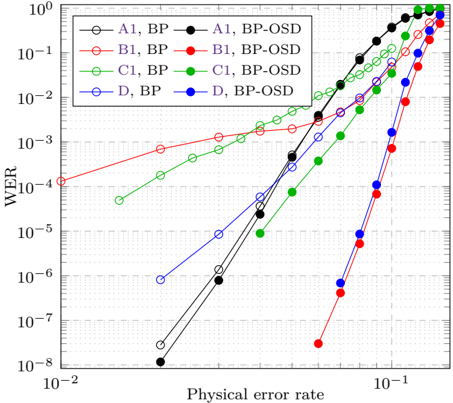
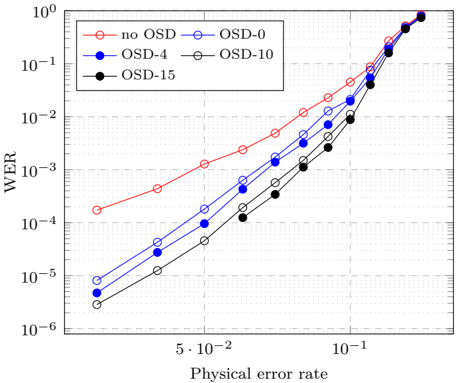
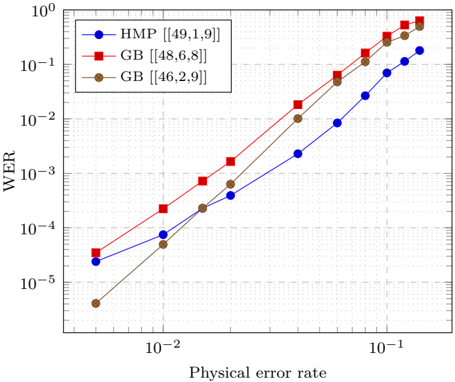
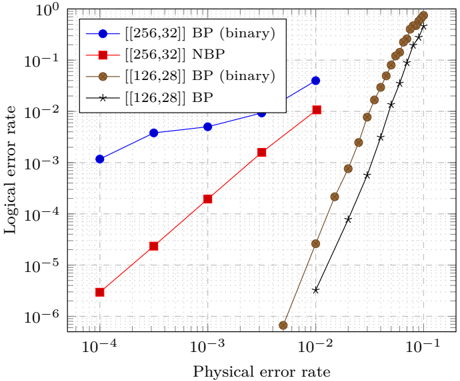
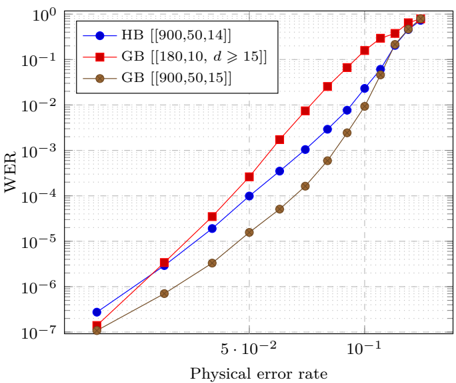
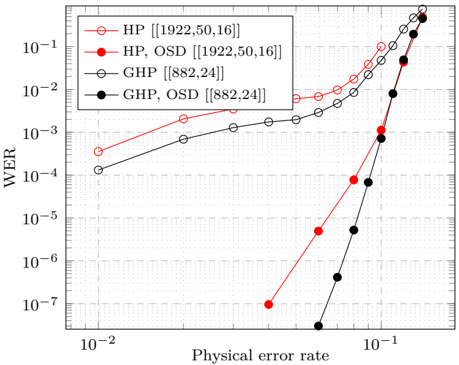
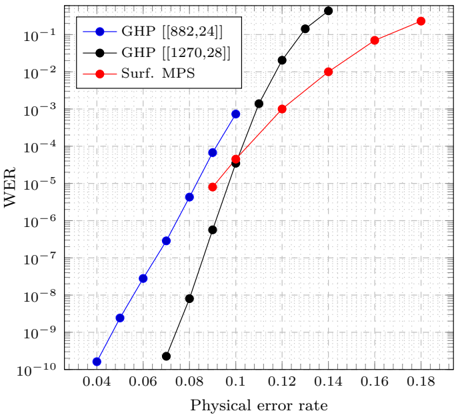
We study the performance of medium-length quantum LDPC (QLDPC) codes in the depolarizing channel. Only degenerate codes with the maximal stabilizer weight much smaller than their minimum distance are considered. It is shown that with the help of OSD-like post-processing the performance of the standard belief propagation (BP) decoder on many QLDPC codes can be improved by several orders of magnitude. Using this new BP-OSD decoder we study the performance of several known classes of degenerate QLDPC codes including hypergraph product codes, hyperbicycle codes, homological product codes, and Haah's cubic codes. We also construct several interesting examples of short generalized bicycle codes. Some of them have an additional property that their syndromes are protected by small BCH codes, which may be useful for the fault-tolerant syndrome measurement. We also propose a new large family of QLDPC codes that contains the class of hypergraph product codes, where one of the used parity-check matrices is square. It is shown that in some cases such codes have better performance than hypergraph product codes. Finally, we demonstrate that the performance of the proposed BP-OSD decoder for some of the constructed codes is better than for a relatively large surface code decoded by a near-optimal decoder.
Overview
The claims and statistics of this paper haven’t been checked yet.
Free: it reads the open-access text and checks the first 5 claims that cite a source we can check. Create a free account to check every claim.
Integrity signals
Registry
Cites
Statistics
Figures
Verification
Claims the paper makes
The claims and statistics of this paper haven’t been checked yet.
Free: it reads the open-access text and checks the first 5 claims that cite a source we can check. Create a free account to check every claim.
Claims other papers make about this one
Each is checked against this paper’s own text: does it say what the citing paper says it does?
The cited source says what the claim attributes to it.
In the citing paper
“The original work36 described BP-OSD in the context of a toy noise model with memory errors only.”
From High-threshold and low-overhead fault-tolerant quantum memory (2024) · cites this paper as [36]
Self-check
Percentages, sums and reported differences re-computed from the paper’s own numbers.
The self-check needs the paper’s full text.
Citations
Cites
Low-density parity-check codes
Gallager, R. (1962) · IEEE Transactions on Information Theory · doi:10.1109/tit.1962.1057683 · Cited by 10,602
Factor graphs and the sum-product algorithm
Kschischang, F. R., Frey, B. J., & Loeliger, H.-A. (2001) · IEEE Transactions on Information Theory · doi:10.1109/18.910572 · Cited by 6,486 · cited 1×
“There are a number of decoding algorithms for classical LDPC codes, but the most frequently used one is the belief propagation (BP) decoder [27], also known as the message passing decoder or the sum-product de-coder [29].”
Information theory, inference, and learning algorithms
(2004) · Choice Reviews Online · doi:10.5860/choice.41-5949 · Cited by 6,362
Low-Density Parity-Check Codes
Gallager, R. G. (1963) · The MIT Press eBooks · doi:10.7551/mitpress/4347.001.0001 · Cited by 4,401
A recursive approach to low complexity codes
Tanner, R. (1981) · IEEE Transactions on Information Theory · doi:10.1109/tit.1981.1056404 · Cited by 3,138
Error Correcting Codes in Quantum Theory
Steane, A. M. (1996) · Physical Review Letters · doi:10.1103/physrevlett.77.793 · Cited by 2,677
Good quantum error-correcting codes exist
Calderbank, A. R., & Shor, P. W. (1996) · Physical Review A · doi:10.1103/physreva.54.1098 · Cited by 2,516 · cited 1×
“A very important subclass of quantum stabilizer codes are the quantum Calderbank-Shor-Steane (CSS) codes introduced in [21].”
BackgroundEdmonds, J. (1965) · Canadian Journal of Mathematics · doi:10.4153/cjm-1965-045-4 · Cited by 2,428 · cited 1×
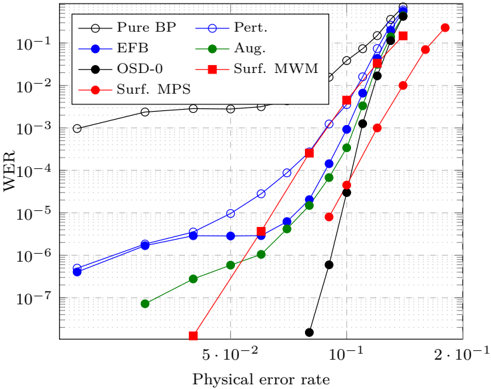
“The red curves are for the 4-limited [[1201,1,25]] surface code under the minimum weight matching (MWM) and the MPS-based decoders [36, 5].”
MethodDennis, E., Kitaev, A., Landahl, A., & Preskill, J. (2002) · Journal of Mathematical Physics · doi:10.1063/1.1499754 · Cited by 1,768
Edmonds, J. (2009) · Classic Papers in Combinatorics · doi:10.1007/978-0-8176-4842-8_26 · Cited by 1,517
Dennis, E., Kitaev, A., Landahl, A., & Preskill, J. (2001) · CERN Document Server (European Organization for Nuclear Research) · Cited by 1,485
Perfect Quantum Error Correcting Code
Laflamme, R., Miquel, C., Paz, J. P., & Zurek, W. H. (1996) · Physical Review Letters · doi:10.1103/physrevlett.77.198 · Cited by 963
Matroids and the greedy algorithm
Edmonds, J. (1971) · Mathematical Programming · doi:10.1007/bf01584082 · Cited by 866
Stabilizer Codes and Quantum Error Correction
Gottesman, D. (1997) · arXiv · doi:10.48550/arxiv.quant-ph/9705052 · Cited by 753
Purans, J., Afify, N., Dalba, G., Grisenti, R., Sanson, A., Fornasini, P., de Panfilis, S., Kuzmin, A., Ozhogin, V., Rocca, F., et al. (2004) · HAL (Le Centre pour la Communication Scientifique Directe) · doi:10.1103/physrevlett · Cited by 731
Topological Quantum Distillation
Bombin, H., & Martin-Delgado, M. A. (2006) · Physical Review Letters · doi:10.1103/physrevlett.97.180501 · Cited by 700
Local stabilizer codes in three dimensions without string logical operators
Haah, J. (2011) · Physical Review A · doi:10.1103/physreva.83.042330 · Cited by 690
Soft-decision decoding of linear block codes based on ordered statistics
Fossorier, M. P. C., & Lin, S. (1995) · IEEE Transactions on Information Theory · doi:10.1109/18.412683 · Cited by 690
Richardson, T. (2003) · Illinois Digital Environment for Access to Learning and Scholarship (University of Illinois at Urbana-Champaign) · Cited by 682
The use of information sets in decoding cyclic codes
Prange, E. (1962) · IEEE Transactions on Information Theory · doi:10.1109/tit.1962.1057777 · Cited by 463 · cited 4×
“In fact, even after very long runs of the BP-OSD decoder on this [[1024,30]] code, we have not found any non-degenerate codewords of weight less than 32.”
BackgroundInfluentialSparse-Graph Codes for Quantum Error Correction
MacKay, D. J. C., Mitchison, G., & McFadden, P. L. (2004) · IEEE Transactions on Information Theory · doi:10.1109/tit.2004.834737 · Cited by 376
Surface code quantum computing with error rates over 1%
Wang, D. S., Fowler, A. G., & Hollenberg, L. C. L. (2011) · Physical Review A · doi:10.1103/physreva.83.020302 · Cited by 343
Tillich, J.-P., & Zemor, G. (2014) · IEEE Transactions on Information Theory · doi:10.1109/tit.2013.2292061 · Cited by 288
Efficient algorithms for maximum likelihood decoding in the surface code
Bravyi, S., Suchara, M., & Vargo, A. (2014) · Physical Review A · doi:10.1103/physreva.90.032326 · Cited by 214 · cited 6×
“Comparison between different post-processing algorithms on the [[1270,28]] QLDPC code (Appendix B, code B3) and the [[1201,1,25]] surface code on the minimum weight matching (MWM) decoder, and the MPS-based decoder from [5].”
BackgroundMethodInfluentialProjective Plane and Planar Quantum Codes
Freedman, M. H., & Meyer, D. A. (2001) · Foundations of Computational Mathematics · doi:10.1007/s102080010013 · Cited by 183
Iterative reliability-based decoding of low-density parity check codes
Fossorier, M. P. C. (2001) · IEEE Journal on Selected Areas in Communications · doi:10.1109/49.924874 · Cited by 166
Quantum LDPC Codes With Almost Linear Minimum Distance
Panteleev, P., & Kalachev, G. (2022) · IEEE Transactions on Information Theory · doi:10.1109/tit.2021.3119384 · Cited by 165
Self-citationAlgebraic structure of quasicyclic codes
Lally, K., & Fitzpatrick, P. M. (2001) · Discrete Applied Mathematics · doi:10.1016/s0166-218x(00)00350-4 · Cited by 161
On the iterative decoding of sparse quantum codes
Poulin, D., & Chung, Y. (2008) · Quantum Information and Computation · doi:10.26421/qic8.10-8 · Cited by 146
A decoding algorithm for binary block codes andJ-ary output channels (Corresp.)
Dorsch, B. G. (1974) · IEEE Transactions on Information Theory · doi:10.1109/tit.1974.1055217 · Cited by 143
Balanced Product Quantum Codes
Breuckmann, N. P., & Eberhardt, J. N. (2021) · IEEE Transactions on Information Theory · doi:10.1109/tit.2021.3097347 · Cited by 140
Smarandache, R., & Vontobel, P. O. (2012) · IEEE Transactions on Information Theory · doi:10.1109/tit.2011.2173244 · Cited by 127
Constructions and Noise Threshold of Hyperbolic Surface Codes
Breuckmann, N. P., & Terhal, B. M. (2016) · IEEE Transactions on Information Theory · doi:10.1109/tit.2016.2555700 · Cited by 122
Fifteen Years of Quantum LDPC Coding and Improved Decoding Strategies
Babar, Z., Botsinis, P., Alanis, D., Ng, S. X., & Hanzo, L. (2015) · IEEE Access · doi:10.1109/access.2015.2503267 · Cited by 109
Quantum Kronecker sum-product low-density parity-check codes with finite rate
Kovalev, A. A., & Pryadko, L. P. (2013) · Physical Review A · doi:10.1103/physreva.88.012311 · Cited by 107
Smarandache, R., & Vontobel, P. O. (2009) · Cited by 102
Neural Belief-Propagation Decoders for Quantum Error-Correcting Codes
Liu, Y.-H., & Poulin, D. (2019) · Physical Review Letters · doi:10.1103/physrevlett.122.200501 · Cited by 97
Channel coding : theory, algorithms, and applications
Declercq, D., Fossorier, M. P. C., & Biglieri, E. (2014) · HAL · Cited by 89
Fiber bundle codes: breaking the n 1/2 polylog( n ) barrier for Quantum LDPC codes
Hastings, M. B., Haah, J., & O'Donnell, R. (2021) · Proceedings of the 53rd Annual ACM SIGACT Symposium on Theory of Computing · doi:10.1145/3406325.3451005 · Cited by 85
Bravyi, S., & Hastings, M. B. (2014) · Proceedings of the forty-sixth annual ACM symposium on Theory of computing · doi:10.1145/2591796.2591870 · Cited by 81
Self-correcting quantum computers
Bombin, H., Chhajlany, R. W., Horodecki, M., & Martin-Delgado, M. A. (2013) · New Journal of Physics · doi:10.1088/1367-2630/15/5/055023 · Cited by 76
Quantum Quasi-Cyclic LDPC Codes
Hagiwara, M., & Imai, H. (2007) · 2007 IEEE International Symposium on Information Theory · doi:10.1109/isit.2007.4557323 · Cited by 75
Quantum Quasi-Cyclic LDPC Codes
Hagiwara, M., & Imai, H. (2007) · CERN Document Server (European Organization for Nuclear Research) · Cited by 73
Refined Belief Propagation Decoding of Sparse-Graph Quantum Codes
Kuo, K.-Y., & Lai, C. (2020) · IEEE Journal on Selected Areas in Information Theory · doi:10.1109/jsait.2020.3011758 · Cited by 69
Building manifolds from quantum codes
Freedman, M. H., & Hastings, M. B. (2021) · Geometric and Functional Analysis · doi:10.1007/s00039-021-00567-3 · Cited by 67
On the Algebraic Structure of Quasi-cyclic Codes IV: Repeated Roots
Ling, S., Niederreiter, H., & Solé, P. (2006) · Designs Codes and Cryptography · doi:10.1007/s10623-005-1431-7 · Cited by 59
Enhanced Feedback Iterative Decoding of Sparse Quantum Codes
Wang, Y.-J., Sanders, B. C., Bai, B.-M., & Wang, X.-M. (2012) · IEEE Transactions on Information Theory · doi:10.1109/tit.2011.2169534 · Cited by 58
Modified belief propagation decoders for quantum low-density parity-check codes
Rigby, A., Olivier, J. C., & Jarvis, P. (2019) · Physical Review A · doi:10.1103/physreva.100.012330 · Cited by 47
Quantum LDPC codes with positive rate and minimum distance proportional to n½
Tillich, J.-P., & Zemor, G. (2009) · 2009 IEEE International Symposium on Information Theory · doi:10.1109/isit.2009.5205648 · Cited by 46
Improved quantum hypergraph-product LDPC codes
Kovalev, A. A., & Pryadko, L. P. (2012) · 2012 IEEE International Symposium on Information Theory Proceedings · doi:10.1109/isit.2012.6284206 · Cited by 45
Ability of stabilizer quantum error correction to protect itself from its own imperfection
Fujiwara, Y. (2014) · Physical Review A · doi:10.1103/physreva.90.062304 · Cited by 41
Enhanced Feedback Iterative Decoding of Sparse Quantum CodesPreprint
Wang, Y.-J., Sanders, B. C., Bai, B., & Wang, X. (2016) · Cited by 38
Distance Verification for Classical and Quantum LDPC Codes
Dumer, I. I., Kovalev, A. A., & Pryadko, L. P. (2017) · IEEE Transactions on Information Theory · doi:10.1109/tit.2017.2690381 · Cited by 36
Reliability-based syndrome decoding of linear block codes
Fossorier, M. P. C., Lin, S., & Snyders, J. (1998) · IEEE Transactions on Information Theory · doi:10.1109/18.651070 · Cited by 31
On the iterative decoding of sparse quantum codes
PoulinDavid, & ChungYeojin (2008) · Quantum Information and Computation · doi:10.5555/2016985.2016993 · Cited by 11
Academic Press Library in Mobile and Wireless Communications
(2014) · Elsevier eBooks · doi:10.1016/c2011-0-07211-3 · Cited by 8
Cited by
Suppressing quantum errors by scaling a surface code logical qubit
Google Quantum, A. I., Acharya, R., Aleiner, I., Allen, R., Andersen, T. I., Ansmann, M., Arute, F., Arya, K., Asfaw, A., Atalaya, J., et al. (2023) · Nature · doi:10.1038/s41586-022-05434-1 · Cited by 1,103
High-threshold and low-overhead fault-tolerant quantum memory
Bravyi, S., Cross, A. W., Gambetta, J. M., Maslov, D., Rall, P., & Yoder, T. J. (2024) · Nature · doi:10.1038/s41586-024-07107-7 · Cited by 456
“Our numerical experiments are based on the belief propagation with an ordered statistics decoder (BP-OSD) proposed by Panteleev and Kalachev 36 .”
MethodInfluentialConstant-overhead fault-tolerant quantum computation with reconfigurable atom arrays
Xu, Q., Bonilla Ataides, J. P., Pattison, C. A., Raveendran, N., Bluvstein, D., Wurtz, J., Vasić, B., Lukin, M. D., Jiang, L., & Zhou, H. (2024) · Nature Physics · doi:10.1038/s41567-024-02479-z · Cited by 157
Balanced Product Quantum Codes
Breuckmann, N. P., & Eberhardt, J. N. (2021) · IEEE Transactions on Information Theory · doi:10.1109/tit.2021.3097347 · Cited by 140
IBM quantum computers: evolution, performance, and future directions
AbuGhanem, M. (2025) · The Journal of Supercomputing · doi:10.1007/s11227-025-07047-7 · Cited by 340
Metadata
- Authors
- Panteleev, P., & Kalachev, G.
- Affiliations
- Lomonosov Moscow State University (RU)
- Venue
- Quantum
- Published
- 2021-11-22
- Volume
- 5
- Pages
- 585
- ISSN
- 2521-327X (ISSN-L)
- OpenAlex
- W2926023653
- Cited by
- 257
- References
- 56
- Citations by year
- 2026: 48 · 2025: 89 · 2024: 49 · 2023: 25 · 2022: 22 · 2021: 21
- FWCI
- 10.30
- Type
- journal article
- Language
- en
- Open access
- gold
- doi.org
- Locations
- Quantum (publishedVersion, cc-by)
- arXiv (Cornell University) (acceptedVersion)
- arXiv (Cornell University) (submittedVersion)
- DOAJ (DOAJ: Directory of Open Access Journals) (submittedVersion, cc-by-sa)
- arXiv (Cornell University) (cc-by)
- Funders
- The Ministry of Science and Higher Education of the Russian Federation (075-15-2020-801)
- Topics
- Physical Sciences › Computer Science › Artificial Intelligence › Quantum Computing Algorithms and Architecture
- Physical Sciences › Computer Science › Computer Networks and Communications › Error Correcting Code Techniques
- Physical Sciences › Mathematics › Discrete Mathematics and Combinatorics › Coding theory and cryptography
- Keywords
- quantum LDPC codes, depolarizing channel, belief propagation decoding, hypergraph product codes, BCH codes, surface code, finite-length performance
About these checks
Registry, retraction, Cites and statistics results are computed, not judged, with one exception: a printed reference that no index lists is read once by a model before it counts as a citation error. Claims are extracted by a model and kept only when their quote appears verbatim in the text; each cited source is then checked, with a model’s help, for whether it says what the claim relies on. Those verdicts can be wrong — read the claim’s quote and the cited source before relying on one.
Statistics and arithmetic are recomputed, not judged.
Confidence bands are shown only for fields calibrated on our annotated test set. None is calibrated yet, so no band is shown.
What counts as a claim ›How we measure confidence ›How we check this ›
Are you an author, or do you see a problem with this page? Request a review
Data sources
Bibliographic data: Semantic Scholar, OpenAlex, Crossref.
Contains information from the Semantic Scholar Academic Graph Datasets, made available under the ODC Attribution License (ODC-BY 1.0).
Semantic Scholar’s data is described in: Kinney, R., et al. (2023). The Semantic Scholar Open Data Platform. arXiv:2301.10140.
