

Degenerate Quantum LDPC Codes With Good Finite Length Performance
Open accessThe DOI matches its Crossref record; 57 of the 57 references it cites were found in a registry or an index.
Abstract
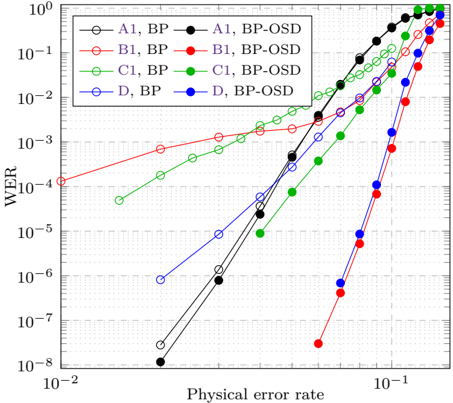
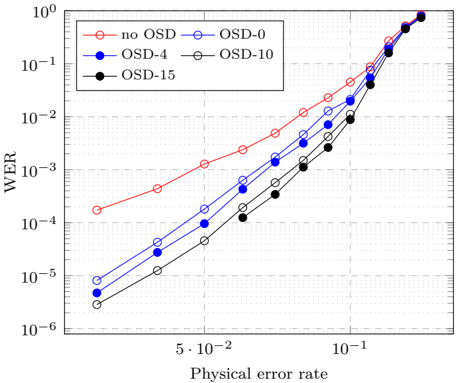
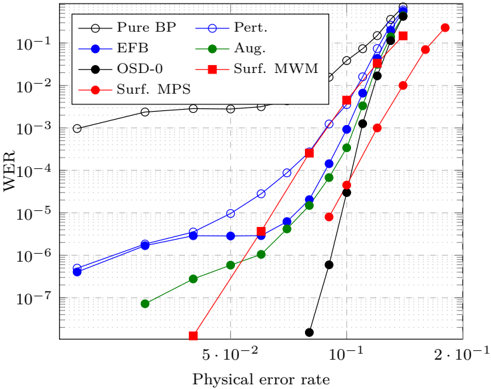
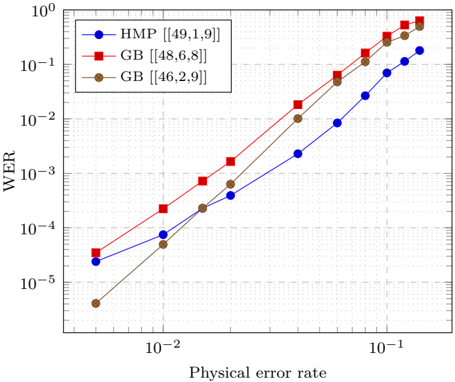
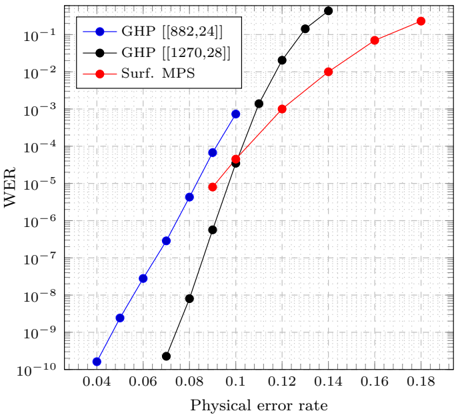
We study the performance of medium-length quantum LDPC (QLDPC) codes in the depolarizing channel. Only degenerate codes with the maximal stabilizer weight much smaller than their minimum distance are considered. It is shown that with the help of OSD-like post-processing the performance of the standard belief propagation (BP) decoder on many QLDPC codes can be improved by several orders of magnitude. Using this new BP-OSD decoder we study the performance of several known classes of degenerate QLDPC codes including hypergraph product codes, hyperbicycle codes, homological product codes, and Haah's cubic codes. We also construct several interesting examples of short generalized bicycle codes. Some of them have an additional property that their syndromes are protected by small BCH codes, which may be useful for the fault-tolerant syndrome measurement. We also propose a new large family of QLDPC codes that contains the class of hypergraph product codes, where one of the used parity-check matrices is square. It is shown that in some cases such codes have better performance than hypergraph product codes. Finally, we demonstrate that the performance of the proposed BP-OSD decoder for some of the constructed codes is better than for a relatively large surface code decoded by a near-optimal decoder.
Overview
The claims and statistics of this paper haven’t been checked yet.
Free: it reads the open-access text and checks the first 5 claims that cite a source we can check. Create a free account to check every claim.
Integrity signals
Registry
Cites
Statistics
Figures
Verification
Claims the paper makes
The claims and statistics of this paper haven’t been checked yet.
Free: it reads the open-access text and checks the first 5 claims that cite a source we can check. Create a free account to check every claim.
Claims other papers make about this one
Each is checked against this paper’s own text: does it say what the citing paper says it does?
The cited source says what the claim attributes to it.
In the citing paper
“The original work36 described BP-OSD in the context of a toy noise model with memory errors only.”
From High-threshold and low-overhead fault-tolerant quantum memory (2024) · cites this paper as [36]
Self-check
Percentages, sums and reported differences re-computed from the paper’s own numbers.
The self-check needs the paper’s full text.
Citations
Cites
Low-density parity-check codes
Gallager, R. (1962) · IEEE Transactions on Information Theory · doi:10.1109/tit.1962.1057683 · Cited by 10,602
Factor graphs and the sum-product algorithm
Kschischang, F. R., Frey, B. J., & Loeliger, H.-A. (2001) · IEEE Transactions on Information Theory · doi:10.1109/18.910572 · Cited by 6,486 · cited 1×
“There are a number of decoding algorithms for classical LDPC codes, but the most frequently used one is the belief propagation (BP) decoder [27], also known as the message passing decoder or the sum-product de-coder [29].”
Information theory, inference, and learning algorithms
(2004) · Choice Reviews Online · doi:10.5860/choice.41-5949 · Cited by 6,362
Low-Density Parity-Check Codes
Gallager, R. G. (1963) · The MIT Press eBooks · doi:10.7551/mitpress/4347.001.0001 · Cited by 4,401
A recursive approach to low complexity codes
Tanner, R. (1981) · IEEE Transactions on Information Theory · doi:10.1109/tit.1981.1056404 · Cited by 3,138
Error Correcting Codes in Quantum Theory
Steane, A. M. (1996) · Physical Review Letters · doi:10.1103/physrevlett.77.793 · Cited by 2,677
Good quantum error-correcting codes exist
Calderbank, A. R., & Shor, P. W. (1996) · Physical Review A · doi:10.1103/physreva.54.1098 · Cited by 2,516 · cited 1×
“A very important subclass of quantum stabilizer codes are the quantum Calderbank-Shor-Steane (CSS) codes introduced in [21].”
BackgroundEdmonds, J. (1965) · Canadian Journal of Mathematics · doi:10.4153/cjm-1965-045-4 · Cited by 2,428 · cited 1×
“The red curves are for the 4-limited [[1201,1,25]] surface code under the minimum weight matching (MWM) and the MPS-based decoders [36, 5].”
MethodDennis, E., Kitaev, A., Landahl, A., & Preskill, J. (2002) · Journal of Mathematical Physics · doi:10.1063/1.1499754 · Cited by 1,768
Edmonds, J. (2009) · Classic Papers in Combinatorics · doi:10.1007/978-0-8176-4842-8_26 · Cited by 1,517
Cited by
Suppressing quantum errors by scaling a surface code logical qubit
Google Quantum, A. I., Acharya, R., Aleiner, I., Allen, R., Andersen, T. I., Ansmann, M., Arute, F., Arya, K., Asfaw, A., Atalaya, J., et al. (2023) · Nature · doi:10.1038/s41586-022-05434-1 · Cited by 1,103
High-threshold and low-overhead fault-tolerant quantum memory
Bravyi, S., Cross, A. W., Gambetta, J. M., Maslov, D., Rall, P., & Yoder, T. J. (2024) · Nature · doi:10.1038/s41586-024-07107-7 · Cited by 456
“Our numerical experiments are based on the belief propagation with an ordered statistics decoder (BP-OSD) proposed by Panteleev and Kalachev 36 .”
MethodInfluentialConstant-overhead fault-tolerant quantum computation with reconfigurable atom arrays
Xu, Q., Bonilla Ataides, J. P., Pattison, C. A., Raveendran, N., Bluvstein, D., Wurtz, J., Vasić, B., Lukin, M. D., Jiang, L., & Zhou, H. (2024) · Nature Physics · doi:10.1038/s41567-024-02479-z · Cited by 157
Balanced Product Quantum Codes
Breuckmann, N. P., & Eberhardt, J. N. (2021) · IEEE Transactions on Information Theory · doi:10.1109/tit.2021.3097347 · Cited by 140
IBM quantum computers: evolution, performance, and future directions
AbuGhanem, M. (2025) · The Journal of Supercomputing · doi:10.1007/s11227-025-07047-7 · Cited by 343
Quantum Low-Density Parity-Check Codes
Breuckmann, N. P., & Eberhardt, J. N. (2021) · PRX Quantum · doi:10.1103/prxquantum.2.040101 · Cited by 328
“Lifted product codes, introduced by Panteleev–Kalachev [57, 69] are based on the observation that the tensor product of vector spaces or Kronecker product of matrices extend to modules over algebras.”
BackgroundMethodInfluentialBlueprint for a Scalable Photonic Fault-Tolerant Quantum Computer
Bourassa, J. E., Alexander, R. N., Vasmer, M., Patil, A., Tzitrin, I., Matsuura, T., Su, D., Baragiola, B. Q., Guha, S., Dauphinais, G., et al. (2021) · Quantum · doi:10.22331/q-2021-02-04-392 · Cited by 302
Good Quantum LDPC Codes with Linear Time Decoders
Dinur, I., Hsieh, M.-H., Lin, T.-C., & Vidick, T. (2023) · ACM Symposium on Theory of Computing (STOC) · doi:10.1145/3564246.3585101 · Cited by 266
Tour de gross: A modular quantum computer based on bivariate bicycle codesPreprint
Yoder, T. J., Schoute, E., Rall, P., Pritchett, E., Gambetta, J., Cross, A. W., Carroll, M. S., & Beverland, M. E. (2025) · arXiv (Cornell University) · doi:10.48550/arxiv.2506.03094 · Cited by 254
Fiber bundle codes: breaking the n 1/2 polylog( n ) barrier for Quantum LDPC codes
Hastings, M. B., Haah, J., & O'Donnell, R. (2021) · Proceedings of the 53rd Annual ACM SIGACT Symposium on Theory of Computing · doi:10.1145/3406325.3451005 · Cited by 85
Asymptotically good Quantum and locally testable classical LDPC codes
Panteleev, P., & Kalachev, G. (2022) · Proceedings of the 54th Annual ACM SIGACT Symposium on Theory of Computing · doi:10.1145/3519935.3520017 · Cited by 222
“It is also interesting to note that the codes that were actually used to get the main results in [6, 27, 44] are from a more restricted class of lifted product codes, which were previously studied in [43] under the name GHP codes and shown to have surprisingly good practical error-correcting performance under the BP-O…”
BackgroundSelf-citationParallel window decoding enables scalable fault tolerant quantum computation
Skoric, L., Browne, D. E., Barnes, K. M., Gillespie, N. I., & Campbell, E. T. (2023) · Nature Communications · doi:10.1038/s41467-023-42482-1 · Cited by 80
Improved Decoding of Circuit Noise and Fragile Boundaries of Tailored Surface Codes
Higgott, O., Bohdanowicz, T. C., Kubica, A., Flammia, S. T., & Campbell, E. T. (2023) · Physical Review X · doi:10.1103/physrevx.13.031007 · Cited by 82
Decoding across the quantum low-density parity-check code landscape
Roffe, J., White, D. R., Burton, S., & Campbell, E. (2020) · Physical Review Research · doi:10.1103/physrevresearch.2.043423 · Cited by 192
Low-overhead transversal fault tolerance for universal quantum computation
Zhou, H., Zhao, C., Cain, M., Bluvstein, D., Maskara, N., Duckering, C., Hu, H.-Y., Wang, S.-T., Kubica, A., & Lukin, M. D. (2025) · Nature · doi:10.1038/s41586-025-09543-5 · Cited by 197
Shor's algorithm is possible with as few as 10,000 reconfigurable atomic qubitsPreprint
Cain, M., Xu, Q., King, R., Picard, L. R. B., Levine, H., Endres, M., Preskill, J., Huang, H.-Y., & Bluvstein, D. (2026) · arXiv (Cornell University) · doi:10.48550/arxiv.2603.28627 · Cited by 181
Quantum LDPC Codes With Almost Linear Minimum Distance
Panteleev, P., & Kalachev, G. (2022) · IEEE Transactions on Information Theory · doi:10.1109/tit.2021.3119384 · Cited by 165
“In [17] for simplicity we considered only the case when the lift size is odd.”
BackgroundMethodInfluentialSelf-citationImproved belief propagation is sufficient for real-time decoding of quantum memoryPreprint
Müller, T., Alexander, T., Beverland, M. E., Bühler, M., Johnson, B. R., Maurer, T., & Vandeth, D. (2025) · arXiv (Cornell University) · doi:10.48550/arxiv.2506.01779 · Cited by 166
Focus beyond Quadratic Speedups for Error-Corrected Quantum Advantage
Babbush, R., McClean, J. R., Newman, M., Gidney, C., Boixo, S., & Neven, H. (2021) · PRX Quantum · doi:10.1103/prxquantum.2.010103 · Cited by 148
“noise settings using variations on efficient belief propagation decoding [82,83].”
MethodMind the gaps: The fraught road to quantum advantagePreprint
Eisert, J., & Preskill, J. P. (2025) · arXiv (Cornell University) · doi:10.48550/arxiv.2510.19928 · Cited by 144
Improved QLDPC Surgery: Logical Measurements and Bridging CodesPreprint
Cross, A. W., He, Z., Rall, P., & Yoder, T. J. (2024) · arXiv (Cornell University) · doi:10.48550/arxiv.2407.18393 · Cited by 140
Correlated Decoding of Logical Algorithms with Transversal Gates
Cain, M., Zhao, C., Zhou, H., Meister, N., Ataides, J. P. B., Jaffe, A., Bluvstein, D., & Lukin, M. D. (2024) · Physical Review Letters · doi:10.1103/physrevlett.133.240602 · Cited by 37
Low-overhead fault-tolerant quantum computation by gauging logical operators
Williamson, D. J., & Yoder, T. J. (2026) · Nature Physics · doi:10.1038/s41567-026-03220-8 · Cited by 139
Demonstration of low-overhead quantum error correction codes
Wang, K., Lu, Z., Zhang, C., Liu, G., Chen, J., Wang, Y., Wu, Y., Xu, S., Zhu, X., Jin, F., et al. (2026) · Nature Physics · doi:10.1038/s41567-025-03157-4 · Cited by 124
Trapping Sets of Quantum LDPC Codes
Raveendran, N., & Vasic, B. V. (2021) · Quantum · doi:10.22331/q-2021-10-14-562 · Cited by 123
Extractors: QLDPC Architectures for Efficient Pauli-Based ComputationPreprint
He, Z., Cowtan, A., Williamson, D. J., & Yoder, T. J. (2025) · arXiv (Cornell University) · doi:10.48550/arxiv.2503.10390 · Cited by 120
Quantum two-block group algebra codes
Lin, H.-K., & Pryadko, L. P. (2024) · Physical Review A · doi:10.1103/physreva.109.022407 · Cited by 114
Learning high-accuracy error decoding for quantum processors
Bausch, J., Senior, A. W., Heras, F. J. H., Edlich, T., Davies, A., Newman, M., Jones, C., Satzinger, K., Niu, M. Y., Blackwell, S., et al. (2024) · Nature · doi:10.1038/s41586-024-08148-8 · Cited by 106
Partitioning qubits in hypergraph product codes to implement logical gates
Quintavalle, A. O., Webster, P., & Vasmer, M. (2023) · Quantum · doi:10.22331/q-2023-10-24-1153 · Cited by 35
Low-overhead fault-tolerant quantum computing using long-range connectivity
Cohen, L. Z., Kim, I. H., Bartlett, S. D., & Brown, B. J. (2022) · Science Advances · doi:10.1126/sciadv.abn1717 · Cited by 98
Single-Shot Error Correction of Three-Dimensional Homological Product Codes
Quintavalle, A. O., Vasmer, M., Roffe, J., & Campbell, E. T. (2021) · PRX Quantum · doi:10.1103/prxquantum.2.020340 · Cited by 96
Toward a Union-Find Decoder for Quantum LDPC Codes
Delfosse, N., Londe, V., & Beverland, M. E. (2022) · IEEE Transactions on Information Theory · doi:10.1109/tit.2022.3143452 · Cited by 99
Fast and Parallelizable Logical Computation with Homological Product Codes
Xu, Q., Zhou, H., Zheng, G., Bluvstein, D., Ataides, J. P. B., Lukin, M. D., & Jiang, L. (2025) · Physical Review X · doi:10.1103/physrevx.15.021065 · Cited by 93
Scalable Fault-Tolerant Quantum Technologies with Silicon Color Centers
Simmons, S. (2024) · PRX Quantum · doi:10.1103/prxquantum.5.010102 · Cited by 91
LDPC-cat codes for low-overhead quantum computing in 2D
Ruiz, D., Guillaud, J., Leverrier, A., Mirrahimi, M., & Vuillot, C. (2025) · Nature Communications · doi:10.1038/s41467-025-56298-8 · Cited by 91
Toward Low-latency Iterative Decoding of QLDPC Codes Under Circuit-Level NoisePreprint
Gong, A., Cammerer, S., & Renes, J. M. (2024) · arXiv (Cornell University) · doi:10.48550/arxiv.2403.18901 · Cited by 89
Gidney, C., Newman, M., Brooks, P., & Jones, C. (2025) · Nature Communications · doi:10.1038/s41467-025-59714-1 · Cited by 85
Constant-Overhead Quantum Error Correction with Thin Planar Connectivity
Tremblay, M. A., Delfosse, N., & Beverland, M. E. (2022) · Physical Review Letters · doi:10.1103/physrevlett.129.050504 · Cited by 83
Magic-Induced Computational Separation in Entanglement Theory
Gu, A., Oliviero, S. F. E., & Leone, L. (2025) · PRX Quantum · doi:10.1103/prxquantum.6.020324 · Cited by 83
Combining hard and soft decoders for hypergraph product codes
Grospellier, A., Grouès, L., Krishna, A., & Leverrier, A. (2021) · Quantum · doi:10.22331/q-2021-04-15-432 · Cited by 48
Exploiting degeneracy in belief propagation decoding of quantum codes
Kuo, K.-Y., & Lai, C. (2022) · npj Quantum Information · doi:10.1038/s41534-022-00623-2 · Cited by 85
Belief Propagation Decoding of Quantum LDPC Codes with Guided Decimation
Yao, H., Laban, W. A., Häger, C., Amat, A. G. I., & Pfister, H. D. (2024) · IEEE International Symposium on Information Theory (ISIT) · doi:10.1109/isit57864.2024.10619083 · Cited by 81
Fault-Tolerant Gates on Hypergraph Product Codes
Krishna, A., & Poulin, D. (2021) · Physical Review X · doi:10.1103/physrevx.11.011023 · Cited by 36
Bias-tailored quantum LDPC codes
Roffe, J., Cohen, L. Z., Quintavalle, A. O., Chandra, D., & Campbell, E. T. (2023) · Quantum · doi:10.22331/q-2023-05-15-1005 · Cited by 77
Generalized Toric Codes on Twisted Tori for Quantum Error Correction
Liang, Z., Liu, K., Song, H., & Chen, Y.-A. (2025) · PRX Quantum · doi:10.1103/rmy6-9n89 · Cited by 76
Leverrier, A., & Zémor, G. (2023) · IEEE Transactions on Information Theory · doi:10.1109/tit.2023.3267945 · Cited by 76
Hierarchical memories: Simulating quantum LDPC codes with local gates
Pattison, C. A., Krishna, A., & Preskill, J. P. (2025) · Quantum · doi:10.22331/q-2025-05-05-1728 · Cited by 74
Resource Analysis of Low-Overhead Transversal Architectures for Reconfigurable Atom Arrays
Zhou, H., Duckering, C., Zhao, C., Bluvstein, D., Cain, M., Kubica, A., Wang, S.-T., & Lukin, M. D. (2025) · Proceedings - International Symposium on Computer Architecture/Proceedings · doi:10.1145/3695053.3731039 · Cited by 75
Modular decoding: parallelizable real-time decoding for quantum computersPreprint
Bombín, H., Dawson, C., Liu, Y.-H., Nickerson, N., Pastawski, F., & Roberts, S. (2023) · arXiv (Cornell University) · doi:10.48550/arxiv.2303.04846 · Cited by 76
QDistRnd: A GAP package for computing the distance of quantum error-correcting codes
Pryadko, L. P., Shabashov, V. A., & Kozin, V. K. (2022) · The Journal of Open Source Software · doi:10.21105/joss.04120 · Cited by 73
Ambiguity Clustering: an accurate and efficient decoder for qLDPC codesPreprint
Wolanski, S., & Barber, B. (2024) · arXiv (Cornell University) · doi:10.48550/arxiv.2406.14527 · Cited by 74
An Efficient Decoder for a Linear Distance Quantum LDPC Code
Gu, S., Pattison, C. A., & Tang, E. (2023) · ACM Symposium on Theory of Computing (STOC) · doi:10.1145/3564246.3585169 · Cited by 73
High-performance fault-tolerant quantum computing with many-hypercube codes
Goto, H. (2024) · Science Advances · doi:10.1126/sciadv.adp6388 · Cited by 72
Refined Belief Propagation Decoding of Sparse-Graph Quantum Codes
Kuo, K.-Y., & Lai, C. (2020) · IEEE Journal on Selected Areas in Information Theory · doi:10.1109/jsait.2020.3011758 · Cited by 69
Toward a 2D Local Implementation of Quantum Low-Density Parity-Check Codes
Berthusen, N., Devulapalli, D., Schoute, E., Childs, A. M., Gullans, M. J., Gorshkov, A. V., & Gottesman, D. (2025) · PRX Quantum · doi:10.1103/prxquantum.6.010306 · Cited by 70
Leveraging Qubit Loss Detection in Fault-Tolerant Quantum Algorithms
Baranes, G., Cain, M., Ataides, J. P. B., Bluvstein, D., Sinclair, J., Vuletić, V., Zhou, H., & Lukin, M. D. (2026) · Physical Review X · doi:10.1103/ycwc-3myc · Cited by 66
Lowering Connectivity Requirements for Bivariate Bicycle Codes Using Morphing Circuits
Shaw, M. H., & Terhal, B. M. (2025) · Physical Review Letters · doi:10.1103/physrevlett.134.090602 · Cited by 66
Stabilizer Inactivation for Message-Passing Decoding of Quantum LDPC Codes
Crest, J. D., Mhalla, M., & Savin, V. (2022) · IEEE Information Theory Workshop (ITW) · doi:10.1109/itw54588.2022.9965902 · Cited by 64
Improved Single-Shot Decoding of Higher-Dimensional Hypergraph-Product Codes
Higgott, O., & Breuckmann, N. P. (2023) · PRX Quantum · doi:10.1103/prxquantum.4.020332 · Cited by 62
Fault-Tolerant Logical Measurements via Homological Measurement
Ide, B., Gowda, M. G., Nadkarni, P. J., & Dauphinais, G. (2025) · Physical Review X · doi:10.1103/physrevx.15.021088 · Cited by 65
Decoding algorithms for surface codes
deMarti iOlius, A., Fuentes, P., Orús, R., Crespo, P. M., & Etxezarreta Martinez, J. (2024) · Quantum · doi:10.22331/q-2024-10-10-1498 · Cited by 60
“Although the existence of sparse codes exhibiting such favorable parameter scaling remained unproven for the past two decades, groundbreaking results by Panteleev and Kalachev (Panteleev and Kalachev, 2021a) as well as (Breuckmann and Eberhardt, 2021a; Hastings et al., 2020; Leverrier and Zemor, 2022) have finally sho…”
BackgroundMethodResultInfluentialDegeneracy and Its Impact on the Decoding of Sparse Quantum Codes
Fuentes, P., Martínez, J. E., Crespo, P. M., & Garcia‐Frias, J. (2021) · IEEE Access · doi:10.1109/access.2021.3089829 · Cited by 63
Fast correlated decoding of transversal logical algorithmsPreprint
Cain, M., Bluvstein, D., Zhao, C., Gu, S., Maskara, N., Kalinowski, M., Geim, A. A., Kubica, A., Lukin, M. D., & Zhou, H. (2025) · arXiv (Cornell University) · doi:10.48550/arxiv.2505.13587 · Cited by 59
Machine learning message-passing for the scalable decoding of QLDPC codes
Maan, A. S., & Paler, A. (2025) · npj Quantum Information · doi:10.1038/s41534-025-01033-w · Cited by 58
Computing efficiently in QLDPC codes
Malcolm, A. J., Glaudell, A. N., Fuentes, P., Chandra, D., Schotte, A., DeLisle, C., Haenel, R., Ebrahimi, A. M., Roffe, J., Quintavalle, A. O., et al. (2026) · Nature Communications · doi:10.1038/s41467-026-73061-9 · Cited by 58
Scalable Neural Decoders for Practical Fault-Tolerant Quantum ComputationPreprint
Gu, A., Ataides, J. P. B., Lukin, M. D., & Yelin, S. F. (2026) · arXiv (Cornell University) · doi:10.48550/arxiv.2604.08358 · Cited by 58
Time-Efficient Logical Operations on Quantum Low-Density Parity Check Codes
Zhang, G., & Li, Y. (2025) · Physical Review Letters · doi:10.1103/physrevlett.134.070602 · Cited by 56
Delfosse, N., Beverland, M. E., & Tremblay, M. A. (2021) · arXiv (Cornell University) · doi:10.48550/arxiv.2109.14599 · Cited by 56
Towards Ultra-High-Rate Quantum Error Correction with Reconfigurable Atom ArraysPreprint
Zhao, C., Duckering, C., Gu, A., Maskara, N., & Zhou, H. (2026) · arXiv (Cornell University) · doi:10.48550/arxiv.2604.16209 · Cited by 58
Quantum Information Processing, Sensing, and Communications: Their Myths, Realities, and Futures
Hanzo, L., Babar, Z., Cai, Z., Chandra, D., Djordjević, I. B., Koczor, B., Ng, S. X., Razavi, M., & Simeone, O. (2025) · Proceedings of the IEEE · doi:10.1109/jproc.2024.3510394 · Cited by 54
Single-Shot Decoding of Linear Rate LDPC Quantum Codes With High Performance
Breuckmann, N. P., & Londe, V. (2021) · IEEE Transactions on Information Theory · doi:10.1109/tit.2021.3122352 · Cited by 53
SSIP: automated surgery with quantum LDPC codesPreprint
Cowtan, A. (2024) · arXiv (Cornell University) · doi:10.48550/arxiv.2407.09423 · Cited by 52
Quantum Low-Density Parity-Check Codes for Modular Architectures
Strikis, A., & Berent, L. (2023) · PRX Quantum · doi:10.1103/prxquantum.4.020321 · Cited by 51
Conservation Laws and Quantum Error Correction: Toward a Generalized Matching Decoder
Brown, B. J. (2022) · IEEE BITS the Information Theory Magazine · doi:10.1109/mbits.2023.3246025 · Cited by 48
qSIEVE: Efficient qLDPC Memory via Systolic Movement in Atom Arrays
Viszlai, J., Yang, W., Lin, S. F., Liu, J., Nottingham, N., Baker, J. M., & Chong, F. T. (2026) · ACM Transactions on Quantum Computing · doi:10.1145/3779066 · Cited by 47
Akahoshi, Y., Toshio, R., Fujisaki, J., Oshima, H., Sato, S., & Fujii, K. (2025) · PRX Quantum · doi:10.1103/93zr-1ykb · Cited by 49
Efficient soft-output decoders for the surface codePreprint
Meister, N., Pattison, C. A., & Preskill, J. P. (2024) · arXiv (Cornell University) · doi:10.48550/arxiv.2405.07433 · Cited by 49
Towards Early Fault Tolerance on a 2 × N Array of Qubits Equipped with Shuttling
Siegel, A. C., Strikis, A., & Fogarty, M. A. (2024) · PRX Quantum · doi:10.1103/prxquantum.5.040328 · Cited by 48
High-rate qLDPC processorsPreprint
Bhardwaj, A., Ma, M., Meister, N., King, R., Bluvstein, D., Preskill, J., Cain, M., Xu, Q., & Huang, H.-Y. (2026) · arXiv (Cornell University) · doi:10.48550/arxiv.2607.28795 · Cited by 54
The Physics of (good) LDPC Codes II. Product constructionsPreprint
Rakovszky, T., & Khemani, V. (2024) · arXiv (Cornell University) · doi:10.48550/arxiv.2402.16831 · Cited by 46
High-Threshold, Low-Overhead and Single-Shot Decodable Fault-Tolerant Quantum Memory
Scruby, T. R., Hillmann, T., & Roffe, J. (2026) · PRX Quantum · doi:10.1103/67xf-zdjb · Cited by 48
Coprime Bivariate Bicycle Codes and Their Layouts on Cold Atoms
Wang, M., & Mueller, F. (2026) · Quantum · doi:10.22331/q-2026-02-23-2009 · Cited by 44
Constant-Overhead Fault-Tolerant Bell-Pair Distillation Using High-Rate Codes
Ataides, J. P. B., Zhou, H., Xu, Q., Baranes, G., Li, B., Lukin, M. D., & Jiang, L. (2025) · Physical Review Letters · doi:10.1103/s39k-r2kq · Cited by 44
Williamson, D. J., & Baspin, N. (2024) · Nature Communications · doi:10.1038/s41467-024-53881-3 · Cited by 44
Single-shot and measurement-based quantum error correction via fault complexes
Hillmann, T., Dauphinais, G., Tzitrin, I., & Vasmer, M. (2025) · Physical Review A · doi:10.1103/cjb4-l57n · Cited by 44
Magic Tricycles: Efficient Magic-State Generation with Finite Block-Length Quantum LDPC Codes
Menon, V., Ataides, J. P. B., Mehta, R., Gu, A., Tan, D. B., & Lukin, M. D. (2026) · Physical Review X · doi:10.1103/ghhp-cytl · Cited by 45
Quantum error correction for long chains of trapped ions
Ye, M., & Delfosse, N. (2025) · Quantum · doi:10.22331/q-2025-11-27-1920 · Cited by 43
Platform Architecture for Tight Coupling of High-Performance Computing with Quantum ProcessorsPreprint
Caldwell, S. A., Khazraee, M., Agostini, E., Lassiter, T., Simpson, C., Kahalon, O., Kanuri, M., Kim, J.-S., Stanwyck, S., Li, M., et al. (2025) · arXiv (Cornell University) · doi:10.48550/arxiv.2510.25213 · Cited by 43
Planar Quantum Low-Density Parity-Check Codes with Open Boundaries
Liang, Z., Eberhardt, J. N., & Chen, Y.-A. (2025) · PRX Quantum · doi:10.1103/qv65-vmzr · Cited by 41
An almost-linear time decoding algorithm for quantum LDPC codes under circuit-level noise
iOlius, A. D., Martinez, I. E., Roffe, J., & Martínez, J. E. (2026) · npj Quantum Information · doi:10.1038/s41534-026-01292-1 · Cited by 40
Tailoring Three-Dimensional Topological Codes for Biased Noise
Huang, E., Pesah, A. C., Chubb, C. T., Vasmer, M., & Dua, A. (2023) · PRX Quantum · doi:10.1103/prxquantum.4.030338 · Cited by 40
Distance Bounds for Generalized Bicycle Codes
Wang, R., & Pryadko, L. P. (2022) · Symmetry · doi:10.3390/sym14071348 · Cited by 39
Quantum memory at nonzero temperature in a thermodynamically trivial system
Hong, Y., Guo, J., & Lucas, A. (2025) · Nature Communications · doi:10.1038/s41467-024-55570-7 · Cited by 41
Leverrier, A., & Zémor, G. (2023) · Society for Industrial and Applied Mathematics eBooks · doi:10.1137/1.9781611977554.ch45 · Cited by 39
Generalized Belief Propagation Algorithms for Decoding of Surface Codes
Old, J., & Rispler, M. (2023) · Quantum · doi:10.22331/q-2023-06-07-1037 · Cited by 38
All-photonic one-way quantum repeaters with measurement-based error correction
Niu, D., Zhang, Y., Shabani, A., & Shapourian, H. (2023) · npj Quantum Information · doi:10.1038/s41534-023-00775-9 · Cited by 38
Quantum Codes with Addressable and Transversal Non-Clifford GatesPreprint
He, Z., Vaikuntanathan, V., Wills, A., & Zhang, R. (2025) · arXiv (Cornell University) · doi:10.48550/arxiv.2502.01864 · Cited by 38
Fast and fault-tolerant logical measurements: Auxiliary hypergraphs and transversal surgeryPreprint
Cowtan, A., He, Z., Williamson, D. J., & Yoder, T. J. (2025) · arXiv (Cornell University) · doi:10.48550/arxiv.2510.14895 · Cited by 38
Fault-Tolerant Quantum Computing with Trapped Ions: The Walking Cat ArchitecturePreprint
Tripier, F., Chung, W. C., Young, J., Alam, S., Bjork, B., Brodutch, A., Buessen, F. L., Coble, N. J., Dellaert, T., Maslov, D., et al. (2026) · arXiv (Cornell University) · doi:10.48550/arxiv.2604.19481 · Cited by 42
Localized statistics decoding for quantum low-density parity-check codes
Hillmann, T., Berent, L., Quintavalle, A. O., Eisert, J., Wille, R., & Roffe, J. (2025) · Nature Communications · doi:10.1038/s41467-025-63214-7 · Cited by 37
“However, improved decoding accuracy can be achieved with higher-order reprocessing, i.e., BP+OSD − w for w > 0 [11, 21].”
Influential
Metadata
- Authors
- Panteleev, P., & Kalachev, G.
- Affiliations
- Lomonosov Moscow State University (RU)
- Venue
- Quantum
- Published
- 2021-11-22
- Volume
- 5
- Pages
- 585
- ISSN
- 2521-327X (ISSN-L)
- OpenAlex
- W2926023653
- Cited by
- 257
- References
- 56
- Citations by year
- 2026: 48 · 2025: 89 · 2024: 49 · 2023: 25 · 2022: 22 · 2021: 21
- FWCI
- 10.30
- Type
- journal article
- Language
- en
- Open access
- gold
- doi.org
- Locations
- Quantum (publishedVersion, cc-by)
- arXiv (Cornell University) (acceptedVersion)
- arXiv (Cornell University) (submittedVersion)
- DOAJ (DOAJ: Directory of Open Access Journals) (submittedVersion, cc-by-sa)
- arXiv (Cornell University) (cc-by)
- Funders
- The Ministry of Science and Higher Education of the Russian Federation (075-15-2020-801)
- Topics
- Physical Sciences › Computer Science › Artificial Intelligence › Quantum Computing Algorithms and Architecture
- Physical Sciences › Computer Science › Computer Networks and Communications › Error Correcting Code Techniques
- Physical Sciences › Mathematics › Discrete Mathematics and Combinatorics › Coding theory and cryptography
- Keywords
- quantum LDPC codes, depolarizing channel, belief propagation decoding, hypergraph product codes, BCH codes, surface code, finite-length performance
About these checks
Registry, retraction, Cites and statistics results are computed, not judged, with one exception: a printed reference that no index lists is read once by a model before it counts as a citation error. Claims are extracted by a model and kept only when their quote appears verbatim in the text; each cited source is then checked, with a model’s help, for whether it says what the claim relies on. Those verdicts can be wrong — read the claim’s quote and the cited source before relying on one.
Statistics and arithmetic are recomputed, not judged.
Confidence bands are shown only for fields calibrated on our annotated test set. None is calibrated yet, so no band is shown.
What counts as a claim ›How we measure confidence ›How we check this ›
Are you an author, or do you see a problem with this page? Request a review
Data sources
Bibliographic data: Semantic Scholar, OpenAlex, Crossref.
Contains information from the Semantic Scholar Academic Graph Datasets, made available under the ODC Attribution License (ODC-BY 1.0).
Semantic Scholar’s data is described in: Kinney, R., et al. (2023). The Semantic Scholar Open Data Platform. arXiv:2301.10140.
