

Minimum Trotterization Formulas for a Time-Dependent Hamiltonian
Open accessThe DOI matches its Crossref record; 33 of the 33 references it cites were found in a registry or an index.
Abstract
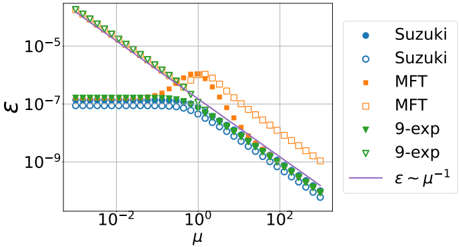
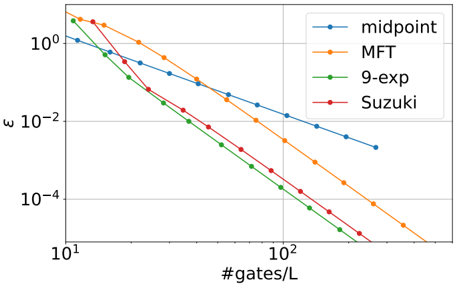
When a time propagator eδtA for duration δt consists of two noncommuting parts A=X+Y, Trotterization approximately decomposes the propagator into a product of exponentials of X and Y. Various Trotterization formulas have been utilized in quantum and classical computers, but much less is known for the Trotterization with the time-dependent generator A(t). Here, for A(t) given by the sum of two operators X and Y with time-dependent coefficients A(t)=x(t)X+y(t)Y, we develop a systematic approach to derive high-order Trotterization formulas with minimum possible exponentials. In particular, we obtain fourth-order and sixth-order Trotterization formulas involving seven and fifteen exponentials, respectively, which are no more than those for time-independent generators. We also construct another fourth-order formula consisting of nine exponentials having a smaller error coefficient. Finally, we numerically benchmark the fourth-order formulas in a Hamiltonian simulation for a quantum Ising chain, showing that the 9-exponential formula accompanies smaller errors per local quantum gate than the well-known Suzuki formula.
Overview
The claims and statistics of this paper haven’t been checked yet.
Free: it reads the open-access text and checks the first 5 claims that cite a source we can check. Create a free account to check every claim.
Integrity signals
Registry
Cites
Statistics
Figures

Verification
Claims the paper makes
The claims and statistics of this paper haven’t been checked yet.
Free: it reads the open-access text and checks the first 5 claims that cite a source we can check. Create a free account to check every claim.
Claims other papers make about this one
Each is checked against this paper’s own text: does it say what the citing paper says it does?
The cited source says what the claim attributes to it.
In the citing paper
“Trotterization methods are commonly employed, and allow discretization errors that are controlled polynomially in dt, with a number of unitary operations that scales linearly in the number of Hamiltonian terms and simulation time IV .”
From Beyond-classical computation in quantum simulation (2025) · cites this paper as [104]
Self-check
Percentages, sums and reported differences re-computed from the paper’s own numbers.
The self-check needs the paper’s full text.
Citations
Cites
Relation between the Anderson and Kondo Hamiltonians
Schrieffer, J. R., & Wolff, P. A. (1966) · Physical Review · doi:10.1103/physrev.149.491 · Cited by 2,389
Construction of higher order symplectic integrators
Yoshida, H. (1990) · Physics Letters A · doi:10.1016/0375-9601(90)90092-3 · Cited by 2,289
On the product of semi-groups of operators
Trotter, H. F. (1959) · Proceedings of the American Mathematical Society · doi:10.1090/s0002-9939-1959-0108732-6 · Cited by 2,282
The Magnus expansion and some of its applications
Blanes, S., Casas, F., Oteo, J. A., & Ros, J. (2009) · Physics Reports · doi:10.1016/j.physrep.2008.11.001 · Cited by 1,157
Suzuki, M. (1990) · Physics Letters A · doi:10.1016/0375-9601(90)90962-n · Cited by 853
Optimal Hamiltonian Simulation by Quantum Signal Processing
Low, G. H., & Chuang, I. L. (2017) · Physical Review Letters · doi:10.1103/physrevlett.118.010501 · Cited by 769
Self-citationFourth-order symplectic integration
Forest, E., & Ruth, R. D. (1990) · Physica D: Nonlinear Phenomena · doi:10.1016/0167-2789(90)90019-l · Cited by 644
Schrieffer–Wolff transformation for quantum many-body systems
Bravyi, S., DiVincenzo, D. P., & Loss, D. (2011) · Annals of Physics · doi:10.1016/j.aop.2011.06.004 · Cited by 569
Quasiparticle kinetic theory for Calogero modelsPreprint
Bulchandani, V. B., Kulkarni, M., Moore, J. E., et al. (2021) · doi:10.1088/1751- · Cited by 482
Theory of Trotter Error with Commutator Scaling
Childs, A. M., Su, Y., Tran, M. C., Wiebe, N., & Zhu, S. (2021) · Physical Review X · doi:10.1103/physrevx.11.011020 · Cited by 451
Research works printed but not linked: 1
- Tatsuhiko N. Ikeda and Keisuke Fujii. Trotter24: A precision-guaranteed adaptive stepsize trotterization for hamiltonian simulations. arXiv:2307.05406, 2023. https://doi.org/10.48550/arXiv.2307.05406. · arXiv · doi:10.48550/arxiv.2307.05406
Cited by
Beyond-classical computation in quantum simulation
King, A. D., Nocera, A., Rams, M. M., Dziarmaga, J., Wiersema, R., Bernoudy, W., Raymond, J., Kaushal, N., Heinsdorf, N., Harris, R., et al. (2025) · Science · doi:10.1126/science.ado6285 · Cited by 138
Belaloui, N. E., Tounsi, A., Khamadja, A. R., Louamri, M. M., Benslama, A., Bernal, D. E., & Rouabah, M. T. (2025) · Journal of Chemical Theory and Computation · doi:10.1021/acs.jctc.4c01657 · Cited by 34
Zhao, H., Bukov, M., Heyl, M., & Moessner, R. (2024) · Physical Review Letters · doi:10.1103/physrevlett.133.010603 · Cited by 31
Block encoding bosons by signal processing
Kane, C. F., Hariprakash, S., Modi, N. S., Kreshchuk, M., & Bauer, C. (2025) · Quantum · doi:10.22331/q-2025-05-15-1747 · Cited by 26
Unifying framework for quantum simulation algorithms for time-dependent Hamiltonian dynamics
Cao, Y. H., Jin, S., & Liu, N. (2025) · Physical Review Research · doi:10.1103/fkh5-b669 · Cited by 22
Metadata
- Authors
- Ikeda, T. N., Abrar, A., Chuang, I. L., & Sugiura, S.
- Affiliations
- Boston University (US)
- NTT (United States) (US)
- Massachusetts Institute of Technology (US)
- Venue
- Quantum
- Published
- 2023-11-06
- Volume
- 7
- Pages
- 1168
- ISSN
- 2521-327X (ISSN-L)
- OpenAlex
- W4388411670
- Cited by
- 14
- References
- 29
- Citations by year
- 2026: 2 · 2025: 5 · 2024: 7
- FWCI
- 1.32
- Type
- journal article
- Language
- en
- Open access
- gold
- doi.org
- Locations
- Quantum (publishedVersion, cc-by)
- arXiv (Cornell University) (submittedVersion)
- DOAJ (DOAJ: Directory of Open Access Journals) (submittedVersion, cc-by-sa)
- arXiv (Cornell University) (cc-by)
- Funders
- JST PRESTO (JPMJPR2112)
- JSPS KAKENHI (JP21K13852)
- Topics
- Physical Sciences › Computer Science › Artificial Intelligence › Quantum Computing Algorithms and Architecture
- Physical Sciences › Mathematics › Numerical Analysis › Numerical Solvers for Ordinary Differential Equations
- Physical Sciences › Physics and Astronomy › Atomic and Molecular Physics, and Optics › Quantum many-body systems
- Keywords
- Trotterization, time-dependent Hamiltonian, quantum simulation, quantum Ising chain, quantum gate errors, non-commuting operators
About these checks
Registry, retraction, Cites and statistics results are computed, not judged, with one exception: a printed reference that no index lists is read once by a model before it counts as a citation error. Claims are extracted by a model and kept only when their quote appears verbatim in the text; each cited source is then checked, with a model’s help, for whether it says what the claim relies on. Those verdicts can be wrong — read the claim’s quote and the cited source before relying on one.
Statistics and arithmetic are recomputed, not judged.
Confidence bands are shown only for fields calibrated on our annotated test set. None is calibrated yet, so no band is shown.
What counts as a claim ›How we measure confidence ›How we check this ›
Are you an author, or do you see a problem with this page? Request a review
How to cite
Cite CoChat for the checks on this page, and the paper for its own findings.
- This page
- CoChat. (2026). Citation check: Minimum Trotterization Formulas for a Time-Dependent Hamiltonian. https://app.cochat.ai/papers/10.22331/q-2023-11-06-1168
- The paper
- Ikeda, T. N., Abrar, A., Chuang, I. L., & Sugiura, S. (2023). Minimum Trotterization Formulas for a Time-Dependent Hamiltonian. Quantum. https://doi.org/10.22331/q-2023-11-06-1168
Data sources
Bibliographic data: Semantic Scholar, OpenAlex, Crossref.
Contains information from the Semantic Scholar Academic Graph Datasets, made available under the ODC Attribution License (ODC-BY 1.0).
Semantic Scholar’s data is described in: Kinney, R., et al. (2023). The Semantic Scholar Open Data Platform. arXiv:2301.10140.
