

Towards violations of Local Friendliness with quantum computers
Open accessThe DOI matches its Crossref record; 60 of the 61 references it cites were found in a registry or an index; 15 of the 32 sources its claims cite were checked for support.
Abstract
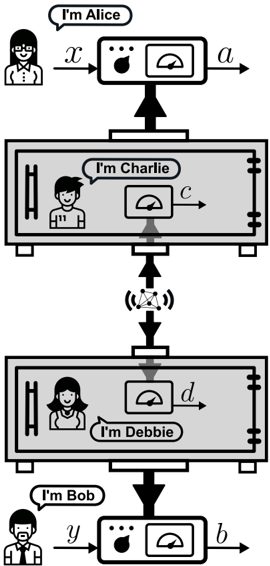
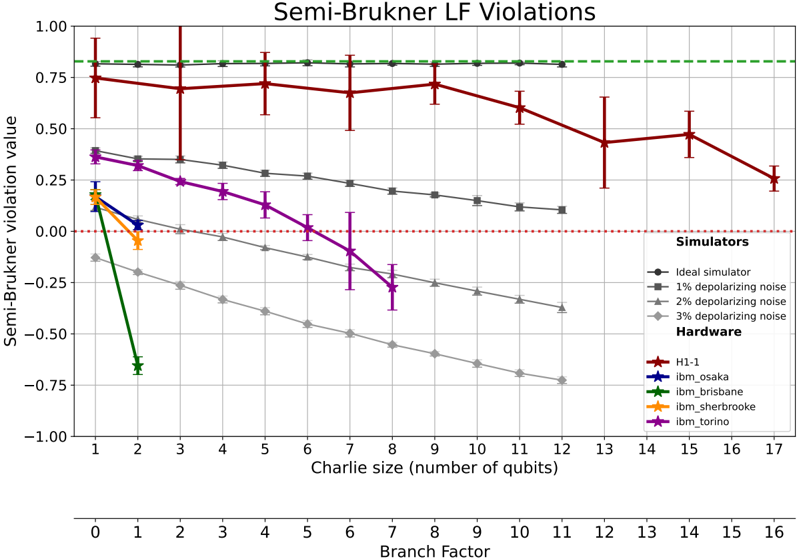
Local Friendliness (LF) inequalities follow from seemingly reasonable assumptions about reality: (i) ``absoluteness of observed events'' (e.g., every observed event happens for all observers) and (ii) ``local agency'' (e.g., free choices can be made uncorrelated with other events outside their future light cone). Extended Wigner's Friend Scenario (EWFS) thought experiments show that textbook quantum mechanics violates these inequalities. Thus, experimental evidence of these violations would make these two assumptions incompatible. In [Nature Physics 16, 1199 (2020)], the authors experimentally implemented an EWFS, using a photonic qubit to play the role of each of the ``friends'' and measured violations of LF. One may question whether a photonic qubit is a physical system that counts as an ``observer'' and thereby question whether the experiment's outcome is significant. Intending to measure increasingly meaningful violations, we propose using a statistical measure called the ``branch factor'' to quantify the ``observerness'' of the system. We then encode the EWFS as a quantum circuit such that the components of the circuit that define the friend are quantum systems of increasing branch factor. We run this circuit on quantum simulators and hardware devices, observing LF violations as the system sizes scale. As errors in quantum computers reduce the significance of the violations, better quantum computers can produce better violations. Our results extend the state of the art in proof-of-concept experimental violations from branch factor 0.0 to branch factor 16.0. This is an initial result in an experimental program for measuring LF violations at increasingly meaningful branch factors using increasingly more powerful quantum processors and networks. We introduce this program as a fundamental science application for near-term and developing quantum technology.
Overview
CoChat Summary
## TL;DR
The paper proposes and demonstrates an experimental program for testing Local Friendliness (LF) violations with quantum computers, using the branch factor to quantify how “observer-like” the friend system is. It reports LF violations on simulators and hardware, extending proof-of-concept violations from branch factor 0.0 to branch factor 16.0.
## Key findings
- The paper uses the semi-Brukner LF inequality, stated as
\(-\langle A_1B_2\rangle + \langle A_1B_3\rangle - \langle A_3B_2\rangle - \langle A_3B_3\rangle - 2 \le 0\),
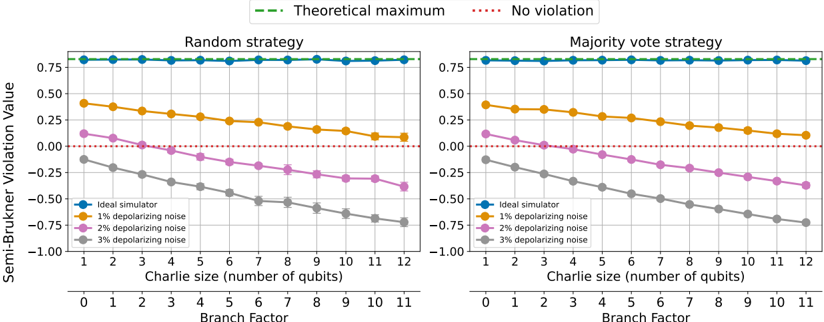
and reports a theoretical maximum left-hand side of 0.82843 in Table 1.
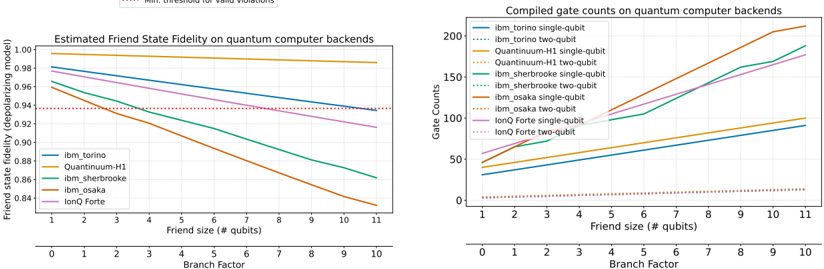
- Under a depolarizing-noise model, the paper derives that to preserve a violation the prepared friend state must have fidelity greater than 93.66%; equivalently, it states \(X \ge 8 - 6q\) and that the minimum fidelity supporting violation is 93.66%.
- On real hardware, the paper reports that ibm_torino obtained a violation at branch factor 4, while Quantinuum H1-1 obtained a violation at branch factor 16; the other IBM devices shown (ibm_osaka, ibm_sherbrooke) did not show violations beyond branch factor 0.
- The authors state that their results extend proof-of-concept experimental violations from branch factor 0.0 to branch factor 16.0.
## Methods
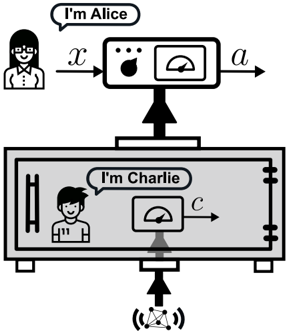
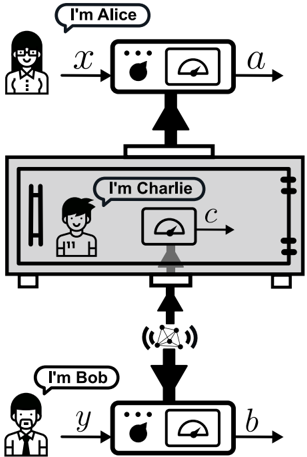
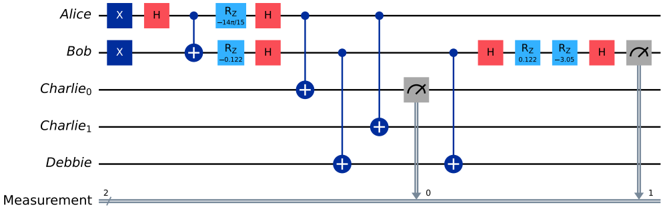
- The paper studies Extended Wigner’s Friend Scenarios (EWFS) and focuses on the three-setting, two-party semi-Brukner inequality; it also analyzes a simplified single-friend variant where Bob has no friend register beyond a single qubit.
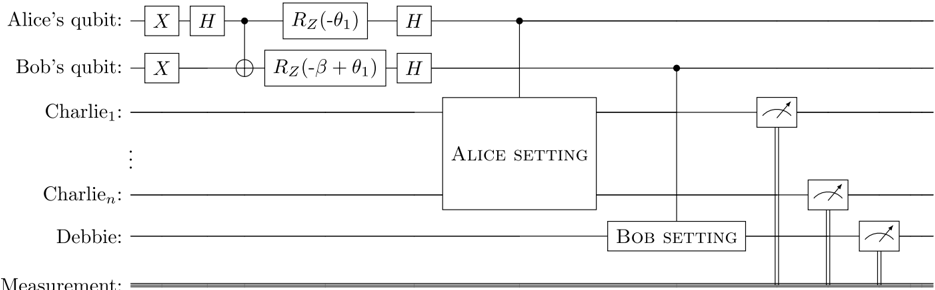
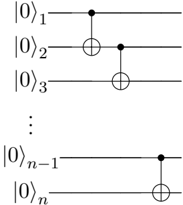
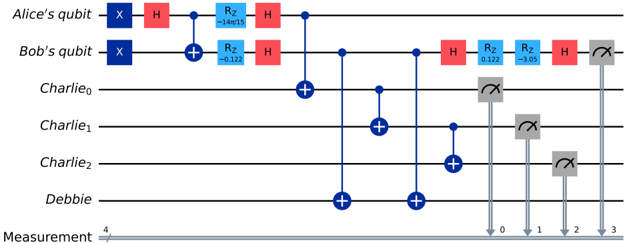
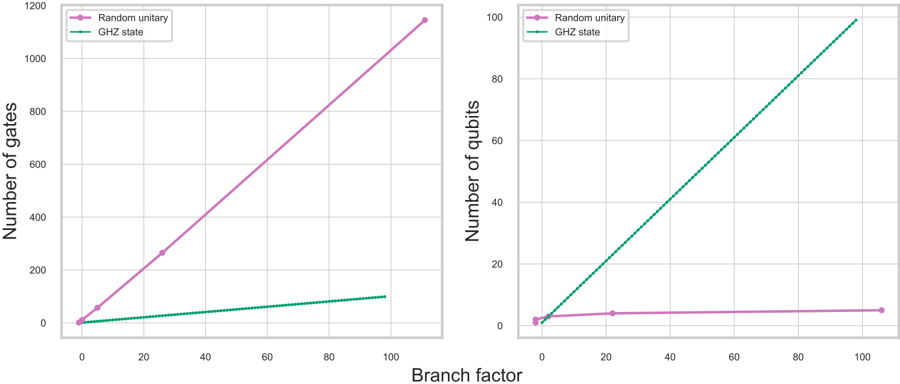
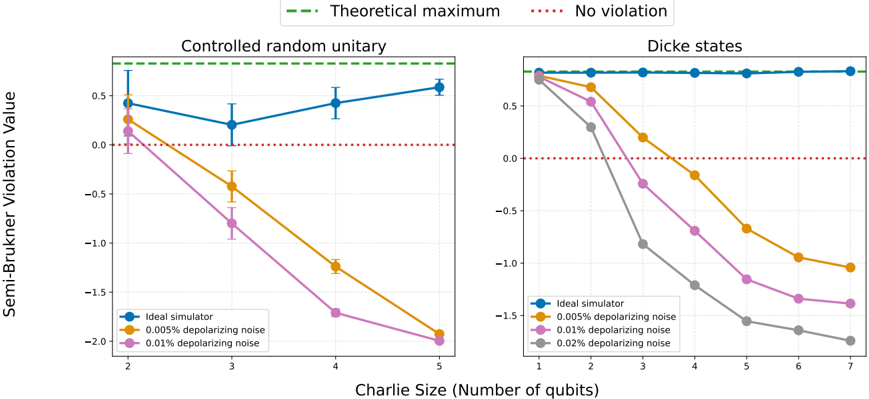
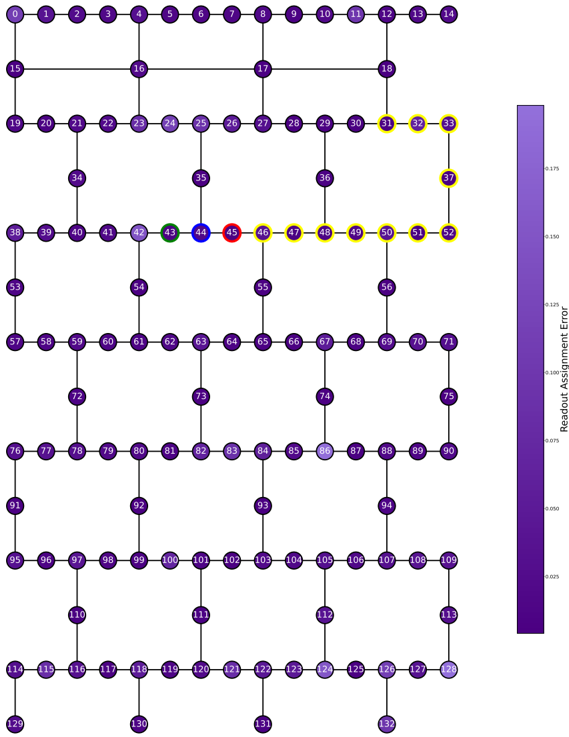
- It implements EWFS as quantum circuits using GHZ friend states, and also discusses controlled-random-unitary and Dicke-state friends as alternative branch-factor constructions; experiments are run on noiseless simulators, noisy simulators/emulators, and real quantum hardware.
- To infer friend outcomes under noise, the paper uses a majority-vote measurement strategy and validates branch-factor preparation via fidelity estimates, depolarizing-noise modeling, and circuit compilation/transpilation to IBM and Quantinuum hardware.
## Limitations
- The paper explicitly states that the LF violations shown are not loophole-free; it notes, for example, that the experiments do not use speed-of-light separation to isolate the relevant parties.
- It acknowledges that the results are limited by noise and hardware errors, which reduce the significance of the violations and restrict the maximum branch factor on current devices.
- Evident from the text: the strongest hardware result is still a proof-of-concept demonstration, and the paper says that better quantum computers will be needed to reach larger, more meaningful branch factors.
Model-written summary. Check it against the paper before relying on it.
Integrity signals
Registry
Cites
Statistics
Figures

Verification
Claims the paper makes
12 Valid · 5 Not valid · 16 Not checked · 91 Own results and interpretations
The cited sources that could be checked couldn’t confirm or dispute this claim.
In the paper
“Local Friendliness comes from the conjunction of two basic assumptions about reality [3,5].”
§ Towards violations of Local Friendliness with quantum computers > 2 Local Friendliness and tests to violate it
What the sources say
- Not checked — no full text of the sourcecites [3] 3. Kok-Wei Bong, Aníbal Utreras-Alarcón, Farzad Ghafari, Yeong-Cherng Liang, Nora Tis- chler, Eric G Cavalcanti, Geoff J Pryde, and Howard M Wiseman. "A strong no-go theorem on the Wigner's friend paradox". Nature Physics 16, 1199-1205 (2020). source
- Could not verifycites [5] 5. Marwan Haddara and Eric G Cavalcanti. "A possibilistic no-go theorem on the Wigner's friend paradox" (2022). sourceExperimental — accuracy not yet measured
Our full copy of Wiseman (2014) contains no occurrence of 'Local Friendliness', 'absoluteness of observed events', or 'local agency' (searched: Local Friendliness / absoluteness / local agency; Wigner's friend observer absolute event; two basic assumptions about reality conjunction). The paper's assumptions framework is Bell's: locality (definition 9), determinism (definition 8), local causality (criterion 11), Jarrett-completeness, plus axioms 1-4 including 'macroreality' — a different and earlier scheme that predates the Local Friendliness framework, so nothing in our copy states or contradicts the attributed conjunction of assumptions. Since our copy is complete (not truncated) yet does not address the claim's point, the attribution cannot be checked against this source. (LLM, conf=0.75)
plainstates a cause- Asserted: passes — The authors put it forward as true.
- Checkable: passes — It can be checked against evidence.
- Load-bearing: passes — The paper’s conclusions depend on it.
- Based: passes — The paper gives a reason why it holds.
Every source the paper cites for this claim was checked and supports it.
In the paper
“We know there is a signature for random quantum states given by heavy output distributions whose statistics can act as a proxy for having prepared random quantum states [55].”
§ Towards violations of Local Friendliness with quantum computers > 4.1.1 Other approaches to validate branch factors
What the sources say
- Supportedcites [55] 55. Frank Arute, Kunal Arya, Ryan Babbush, Dave Bacon, Joseph C Bardin, Rami Barends, Rupak Biswas, Sergio Boixo, Fernando GSL Brandao, David A Buell, et al. "Quantum supremacy using a programmable superconducting processor". Nature 574, 505-510 (2019). source
Section II (p. 2) states the signature: sampling from a Haar-random pure state gives a non-uniform, Porter-Thomas (exponentially peaked/heavy-tailed) distribution of outcome probabilities, in contrast to a flat/uniform distribution; the same peaked character is restated in the appendix note [37] (p. 10) and in the outlook item 4 (p. 8, 'more peaked output distribution and therefore a larger quantum collision anomaly'). The Conclusions (p. 7) supply the proxy half: the collision/cross-collision anomaly observed in the measurement outcomes tests 'whether their measurement outcomes are consistent with the same random quantum state' and lets the state-preparation fidelity be deduced 'without knowing the wave function of the ideal quantum state'. The only wording difference is terminological — our copy speaks of Porter-Thomas/peaked output distributions and collision statistics rather than the literal phrase 'heavy output' — so the paraphrased content is supported. (LLM, conf=0.80)
boostedstates an association- Asserted: passes — The authors put it forward as true.
- Checkable: passes — It can be checked against evidence.
- Load-bearing: unclear — It is unclear whether the paper’s conclusions depend on it.
- Based: passes — The paper gives a reason why it holds.
- Supported
The cited sources support only part of this claim — read each source’s verdict below.
In the paper
“It was shown in [52] that these proxy metrics are within a constant factor O(1) of the true interference and distinguishability complexities 4 .”
§ Towards violations of Local Friendliness with quantum computers > Definition 3.1 (Interference complexity proxy).
What the sources say
- Partly supportedcites [52] 52. Scott Aaronson, Yosi Atia, and Leonard Susskind. "On the hardness of detecting macro- scopic superpositions" (2020). sourceExperimental — accuracy not yet measured
Knill's paper does prove constant-factor relations between proxy (measurement/total-variation) distances and the norm-based measures: Lemma 2.1 (p. 5) bounds v_l(|u>,|v>) and v_{l,k}(U,V) by the 2-norm / weak 2-norm, and p. 7 states 'According to Lemmas 2.1 and 2.2, if it is difficult to approximate states or operators in a v_l or v_{l,k} (semi)metric, then all the other metrics are difficult too.' That supports the general shape of the claim (proxy metrics within O(1) of the true distance measures, so approximation hardness transfers). However, our copy nowhere defines or discusses 'interference complexity' or 'distinguishability complexity' (searched: interference, distinguishability, proxy metric, complexity parameters) — its complexity parameters are b(g,n,k), b(g,n,I_w) and gate-count bounds for exact/approximate unitary representation (pp. 9, 11, 14-16). The specific quantities the citing sentence names are therefore not attributed to this source; also the decoded text shows one-directional inequalities with the formulas not decoded, so the exact constant-factor equivalence cannot be verified here. (LLM, conf=0.72)
boostedstates an association- Asserted: passes — The authors put it forward as true.
- Checkable: passes — It can be checked against evidence.
- Load-bearing: unclear — It is unclear whether the paper’s conclusions depend on it.
- Based: passes — The paper gives a reason why it holds.
- Partly supported
A result the paper states — it cites no source for it, so there is none to check. The quote shows it is in the paper.
In the paper
“In fact, we can show that the semi-Brukner inequality still holds even when we remove Debbie from the scenario entirely.”
§ Towards violations of Local Friendliness with quantum computers > 2.3 EWFS scenarios with one friend
plain- Asserted: passes — The authors put it forward as true.
- Checkable: passes — It can be checked against evidence.
- Load-bearing: passes — The paper’s conclusions depend on it.
- Based: passes — The paper gives a reason why it holds.
A result the paper reports from its own data — it cites no other source for it, so there is none to check. The quote shows it is in the paper.
In the paper
“Our results extend the state of the art in proof-of-concept experimental violations from branch factor 0.0 to branch factor 16.0.”
§ Towards violations of Local Friendliness with quantum computers > Abstract
plainstates a cause- Asserted: passes — The authors put it forward as true.
- Checkable: passes — It can be checked against evidence.
- Load-bearing: passes — The paper’s conclusions depend on it.
- Based: passes — The paper gives a reason why it holds.
54 more claims
Create a free account to see all 124 claims and to verify the 6 references still open.
- It may state two separate claims as one. 23
- Probably not a substantial claim. 47
Self-check
Percentages, sums and reported differences re-computed from the paper’s own numbers.
Each contradiction between two passages listed here was confirmed by an independent check.
Rated major: it would touch a result — a value a result rests on, reported and recomputed p-values on opposite sides of the significance level, two passages that conflict with no sign which is right, or a cited work retracted before this paper was published.
In the paper
“The maximum value for X in the Semi-Brukner inequality is 2.82843 (See Table 1).Solving for the minimum fidelity that supports this gives 93.66%.”
§ Towards violations of Local Friendliness with quantum computers > 4.1 Noisy Friends: preparing branch factors under noise
Reported 0.9366 · recomputed 0.707106
Rated minor: it would not touch a result — a value no result rests on, a p-value that stays on the same side of the significance level, or a conflict that is clerical, resolved elsewhere in the paper, or outside its own findings.
In the paper
§ Towards violations of Local Friendliness with quantum computers > 4.3.1 Validation of branch factor preparation
“IBM Torino has a single and two-qubit gate errors that are sufficiently low to show violations up to branch factor 9,”
§ Towards violations of Local Friendliness with quantum computers > B.1 Running EWFS on IBM quantum hardware
“The IBM Torino device supports valid LF violations up to branch factor 7, while the H1 device could theoretically support much larger violations.”
Citations
Cites
Quantum supremacy using a programmable superconducting processor
Arute, F., Arya, K., Babbush, R., Bacon, D., Bardin, J. C., Barends, R., Biswas, R., Boixo, S., Brandao, F. G. S. L., Buell, D. A., et al. (2019) · Nature · doi:10.1038/s41586-019-1666-5 · Cited by 7,720 · cited 2×
“The measurements from the validation runs can be verified using cross-entropy benchmarking following [55].”
Quantum internet: a vision for the road ahead
Wehner, S., Elkouss, D., & Hanson, R. (2018) · Science · doi:10.1126/science.aam9288 · Cited by 2,467 · cited 1×
“4 5 6 7 8 9 Charlie size (number of qubits)”
Significant-Loophole-Free Test of Bell’s Theorem with Entangled Photons
Giustina, M., Versteegh, M. A. M., Wengerowsky, S., Handsteiner, J., Hochrainer, A., Phelan, K., Steinlechner, F., Kofler, J., Larsson, J.-Å., Abellán, C., et al. (2015) · Physical Review Letters · doi:10.1103/physrevlett.115.250401 · Cited by 1,529 · cited 1×
“4 5 6 7 8 9 Charlie size (number of qubits)”
Random numbers certified by Bell’s theorem
Pironio, S., Acín, A., Massar, S., de la Giroday, A. B., Matsukevich, D. N., Maunz, P., Olmschenk, S., Hayes, D., Luo, L., Manning, T. A., et al. (2010) · Nature · doi:10.1038/nature09008 · Cited by 1,420 · cited 1×
“We note that before being derived in [3], the LF inequalities were obtained under a different context regarding device-independent settings [26, 27, 28] in this thesis [29] (Appendix-A) under the name of “partially deterministic polytopes”.”
Rovelli, C. (1996) · International Journal of Theoretical Physics · doi:10.1007/bf02302261 · Cited by 1,381 · cited 1×
“There are also other proposals for refuting AOE [10, 11, 12, 13, 14, 15, 16].”
Hameroff, S., & Penrose, R. (2014) · Physics of Life Reviews · doi:10.1016/j.plrev.2013.08.002 · Cited by 983 · cited 1×
“4.”
Cooling of a levitated nanoparticle to the motional quantum ground state
Delić, U., Reisenbauer, M., Dare, K., Grass, D., Vuletić, V., Kiesel, N., & Aspelmeyer, M. (2020) · Science · doi:10.1126/science.aba3993 · Cited by 646
Zurek, W. H. (2009) · Nature Physics · doi:10.1038/nphys1202 · Cited by 564 · cited 1×
“• More objectivity [35] (e.g. redundancy and consensus via Quantum Darwinism [36]).”
Quantum computing with neutral atoms
Henriet, L., Beguin, L., Signoles, A., Lahaye, T., Browaeys, A., Reymond, G.-O., & Jurczak, C. (2020) · Quantum · doi:10.22331/q-2020-09-21-327 · Cited by 550 · cited 1×
“For example, many neutral atom platforms can natively execute global CZ gates [63, 64].”
Remarks on the mind-body question
Wigner, E. P. (1995) · Philosophical Reflections and Syntheses · doi:10.1007/978-3-642-78374-6_20 · Cited by 486 · cited 3×
“In this work, we: 1. propose how quantum computers (and related quantum technology like quantum networks) can be used to build increasingly more meaningful (larger and loophole-free) tests of Local Friendliness and 2. use small quantum computers to give experimental evidence (with loopholes) of…”
Cited by
Operational criteria for quantum advantage in latency-constrained nonlocal gamesPreprint
Li, C., Kikura, S., Goban, A., Yamasaki, H., & Sunami, S. (2026) · arXiv (Cornell University) · doi:10.48550/arxiv.2604.07451
“As such, while some mathematical formulations and analysis techniques are similar, several foundational analyses for the Bell tests may not directly apply to the analysis of quantum advantage in LCTC tasks, such as loop-hole analyses and the strictness of the no-signaling condition [3, 6, 9, 122].”
Emergence of Classicality in Wigner's Friend ScenariosPreprint
Rivlin, T., Engineer, S., & Baumann, V. (2025) · arXiv (Cornell University) · doi:10.48550/arxiv.2507.21221 · Cited by 5
“( These results should be compared with [23], which implements Wigner’s Friend scenarios on a quantum circuit with a similar number of qubits.)”
Quantum observers can communicate across multiverse branches
Violaris, M. (2026) · arXiv · doi:10.48550/arxiv.2601.08102
“…also growing interest in the scientific community to extend beyond such toy models and implement increasingly realistic Wigner’s-friend–type experiments on quantum information processing platforms, including ex-6 plicit proposals towards encoding an observer within a quantum computer [12, 26, 27].”
Extended Wigner's Friend Scenarios with Agent-like Observers on Quantum ComputersPreprint
Laux, J., & Cavalcanti, E. G. (2026) · arXiv (Cornell University) · doi:10.48550/arxiv.2609.12527
“The closest comparison is the quantum-computer implementation of Zeng et al. [9], where the friend is made more observer-like by increasing a figure of merit called “branch factor”.”
InfluentialClosing the Objectivity Loophole in Bell Tests on a Public Quantum Computer
Bednorz, A., Batle, J. A. I., Białecki, T., & Korbicz, J. K. (2026) · Advanced Quantum Technologies · doi:10.1002/qute.70420 · Cited by 1
“Motivated by the objectivity research, in the hereby paper, we rerun Bell tests on IBMQ and IonQ quantum platforms, simulating 3 observers (friends) at each side, with the requirement that the result +1 or − 1 must be unanimous among the party to be assigned, otherwise we set 0 .”
Metadata
- Authors
- Zeng, W. J., Labib, F., & Russo, V.
- Affiliations
- Unitary Foundation
- Venue
- Quantum
- Published
- 2025-09-05
- Volume
- 9
- Pages
- 1851
- ISSN
- 2521-327X (ISSN-L)
- OpenAlex
- W4414019682
- Semantic Scholar
- 8806d6cea51d191b13c249de925b73162516a150
- Cited by
- 0
- References
- 53
- FWCI
- 0.00
- Type
- journal article
- Language
- en
- Open access
- gold
- doi.org
- Locations
- Quantum (publishedVersion, cc-by)
- arXiv (Cornell University) (submittedVersion, cc-by)
- DOAJ (DOAJ: Directory of Open Access Journals) (submittedVersion, cc-by-sa)
- arXiv (Cornell University) (cc-by)
- Funders
- Australian Research Council (DP250102162)
- Topics
- Physical Sciences › Physics and Astronomy › Atomic and Molecular Physics, and Optics › Quantum Mechanics and Applications
- Physical Sciences › Physics and Astronomy › Atomic and Molecular Physics, and Optics › Quantum Information and Cryptography
- Physical Sciences › Computer Science › Artificial Intelligence › Quantum Computing Algorithms and Architecture
- Keywords
- Wigner's friend, quantum computing hardware, quantum simulators, quantum circuits, quantum foundations, local agency, photonic qubits
About these checks
Registry, retraction, Cites and statistics results are computed, not judged, with one exception: a printed reference that no index lists is read once by a model before it counts as a citation error. Claims are extracted by a model and kept only when their quote appears verbatim in the text; each cited source is then checked, with a model’s help, for whether it says what the claim relies on. Those verdicts can be wrong — read the claim’s quote and the cited source before relying on one.
The claim verdicts this report counts are experimental: their accuracy is not yet measured.
A language model drew the claims from the paper on 2026-10-10, under version 3 of the claim definition (model deepseek-v4.1-flash, prompt extract-v3).
A second model labelled each claim on 2026-10-10 (model jev-1.13-20260917, definition revision gold-guideline-v0.2).
Cited sources are checked with a language model’s help (qwen3.8-omni-flash).
Statistics and arithmetic are recomputed, not judged.
Confidence bands are shown only for fields calibrated on our annotated test set. None is calibrated yet, so no band is shown.
What counts as a claim ›How we measure confidence ›How we check this ›
Are you an author, or do you see a problem with this page? Request a review
Data sources
Bibliographic data: Semantic Scholar, OpenAlex, Crossref.
Contains information from the Semantic Scholar Academic Graph Datasets, made available under the ODC Attribution License (ODC-BY 1.0).
Semantic Scholar’s data is described in: Kinney, R., et al. (2023). The Semantic Scholar Open Data Platform. arXiv:2301.10140.
