

Transferability and Fine Mapping of Type 2 Diabetes Loci in African Americans
Open accessThe DOI matches its Crossref record; 51 of the 52 references it cites were found in a registry or an index.
Abstract
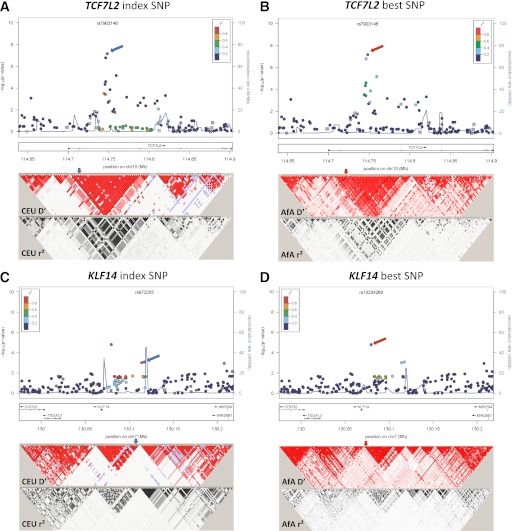
Type 2 diabetes (T2D) disproportionally affects African Americans (AfA) but, to date, genetic variants identified from genome-wide association studies (GWAS) are primarily from European and Asian populations. We examined the single nucleotide polymorphism (SNP) and locus transferability of 40 reported T2D loci in six AfA GWAS consisting of 2,806 T2D case subjects with or without end-stage renal disease and 4,265 control subjects from the Candidate Gene Association Resource Plus Study. Our results revealed that seven index SNPs at the TCF7L2, KLF14, KCNQ1, ADCY5, CDKAL1, JAZF1, and GCKR loci were significantly associated with T2D (P < 0.05). The strongest association was observed at TCF7L2 rs7903146 (odds ratio [OR] 1.30; P = 6.86 × 10⁻⁸). Locus-wide analysis demonstrated significant associations (Pemp < 0.05) at regional best SNPs in the TCF7L2, KLF14, and HMGA2 loci as well as suggestive signals in KCNQ1 after correction for the effective number of SNPs at each locus. Of these loci, the regional best SNPs were in differential linkage disequilibrium (LD) with the index and adjacent SNPs. Our findings suggest that some loci discovered in prior reports affect T2D susceptibility in AfA with similar effect sizes. The reduced and differential LD pattern in AfA compared with European and Asian populations may facilitate fine mapping of causal variants at loci shared across populations.
Overview
The claims and statistics of this paper haven’t been checked yet.
Free: it reads the open-access text and checks the first 5 claims that cite a source we can check. Create a free account to check every claim.
Integrity signals
Registry
Cites
Statistics
Figures
Verification
Claims the paper makes
The claims and statistics of this paper haven’t been checked yet.
Free: it reads the open-access text and checks the first 5 claims that cite a source we can check. Create a free account to check every claim.
Claims other papers make about this one
Each is checked against this paper’s own text: does it say what the citing paper says it does?
The source backs part of the claim, not all of it — or backs it for a different population, condition or comparison.
In the citing paper
“Human ADCY5 polymorphisms have been associated with metabolic diseases including diabetes and obesity”
From Physiological roles of mammalian transmembrane adenylyl cyclase isoforms (2022) · cites this paper as [173]
Experimental — accuracy not yet measured
Self-check
Percentages, sums and reported differences re-computed from the paper’s own numbers.
The self-check needs the paper’s full text.
Citations
Cites
Inference of Population Structure Using Multilocus Genotype Data
Pritchard, J. K., Stephens, M., & Donnelly, P. (2000) · Genetics · doi:10.1093/genetics/155.2.945 · Cited by 33,908
genalex 6: genetic analysis in Excel. Population genetic software for teaching and research
PEAKALL, R., & SMOUSE, P. E. (2006) · Molecular Ecology Notes · doi:10.1111/j.1471-8286.2005.01155.x · Cited by 16,589
Report of the Expert Committee on the Diagnosis and Classification of Diabetes Mellitus
The Expert Committee on the Diagnosis and Classification of Diabetes Mellitus* (2002) · Diabetes Care · doi:10.2337/diacare.25.2007.s5 · Cited by 10,338
Genome-wide association study of 14,000 cases of seven common diseases and 3,000 shared controls
The Wellcome Trust Case Control Consortium, Management Committee, Burton, P. R., Clayton, D. G., Cardon, L. R., Craddock, N., Deloukas, P., Duncanson, A., Kwiatkowski, D. P., McCarthy, M. I., et al. (2007) · Nature · doi:10.1038/nature05911 · Cited by 9,442
Population Structure and Eigenanalysis
Patterson, N., Price, A. L., & Reich, D. (2006) · PLoS Genetics · doi:10.1371/journal.pgen.0020190 · Cited by 5,280 · cited 3×
“By analyzing unrelated samples from all studies using SMARTPCA (33), only the fi rst PC appeared to account for substantial genetic variation in the screen plot (data not shown), whereas the subsequent PCs may re fl ect sampling noise and/or relatedness in samples (34).”
Hindorff, L. A., Sethupathy, P., Junkins, H. A., Ramos, E. M., Mehta, J. P., Collins, F. S., & Manolio, T. A. (2009) · Proceedings of the National Academy of Sciences · doi:10.1073/pnas.0903103106 · Cited by 4,013 · cited 1×
“gov/gwastudies) (38) (Supplementary Table 1).”
Follow-up report on the diagnosis of diabetes mellitus
The Expert Committee on the Diagnosis and Classification of Diabetes Mellitus* (2003) · Diabetes Care · doi:10.2337/diacare.26.11.3160 · Cited by 3,784
Multipoint Quantitative-Trait Linkage Analysis in General Pedigrees
Almasy, L., & Blangero, J. (1998) · The American Journal of Human Genetics · doi:10.1086/301844 · Cited by 3,028 · cited 1×
“The effective number of SNPs (independent SNPs) was estimated from the eigenvalues of the covariance matrix of the SNPs in each locus using the Li and Ji method implemented in SOLAR (39).”
A genome-wide association study identifies novel risk loci for type 2 diabetes
Sladek, R., Rocheleau, G., Rung, J., Dina, C., Shen, L., Serre, D., Boutin, P., Vincent, D., Belisle, A., Hadjadj, S., et al. (2007) · Nature · doi:10.1038/nature05616 · Cited by 2,993
A Map of Recent Positive Selection in the Human Genome
Voight, B. F., Kudaravalli, S., Wen, X., & Pritchard, J. K. (2006) · PLoS Biology · doi:10.1371/journal.pbio.0040072 · Cited by 2,893 · cited 1×
“We also assessed two matrices using Haplotter, FST for measurement of population differentiation, and integrated haplotype score for the detection of recent positive selection in the CEU (or ASN) and YRI populations (40).”
Genome-wide association analysis identifies loci for type 2 diabetes and triglyceride levels
Saxena, R., Voight, B. F., Lyssenko, V., Burtt, N. P., de Bakker, P. I. W., Chen, H., Roix, J. J., Kathiresan, S., Hirschhorn, J. N., Daly, M. J., et al. (2007) · Science · doi:10.1126/science.1142358 · Cited by 2,843
Self-citationA genome-wide association study of type 2 diabetes in Finns detects multiple susceptibility variants
Scott, L. J., Mohlke, K. L., Bonnycastle, L. L., Willer, C. J., Li, Y., Duren, W. L., Erdos, M. R., Stringham, H. M., Chines, P. S., Jackson, A. U., et al. (2007) · Science · doi:10.1126/science.1142382 · Cited by 2,753
The Wellcome Trust Case Control Consortium, U.K.
Mossman, K. (2008) · Scientific American · doi:10.1038/scientificamerican0108-42a · Cited by 2,684
Replication of Genome-Wide Association Signals in UK Samples Reveals Risk Loci for Type 2 Diabetes
Zeggini, E., Weedon, M. N., Lindgren, C. M., Frayling, T. M., Elliott, K. S., Lango, H., Timpson, N. J., Perry, J. R. B., Rayner, N. W., Freathy, R. M., et al. (2007) · Science · doi:10.1126/science.1142364 · Cited by 2,194
New genetic loci implicated in fasting glucose homeostasis and their impact on type 2 diabetes risk
DIAGRAM Consortium, Dupuis, J., GIANT Consortium, Global BPgen Consortium, Anders Hamsten on behalf of Procardis Consortium, the MAGIC investigators, Langenberg, C., Prokopenko, I., Saxena, R., Soranzo, N., et al. (2010) · Nature Genetics · doi:10.1038/ng.520 · Cited by 2,166
Self-citationPurcell, S., Cherny, S. S., & Sham, P. C. (2003) · Bioinformatics · doi:10.1093/bioinformatics/19.1.149 · Cited by 2,057 · cited 1×
“Posterior study power was calculated using the genetic power calculator (42) under an additive model, using the SNP-specific effective sample size (43) of this study and reported effect sizes from the replication phases (wherever available) or all phases in prior T2D reports to minimize winner’s curse effect.”
Wellcome Trust Case Control Consortium, Zeggini, E., Scott, L. J., Saxena, R., Voight, B. F., Marchini, J. L., Hu, T., de Bakker, P. I., Abecasis, G. R., Almgren, P., et al. (2008) · Nature Genetics · doi:10.1038/ng.120 · Cited by 1,864
Self-citationA Genome-Wide Association Search for Type 2 Diabetes Genes in African Americans
Palmer, N. D., McDonough, C. W., Hicks, P. J., Roh, B. H., Wing, M. R., An, S. S., Hester, J. M., Cooke, J. N., Bostrom, M. A., Rudock, M. E., et al. (2012) · PLoS ONE · doi:10.1371/journal.pone.0029202 · Cited by 1,799
Self-citationTwelve type 2 diabetes susceptibility loci identified through large-scale association analysis
The MAGIC investigators, Voight, B. F., The GIANT Consortium, Scott, L. J., Steinthorsdottir, V., Morris, A. P., Dina, C., Welch, R. P., Zeggini, E., Huth, C., et al. (2010) · Nature Genetics · doi:10.1038/ng.609 · Cited by 1,761
Self-citationFull accounting of diabetes and pre-diabetes in the U.S. population in 1988–1994 and 2005–2006
Cowie, C. C., Rust, K. F., Ford, E. S., Eberhardt, M. S., Byrd-Holt, D. D., Li, C., Williams, D. E., Gregg, E. W., Bainbridge, K. E., Saydah, S. H., et al. (2009) · Diabetes Care · doi:10.2337/dc08-1296 · Cited by 1,154 · cited 1×
“40 years of age having nearly twofold higher prevalence than European Americans (27.1 and 15.5%, respectively) (2).”
InfluentialA variant in CDKAL1 influences insulin response and risk of type 2 diabetes
Steinthorsdottir, V., Thorleifsson, G., Reynisdottir, I., Benediktsson, R., Jonsdottir, T., Walters, G. B., Styrkarsdottir, U., Gretarsdottir, S., Emilsson, V., Ghosh, S., et al. (2007) · Nature Genetics · doi:10.1038/ng2043 · Cited by 1,072
Self-citationVariants in KCNQ1 are associated with susceptibility to type 2 diabetes mellitus
Yasuda, K., Miyake, K., Horikawa, Y., Hara, K., Osawa, H., Furuta, H., Hirota, Y., Mori, H., Jonsson, A., Sato, Y., et al. (2008) · Nature Genetics · doi:10.1038/ng.207 · Cited by 776 · cited 7×
“Interestingly, a locus-wide study of 16 T2D loci in world-wide populations revealed many moderately differentiated loci in sub-Saharan Africans (e.g., TCF7L2 , KCNJ11 , IGF2BP2 , and SLC30A8 ) and several highly differentiated loci in East Asians (e.g., HHEX , THADA , and FTO ) that contribute to the global differenti…”
InfluentialSelf-citationUnoki, H., Takahashi, A., Kawaguchi, T., Hara, K., Horikoshi, M., Andersen, G., Ng, D. P. K., Holmkvist, J., Borch-Johnsen, K., Jørgensen, T., et al. (2008) · Nature Genetics · doi:10.1038/ng.208 · Cited by 725 · cited 1×
“50 loci with common genetic variants associated with T2D risk in primarily European-descent populations (4 – 14) and more recently in East and South Asians (15 – 21).”
DIAGRAM Consortium, Cho, Y. S., MuTHER Consortium, Chen, C.-H., Hu, C., Long, J., Hee Ong, R. T., Sim, X., Takeuchi, F., Wu, Y., et al. (2012) · Nature Genetics · doi:10.1038/ng.1019 · Cited by 611
Self-citationDIAGRAM, Kooner, J. S., MuTHER, Saleheen, D., Sim, X., Sehmi, J., Zhang, W., Frossard, P., Been, L. F., Chia, K.-S., et al. (2011) · Nature Genetics · doi:10.1038/ng.921 · Cited by 539
Rung, J., Cauchi, S., Albrechtsen, A., Shen, L., Rocheleau, G., Cavalcanti-Proença, C., Bacot, F., Balkau, B., Belisle, A., Borch-Johnsen, K., et al. (2009) · Nature Genetics · doi:10.1038/ng.443 · Cited by 479
Methods for High-Density Admixture Mapping of Disease Genes
Patterson, N., Hattangadi, N., Lane, B., Lohmueller, K. E., Hafler, D. A., Oksenberg, J. R., Hauser, S. L., Smith, M. W., O’Brien, S. J., Altshuler, D., et al. (2004) · The American Journal of Human Genetics · doi:10.1086/420871 · Cited by 478 · cited 3×
“subsequent PCs may reflect sampling noise and/or relatedness in samples (34).”
InfluentialNg, M. C. Y., Park, K. S., Oh, B., Tam, C. H. T., Cho, Y. M., Shin, H. D., Lam, V. K. L., Ma, R. C. W., So, W. Y., Cho, Y. S., et al. (2008) · Diabetes · doi:10.2337/db07-1583 · Cited by 362
Self-citationTsai, F.-J., Yang, C.-F., Chen, C.-C., Chuang, L.-M., Lu, C.-H., Chang, C.-T., Wang, T.-Y., Chen, R.-H., Shiu, C.-F., Liu, Y.-M., et al. (2010) · PLoS Genetics · doi:10.1371/journal.pgen.1000847 · Cited by 346
Self-citationLettre, G., Palmer, C. D., Young, T., Ejebe, K. G., Allayee, H., Benjamin, E. J., Bennett, F., Bowden, D. W., Chakravarti, A., Dreisbach, A., et al. (2011) · PLoS Genetics · doi:10.1371/journal.pgen.1001300 · Cited by 272 · cited 4×
“Principal component (PC) was computed on each study by using high-quality SNPs (26,32,33).”
InfluentialSelf-citationYamauchi, T., Hara, K., Maeda, S., Yasuda, K., Takahashi, A., Horikoshi, M., Nakamura, M., Fujita, H., Grarup, N., Cauchi, S., et al. (2010) · Nature Genetics · doi:10.1038/ng.660 · Cited by 270
Large-Scale Gene-Centric Meta-Analysis across 39 Studies Identifies Type 2 Diabetes Loci
Saxena, R., Elbers, C. C., Guo, Y., Peter, I., Gaunt, T. R., Mega, J. L., Lanktree, M. B., Tare, A., Castillo, B. A., Li, Y. R., et al. (2012) · The American Journal of Human Genetics · doi:10.1016/j.ajhg.2011.12.022 · Cited by 270
Self-citationTakeuchi, F., Serizawa, M., Yamamoto, K., Fujisawa, T., Nakashima, E., Ohnaka, K., Ikegami, H., Sugiyama, T., Katsuya, T., Miyagishi, M., et al. (2009) · Diabetes · doi:10.2337/db08-1494 · Cited by 236
Identification of New Genetic Risk Variants for Type 2 Diabetes
Shu, X. O., Long, J., Cai, Q., Qi, L., Xiang, Y.-B., Cho, Y. S., Tai, E. S., Li, X., Lin, X., Chow, W.-H., et al. (2010) · PLoS Genetics · doi:10.1371/journal.pgen.1001127 · Cited by 216 · cited 1×
“At the CDC123-CAMK1D and KCNQ1 loci, independent T2D index SNPs had been identified in European and East Asian populations, respectively (10,12,16,19).”
GWAF: an R package for genome-wide association analyses with family data
Chen, M.-H., & Yang, Q. (2010) · Bioinformatics · doi:10.1093/bioinformatics/btp710 · Cited by 208
Methodological challenges of genome-wide association analysis in Africa
Teo, Y.-Y., Small, K. S., & Kwiatkowski, D. P. (2010) · Nature Reviews Genetics · doi:10.1038/nrg2731 · Cited by 195 · cited 2×
“This issue prompts the need to examine T2D loci in other populations with different allelic and LD architecture, which may help fi ne mapping of the underlying functional variants (28).”
Genetic variants at 2q24 are associated with susceptibility to type 2 diabetes
Qi, L., Cornelis, M. C., Kraft, P., Stanya, K. J., Linda Kao, W. H., Pankow, J. S., Dupuis, J., Florez, J. C., Fox, C. S., Paré, G., et al. (2010) · Human Molecular Genetics · doi:10.1093/hmg/ddq156 · Cited by 191
Self-citationWaters, K. M., Stram, D. O., Hassanein, M. T., Le Marchand, L., Wilkens, L. R., Maskarinec, G., Monroe, K. R., Kolonel, L. N., Altshuler, D., Henderson, B. E., et al. (2010) · PLoS Genetics · doi:10.1371/journal.pgen.1001078 · Cited by 191
A GENOME WIDE ASSOCIATION STUDY FOR DIABETIC NEPHROPATHY GENES IN AFRICAN AMERICANS
McDonough, C. W., Palmer, N., Hicks, P. J., Roh, B. H., An, S., Cooke, J. N., Hester, J. M., Wing, M. R., Bostrom, M. A., Rudock, M., et al. (2010) · Kidney International · doi:10.1038/ki.2010.467 · Cited by 154 · cited 1×
“For the WFSM study, genotyping was performed at the Center for Inherited Disease Research (CIDR), and analyses were performed at WFSM and described elsewhere (30,31).”
Self-citationTransferability of Type 2 Diabetes Implicated Loci in Multi-Ethnic Cohorts from Southeast Asia
Sim, X., Ong, R. T.-H., Suo, C., Tay, W.-T., Liu, J., Ng, D. P.-K., Boehnke, M., Chia, K.-S., Wong, T.-Y., Seielstad, M., et al. (2011) · PLoS Genetics · doi:10.1371/journal.pgen.1001363 · Cited by 152 · cited 1×
“The reported index single nucleotide polymorphisms (SNPs) at these loci have been replicated in multiple populations (22 – 24) but less successfully in AfA (25 – 27).”
Lewis, J. P., Palmer, N. D., Hicks, P. J., Sale, M. M., Langefeld, C. D., Freedman, B. I., Divers, J., & Bowden, D. W. (2008) · Diabetes · doi:10.2337/db07-1319 · Cited by 152
Self-citationChen, R., Corona, E., Sikora, M., Dudley, J. T., Morgan, A. A., Moreno-Estrada, A., Nilsen, G. B., Ruau, D., Lincoln, S. E., Bustamante, C. D., et al. (2012) · PLoS Genetics · doi:10.1371/journal.pgen.1002621 · Cited by 127 · cited 1×
“(47) showed that risk alleles at 12 T2D loci showed high FST values, as well as a trend of decreasing frequencies from Africa through Europe to East Asia.”
Southam, L., Soranzo, N., Montgomery, S. B., Frayling, T. M., McCarthy, M. I., Barroso, I., & Zeggini, E. (2009) · Diabetologia · doi:10.1007/s00125-009-1419-3 · Cited by 103
Palmer, N. D., Hester, J. M., An, S. S., Adeyemo, A., Rotimi, C. N., Langefeld, C. D., Freedman, B. I., Ng, M. C. Y., & Bowden, D. W. (2010) · Diabetes · doi:10.2337/db10-0134 · Cited by 92 · cited 1×
“Taken together, T2D association at TCF7L2 was transferable to multiple populations, including AfA, and rs7903146 is likely the causal variant, as suggested by a recent resequencing study (49), or it may share the same haplotype with the causal variant across different populations.”
BackgroundSelf-citationKlimentidis, Y. C., Abrams, M., Wang, J., Fernandez, J. R., & Allison, D. B. (2011) · Human Genetics · doi:10.1007/s00439-010-0935-z · Cited by 74 · cited 1×
“…T2D loci in world-wide populations revealed many moderately differentiated loci in sub-Saharan Africans (e.g., TCF7L2 , KCNJ11 , IGF2BP2 , and SLC30A8 ) and several highly differentiated loci in East Asians (e.g., HHEX , THADA , and FTO ) that contribute to the global differentiation pattern (46).”
Implication of European-derived adiposity loci in African Americans
Hester, J. M., Wing, M. R., Li, J., Palmer, N. D., Xu, J., Hicks, P. J., Roh, B. H., Norris, J. M., Wagenknecht, L. E., Langefeld, C. D., et al. (2012) · International Journal of Obesity · doi:10.1038/ijo.2011.131 · Cited by 62 · cited 2×
“Principal component (PC) was computed on each study by using high-quality SNPs (26,32,33).”
Self-citationvarLD: a program for quantifying variation in linkage disequilibrium patterns between populations
Ong, R. T.-H., & Teo, Y.-Y. (2010) · Bioinformatics · doi:10.1093/bioinformatics/btq125 · Cited by 59 · cited 9×
“To assess for interpopulation differences in LD patterns, the varLD method was used to assess genome-wide distribution of varLD scores between CEU (or ASN) and YRI (41).”
InfluentialKeene, K. L., Mychaleckyj, J. C., Leak, T. S., Smith, S. G., Perlegas, P. S., Divers, J., Langefeld, C. D., Freedman, B. I., Bowden, D. W., & Sale, M. M. (2008) · Human Genetics · doi:10.1007/s00439-008-0532-6 · Cited by 37 · cited 2×
“87) with global African-European ancestry, as measured by ANCESTRYMAP (34), STRUCTURE (35), or FRAPPE (36).”
InfluentialSelf-citationIdentifying candidate causal variants via trans‐population fine‐mapping
Teo, Y., Ong, R. T., Sim, X., Tai, E. S., & Chia, K. S. (2010) · Genetic Epidemiology · doi:10.1002/gepi.20522 · Cited by 37
Familial aggregation of cardiovascular diseases in African‐American pedigrees
Rotimi, C., Cooper, R., Cao, G., Sundarum, C., & McGee, D. (1994) · Genetic Epidemiology · doi:10.1002/gepi.1370110502 · Cited by 33 · cited 1×
“In addition to socioeconomic and behavioral risk factors, genetic factors are likely contributors to T2D risk in AfA (3).”
Yang, Y., Remmers, E. F., Ogunwole, C. B., Kastner, D. L., Gregersen, P. K., & Li, W. (2007) · Nature Precedings · doi:10.1016/j.compbiolchem.2010.12.006 · Cited by 23
Research works printed but not linked: 1
- Centers for Disease Control and Prevention National Diabetes Fact Sheet: National Estimates and General Information on Diabetes and Prediabetes in the United States. Atlanta, GA, U.S. Department of Health and Human Services, Centers for Disease Control and Prevention, 2011
Cited by
Dessauer, C. W., Watts, V. J., Ostrom, R. S., Conti, M., Dove, S., & Seifert, R. (2017) · Pharmacological Reviews · doi:10.1124/pr.116.013078 · Cited by 201
“Numerous studies have linked ADCY5 gene polymorphisms to altered glucose metabolism, diabetes, and obesity (Barker et al., 2011; Rees et al., 2011; Wagner et al., 2011; Windholz et al., 2011; Holstein et al., 2013; Ng et al., 2013; Hodson et al., 2014; Knigge et al., 2015).”
BackgroundPhysiological roles of mammalian transmembrane adenylyl cyclase isoforms
Ostrom, K. F., LaVigne, J. E., Brust, T. F., Seifert, R., Dessauer, C. W., Watts, V. J., & Ostrom, R. S. (2022) · Physiological Reviews · doi:10.1152/physrev.00013.2021 · Cited by 131
Polygenic Scores for Height in Admixed Populations
Bitarello, B. D., & Mathieson, I. (2020) · G3 Genes|Genomes|Genetics · doi:10.1534/g3.120.401658 · Cited by 125
Adeyemo, A. A., Zaghloul, N. A., Chen, G., Doumatey, A. P., Leitch, C. C., Hostelley, T. L., Nesmith, J. E., Zhou, J., Bentley, A. R., Shriner, D., et al. (2019) · Nature Communications · doi:10.1038/s41467-019-10967-7 · Cited by 114
Challenges in Elucidating the Genetics of Diabetic Retinopathy
Kuo, J. Z.-C., Wong, T. Y., & Rotter, J. I. (2013) · JAMA Ophthalmology · doi:10.1001/jamaophthalmol.2013.5024 · Cited by 125
Self-citation
Metadata
- Authors
- Ng, M. C. Y., Saxena, R., Li, J., Palmer, N. D., Dimitrov, L., Xu, J., Rasmussen-Torvik, L. J., Zmuda, J. M., Siscovick, D. S., Patel, S. R., Crook, E. D., Sims, M., Chen, Y.-D. I., Bertoni, A. G., Li, M., Grant, S. F. A., Dupuis, J., Meigs, J. B., Psaty, B. M., Pankow, J. S., Langefeld, C. D., Freedman, B. I., Rotter, J. I., Wilson, J. G., & Bowden, D. W.
- Affiliations
- Wake Forest University Health Sciences (US)
- Massachusetts General Hospital (US)
- Department of Preventive Medicine, Northwestern University, Chicago, Illinois
- University of Pittsburgh (US)
- University of Washington (US)
- Brigham and Women's Hospital (US)
- University of South Alabama (US)
- University of Mississippi Medical Center (US)
- Cedars-Sinai Medical Center (US)
- University of Pennsylvania (US)
- Children's Hospital of Philadelphia (US)
- Boston University (US)
- Harvard University (US)
- University of Minnesota (US)
- Corresponding author
- Ng, Maggie C.Y.
- ORCID
- Ng, Maggie C.Y.
- Saxena, Richa
- Palmer, Nicholette D.
- Dimitrov, Latchezar
- Xu, Jianzhao
- Zmuda, Joseph M.
- Siscovick, David S.
- Patel, Sanjay R.
- Chen, Yii-Der I.
- Bertoni, Alain G.
- Li, Mingyao
- Grant, Struan F.A.
- Dupuis, Josée
- Meigs, James B.
- Psaty, Bruce M.
- Pankow, James S.
- Langefeld, Carl D.
- Freedman, Barry I.
- Rotter, Jerome I.
- Wilson, James G.
- Bowden, Donald W.
- Venue
- Diabetes
- Publisher
- American Diabetes Association
- Published
- 2013-02-14
- Volume
- 62
- Issue
- 3
- Pages
- 965-976
- ISSN
- 0012-1797 (ISSN-L)
- 1939-327X
- PMC
- PMC3581206
- OpenAlex
- W2139705506
- Cited by
- 62
- References
- 52
- Citations by year
- 2026: 1 · 2025: 1 · 2023: 3 · 2022: 1 · 2021: 5 · 2020: 1 · 2019: 6 · 2018: 3 · 2017: 5 · 2016: 11 · 2015: 7 · 2014: 10 · 2013: 7
- FWCI
- 0.94
- Type
- journal article
- Language
- en
- Open access
- hybrid
- doi.org
- Licence
- Locations
- Diabetes (publishedVersion, cc-by-nc-nd)
- Europe PMC (PubMed Central) (publishedVersion, cc-by-nc-nd)
- PubMed Central (publishedVersion, cc-by-nc-nd)
- PubMed (publishedVersion)
- Digital Access to Scholarship at Harvard (DASH) (Harvard University) (submittedVersion, cc-by)
- Funders
- National Institutes of Health (n01hc95095-66-0-1, n01hc095100-000, n01hc95164-17-0-1, n01hc95170-30-0-1, n01hc48050-59-0-1, n01hc48048-58-0-1, n01hc045134-008, n01hc95165-34-0-1, n01hc48047-55-0-1, n01hc95161-24-0-1, n01hc095169-003, n01hc95171-31-0-1, n01hc45205-9-0-0, n01hc005187-000, UL1TR000124, n01hc65226-6-0-0, n01hc95166-21-0-1, n01hc48049-61-0-1, n01hc95162-31-0-1, n01hc95168-27-0-1, n01hc95160-18-0-1, n01hc45204-11-0-1, n01hc095167-000, UL1TR000150, n01hc95163-22-0-1, n01hc95159-40-0-1, n01hc95172-31-0-1)
- U.S. Public Health Service (HHSN 268200625226C, HHSC268200782096C)
- National Heart, Lung, and Blood Institute (HHSN268201 100012C, HHSN268201100007I, N01-HC-65226, N01HC48050, HHSN268201100007C, N01 HC-95159, N01-HC-95160, N01-HC095169, HHSN2682 01100008C, N01-HC045134, N01 HC-95168, N01-HC-095165, HH-SN-268201100006C, HHSN268201100011C, N01 HC 95095, HHSN2682011-00005I, N01 HC95167, (N01-HC-95163, N01 HC095163, R01 HL 56266, N01 HC045205, HHSN2682011-00009I, R01 HL-59367, N01 HC-95161, N01 HC95165, N01HC95164, N01 HC048048, HHSN268201100005C, N01 HC095171, N01-HC05187, R01HL046380, N01-HC-048049, HHSN268201100005G, N01 HC045204, HHSN268201100010C, N01 HC095172, N01-HC-095159, N01 HC095168, N02- HL-64278, N01-HC-095162, N01-HC- 45204, N01 HC095095, N01-HC-095161, HHSN268201100011I, N01HC95172, N01 HC048050, N01-HC48048, N01-HC-45205, N01 HC095170, N01 HC 95170, R01HL087641, N01 HC005187, R01HL059367, HHSN26820 1100009C, N01 HC095167, N01-HC-48-049, N01 HC065226, N01-HC-095160, N01-HC-95100, N01 HC095166, R01HL056266, N01 HC095164, N01 HC048047, HHSN2682011-00008I, N01‐HC‐95166, HL 46380, N01-HC-480-47, N01 HC-95162, N01 HC-95171, R01HL086694, N01 HC95169)
- National Human Genome Research Institute (U01HG004402)
- National Institute of Diabetes and Digestive and Kidney Diseases (R01DK066358, R01DK053591, R01DK078616, R01DK070941, K24DK080140, K99DK081350, R01DK071891, P30DK063491)
- National Center for Research Resources (M01RR-07122, M01RR000080, UL1RR024156, UL1RR025005, RR024156, M01RR00080, M01RR007122)
- National Center for Advancing Translational Sciences
- Topics
- Life Sciences › Biochemistry, Genetics and Molecular Biology › Genetics › Genetic Associations and Epidemiology
- Life Sciences › Biochemistry, Genetics and Molecular Biology › Genetics › Genetic Mapping and Diversity in Plants and Animals
- Life Sciences › Biochemistry, Genetics and Molecular Biology › Genetics › Diabetes and associated disorders
- Keywords
- type 2 diabetes, African Americans, genetic susceptibility loci, fine mapping, TCF7L2, KLF14, KCNQ1, ADCY5, CDKAL1, JAZF1, GCKR, HMGA2, linkage disequilibrium, end-stage renal disease, candidate gene association
- MeSH terms
- Aged, Black or African American, Diabetes Mellitus, Type 2, Female, Humans, Male, Middle Aged, Prospective Studies, United States, Cohort Studies, Case-Control Studies, Polymorphism, Single Nucleotide, Genome-Wide Association Study, Genetic Loci, Transcription Factor 7-Like 2 Protein
About these checks
Registry, retraction, Cites and statistics results are computed, not judged, with one exception: a printed reference that no index lists is read once by a model before it counts as a citation error. Claims are extracted by a model and kept only when their quote appears verbatim in the text; each cited source is then checked, with a model’s help, for whether it says what the claim relies on. Those verdicts can be wrong — read the claim’s quote and the cited source before relying on one.
Statistics and arithmetic are recomputed, not judged.
Confidence bands are shown only for fields calibrated on our annotated test set. None is calibrated yet, so no band is shown.
What counts as a claim ›How we measure confidence ›How we check this ›
Are you an author, or do you see a problem with this page? Request a review
Data sources
Bibliographic data: Semantic Scholar, OpenAlex, Crossref.
Contains information from the Semantic Scholar Academic Graph Datasets, made available under the ODC Attribution License (ODC-BY 1.0).
Semantic Scholar’s data is described in: Kinney, R., et al. (2023). The Semantic Scholar Open Data Platform. arXiv:2301.10140.
