

Muscle-Specific Vascular Endothelial Growth Factor Deletion Induces Muscle Capillary Rarefaction Creating Muscle Insulin Resistance
Open accessThe DOI matches its Crossref record; 56 of the 56 references it cites were found in a registry or an index.
Abstract
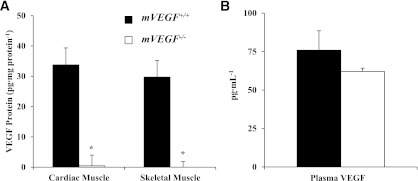
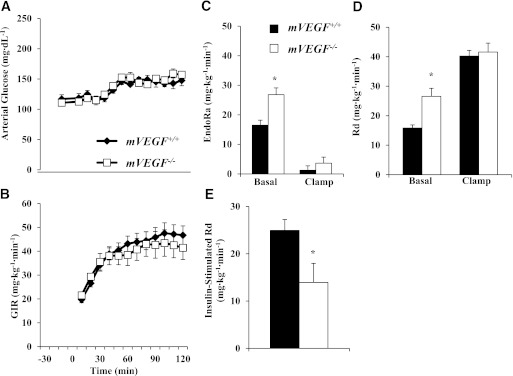
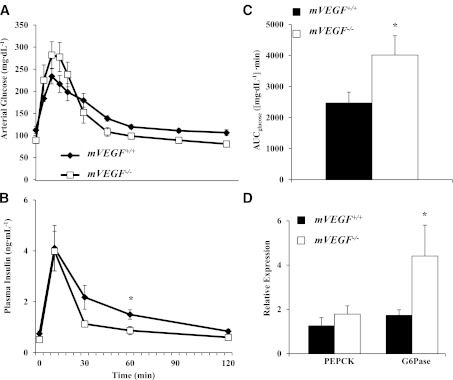
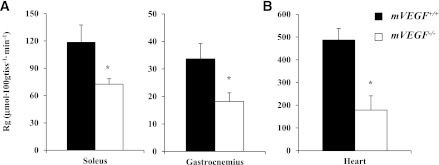
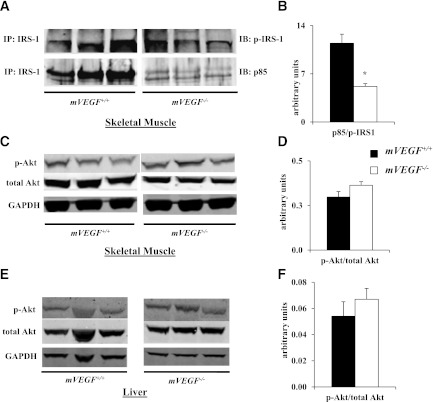
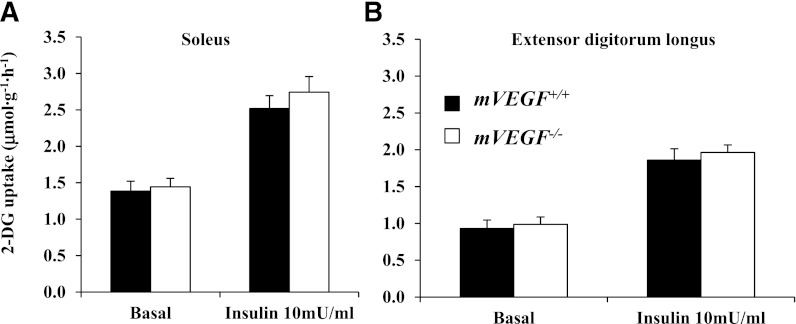
Muscle insulin resistance is associated with a reduction in vascular endothelial growth factor (VEGF) action and muscle capillary density. We tested the hypothesis that muscle capillary rarefaction critically contributes to the etiology of muscle insulin resistance in chow-fed mice with skeletal and cardiac muscle VEGF deletion (mVEGF−/−) and wild-type littermates (mVEGF+/+) on a C57BL/6 background. The mVEGF−/− mice had an ∼60% and ∼50% decrease in capillaries in skeletal and cardiac muscle, respectively. The mVEGF−/− mice had augmented fasting glucose turnover. Insulin-stimulated whole-body glucose disappearance was blunted in mVEGF−/− mice. The reduced peripheral glucose utilization during insulin stimulation was due to diminished in vivo cardiac and skeletal muscle insulin action and signaling. The decreased insulin-stimulated muscle glucose uptake was independent of defects in insulin action at the myocyte, suggesting that the impairment in insulin-stimulated muscle glucose uptake was due to poor muscle perfusion. The deletion of VEGF in cardiac muscle did not affect cardiac output. These studies emphasize the importance for novel therapeutic approaches that target the vasculature in the treatment of insulin-resistant muscle.
Overview
The claims and statistics of this paper haven’t been checked yet.
Free: it reads the open-access text and checks the first 5 claims that cite a source we can check. Create a free account to check every claim.
Integrity signals
Registry
Cites
Statistics
Figures
Verification
Claims the paper makes
The claims and statistics of this paper haven’t been checked yet.
Free: it reads the open-access text and checks the first 5 claims that cite a source we can check. Create a free account to check every claim.
Claims other papers make about this one
Each is checked against this paper’s own text: does it say what the citing paper says it does?
In the citing paper
“ECM remodeling is necessary for increased capillary growth and proliferation.”
From The Vasculature in Prediabetes (2018) · cites this paper as [165]
Self-check
Percentages, sums and reported differences re-computed from the paper’s own numbers.
The self-check needs the paper’s full text.
Citations
Cites
A new mathematical model for relative quantification in real-time RT-PCR
Pfaffl, M. W. (2001) · Nucleic Acids Research · doi:10.1093/nar/29.9.e45 · Cited by 34,610
DeFronzo, R. A., & Ferrannini, E. (1991) · Diabetes Care · doi:10.2337/diacare.14.3.173 · Cited by 4,535 · cited 1×
“Insulin resistance is closely associated with cardiovascular disease and together they are central to the metabolic syndrome (1).”
BackgroundAbnormal blood vessel development and lethality in embryos lacking a single VEGF allele
Carmeliet, P., Ferreira, V., Breier, G., Pollefeyt, S., Kieckens, L., Gertsenstein, M., Fahrig, M., Vandenhoeck, A., Harpal, K., Eberhardt, C., et al. (1996) · Nature · doi:10.1038/380435a0 · Cited by 4,117
Heterozygous embryonic lethality induced by targeted inactivation of the VEGF gene
Ferrara, N., Carver-Moore, K., Chen, H., Dowd, M., Lu, L., O'Shea, K. S., Powell-Braxton, L., Hillan, K. J., & Moore, M. W. (1996) · Nature · doi:10.1038/380439a0 · Cited by 3,628
VEGF receptor signalling ? in control of vascular function
Olsson, A.-K., Dimberg, A., Kreuger, J., & Claesson-Welsh, L. (2006) · Nature Reviews Molecular Cell Biology · doi:10.1038/nrm1911 · Cited by 3,122 · cited 2×
“In particular, VEGF-A stimulates the formation of new vascular networks by recruiting and differentiating endothelial progenitor cells in addition to inducing endothelial cell proliferation and migration (24).”
BackgroundAutocrine VEGF Signaling Is Required for Vascular Homeostasis
Lee, S., Chen, T. T., Barber, C. L., Jordan, M. C., Murdock, J., Desai, S., Ferrara, N., Nagy, A., Roos, K. P., & Iruela-Arispe, M. L. (2007) · Cell · doi:10.1016/j.cell.2007.06.054 · Cited by 1,046 · cited 1×
“Furthermore, endothelial-specific deletion of VEGF results in endothelial apoptosis and sudden death in 55% of mutant mice by age 25 weeks, which indicates the importance of autocrine VEGF signaling in the maintenance of endothelial integrity in the adult animal (51).”
BackgroundLaakso, M., Edelman, S. V., Brechtel, G., & Baron, A. D. (1990) · Journal of Clinical Investigation · doi:10.1172/jci114644 · Cited by 930
VEGF is required for growth and survival in neonatal mice
Gerber, H.-P., Hillan, K. J., Ryan, A. M., Kowalski, J., Keller, G.-A., Rangell, L., Wright, B. D., Radtke, F., Aguet, M., & Ferrara, N. (1999) · Development · doi:10.1242/dev.126.6.1149 · Cited by 915
Ruhrberg, C., Gerhardt, H., Golding, M., Watson, R., Ioannidou, S., Fujisawa, H., Betsholtz, C., & Shima, D. T. (2002) · Genes & Development · doi:10.1101/gad.242002 · Cited by 914 · cited 1×
“The myocellular paracrine signaling of VEGF is essential for the spatial branching of the capillary network and is necessary for muscle capillary architectural organization (29,52,53).”
BackgroundMeasurement of Size and Turnover Rate of Body Glucose Pool by the Isotope Dilution Method
Steele, R., Wall, J. S., de Bodo, R. C., & Altszuler, N. (1956) · American Journal of Physiology-Legacy Content · doi:10.1152/ajplegacy.1956.187.1.15 · Cited by 816 · cited 1×
“Ra and Rd were calculated using non–steady-state equations (35).”
Method
Cited by
Items 101–113 of 113
Muscle Insulin Resistance: Novel Mechanisms and New Treatment Targets
Bonner, J. S. (2013)
Self-citationMicrovascular dysfunction and diabetes: a vicious cycle?
Muris, D. M. J. (2015) · Research Publications (Maastricht University) · doi:10.26481/dis.20150513dm
The developing link of metabolic growth factors in insulin resistance
Gao, R., Hassan, W., Shahzadi, A., din, F. U., & Rasheed, H. M. F. (2017) · Journal of Contemporary Pharmacy · doi:10.56770/jcp201705
“Bonner et al [53] argued that VEGF deletion in transgenic mice in skeletal muscles generates about 40-45% less glucose uptake by skeletal muscle which is quite significant.”
BackgroundZhao, Y., Gu, Y., & Zhang, B. (2024) · Figshare · doi:10.6084/m9.figshare.25513771
Ikediashi Nwadozi, E. (2020) · York University Digital Library (York University)
Mandel, E. R. (2016) · YorkSpace (York University)
Wickham, K. A. (2023) · Brock University Digital Repository (Brock University)
Guo, C., Wei, X., Li, W., Wang, G., Gao, B., Zhang, L., & Gao, B. (2026) · Journal of Nanobiotechnology · doi:10.1186/s12951-026-04610-z
“In type 2 diabetes mellitus (T2DM) patients, altered skeletal muscle function and insulin resistance are highly correlated with significantly reduced skeletal muscle capillary density, potentially due to decreased vascular endothelial growth factor (VEGF) expression [84, 85].”
蔡月丽 (2026) · Advances in Clinical Medicine · doi:10.12677/acm.2026.1662307
Karimi, E., Brayner, B., Keske, M. A., Parker, L., Way, K. L., Hamilton, D. L., McGlory, C., & Kaur, G. (2026) · Nutrition and Diabetes · doi:10.1038/s41387-026-00461-7
The Impact of Omega-3 Polyunsaturated Fatty Acids on Skeletal Muscle Regeneration in Aged Mice
Chabert, C. (2026) · uO Research (University of Ottawa) · doi:10.20381/ruor-32212
Pislaru, A., Roudier, É., Rezvan, O., Breadmore, C., Fathi, M., Nader, G., AlZaim, I., Nwadozi, E., Lee, G., Yavari, E., et al. (2026) · Angiogenesis · doi:10.1007/s10456-026-10093-1
“As muscle capillarity is an important predictor of insulin-mediated glucose disposal in mice and humans [26, 27], we next analyzed whole-body glucose regulation in HFD-fed EC-FoxO1 KD and control female mice.”
Metadata
- Authors
- Bonner, J. S., Lantier, L., Hasenour, C. M., James, F. D., Bracy, D. P., & Wasserman, D. H.
- Affiliations
- Vanderbilt University (US)
- Corresponding author
- Bonner, Jeffrey S.
- Venue
- Diabetes
- Publisher
- American Diabetes Association
- Published
- 2013-01-17
- Volume
- 62
- Issue
- 2
- Pages
- 572-580
- ISSN
- 0012-1797 (ISSN-L)
- 1939-327X
- PMC
- PMC3554359
- OpenAlex
- W2117114195
- Cited by
- 107
- References
- 56
- Citations by year
- 2026: 6 · 2025: 5 · 2024: 5 · 2023: 6 · 2022: 8 · 2021: 7 · 2020: 8 · 2019: 4 · 2018: 8 · 2017: 7 · 2016: 12 · 2015: 11 · 2014: 12 · 2013: 8
- FWCI
- 24.17
- Type
- journal article
- Language
- en
- Open access
- hybrid
- doi.org
- Licence
- Locations
- Diabetes (publishedVersion, cc-by-nc-nd)
- Europe PMC (PubMed Central) (publishedVersion, cc-by-nc-nd)
- PubMed Central (publishedVersion, cc-by-nc-nd)
- PubMed (publishedVersion)
- Funders
- American Diabetes Association
- National Institutes of Health
- National Institute of Diabetes and Digestive and Kidney Diseases (U24DK059637, DK-054902, DK 059637, R01DK054902, R56DK054902, T32DK007563)
- Topics
- Health Sciences › Medicine › Physiology (medical) › Cardiovascular and exercise physiology
- Health Sciences › Medicine › Endocrinology, Diabetes and Metabolism › Diabetes, Cardiovascular Risks, and Lipoproteins
- Life Sciences › Biochemistry, Genetics and Molecular Biology › Molecular Biology › Metabolism, Diabetes, and Cancer
- Keywords
- vascular endothelial growth factor, muscle insulin resistance, capillary rarefaction, skeletal muscle, myocardium, muscle glucose uptake, insulin signaling, muscle blood flow, anti-VEGF therapy
- MeSH terms
- Animals, Blood Glucose, Capillaries, Hypoglycemic Agents, Insulin, Insulin Resistance, Mice, Inbred C57BL, Myocardium, Signal Transduction, Gene Deletion, Muscle, Skeletal, Muscle Cells, Vascular Endothelial Growth Factor A, Mice
About these checks
Registry, retraction, Cites and statistics results are computed, not judged, with one exception: a printed reference that no index lists is read once by a model before it counts as a citation error. Claims are extracted by a model and kept only when their quote appears verbatim in the text; each cited source is then checked, with a model’s help, for whether it says what the claim relies on. Those verdicts can be wrong — read the claim’s quote and the cited source before relying on one.
Statistics and arithmetic are recomputed, not judged.
Confidence bands are shown only for fields calibrated on our annotated test set. None is calibrated yet, so no band is shown.
What counts as a claim ›How we measure confidence ›How we check this ›
Are you an author, or do you see a problem with this page? Request a review
Data sources
Bibliographic data: Semantic Scholar, OpenAlex, Crossref.
Contains information from the Semantic Scholar Academic Graph Datasets, made available under the ODC Attribution License (ODC-BY 1.0).
Semantic Scholar’s data is described in: Kinney, R., et al. (2023). The Semantic Scholar Open Data Platform. arXiv:2301.10140.
