

Muscle-Specific Vascular Endothelial Growth Factor Deletion Induces Muscle Capillary Rarefaction Creating Muscle Insulin Resistance
Open accessThe DOI matches its Crossref record; 56 of the 56 references it cites were found in a registry or an index.
Abstract
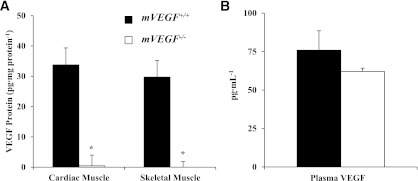
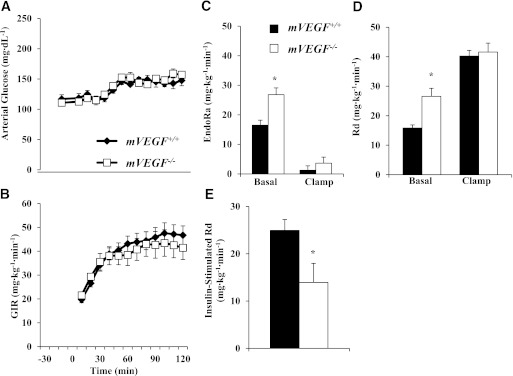
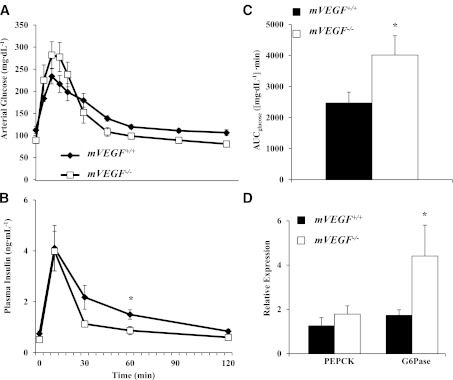
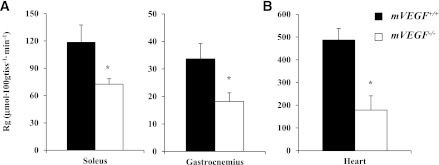
Muscle insulin resistance is associated with a reduction in vascular endothelial growth factor (VEGF) action and muscle capillary density. We tested the hypothesis that muscle capillary rarefaction critically contributes to the etiology of muscle insulin resistance in chow-fed mice with skeletal and cardiac muscle VEGF deletion (mVEGF−/−) and wild-type littermates (mVEGF+/+) on a C57BL/6 background. The mVEGF−/− mice had an ∼60% and ∼50% decrease in capillaries in skeletal and cardiac muscle, respectively. The mVEGF−/− mice had augmented fasting glucose turnover. Insulin-stimulated whole-body glucose disappearance was blunted in mVEGF−/− mice. The reduced peripheral glucose utilization during insulin stimulation was due to diminished in vivo cardiac and skeletal muscle insulin action and signaling. The decreased insulin-stimulated muscle glucose uptake was independent of defects in insulin action at the myocyte, suggesting that the impairment in insulin-stimulated muscle glucose uptake was due to poor muscle perfusion. The deletion of VEGF in cardiac muscle did not affect cardiac output. These studies emphasize the importance for novel therapeutic approaches that target the vasculature in the treatment of insulin-resistant muscle.
Overview
The claims and statistics of this paper haven’t been checked yet.
Free: it reads the open-access text and checks the first 5 claims that cite a source we can check. Create a free account to check every claim.
Integrity signals
Registry
Cites
Statistics
Figures
Verification
Claims the paper makes
The claims and statistics of this paper haven’t been checked yet.
Free: it reads the open-access text and checks the first 5 claims that cite a source we can check. Create a free account to check every claim.
Claims other papers make about this one
Each is checked against this paper’s own text: does it say what the citing paper says it does?
In the citing paper
“ECM remodeling is necessary for increased capillary growth and proliferation.”
From The Vasculature in Prediabetes (2018) · cites this paper as [165]
Self-check
Percentages, sums and reported differences re-computed from the paper’s own numbers.
The self-check needs the paper’s full text.
Citations
Cites
A new mathematical model for relative quantification in real-time RT-PCR
Pfaffl, M. W. (2001) · Nucleic Acids Research · doi:10.1093/nar/29.9.e45 · Cited by 34,610
DeFronzo, R. A., & Ferrannini, E. (1991) · Diabetes Care · doi:10.2337/diacare.14.3.173 · Cited by 4,535 · cited 1×
“Insulin resistance is closely associated with cardiovascular disease and together they are central to the metabolic syndrome (1).”
BackgroundAbnormal blood vessel development and lethality in embryos lacking a single VEGF allele
Carmeliet, P., Ferreira, V., Breier, G., Pollefeyt, S., Kieckens, L., Gertsenstein, M., Fahrig, M., Vandenhoeck, A., Harpal, K., Eberhardt, C., et al. (1996) · Nature · doi:10.1038/380435a0 · Cited by 4,117
Heterozygous embryonic lethality induced by targeted inactivation of the VEGF gene
Ferrara, N., Carver-Moore, K., Chen, H., Dowd, M., Lu, L., O'Shea, K. S., Powell-Braxton, L., Hillan, K. J., & Moore, M. W. (1996) · Nature · doi:10.1038/380439a0 · Cited by 3,628
VEGF receptor signalling ? in control of vascular function
Olsson, A.-K., Dimberg, A., Kreuger, J., & Claesson-Welsh, L. (2006) · Nature Reviews Molecular Cell Biology · doi:10.1038/nrm1911 · Cited by 3,122 · cited 2×
“In particular, VEGF-A stimulates the formation of new vascular networks by recruiting and differentiating endothelial progenitor cells in addition to inducing endothelial cell proliferation and migration (24).”
BackgroundAutocrine VEGF Signaling Is Required for Vascular Homeostasis
Lee, S., Chen, T. T., Barber, C. L., Jordan, M. C., Murdock, J., Desai, S., Ferrara, N., Nagy, A., Roos, K. P., & Iruela-Arispe, M. L. (2007) · Cell · doi:10.1016/j.cell.2007.06.054 · Cited by 1,046 · cited 1×
“Furthermore, endothelial-specific deletion of VEGF results in endothelial apoptosis and sudden death in 55% of mutant mice by age 25 weeks, which indicates the importance of autocrine VEGF signaling in the maintenance of endothelial integrity in the adult animal (51).”
BackgroundLaakso, M., Edelman, S. V., Brechtel, G., & Baron, A. D. (1990) · Journal of Clinical Investigation · doi:10.1172/jci114644 · Cited by 930
VEGF is required for growth and survival in neonatal mice
Gerber, H.-P., Hillan, K. J., Ryan, A. M., Kowalski, J., Keller, G.-A., Rangell, L., Wright, B. D., Radtke, F., Aguet, M., & Ferrara, N. (1999) · Development · doi:10.1242/dev.126.6.1149 · Cited by 915
Ruhrberg, C., Gerhardt, H., Golding, M., Watson, R., Ioannidou, S., Fujisawa, H., Betsholtz, C., & Shima, D. T. (2002) · Genes & Development · doi:10.1101/gad.242002 · Cited by 914 · cited 1×
“The myocellular paracrine signaling of VEGF is essential for the spatial branching of the capillary network and is necessary for muscle capillary architectural organization (29,52,53).”
BackgroundMeasurement of Size and Turnover Rate of Body Glucose Pool by the Isotope Dilution Method
Steele, R., Wall, J. S., de Bodo, R. C., & Altszuler, N. (1956) · American Journal of Physiology-Legacy Content · doi:10.1152/ajplegacy.1956.187.1.15 · Cited by 816 · cited 1×
“Ra and Rd were calculated using non–steady-state equations (35).”
MethodLillioja, S., Young, A. A., Culter, C. L., Ivy, J. L., Abbott, W. G., Zawadzki, J. K., Yki-Järvinen, H., Christin, L., Secomb, T. W., & Bogardus, C. (1987) · Journal of Clinical Investigation · doi:10.1172/jci113088 · Cited by 782 · cited 2×
“Capillary density correlates with the severity of insulin resistance in obesity; however, the specific effect of capillary rarefaction to the pathogenesis of skeletal and cardiac muscle insulin resistance has not been elucidated (8,9,11,19).”
BackgroundJørgensen, S. B., Viollet, B., Andreelli, F., Frøsig, C., Birk, J. B., Schjerling, P., Vaulont, S., Richter, E. A., & Wojtaszewski, J. F. P. (2004) · Journal of Biological Chemistry · doi:10.1074/jbc.m306205200 · Cited by 553
Differential Effects of Interleukin-6 and -10 on Skeletal Muscle and Liver Insulin Action In Vivo
Kim, H.-J., Higashimori, T., Park, S.-Y., Choi, H., Dong, J., Kim, Y.-J., Noh, H.-L., Cho, Y.-R., Cline, G., Kim, Y.-B., et al. (2004) · Diabetes · doi:10.2337/diabetes.53.4.1060 · Cited by 534 · cited 1×
“(33,34): mice are not handled and are unstressed (32); moreover, erythrocytes are replaced to prevent a fall in hematocrit that would inevitably occur.”
BackgroundKim, Y.-B., Nikoulina, S. E., Ciaraldi, T. P., Henry, R. R., & Kahn, B. B. (1999) · Journal of Clinical Investigation · doi:10.1172/jci6928 · Cited by 487
Vincent, M. A., Clerk, L. H., Lindner, J. R., Klibanov, A. L., Clark, M. G., Rattigan, S., & Barrett, E. J. (2004) · Diabetes · doi:10.2337/diabetes.53.6.1418 · Cited by 438 · cited 16×
“Studies estimate that 40% of insulinstimulated MGU results from increased muscle perfusion and that this hemodynamic response is absent in patients with type 2 diabetes (2,6,13–17).”
BackgroundInfluentialKubota, T., Kubota, N., Kumagai, H., Yamaguchi, S., Kozono, H., Takahashi, T., Inoue, M., Itoh, S., Takamoto, I., Sasako, T., et al. (2011) · Cell Metabolism · doi:10.1016/j.cmet.2011.01.018 · Cited by 435 · cited 1×
“Moreover, in genetic- and diet-induced models of muscle insulin resistance, the physiological actions of insulin to increase muscle microvascular recruitment and nutrient blood flow are impaired, resulting in an abatement in insulin and glucose delivery to the myocyte (4,6,16,43,44).”
BackgroundChan, T. M., & Exton, J. H. (1976) · Analytical Biochemistry · doi:10.1016/0003-2697(76)90014-2 · Cited by 413 · cited 1×
“insulin clamp and after a time control experiment during which saline was infused as previously reported (36).”
MethodConsiderations in the Design of Hyperinsulinemic-Euglycemic Clamps in the Conscious Mouse
Ayala, J. E., Bracy, D. P., McGuinness, O. P., & Wasserman, D. H. (2006) · Diabetes · doi:10.2337/diabetes.55.02.06.db05-0686 · Cited by 403
Self-citationGiordano, F. J., Gerber, H.-P., Williams, S.-P., VanBruggen, N., Bunting, S., Ruiz-Lozano, P., Gu, Y., Nath, A. K., Huang, Y., Hickey, R., et al. (2001) · Proceedings of the National Academy of Sciences · doi:10.1073/pnas.091415198 · Cited by 370 · cited 1×
“The myocellular paracrine signaling of VEGF is essential for the spatial branching of the capillary network and is necessary for muscle capillary architectural organization (29,52,53).”
BackgroundKim, F., Pham, M., Maloney, E., Rizzo, N. O., Morton, G. J., Wisse, B. E., Kirk, E. A., Chait, A., & Schwartz, M. W. (2008) · Arteriosclerosis Thrombosis and Vascular Biology · doi:10.1161/atvbaha.108.169722 · Cited by 364
Vascular endothelial growth factor stimulates skeletal muscle regeneration in Vivo
Arsic, N., Zacchigna, S., Zentilin, L., Ramirez-Correa, G., Pattarini, L., Salvi, A., Sinagra, G., & Giacca, M. (2004) · Molecular Therapy · doi:10.1016/j.ymthe.2004.08.007 · Cited by 349 · cited 1×
“Skeletal muscle does not express VEGF receptors, indicating the decrease in muscle VEGF does not have direct effects at the myocyte (40).”
BackgroundMuscle Fiber Composition and Capillary Density in Women and Men With NIDDM
MÅrin, P., Andersson, B., Krotkiewski, M., & Björntorp, P. (1994) · Diabetes Care · doi:10.2337/diacare.17.5.382 · Cited by 342 · cited 2×
“The present investigation is consistent with human data that exhibit a strong relationship between muscle capillary density and insulin-mediated peripheral glucose disposal (18,20,56).”
BackgroundResultChou, E., Suzuma, I., Way, K. J., Opland, D., Clermont, A. C., Naruse, K., Suzuma, K., Bowling, N. L., Vlahos, C. J., Aiello, L. P., et al. (2002) · Circulation · doi:10.1161/hc0302.102143 · Cited by 337 · cited 1×
“Diabetic states are characterized by cardiac muscle capillary regression and impaired VEGF action (25,26).”
BackgroundVincent, M. A., Barrett, E. J., Lindner, J. R., Clark, M. G., & Rattigan, S. (2003) · American Journal of Physiology-Endocrinology and Metabolism · doi:10.1152/ajpendo.00021.2003 · Cited by 305 · cited 16×
“Studies estimate that 40% of insulinstimulated MGU results from increased muscle perfusion and that this hemodynamic response is absent in patients with type 2 diabetes (2,6,13–17).”
BackgroundInfluentialObesity Blunts Insulin-Mediated Microvascular Recruitment in Human Forearm Muscle
Clerk, L. H., Vincent, M. A., Jahn, L. A., Liu, Z., Lindner, J. R., & Barrett, E. J. (2006) · Diabetes · doi:10.2337/db05-1373 · Cited by 300 · cited 4×
“This effect is similar to the decrease in capillary recruitment that prevents an increase in muscle blood volume and impairs muscle insulin action in obese, type 2 diabetic individuals (43).”
BackgroundInfluentialYoon, Y.-S., Uchida, S., Masuo, O., Cejna, M., Park, J.-S., Gwon, H.-C., Kirchmair, R., Bahlman, F., Walter, D., Curry, C., et al. (2005) · Circulation · doi:10.1161/01.cir.0000162472.52990.36 · Cited by 288 · cited 1×
“Severe hyperglycemia downregulates VEGF expression, which is seminal in the pathology of diabetic cardiomyopathy (54).”
BackgroundGlucose Metabolism In Vivo in Four Commonly Used Inbred Mouse Strains
Berglund, E. D., Li, C. Y., Poffenberger, G., Ayala, J. E., Fueger, P. T., Willis, S. E., Jewell, M. M., Powers, A. C., & Wasserman, D. H. (2008) · Diabetes · doi:10.2337/db07-1615 · Cited by 265 · cited 1×
“insulin clamps were performed as described previously (7,22,31,32).”
MethodSelf-citationAyala, J. E., Bracy, D. P., Julien, B. M., Rottman, J. N., Fueger, P. T., & Wasserman, D. H. (2007) · Diabetes · doi:10.2337/db06-0883 · Cited by 237 · cited 20×
“Studies estimate that 40% of insulinstimulated MGU results from increased muscle perfusion and that this hemodynamic response is absent in patients with type 2 diabetes (2,6,13–17).”
BackgroundMethodResultInfluentialSelf-citationBARON, A. D., LAAKSO, M., BRECHTEL, G., & EDELMAN, S. V. (1991) · The Journal of Clinical Endocrinology & Metabolism · doi:10.1210/jcem-73-3-637 · Cited by 212 · cited 15×
“Studies estimate that 40% of insulinstimulated MGU results from increased muscle perfusion and that this hemodynamic response is absent in patients with type 2 diabetes (2,6,13–17).”
ResultInfluentialHazarika, S., Dokun, A. O., Li, Y., Popel, A. S., Kontos, C. D., & Annex, B. H. (2007) · Circulation Research · doi:10.1161/circresaha.107.160630 · Cited by 202
Capillary regression in vascular endothelial growth factor-deficient skeletal muscle
Tang, K., Breen, E. C., Gerber, H.-P., Ferrara, N. M. A., & Wagner, P. D. (2004) · Physiological Genomics · doi:10.1152/physiolgenomics.00023.2004 · Cited by 196 · cited 3×
“Diabetic states are characterized by muscle capillary regression that results from impaired VEGF action (21,29).”
BackgroundBaron, A. D., Tarshoby, M., Hook, G., Lazaridis, E. N., Cronin, J., Johnson, A., & Steinberg, H. O. (2000) · Diabetes · doi:10.2337/diabetes.49.5.768 · Cited by 174 · cited 1×
“These data emphasize the importance of increased muscle blood volume and capillary surface area for the delivery of insulin and glucose to skeletal muscle during hyperinsulinemia (2,12,14).”
BackgroundSasso, F. C., Torella, D., Carbonara, O., Ellison, G. M., Torella, M., Scardone, M., Marra, C., Nasti, R., Marfella, R., Cozzolino, D., et al. (2005) · Journal of the American College of Cardiology · doi:10.1016/j.jacc.2005.06.007 · Cited by 173 · cited 1×
“Diabetic states are characterized by cardiac muscle capillary regression and impaired VEGF action (25,26).”
BackgroundIncreased collagen content in insulin-resistant skeletal muscle
Berria, R., Wang, L., Richardson, D. K., Finlayson, J., Belfort, R., Pratipanawatr, T., De Filippis, E. A., Kashyap, S., & Mandarino, L. J. (2006) · American Journal of Physiology-Endocrinology and Metabolism · doi:10.1152/ajpendo.00202.2005 · Cited by 171 · cited 1×
“Recent studies have linked diet-induced extramyocellular adaptations to insulin resistance in rodent models (7–9) and humans (10).”
BackgroundInsulin regulates its own delivery to skeletal muscle by feed-forward actions on the vasculature
Barrett, E. J., Wang, H., Upchurch, C. T., & Liu, Z. (2011) · American Journal of Physiology-Endocrinology and Metabolism · doi:10.1152/ajpendo.00186.2011 · Cited by 171 · cited 16×
“Studies estimate that 40% of insulinstimulated MGU results from increased muscle perfusion and that this hemodynamic response is absent in patients with type 2 diabetes (2,6,13–17).”
BackgroundResultInfluentialMuscle‐specific VEGF deficiency greatly reduces exercise endurance in mice
Olfert, I. M., Howlett, R. A., Tang, K., Dalton, N. D., Gu, Y., Peterson, K. L., Wagner, P. D., & Breen, E. C. (2009) · The Journal of Physiology · doi:10.1113/jphysiol.2008.164384 · Cited by 166 · cited 3×
“Cardiac and skeletal myocellular VEGF-A production regulates capillarity by paracrine signaling to the endothelium (28,29).”
BackgroundMethodHepatic insulin resistance in mice with hepatic overexpression of diacylglycerol acyltransferase 2
Jornayvaz, F. R., Birkenfeld, A. L., Jurczak, M. J., Kanda, S., Guigni, B. A., Jiang, D. C., Zhang, D., Lee, H.-Y., Samuel, V. T., & Shulman, G. I. (2011) · Proceedings of the National Academy of Sciences · doi:10.1073/pnas.1103451108 · Cited by 164
Kang, L., Ayala, J. E., Lee-Young, R. S., Zhang, Z., James, F. D., Neufer, P. D., Pozzi, A., Zutter, M. M., & Wasserman, D. H. (2011) · Diabetes · doi:10.2337/db10-1116 · Cited by 159 · cited 6×
“insulin clamps were performed as described previously (7,22,31,32).”
BackgroundMethodInfluentialSelf-citationGavin, T. P., Stallings, H. W., Zwetsloot, K. A., Westerkamp, L. M., Ryan, N. A., Moore, R. A., Pofahl, W. E., & Hickner, R. C. (2005) · Journal of Applied Physiology · doi:10.1152/japplphysiol.00353.2004 · Cited by 149 · cited 1×
“The present investigation is consistent with human data that exhibit a strong relationship between muscle capillary density and insulin-mediated peripheral glucose disposal (18,20,56).”
ResultChung, A. W. Y., Hsiang, Y. N., Matzke, L. A., McManus, B. M., van Breemen, C., & Okon, E. B. (2006) · Circulation Research · doi:10.1161/01.res.0000232352.90786.fa · Cited by 140 · cited 1×
“Diabetic states are characterized by muscle capillary regression that results from impaired VEGF action (21,29).”
BackgroundActive and passive capillary control in red muscle at rest and in exercise
Honig, C. R., Odoroff, C. L., & Frierson, J. L. (1982) · American Journal of Physiology-Heart and Circulatory Physiology · doi:10.1152/ajpheart.1982.243.2.h196 · Cited by 121 · cited 1×
“At rest, ;30% of capillaries are required to maintain the demand for skeletal muscle perfusion (45,46).”
BackgroundDelayed Transcapillary Transport of Insulin to Muscle Interstitial Fluid in Obese Subjects
Sjöstrand, M., Gudbjörnsdottir, S., Holmäng, A., Lönn, L., Strindberg, L., & Lönnroth, P. (2002) · Diabetes · doi:10.2337/diabetes.51.9.2742 · Cited by 114 · cited 1×
“Moreover, in genetic- and diet-induced models of muscle insulin resistance, the physiological actions of insulin to increase muscle microvascular recruitment and nutrient blood flow are impaired, resulting in an abatement in insulin and glucose delivery to the myocyte (4,6,16,43,44).”
BackgroundTissue-specific distribution and developmental regulation of M and B creatine kinase mRNAs
Trask, R. V., & Billadello, J. J. (1990) · Biochimica et Biophysica Acta (BBA) - Gene Structure and Expression · doi:10.1016/0167-4781(90)90039-5 · Cited by 109 · cited 1×
“In our model of muscle-specific VEGF deletion, Cre recombinase is under the MCK promoter, which is not expressed until fetal day 16 and then is upregulated after birth (48).”
BackgroundFRISBEE, J. C. (2005) · Microcirculation · doi:10.1080/10739680590960241 · Cited by 103 · cited 1×
“Capillary density correlates with the severity of insulin resistance in obesity; however, the specific effect of capillary rarefaction to the pathogenesis of skeletal and cardiac muscle insulin resistance has not been elucidated (8,9,11,19).”
BackgroundEffects of chronic elevation in plasma cortisol on hepatic carbohydrate metabolism
Goldstein, R. E., Wasserman, D. H., McGuinness, O. P., Lacy, D. B., Cherrington, A. D., & Abumrad, N. N. (1993) · American Journal of Physiology-Endocrinology and Metabolism · doi:10.1152/ajpendo.1993.264.1.e119 · Cited by 100 · cited 1×
“Moreover, the increased basal glucose turnover suggests accelerated hepatic cycling of glucose independent of hepatic insulin action (55).”
BackgroundSelf-citationChiu, J. D., Richey, J. M., Harrison, L. N., Zuniga, E., Kolka, C. M., Kirkman, E., Ellmerer, M., & Bergman, R. N. (2008) · Diabetes · doi:10.2337/db07-1444 · Cited by 96
Decreased Muscle Capillary Permeability Surface Area in Type 2 Diabetic Subjects
Gudbjörnsdóttir, S., Sjöstrand, M., Strindberg, L., & Lönnroth, P. (2005) · The Journal of Clinical Endocrinology & Metabolism · doi:10.1210/jc.2004-0947 · Cited by 80 · cited 1×
“The present investigation is consistent with human data that exhibit a strong relationship between muscle capillary density and insulin-mediated peripheral glucose disposal (18,20,56).”
ResultAn improved procedure for the assay of glycogen synthase and phosphorylase in rat liver homogenates
Golden, S., Wals, P. A., & Katz, J. J. (1977) · Analytical Biochemistry · doi:10.1016/0003-2697(77)90257-3 · Cited by 77
de Jongh, R. T., Clark, A. D. H., IJzerman, R. G., Serné, E. H., de Vries, G., & Stehouwer, C. D. A. (2004) · Diabetologia · doi:10.1007/s00125-004-1412-9 · Cited by 71 · cited 2×
“The augmented insulin and glucose delivery to the muscle interstitium during hyperinsulinemia is dependent on the increased surface area for substrate exchange induced by insulin-mediated capillary recruitment (42,43,47).”
BackgroundAngiotensin II Receptors Modulate Muscle Microvascular and Metabolic Responses to Insulin In Vivo
Chai, W., Wang, W., Dong, Z., Cao, W., & Liu, Z. (2011) · Diabetes · doi:10.2337/db10-1691 · Cited by 70 · cited 1×
“This affirms the importance of restoring skeletal muscle perfusion in ameliorating insulin resistance (7,9,22,23).”
BackgroundFueger, P. T., Shearer, J., Bracy, D. P., Posey, K. A., Pencek, R. R., McGuinness, O. P., & Wasserman, D. H. (2005) · The Journal of Physiology · doi:10.1113/jphysiol.2004.076158 · Cited by 68 · cited 15×
“Studies estimate that 40% of insulinstimulated MGU results from increased muscle perfusion and that this hemodynamic response is absent in patients with type 2 diabetes (2,6,13–17).”
ResultInfluentialSelf-citationSolomon, T. P. J., Haus, J. M., Li, Y., & Kirwan, J. P. (2011) · The Journal of Clinical Endocrinology & Metabolism · doi:10.1210/jc.2010-2069 · Cited by 68 · cited 2×
“Capillary density correlates with the severity of insulin resistance in obesity; however, the specific effect of capillary rarefaction to the pathogenesis of skeletal and cardiac muscle insulin resistance has not been elucidated (8,9,11,19).”
BackgroundLimitations to basal and insulin-stimulated skeletal muscle glucose uptake in the high-fat-fed rat
Halseth, A. E., Bracy, D. P., & Wasserman, D. H. (2000) · American Journal of Physiology-Endocrinology and Metabolism · doi:10.1152/ajpendo.2000.279.5.e1064 · Cited by 57 · cited 16×
“Moreover, in genetic- and diet-induced models of muscle insulin resistance, the physiological actions of insulin to increase muscle microvascular recruitment and nutrient blood flow are impaired, resulting in an abatement in insulin and glucose delivery to the myocyte (4,6,16,43,44).”
BackgroundResultInfluentialSelf-citationReduced Access to Insulin-Sensitive Tissues in Dogs With Obesity Secondary to Increased Fat Intake
Ellmerer, M., Hamilton-Wessler, M., Kim, S. P., Hücking, K., Kirkman, E. L., Chiu, J. D., Richey, J. M., & Bergman, R. N. (2006) · Diabetes · doi:10.2337/db05-1509 · Cited by 48 · cited 1×
“Moreover, in genetic- and diet-induced models of muscle insulin resistance, the physiological actions of insulin to increase muscle microvascular recruitment and nutrient blood flow are impaired, resulting in an abatement in insulin and glucose delivery to the myocyte (4,6,16,43,44).”
BackgroundLindbom, L. (1983) · PubMed · Cited by 36
Guo, Q., Mori, T., Jiang, Y., Hu, C., Ohsaki, Y., Yoneki, Y., Nakamichi, T., Ogawa, S., Sato, H., & Ito, S. (2011) · Hypertension Research · doi:10.1038/hr.2011.140 · Cited by 21 · cited 4×
“Pharmacological agents that target the vasculature to increase tissue perfusion also improve skeletal muscle insulin resistance and augment muscle microvascular density (7,9,22).”
BackgroundInfluential
Cited by
Diabetic Microvascular Disease: An Endocrine Society Scientific Statement
Barrett, E. J., Liu, Z., Khamaisi, M., King, G. L., Klein, R., Klein, B. E. K., Hughes, T. M., Craft, S., Freedman, B. I., Bowden, D. W., et al. (2017) · The Journal of Clinical Endocrinology & Metabolism · doi:10.1210/jc.2017-01922 · Cited by 515
“Bonner and colleagues created a muscle1934 specific VEGF-A knockout mouse using the Cre/lox method (505).”
MethodMicrovascular Dysfunction in Diabetes Mellitus and Cardiometabolic Disease
Horton, W. B., & Barrett, E. J. (2021) · Endocrine Reviews · doi:10.1210/endrev/bnaa025 · Cited by 424
Muscle as a paracrine and endocrine organ
Giudice, J., & Taylor, J. M. (2017) · Current Opinion in Pharmacology · doi:10.1016/j.coph.2017.05.005 · Cited by 331
“Genetically engineered mice with skeletal muscle-specific deletion of VEGFA have significantly reduced interstitial VEGFA levels accompanied by vascular rarefaction, reduced exercise capacity, and insulin resistance [8,9].”
Obesity-associated low-grade inflammation in type 2 diabetes mellitus: causes and consequences.
van Greevenbroek, M. M. J., Schalkwijk, C., & Stehouwer, C. D. A. (2013) · PubMed · Cited by 290
Robciuc, M. R., Kivelä, R., Williams, I. M., de Boer, J. F., van Dijk, T. H., Elamaa, H., Tigistu-Sahle, F., Molotkov, D., Leppänen, V.-M., Käkelä, R., et al. (2016) · Cell Metabolism · doi:10.1016/j.cmet.2016.03.004 · Cited by 234
“Recent data show that deficient vascularization of skeletal muscle induces insulin resistance in lean mice (Bonner et al., 2013).”
Self-citation
Metadata
- Authors
- Bonner, J. S., Lantier, L., Hasenour, C. M., James, F. D., Bracy, D. P., & Wasserman, D. H.
- Affiliations
- Vanderbilt University (US)
- Corresponding author
- Bonner, Jeffrey S.
- Venue
- Diabetes
- Publisher
- American Diabetes Association
- Published
- 2013-01-17
- Volume
- 62
- Issue
- 2
- Pages
- 572-580
- ISSN
- 0012-1797 (ISSN-L)
- 1939-327X
- PMC
- PMC3554359
- OpenAlex
- W2117114195
- Cited by
- 107
- References
- 56
- Citations by year
- 2026: 6 · 2025: 5 · 2024: 5 · 2023: 6 · 2022: 8 · 2021: 7 · 2020: 8 · 2019: 4 · 2018: 8 · 2017: 7 · 2016: 12 · 2015: 11 · 2014: 12 · 2013: 8
- FWCI
- 24.17
- Type
- journal article
- Language
- en
- Open access
- hybrid
- doi.org
- Licence
- Locations
- Diabetes (publishedVersion, cc-by-nc-nd)
- Europe PMC (PubMed Central) (publishedVersion, cc-by-nc-nd)
- PubMed Central (publishedVersion, cc-by-nc-nd)
- PubMed (publishedVersion)
- Funders
- American Diabetes Association
- National Institutes of Health
- National Institute of Diabetes and Digestive and Kidney Diseases (U24DK059637, DK-054902, DK 059637, R01DK054902, R56DK054902, T32DK007563)
- Topics
- Health Sciences › Medicine › Physiology (medical) › Cardiovascular and exercise physiology
- Health Sciences › Medicine › Endocrinology, Diabetes and Metabolism › Diabetes, Cardiovascular Risks, and Lipoproteins
- Life Sciences › Biochemistry, Genetics and Molecular Biology › Molecular Biology › Metabolism, Diabetes, and Cancer
- Keywords
- vascular endothelial growth factor, muscle insulin resistance, capillary rarefaction, skeletal muscle, myocardium, muscle glucose uptake, insulin signaling, muscle blood flow, anti-VEGF therapy
- MeSH terms
- Animals, Blood Glucose, Capillaries, Hypoglycemic Agents, Insulin, Insulin Resistance, Mice, Inbred C57BL, Myocardium, Signal Transduction, Gene Deletion, Muscle, Skeletal, Muscle Cells, Vascular Endothelial Growth Factor A, Mice
About these checks
Registry, retraction, Cites and statistics results are computed, not judged, with one exception: a printed reference that no index lists is read once by a model before it counts as a citation error. Claims are extracted by a model and kept only when their quote appears verbatim in the text; each cited source is then checked, with a model’s help, for whether it says what the claim relies on. Those verdicts can be wrong — read the claim’s quote and the cited source before relying on one.
Statistics and arithmetic are recomputed, not judged.
Confidence bands are shown only for fields calibrated on our annotated test set. None is calibrated yet, so no band is shown.
What counts as a claim ›How we measure confidence ›How we check this ›
Are you an author, or do you see a problem with this page? Request a review
Data sources
Bibliographic data: Semantic Scholar, OpenAlex, Crossref.
Contains information from the Semantic Scholar Academic Graph Datasets, made available under the ODC Attribution License (ODC-BY 1.0).
Semantic Scholar’s data is described in: Kinney, R., et al. (2023). The Semantic Scholar Open Data Platform. arXiv:2301.10140.
