

Phosphodiesterase 5 Inhibition Improves β-Cell Function in Metabolic Syndrome
Open accessThe DOI matches its Crossref record; 15 of the 15 references it cites were found in a registry or an index.
Abstract
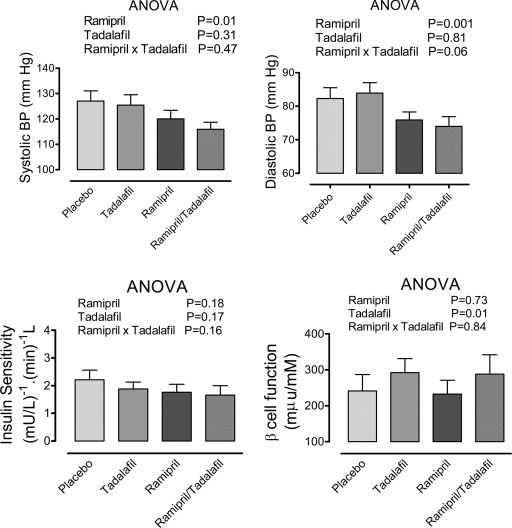
OBJECTIVE: This study tested the hypothesis that phosphodiesterase 5 inhibition alone or in combination with ACE inhibition improves glucose homeostasis and fibrinolysis in individuals with metabolic syndrome. RESEARCH DESIGN AND METHODS: Insulin sensitivity, β-cell function, and fibrinolytic parameters were measured in 18 adults with metabolic syndrome on 4 separate days after a randomized, crossover, double-blind, 3-week treatment with placebo, ramipril (10 mg/day), tadalafil (10 mg o.d.), and ramipril plus tadalafil. RESULTS: Ramipril decreased systolic and diastolic blood pressure, ACE activity, and angiotensin II and increased plasma renin activity. Ramipril did not affect insulin sensitivity or β-cell function. In contrast, tadalafil improved β-cell function (P = 0.01). This effect was observed in women (331.9 ± 209.3 vs. 154.4 ± 48.0 32 μ · mmol−1 · l−1, respectively, for tadalafil treatment vs. placebo; P = 0.01) but not in men. There was no effect of any treatment on fibrinolysis. CONCLUSIONS: Phosphodiesterase 5 inhibition may represent a novel strategy for improving β-cell function in metabolic syndrome.
Overview
The claims and statistics of this paper haven’t been checked yet.
Free: it reads the open-access text and checks the first 5 claims that cite a source we can check. Create a free account to check every claim.
Integrity signals
Registry
Cites
Statistics
Figures
Verification
Claims the paper makes
The claims and statistics of this paper haven’t been checked yet.
Free: it reads the open-access text and checks the first 5 claims that cite a source we can check. Create a free account to check every claim.
Claims other papers make about this one
Each is checked against this paper’s own text: does it say what the citing paper says it does?
In the citing paper
“In a proof-of-concept study, three-week treatment tadalafil improved β-cell function measured using the frequently-sampled IVGTT in individuals with metabolic syndrome, and reduced disposition index (DI, a composite measure of insulin sensitivity and secretion) in the women studied.232”
From The Vasculature in Prediabetes (2018) · cites this paper as [232]
Self-check
Percentages, sums and reported differences re-computed from the paper’s own numbers.
The self-check needs the paper’s full text.
Citations
Cites
Ford, E. S., Giles, W. H., & Dietz, W. H. (2002) · JAMA · doi:10.1001/jama.287.3.356 · Cited by 6,698 · cited 1×
“adults, predicts diabetes, and will soon overtake smoking as the premier cardiovascular risk factor (1).”
Kahn, S. E. (2003) · Diabetologia · doi:10.1007/s00125-002-1009-0 · Cited by 2,166 · cited 4×
“Progression to type 2 diabetes results from impaired insulin sensitivity and pancreatic -cell dysfunction (2,3).”
BackgroundMethodInfluentialInsulin Secretion from Pancreatic B Cells Caused by L-Arginine-Derived Nitrogen Oxides
Schmidt, H. H. H. W., Warner, T. D., Ishii, K., Sheng, H., & Murad, F. (1992) · Science · doi:10.1126/science.1371193 · Cited by 420 · cited 2×
“Previous studies provide conflicting data, however, regarding the effect of NO on -cell function, with some suggesting that NO suppresses insulin secretion (13,14) and others indicating that NO enhances insulin secretion (12,15).”
ResultCross-talk between the insulin and angiotensin signaling systems.
Velloso, L. A., Folli, F., Sun, X. J., White, M. F., Saad, M. J., & Kahn, C. R. (1996) · Proceedings of the National Academy of Sciences · doi:10.1073/pnas.93.22.12490 · Cited by 403 · cited 1×
“These agents can improve insulin sensitivity by preventing inhibitory effects of angiotensin II on GLUT4 translocation (5) or improve insulin secretion by preventing angiotensin II type 1 receptor–dependent inhibition of insulin release (6).”
BackgroundPrevention of Type 2 Diabetes Mellitus Through Inhibition of the Renin-Angiotensin System
Scheen, A. J. (2004) · Drugs · doi:10.2165/00003495-200464220-00004 · Cited by 293
Effects of Hemipancreatectomy on Insulin Secretion and Glucose Tolerance in Healthy Humans
Kendall, D. M., Sutherland, D. E. R., Najarian, J. S., Goetz, F. C., & Robertson, R. P. (1990) · New England Journal of Medicine · doi:10.1056/nejm199003293221305 · Cited by 244 · cited 1×
“than previously appreciated in that pancreatic -cell apoptosis precedes overt diabetes in high-risk individuals (10) and surgical reduction of pancreatic mass causes impaired glucose tolerance and diabetes (11).”
BackgroundAyala, J. E., Bracy, D. P., Julien, B. M., Rottman, J. N., Fueger, P. T., & Wasserman, D. H. (2007) · Diabetes · doi:10.2337/db06-0883 · Cited by 237 · cited 1×
“In mice, inhibiting cGMP degradation by phosphodiesterase 5 increases insulin sensitivity and muscle glucose uptake (8).”
BackgroundLau, T., Carlsson, P.-O., & Leung, P. S. (2004) · Diabetologia · doi:10.1007/s00125-003-1295-1 · Cited by 230 · cited 1×
“These agents can improve insulin sensitivity by preventing inhibitory effects of angiotensin II on GLUT4 translocation (5) or improve insulin secretion by preventing angiotensin II type 1 receptor–dependent inhibition of insulin release (6).”
BackgroundBeta cell mass in diabetes: a realistic therapeutic target?
Meier, J. J. (2008) · Diabetologia · doi:10.1007/s00125-008-0936-9 · Cited by 155 · cited 1×
“Progression to type 2 diabetes results from impaired insulin sensitivity and pancreatic -cell dysfunction (2,3).”
BackgroundACE Inhibitor Improves Insulin Resistance in Diabetic Mouse Via Bradykinin and NO
Shiuchi, T., Cui, T.-X., Wu, L., Nakagami, H., Takeda-Matsubara, Y., Iwai, M., & Horiuchi, M. (2002) · Hypertension · doi:10.1161/01.hyp.0000028979.98877.0c · Cited by 149
Exogenous Nitric Oxide and Endogenous Glucose-Stimulated β-Cell Nitric Oxide Augment Insulin Release
Smukler, S. R., Tang, L., Wheeler, M. B., & Salapatek, A. M. F. (2002) · Diabetes · doi:10.2337/diabetes.51.12.3450 · Cited by 101 · cited 2×
“cGMP decreases apoptosis and increases intracellular calcium in pancreatic -cells, suggesting an insulinotropic effect (9,10).”
BackgroundPanagiotidis, G., Åkesson, B., Rydell, E. L., & Lundquist, I. (1995) · British Journal of Pharmacology · doi:10.1111/j.1476-5381.1995.tb13225.x · Cited by 79 · cited 1×
“Previous studies provide conflicting data, however, regarding the effect of NO on -cell function, with some suggesting that NO suppresses insulin secretion (13,14) and others indicating that NO enhances insulin secretion (12,15).”
ResultCunningham, J. M., Mabley, J. G., Delaney, C. A., & Green, I. C. (1994) · Molecular and Cellular Endocrinology · doi:10.1016/0303-7207(94)90093-0 · Cited by 55 · cited 1×
“Previous studies provide conflicting data, however, regarding the effect of NO on -cell function, with some suggesting that NO suppresses insulin secretion (13,14) and others indicating that NO enhances insulin secretion (12,15).”
ResultTwo Distinct Effects of cGMP on Cytosolic Ca2+ Concentration of Rat Pancreatic β-Cells
Ishikawa, T., Kaneko, Y. K., Sugino, F., & Nakayama, K. (2003) · Journal of Pharmacological Sciences · doi:10.1254/jphs.91.41 · Cited by 24 · cited 1×
“cGMP decreases apoptosis and increases intracellular calcium in pancreatic -cells, suggesting an insulinotropic effect (9,10).”
BackgroundDing, Y., & Rana, R. S. (1998) · Biochemical and Biophysical Research Communications · doi:10.1006/bbrc.1998.9536 · Cited by 23 · cited 1×
“Previous studies provide conflicting data, however, regarding the effect of NO on -cell function, with some suggesting that NO suppresses insulin secretion (13,14) and others indicating that NO enhances insulin secretion (12,15).”
Result
Cited by
The Vasculature in Prediabetes
Wasserman, D. H., Wang, T. J., & Brown, N. J. (2018) · Circulation Research · doi:10.1161/circresaha.118.311912 · Cited by 137
Self-citationCorona, G., Mondaini, N., Ungar, A., Razzoli, E., Rossi, A., & Fusco, F. (2011) · The Journal of Sexual Medicine · doi:10.1111/j.1743-6109.2011.02473.x · Cited by 97
From rapalogs to anti-aging formula
Blagosklonny, M. V. (2017) · Oncotarget · doi:10.18632/oncotarget.18033 · Cited by 83
“PDE5 inhibition improves betacell function in metabolic syndrome [218, 219].”
BackgroundRamirez, C. E., Nian, H., Yu, C., Gamboa, J. L., Luther, J. M., Brown, N. J., & Shibao, C. A. (2015) · The Journal of Clinical Endocrinology & Metabolism · doi:10.1210/jc.2015-3415 · Cited by 76
“After a 3-week treatment with tadalafil, Hill et al (14) observed an improvement in DI in women reflecting an overall improvement in -cell function measured using the frequently sampled IVGTT.”
BackgroundMethodSelf-citationPhosphodiesterase Type 5 Inhibition Reduces Albuminuria in Subjects with Overt Diabetic Nephropathy
Scheele, W., Diamond, S., Gale, J., Clerin, V., Tamimi, N., Le, V., Walley, R., Grover-Páez, F., Perros-Huguet, C., Rolph, T., et al. (2016) · Journal of the American Society of Nephrology · doi:10.1681/asn.2015050473 · Cited by 65
Metadata
- Authors
- Hill, K. D., Eckhauser, A. W., Marney, A., & Brown, N. J.
- Affiliations
- Vanderbilt University Medical Center (US)
- Corresponding author
- Brown, Nancy J.
- Venue
- Diabetes Care
- Publisher
- American Diabetes Association
- Published
- 2009-02-05
- Volume
- 32
- Issue
- 5
- Pages
- 857-859
- ISSN
- 0149-5992 (ISSN-L)
- 1935-5548
- PMC
- PMC2671107
- OpenAlex
- W2102404273
- Cited by
- 40
- References
- 15
- Citations by year
- 2025: 1 · 2023: 3 · 2022: 4 · 2021: 2 · 2020: 5 · 2018: 2 · 2017: 5 · 2016: 4 · 2015: 2 · 2014: 3 · 2013: 1 · 2012: 2
- FWCI
- 1.94
- Type
- journal article
- Language
- en
- Open access
- hybrid
- doi.org
- Licence
- Locations
- Diabetes Care (publishedVersion, cc-by-nc-nd)
- PubMed Central (publishedVersion, cc-by-nc-nd)
- PubMed (publishedVersion)
- DukeSpace (Duke University) (submittedVersion)
- Topics
- Health Sciences › Medicine › Endocrinology, Diabetes and Metabolism › Diabetes Treatment and Management
- Life Sciences › Biochemistry, Genetics and Molecular Biology › Molecular Biology › Phosphodiesterase function and regulation
- Health Sciences › Medicine › Endocrinology, Diabetes and Metabolism › Diabetes, Cardiovascular Risks, and Lipoproteins
- Keywords
- phosphodiesterase-5 inhibition, tadalafil, ramipril, angiotensin-converting enzyme inhibition, metabolic syndrome, beta-cell function, insulin sensitivity, glucose homeostasis, fibrinolysis, sex differences, angiotensin II, plasma renin activity
- MeSH terms
- Tadalafil, Adult, Angiotensin-Converting Enzyme Inhibitors, Blood Pressure, Carbolines, Double-Blind Method, Female, Humans, Male, Phosphodiesterase Inhibitors, Renin, Ramipril, Cross-Over Studies, Metabolic Syndrome, Insulin-Secreting Cells, Phosphodiesterase 5 Inhibitors
About these checks
Registry, retraction, Cites and statistics results are computed, not judged, with one exception: a printed reference that no index lists is read once by a model before it counts as a citation error. Claims are extracted by a model and kept only when their quote appears verbatim in the text; each cited source is then checked, with a model’s help, for whether it says what the claim relies on. Those verdicts can be wrong — read the claim’s quote and the cited source before relying on one.
Statistics and arithmetic are recomputed, not judged.
Confidence bands are shown only for fields calibrated on our annotated test set. None is calibrated yet, so no band is shown.
What counts as a claim ›How we measure confidence ›How we check this ›
Are you an author, or do you see a problem with this page? Request a review
Data sources
Bibliographic data: Semantic Scholar, OpenAlex, Crossref.
Contains information from the Semantic Scholar Academic Graph Datasets, made available under the ODC Attribution License (ODC-BY 1.0).
Semantic Scholar’s data is described in: Kinney, R., et al. (2023). The Semantic Scholar Open Data Platform. arXiv:2301.10140.
