

The DOI matches its Crossref record; 28 of the 28 references it cites were found in a registry or an index.
Hyperbaric oxygen therapy facilitates healing of chronic foot ulcers in patients with diabetes.
Open accessAbstract
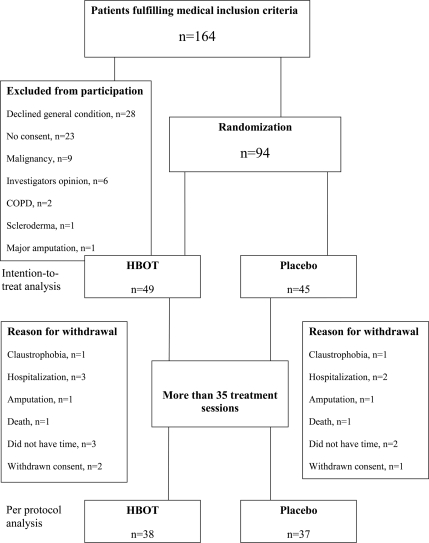
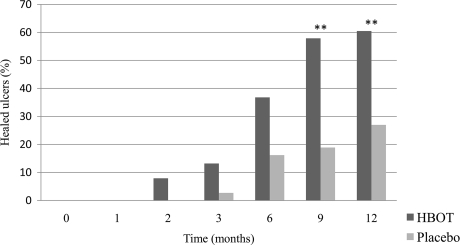
OBJECTIVE: Chronic diabetic foot ulcers are a source of major concern for both patients and health care systems. The aim of this study was to evaluate the effect of hyperbaric oxygen therapy (HBOT) in the management of chronic diabetic foot ulcers. RESEARCH DESIGN AND METHODS: The Hyperbaric Oxygen Therapy in Diabetics with Chronic Foot Ulcers (HODFU) study was a randomized, single-center, double-blinded, placebo-controlled clinical trial. The outcomes for the group receiving HBOT were compared with those of the group receiving treatment with hyperbaric air. Treatments were given in a multi-place hyperbaric chamber for 85-min daily (session duration 95 min), five days a week for eight weeks (40 treatment sessions). The study was performed in an ambulatory setting. RESULTS: Ninety-four patients with Wagner grade 2, 3, or 4 ulcers, which had been present for >3 months, were studied. In the intention-to-treat analysis, complete healing of the index ulcer was achieved in 37 patients at 1-year of follow-up: 25/48 (52%) in the HBOT group and 12/42 (29%) in the placebo group (P = 0.03). In a sub-analysis of those patients completing >35 HBOT sessions, healing of the index ulcer occurred in 23/38 (61%) in the HBOT group and 10/37 (27%) in the placebo group (P = 0.009). The frequency of adverse events was low. CONCLUSIONS: The HODFU study showed that adjunctive treatment with HBOT facilitates healing of chronic foot ulcers in selected patients with diabetes.
Overview
The claims and statistics of this paper haven’t been checked yet.
Run the check — free, no account needed. It reads the open-access text and checks the sources it cites.
Integrity signals
Registry
Cites
Statistics
Figures
Verification
Claims the paper makes
The claims and statistics of this paper haven’t been checked yet.
Run the check — free, no account needed. It reads the open-access text and checks the sources it cites.
Claims other papers make about this one
Each is checked against this paper’s own text: does it say what the citing paper says it does?
The check wasn’t confident either way, so it gives no verdict — never disputed.
In the citing paper
“Dressing selection Based on wound characteristics, ie, location, inflammation, and amount of exudate Promote a moist environment conducive to tissue growth and epithelial migration.63,64”
From Diabetic Foot Ulcers: A Review (2023) · cites this paper as [63]
Experimental — accuracy not yet measured
Self-check
Percentages, sums and reported differences re-computed from the paper’s own numbers.
The self-check needs the paper’s full text.
Citations
Cites
Tonnesen, M. G., Feng, X., & Clark, R. A. F. (2000) · Journal of Investigative Dermatology Symposium Proceedings · doi:10.1046/j.1087-0024.2000.00014.x · Cited by 1,463
The Dysvascular Foot: A System for Diagnosis and Treatment
Wagner, F. W. (1981) · Foot & Ankle · doi:10.1177/107110078100200202 · Cited by 1,109 · cited 3×
“Two of these ulcers were classified as Wagner grade 4 and two were classified as grade 3 ulcers (20).”
BackgroundMethodInfluentialPrompers, L., Huijberts, M., Apelqvist, J., Jude, E., Piaggesi, A., Bakker, K., Edmonds, M., Holstein, P., Jirkovska, A., Mauricio, D., et al. (2007) · Diabetologia · doi:10.1007/s00125-006-0491-1 · Cited by 1,023 · cited 1×
“D iabetic foot ulcers are a common and serious complication of diabetes (1,2).”
BackgroundHyperbaric oxygen therapy for chronic wounds
Kranke, P., Bennett, M. H., James, M. M., Schnabel, A., Debus, S. E., & Weibel, S. (2015) · Cochrane Database of Systematic Reviews · doi:10.1002/14651858.cd004123.pub4 · Cited by 705
The burden of diabetic foot ulcers
Reiber, G., Lipsky, B. A., & Gibbons, G. (1998) · The American Journal of Surgery · doi:10.1016/s0002-9610(98)00181-0 · Cited by 528
Relationship of oxygen dose to angiogenesis induction in irradiated tissue
Marx, R. E., Ehler, W. J., Tayapongsak, P., & Pierce, L. W. (1990) · The American Journal of Surgery · doi:10.1016/s0002-9610(05)81019-0 · Cited by 448
Faglia, E., Favales, F., Aldeghi, A., Calia, P., Quarantiello, A., Oriani, G., Michael, M., Campagnoli, P., & Morabito, A. (1996) · Diabetes Care · doi:10.2337/diacare.19.12.1338 · Cited by 392 · cited 2×
“In contrast to our findings, some studies have shown the beneficial effect of HBOT in preventing amputations (8,21,23).”
BackgroundResultAbidia, A., Laden, G., Kuhan, G., Johnson, B., Wilkinson, A. R., Renwick, P., Masson, E. A., & McCollum, P. T. (2003) · European Journal of Vascular and Endovascular Surgery · doi:10.1053/ejvs.2002.1911 · Cited by 367 · cited 1×
“(17) in 2003 suggested the benefit of HBOT, but the study was small and included only patients with Wagner grade 1 and 2 ulcers.”
BackgroundOyibo, S. O., Jude, E. B., Tarawneh, I., Nguyen, H. C., Armstrong, D. G., Harkless, L. B., & Boulton, A. J. M. (2001) · Diabetic Medicine · doi:10.1046/j.1464-5491.2001.00422.x · Cited by 339
Health-Economic Consequences of Diabetic Foot Lesions
Tennvall, G. R., & Apelqvist, J. (2004) · Clinical Infectious Diseases · doi:10.1086/383275 · Cited by 304 · cited 1×
“Furthermore, loss of mobility poses a great burden on the patient and the health care system (3).”
Background
Cited by
Sorted by citations
Items 201–300 of 437
Fadol, E. M., Suliman, H. M., Osman, B., Abdalla, S. A., Osman, W., Elwasila, E. M. M., & Abdoon, I. H. (2021) · Diabetes & Metabolic Syndrome Clinical Research & Reviews · doi:10.1016/j.dsx.2021.06.010 · Cited by 13
Wibowo, I., Utami, N., Anggraeni, T., Barlian, A., Putra, R. E., Indriani, A. D., Masadah, R., & Ekawardhani, S. (2021) · Zebrafish · doi:10.1089/zeb.2020.1969 · Cited by 14
Elsharnoby, A. M., Elbarbary, A. H., El-Deeb, A. E., & Hassan, H. A. (2022) · The International Journal of Lower Extremity Wounds · doi:10.1177/15347346221100891 · Cited by 13
“13,14 However, still this effect to be proved with respect to chronic VLUs studied alone.”
Pan, C., Xu, P., Zheng, Y., Wang, Y., Chen, C., Fu, S., Liu, Z., Chen, Y., Xue, K., Zhou, Q., et al. (2023) · Frontiers in Bioengineering and Biotechnology · doi:10.3389/fbioe.2023.1129187 · Cited by 15
“, 2012), and physical interventions including hyperbaric oxygen (Löndahl et al., 2010) and negative pressure wound therapies (Masters et al.”
BackgroundHarithpriya, K., Jayasuriya, R., Milan, K. L., Juttada, U., Kumpatla, S., Viswanathan, V., & Ramkumar, K. M. (2024) · Archives of Biochemistry and Biophysics · doi:10.1016/j.abb.2024.110133 · Cited by 12
Idris, O. A., Uridge, A. L., Hollins, S., & Steeg, K. V. (2024) · Oxygen · doi:10.3390/oxygen4040023 · Cited by 12
The role of hyperbaric oxygen therapy in the treatment of diabetic foot ulcers - A literature review
Mackay, K., Thompson, R., Parker, M., Pedersen, J., Kelly, H., Loynd, M., Giffen, E., & Baker, A. B. (2025) · Journal of Diabetes and its Complications · doi:10.1016/j.jdiacomp.2025.108973 · Cited by 14
Hu, X., Meng, H., Liang, J., An, H., Zhou, J., Gao, Y., You, C., Zhang, Z., Gong, X., & Liu, Y. (2025) · PeerJ · doi:10.7717/peerj.19809 · Cited by 16
“…et al., 2003 ; Chen et al., 2017 ; Duzgun et al., 2008 ; Faglia et al., 1996 ; Fedorko et al., 2016 ; Kessler et al., 2003 ; Kumar et al., 2020 ; Londahl et al., 2010 ; Salama et al., 2019 ; Santema et al., 2018 ; Al-Jalodi et al., 2022 ; Driver et al., 2017 ; Frykberg et al., 2020 ; He et al.,…”
Kjellberg, A., Lindholm, M. E., Zheng, X., Liwenborg, L., Rodriguez‐Wallberg, K. A., Catrina, S., & Lindholm, P. (2023) · Antioxidants · doi:10.3390/antiox12122043 · Cited by 11
Cutaneous manifestations of diabetes mellitus: a narrative review
Abate, M. C. M. D. O., Aroucha, P. M. T., da Nóbrega, D. V. M., Rocha, I. P. M., Soares, S. D., Reis, A. A., Paliares, I. C., Giuffrida, F. M. A., Dib, S. A., Reis, A. F., et al. (2025) · Einstein (São Paulo) · doi:10.31744/einstein_journal/2025rw1193 · Cited by 15
“(63,64) Topical oxygen therapy may be considered in patients with treatment failure.”
Hyperbaric Medicine for the Hospital-Based Physician
Weaver, L. K. (2012) · Hospital Practice · doi:10.3810/hp.2012.08.993 · Cited by 11
“009).(47) In addition, those patients treated with HBO 2 had improved long-term health-related quality of life.”
BackgroundAmputation predictors in diabetic foot ulcers treated with hyperbaric oxygen
Kaplan, S. T., Hemşinli, D., Kaplan, S., & Arslan, A. (2017) · Journal of Wound Care · doi:10.12968/jowc.2017.26.7.361 · Cited by 11
Understanding molecular mechanisms and miRNA-based targets in diabetes foot ulcers
Anuradha, U., Mehra, N. K., & Khatri, D. K. (2024) · Molecular Biology Reports · doi:10.1007/s11033-023-09074-0 · Cited by 9
“However, randomized placebo-controlled scientific research showed that advantages up to nine to twelve months after the end of the treatment, raising some concerns about the efficacy of the intervention [35].”
Panayi, A. C., Reitblat, C. R., & Orgill, D. P. (2019) · Springer eBooks · doi:10.1007/978-981-32-9791-3_1 · Cited by 10
RETRACTED: Application of hyperbaric oxygen therapy in diabetic foot ulcers: A meta‐analysis
Chen, H., Lu, S., Wang, Q., Li, M., Chen, X., & Pan, B. (2024) · International Wound Journal · doi:10.1111/iwj.14621 · Cited by 10
“20,48 Londahl's et al. 16 and Sharma's et al. 42 all reported higher rates of complete ulcer healing in patients with DFU receiving HBOT than conventional treatment, consistent with our findings.”
ResultRetractedChronic Wound Healing: A Review of Current Management and Treatments
Jha, K. K., Raj, A., Shreyasi, S., Bishnoi, H., Raj, M., & Thakur, V. (2023) · Asian Journal of Pharmaceutical Research and Development · doi:10.22270/ajprd.v11i3.1262 · Cited by 10
Hyperbaric Oxygen Therapy in Orthopaedics: An Adjunct Therapy with an Emerging Role
Jeyaraman, M., Sami, A., Nallakumarasamy, A., Jeyaraman, N., & Jain, V. K. (2023) · Indian Journal of Orthopaedics · doi:10.1007/s43465-023-00837-2 · Cited by 9
Contemporary Medical Management of Peripheral Arterial Disease
Cook, I. O., & Chung, J. (2023) · Cardiovascular Drugs and Therapy · doi:10.1007/s10557-023-07516-2 · Cited by 11
“Early studies demonstrated promise, with one trial finding that HBOT significantly decreased major amputation rates in diabetic ischemic foot ulcers [98] and two other trials finding that HBOT significantly improved wound healing rates in diabetic foot ulcers [99, 100].”
Clinical Management of Diabetic Ulcers
Thomas, D. R. (2013) · Clinics in Geriatric Medicine · doi:10.1016/j.cger.2013.01.007 · Cited by 9
Hyperbaric oxygen treatment of intractable ulcers in a systemic sclerosis patient
Gerodimos, C., Stefanidou, S., Kotsiou, M., Melekos, T., & Mesimeris, T. (2013) · Aristotle University Medical journal/Aristotle University Medical Journal · Cited by 9
Atypical Wounds; Hyperbaric Oxygen Therapy
Mitnick, C. D. B., & Johnson-Arbor, K. K. (2019) · Clinics in Podiatric Medicine and Surgery · doi:10.1016/j.cpm.2019.02.008 · Cited by 9
RETRACTED: Effect of hyperbaric oxygen treatment on diabetic foot ulcers: A meta‐analysis
Imam, M. S., Almutairi, A. K., Alhajri, A. M., Alharby, M. M., Alanazi, M. H., Alotaibi, A. G., & Abdelrahim, M. E. A. (2023) · International Wound Journal · doi:10.1111/iwj.14427 · Cited by 10
“Studies that were included had documented negative effects, including oxygen toxicity, oxygen-induced seizure, 27 ocular effects, barotraumatic lesions, harm to the ear, 23,24,27,31,33 hypoglycemia 27,31 and cataracts.”
BackgroundRetractedFagher, K., Katzman, P., & Löndahl, M. (2015) · Journal of Diabetes and its Complications · doi:10.1016/j.jdiacomp.2015.07.023 · Cited by 9
“Design and procedures of the randomized, double-blinded, placebo-controlled Hyperbaric Oxygen Treatment in Diabetic Patients with Chronic FootUlcers (HODFU) study evaluating effects ofHBO in patients with chronic diabetic foot ulcers, havebeen reported indetail previously (Londahl et al., 2006; Londahl et al., 2010).”
BackgroundMethodAkgul, E. A., Karakaya, J., & Aydın, S. (2014) · Diabetes Therapy · doi:10.1007/s13300-014-0085-8 · Cited by 9
“Although conclusions are different in these studies, each of them has been focused on different types of wounds and patients [8–12].”
BackgroundCohen, B., Ahuja, S., Schacham, Y. N., Chelnick, D., Mao, G., Esa, W. A. S., Maheshwari, K. K., Sessler, D. I., & Turan, A. (2019) · Anesthesia & Analgesia · doi:10.1213/ane.0000000000004002 · Cited by 9
“Primary analysis: 0–2 h Opioid consumptiona 9 [3, 17] 9 [3, 16] 0 (0.”
Wound healing: the evidence for hyperbaric oxygen therapy
Mills, B. J. (2012) · British Journal of Nursing · doi:10.12968/bjon.2012.21.sup14.s28 · Cited by 9
Tao, L., & Yuan, X. (2023) · International Wound Journal · doi:10.1111/iwj.14507 · Cited by 12
RetractedBerner, J. E., Vidal, P., Will, P. A., & Castillo, P. (2014) · Revista médica de Chile · doi:10.4067/s0034-98872014001200011 · Cited by 8
Wound Healing Devices Brief Vignettes
Anderson, C. A., Hare, M. A., & Perdrizet, G. A. (2015) · Advances in Wound Care · doi:10.1089/wound.2015.0651 · Cited by 8
“Several RCTs report favorable effects on DFU healing.(9,10) Centers for Medicaid and Medicare Services (CMS) cover HBOT for DFUs that have failed 30 days of standard wound care and show evidence of deep soft-tissue infection, osteomyelitis, or gangrene (Wagner Grades 3,4,5) (Level/Class: A/I).”
BackgroundWadee, A. N., Fahmy, S. M., & El-Deen, H. A. B. (2021) · Physical Therapy Reviews · doi:10.1080/10833196.2021.1876380 · Cited by 8
Szabad, G. (2011) · Orvosi Hetilap · doi:10.1556/oh.2011.29168 · Cited by 8
Rümenapf, G., & Morbach, S. (2014) · The International Journal of Lower Extremity Wounds · doi:10.1177/1534734614554283 · Cited by 8
“Hyperbaric oxygen therapy (HBOT) has been shown to facilitate healing of chronic foot ulcers in selected patients with diabetes in a recent study from Sweden.(54) However, when study patients were stratified according to the severity of their PAD, there was no healing in patients with a TcPO 2 below 25 mm Hg (TcPO 2 /…”
BackgroundEthical Issues, Standards, and Quality Control in the Practice of Hyperbaric Medicine
Fife, C. E., Eckert, K. A., & Workman, W. T. (2016) · Springer eBooks · doi:10.1007/978-3-319-47140-2_48 · Cited by 8
A diabetic foot ulcer treated with hydrogel and hyperbaric oxygen therapy: a case study
de Aguiar, P. H. P., Amaral, C., Rodrigues, A., & de Souza, A. H. (2017) · Journal of Wound Care · doi:10.12968/jowc.2017.26.11.692 · Cited by 8
Management of diabetic foot disease
Vas, P. R. J., & Kavarthapu, V. (2022) · Elsevier eBooks · doi:10.1016/b978-0-12-820669-0.00004-9 · Cited by 9
Löndahl, M., Fagher, K., & Katzman, P. (2016) · Diabetes Care · doi:10.2337/dc16-0105 · Cited by 8
Huang, E. T. (2016) · Diabetes Care · doi:10.2337/dc16-0196 · Cited by 8
“A further example of confirmation bias is the willingness of the authors to categorically dismiss the results of two other randomized controlled trials (4,5) for not having inert placebo groups (i.”
ResultPractical guidelines for the prevention and management of diabetic foot disease in China
Luo, G., Liu, Y., & Wang, A. (2025) · Burns & Trauma · doi:10.1093/burnst/tkaf064 · Cited by 12
“Several study conclusions exhibit contradictions, with one study being prematurely terminated because of baseline imbalance [222, 226–231].”
Stem Cells and Regenerative Strategies for Wound Healing: Therapeutic and Clinical Implications
Garg, A., Garg, S., Adlak, P., Kori, M. L., & Lodhi, S. (2024) · Current Pharmacology Reports · doi:10.1007/s40495-024-00352-4 · Cited by 10
Amputations in patients with diabetes
Hinchliffe, R. J. (2011) · British journal of surgery · doi:10.1002/bjs.7674 · Cited by 7
van der Staal, S. R., Ubbink, D. T., & Lubbers, M. J. (2011) · Diabetes Care · doi:10.2337/dc11-0019 · Cited by 7
“(2) is the limited availability and the issue of cost-effectiveness to convince policy makers to facilitate hyperbaric oxygen centers.”
Praxisbeispiele zu klinischen Studien mit Medizinprodukten und deren Anwendung: Wundversorgung
Augustin, M. (2012) · Zeitschrift für Evidenz Fortbildung und Qualität im Gesundheitswesen · doi:10.1016/j.zefq.2012.05.015 · Cited by 6
Demirtas, A., Azboy, İ., Bulut, M., Uçar, B. Y., Alabalık, U., & İlgezdi, S. (2012) · Journal of Hand Surgery (European Volume) · doi:10.1177/1753193412469130 · Cited by 6
“Löndahl et al. (2010) demonstrated that HBO therapy facilitated healing of chronic foot ulcers in patients with diabetes.”
BackgroundEvidence for the Use of Biological Therapies in Ulcers of the Foot in Diabetes
Jeffcoate, W. J., & Game, F. L. (2013) · BioDrugs · doi:10.1007/s40259-013-0052-3 · Cited by 6
Computerized planimetry evaluation of hyperbaric oxygen therapy in the treatment of diabetic foot
Kawecki, M., Pasek, J., Cieślar, G., Sieroń, A., Knefel, G., Nowak, M., & Glik, J. (2018) · Advances in Clinical and Experimental Medicine · doi:10.17219/acem/66392 · Cited by 6
“12,13 Our findings are in agreement with some studies which have shown the beneficial effect of HBOT in preventing amputations.”
Hyperbaric oxygen for treatment of diabetic foot ulcers: love you more than I can say
Wu, Q. (2018) · Annals of Translational Medicine · doi:10.21037/atm.2018.04.33 · Cited by 6
“The research also suggested that the percutaneous oxygen pressure (tcPO 2 ) was a good indicator of the healing of the ulcer, not a toe or the ankle brachial index (ABI) (4,5).”
Mankuzhy, P. D., Ramesh, S. T., Thirupathi, Y., Mohandas, P. S., Chandra, V., & Sharma, T. G. (2021) · Wound Repair and Regeneration · doi:10.1111/wrr.12911 · Cited by 6
“In recent years, innovative treatment strategies have been developed such as application of skin grafting,(102,103) exogenous supplementation of growth factors and cytokines,(104) and hyperbaric oxygen (HBO2) therapy.(105) Among them, the benchmark treatment strategy for wound therapy presently followed in hospitals i…”
BackgroundVeyseller, B., Doğan, R., Yenigün, A., Aksoy, F., Tuğrul, S., Dogan, E. E., & Özturan, O. (2016) · Rhinology Journal · doi:10.4193/rhin15.314 · Cited by 6
“for the medical treatment of diabetic neuropathies (9).”
BackgroundSmith, R. G. (2011) · PubMed · Cited by 6
Australian Diabetes Foot Network: management of diabetes‐related foot ulceration — a clinical update
Hawkins, G. C., Bennett, M. H., & Smart, D. R. (2013) · The Medical Journal of Australia · doi:10.5694/mja12.11486 · Cited by 6
Sato, Y., Urasawa, K., Morishita, T., Tan, M., Hayakawa, N., Tokuda, T., Nakano, A., Miyazawa, T., Shimooka, Y., Minegishi, Y., et al. (2021) · Circulation Reports · doi:10.1253/circrep.cr-21-0097 · Cited by 5
“Another previous RCT showed that a higher completion rate of the HBOT regimen resulted in a better wound healing rate; 9 however, approximately 35% of participants were not able to complete the HBOT regimen in the ischemic diabetic ulcer RCT of Santema et al. 7 Therefore, the HOTFOOT study will…”
Number Eight in the Service of Diabetic Foot Ulcer Healing
Löndahl, M. (2020) · Diabetes Care · doi:10.2337/dci19-0052 · Cited by 5
“participants had a history of previous vascular disease, and 29% had an arterial toe blood pressure#35mmHg (9).”
BackgroundOxygen Therapy in Wound Healing
Barysch, M. J., & Läuchli, S. (2020) · Updates in clinical dermatology · doi:10.1007/978-3-030-28872-3_12 · Cited by 5
Laulund, A. S., Schwartz, F. A., Høiby, N., Thomsen, K., & Moser, C. E. (2023) · Biofilm · doi:10.1016/j.bioflm.2023.100159 · Cited by 7
Hyperbaric Oxygen Therapy and Utilization in Infectious Disease
Bennett, M., Kaide, C. G., Matheson, E., & Bari, V. (2018) · Current Emergency and Hospital Medicine Reports · doi:10.1007/s40138-018-0166-5 · Cited by 5
Löndahl, M., & Katzman, P. (2013) · International Wound Journal · doi:10.1111/iwj.12093 · Cited by 5
“Therefore, a follow-up period of 16 weeks might be too short to identify the full effect of HBO as indicated by our own findings at 16 weeks (in the randomised placebo-controlled double-blind HODFU-study) showing an ulcer healing rate of less than 15% in the HBO group (3).”
ResultMargolis, D. J., Gupta, J., Hoffstad, O., Papdopoulos, M., Thom, S. R., & Mitra, N. (2013) · Diabetes Care · doi:10.2337/dc13-0904 · Cited by 5
“is correct, then it is vitally important for users of HBOT to carefully consider how they use HBOT and how they manage those that receive it (4,9).”
The Interface Effect of Electrospun Fiber Promotes Wound Healing
Wang, Z., Gao, C., Yang, R., & Xiong, F. (2025) · Macromolecular Rapid Communications · doi:10.1002/marc.202500038 · Cited by 5
Peng, S., Zeng, L., Lu, B., & Li, Q. (2025) · Medical Gas Research · doi:10.4103/mgr.medgasres-d-24-00111 · Cited by 4
Martins‐Mendes, D., Costa, R., Rodrigues, I., Camacho, O. E., Barata, P., Paixão-Dias, V. M., Luís, C., Pereira, A. C., Fernandes, R., Lima, J. P., et al. (2025) · Cells · doi:10.3390/cells14151196 · Cited by 4
“Our sample population presented mean values for age, gender distribution, DM duration, and HbA1c that were comparable to those reported in RCTs [29–37] and non-randomized trials (NRTs) [38,39].”
Isei, T., Abe, M., Ikegami, R., Kato, H., Sakurai, E., Tanizaki, H., Nakanishi, T., Matsuo, K., Yamasaki, O., Asai, J., et al. (2025) · Journal of dermatology (Print) · doi:10.1111/1346-8138.17697 · Cited by 4
Diabetic Lower Extremity Ulcers and Hyperbaric Oxygen Therapy
Bishop, A. J. (2015) · Journal of Endocrinology and Diabetes · doi:10.15226/2374-6890/2/5/00133 · Cited by 4
“[31] each compared patients receiving HBO to those undergoing a sham treatment.”
BackgroundMethodHou, Z., Li, J., Du, J., Xu, C., Wang, X., & Tang, R. (2022) · Particle & Particle Systems Characterization · doi:10.1002/ppsc.202200050 · Cited by 4
Kadanalı, A., Saltoğlu, N., Ak, Ö., Aktaş, Ş., Altay, F. A., Bayraktaroğlu, T., Bek, N., Bingöl, U. A., Kucuk, B. B., Çayırlı-Güner, M., et al. (2024) · Klimik Dergisi/Klimik Journal · doi:10.36519/kd.2024.4822 · Cited by 4
Van, G. H., Amouyal, C., Perrier, A., Haddad, J., Bensimon, Y., Bourron, O., & Hartemann, A. (2019) · EMC - Podología · doi:10.1016/s1762-827x(18)41662-8 · Cited by 4
Munjewar, C., Nabi, I., Gautam, S., Ahirwar, N., Chaudhary, P., Kumar, R., Arora, M. P., & Ramteke, V. K. (2016) · Hellenic Journal of Surgery · doi:10.1007/s13126-016-0321-y · Cited by 4
“The majority of studies [16,18] have demonstrated an inverse correlation between HbA1C levels and the rate of healing in diabetic wounds.”
BackgroundResultFedorko, L., Bowen, J. M., Jones, W. G., Oreopoulos, G. D., Goeree, R. A., Hopkins, R. B., & O’Reilly, D. J. (2016) · Diabetes Care · doi:10.2337/dci16-0006 · Cited by 4
“shorter follow-up times between our and their (Swedish) study (6).”
BackgroundMethodInfluentialComparative efficacy of gas therapy for diabetic foot ulcers using network meta-analysis
Yang, J. F., Ning, P., Huang, J., Ouyang, H., Zhang, J., Yang, F., Cao, H., & Zhang, F. (2025) · PeerJ · doi:10.7717/peerj.19571 · Cited by 3
“In addition, some patients experienced dizziness ( Löndahl et al., 2010 ), pneumatic traumatic tympanic membrane perforation ( Santema et al., 2018 ), pneumatic traumatic otitis media ( Faglia et al., 1996 ; Löndahl et al., 2010 ), and oxygen-induced seizures ( Santema et al., 2018 ).”
Ma, H., Cao, Y., Gao, Z., Xu, Z., Yang, B., Luo, P., Hu, Y., & He, Q. (2025) · Stem Cell Reviews and Reports · doi:10.1007/s12015-025-10929-1 · Cited by 3
Gas-based therapies in chronic wounds: A scoping review of preclinical and clinical data
Kasha, S., Hanning, S. M., Mugisho, O. O., & Thakur, S. S. (2025) · European Journal of Pharmaceutics and Biopharmaceutics · doi:10.1016/j.ejpb.2025.114894 · Cited by 3
Republication of “The Evaluation and Treatment of Diabetic Foot Ulcers and Diabetic Foot Infections”
Core, M. A. D., Ahn, J., Lewis, R. B., Raspovic, K. M., Lalli, T. A. J., & Wukich, D. K. (2023) · Foot & Ankle Orthopaedics · doi:10.1177/24730114231193418 · Cited by 3
Nanotechnology-enabled approaches for combating diabetic foot ulcer
Chary, P. S., Anuradha, U., Shaikh, S., Yadav, R., Bhavana, V., Rajana, N., & Mehra, N. K. (2024) · Journal of Drug Delivery Science and Technology · doi:10.1016/j.jddst.2024.106593 · Cited by 3
Hyperbaric oxygenation in prevention of amputations of diabetic foot
Stefanovic, Z., Donfrid, B., Jovanović, T., Zoran, Z., Radojevic-Popovic, R., & Zoranović, U. (2018) · Vojnosanitetski pregled · doi:10.2298/vsp180220081s · Cited by 3
“7 prostaglandin gamma interferons (IFNG), interleukin-1 and interleukin-2 [9].”
BackgroundMatić, P., Cejic, D., Tanasković, S., Unic-Stojanovic, D. R., Nenezić, D., & Radak, D. J. (2019) · International Journal of Diabetes in Developing Countries · doi:10.1007/s13410-019-00737-y · Cited by 3
Wounds an overlooked burden (Part 3) - Chronic wounds : a conundrum of complications
Parkar, H., Mlambo, S., Naudé, L., Strydom, H., Nakidien, N., & Cromarty, D. (2021) · South African General Practitioner · doi:10.36303/sagp.2021.2.2.0068 · Cited by 3
Lalieu, R. C., Mulder, W., Raap, R. D. B., Stolk, S., Smit, C., Dubois, E. F., & van Hulst, R. A. (2021) · Journal of Wound Care · doi:10.12968/jowc.2021.30.9.722 · Cited by 3
Educational Interventions and Its Impact on the Treatment Outcomes of Diabetic Foot Ulcer Patients
Raju, B. N., Mateti, U. V., Mohan, R., Shastry, C. S., Joel, J. J., D’Souza, N., & Mariam, A. (2022) · Journal of Diabetology · doi:10.4103/jod.jod_99_21 · Cited by 3
Apolo-Arenas, M. D., Guerrero-Nogales, L., Díaz‐Muñoz, C. L., Puértolas, B. C., Parraça, J. A., & Caña-Pino, A. (2024) · International Journal of Vascular Medicine · doi:10.1155/ijvm/8450783 · Cited by 3
Soft Tissue Reconstructive Options for the Ulcerated or Gangrenous Diabetic Foot
Iorio, M. L., Evans, K. K., & Attinger, C. E. (2018) · Contemporary diabetes · doi:10.1007/978-3-319-89869-8_21 · Cited by 3
Relevance of Osteomyelitis to Clinical Practice
Garwood, C. S., & Kim, P. J. (2015) · Springer eBooks · doi:10.1007/978-3-319-18926-0_1 · Cited by 3
Extracorporeal Shock Wave Therapy in the Treatment of Non-Healing Diabetic Ulcer: A Pilot Study
Variji, Z. (2015) · Journal of Clinical & Experimental Dermatology Research · doi:10.4172/2155-9554.10000289 · Cited by 3
“Some novel therapeutic modalities have been used to enhance wound healing including growth factors, tissue-cultured skin substitutes, hyperbaric oxygen, and extracorporeal shock wave therapy (ESWT) [7,8].”
BackgroundPrimum Non Nocere and the 5 Rights
Popp, G., Clarke, D., & Rothstein, S. (2017) · Advances in Skin & Wound Care · doi:10.1097/01.asw.0000524607.90328.1b · Cited by 3
A case report: Treatment of chronic diabetic foot ulcer with Hyperbaric Oxygen Therapy
Jeffrey, C. C., & Joe, K. L. (2021) · Journal of Orthopaedics Trauma and Rehabilitation · doi:10.1177/22104917211012709 · Cited by 3
“In 2010, Londahl performed a randomised double-blind shamcontrolled trial in which he showed the one-year healing rate based on intention-to-treat analysis was significantly higher in the HBOT group (52% vs 29%) and was even higher when using per-protocol analysis for patients that received more than 35 treatments (61…”
Kruse, D. L., Morgan, K., Christensen, J., Derner, B. S., & Sachs, B. D. (2021) · Journal of the American Podiatric Medical Association · doi:10.7547/20-259 · Cited by 3
Mathew‐Steiner, S. S., Khona, D. K., & Sen, C. K. (2020) · Elsevier eBooks · doi:10.1016/b978-0-12-816413-6.00001-0 · Cited by 3
Evidence-based management of diabetic foot problems
Boulton, A. J. M., & Viswanathan, V. (2025) · Diabetes Research and Clinical Practice · doi:10.1016/j.diabres.2025.112932 · Cited by 3
Mihalache, O., Simion, L., Doran, H., Bîrligea, A., Luca, D. C., Chitoran, E., BOBIRCA, F. T., Mustăţea, P., & Pătraşcu, T. (2025) · Journal of Clinical Medicine · doi:10.3390/jcm14207193 · Cited by 3
Zheng, X., Li, T., Wang, J. R., & Gao, L. (2026) · Journal of Clinical Medicine · doi:10.3390/jcm15072783 · Cited by 2
Schreib, C. C., Kelley, E. L., Audia, G., Garg, R., Johnson, S. A., Fleury, S., Behun, M. N., Vohidova, D., Kulkarni, M. M., Donnell, G. M., et al. (2026) · Nature Biomedical Engineering · doi:10.1038/s41551-026-01687-7 · Cited by 2
Regenerative Medicine of Epidermal Structures
Stocum, D. L. (2012) · Elsevier eBooks · doi:10.1016/b978-0-12-384860-4.00010-1 · Cited by 2
Van, G. H., Hartemann, A., Gautier, F., Haddad, J., Bensimon, Y., Ponseau, W., Baillot, J., Fourniols, E., Koskas, F., & Grimaldi, A. (2011) · EMC - Endocrinologie - Nutrition · doi:10.1016/s1155-1941(11)51218-1 · Cited by 2
Heyboer, M., Kozminski, A. G., Pacelli, L., & Wojcik, S. M. (2022) · Wound Repair and Regeneration · doi:10.1111/wrr.13052 · Cited by 2
“In general, we find more sessions completed means better healing, however, a range of sessions has been used in practice.(4,9,22) Being able to tailor treatment based on measurable criteria throughout a patient's course would make”
BackgroundHyperbaric Oxygen Therapy in the Treatment of Necrosis and Gangrene
Alexander, A. (2011) · InTech eBooks · doi:10.5772/22160 · Cited by 2
Update zum diabetischen Fußsyndrom
Tanudjaja, T., & Spraul, M. (2015) · Der Diabetologe · doi:10.1007/s11428-015-1342-9 · Cited by 2
Nouvelles avancées dans les infections des plaies du pied chez le patient diabétique
Lavigne, J., Richard, J.-L., & Sotto, A. (2011) · Revue Francophone des Laboratoires · doi:10.1016/s1773-035x(11)71055-3 · Cited by 2
Daily Application of Transdermal Fentanyl Patches in Patients Receiving Hyperbaric Oxygen Therapy
Pawasauskas, J. E., & Perdrizet, G. A. (2014) · Journal of Pain & Palliative Care Pharmacotherapy · doi:10.3109/15360288.2014.938885 · Cited by 2
Soft Tissue Reconstructive Options for the Ulcerated or Gangrenous Diabetic Foot
Attinger, C. E., & Clemens, M. W. (2012) · Humana Press eBooks · doi:10.1007/978-1-61779-791-0_21 · Cited by 2
Clerici, G., & Faglia, E. (2016) · Springer eBooks · doi:10.1007/978-81-322-2635-2_12 · Cited by 2
Caring for Patients With Chronic Wounds: Safety Considerations During the Surgical Experience
Criscitelli, T. M. (2016) · AORN Journal · doi:10.1016/j.aorn.2016.05.002 · Cited by 2
Metadata
- Authors
- Löndahl, M., Katzman, P., Nilsson, A., & Hammarlund, C.
- Affiliations
- Lund University (SE)
- Department of Internal Medicine, Ängelholm Hospital, Ängelholm, Sweden;
- Helsingborgs lasarett (SE)
- Corresponding author
- Löndahl, Magnus
- ORCID
- Löndahl, Magnus
- Venue
- Diabetes Care
- Publisher
- American Diabetes Association
- Published
- 2010-05-01
- Volume
- 33
- Issue
- 5
- Pages
- 998-1003
- ISSN
- 0149-5992 (ISSN-L)
- 1935-5548
- PMC
- PMC2858204
- OpenAlex
- W2143723758
- Cited by
- 441
- References
- 28
- Citations by year
- 2026: 22 · 2025: 28 · 2024: 25 · 2023: 20 · 2022: 16 · 2021: 31 · 2020: 33 · 2019: 25 · 2018: 31 · 2017: 26 · 2016: 26 · 2015: 28 · 2014: 22 · 2013: 45 · 2012: 29
- FWCI
- 25.69
- Type
- journal article
- Language
- en
- Open access
- hybrid
- doi.org
- Licence
- Locations
- Diabetes Care (publishedVersion, cc-by-nc-nd)
- Europe PMC (PubMed Central) (publishedVersion, cc-by-nc-nd)
- PubMed Central (publishedVersion, cc-by-nc-nd)
- PubMed (publishedVersion)
- Lund University Publications (Lund University) (submittedVersion)
- Topics
- Health Sciences › Medicine › Endocrinology, Diabetes and Metabolism › Diabetic Foot Ulcer Assessment and Management
- Health Sciences › Medicine › Surgery › Wound Healing and Treatments
- Health Sciences › Medicine › Dermatology › Skin Diseases and Diabetes
- Keywords
- hyperbaric oxygen therapy, chronic diabetic foot ulcers, wound healing, hyperbaric air, Wagner grade, adjunctive therapy, diabetes mellitus, adverse events
- MeSH terms
- Adult, Aged, Aged, 80 and over, Air, Amputation, Surgical, Chronic Disease, Female, Follow-Up Studies, Humans, Hyperbaric Oxygenation, Male, Middle Aged, Placebos, Wound Healing, Treatment Outcome, Diabetic Foot
About these checks
Registry, retraction, Cites and statistics results are computed, not judged, with one exception: a printed reference that no index lists is read once by a model before it counts as a citation error. Claims are extracted by a model and kept only when their quote appears verbatim in the text; each cited source is then checked, with a model’s help, for whether it says what the claim relies on. Those verdicts can be wrong — read the claim’s quote and the cited source before relying on one.
Statistics and arithmetic are recomputed, not judged.
Confidence bands are shown only for fields calibrated on our annotated test set. None is calibrated yet, so no band is shown.
What counts as a claim ›How we measure confidence ›How we check this ›
Are you an author, or do you see a problem with this page? Request a review
