

The DOI matches its Crossref record; 24 of the 24 references it cites were found in a registry or an index; none of the 15 sources its claims cite is checked for support yet.
Long-Term Safety, Tolerability, and Weight Loss Associated With Metformin in the Diabetes Prevention Program Outcomes Study
Open accessAbstract
OBJECTIVE: Metformin produced weight loss and delayed or prevented diabetes in the Diabetes Prevention Program (DPP). We examined its long-term safety and tolerability along with weight loss, and change in waist circumference during the DPP and its long-term follow-up. RESEARCH DESIGN AND METHODS: The randomized double-blind clinical trial of metformin or placebo followed by a 7–8-year open-label extension and analysis of adverse events, tolerability, and the effect of adherence on change in weight and waist circumference. RESULTS: No significant safety issues were identified. Gastrointestinal symptoms were more common in metformin than placebo participants and declined over time. During the DPP, average hemoglobin and hematocrit levels were slightly lower in the metformin group than in the placebo group. Decreases in hemoglobin and hematocrit in the metformin group occurred during the first year following randomization, with no further changes observed over time. During the DPP, metformin participants had reduced body weight and waist circumference compared with placebo (weight by 2.06 ± 5.65% vs. 0.02 ± 5.52%, P < 0.001, and waist circumference by 2.13 ± 7.06 cm vs. 0.79 ± 6.54 cm, P < 0.001 in metformin vs. placebo, respectively). The magnitude of weight loss during the 2-year double-blind period was directly related to adherence (P < 0.001). Throughout the unblinded follow-up, weight loss remained significantly greater in the metformin group than in the placebo group (2.0 vs. 0.2%, P < 0.001), and this was related to the degree of continuing metformin adherence (P < 0.001). CONCLUSIONS: Metformin used for diabetes prevention is safe and well tolerated. Weight loss is related to adherence to metformin and is durable for at least 10 years of treatment.
Overview
AI snapshot
Written from the paper’s full text.
TL;DR
In the Diabetes Prevention Program and its Outcomes Study, metformin for diabetes prevention showed no significant safety issues, was well tolerated, and produced modest durable weight loss. Weight loss was directly related to metformin adherence and persisted over long-term follow-up.
Key findings
- During the DPP, metformin vs placebo reduced body weight (2.06 ± 5.65% vs. 0.02 ± 5.52%, P < 0.001) and waist circumference (2.13 ± 7.06 cm vs. 0.79 ± 6.54 cm, P < 0.001); at 2 years, weight loss was 2.1 ± 5.7% vs. 0.02 ± 5.5%.
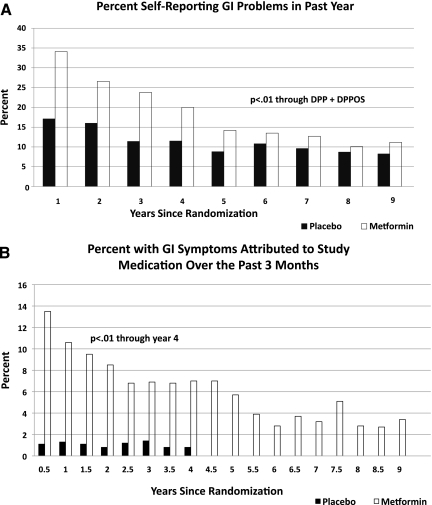
- Gastrointestinal symptoms were more common with metformin than placebo (average 28% vs. 16%, P = 0.01; medication-related 9.5% vs. 1.1%, P < 0.001) and declined over time, with similar rates by years 6–9 (P > 0.10).
- Hemoglobin and hematocrit were slightly lower in the metformin group during the DPP (13.6 vs. 13.8 mg/dL; 40.6 vs. 41.1%; P < 0.001 for both), with changes occurring in the first year and no further changes; low hematocrit was higher with metformin (12.6% vs. 8.4%, P = 0.035), while low hemoglobin was not significantly different (11.2% vs. 7.6%, P = 0.17).
- Over total follow-up, weight loss remained greater with metformin than placebo (2.0% vs. 0.2%, P < 0.001) and was related to continuing metformin adherence (P < 0.001); highly adherent metformin participants lost 3.5% (3.1 kg). No lactic acidosis or hypoglycemia serious adverse events occurred during nearly 18,000 patient-years.
Methods
- Randomized double-blind trial: 3,234 participants enrolled in the DPP; 2,155 assigned to metformin (1,073) or placebo (1,082), followed by a 7–8-year open-label DPPOS extension. Participants were ≥25 years, had BMI ≥24 kg/m² (≥22 kg/m² in Asian Americans), elevated fasting glucose, and impaired glucose tolerance.
- Adverse events were collected by quarterly queries during the DPP and annual gastrointestinal symptom questions; weight was measured twice yearly, waist circumference annually, and hemoglobin/hematocrit annually. Adherence was assessed by pill counts as ≥80% or <80%.
- Analyses covered the first 2 years of double-blind treatment and the full follow-up period; fixed-effects repeated-measures models adjusted for baseline weight and waist circumference, and generalized estimating equations assessed symptoms and adverse events over time.
Limitations
- Stated: 12% of DPP participants chose not to continue into the DPPOS; some may have discontinued or declined open-label metformin because of side effects, potentially influencing the safety and tolerability profile during the open-label DPPOS period.
- Stated/implied: the adherence–weight analyses were post hoc, adherence was not randomized, and placebo was discontinued during the open-label phase so adherence could not be assigned for placebo.
- Evident: the open-label DPPOS phase was unblinded, and adherence categories may be confounded by tolerability, health behaviors, or reasons for low adherence; the paper notes that low-adherence metformin and placebo groups would not be expected to have the same characteristics.
Model-written summary. Check it against the paper before relying on it.
Integrity signals
Registry
Cites
Statistics
Figures
Verification
Claims the paper makes
35 Own result · 9 Not checked yet · 8 Own interpretation · 3 No basis given · 1 Own method
A result the paper reports from its own data — it cites no other source for it, so there is none to check. The quote shows it is in the paper.
In the paper
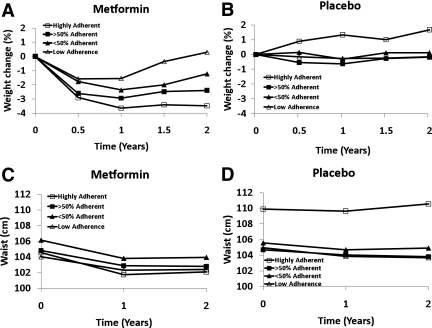
“The associations of adherence to medication with changes in waist circumference were not statistically significant for either the metformin or placebo groups. (Fig. 1C and D).”
§ Long-Term Safety, Tolerability, and Weight Loss Associated With Metformin in the Diabetes Prevention Program Outcomes Study > RESULTS > DPP—results from the double-blind phase
plain- Asserted: passes — The authors put it forward as true.
- Checkable: passes — It can be checked against evidence.
- Load-bearing: unclear — It is unclear whether the paper’s conclusions depend on it.
- Based: passes — The paper gives a reason why it holds.
A result the paper reports from its own data — it cites no other source for it, so there is none to check. The quote shows it is in the paper.
In the paper
“The percentage losing ≥10% of their body weight at 1 year was 8% for the metformin versus 4% for the placebo group and at 2 years was 10% for the metformin and 5% for the placebo group (P < 0.001 for both time periods).”
§ Long-Term Safety, Tolerability, and Weight Loss Associated With Metformin in the Diabetes Prevention Program Outcomes Study > RESULTS > DPP—results from the double-blind phase
plaincorrelational- Asserted: passes — The authors put it forward as true.
- Checkable: passes — It can be checked against evidence.
- Load-bearing: passes — The paper’s conclusions depend on it.
- Based: passes — The paper gives a reason why it holds.
A result the paper reports from its own data — it cites no other source for it, so there is none to check. The quote shows it is in the paper.
In the paper
“Rates of gastrointestinal symptoms were similar between groups by years 6 through 9 (P > 0.10).”
§ Long-Term Safety, Tolerability, and Weight Loss Associated With Metformin in the Diabetes Prevention Program Outcomes Study > RESULTS > Safety and tolerability
plain- Asserted: passes — The authors put it forward as true.
- Checkable: passes — It can be checked against evidence.
- Load-bearing: passes — The paper’s conclusions depend on it.
- Based: passes — The paper gives a reason why it holds.
A result the paper reports from its own data — it cites no other source for it, so there is none to check. The quote shows it is in the paper.
In the paper
“Over the total follow-up, average weight loss from baseline in the metformin treatment group, independent of adherence, was 2.0% (1.9 kg).”
§ Long-Term Safety, Tolerability, and Weight Loss Associated With Metformin in the Diabetes Prevention Program Outcomes Study > RESULTS > Results including DPPOS—open-label treatment
plain- Asserted: passes — The authors put it forward as true.
- Checkable: passes — It can be checked against evidence.
- Load-bearing: passes — The paper’s conclusions depend on it.
- Based: passes — The paper gives a reason why it holds.
A result the paper reports from its own data — it cites no other source for it, so there is none to check. The quote shows it is in the paper.
In the paper
“During the DPP, metformin participants had reduced body weight and waist circumference compared with placebo (weight by 2.06 ± 5.65% vs. 0.02 ± 5.52%, P < 0.001, and waist circumference by 2.13 ± 7.06 cm vs. 0.79 ± 6.54 cm, P < 0.001 in metformin vs. placebo, respectively).”
- Also stated in: § DPP—results from the double-blind phase · plain
“After 2 years, weight loss was 2.1 ± 5.7% in the metformin group compared with 0.02 ± 5.5% (P < 0.001) in the placebo group.”
§ Long-Term Safety, Tolerability, and Weight Loss Associated With Metformin in the Diabetes Prevention Program Outcomes Study > Abstract
plaincorrelational- Asserted: passes — The authors put it forward as true.
- Checkable: passes — It can be checked against evidence.
- Load-bearing: passes — The paper’s conclusions depend on it.
- Based: passes — The paper gives a reason why it holds.
- Also stated in: § DPP—results from the double-blind phase · plain
A result the paper reports from its own data — it cites no other source for it, so there is none to check. The quote shows it is in the paper.
In the paper
“Gastrointestinal symptoms were more common in metformin than placebo participants and declined over time.”
- Also stated in: § Safety and tolerability · plain
“Both types of gastrointestinal symptom reports declined throughout the DPP.”
§ Long-Term Safety, Tolerability, and Weight Loss Associated With Metformin in the Diabetes Prevention Program Outcomes Study > Abstract
plain- Asserted: passes — The authors put it forward as true.
- Checkable: passes — It can be checked against evidence.
- Load-bearing: unclear — It is unclear whether the paper’s conclusions depend on it.
- Based: passes — The paper gives a reason why it holds.
- Also stated in: § Safety and tolerability · plain
A result the paper reports from its own data — it cites no other source for it, so there is none to check. The quote shows it is in the paper.
In the paper
“During the DPP, metformin participants had reduced body weight and waist circumference compared with placebo (weight by 2.06 ± 5.65% vs. 0.02 ± 5.52%, P < 0.001, and waist circumference by 2.13 ± 7.06 cm vs. 0.79 ± 6.54 cm, P < 0.001 in metformin vs. placebo, respectively).”
- Also stated in: § DPP—results from the double-blind phase · plain
“Waist circumference was reduced at year 1 in the metformin group by 2.2 ± 6.2 cm vs. 0.71 ± 5.6 cm in the placebo group (P < 0.001) and at 2 years by 2.1 ± 7.1 cm in the metformin group vs. 0.79 ± 6.5 cm in the placebo group (P < 0.001 for both time periods).”
§ Long-Term Safety, Tolerability, and Weight Loss Associated With Metformin in the Diabetes Prevention Program Outcomes Study > Abstract
plaindirect- Asserted: passes — The authors put it forward as true.
- Checkable: passes — It can be checked against evidence.
- Load-bearing: unclear — It is unclear whether the paper’s conclusions depend on it.
- Based: passes — The paper gives a reason why it holds.
- Also stated in: § DPP—results from the double-blind phase · plain
A result the paper reports from its own data — it cites no other source for it, so there is none to check. The quote shows it is in the paper.
In the paper
“The percentage losing ≥10% of their body weight at 1 year was 8% for the metformin versus 4% for the placebo group and at 2 years was 10% for the metformin and 5% for the placebo group (P < 0.001 for both time periods).”
§ Long-Term Safety, Tolerability, and Weight Loss Associated With Metformin in the Diabetes Prevention Program Outcomes Study > RESULTS > DPP—results from the double-blind phase
plaincorrelational- Asserted: passes — The authors put it forward as true.
- Checkable: passes — It can be checked against evidence.
- Load-bearing: passes — The paper’s conclusions depend on it.
- Based: passes — The paper gives a reason why it holds.
A result the paper reports from its own data — it cites no other source for it, so there is none to check. The quote shows it is in the paper.
In the paper
“At year 1, 29% in the metformin group had lost ≥5% of their initial body weight, compared with 13% of the placebo group, and at 2 years, 26% of the metformin and 14% of the placebo group had lost ≥5% of baseline body weight (P < 0.001 for both time periods).”
§ Long-Term Safety, Tolerability, and Weight Loss Associated With Metformin in the Diabetes Prevention Program Outcomes Study > RESULTS > DPP—results from the double-blind phase
plaincorrelational- Asserted: passes — The authors put it forward as true.
- Checkable: passes — It can be checked against evidence.
- Load-bearing: passes — The paper’s conclusions depend on it.
- Based: passes — The paper gives a reason why it holds.
A result the paper reports from its own data — it cites no other source for it, so there is none to check. The quote shows it is in the paper.
In the paper
“During the total follow-up period, 62% of the metformin participants were in the ≥50% or highly adherent categories compared with 72% in the 2-year double-blind phase (Table 1).”
§ Long-Term Safety, Tolerability, and Weight Loss Associated With Metformin in the Diabetes Prevention Program Outcomes Study > RESULTS > Results including DPPOS—open-label treatment
plain- Asserted: passes — The authors put it forward as true.
- Checkable: passes — It can be checked against evidence.
- Load-bearing: unclear — It is unclear whether the paper’s conclusions depend on it.
- Based: passes — The paper gives a reason why it holds.
- It may state two separate claims as one. 20
- Probably not a substantial claim. 1
A result the paper reports from its own data — it cites no other source for it, so there is none to check. The quote shows it is in the paper.
In the paper
“Placebo participants in all adherence subgroups remained within 1% of their baseline weight, on average, over the 2 years (Table 1), except for the 7% who were highly adherent with placebo, who had a small weight gain of 1.2% (P < 0.05 for the highly adherent compared with the >50% adherent group; all other P values >0.05).”
§ Long-Term Safety, Tolerability, and Weight Loss Associated With Metformin in the Diabetes Prevention Program Outcomes Study > RESULTS > DPP—results from the double-blind phase
plain- Asserted: passes — The authors put it forward as true.
- Checkable: passes — It can be checked against evidence.
- Load-bearing: unclear — It is unclear whether the paper’s conclusions depend on it.
- Based: passes — The paper gives a reason why it holds.
It may state two separate claims as one.
A result the paper reports from its own data — it cites no other source for it, so there is none to check. The quote shows it is in the paper.
In the paper
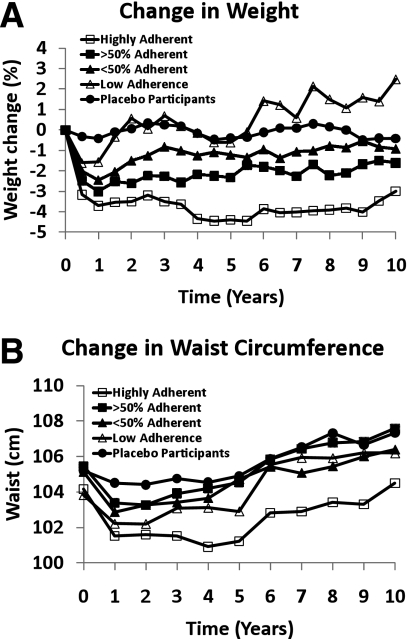
“Among placebo participants, body weight was relatively stable but waist circumference increased after the fourth year, continuing throughout the entire open-label follow-up (Fig. 2).”
§ Long-Term Safety, Tolerability, and Weight Loss Associated With Metformin in the Diabetes Prevention Program Outcomes Study > RESULTS > Results including DPPOS—open-label treatment
plaindirect- Asserted: passes — The authors put it forward as true.
- Checkable: passes — It can be checked against evidence.
- Load-bearing: unclear — It is unclear whether the paper’s conclusions depend on it.
- Based: passes — The paper gives a reason why it holds.
It may state two separate claims as one.
A result the paper reports from its own data — it cites no other source for it, so there is none to check. The quote shows it is in the paper.
In the paper
“Average weight of highly adherent participants was 3.5 ± 0.35% below baseline at 2 years, very close to their 1-year weight loss.”
§ Long-Term Safety, Tolerability, and Weight Loss Associated With Metformin in the Diabetes Prevention Program Outcomes Study > RESULTS > DPP—results from the double-blind phase
plaincorrelational- Asserted: passes — The authors put it forward as true.
- Checkable: passes — It can be checked against evidence.
- Load-bearing: passes — The paper’s conclusions depend on it.
- Based: passes — The paper gives a reason why it holds.
It may state two separate claims as one.
The paper states this without a source or data behind it here, so there is nothing to check it against. The quote shows it is in the paper.
In the paper
“Metformin participants in the low adherence group lost weight but placebo participants with low adherence did not.”
§ Long-Term Safety, Tolerability, and Weight Loss Associated With Metformin in the Diabetes Prevention Program Outcomes Study > CONCLUSIONS
plain- Asserted: passes — The authors put it forward as true.
- Checkable: passes — It can be checked against evidence.
- Load-bearing: passes — The paper’s conclusions depend on it.
- Based: passes — The paper gives a reason why it holds.
It may state two separate claims as one.
A result the paper reports from its own data — it cites no other source for it, so there is none to check. The quote shows it is in the paper.
In the paper
“No unexpected adverse events or treatment group differences in adverse events were identified, either by the study’s Data and Safety Monitoring Board or in this analysis.”
§ Long-Term Safety, Tolerability, and Weight Loss Associated With Metformin in the Diabetes Prevention Program Outcomes Study > RESULTS > Safety and tolerability
plain- Asserted: passes — The authors put it forward as true.
- Checkable: passes — It can be checked against evidence.
- Load-bearing: passes — The paper’s conclusions depend on it.
- Based: passes — The paper gives a reason why it holds.
It may state two separate claims as one.
A result the paper reports from its own data — it cites no other source for it, so there is none to check. The quote shows it is in the paper.
In the paper
“Waist circumference remained significantly lower than at baseline in the highly adherent group (P < 0.05) through the 7-year visit, whereas in the partially adherent groups it was lower up to the 4-year visit, and in the low-adherence group only through 2 years.”
§ Long-Term Safety, Tolerability, and Weight Loss Associated With Metformin in the Diabetes Prevention Program Outcomes Study > RESULTS > Results including DPPOS—open-label treatment
plaincorrelational- Asserted: passes — The authors put it forward as true.
- Checkable: passes — It can be checked against evidence.
- Load-bearing: passes — The paper’s conclusions depend on it.
- Based: passes — The paper gives a reason why it holds.
It may state two separate claims as one.
The paper states this without a source or data behind it here, so there is nothing to check it against. The quote shows it is in the paper.
In the paper
“Waist circumference increased in all groups after year 2, except for the highly adherent participants where the increase began after 5 years and waist circumference remained lower than baseline.”
§ Long-Term Safety, Tolerability, and Weight Loss Associated With Metformin in the Diabetes Prevention Program Outcomes Study > CONCLUSIONS
plaincorrelational- Asserted: passes — The authors put it forward as true.
- Checkable: passes — It can be checked against evidence.
- Load-bearing: passes — The paper’s conclusions depend on it.
- Based: passes — The paper gives a reason why it holds.
It may state two separate claims as one.
A result the paper reports from its own data — it cites no other source for it, so there is none to check. The quote shows it is in the paper.
In the paper
“Nonserious adverse events for hypoglycemia and anemia during the DPP were also uncommon and similar in metformin and placebo participants, with seven metformin participants and eight placebo participants ever reporting hypoglycemia, and fifty metformin participants and thirty-eight placebo participants ever reporting anemia.”
§ Long-Term Safety, Tolerability, and Weight Loss Associated With Metformin in the Diabetes Prevention Program Outcomes Study > RESULTS > Safety and tolerability
plainn = 7- Asserted: passes — The authors put it forward as true.
- Checkable: passes — It can be checked against evidence.
- Load-bearing: passes — The paper’s conclusions depend on it.
- Based: passes — The paper gives a reason why it holds.
It may state two separate claims as one.
The paper states this without a source or data behind it here, so there is nothing to check it against. The quote shows it is in the paper.
In the paper
“Waist circumference initially declines, then steadily increases after a nadir at 12–36 months in all groups except in the highly adherent group, in which this increase was delayed for 5 years.”
§ Long-Term Safety, Tolerability, and Weight Loss Associated With Metformin in the Diabetes Prevention Program Outcomes Study > CONCLUSIONS
plaindirect- Asserted: passes — The authors put it forward as true.
- Checkable: passes — It can be checked against evidence.
- Load-bearing: passes — The paper’s conclusions depend on it.
- Based: passes — The paper gives a reason why it holds.
It may state two separate claims as one.
A result the paper reports from its own data — it cites no other source for it, so there is none to check. The quote shows it is in the paper.
In the paper
“There were three SAE reports for anemia (two metformin and one placebo participant), and there were none for lactic acidosis or hypoglycemia during nearly 18,000 patient-years of follow-up.”
§ Long-Term Safety, Tolerability, and Weight Loss Associated With Metformin in the Diabetes Prevention Program Outcomes Study > RESULTS > Safety and tolerability
plain- Asserted: passes — The authors put it forward as true.
- Checkable: passes — It can be checked against evidence.
- Load-bearing: passes — The paper’s conclusions depend on it.
- Based: passes — The paper gives a reason why it holds.
It may state two separate claims as one.
In the paper
“Weight loss in the metformin group was maintained throughout the combined DPP and DPPOS period with metformin participants having an average 2.5-kg weight loss over time (6).”
§ Long-Term Safety, Tolerability, and Weight Loss Associated With Metformin in the Diabetes Prevention Program Outcomes Study > Abstract
What the sources say
- Not checked yetcites [6] Knowler, 2009, 10-year follow-up of diabetes incidence and weight loss in the Diabetes Prevention Program Outcomes Study, Lancet source
plaincorrelational- Asserted: passes — The authors put it forward as true.
- Checkable: passes — It can be checked against evidence.
- Load-bearing: passes — The paper’s conclusions depend on it.
- Based: passes — The paper gives a reason why it holds.
It may state two separate claims as one.
A conclusion the paper draws from its own results — it cites no other source for it, so there is none to check. The quote shows it is in the paper.
In the paper
“Metformin used for diabetes prevention is safe and well tolerated.”
- Also stated in: § CONCLUSIONS · plain
“Metformin used in overweight or obese individuals with elevated fasting glucose and impaired glucose tolerance was associated with modest but durable weight loss and was safe and well tolerated over many years.”
§ Long-Term Safety, Tolerability, and Weight Loss Associated With Metformin in the Diabetes Prevention Program Outcomes Study > Abstract
plain- Asserted: passes — The authors put it forward as true.
- Checkable: passes — It can be checked against evidence.
- Load-bearing: passes — The paper’s conclusions depend on it.
- Based: passes — The paper gives a reason why it holds.
It may state two separate claims as one.
- Also stated in: § CONCLUSIONS · plain
In the paper
“Weight loss was a strong predictor of diabetes prevention in both the metformin and placebo groups with weight loss accounting for 64% of the metformin versus placebo effect on diabetes prevention (7).”
§ Long-Term Safety, Tolerability, and Weight Loss Associated With Metformin in the Diabetes Prevention Program Outcomes Study > Abstract
What the sources say
- Not checked yetcites [7] Lachin, 2007, Factors associated with diabetes onset during metformin versus placebo therapy in the Diabetes Prevention Program, Diabetes source
boostedcorrelational- Asserted: passes — The authors put it forward as true.
- Checkable: passes — It can be checked against evidence.
- Load-bearing: passes — The paper’s conclusions depend on it.
- Based: passes — The paper gives a reason why it holds.
It may state two separate claims as one.
In the paper
“In summary, metformin produces a highly significant reduction in body weight and waist circumference with minimal safety issues and limited issues of tolerability (22).”
§ Long-Term Safety, Tolerability, and Weight Loss Associated With Metformin in the Diabetes Prevention Program Outcomes Study > CONCLUSIONS
What the sources say
- Not checked yetcites [22] Fujioka, 2005, Efficacy, dose-response relationship and safety of once-daily extended-release metformin (Glucophage XR) in type 2 diabetic patients with inadequate glycaemic control despite prior treatment with diet and exercise: results from two double-blind, placebo-controlled studies, Diabetes Obes Metab source
boosteddirect- Asserted: passes — The authors put it forward as true.
- Checkable: passes — It can be checked against evidence.
- Load-bearing: passes — The paper’s conclusions depend on it.
- Based: passes — The paper gives a reason why it holds.
It may state two separate claims as one.
A conclusion the paper draws from its own results — it cites no other source for it, so there is none to check. The quote shows it is in the paper.
In the paper
“Adherence to placebo did not affect weight loss, suggesting that metformin, rather than nonspecific adherence to positive health behaviors, was the relevant factor.”
§ Long-Term Safety, Tolerability, and Weight Loss Associated With Metformin in the Diabetes Prevention Program Outcomes Study > CONCLUSIONS
hedged- Asserted: passes — The authors put it forward as true.
- Checkable: passes — It can be checked against evidence.
- Load-bearing: passes — The paper’s conclusions depend on it.
- Based: passes — The paper gives a reason why it holds.
It may state two separate claims as one.
A conclusion the paper draws from its own results — it cites no other source for it, so there is none to check. The quote shows it is in the paper.
In the paper
“Adherence to metformin improved the magnitude of weight loss—but not waist circumference—during the first 2 years.”
§ Long-Term Safety, Tolerability, and Weight Loss Associated With Metformin in the Diabetes Prevention Program Outcomes Study > CONCLUSIONS
plaindirect- Asserted: passes — The authors put it forward as true.
- Checkable: passes — It can be checked against evidence.
- Load-bearing: passes — The paper’s conclusions depend on it.
- Based: passes — The paper gives a reason why it holds.
It may state two separate claims as one.
A conclusion the paper draws from its own results — it cites no other source for it, so there is none to check. The quote shows it is in the paper.
In the paper
“Metformin was well tolerated with few side effects.”
§ Long-Term Safety, Tolerability, and Weight Loss Associated With Metformin in the Diabetes Prevention Program Outcomes Study > CONCLUSIONS
plain- Asserted: passes — The authors put it forward as true.
- Checkable: passes — It can be checked against evidence.
- Load-bearing: passes — The paper’s conclusions depend on it.
- Based: passes — The paper gives a reason why it holds.
It may state two separate claims as one.
What the paper did — it cites no source for this, so there is none to check. The quote shows it is in the paper.
In the paper
“One potential bias is that 12% of DPP participants chose not to continue into the DPPOS. It is likely that some of those who discontinued the study or who continued but chose not to take open-label metformin did so because of side effects, which may have influenced the safety and tolerability profile of metformin during the open-label DPPOS period.”
§ Long-Term Safety, Tolerability, and Weight Loss Associated With Metformin in the Diabetes Prevention Program Outcomes Study > CONCLUSIONS
hedgedconditional- Asserted: passes — The authors put it forward as true.
- Checkable: passes — It can be checked against evidence.
- Load-bearing: fails — The paper’s conclusions may not depend on it.
- Based: passes — The paper gives a reason why it holds.
Probably not a substantial claim. The paper’s conclusions may not depend on it. It may state two separate claims as one.
A conclusion the paper draws from its own results — it cites no other source for it, so there is none to check. The quote shows it is in the paper.
In the paper
“The weight reduction persists for up to 10 years and is related to adherence to metformin.”
§ Long-Term Safety, Tolerability, and Weight Loss Associated With Metformin in the Diabetes Prevention Program Outcomes Study > CONCLUSIONS
plaincorrelational- Asserted: passes — The authors put it forward as true.
- Checkable: passes — It can be checked against evidence.
- Load-bearing: passes — The paper’s conclusions depend on it.
- Based: passes — The paper gives a reason why it holds.
It may state two separate claims as one.
None of the sources cited for this claim have been checked yet.
In the paper
“Metformin lowers glucose and reduces risk for diabetes in part through weight loss (2,7,16,17).”
§ Long-Term Safety, Tolerability, and Weight Loss Associated With Metformin in the Diabetes Prevention Program Outcomes Study > CONCLUSIONS
What the sources say
- Not checked yetcites [2] UK Prospective Diabetes Study (UKPDS) Group, 1998, Effect of intensive blood-glucose control with metformin on complications in overweight patients with type 2 diabetes (UKPDS 34), Lancet source
- Not checked yetcites [7] Lachin, 2007, Factors associated with diabetes onset during metformin versus placebo therapy in the Diabetes Prevention Program, Diabetes source
- Not checked yetcites [16] Yanovski, 2011, Effects of metformin on body weight and body composition in obese insulin-resistant children: a randomized clinical trial, Diabetes source
- Not checked yetcites [17] Avenell, 2004, Systematic review of the long-term effects and economic consequences of treatments for obesity and implications for health improvement, Health Technol Assess source
plaindirect- Asserted: passes — The authors put it forward as true.
- Checkable: passes — It can be checked against evidence.
- Load-bearing: passes — The paper’s conclusions depend on it.
- Based: passes — The paper gives a reason why it holds.
It may state two separate claims as one.
Claims other papers make about this one
Each is checked against this paper’s own text: does it say what the citing paper says it does?
In the citing paper
“In addition, data from the Diabetes Prevention Program (DPP) indicates that metformin is effective in preventing the development of diabetes in patients with pre-diabetes and its use following a 10-year follow up associated with an average 2.1-kg weight loss (7).”
From A Critical Review of the Evidence That Metformin Is a Putative Anti-Aging Drug That Enhances Healthspan and Extends Lifespan (2021) · cites this paper as [7]
In the citing paper
“In addition to its benefits as an anti-hyperglycemic agent, metformin also lowers the atherosclerotic burden in non-diabetic persons at risk of developing T2DM (1, 7).”
From A Critical Review of the Evidence That Metformin Is a Putative Anti-Aging Drug That Enhances Healthspan and Extends Lifespan (2021) · cites this paper as [7]
In the citing paper
“data from the Diabetes Prevention Program study of 3234 pre-diabetic subjects over an average of 2.8 years who were randomized to receive placebo, metformin (850 mg bid), or lifestyle intervention, indicated that although both metformin and lifestyle changes were effective in reducing the risk of developing diabetes, lifestyle intervention was more effective (7).”
From A Critical Review of the Evidence That Metformin Is a Putative Anti-Aging Drug That Enhances Healthspan and Extends Lifespan (2021) · cites this paper as [7]
In the citing paper
“In contrast to other antidiabetic drugs including insulin, metformin can lead independently to glycemic control and weight loss by decreasing food intake in both diabetic and non-diabetic individuals (18–20).”
From GDF-15 as a Weight Watcher for Diabetic and Non-Diabetic People Treated With Metformin (2020) · cites this paper as [19]
In the citing paper
“The magnitude of weight loss during the 2-year double-blind period was directly related to drug adherence, indicating a potential dose-effect (19).”
From GDF-15 as a Weight Watcher for Diabetic and Non-Diabetic People Treated With Metformin (2020) · cites this paper as [19]
Self-check
Percentages, sums and reported differences re-computed from the paper’s own numbers.
Each contradiction between two passages listed here was confirmed by an independent check.
Rated minor: it would not touch a result — a value no result rests on, a p-value that stays on the same side of the significance level, or a conflict that is clerical, resolved elsewhere in the paper, or outside its own findings.
In the paper
§ Long-Term Safety, Tolerability, and Weight Loss Associated With Metformin in the Diabetes Prevention Program Outcomes Study > CONCLUSIONS
“In the double-blind phase of the trial, 72% were highly adherent, and throughout the entire trial, 62% of the metformin group was highly adherent.”
§ Long-Term Safety, Tolerability, and Weight Loss Associated With Metformin in the Diabetes Prevention Program Outcomes Study > RESULTS > Results including DPPOS—open-label treatment
“During the total follow-up period, 62% of the metformin participants were in the ≥50% or highly adherent categories compared with 72% in the 2-year double-blind phase (Table 1).”
Citations
Cites
Reduction in the incidence of type 2 diabetes with lifestyle intervention or metformin
(2002) · New England Journal of Medicine · doi:10.1056/nejmoa012512 · Cited by 19,011
Everitt, B. S. (2001) · Psychology Press eBooks · doi:10.4324/9781410605542-11 · Cited by 6,877
Diabetes Prevention Program Research Group (2009) · The Lancet · doi:10.1016/s0140-6736(09)61457-4 · Cited by 3,020
Ramachandran, A., Snehalatha, C., Mary, S., Mukesh, B., Bhaskar, A. D., Vijay, V., & Indian Diabetes Prevention Programme (IDPP) (2006) · Diabetologia · doi:10.1007/s00125-005-0097-z · Cited by 1,881
Pharmacologic Therapy for Type 2 Diabetes Mellitus
DeFronzo, R. A. (1999) · Annals of Internal Medicine · doi:10.7326/0003-4819-131-4-199908170-00008 · Cited by 1,173
Analysis of Longitudinal Data.
Have, T. R. T., Diggle, P. J., Liang, K., & Zeger, S. L. (1995) · Journal of the American Statistical Association · doi:10.2307/2291352 · Cited by 1,171
Metabolic effects of metformin in non-insulin-dependent diabetes mellitus
Stumvoll, M., Nurjhan, N., Perriello, G., Dailey, G., & Gerich, J. E. (1995) · New England Journal of Medicine · doi:10.1056/nejm199508313330903 · Cited by 1,148 · cited 2×
“This is because metformininduced weight loss is almost exclusively confined to reductions in adipose mass (2,16,18) with little change in lean tissue.”
BackgroundAvenell, A., Broom, J., Brown, T., Poobalan, A., Aucott, L., Stearns, S., Smith, W., Jung, R., Campbell, M., & Grant, A. (2004) · Health Technology Assessment · doi:10.3310/hta8210 · Cited by 1,041
Cited by
Sorted by citations
Items 301–400 of 493
Ji, L., Jiang, X., Hao, Q., Cheng, Z., Wang, K., Pang, S., Liu, M., Guo, Y., Chen, X., Su, X., et al. (2023) · Diabetes Obesity and Metabolism · doi:10.1111/dom.14971 · Cited by 7
Gabriel, R., Boukichou-Abdelkader, N., Gilis‐Januszewska, A., Makrilakis, K., Gómez‐Huelgas, R., Kamenov, Z. A., Paulweber, B., Satman, İ., Djordjević, P., Alkandari, A., et al. (2023) · Journal of Clinical Medicine · doi:10.3390/jcm12052035 · Cited by 6
Metformin induces a Lac-Phe gut–brain signalling axis
TeSlaa, T. A. (2024) · Nature Metabolism · doi:10.1038/s42255-024-01014-x · Cited by 7
Obesity in Polycystic Ovary Syndrome: Insulin Sensitizing Therapy
Hoeger, K. M. (2012) · Current Obesity Reports · doi:10.1007/s13679-012-0030-y · Cited by 6
Ji, L., Sun, N., Zhang, Y., Zhang, L., Shen, S., Wang, X., Li, Q., Dong, L., Ren, W., Qi, L., et al. (2019) · Diabetes Obesity and Metabolism · doi:10.1111/dom.13884 · Cited by 6
Fofié, C. K., Katekhaye, S. D., Borse, S., Sharma, V., Nivsarkar, M., Nguelefack‐Mbuyo, E. P., Kamanyi, A., Singh, V., & Nguelefack, T. B. (2019) · Journal of Cellular Biochemistry · doi:10.1002/jcb.28437 · Cited by 6
[Primary progressive aphasia (Mesulam syndrome)].
Habib, M., Pelletier, J., & Khalil, R. (1993) · PubMed · Cited by 6
Metformin Prescription for Insured Adults With Prediabetes From 2010 to 2012
Rodríguez‐Gutiérrez, R., & Montori, V. M. (2015) · Annals of Internal Medicine · doi:10.7326/l15-5136 · Cited by 6
Metformin Prescription for Insured Adults With Prediabetes From 2010 to 2012
Moin, T., Duru, O. K., & Mangione, C. M. (2015) · Annals of Internal Medicine · doi:10.7326/l15-5136-2 · Cited by 6
Diabetes, Gaps in Care Coordination, and Preventable Adverse Events
Colvin, C. L. (2023) · The American Journal of Managed Care · doi:10.37765/ajmc.2023.89374 · Cited by 5
The Epistemic Policies of Anti-Ageing Medicines in the European Union
Penella, G. M. (2024) · Health Care Analysis · doi:10.1007/s10728-024-00497-9 · Cited by 6
Misceo, D., Mocciaro, G., D’Amore, S., & Vacca, M. (2024) · Nutrition & Metabolism · doi:10.1186/s12986-024-00871-3 · Cited by 6
Fetzner, J., & Rafi, E. (2025) · The Journal of Clinical Endocrinology & Metabolism · doi:10.1210/clinem/dgae817 · Cited by 6
Mohri, T., Okamoto, S., Nishioka, Y., Myojin, T., Kubo, S., Higashino, T., Okada, S., Akai, Y., Noda, T., Ishii, H., et al. (2023) · International Journal of Environmental Research and Public Health · doi:10.3390/ijerph20075300 · Cited by 5
Current and Emerging Parenteral and Peroral Medications for Weight Loss: A Narrative Review
Lawati, A. A., Alhabsi, A. N., Rahul, R., Savino, M.-L., Alwahaibi, H., Das, S., & Lawati, H. A. (2025) · Diseases · doi:10.3390/diseases13050129 · Cited by 5
“Nonetheless, a few cases of significant liver injury have occurred that required monitoring of hepatic function [104].”
Involuntary Weight Loss Secondary to Metformin Use in Elderly Adults
Pérez‐Hernández, O., González-Pérez, J. M., Martı́nez-Riera, A., Durán‐Castellón, M. D. C., Muñoz, M. B. M., Martín‐González, C., & Santolaria-Fernández, F. (2016) · Journal of the American Geriatrics Society · doi:10.1111/jgs.14064 · Cited by 5
Efficacy and Safety of Metformin in Weight Loss in Bahraini Population
Alqallaf, S. M. (2016) · Journal of Applied Pharmaceutical Science · doi:10.7324/japs.2016.60616 · Cited by 5
Kyler, K. E., Kadakia, R., Palac, H., Kwon, S., Ariza, A. J., & Binns, H. J. (2018) · Clinical Pediatrics · doi:10.1177/0009922818803404 · Cited by 6
Kasturiratne, A., Khawaja, K. I., Ahmad, S., Siddiqui, S., Shahzad, K., Athauda, L., Jayawardena, R., Mahmood, S., Muilwijk, M., Batool, T., et al. (2021) · Trials · doi:10.1186/s13063-021-05803-7 · Cited by 5
The Role of Anti-obesity Drugs in Patients with Type 2 Diabetes
Hollander, P. A. (2013) · US Endocrinology · doi:10.17925/use.2013.09.02.101 · Cited by 5
Management of Diabetes Mellitus
Jenkins, A. J., SCOTT, E. S., Fulcher, J., Kilov, G., & Januszewski, A. S. (2018) · Contemporary cardiology · doi:10.1007/978-3-319-97622-8_7 · Cited by 5
Trial of restarting and tolerating metformin ( TreatMet )
Orloff, J. N., Touhamy, S., Truong, W., Casper, A., Shukla, A. P., Igel, L. I., & Flory, J. (2020) · Diabetes Obesity and Metabolism · doi:10.1111/dom.14137 · Cited by 5
Pharmacology and safe prescribing of metformin
Apampa, B. (2012) · Nurse Prescribing · doi:10.12968/npre.2012.10.12.597 · Cited by 5
Searching For Prediabetes before Diabetes
Schianca, G. P. C., & Bellan, M. (2016) · General Medicine Open Access · doi:10.4172/2327-5146.1000237 · Cited by 4
Dereziński, T., Zozulińska‐Ziółkiewicz, D., Uruska, A. A., & Dąbrowski, M. (2019) · Clinical Diabetology · doi:10.5603/dk.2019.0022 · Cited by 4
Kraal, A. Z., Ellingrod, V. L., & Zahodne, L. B. (2023) · Diabetes Care · doi:10.2337/dc23-0656 · Cited by 4
Wass, S. Y., Barnard, J. A., Kim, H. S., Sun, H., Telfer, W., Schilling, T., Barzilai, B., Bruemmer, D., Cho, L., Huang, J. C., et al. (2024) · Journal of Interventional Cardiac Electrophysiology · doi:10.1007/s10840-024-01955-z · Cited by 4
“In the Diabetes Prevention Program, metformin produced durable weight loss for at least 10 years of treatment [22].”
Kim, D., Yu, J., Wang, E. K., Lee, S., Kim, J. S., Hwang, J., Ku, C. R., Cho, Y. H., & Lee, E. J. (2021) · Biomedicines · doi:10.3390/biomedicines9070745 · Cited by 4
Prediabetes: challenges and opportunities
Моргунова, Т. Б., Glinkina, I. V., & Fadeev, V. V. (2021) · Meditsinskiy sovet = Medical Council · doi:10.21518/2079-701x-2021-12-220-227 · Cited by 5
Morales, C., Merino-Torres, J. F., Moreno-Moreno, P., Laínez, M. G. L., Tejado, I., Yoldi, A., Medina, S. G., Soto, A., Botana, M., Bellido, V., et al. (2022) · Drugs in Context · doi:10.7573/dic.2021-11-5 · Cited by 4
Pharmacological Approaches in Obesity Treatment
Erden, E. E., YAZICI, Z. G., KILIÇ, C., Aydın, S., & Kılıç, F. S. (2022) · OSMANGAZİ JOURNAL OF MEDICINE · doi:10.20515/otd.1093390 · Cited by 4
Liu, C., Zhang, S., Xue, J., Zhang, H., & Yin, J. (2023) · Molecular and Biochemical Parasitology · doi:10.1016/j.molbiopara.2023.111580 · Cited by 4
Tu, S., Chen, J. Z., Singh, S. R. K., Maraboyina, S., Gökden, N., Hsu, P.-C., & Langford, T. (2024) · Cancers · doi:10.3390/cancers16030624 · Cited by 5
“[75].”
Position statement of the SEMI, SED, redGDPS, SEC, SEEDO, SEEN, SEMERGEN y SEMFYC
Huelgas, R. G., Peralta, F. G., Fernández, L. C., Galve, E., Casanueva, F. F., Puig‐Domingo, M., Bravo, J. J. M., Beltrán, D. O., Muñoz, J. E., Torre, E. L. M., et al. (2015) · Revista Clínica Española (English Edition) · doi:10.1016/j.rceng.2015.09.004 · Cited by 4
Lifestyle and Pharmacotherapy for Weight Loss in Preventing or Delaying Diabetes
Price, S. A., Le, Q. N., & White, N. D. (2017) · American Journal of Lifestyle Medicine · doi:10.1177/1559827617740825 · Cited by 4
Xhakaza, L., Abrahams-October, Z., Pearce, B., Masilela, C. M., Adeniyi, O. V., Johnson, R., Ongole, J. J., & Benjeddou, M. (2020) · Drug Metabolism and Personalized Therapy · doi:10.1515/dmdi-2020-0111 · Cited by 4
Механізми дії метформіну за діабету та пов’язаних із діабетом патологій
SOKOLOVA, L. K., Pushkarev, V. M., & Ковзун, О. І. (2020) · Endokrynologia · doi:10.31793/1680-1466.2020.25-2.143 · Cited by 5
The story of metformin continues …
Miraj, S. S., Thunga, G., & Suhaj, A. (2014) · Journal of Pharmacy Practice and Research · doi:10.1002/jppr.1042 · Cited by 4
Bailey, C. J. (2013) · Springer eBooks · doi:10.1007/978-3-7091-1331-8_8 · Cited by 4
Building Capacity for Self-Management Interventions: The Challenges
McCallion, P., & Ferretti, L. (2015) · Journal of Nursing & Care · doi:10.4172/2167-1168.1000308 · Cited by 2
Lac-Phe mediates the anti-obesity effect of metforminPreprint
Xiao, S., Li, V. L., Lyu, X., Chen, X., Wei, W., Abbasi, F., Knowles, J. W., Deng, S., Tiwari, G., Shi, X., et al. (2023) · bioRxiv (Cold Spring Harbor Laboratory) · doi:10.1101/2023.11.02.565321 · Cited by 4
Ezenekwe, L., & Newberry, C. A. (2025) · Nutrition in Clinical Practice · doi:10.1002/ncp.70074 · Cited by 3
Pereira, A. C. C., Cruz, M. A. C., Barbosa, C. C., Teixeira, G. T., Perez, G. S., Machado, I. L., Freitas, I. C., Lopes, J. M. C., Assis, L. A., & Lopes, A. G. (2020) · Revista Eletrônica Acervo Saúde · doi:10.25248/reas.e4469.2020 · Cited by 5
Metformin Boosts Intestinal Lipid Sensing via GIP to Suppress Feeding
Kuah, R., Wang, M. T., Yang, Z., Back, G., Li, R., Bruce, K., LoChoy, J. N., Beaudry, J. L., Barros, D. R., Zhang, S., et al. (2025) · Diabetes · doi:10.2337/db25-0100 · Cited by 5
The use of metformin in a patient with renal impairment
Coleman, A., & Chai, M. O. (2014) · Journal of Renal Nursing · doi:10.12968/jorn.2014.6.1.20 · Cited by 3
Comparison of orlistat and orlistat plus metformin therapy between diabetic and nondiabetic groups
Günay, Y., Kı̇şı̇oğlu, S. V., Karakullukçu, S., Tüfekçı̇, D., Demır, A. S., Coşkun, H., Nuhoğlu, İ., Koçak, M., & Ersöz, H. Ö. (2023) · Revista da Associação Médica Brasileira · doi:10.1590/1806-9282.20230174 · Cited by 3
Hoekx, C. A., Straat, M. E., Bizino, M. B., van Eyk, H. J., Lamb, H. J., Smit, J. W. A., Jazet, I. M., de Jager, S. C. A., Boon, M. R., & Martínez‐Téllez, B. (2024) · Experimental Physiology · doi:10.1113/ep091815 · Cited by 2
“Besides improving glucose regulation, metformin also reduces body weight (Diabetes Prevention Program Research Group, 2012; Lee & Morley, 1998).”
BackgroundA Saudi Heart Association Position Statement on Obesity and Cardiovascular Disease
AlHabeeb, W., Kinsara, A. J., Bakhsh, A., Tash, A. A., Alshammary, A., Almasood, A. S., Alghalayini, K. W., Arafah, M., Hamdy, O., Alsifri, S. N., et al. (2024) · Journal of the Saudi Heart Association · doi:10.37616/2212-5043.1391 · Cited by 3
“…metformin can also lead to weight loss; metformin was linked signi fi cant and sustainable decreases in both weight and WC in participants of the diabetes prevention program outcomes study, a large-scale RCT of metformin in prediabetes with a long-term (7 e 8 years) open-label extension [318].”
BackgroundLin, X., Wu, S., Shi, Y., Lin, W., Yue, F., Lam, S. M., Shui, G., Russell, R., & Zhang, D. (2025) · Journal of Pharmacology and Experimental Therapeutics · doi:10.1016/j.jpet.2025.103388 · Cited by 3
Drug treatment of obesity in the cardiovascular patient
Charakida, M., Tousoulis, D., & Finer, N. (2013) · Current Opinion in Cardiology · doi:10.1097/hco.0b013e3283642a4c · Cited by 3
The effect of metformin on ghrelin serum level in type 2 diabetes mellitus
Mohammed, M. N., & Tawfik, N. O. M. (2013) · Al-Mağallaẗ al-ʻirāqiyyaẗ li-l-ṣaydalaẗ · doi:10.33899/iphr.2013.066909 · Cited by 3
Peso y diabetes tipo 2: nuevas recomendaciones
Gómez‐Huelgas, R. (2016) · Medicina Clínica · doi:10.1016/s0025-7753(17)30620-6 · Cited by 3
Georgiou, A. N., Zanos, P., & Onisiforou, A. (2025) · bioRxiv · doi:10.1101/2025.03.14.643306 · Cited by 2
“Individuals with DM2 taking Metformin typically experience a ≥5% reduction in initial body weight within the first year 46 , whereas Semaglutide treatment achieves 15% or more weight loss, as demonstrated in the OASIS 1 Clinical Trial 47 .”
Predictors of Obesity among Adults Who Have Diabetes Mellitus Type Two
Jarrad, R. A., Saleh, Z. T., & Mahmoud, N. (2018) · Open Journal of Nursing · doi:10.4236/ojn.2018.88043 · Cited by 2
Reproductive outcomes in female mice offspring due to maternal metformin treatment
Velázquez, C., Herrero, Y., Prost, K., Bordaquievich, M., Neira, M., Parborell, F., & Abramovich, D. (2025) · Life Sciences · doi:10.1016/j.lfs.2025.123416 · Cited by 2
Challenges in the management of MetALD after liver transplantation
Cucco, M., Becchetti, C., Scaravaglio, M., Dispinzieri, G., Bolis, F., Bagalà, L., Strollo, M., Orlando, M., Perricone, G., Mazzarelli, C., et al. (2025) · Metabolism and Target Organ Damage · doi:10.20517/mtod.2024.144 · Cited by 2
Kananuraks, S., Akkarakanoksin, E., Panaput, T., Faisatjatham, S., Phisalwut, S., & Nongnuch, A. (2025) · Renal Failure · doi:10.1080/0886022x.2025.2586333 · Cited by 2
“…is associated with a decrease in cardio-vascular disease and mortality rates. this medication demonstrates efficacy and has economic value [3– 5]. nevertheless, the serious condition known as metformin-associated lactic acidosis (Mala) may arise in individuals with predisposing conditions…”
Mukherjee, S., Skrede, S., & Fernø, J. (2025) · Reviews in Endocrine and Metabolic Disorders · doi:10.1007/s11154-025-10009-2 · Cited by 2
“Metformin may also induce a moderate, but prolonged decrease in body weight [ 102 ].”
Georgiou, A. N., Zanos, P., & Onisiforou, A. (2026) · Communications Medicine · doi:10.1038/s43856-026-01471-3 · Cited by 6
“Individuals with DM2 taking metformin typically experience a ≥ 5% reduction in initial body weight within the fi rst year 62 , whereas semaglutide treatment achieves 15% or more weight loss, as demonstrated in the OASIS 1 Clinical Trial 63 .”
Kang, Y., Liu, Y., Long, L., Chen, W., Zhang, Z., 古明晖, Wang, C., Li, C., Zhang, S., Pan, B., et al. (2026) · Clinical Rheumatology · doi:10.1007/s10067-026-08181-0 · Cited by 2
Vencio, S. A. C., Manosalva, J. P., Mathieu, C., Proot, P., Yupanqui-Lozno, H., & Paldánius, P. M. (2021) · Diabetology & Metabolic Syndrome · doi:10.1186/s13098-021-00686-9 · Cited by 2
Metformin prescription for U.S. veterans with prediabetes, 2010–2019
Gulanski, B., Goulet, J. L., Radhakrishnan, K., Ko, J., Li, Y., Rajeevan, N., Lee, K. M., Heberer, K. R., Lynch, J. A., Streja, E., et al. (2023) · Journal of Investigative Medicine · doi:10.1177/10815589231201141 · Cited by 2
Fayfman, M., Gewirtz, A. T., Delaroque, C., Blanco, G., Gibanica, S., Srinivasan, S., & Chassaing, B. (2023) · Metabolism Open · doi:10.1016/j.metop.2023.100256 · Cited by 4
“Use of metformin in the clinical setting is limited by significant gastrointestinal side effects in approximately 25% of patients taking it [7 – 10].”
BackgroundDavis, E. W., Hsiao, H.-H., Barone, N., Rosario, S. R., & Cannioto, R. A. (2024) · Frontiers in Immunology · doi:10.3389/fimmu.2024.1419257 · Cited by 2
Modern-Day Management of the Dysglycemic Continuum: An Expert Viewpoint from the Arabian Gulf
Alessa, T., Alawadi, F., Alkaabi, J., Al-Mamari, A., Al‐Ozairi, E., Alromaihi, D., Elhadd, T. A., Gunaid, A. A., Hassanein, M. M., Jayyousi, A., et al. (2024) · Diabetes Metabolic Syndrome and Obesity · doi:10.2147/dmso.s491591 · Cited by 2
Rational approaches to the treatment of patients with overweight and obesity: a cardiologist’s view
Miklishanskaya, S. V., & Mazur, N. A. (2024) · Rational Pharmacotherapy in Cardiology · doi:10.20996/1819-6446-2024-3087 · Cited by 2
Metformin reduces the risk of frailty: evidence from a Mendelian randomization study
Chen, T., Liu, Y.-L., Qiu, H.-N., Lin, C.-Y., Wu, F., Li, J., & Lin, J. (2025) · Diabetology & Metabolic Syndrome · doi:10.1186/s13098-025-01825-2 · Cited by 2
“Met-formin, a first-line antidiabetic medication for T2DM, is effective in lowering blood glucose levels and promoting weight loss [18–21], possibly due to its pharmacological effects of appetite suppression and improvement of insulin resistance (IR) [22].”
Kuorikoski, V., Tampio, J., Kerachni, S., Timonen, D., Tonduru, A. K., Markowicz-Piasecka, M., Terasaki, T., Poso, A., & Huttunen, K. M. (2025) · Molecular Pharmaceutics · doi:10.1021/acs.molpharmaceut.5c00432 · Cited by 2
Pharmacotherapy of Obesity and Metabolic Syndrome
Duan, D., & Ahima, R. S. (2023) · Springer eBooks · doi:10.1007/978-3-031-40116-9_44 · Cited by 2
Xu, S., Fan, L., Zaborniak, P., Zhu, R., Ji, H., Harris, K. S., de Souza, J. V., & Bronowska, A. K. (2024) · QRB Discovery · doi:10.1017/qrd.2024.1 · Cited by 1
Metformin Modulates the Mechanisms of Ageing
Cătoi, A. F., Andreicuț, A. D., Vodnar, D. C., Szabó, K., Corina, A., Arsene, A. L., Ștefan, S., Stoica, R. A., & Rizzo, M. (2019) · IntechOpen eBooks · doi:10.5772/intechopen.89431 · Cited by 2
METFORMIN EXERTS CARDIOPROTECTION IN ISOPROTERENOL-INDUCED CARDIOMYOPATHY IN RATS
Лой, Г. Я., Павлюк, Б. В., Крамар, С., Korda, M. M., & Oleshchuk, O. (2020) · Medical and Clinical Chemistry · doi:10.11603/mcch.2410-681x.2019.v.i4.10855 · Cited by 2
Ojha, A., Vidwans, H., & Watve, M. (2022) · medRxiv · doi:10.1101/2022.08.02.22278347 · Cited by 2
Metformin inhibits mitochondrial complex I in intestinal epithelium to promote glycemic controlPreprint
Sebo, Z. L., Chakrabarty, R. P., Grant, R. A., D’Alessandro, K. B., Koss, A. R., Blum, J. L. E., Davidson, S. M., Reczek, C. R., & Chandel, N. S. (2025) · bioRxiv (Cold Spring Harbor Laboratory) · doi:10.1101/2025.10.02.678294 · Cited by 2
“Metformin modestly lowers body weight in humans (~3% loss over a year) 74 .”
Pharmacotherapy of Obesity and Metabolic Syndrome
Ahima, R. S. (2016) · Springer eBooks · doi:10.1007/978-3-319-11251-0_44 · Cited by 1
Metformin use among obese patients with prediabetes in Qassim, Saudi Arabia: An observational study
Alfayez, O. M., Alfuraih, S. N., Alsalamah, B. I., Almendeel, H. M., Alkhezi, O. S., Alharbi, S., Alwohaibi, N. A., & Rasheed, M. K. (2023) · Saudi Pharmaceutical Journal · doi:10.1016/j.jsps.2023.06.027 · Cited by 1
Hippocampal Serotonin and Responses to Immobilization Stress in Rats Treated with Metformin
Afroz, R., Salman, T., Nawaz, S., Mustafa, N., Zafar, M., & Haleem, D. J. (2024) · Current Psychopharmacologye · doi:10.2174/0122115560289942240427041345 · Cited by 1
Lethal toxicity of metformin on zebrafish during early embryonic development by multi-omics analysis
Lin, Z., Liu, M., Chen, F., Zhao, C., Liu, Y., & Sun, H. (2025) · Scientific Reports · doi:10.1038/s41598-025-95816-y · Cited by 1
“These drugs have excellent safety and tolerability profiles 22 .”
Current Evidence on SGLT‐2 Inhibitors in Prediabetes: A Review of Preclinical and Clinical Data
Pourkarim, F., Entezari‐Maleki, T., & Rezaee, H. (2025) · The Journal of Clinical Pharmacology · doi:10.1002/jcph.70026 · Cited by 1
Song, L., Wang, R., Cui, J., Hu, S., Wang, J., Xie, J., Miao, P., & Sun, B. (2025) · Frontiers in Endocrinology · doi:10.3389/fendo.2025.1650805 · Cited by 2
Moreira, H. R. S. D., Moreira, F., Jesus, A. M. C., Monteiro‐Soares, M., & Santos, P. (2025) · Diabetology · doi:10.3390/diabetology6100114 · Cited by 2
Yang, L., Yao, B.-B., Zhong, W.-W., Guo, S. J., & Wei, P.-D. (2025) · World Journal of Psychiatry · doi:10.5498/wjp.v15.i11.109331 · Cited by 1
Abusnana, S., Sabbour, H. M., Afandi, B. O., Farghaly, M., Farooqi, M. H., Hafidh, K., Hassanein, M. M., Jabbar, A., Shehab, A., Kalimat, R., et al. (2026) · Vascular Health and Risk Management · doi:10.2147/vhrm.s579970 · Cited by 1
Lactate as a Chemical Modification on Proteins and Metabolites
Xiao, S., Markhard, A. L., & Long, J. Z. (2026) · Annual Review of Biochemistry · doi:10.1146/annurev-biochem-051024-015746 · Cited by 1
“In addition to its glucose-lowering activity, metformin exhibits a reproducible lowering of body weight across many clinical studies (96–98) and in mice (99, 100).”
Grandy, S., Green, A. J., & Fox, K. (2014) · Journal of Diabetes Mellitus · doi:10.4236/jdm.2014.43031 · Cited by 3
The importance of prediabetes and therapeutic approach
Altuntaş, Y., & Öztürk, F. Y. (2015) · SiSli Etfal Hastanesi Tip Bulteni / The Medical Bulletin of Sisli Hospital · doi:10.5350/semb.20151126122000 · Cited by 1
Pharmacotherapy of Obesity and Metabolic Syndrome
Ahima, R. S. (2015) · Springer eBooks · doi:10.1007/978-3-319-12125-3_44-1 · Cited by 1
Prescription pattern of metformin for various indications: a prospective study
Vaseem, A., Ali, M., & Afshan, K. (2017) · International Journal of Basic & Clinical Pharmacology · doi:10.18203/2319-2003.ijbcp20174659 · Cited by 1
Alanazi, A., & Alanazi, M. H. S. A. (2013) · Pharmacologia · doi:10.5567/pharmacologia.2013.511.518 · Cited by 1
Targeting Prediabetes to Preempt Diabetes
Nair, S., Rao, M., & Miraj, S. S. (2018) · Elsevier eBooks · doi:10.1016/b978-0-12-812019-4.00003-9 · Cited by 1
Nonglycemic Outcomes of Antidiabetic Medications
Morse, C., Sze, D., Patel, D. K., & Goldman, J. D. (2018) · Clinical Diabetes · doi:10.2337/cd18-0015 · Cited by 1
Metformin is the most recognized first choice drug for patients with type 2 diabetes mellitus
Mkrtumyan, A. M. (2018) · Meditsinskiy sovet = Medical Council · doi:10.21518/2079-701x-2018-4-20-27 · Cited by 1
Oyewole, B. K., Boshnaq, M., Yaktien, M., & Ahmed, S. (2019) · BMJ Case Reports · doi:10.1136/bcr-2019-230594 · Cited by 1
Obesity: Medical and Surgical Treatment
Tassinari, D., Giovanelli, A., & Asteria, C. (2021) · Springer eBooks · doi:10.1007/978-3-030-80267-7_9 · Cited by 1
Tee, K. B., Ibrahim, L., Hashim, N. M., Saiman, M. Z., Zakaria, Z. H., & Huri, H. Z. (2022) · Journal of Clinical Medicine · doi:10.3390/jcm11143931 · Cited by 1
Place of metformin in modern clinical guidelines for the treatment of type 2 diabetes mellitus
Моргунова, Т. Б., Glinkina, I. V., Дмитриевна, П. Е., Zorina, A. A., & Fadeev, V. V. (2023) · Meditsinskiy sovet = Medical Council · doi:10.21518/ms2023-211 · Cited by 1
Pharmacotherapy of Obesity and Metabolic Syndrome
Duan, D., & Ahima, R. S. (2023) · Springer eBooks · doi:10.1007/978-3-319-12125-3_44-2 · Cited by 1
Fu, J., Chen, Y., Huang, Z., & Wang, X. (2024) · Pakistan Journal of Medical Sciences · doi:10.12669/pjms.40.6.9304 · Cited by 1
“16 Body weight reduction was reported to restore physical health and reproductive function of PCOS patients.”
BackgroundElucidating metformin action on the ovary and fertility in healthy mice
Velázquez, C., Bordaquievich, M., Herrero, Y., Cohen, D. J., Bianchi, M. S., Cuasnicu, P. S., Prost, K., Pascuali, N., Parborell, F., & Abramovich, D. (2024) · Reproduction · doi:10.1530/rep-24-0229 · Cited by 1
Abdulrahman, Z. S., Al-Atrakji, M. Q. Y. M. A., Al-Maliky, A. A., Hussein, K. I., & Hussain, S. A. (2022) · Biomedical & Pharmacology Journal · doi:10.13005/bpj/2441 · Cited by 1
Metadata
- Authors
- The Diabetes Prevention Program Research Group
- Affiliations
- Pennington Biomedical Research Center (US)
- Corresponding author
- The Diabetes Prevention Program Research Group
- Venue
- Diabetes Care
- Publisher
- American Diabetes Association
- Published
- 2012-03-13
- Volume
- 35
- Issue
- 4
- Pages
- 731-737
- ISSN
- 0149-5992 (ISSN-L)
- 1935-5548
- PMC
- PMC3308305
- OpenAlex
- W2096559770
- Cited by
- 494
- References
- 24
- Citations by year
- 2026: 19 · 2025: 34 · 2024: 68 · 2023: 44 · 2022: 31 · 2021: 51 · 2020: 36 · 2019: 35 · 2018: 36 · 2017: 25 · 2016: 28 · 2015: 35 · 2014: 19 · 2013: 22 · 2012: 10
- FWCI
- 22.06
- Type
- journal article
- Language
- en
- Open access
- hybrid
- doi.org
- Licence
- cc-by-nc-nd
- Locations
- Diabetes Care (publishedVersion, cc-by-nc-nd)
- Europe PMC (PubMed Central) (publishedVersion, cc-by-nc-nd)
- PubMed Central (publishedVersion, cc-by-nc-nd)
- PubMed (publishedVersion)
- Hispana (submittedVersion)
- Lund University Publications (Lund University) (submittedVersion)
- Funders
- National Institutes of Health
- National Institute of Diabetes and Digestive and Kidney Diseases (P30DK017047)
- Topics
- Health Sciences › Medicine › Endocrinology, Diabetes and Metabolism › Diabetes Treatment and Management
- Health Sciences › Medicine › Endocrinology, Diabetes and Metabolism › Diabetes, Cardiovascular Risks, and Lipoproteins
- Health Sciences › Medicine › Pharmacology (medical) › Pharmacology and Obesity Treatment
- Keywords
- metformin, diabetes prevention, long-term safety, tolerability, weight loss, waist circumference, gastrointestinal adverse effects, hemoglobin, hematocrit, medication adherence, type 2 diabetes prevention, open-label extension
- MeSH terms
- Adult, Aged, Aged, 80 and over, Diabetes Mellitus, Type 2, Double-Blind Method, Female, Follow-Up Studies, Humans, Hypoglycemic Agents, Male, Metformin, Middle Aged, Placebos, Prediabetic State, Time Factors, Weight Loss, Treatment Outcome
About these checks
Registry, retraction, Cites and statistics results are computed, not judged, with one exception: a printed reference that no index lists is read once by a model before it counts as a citation error. Claims are extracted by a model and kept only when their quote appears verbatim in the text; each cited source is then checked, with a model’s help, for whether it says what the claim relies on. Those verdicts can be wrong — read the claim’s quote and the cited source before relying on one.
A language model drew the claims from the paper on 2026-10-10, under version 3 of the claim definition (model deepseek-v4.1-flash, prompt extract-v3).
A second model labelled each claim on 2026-10-10 (model jev-1.13-20260917, definition revision gold-guideline-v0.2).
Statistics and arithmetic are recomputed, not judged.
Confidence bands are shown only for fields calibrated on our annotated test set. None is calibrated yet, so no band is shown.
What counts as a claim ›How we measure confidence ›How we check this ›
Are you an author, or do you see a problem with this page? Request a review
